What's Your Current Salary? How to Answer the Salary History Question (Ban States List, 2026)
A recruiter opens the call warmly, asks two easy questions about your background, and then, almost as an afterthought, asks what you currently make. It sounds procedural. It is not. Whatever number leaves your mouth in that moment becomes the floor the rest of the conversation gets built on, and in a growing number of states, the question itself is no longer legal to ask at all.
Quick answer
Quick answer: Seventeen US states plus Washington DC ban employers from asking your salary history in 2026. Almost none of them ban a different question, your salary expectations, which is legal everywhere and is the one you should actually prepare for. Redirect to a researched range instead of a past number: "I'm targeting $X to $Y for a role at this level" answers the question they meant to ask without anchoring every offer that comes after it.
Why employers ask it in the first place
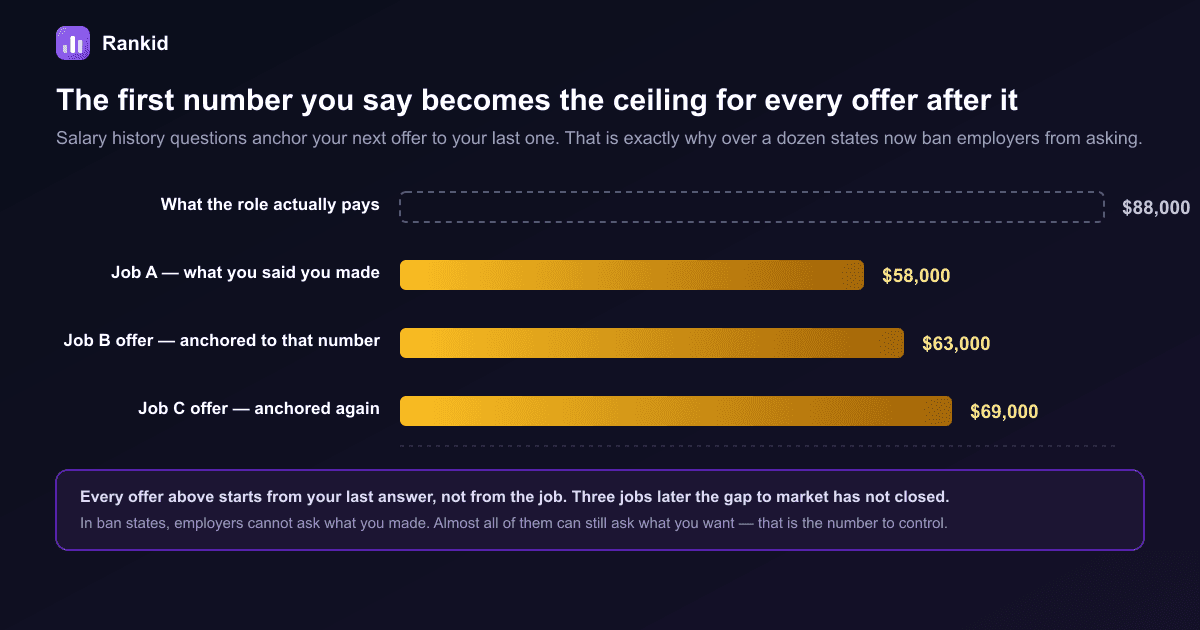
The question is not really about verifying anything. Almost nobody checks. It works as an anchor: whatever figure you say first quietly becomes the reference point for every number that follows, even when the role, the market and your actual fit would support a much higher offer.
The asymmetry is the whole mechanism. You do not know the employer's budget. They now know your last number, or think they do. One side of that negotiation just gave up its only piece of leverage, for free, usually within the first five minutes of the first call.
And it compounds. A number reported low at one job becomes the anchor for the next offer, which becomes the anchor for the reported number at the job after that. Nobody along the way decided to underpay you on purpose. The number just never got the chance to catch up to what the role was actually worth.
Is it even legal to ask? Depends where you are
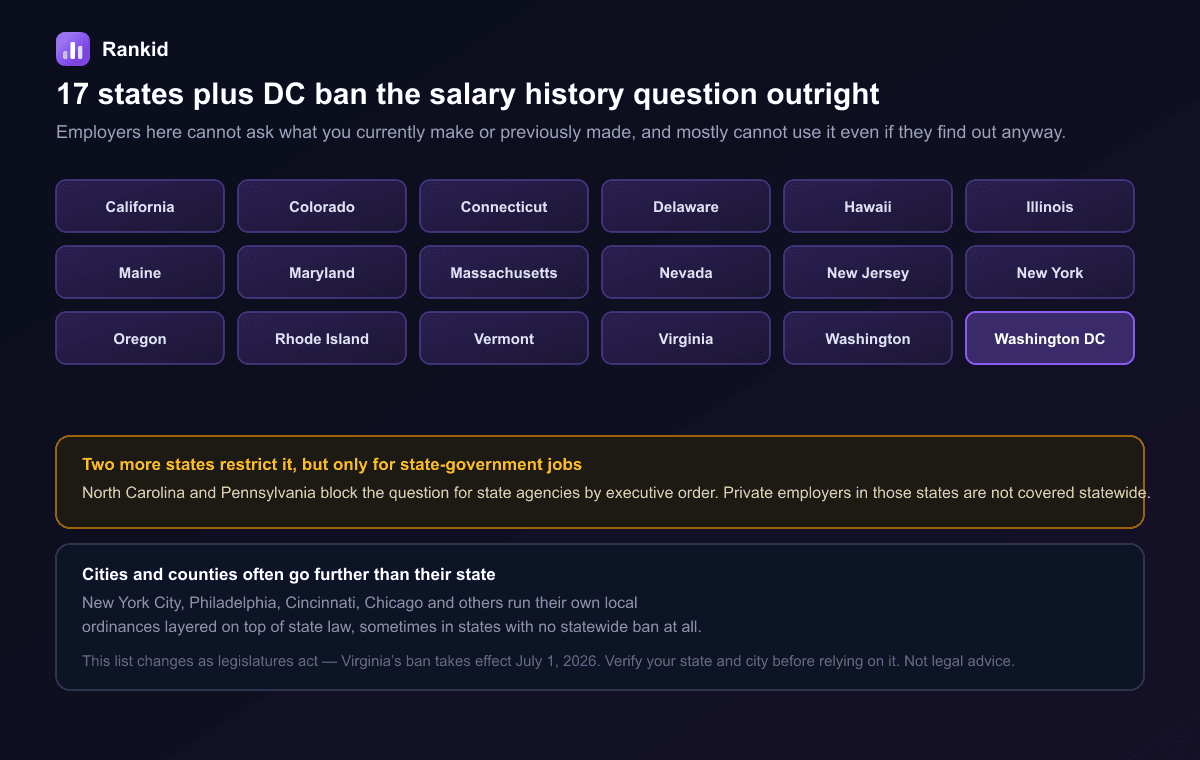
Increasingly, no, though coverage is not universal and it is easy to overestimate how protected you are. Seventeen states plus Washington DCnow ban employers from asking about or relying on a candidate's pay history statewide. A couple more restrict it narrowly, for state-government roles only.
One disclaimer, stated plainly
Outside that coverage, in most of the country, it is still completely legal for a private employer to ask. The honest takeaway is not "I don't have to answer this" everywhere. It is "I should have a good answer ready everywhere," because the legal question and the practical question are not the same one.
The question that is banned is not the question that matters
This is the part almost everyone misses, including plenty of recruiters. A ban on salary history almost never touches a completely different question: salary expectations. Those are legal to ask everywhere, in every state on the list above, and they are the ones that actually decide your offer.
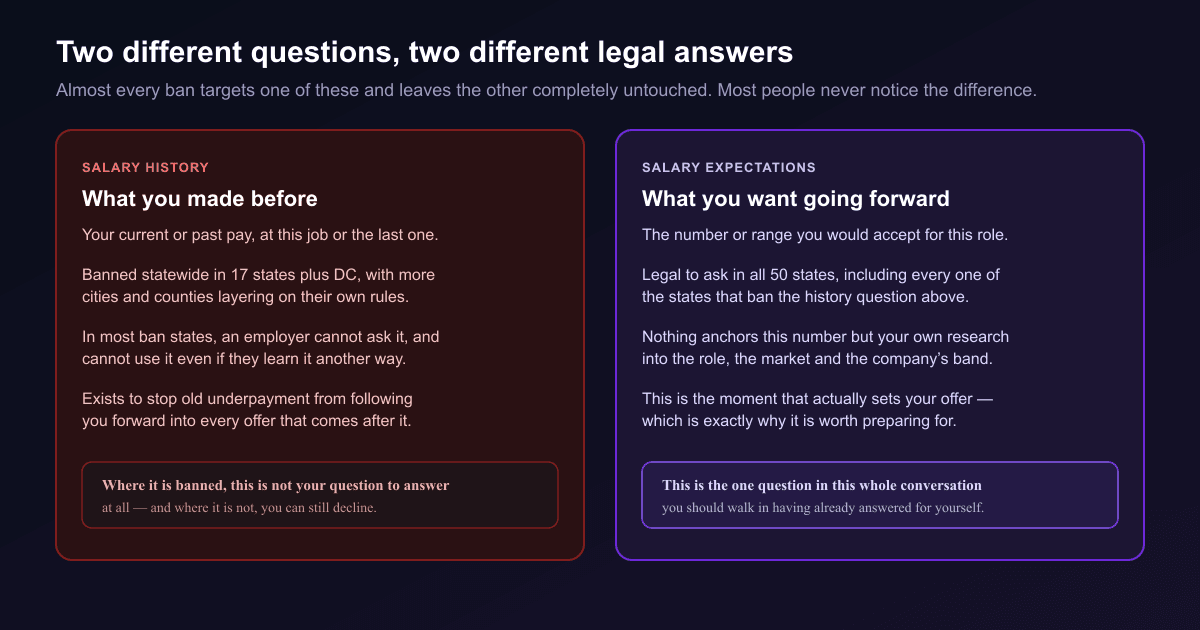
In practice this means the history question, where it survives at all, is often followed immediately by the expectations question the employer was always allowed to ask. Preparing only to dodge the first one and having nothing ready for the second is how people end up back where they started.
The four-step conversation, scripted end to end
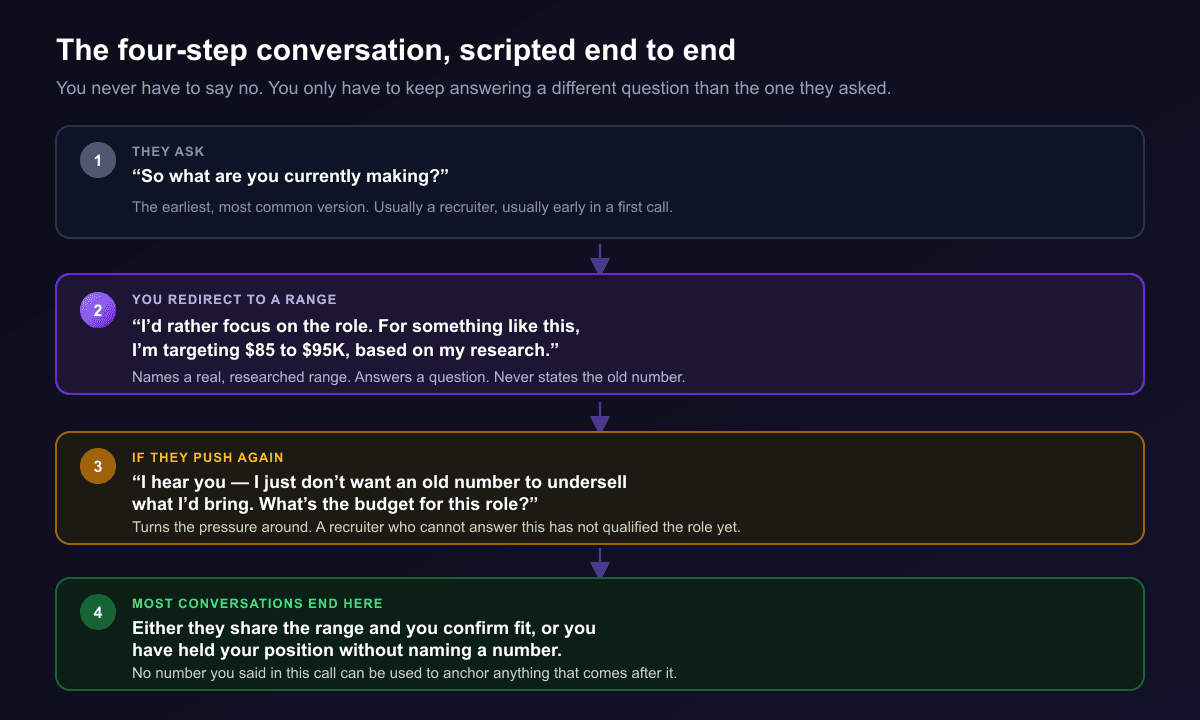
You never have to refuse outright, which is the part that trips people up. You only need to keep answering a different, better question than the one that was asked.
They ask
You redirect to a range
If they push a second time
Most conversations end here
When the application form will not let you skip it
A form cannot hear your tone, so the workaround depends entirely on what kind of field you are looking at. Check which one before assuming you are stuck.
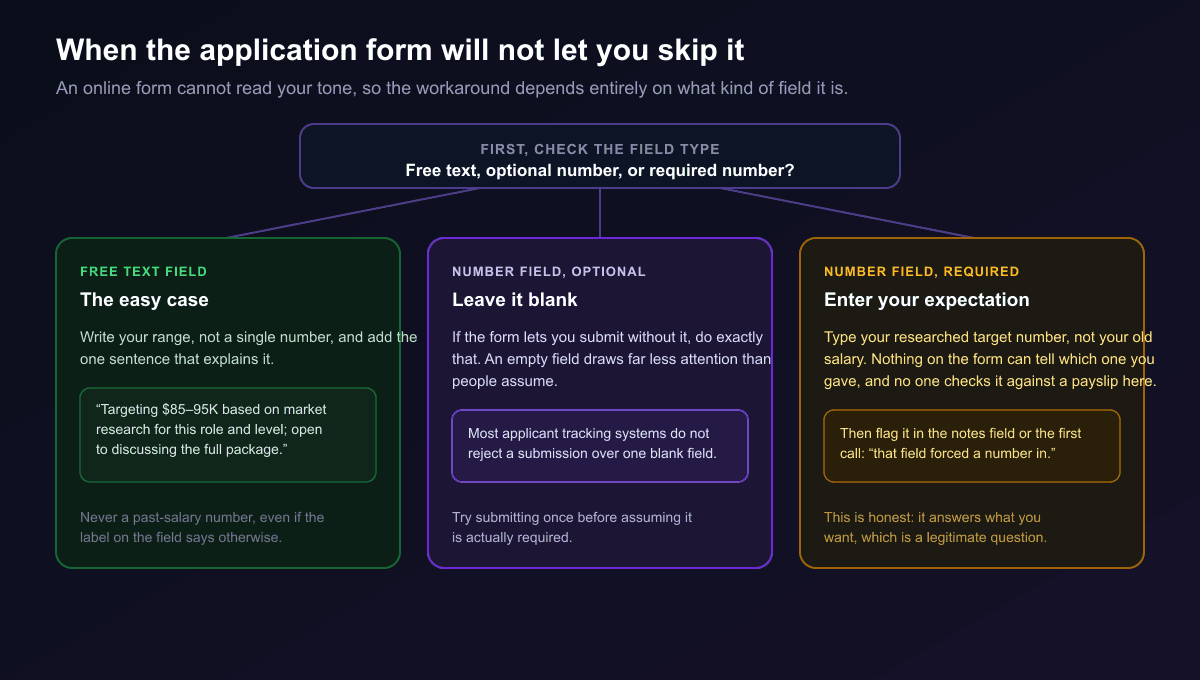
- Free text field: write your range and one supporting sentence, exactly as you would say it out loud on a call.
- Number field, but the form submits when blank: leave it blank. Most applicant tracking systems do not reject a submission over one empty field, and it is worth testing before assuming otherwise.
- Number field that genuinely will not submit empty: enter your researched target expectation, not your old salary. Nothing distinguishes the two on the form, and nobody is cross-referencing it against payroll documents at this stage.
Researching your number before you need it
The redirect script above only works if the range you say sounds like it came from somewhere real, because a number invented on the spot sounds exactly like that. Do this homework before the first call, not during it.
Cross-reference two or three sources rather than trusting one: a salary aggregator such as Levels.fyi, Glassdoor or LinkedIn Salary for the specific role and level, the posted range if the employer operates in a pay-transparency state and has already published one, and, where you can get it, a conversation with someone doing a comparable job, since aggregated data tends to lag real current offers.
Read the actual job description closely, too. Scope signals, team size, the reporting line, required years of experience, since two roles with an identical title on paper often sit in genuinely different bands. Set a floor you would actually accept and a ceiling backed by evidence rather than hope.
Before you name a number, make sure you're aiming at the right role
A range only helps if the job actually fits what you've done. Paste your resume and the job description into Rankid for a free 0-100 match score and the exact skills gap between the two, so your target range is aimed at a role you're genuinely competitive for.
Check your resume freeWhat a weak answer costs, next to what a strong one buys
Put side by side, the difference is not really about confidence or delivery. It is about which question each answer responds to.
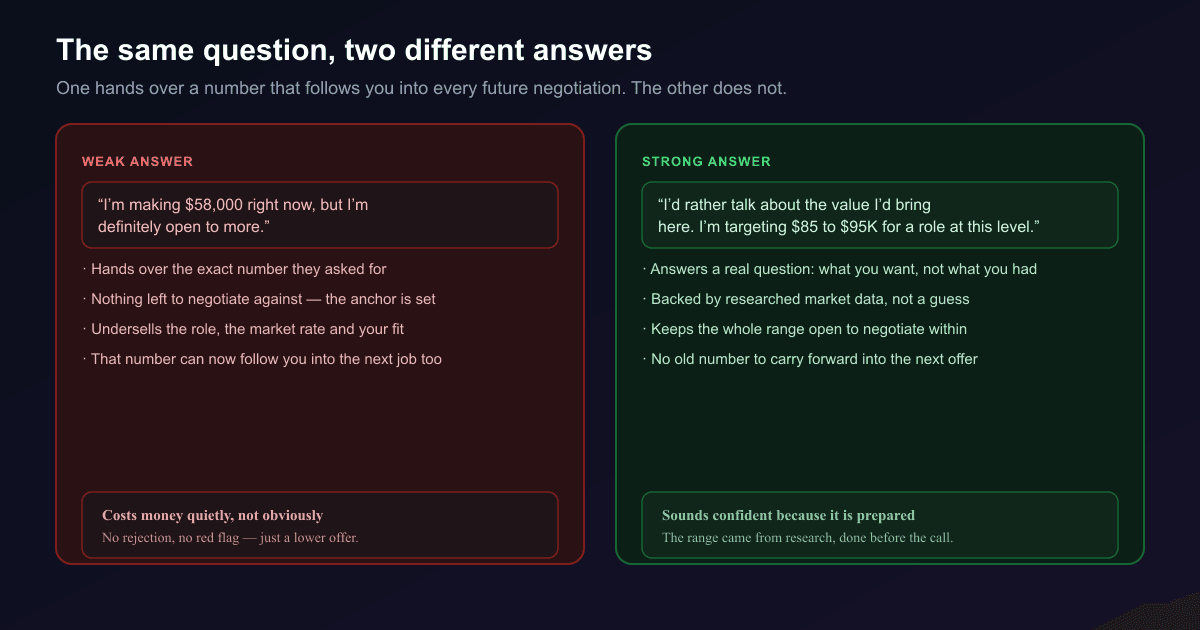
Notice that the strong answer is not a refusal. It is a substitution: a real, evidenced number in place of the one that was asked for, delivered with enough ease that nobody on the call registers it as a dodge.
If they push back, or ask for proof
Most recruiters accept the range and move on, because their actual job is to find out whether you and the budget overlap, and the range already answers that. Occasionally one pushes harder, or asks for a pay stub, a W-2 or an old offer letter as proof.
Decline it. In most states with a salary history ban, requesting documentation like this is covered by the same law as asking the question out loud, so the request is not just pushy, it is often the specific thing the statute prohibits. Outside those states, nothing obligates you to produce payroll records during hiring either way. "I'd rather not share pay documentation, I'm happy to keep talking about the range I'm targeting for this role" is enough. A company that will not proceed without it this early is worth weighing against everything else the process has shown you.
None of this applies once you are already employed somewhere and the conversation shifts to a raise instead of a hire. That is a different negotiation with a different playbook: see how to ask for a raise for the timing and script, and how to negotiate salary for what changes once an actual number is on the table. And once an offer does arrive, how to respond to a job offer covers accepting, declining or buying time to decide. If the whole outreach started with a recruiter message rather than an application, how to respond to a recruiter covers that earlier step too.
A strong number only lands if the resume behind it holds up
Rankid checks your resume against any job description in seconds; a 0-100 match score, the skills you've already evidenced, and the exact keywords you're missing. Free, no signup required.
Try Rankid freeFor employers: ask this instead
If you are on the hiring side, the fix is simpler than the compliance question makes it look. Ask for the candidate's expected range, and share your own budget early, ideally in the posting itself if you operate in a pay-transparency jurisdiction. That gets you the actual information you need, whether a candidate and a role overlap, without the legal exposure of a banned question and without anchoring a strong candidate out of a fair offer because an earlier employer underpaid them.
It screens faster, too. A stated range that does not overlap your budget ends the conversation cleanly after one exchange instead of three rounds of interviews that were never going to close. If your internal bands are inconsistent enough that you are not sure what to publish, salary bands and compa-ratio covers how to build ranges that hold up once you start being transparent about them.
Screening a wider pool? Filter on fit, not on an old paycheck
Upload your applicants and the job description. Rankid scores every resume against the real requirements and shows the evidence behind each score, so you're shortlisting on what someone can actually do. First 5 resumes free, no signup.
Try bulk screening freeFrequently asked questions
What is the salary history question, and why do employers ask it?
It is any version of "what do you currently make" or "what was your salary at your last job," asked before an offer exists, usually on a first recruiter call or buried in an application form. Employers ask it because it is the cheapest possible anchor: whatever number you give becomes the starting point for the offer, and offers built on top of a low number tend to stay low, even when the role and the market would otherwise support more. It rarely reflects any real limit on what the employer could pay. It reflects what they can get away with paying, given what you just told them. That asymmetry, you know your target, they do not know theirs until you tell them, is the entire reason the question exists and the entire reason a growing number of states have banned it.
Is it illegal for an employer to ask my salary history?
Increasingly, yes, but only where you are covered, and coverage is not automatic. As of 2026, seventeen US states plus Washington DC ban employers from asking about or relying on a candidate's pay history statewide, and several cities and counties, including New York City, Philadelphia and Cincinnati, run their own ordinances that can apply even where the state itself has no ban. Two more states, North Carolina and Pennsylvania, restrict it only for state-government employers by executive order, not for private companies generally. Outside all of that coverage, in most of the country, it is still perfectly legal for a private employer to ask. Check your specific state and city rather than assuming either way, because this list keeps changing and a neighboring state can have completely different rules.
Which states ban salary history questions in 2026?
Statewide bans currently cover California, Colorado, Connecticut, Delaware, Hawaii, Illinois, Maine, Maryland, Massachusetts, Nevada, New Jersey, New York, Oregon, Rhode Island, Vermont, Virginia and Washington, plus Washington DC. Virginia's law is one of the newer additions and takes effect July 1, 2026. North Carolina and Pennsylvania restrict the question for state-government employers only, through executive order, so private employers there are not covered statewide. On top of every state list, a number of cities and counties run their own local ordinances that can be stricter than their state, so a city inside a state with no statewide ban can still prohibit the question. Treat any list like this, including this one, as a snapshot rather than a permanent fact, and confirm your specific state and city before relying on it for anything consequential.
Does a salary history ban also stop them asking my salary expectations?
No, and this is the single most misunderstood part of the whole topic. Salary history bans target one specific question, what you were previously or are currently paid. They almost universally do not restrict a second, different question, what you want or would require going forward. Employers can ask about your expectations in all fifty states, including every state on the ban list above, and most of them do, often as the very next sentence after the history question they are no longer allowed to ask. That is not a loophole so much as the point: lawmakers wanted to stop old pay from anchoring new offers, not to stop employers from finding out whether a candidate and a budget are in the same neighborhood. Practically, it means the expectations question is the one you should actually prepare for, because it is the one you will almost certainly get asked.
What do I say if a recruiter asks my current salary on a call?
Answer the question you wish they had asked instead of the one they did, without making that swap sound evasive. Something close to: "I'd rather focus on the value I'd bring to this specific role. For something at this level, I'm targeting $85 to $95K, based on my research into the market." That names a real, researched range, answers with confidence, and never states a past number. If you are in a ban state, you can also say plainly that you understand the question is not one you are required to answer there, though most people find the redirect above gets there without needing to cite the statute. If they push a second time, redirect the pressure back: "I hear you, I just don't want an old number to undersell what I'd bring here. What's the budget for this role?" A recruiter who cannot answer that has not qualified the role yet, which is useful information in its own right.
What if the online application form has a mandatory salary field?
It depends entirely on the field type, and it is worth checking before assuming the worst. If it is free text, write your researched range and one supporting sentence rather than a single number, exactly as you would say it on a call. If it is a number field but the form actually lets you submit with it blank, leave it blank; most applicant tracking systems do not reject a submission over one empty field, and it is worth trying before assuming otherwise. If it is a number field that genuinely will not submit empty, enter your target expectation rather than your old salary. Nothing on the form distinguishes the two, and no one is cross-checking it against a payslip at this stage. If it still bothers you, flag it directly with the recruiter on your first call: "that field forced a number in, happy to talk through what I'm actually looking for."
Will refusing to answer hurt my chances?
Rarely, and where it does, that is useful information about the employer rather than a mark against you. A well-run hiring process cares whether your expectations and their budget overlap, which the deflection above answers directly, not whether you are willing to hand over a specific old number under pressure. An interviewer who drops you entirely because you declined to state a past salary, particularly in a state where they were not legally allowed to ask, has told you something true about how that company operates before you accepted an offer from them. That is a cheap way to find out. The candidates who actually lose ground here are usually the ones who go silent or visibly flustered rather than the ones who answer smoothly with a range.
How do I figure out my target range before I need to answer it?
Do this before the first call, not during it, because a range you invent on the spot sounds like exactly that. Cross-reference two or three sources rather than trusting one: a salary aggregator such as Levels.fyi, Glassdoor or LinkedIn Salary for the role and level, the published range if the employer is in a pay-transparency state and has already posted one, and, where possible, a conversation with someone doing a comparable job, since aggregated data lags real offers. Read the actual job description closely for scope signals, team size, reporting line, required years of experience, since two titles that look identical on paper often sit in different bands. Then set a range with a floor you would genuinely accept and a ceiling backed by evidence, not aspiration. Before you get to the money conversation at all, it helps to know the role actually fits what you have done: checking your resume against the job description is the fastest way to see whether you are aiming at the right band in the first place.
What if I'm asked to provide a pay stub, W-2 or offer letter to verify my salary?
Decline it, and know that in most of the states with a salary history ban, requesting or requiring this kind of documentation is covered by the same law as asking the question out loud, so the request is not just pushy, it is often the specific thing the statute prohibits. Outside those states, you can still decline; nothing obligates a candidate to produce payroll documents during hiring. A simple version: "I'd rather not share pay documentation, I'm happy to keep talking about the range I'm targeting for this role." A company that will not proceed without it, particularly this early, is worth weighing carefully against everything else the process has shown you so far.
Does this apply to internal promotions and raises, or only new external hires?
Salary history bans are written for hiring, specifically for candidates coming in from outside, and generally do not govern how your current employer sets your pay once you are already on staff. Inside your own company, the relevant conversation is a raise or promotion negotiation rather than a history question, and it runs on a different logic entirely, since your employer already knows exactly what you make. That conversation deserves its own preparation: see how to ask for a raise for the timing and the script, and how to negotiate salary for the version that applies once an external offer or an internal promotion is actually on the table.
What should I say if my current salary is embarrassingly low, or surprisingly high?
Neither number needs to leave the room, and that is the entire benefit of redirecting to a target range instead of a history figure. If your current pay is low, likely from an earlier undersell, a slow employer, or a non-profit or public-sector stint, stating it only imports that constraint into your next offer; a forward-looking range breaks the chain instead. If your current pay is unusually high relative to the role you are applying for, perhaps a step down in scope or a change of industry, volunteering it can spook a hiring manager into assuming you will bounce the moment something better appears; the same range-based answer avoids inviting that assumption in the first place. Either direction, the fix is the same one used throughout this article: answer with where you are headed, not where you have been.
As an employer, what should we ask instead of salary history?
Ask for the candidate's expected range and state your own budget early, ideally in the job posting itself if you operate in a pay-transparency jurisdiction. This gets you the information you actually need, whether a candidate and a role are in the same range, without the legal exposure of a banned question and without anchoring good candidates out of a fair offer because of an earlier employer's underpayment. It also screens faster: a stated range that does not overlap with your budget ends the conversation in one exchange instead of three rounds of interviews. If pay bands are inconsistent internally, that is worth fixing before the screening question is, since compa-ratio and salary bands explains how to build ranges that hold up once you start publishing them.
Key takeaways
- The number you report first becomes the anchor for the offer built on top of it, and it can compound across multiple job changes if nothing interrupts it.
- Seventeen states plus Washington DC ban salary history questions statewide in 2026, with more cities and counties layering on stricter local rules.
- A history ban almost never covers a second, different question: your salary expectations. That one is legal everywhere and is the one to actually prepare for.
- The redirect script is a substitution, not a refusal: answer with a researched range instead of a past number, then hold that line if pushed a second time.
- On application forms, the right move depends on the field type: write a range in free text, try leaving optional numeric fields blank, and enter your target expectation where a number is truly required.
- Research your range before the call from two or three sources plus the actual job description, so it sounds prepared rather than invented on the spot.
- You can decline a request for pay stubs or a W-2 to verify salary; in most ban states, requesting that documentation is covered by the same law as asking outright.
- This mostly governs new hiring, not internal raises or promotions, which run on a different playbook entirely.
- Employers get better, faster signal by asking for expected range and sharing budget early than by asking for history at all.
- Treat any list of ban states, including this one, as a snapshot. Verify your specific state and city before relying on it.
Frequently asked questions
What is the salary history question, and why do employers ask it?
It is any version of "what do you currently make" or "what was your salary at your last job," asked before an offer exists, usually on a first recruiter call or buried in an application form. Employers ask it because it is the cheapest possible anchor: whatever number you give becomes the starting point for the offer, and offers built on top of a low number tend to stay low, even when the role and the market would otherwise support more. It rarely reflects any real limit on what the employer could pay. It reflects what they can get away with paying, given what you just told them. That asymmetry, you know your target, they do not know theirs until you tell them, is the entire reason the question exists and the entire reason a growing number of states have banned it.
Is it illegal for an employer to ask my salary history?
Increasingly, yes, but only where you are covered, and coverage is not automatic. As of 2026, seventeen US states plus Washington DC ban employers from asking about or relying on a candidate's pay history statewide, and several cities and counties, including New York City, Philadelphia and Cincinnati, run their own ordinances that can apply even where the state itself has no ban. Two more states, North Carolina and Pennsylvania, restrict it only for state-government employers by executive order, not for private companies generally. Outside all of that coverage, in most of the country, it is still perfectly legal for a private employer to ask. Check your specific state and city rather than assuming either way, because this list keeps changing and a neighboring state can have completely different rules.
Which states ban salary history questions in 2026?
Statewide bans currently cover California, Colorado, Connecticut, Delaware, Hawaii, Illinois, Maine, Maryland, Massachusetts, Nevada, New Jersey, New York, Oregon, Rhode Island, Vermont, Virginia and Washington, plus Washington DC. Virginia's law is one of the newer additions and takes effect July 1, 2026. North Carolina and Pennsylvania restrict the question for state-government employers only, through executive order, so private employers there are not covered statewide. On top of every state list, a number of cities and counties run their own local ordinances that can be stricter than their state, so a city inside a state with no statewide ban can still prohibit the question. Treat any list like this, including this one, as a snapshot rather than a permanent fact, and confirm your specific state and city before relying on it for anything consequential.
Does a salary history ban also stop them asking my salary expectations?
No, and this is the single most misunderstood part of the whole topic. Salary history bans target one specific question, what you were previously or are currently paid. They almost universally do not restrict a second, different question, what you want or would require going forward. Employers can ask about your expectations in all fifty states, including every state on the ban list above, and most of them do, often as the very next sentence after the history question they are no longer allowed to ask. That is not a loophole so much as the point: lawmakers wanted to stop old pay from anchoring new offers, not to stop employers from finding out whether a candidate and a budget are in the same neighborhood. Practically, it means the expectations question is the one you should actually prepare for, because it is the one you will almost certainly get asked.
What do I say if a recruiter asks my current salary on a call?
Answer the question you wish they had asked instead of the one they did, without making that swap sound evasive. Something close to: "I'd rather focus on the value I'd bring to this specific role. For something at this level, I'm targeting $85 to $95K, based on my research into the market." That names a real, researched range, answers with confidence, and never states a past number. If you are in a ban state, you can also say plainly that you understand the question is not one you are required to answer there, though most people find the redirect above gets there without needing to cite the statute. If they push a second time, redirect the pressure back: "I hear you, I just don't want an old number to undersell what I'd bring here. What's the budget for this role?" A recruiter who cannot answer that has not qualified the role yet, which is useful information in its own right.
What if the online application form has a mandatory salary field?
It depends entirely on the field type, and it is worth checking before assuming the worst. If it is free text, write your researched range and one supporting sentence rather than a single number, exactly as you would say it on a call. If it is a number field but the form actually lets you submit with it blank, leave it blank; most applicant tracking systems do not reject a submission over one empty field, and it is worth trying before assuming otherwise. If it is a number field that genuinely will not submit empty, enter your target expectation rather than your old salary. Nothing on the form distinguishes the two, and no one is cross-checking it against a payslip at this stage. If it still bothers you, flag it directly with the recruiter on your first call: "that field forced a number in, happy to talk through what I'm actually looking for."
Will refusing to answer hurt my chances?
Rarely, and where it does, that is useful information about the employer rather than a mark against you. A well-run hiring process cares whether your expectations and their budget overlap, which the deflection above answers directly, not whether you are willing to hand over a specific old number under pressure. An interviewer who drops you entirely because you declined to state a past salary, particularly in a state where they were not legally allowed to ask, has told you something true about how that company operates before you accepted an offer from them. That is a cheap way to find out. The candidates who actually lose ground here are usually the ones who go silent or visibly flustered rather than the ones who answer smoothly with a range.
How do I figure out my target range before I need to answer it?
Do this before the first call, not during it, because a range you invent on the spot sounds like exactly that. Cross-reference two or three sources rather than trusting one: a salary aggregator such as Levels.fyi, Glassdoor or LinkedIn Salary for the role and level, the published range if the employer is in a pay-transparency state and has already posted one, and, where possible, a conversation with someone doing a comparable job, since aggregated data lags real offers. Read the actual job description closely for scope signals, team size, reporting line, required years of experience, since two titles that look identical on paper often sit in different bands. Then set a range with a floor you would genuinely accept and a ceiling backed by evidence, not aspiration. Before you get to the money conversation at all, it helps to know the role actually fits what you have done: checking your resume against the job description is the fastest way to see whether you are aiming at the right band in the first place.
What if I'm asked to provide a pay stub, W-2 or offer letter to verify my salary?
Decline it, and know that in most of the states with a salary history ban, requesting or requiring this kind of documentation is covered by the same law as asking the question out loud, so the request is not just pushy, it is often the specific thing the statute prohibits. Outside those states, you can still decline; nothing obligates a candidate to produce payroll documents during hiring. A simple version: "I'd rather not share pay documentation, I'm happy to keep talking about the range I'm targeting for this role." A company that will not proceed without it, particularly this early, is worth weighing carefully against everything else the process has shown you so far.
Does this apply to internal promotions and raises, or only new external hires?
Salary history bans are written for hiring, specifically for candidates coming in from outside, and generally do not govern how your current employer sets your pay once you are already on staff. Inside your own company, the relevant conversation is a raise or promotion negotiation rather than a history question, and it runs on a different logic entirely, since your employer already knows exactly what you make. That conversation deserves its own preparation: see how to ask for a raise for the timing and the script, and how to negotiate salary for the version that applies once an external offer or an internal promotion is actually on the table.
What should I say if my current salary is embarrassingly low, or surprisingly high?
Neither number needs to leave the room, and that is the entire benefit of redirecting to a target range instead of a history figure. If your current pay is low, likely from an earlier undersell, a slow employer, or a non-profit or public-sector stint, stating it only imports that constraint into your next offer; a forward-looking range breaks the chain instead. If your current pay is unusually high relative to the role you are applying for, perhaps a step down in scope or a change of industry, volunteering it can spook a hiring manager into assuming you will bounce the moment something better appears; the same range-based answer avoids inviting that assumption in the first place. Either direction, the fix is the same one used throughout this article: answer with where you are headed, not where you have been.
As an employer, what should we ask instead of salary history?
Ask for the candidate's expected range and state your own budget early, ideally in the job posting itself if you operate in a pay-transparency jurisdiction. This gets you the information you actually need, whether a candidate and a role are in the same range, without the legal exposure of a banned question and without anchoring good candidates out of a fair offer because of an earlier employer's underpayment. It also screens faster: a stated range that does not overlap with your budget ends the conversation in one exchange instead of three rounds of interviews. If pay bands are inconsistent internally, that is worth fixing before the screening question is, since compa-ratio and salary bands explains how to build ranges that hold up once you start publishing them.