Salary Bands and Compa-Ratio: How Companies Actually Decide What to Pay You (2026)
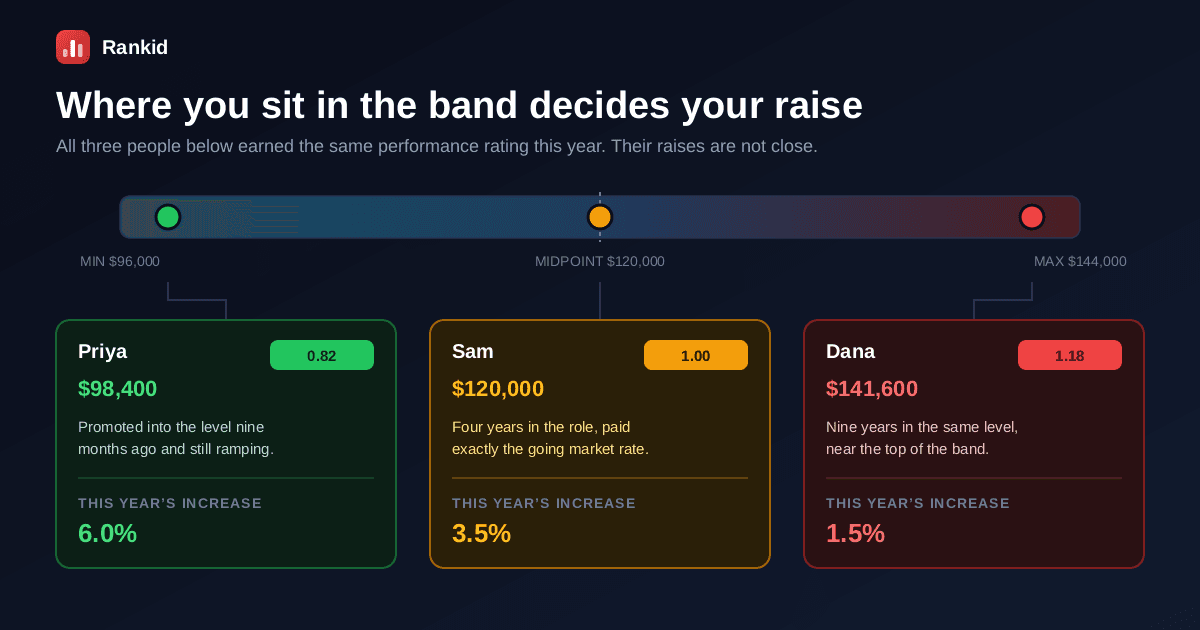
Three people on the same team, doing the same job at the same level, all rated exactly the same in the annual review. One got 6.0 percent. One got 3.5 percent. One got 1.5 percent. Nobody made a mistake, nobody was favoured, and the manager could not have changed it much even if they had wanted to. The number that decided it is a single decimal that all three could have looked up, and none of them had ever been shown.
Quick answer
Quick answer: your compa-ratio is your base salary divided by the midpoint of your salary band. At a $120,000 midpoint, earning $98,400 puts you at 0.82. It matters because most companies run a merit matrix that combines your rating with your compa-ratio to set your raise, so where you sit in the band can triple or third the same performance. Roughly 0.90 to 1.10 is the healthy zone. Above 1.20 is not a compliment: it means base pay is about to stall and the only real move is a level change.
What is a compa-ratio?
A compa-ratio, short for comparative ratio, is your base salary divided by the midpoint of the salary band for your job at your level. It is a positional measure: it tells you where you sit relative to the rate your employer decided the job is worth.
The midpoint is not the average of what your colleagues earn. It is a decision. Your employer picked a target percentile of the market, usually from purchased salary survey data, and made that number the centre of the band.
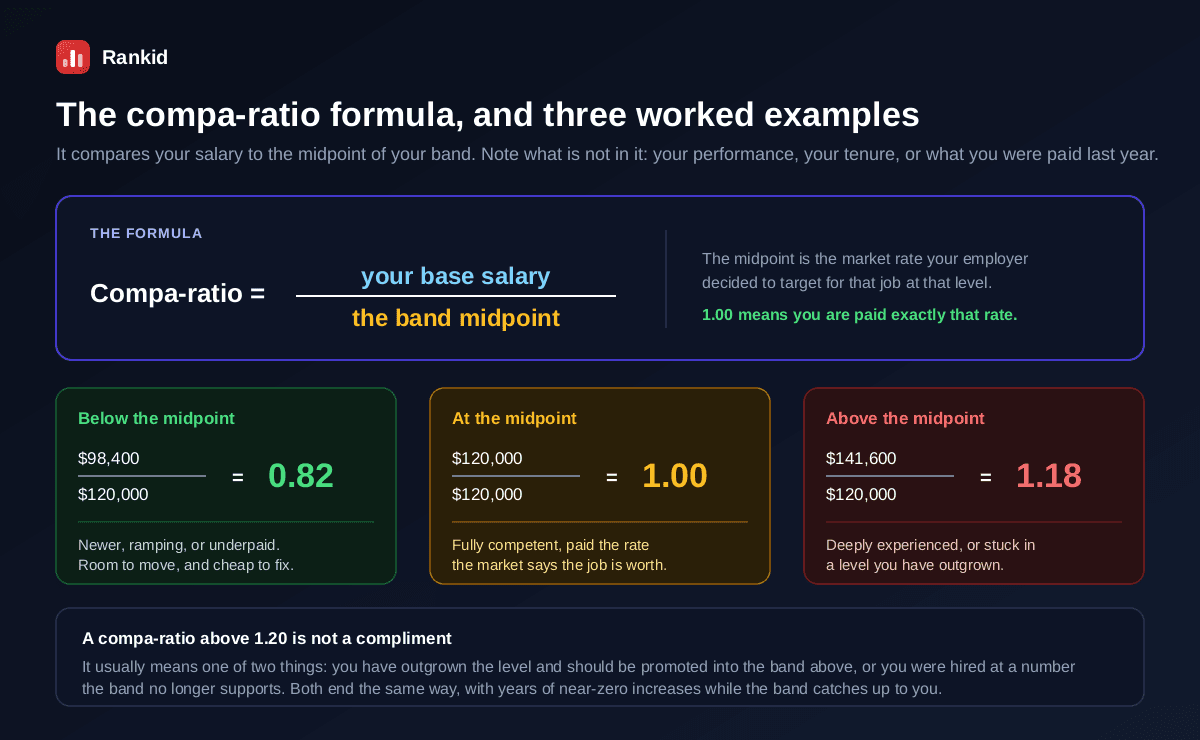
Look at what the formula does not contain. Your performance rating is not in it. Neither is your tenure, your previous salary, or anything about how well you are regarded. That is exactly why it is worth understanding: it is the one number in the pay conversation that is purely structural, and it is doing more work than almost any other input.
Getting the inputs right
What is a good compa-ratio?
For most people, 0.90 to 1.10 is the healthy zone, but the number means nothing without your tenure in the level next to it. Below 0.90 is completely normal in your first year at a level and is a genuine problem in your fourth.
- Under 0.90. Either you are new to the level and still ramping, which is expected, or you are underpaid for the job you are actually doing. The difference is how long you have been there.
- 0.90 to 1.00. Approaching the rate the company says the job is worth. This is the strongest negotiating position in the band, because the matrix still pays you well and there is real headroom above you.
- 1.00 to 1.10. Above the target rate, usually reflecting real depth. Increases begin to shrink here, and that is by design rather than by judgement.
- Above 1.20. Not a compliment. It means you have outgrown the level, or you were hired at a number the band no longer supports. Both end in years of near-zero increases while the band catches up.
Compa-ratio vs range penetration
These get confused constantly, and they give very different impressions of the same salary. Compa-ratio measures you against the midpoint. Range penetration measures how far you have travelled from the floor of the band to the ceiling.
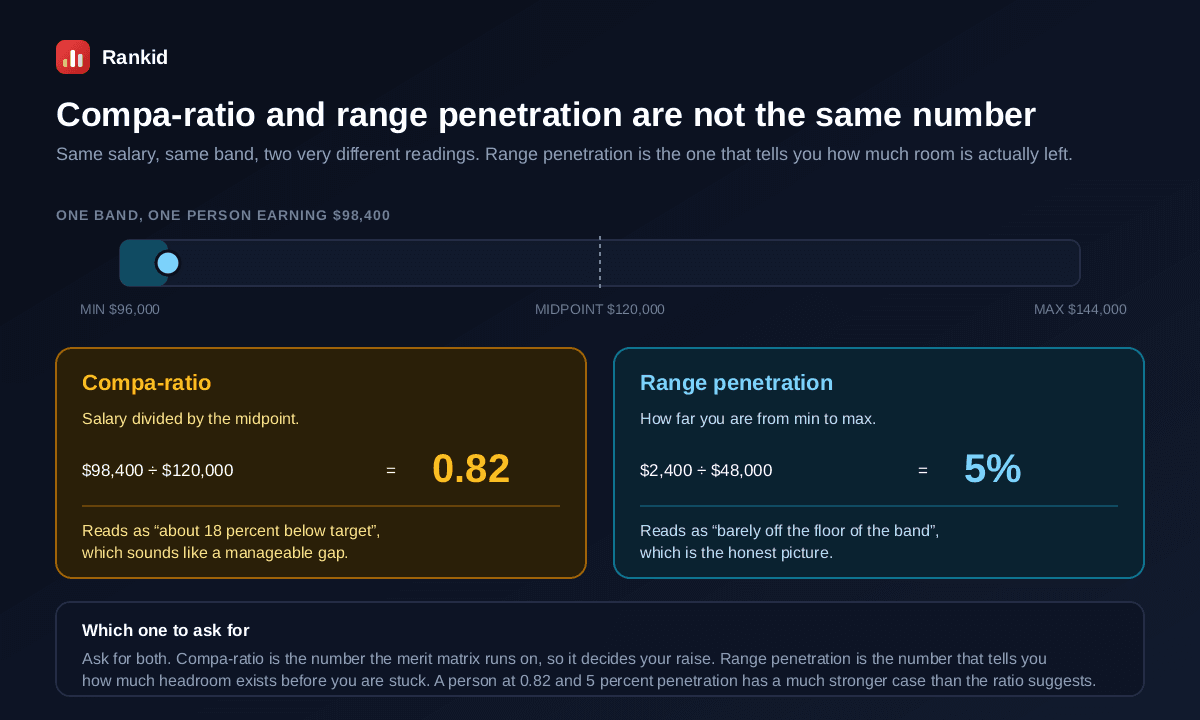
Same person, same salary, same band. 0.82 sounds like a manageable gap. Five percent penetration says you are barely off the floor. Ask for both numbers, because they answer different questions: compa-ratio decides your raise, and range penetration tells you how much room is left before you are stuck.
How salary bands actually get built
The number you will eventually negotiate against was set months before your role was posted, by a process you were not part of. Understanding the four steps tells you which one is worth pushing on.
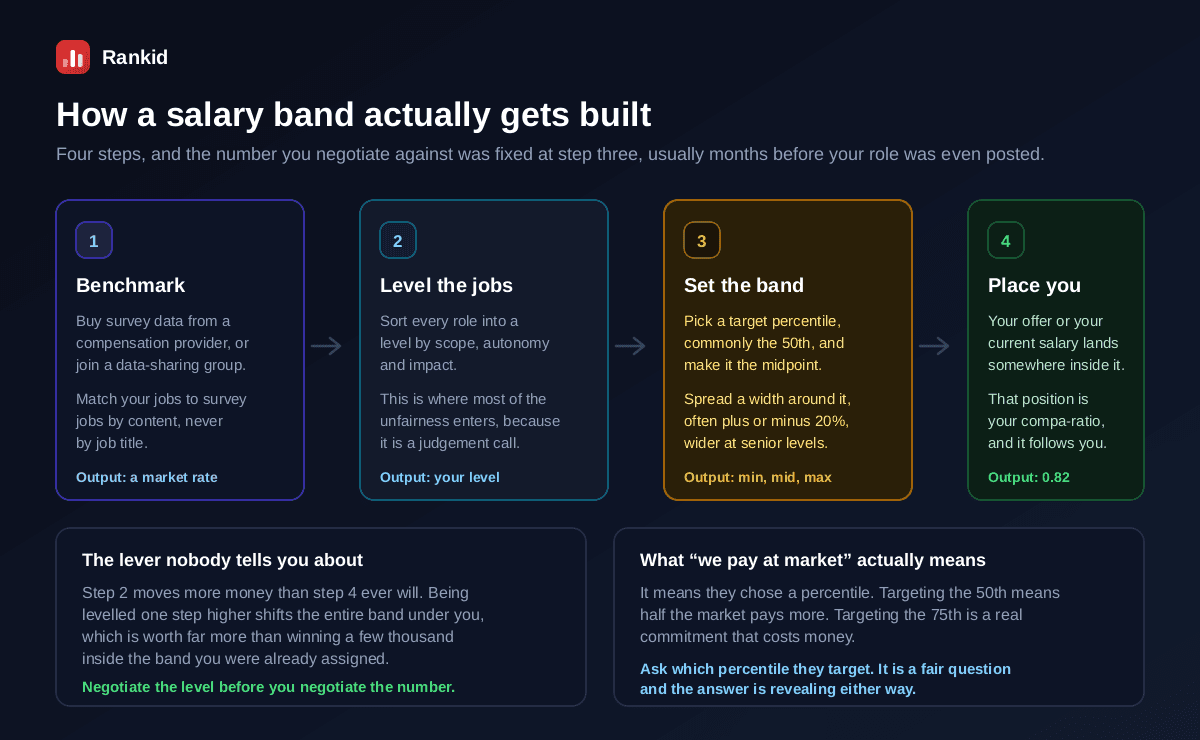
The single most useful thing on that diagram is that step two moves more money than step four ever will. Being levelled one step higher shifts the entire band underneath you, which is worth vastly more than winning a few thousand dollars inside the band you were already assigned to. Negotiate the level before you negotiate the number.
It also reframes a phrase you will hear constantly. "We pay at market" is not a fact, it is a percentile choice. Targeting the 50th means half the market pays more than they do. Asking which percentile a company targets is a completely fair question, and the answer is informative whichever way it goes. If you are weighing an offer, this belongs alongside the other terms in how to respond to a job offer.
The merit matrix: why your rating is only half the input
This is the mechanism behind the three raises in the opening. Most companies convert a performance rating into a percentage increase using a grid, and the second axis of that grid is your compa-ratio.
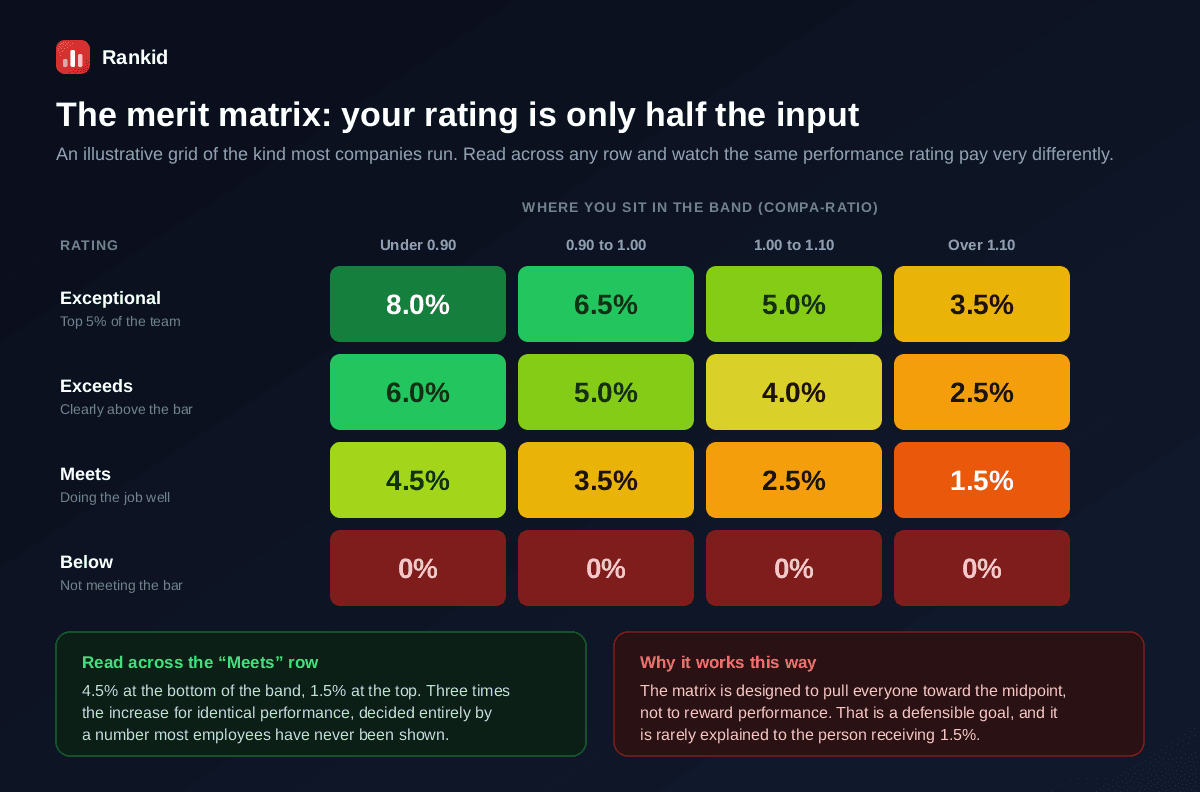
Read across the Meets row. The same rating pays 4.5 percent at the bottom of the band and 1.5 percent at the top. Three times the increase, decided by position rather than by contribution.
The important thing to understand is that this is not personal and not arbitrary. The matrix exists to pull the whole population toward the midpoint, keeping salaries centred on the market rate the company targets. That is a defensible design goal. What is far less defensible is how rarely anyone explains it, which leaves the person receiving 1.5 percent to conclude their work was not valued, when the number was largely fixed before their review was written. Managers: this belongs in a one-on-one, not in the review itself.
Pay compression, and why the new hire earns more
If you have ever discovered that somebody hired last month earns more than you do for the same job after five years, you have met pay compression. It is not favouritism, it is arithmetic.
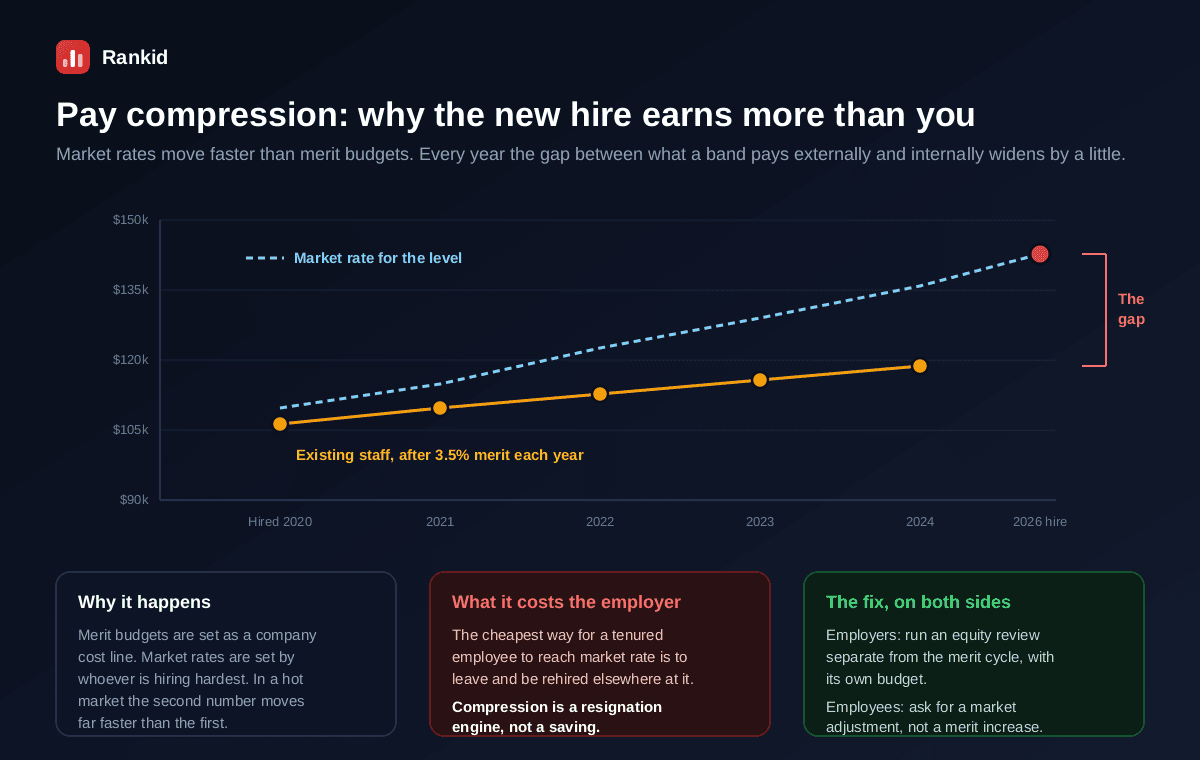
Merit budgets are a cost line, typically 3 to 4 percent. Market rates are set by whoever in your industry is hiring hardest. Compound that gap for five years and the new hire is legitimately worth more to the market than you are being paid, despite doing the same job less well for less time.
The consequence for employers is the part worth sitting with: the cheapest route to market rate, for a tenured employee, is to leave. Compression is a resignation engine, not a saving, and it shows up later in turnover and cost per hire with no obvious cause attached to it.
Green-circled and red-circled
What pay transparency laws changed
A growing number of states and cities now require a salary range in job postings, and several require it be given to existing employees on request. The rules vary and change often, so check what applies where you actually work. But the practical effect is the same everywhere it lands.
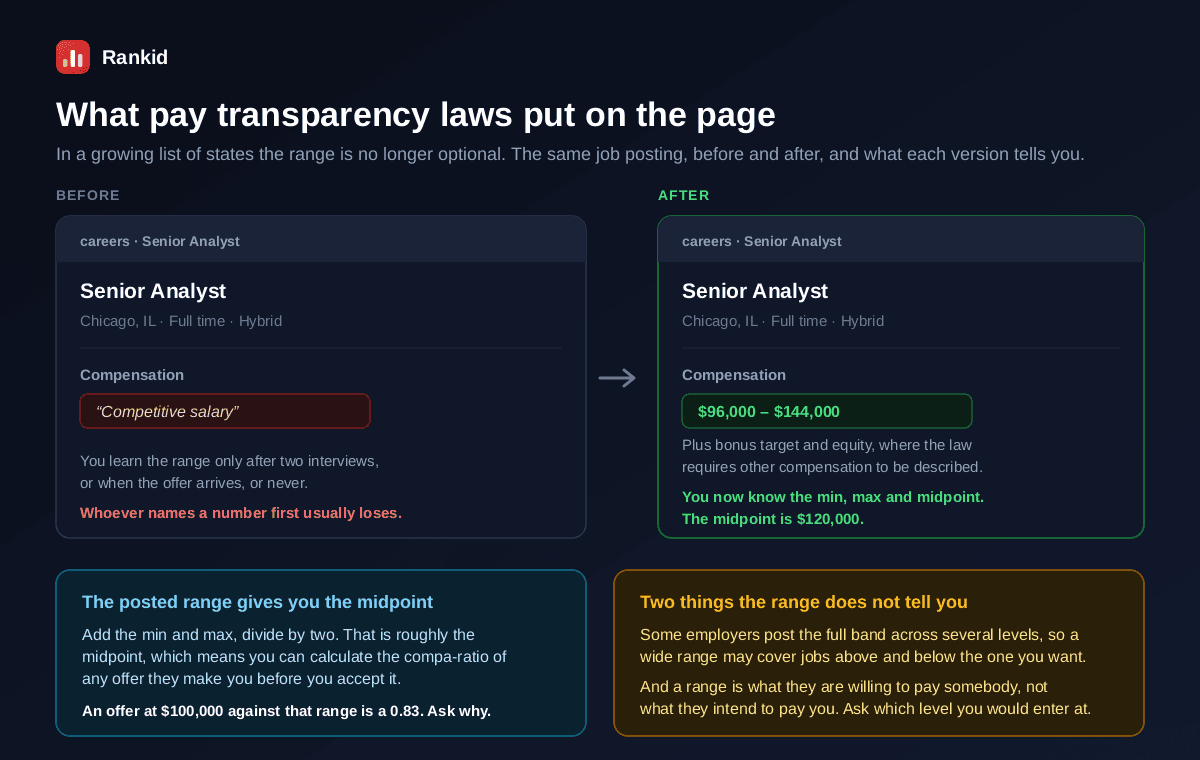
Here is the practical unlock. A posted range gives you an approximate midpoint, which means you can calculate the compa-ratio of an offer before you accept it. An offer of $100,000 against a posted $96,000 to $144,000 range is a 0.83. That is a perfectly reasonable thing to raise, and doing so with the actual number is far more effective than a general sense that the offer felt low. Our guide to salary negotiation covers the scripts once you have the figure.
Two cautions. Some employers post one wide range covering several levels, so it may span jobs above and below the one you want. And a range is what a company is willing to pay somebody, not what it intends to pay you. Always ask which level you would be entering at.
What to ask for, based on where you sit
The same request lands very differently depending on your zone. Find your compa-ratio first, then pick the ask that matches it, because arguing for a base increase from 1.18 is arguing against a matrix that will not move.

Ask the question that starts everything
Work out whether you need merit or a market adjustment
Bring evidence in the form the company already uses
If you are high in the band, change the conversation
If they will not tell you where you sit, reconstruct it. Your own company's postings for your level give you the band directly. Competitor postings for the same job in the same city give you a market midpoint to check it against. And a company that refuses to discuss a structure it built and applies to you every year has told you something useful about how it makes decisions.
Testing the market? Check your resume against the job first
Paste your resume and the job description into Rankid. You'll get a 0-100 match score, the skills you've matched, and the exact keywords you're missing, free. The strongest pay conversation is the one you have with an offer in hand.
Check your match score freeFor employers: keeping bands healthy
Bands are not a set-and-forget artefact. Four habits cover most of what goes wrong, and three of them cost less than the turnover they prevent.
- Refresh the benchmark annually. A band built on two-year-old survey data sits below market and produces declined offers that nobody traces back to the cause. This shows up as a slow pipeline, not as a pay problem.
- Review the compa-ratio distribution by group, not just individually. A pattern where one group clusters below 0.95 while another clusters above 1.05 is precisely what a pay equity analysis exists to surface, and it is far cheaper to find yourself than to have found for you. This is the same failure mode as adverse impact in hiring: the individual decisions each look defensible, and the aggregate does not.
- Budget separately for market adjustments. The merit pool cannot close a gap it did not create. Expecting it to just converts a compensation problem into a manager credibility problem.
- Explain the system. The cheapest item on this list and the most often skipped. Most of the resentment a 1.5 percent increase creates comes from receiving it with no explanation.
Bands also fail upstream, at leveling. If roles are levelled inconsistently, every downstream number inherits that error, and it compounds annually. Writing the level into the requisition and the job description before opening a role, and screening against that definition rather than against a hoped-for candidate, is what keeps the structure honest.
Hiring into a band? Screen against the level you actually defined
Upload the applicants and the job description. Rankid scores every candidate against the real requirements and shows the evidence behind each score, so the person you hire matches the level you budgeted for. First 5 resumes free, no signup.
Try bulk screening freeFrequently asked questions
What is a compa-ratio?
A compa-ratio, short for comparative ratio, is your base salary divided by the midpoint of the salary band for your job at your level. If the midpoint for your role is $120,000 and you earn $98,400, your compa-ratio is 0.82. If you earn exactly $120,000 it is 1.00. The midpoint is not an average of what your colleagues earn: it is the market rate your employer decided to target for that job, usually taken from purchased salary survey data and usually set at a chosen percentile of the market. What matters most about the formula is what is missing from it. Your performance rating is not in it. Neither is your tenure, your last salary, or how much you are liked. It is a purely positional measure that says where you sit relative to the rate your employer decided the job is worth. That is precisely why it is so useful, and why understanding it changes how you approach a pay conversation.
How do you calculate compa-ratio?
Divide your base salary by the midpoint of your band, then express it as a decimal or a percentage. The formula is compa-ratio = base salary / band midpoint. Three worked examples on a band with a $120,000 midpoint. Someone earning $98,400 has a compa-ratio of 98,400 / 120,000 = 0.82, or 82 percent. Someone earning $120,000 has 120,000 / 120,000 = 1.00. Someone earning $141,600 has 141,600 / 120,000 = 1.18. Two practical notes on getting the inputs right. Use base salary only, not bonus, equity, overtime or allowances, unless you are deliberately calculating a total-compensation compa-ratio, which is a separate figure. And if you do not know your midpoint, you can approximate it from a posted range: add the minimum and maximum and divide by two. That approximation is close for symmetrical bands, which most are, though some employers skew the midpoint deliberately.
What is a good compa-ratio?
For most employees, somewhere between 0.90 and 1.10 is the healthy zone, with the interpretation depending heavily on your tenure in the level rather than on the number alone. Below 0.90 usually means one of two things: you are genuinely new to the level and still ramping, which is normal and expected, or you are underpaid relative to the job you are actually doing, which is worth raising. Around 1.00 means you are paid the rate your employer decided the job is worth, which is the intended destination for a fully competent person in the role. Between 1.00 and 1.10 means you sit above the target rate, typically reflecting deep experience. Above 1.20 is not a compliment, and this is the part people misread. It usually means you have outgrown the level and should be promoted into the band above, or that you were hired at a number the band no longer supports. Both end the same way: years of very small increases while the band slowly catches up to you, because merit matrices are designed to slow down people who sit high in the range.
What is the difference between compa-ratio and range penetration?
They measure different things and can give very different impressions of the same salary. Compa-ratio compares your salary to the midpoint: salary divided by midpoint. Range penetration compares your position between the floor and the ceiling of the band: (salary minus minimum) divided by (maximum minus minimum). Take a band running $96,000 to $144,000 with a $120,000 midpoint, and somebody earning $98,400. Their compa-ratio is 0.82, which reads as roughly 18 percent below target and sounds like a manageable gap. Their range penetration is (98,400 - 96,000) / (144,000 - 96,000) = 5 percent, which reads as barely off the floor of the band, and that is the more honest picture. Ask for both numbers. Compa-ratio is the one the merit matrix runs on, so it determines your increase. Range penetration tells you how much headroom exists before you are stuck, and a person at 0.82 with 5 percent penetration has a considerably stronger case than the ratio alone suggests.
How are salary bands actually built?
Four steps, and the number you will eventually negotiate against is usually fixed at step three, months before the role is even posted. First, benchmarking: the company buys survey data from a compensation provider or joins a data-sharing group, then matches its jobs to survey jobs by actual content rather than by job title, because titles are unreliable across companies. Second, job leveling: every role is sorted into a level based on scope, autonomy and impact. This is where most of the unfairness enters the system, because it is a judgement call rather than a calculation. Third, setting the band: the company picks a target market percentile, commonly the 50th, makes that the midpoint, and spreads a width around it, often plus or minus 20 percent, with wider bands at senior levels. Fourth, placement: your offer or your existing salary lands somewhere inside the band, and that position becomes your compa-ratio, which then follows you through every subsequent review cycle. The lever most people miss is step two, because being levelled one step higher shifts the entire band underneath you and is worth far more than winning a few thousand dollars inside the band you were already assigned.
Why is my raise smaller than a colleague with the same performance rating?
Almost certainly because of the merit matrix, a grid that most companies use to convert a performance rating plus a compa-ratio into a percentage increase. Rating runs down one axis and compa-ratio quartile runs across the other. On a typical grid, somebody rated Meets Expectations might receive 4.5 percent if they sit below 0.90, 3.5 percent between 0.90 and 1.00, 2.5 percent between 1.00 and 1.10, and 1.5 percent above 1.10. That is three times the increase for identical performance, decided entirely by position in the band. The logic is not arbitrary and it is not personal: the matrix exists to pull everyone toward the midpoint over time, keeping the population of salaries centred on the market rate the company targets. That is a defensible design goal. What is not defensible is how rarely it gets explained to the person receiving 1.5 percent, who reasonably concludes their work was not valued when in fact the number was largely predetermined before their review was written.
What is pay compression and why does the new hire earn more than me?
Pay compression is what happens when market rates rise faster than internal merit budgets, so newly hired employees end up earning close to, or more than, tenured employees doing the same job. The mechanism is straightforward arithmetic. Merit budgets are set as a company cost line, often 3 to 4 percent a year across the board. Market rates are set by whoever in your industry is hiring hardest, and in a competitive period they can move much faster than that. Compound the gap over five years and a person hired today can legitimately be offered more than someone who has been doing the job well since 2020. Two consequences follow. For employees, the cheapest route to market rate becomes leaving and being rehired elsewhere at it, which is why compression is a resignation engine rather than a saving. For employers, the fix is to run a market adjustment or pay equity review with its own budget, separate from the annual merit cycle, because a merit budget is structurally incapable of closing a gap it did not create.
What do pay transparency laws require?
A growing number of US states and cities now require employers to include a salary range in job postings, and several also require that the range be given to existing employees on request or at specific points such as an offer or a promotion. The precise obligations differ: some cover only job advertisements, some require a good-faith range rather than any range, and some require other compensation such as bonus and equity to be described alongside base pay. Because these rules change frequently and vary by jurisdiction, check the current requirement where you actually work rather than relying on a general summary. What matters practically is what a posted range gives you: add the minimum and the maximum, divide by two, and you have an approximate midpoint, which means you can calculate the compa-ratio of any offer before you accept it. Two cautions. Some employers post a single wide range spanning several levels, so the range may cover jobs above and below the one you are interviewing for. And a range is what an employer is willing to pay somebody, not what they intend to pay you, so always ask which level you would be entering at.
What are green-circled and red-circled employees?
They are the two exceptions that sit outside the band entirely. A green-circled employee is paid below the minimum of their band, which usually happens after a band is raised, after a promotion where the increase did not reach the new floor, or through simple neglect. Most companies treat this as a correction to be made quickly, because it is both cheap to fix and difficult to defend if anyone examines it: an employee below the floor is being paid less than the company's own stated minimum for the work. A red-circled employee is paid above the maximum, usually because they were hired at an aggressive number, because their role was downgraded in a restructure, or because they have been in one level for a very long time. The typical treatment is a pay freeze on base salary until the band rises to meet them, sometimes with a lump-sum payment instead of an increase so that the ongoing cost does not rise. If you are red-circled, base pay is effectively frozen and no amount of performance will change that. The only real move is a level change, which is why the conversation to have is about promotion rather than about salary.
How do I find out my compa-ratio if my employer will not tell me?
Start by simply asking, because it is a more normal question than people assume and many managers can answer it directly. Phrase it as "where do I sit in the band for my level?" rather than as a complaint, and ask in an ordinary one-on-one rather than in a performance review, where the answer will be entangled with the rating conversation. In several jurisdictions you have a legal right to the range for your role on request, so it is worth checking whether that applies to you. If the answer is genuinely unavailable, reconstruct it. Your own company's job postings for your level give you the band directly, since the posted range is usually the band. Postings from competitors for the same job in the same location give you a market midpoint to sanity-check it against. Salary survey aggregators help, though be careful: self-reported data skews high and often mixes levels. One more signal worth noticing. A company that refuses to discuss where you sit in a structure it built, and that it applies to you every year, is telling you something about how it makes decisions.
Should I ask for a market adjustment or a merit increase?
They are different requests with different budgets behind them, and asking for the wrong one is a common reason a reasonable case gets declined. A merit increase rewards performance and comes from the annual merit pool, which is fixed, allocated in advance, and governed by the merit matrix. If you sit high in your band, the matrix caps what your manager can give you regardless of how strong your case is. A market adjustment corrects a gap between your salary and the current market rate for your job, and it typically comes from a different budget with different approval, often held centrally by compensation or HR rather than by your manager. If your evidence is that comparable roles now pay meaningfully more than you earn, that is a market adjustment argument, and framing it as a merit request sends it to a pool that cannot solve it. Bring evidence in the form the company already uses: posted ranges for your job at comparable employers, ideally in your location, rather than anecdotes about what a friend earns.
How should employers keep their bands healthy?
Four habits cover most of it. Refresh the benchmark data annually, because a band built on two-year-old survey data is systematically below market and generates offers that get declined without anyone understanding why. Review the distribution of compa-ratios by group, not just individually, since a pattern where one demographic clusters below 0.95 while another clusters above 1.05 is exactly what a pay equity analysis is designed to surface, and it is far cheaper to find yourself than to have found for you. Budget separately for market adjustments and equity corrections rather than expecting the merit pool to absorb them, because it structurally cannot. And explain the system to employees, which is the cheapest of all four and the most often skipped: much of the resentment created by a 1.5 percent increase comes not from the number itself but from receiving it with no explanation, and a manager who can say "you are at 1.15, here is what that means and here is the path to the next level" turns a demoralising conversation into a career one.
Key takeaways
- Compa-ratio is your base salary divided by your band midpoint. At a $120,000 midpoint, earning $98,400 puts you at 0.82.
- It contains no performance, no tenure and no history. It is purely positional, which is exactly why it is worth knowing.
- Most companies run a merit matrix combining your rating with your compa-ratio. The same rating can pay 4.5% low in the band and 1.5% high in it.
- That design is deliberate: the matrix pulls everyone toward the midpoint. It is defensible, and it is almost never explained to the person receiving the small number.
- Range penetration is a different measure and often a more honest one. 0.82 compa-ratio can be just 5% penetration, meaning you are barely off the band floor.
- Being levelled one step higher moves more money than any negotiation inside a band. Negotiate the level first.
- Above roughly 1.20 base pay stalls by design. The only real move is a promotion, so change the conversation rather than repeating the salary ask.
- Pay compression happens because market rates outrun merit budgets. For a tenured employee the cheapest route to market rate is to leave, which makes compression a retention problem.
- A posted salary range gives you the approximate midpoint, so you can calculate the compa-ratio of an offer before accepting it.
- Ask for a market adjustment, not a merit increase, when your evidence is about market rates. They come from different budgets and only one can solve it.
Frequently asked questions
What is a compa-ratio?
A compa-ratio, short for comparative ratio, is your base salary divided by the midpoint of the salary band for your job at your level. If the midpoint for your role is $120,000 and you earn $98,400, your compa-ratio is 0.82. If you earn exactly $120,000 it is 1.00. The midpoint is not an average of what your colleagues earn: it is the market rate your employer decided to target for that job, usually taken from purchased salary survey data and usually set at a chosen percentile of the market. What matters most about the formula is what is missing from it. Your performance rating is not in it. Neither is your tenure, your last salary, or how much you are liked. It is a purely positional measure that says where you sit relative to the rate your employer decided the job is worth. That is precisely why it is so useful, and why understanding it changes how you approach a pay conversation.
How do you calculate compa-ratio?
Divide your base salary by the midpoint of your band, then express it as a decimal or a percentage. The formula is compa-ratio = base salary / band midpoint. Three worked examples on a band with a $120,000 midpoint. Someone earning $98,400 has a compa-ratio of 98,400 / 120,000 = 0.82, or 82 percent. Someone earning $120,000 has 120,000 / 120,000 = 1.00. Someone earning $141,600 has 141,600 / 120,000 = 1.18. Two practical notes on getting the inputs right. Use base salary only, not bonus, equity, overtime or allowances, unless you are deliberately calculating a total-compensation compa-ratio, which is a separate figure. And if you do not know your midpoint, you can approximate it from a posted range: add the minimum and maximum and divide by two. That approximation is close for symmetrical bands, which most are, though some employers skew the midpoint deliberately.
What is a good compa-ratio?
For most employees, somewhere between 0.90 and 1.10 is the healthy zone, with the interpretation depending heavily on your tenure in the level rather than on the number alone. Below 0.90 usually means one of two things: you are genuinely new to the level and still ramping, which is normal and expected, or you are underpaid relative to the job you are actually doing, which is worth raising. Around 1.00 means you are paid the rate your employer decided the job is worth, which is the intended destination for a fully competent person in the role. Between 1.00 and 1.10 means you sit above the target rate, typically reflecting deep experience. Above 1.20 is not a compliment, and this is the part people misread. It usually means you have outgrown the level and should be promoted into the band above, or that you were hired at a number the band no longer supports. Both end the same way: years of very small increases while the band slowly catches up to you, because merit matrices are designed to slow down people who sit high in the range.
What is the difference between compa-ratio and range penetration?
They measure different things and can give very different impressions of the same salary. Compa-ratio compares your salary to the midpoint: salary divided by midpoint. Range penetration compares your position between the floor and the ceiling of the band: (salary minus minimum) divided by (maximum minus minimum). Take a band running $96,000 to $144,000 with a $120,000 midpoint, and somebody earning $98,400. Their compa-ratio is 0.82, which reads as roughly 18 percent below target and sounds like a manageable gap. Their range penetration is (98,400 - 96,000) / (144,000 - 96,000) = 5 percent, which reads as barely off the floor of the band, and that is the more honest picture. Ask for both numbers. Compa-ratio is the one the merit matrix runs on, so it determines your increase. Range penetration tells you how much headroom exists before you are stuck, and a person at 0.82 with 5 percent penetration has a considerably stronger case than the ratio alone suggests.
How are salary bands actually built?
Four steps, and the number you will eventually negotiate against is usually fixed at step three, months before the role is even posted. First, benchmarking: the company buys survey data from a compensation provider or joins a data-sharing group, then matches its jobs to survey jobs by actual content rather than by job title, because titles are unreliable across companies. Second, job leveling: every role is sorted into a level based on scope, autonomy and impact. This is where most of the unfairness enters the system, because it is a judgement call rather than a calculation. Third, setting the band: the company picks a target market percentile, commonly the 50th, makes that the midpoint, and spreads a width around it, often plus or minus 20 percent, with wider bands at senior levels. Fourth, placement: your offer or your existing salary lands somewhere inside the band, and that position becomes your compa-ratio, which then follows you through every subsequent review cycle. The lever most people miss is step two, because being levelled one step higher shifts the entire band underneath you and is worth far more than winning a few thousand dollars inside the band you were already assigned.
Why is my raise smaller than a colleague with the same performance rating?
Almost certainly because of the merit matrix, a grid that most companies use to convert a performance rating plus a compa-ratio into a percentage increase. Rating runs down one axis and compa-ratio quartile runs across the other. On a typical grid, somebody rated Meets Expectations might receive 4.5 percent if they sit below 0.90, 3.5 percent between 0.90 and 1.00, 2.5 percent between 1.00 and 1.10, and 1.5 percent above 1.10. That is three times the increase for identical performance, decided entirely by position in the band. The logic is not arbitrary and it is not personal: the matrix exists to pull everyone toward the midpoint over time, keeping the population of salaries centred on the market rate the company targets. That is a defensible design goal. What is not defensible is how rarely it gets explained to the person receiving 1.5 percent, who reasonably concludes their work was not valued when in fact the number was largely predetermined before their review was written.
What is pay compression and why does the new hire earn more than me?
Pay compression is what happens when market rates rise faster than internal merit budgets, so newly hired employees end up earning close to, or more than, tenured employees doing the same job. The mechanism is straightforward arithmetic. Merit budgets are set as a company cost line, often 3 to 4 percent a year across the board. Market rates are set by whoever in your industry is hiring hardest, and in a competitive period they can move much faster than that. Compound the gap over five years and a person hired today can legitimately be offered more than someone who has been doing the job well since 2020. Two consequences follow. For employees, the cheapest route to market rate becomes leaving and being rehired elsewhere at it, which is why compression is a resignation engine rather than a saving. For employers, the fix is to run a market adjustment or pay equity review with its own budget, separate from the annual merit cycle, because a merit budget is structurally incapable of closing a gap it did not create.
What do pay transparency laws require?
A growing number of US states and cities now require employers to include a salary range in job postings, and several also require that the range be given to existing employees on request or at specific points such as an offer or a promotion. The precise obligations differ: some cover only job advertisements, some require a good-faith range rather than any range, and some require other compensation such as bonus and equity to be described alongside base pay. Because these rules change frequently and vary by jurisdiction, check the current requirement where you actually work rather than relying on a general summary. What matters practically is what a posted range gives you: add the minimum and the maximum, divide by two, and you have an approximate midpoint, which means you can calculate the compa-ratio of any offer before you accept it. Two cautions. Some employers post a single wide range spanning several levels, so the range may cover jobs above and below the one you are interviewing for. And a range is what an employer is willing to pay somebody, not what they intend to pay you, so always ask which level you would be entering at.
What are green-circled and red-circled employees?
They are the two exceptions that sit outside the band entirely. A green-circled employee is paid below the minimum of their band, which usually happens after a band is raised, after a promotion where the increase did not reach the new floor, or through simple neglect. Most companies treat this as a correction to be made quickly, because it is both cheap to fix and difficult to defend if anyone examines it: an employee below the floor is being paid less than the company's own stated minimum for the work. A red-circled employee is paid above the maximum, usually because they were hired at an aggressive number, because their role was downgraded in a restructure, or because they have been in one level for a very long time. The typical treatment is a pay freeze on base salary until the band rises to meet them, sometimes with a lump-sum payment instead of an increase so that the ongoing cost does not rise. If you are red-circled, base pay is effectively frozen and no amount of performance will change that. The only real move is a level change, which is why the conversation to have is about promotion rather than about salary.
How do I find out my compa-ratio if my employer will not tell me?
Start by simply asking, because it is a more normal question than people assume and many managers can answer it directly. Phrase it as "where do I sit in the band for my level?" rather than as a complaint, and ask in an ordinary one-on-one rather than in a performance review, where the answer will be entangled with the rating conversation. In several jurisdictions you have a legal right to the range for your role on request, so it is worth checking whether that applies to you. If the answer is genuinely unavailable, reconstruct it. Your own company's job postings for your level give you the band directly, since the posted range is usually the band. Postings from competitors for the same job in the same location give you a market midpoint to sanity-check it against. Salary survey aggregators help, though be careful: self-reported data skews high and often mixes levels. One more signal worth noticing. A company that refuses to discuss where you sit in a structure it built, and that it applies to you every year, is telling you something about how it makes decisions.
Should I ask for a market adjustment or a merit increase?
They are different requests with different budgets behind them, and asking for the wrong one is a common reason a reasonable case gets declined. A merit increase rewards performance and comes from the annual merit pool, which is fixed, allocated in advance, and governed by the merit matrix. If you sit high in your band, the matrix caps what your manager can give you regardless of how strong your case is. A market adjustment corrects a gap between your salary and the current market rate for your job, and it typically comes from a different budget with different approval, often held centrally by compensation or HR rather than by your manager. If your evidence is that comparable roles now pay meaningfully more than you earn, that is a market adjustment argument, and framing it as a merit request sends it to a pool that cannot solve it. Bring evidence in the form the company already uses: posted ranges for your job at comparable employers, ideally in your location, rather than anecdotes about what a friend earns.
How should employers keep their bands healthy?
Four habits cover most of it. Refresh the benchmark data annually, because a band built on two-year-old survey data is systematically below market and generates offers that get declined without anyone understanding why. Review the distribution of compa-ratios by group, not just individually, since a pattern where one demographic clusters below 0.95 while another clusters above 1.05 is exactly what a pay equity analysis is designed to surface, and it is far cheaper to find yourself than to have found for you. Budget separately for market adjustments and equity corrections rather than expecting the merit pool to absorb them, because it structurally cannot. And explain the system to employees, which is the cheapest of all four and the most often skipped: much of the resentment created by a 1.5 percent increase comes not from the number itself but from receiving it with no explanation, and a manager who can say "you are at 1.15, here is what that means and here is the path to the next level" turns a demoralising conversation into a career one.