Severance Pay: How Much Is Typical, What You Sign Away, and What You Can Actually Negotiate (2026)
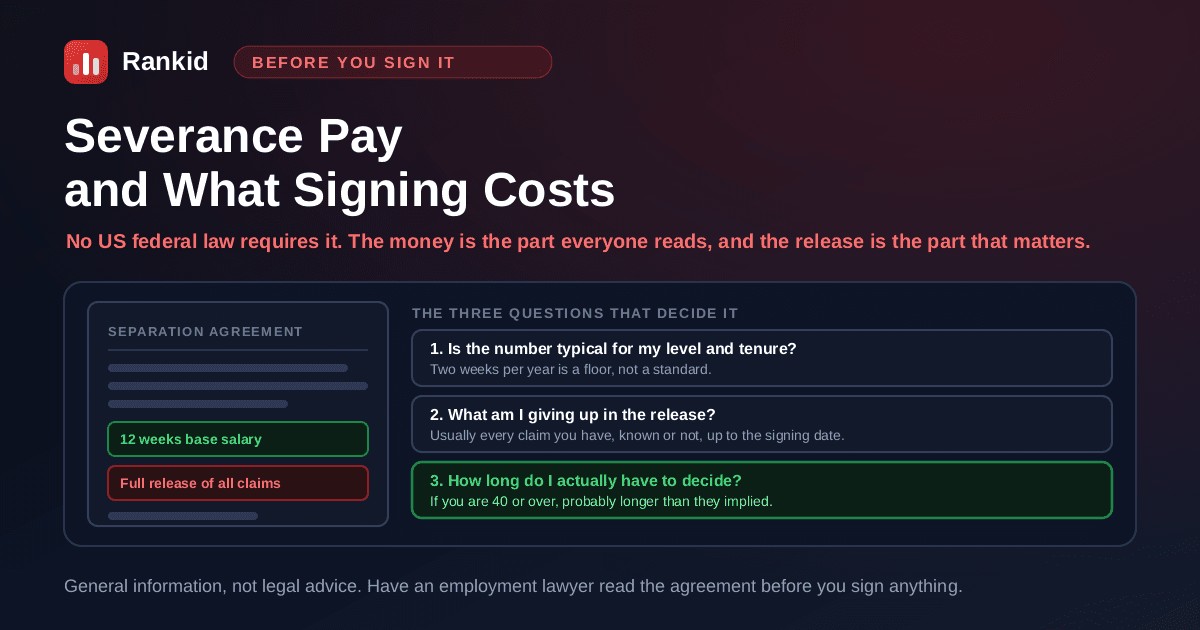
The email arrives with a number in it. Twelve weeks of base salary, say, and a document attached called a separation agreement. Almost everybody reads the number twice and the document once, and the document is the part that decides what the number costs. No federal law in the United States requires severance pay at all, which tells you exactly what it is: not a reward for service, but a payment made to buy something specific from you. Knowing what you are selling is the whole of the skill here.
Quick answer
Quick answer: severance pay is money paid on top of what you are already owed, in exchange for a release of claims. No US federal law requires it. Typical packages run from two to four weeks of base salary for an individual contributor up to six to twelve months for an executive, usually as a base amount for your level plus an amount per year of service. If you are 40 or over you must be given at least 21 days to consider it, 45 in a group layoff, plus 7 days to revoke after signing. The cash formula rarely moves in a layoff, but health coverage, equity treatment, references, non-disparagement and the cooperation clause very often do. Severance is taxed as wages, and how the agreement describes it can change your unemployment benefits.
What is severance pay?
Severance pay is money an employer pays when employment ends, over and above the wages and accrued leave already owed to you. That last part is the definition doing the work. Final wages and, in many states, a payout of accrued unused leave are yours either way. Severance is what sits on top, and it almost always arrives attached to a contract.
That contract is usually called a severance agreement or a separation agreement, and like any contract it has consideration on both sides. The employer's side is the money. Your side is a release of claims: an agreement not to sue over anything that happened up to the day you sign, including, in most drafting, claims you do not currently know you have.
This is why the framing people arrive with is usually wrong. Severance is not gratitude, it is not automatic, and it is not calculated by a rule that someone can look up and confirm for you. It is a transaction, and the interesting question is never just "is this a good number" but "is this a good number for what I am being asked to give up".
One disclaimer, stated plainly
When do you actually get severance pay?
There is no federal requirement to pay severance in the US. What creates an obligation is a contract, a written policy or plan, or a consistent past practice that has effectively hardened into one. Everything else is discretionary, which means it is offered because the employer wants something in return.
So the practical question is not "do I qualify" but "does this employer have a reason to buy a release from me". How you left is what answers that.
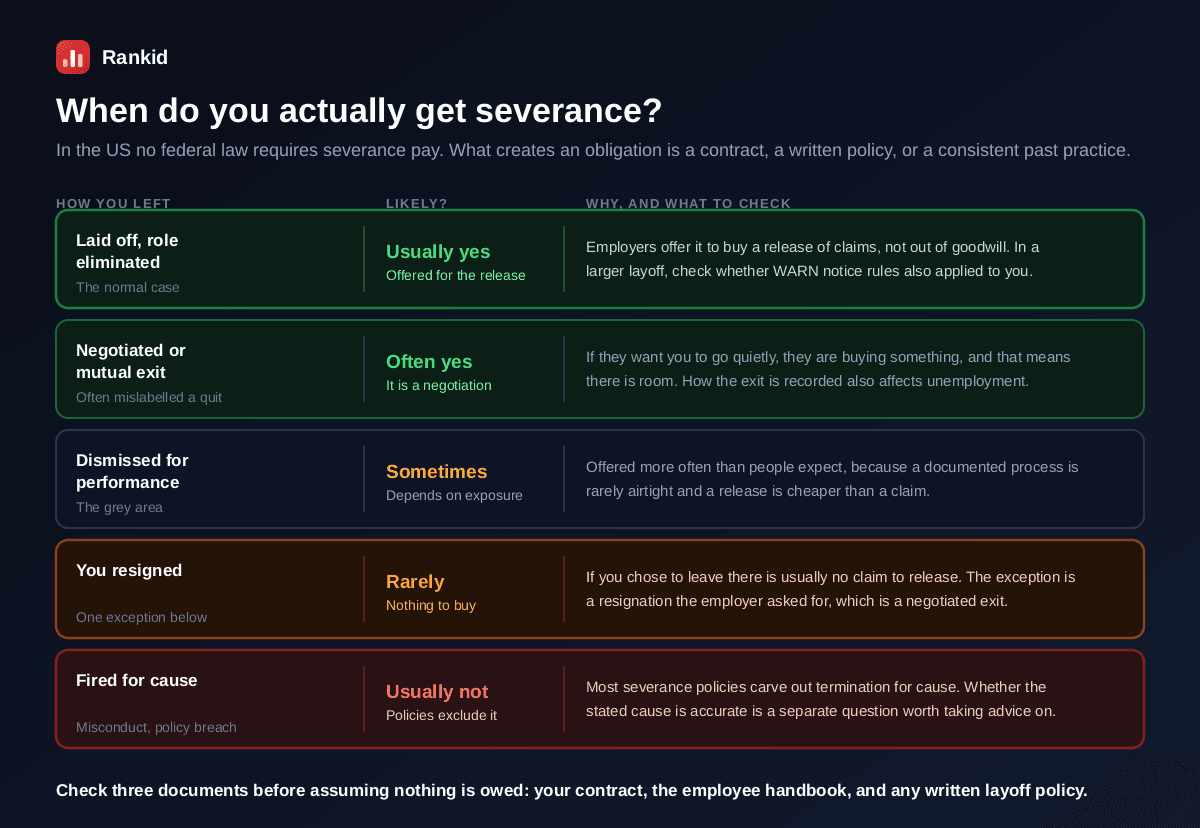
Two rows deserve expanding. A dismissal for performance is not the dead end people assume. Severance is offered in these cases more often than expected, because a documented performance process is rarely as airtight as the employer would like and a modest payment is cheaper than defending a claim. If you have been managed through a performance improvement plan and the exit is coming, resigning to preserve your dignity gives up the payment entirely. Let the process end the employment.
And a resignation the employer asked for is not a resignation.If someone suggests you might be happier elsewhere, or offers to let you leave "on your own terms", that is a negotiated exit dressed as a quit, and it usually carries both severance and room to negotiate. How the departure is recorded matters too, because it feeds into your unemployment claim and into what you will later say about your reason for leaving.
Before concluding that nothing is owed, read three documents: your employment contract, the employee handbook, and any written layoff or severance plan. A published plan is a promise, and where the plan is governed by ERISA it also comes with a formal claims and appeals route. Separately, if you were part of a larger reduction, check whether the federal WARN Act applied, since it requires 60 days of advance notice for qualifying mass layoffs and closings at employers with 100 or more employees, and a number of states run their own versions with lower thresholds. WARN notice is not severance, but pay in lieu of that notice can look very much like it in the paperwork.
How much severance pay is typical?
The honest answer is that market practice is a range, not a rule. But the range has a shape, and knowing the shape is what tells you whether the offer in front of you is normal, generous, or quietly below what your employer gives other people at your level.
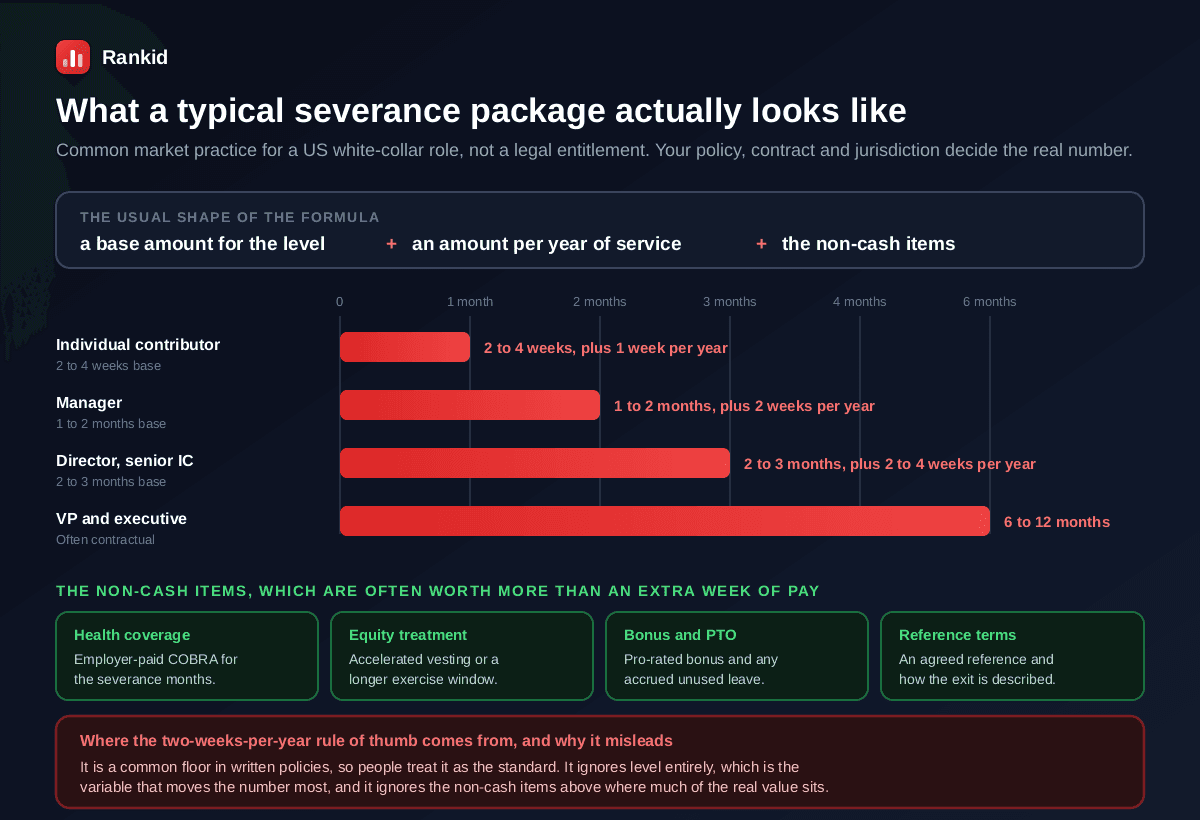
The formula almost always has the same three parts: a base amount that reflects your level, then an amount per year of service, then the non-cash items. People fixate on the middle term because it is the one that feels like it should reward loyalty. In practice the first term moves the total more, which is why two people with identical tenure can receive very different packages without any of it being personal.
The two-weeks-per-year rule of thumb is a floor that got promoted to a standard. It appears in plenty of written policies, which is exactly why it circulates as though it were the market rate. It fails on two counts: it ignores level entirely, and it ignores everything that is not cash. Continued health coverage for the severance months, an extended window to exercise vested equity, a pro-rated bonus, and agreed exit wording can each be worth more than the extra week of salary people spend their negotiating capital asking for.
The number to compare against is not the internet, it is your own employer
What is actually in a severance agreement?
Six clauses do nearly all of the work. The money is the consideration; these are what it buys. Read each one asking a single question: what does this stop me doing after I leave?
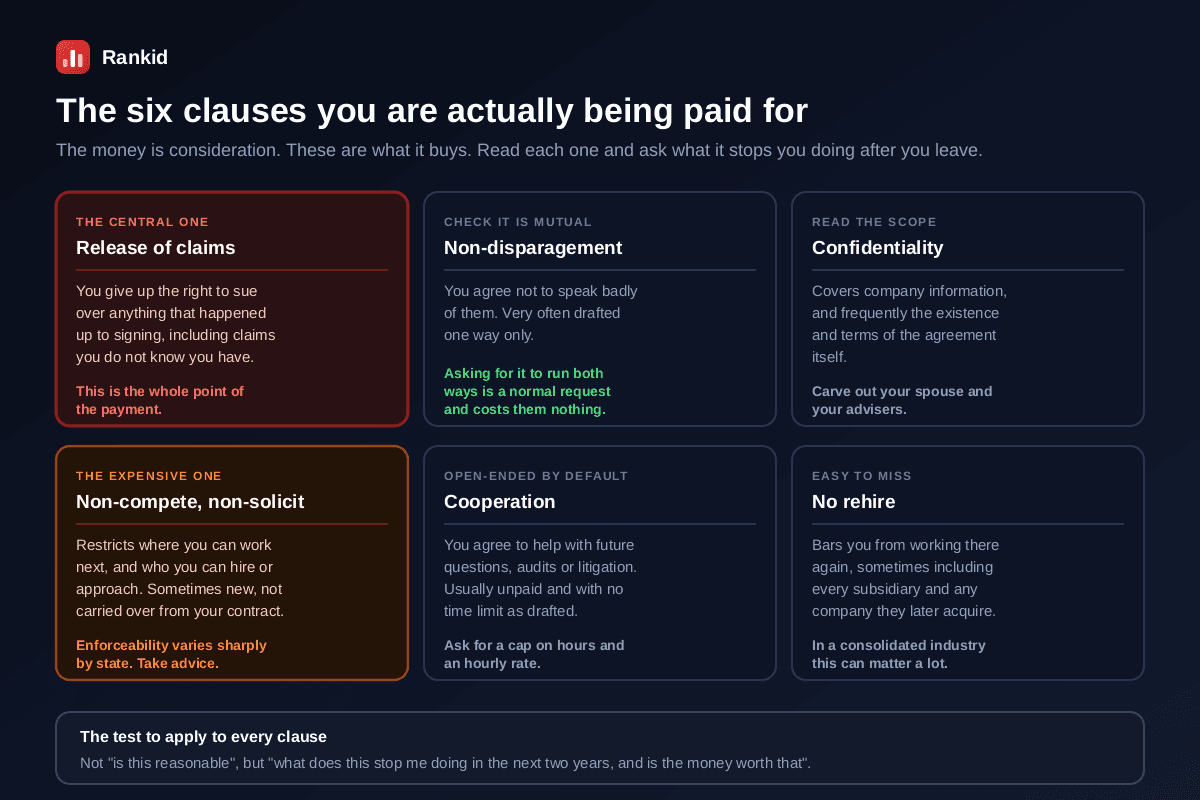
The release of claims is the point of the entire document.Everything else is negotiable detail; this is the thing being purchased. It typically covers discrimination and harassment claims, wrongful termination, retaliation, and disputes over unpaid bonus or commission, and it is normally drafted to include claims you do not know about. If you have a nagging sense that something in your exit was not lawful, that feeling is worth an hour of a lawyer's time before you sign it away, not after.
Restrictive covenants are the expensive clause people skim. A non-compete or non-solicit that appears in a severance agreement is sometimes new rather than carried over from your employment contract, which means you are being asked to accept a fresh restriction at the exact moment you need to find work. Enforceability varies sharply by state, and the answer changes often enough that it is not something to settle from a search result. If a restriction would block the obvious next roles for you, say so specifically, because a named objection is far more likely to be narrowed than a general complaint.
The cooperation clause is open-ended by default. You agree to help with future questions, audits or litigation, usually unpaid and usually with no time limit written in. Asking for a cap on hours and an hourly rate for anything beyond it is a completely standard request that most employers grant without argument, and it is one of the cheapest wins in the whole document.
Non-disparagement is almost always one-directional as drafted. You agree not to speak badly of them; nothing stops them speaking badly of you. Making it mutual costs the employer nothing and is granted routinely. It also pairs naturally with agreeing the exact wording of what they will say when someone calls for a reference, which is worth pinning down in writing while you still have leverage rather than discovering it a year later.
How long do you have to decide?
The pressure to sign quickly is the most common thing people report about severance conversations, and it is frequently unjustified. If you are 40 or over, federal law sets minimum windows for a waiver of age claims to be valid at all.
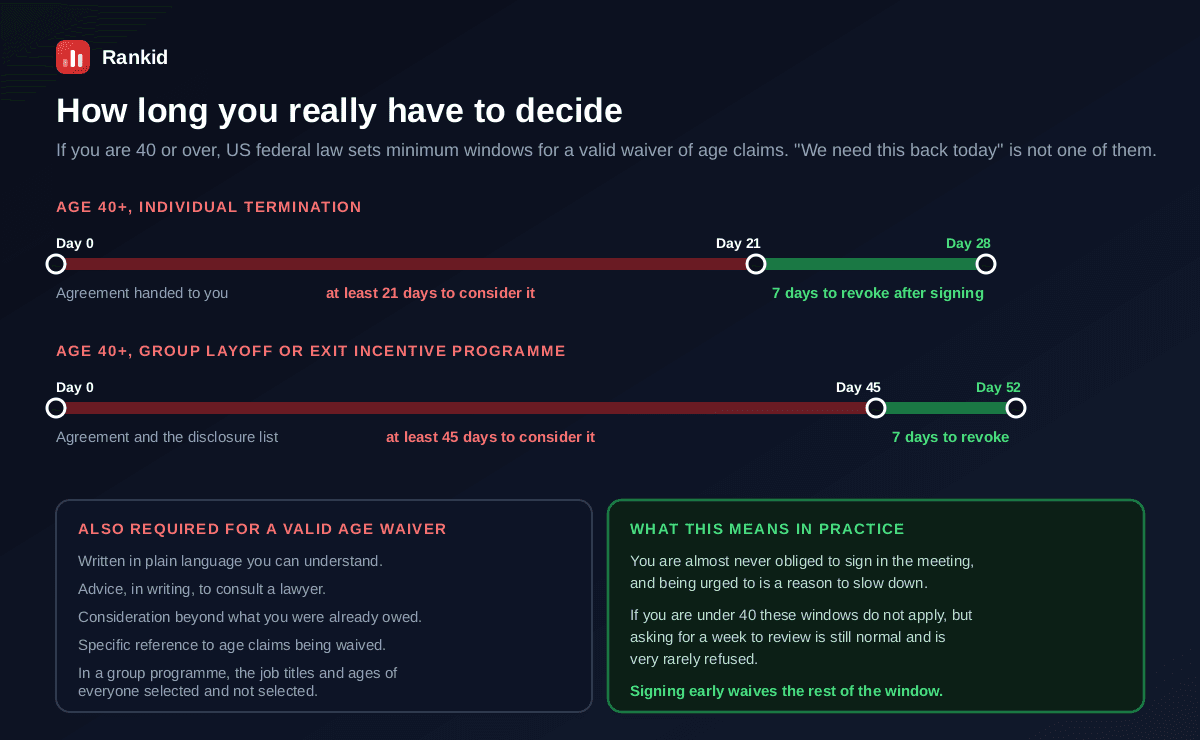
Those windows come from the Age Discrimination in Employment Act as amended by the Older Workers Benefit Protection Act. The mechanics matter: 21 days to consider an individual agreement, 45 days in a group layoff or exit incentive programme, and in both cases 7 days after signing in which you can revoke. The revocation period cannot be waived away, which is also why the payment usually does not arrive until it has expired.
The group case comes with an extra requirement that very few people use: the employer must provide a disclosure list showing the job titles and ages of the people selected and not selected for the programme. That document exists precisely so that a pattern can be seen, and it is worth reading rather than filing.
If you are under 40, none of those minimums apply to you. Ask anyway. "I would like a few days to read this properly, can we speak on Thursday" is a normal, unremarkable sentence, and refusing it is rare enough that a refusal is itself information. Signing early waives the rest of the window, so there is no reason to do it in the room while you are still absorbing the news.
"We need this back today" is not a deadline, it is a technique
The fastest way to make severance a bridge rather than a runway
Whatever the package, the clock starts the day you sign. Paste your resume and a target job description into Rankid for a 0 to 100 match score, the requirements you have evidenced, and the ones a screen cannot see yet. First check is free, no signup.
Check your resume freeWhat you keep even after signing
A release is broad, and it is written to sound total. It is not. Several rights survive a signature regardless of how the document is drafted, and knowing which ones changes how the offer reads.
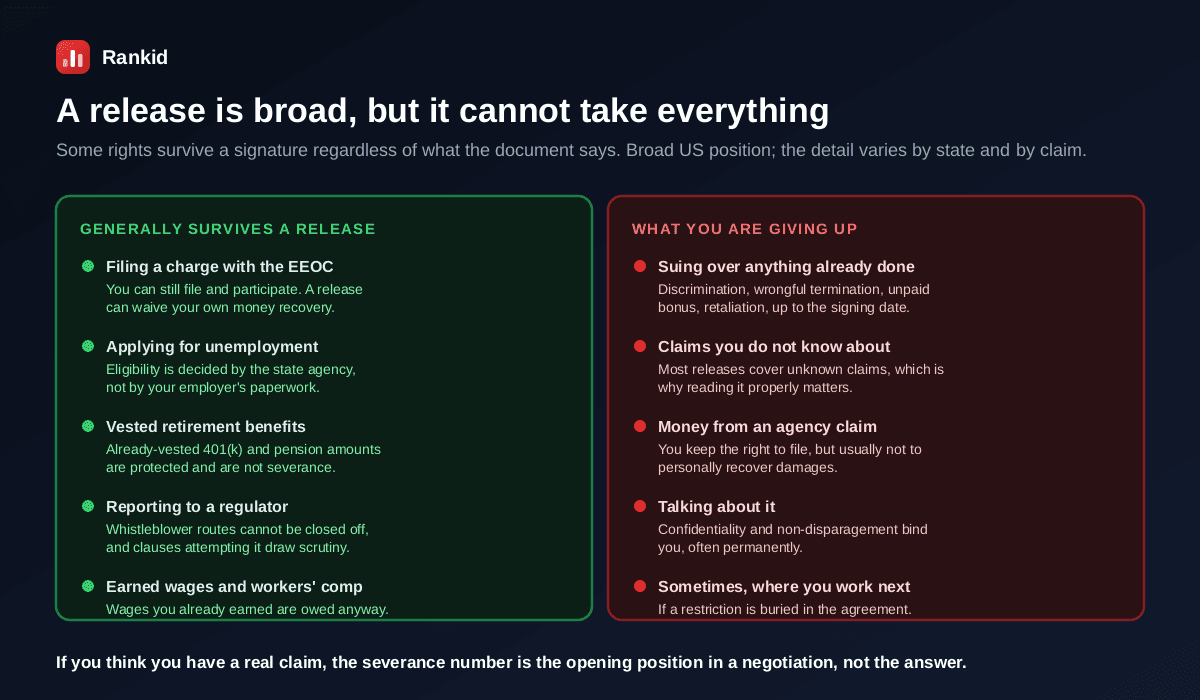
The distinction that trips people up most is the EEOC one. You generally keep the right to file a charge and to take part in an investigation, and any clause purporting to stop you doing so is on shaky ground. What a release can usually do is waive your personal monetary recovery from that route. So the right survives and the payout typically does not, which is a meaningful difference if what you want is a finding rather than money, and an important one to understand properly rather than from a summary.
Unemployment eligibility is decided by your state agency, not by your employer's paperwork. An agreement that describes your exit in a particular way does not settle the question, although as the next section explains, the wording can affect how severance interacts with your benefit. Vested retirement money is already yours and is not severance. Earned wages are owed regardless.
Read the two columns together and the real question emerges. If you believe you have a genuine claim, then the severance figure is an opening position in a negotiation rather than the answer to it, and the correct next step is advice rather than a signature. If you do not, then the release is mostly giving up claims you were never going to bring, and the analysis moves to the restrictive covenants and the money.
Can you negotiate severance, and what actually moves?
Yes, and the mistake nearly everyone makes is spending the entire conversation on the one item with the least give in it. In a group layoff the cash formula is usually applied consistently across everyone, in part to avoid discrimination exposure, so HR often genuinely cannot move it for you alone. The flexible items are further down the list, and most people never ask for them.
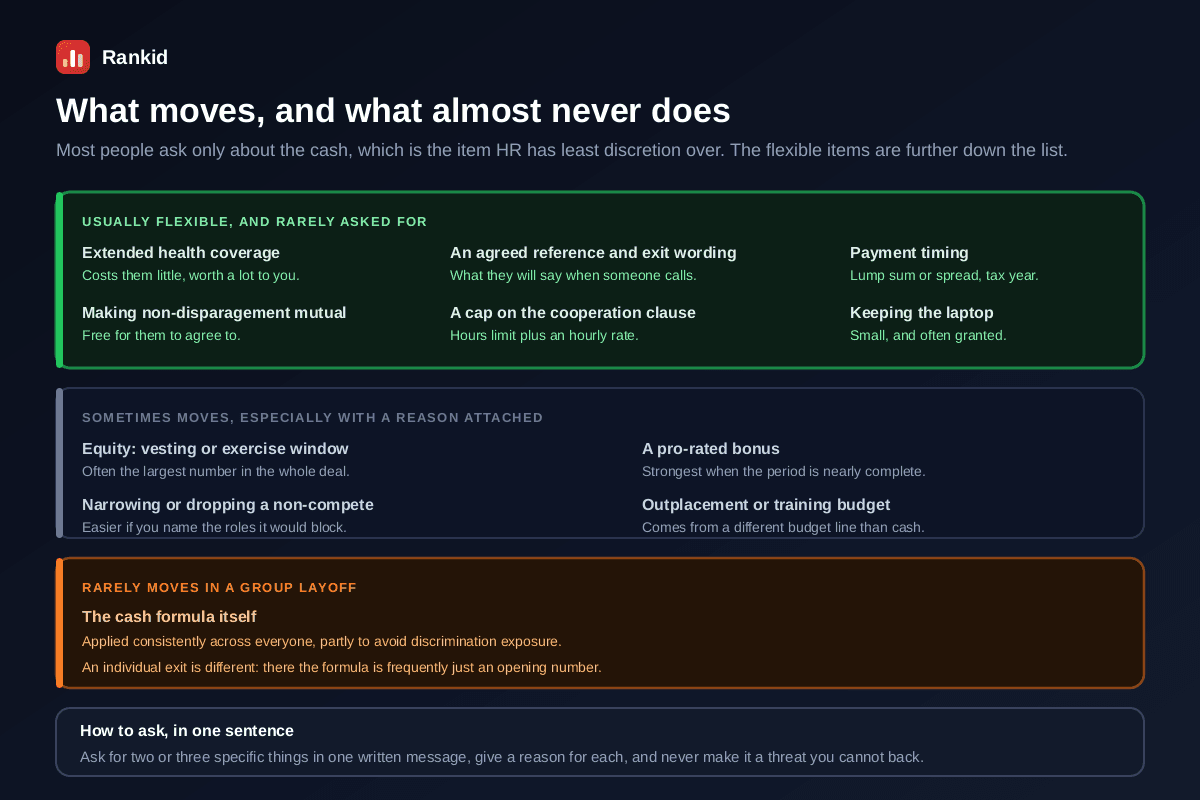
Equity is the item most often left on the table. For anyone at a company with meaningful stock compensation, the treatment of unvested shares and the length of the post-termination exercise window is frequently the largest number in the entire deal, larger than several weeks of salary, and it is decided by documents most people have never read carefully. A 90-day exercise window that expires while you are still job hunting can turn vested equity into nothing. Ask about it early and specifically.
Read the whole document before you say anything about the number
Pick two or three specific asks, not a list of eight
Attach a reason to each ask
Put it in one written message, calmly
Never make a threat you cannot back
Get every agreed change written into the document itself
Tax, and what severance does to unemployment
These are the two things that make the headline number smaller than it looks, and the second one is genuinely state by state in a way that general advice cannot resolve for you.
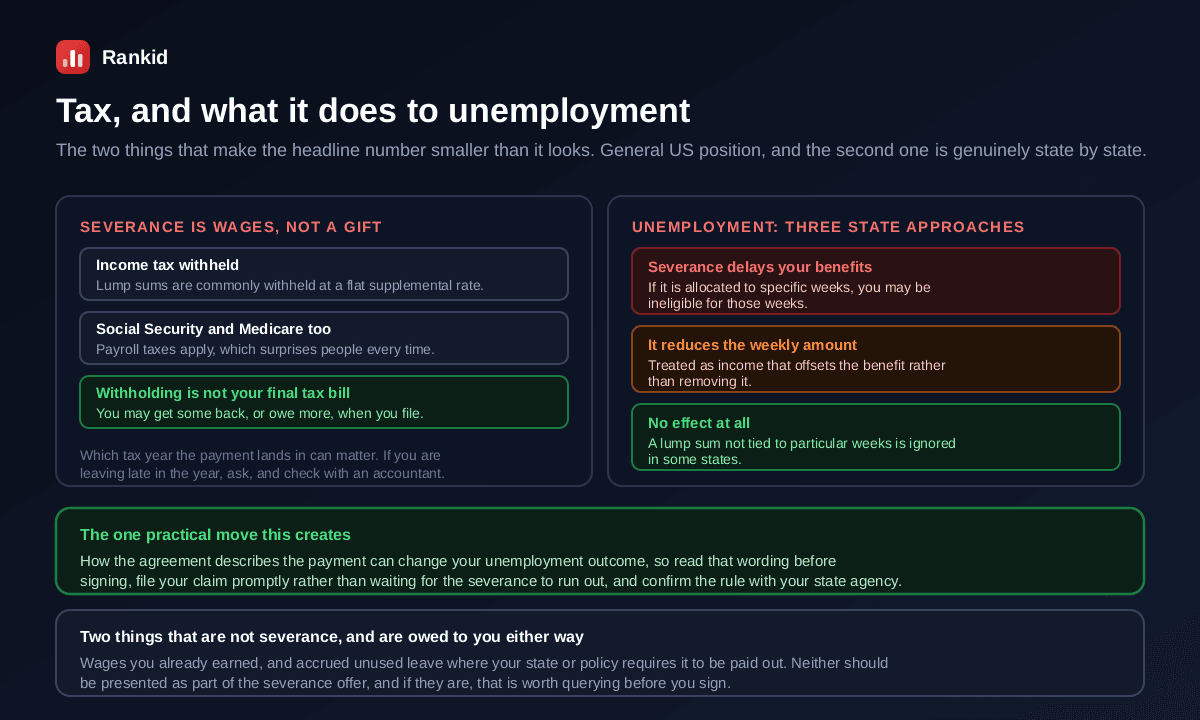
Severance is wages. Income tax is withheld, and Social Security and Medicare come out too, which catches people every time because the payment feels like a settlement rather than a paycheck. Lump sums are commonly withheld at the flat supplemental rate, so the amount that lands can be noticeably smaller than the figure you negotiated. Withholding is not your final bill, though: depending on the rest of your year you may get some back or owe more when you file.
The planning point worth raising before you sign is which tax year the money lands in. If you are leaving in the last weeks of a year and expect a much lower income in the next one, moving the payment can be worth real money, and payment timing is one of the more flexible items in the whole package. This is a conversation for an accountant rather than a guess, but it is only available before signature.
On unemployment, the three state approaches shown above matter less than one practical fact: how the agreement describes the payment can change the outcome. Severance allocated to specific weeks behaves differently from an undifferentiated lump sum in many states. Read that wording before you sign, file your claim promptly rather than waiting for the severance to run out, and confirm the rule with your own state agency. Do not let the fact that you are receiving severance stop you from filing.
Two things that are not severance and are owed either way
Severance mistakes that cost people money
- Signing in the meeting. The news and the decision arrive in the same half hour, which is exactly why the two should be separated. Take the document home.
- Reading the number and skimming the release. The release is what the number pays for. Reading it properly is the single highest-value ten minutes in the process.
- Resigning to avoid being fired. A resignation usually gives up severance entirely and can complicate unemployment. If an exit is coming, let the employer end the employment.
- Negotiating only the cash. In a layoff it is the least flexible item in the package, and the time spent on it is time not spent on health coverage, equity and references.
- Ignoring the equity documents. The post-termination exercise window is often the largest number in the deal and the one with the hardest deadline.
- Accepting a one-way non-disparagement clause. Asking for it to run both ways costs the employer nothing and is granted routinely.
- Leaving the cooperation clause uncapped. Unpaid, open-ended assistance with future audits or litigation is a real obligation, and an hours cap plus an hourly rate is a standard request.
- Missing a new non-compete buried in the agreement. Restrictions in a severance document are not always carried over from your contract, and this is the clause most likely to cost you a job later.
- Delaying the unemployment claim until the severance runs out. Filing dates and eligibility rules do not wait, and in many states the two are not mutually exclusive anyway.
- Relying on a verbal promise. If the agreed reference wording or extra COBRA month is not in the document, the entire-agreement clause erases it.
- Treating the package as a runway rather than a bridge. Twelve weeks of pay is not twelve weeks of search time, because the search should have started in week one.
The clause worth one more read before you sign
What to do in the first week after signing
The paperwork ends and the runway starts shortening immediately. Three things are worth doing in the first week, while the details are still fresh and while any deadlines in the agreement are still far away.
- File for unemployment, and file now. Whatever the severance treatment in your state, the claim is decided by the agency and the filing date matters. Have your separation paperwork to hand and describe the exit exactly as the agreement does.
- Calendar the hard deadlines. The equity exercise window, the end of employer-paid coverage and the start of COBRA, any bonus payment date, and the final pay date. These are the dates that cost money when missed, and none of them will be reminded to you.
- Save a clean copy of everything. The signed agreement, your equity statements, the final payslip and the agreed reference wording, all in one place. You will want the reference wording in particular when someone eventually calls.
- Start the search before you feel ready. A layoff is one of the easiest departures to explain and one of the least stigmatised, which is exactly why the story you tell should be short and factual. Our guides to explaining a reason for leaving and employment gaps on a resume cover the wording for both the form and the call.
Key takeaways
- Severance pay is money on top of what you are already owed, paid in exchange for a release of claims. It is a transaction, not a reward.
- No US federal law requires severance. An obligation comes from a contract, a written policy or plan, or a consistent past practice.
- How you left decides the likelihood: layoffs almost always, negotiated exits often, performance dismissals more often than people expect, resignations rarely, for-cause terminations almost never.
- Typical US practice is a base amount for your level plus an amount per year of service, from two to four weeks for an individual contributor up to six to twelve months for an executive.
- Two weeks per year is a policy floor that got mistaken for a standard. It ignores level, which moves the number most, and ignores the non-cash items.
- The release is what the money buys, and it usually covers claims you do not know about as well as ones you do.
- If you are 40 or over you get at least 21 days to consider an individual agreement, 45 in a group layoff, plus 7 days to revoke after signing. Under 40, ask for a week anyway.
- You generally keep the right to file an EEOC charge, to apply for unemployment, to vested retirement money and to report to a regulator, but a release can waive your own monetary recovery.
- In a group layoff the cash formula rarely moves. Health coverage, mutual non-disparagement, reference wording, a cap on the cooperation clause and payment timing very often do.
- Equity treatment and the post-termination exercise window are frequently the largest numbers in the whole deal, and the easiest to overlook.
- Severance is taxed as wages, including payroll taxes, and lump sums are commonly withheld at the flat supplemental rate.
- How the agreement describes the payment can change your unemployment outcome. File the claim promptly rather than waiting for severance to run out.
- Every agreed change must be written into the document, because the entire-agreement clause erases anything promised verbally.
- Take advice before signing where there is a non-compete, meaningful equity, a below-policy offer, unusual pressure to sign, or any reason to think you have a real claim.
The whole thing reduces to one reframe. A severance offer is not a verdict on your worth to the company, and reading it as one is what makes people either sign it in wounded silence or fight it on the only number they can see. It is a contract with a price on both sides. Work out what the employer is buying, work out which parts of the package actually move, ask for two or three of them in writing with a reason attached, and get every yes into the document. Then treat the money as a bridge rather than a runway: paste your resume and a target job description into Rankid's resume checker in week one to see what a screen can find, and read why am I not getting interviews before the applications start going out rather than after the first fifty go unanswered.
Frequently asked questions
What is severance pay?
Severance pay is money an employer pays an employee when the employment relationship ends, over and above the wages and accrued leave already owed. It normally arrives as part of a severance or separation agreement, which is a contract: the payment is the consideration, and what the employer buys with it is a release of claims, meaning you give up the right to sue over anything that happened up to the day you sign. That framing is the single most useful thing to understand about severance. It is not a thank-you gift, a legal entitlement, or a reward for service. It is a transaction with a price on both sides, and the price on your side is written in the agreement rather than in the offer email. A typical package is a cash figure expressed in weeks or months of base salary, plus non-cash items such as continued health coverage, equity treatment, a pro-rated bonus, outplacement help, and agreed wording about how the exit will be described. This article is general information about how severance works in practice in the United States, not legal advice.
Is severance pay required by law?
In the United States there is no federal law requiring an employer to pay severance. The Fair Labor Standards Act does not mandate it, and severance is generally a matter of agreement between the employer and the employee. What does create an obligation is one of three things: an employment contract that promises it, a written policy or severance plan the employer has published, or a consistent past practice that has effectively become a policy. Some plans are governed by ERISA, which brings a formal claims and appeals process with it. Separately, the federal WARN Act requires 60 days of advance notice for qualifying mass layoffs and plant closings at employers with 100 or more employees, and several states have their own mini-WARN laws with lower thresholds and, in a small number of cases, actual pay requirements. That notice is not severance, but pay in lieu of the notice period can look like it. Before assuming nothing is owed, read your contract, the employee handbook and any written layoff policy.
How much severance pay is typical?
For a US white-collar role, common market practice is a base amount tied to your level plus an amount per year of service. An individual contributor commonly sees two to four weeks of base salary plus roughly a week per year of service. A manager typically sees one to two months plus about two weeks per year. A director or senior individual contributor sees two to three months plus two to four weeks per year. VP and executive severance is usually contractual and frequently runs six to twelve months. The widely quoted rule of thumb of two weeks per year of service is a common floor in written policies rather than a standard, and it misleads in two ways: it ignores level, which is the variable that moves the number most, and it ignores the non-cash items, where a great deal of the real value sits. None of these figures is an entitlement. Your own contract, policy and jurisdiction decide the real number.
Do you get severance if you are fired or if you quit?
It depends far more on why the employment ended than on the label used. A layoff or role elimination is the normal case and severance is usually offered, because the employer wants a release of claims. A negotiated or mutual exit often carries severance too, and it is genuinely a negotiation, because if the employer wants you to leave quietly they are buying something. A dismissal for documented performance sits in the grey area and severance is offered more often than people expect, because a performance process is rarely airtight and a release is cheaper than defending a claim. If you resigned of your own accord there is usually nothing for the employer to buy, so severance is rare, with the exception of a resignation the employer asked for, which is really a negotiated exit. Termination for cause, meaning misconduct or a serious policy breach, is carved out of most severance policies. Whether the stated cause is accurate is a separate question and one worth taking advice on.
What is a release of claims in a severance agreement?
The release is the clause the money is actually paying for. In it you agree to give up the right to bring legal claims against the employer arising from anything that happened up to the date you sign, and most releases are drafted to cover claims you do not know about as well as ones you do. That typically includes discrimination and harassment claims, wrongful termination, retaliation, and disputes about an unpaid bonus or commission. Some rights cannot be signed away: you generally keep the right to file a charge with the EEOC and to participate in its investigation, although a release can usually waive your personal monetary recovery from such a claim; you keep the right to apply for unemployment, which the state agency decides rather than your employer; vested retirement benefits are protected; and whistleblower routes to regulators cannot be closed off. The practical test is simple. If you think you have a real claim, the offer on the table is an opening position rather than the answer, and you should be talking to an employment lawyer before you sign.
How long do I have to decide whether to sign a severance agreement?
If you are 40 or over, US federal law under the ADEA as amended by the OWBPA sets minimum windows for a waiver of age claims to be valid. For an individual termination you must be given at least 21 days to consider the agreement, and 7 days after signing in which you can revoke it. For a group layoff or exit incentive programme the consideration period is at least 45 days, plus the same 7-day revocation period, and the employer must also give you a disclosure list showing the job titles and ages of everyone selected and not selected. A valid waiver also has to be written in plain language, advise you in writing to consult a lawyer, specifically reference age claims, and offer consideration beyond what you were already owed. If you are under 40 those windows do not apply, but asking for a week to review is completely normal and very rarely refused. You are almost never obliged to sign in the meeting, and being pushed to is a reason to slow down rather than to hurry.
Can you negotiate severance pay?
Usually yes, but often not on the item people ask about. In a group layoff the cash formula is typically applied consistently across everyone, partly to avoid discrimination exposure, so it is the least flexible number in the package. What moves more easily is everything around it: extended health coverage, making a one-way non-disparagement clause mutual, agreed reference and exit wording, a cap on the cooperation clause with an hourly rate attached, payment timing and which tax year it lands in, and keeping the laptop. Items that sometimes move with a reason attached include equity vesting or the post-termination exercise window, which is frequently the largest number in the whole deal, narrowing or dropping a non-compete, a pro-rated bonus where the period is nearly complete, and outplacement or training budget, which usually comes from a different budget line than cash. An individual exit is different from a layoff: there, the first number is often just an opening offer.
Is severance pay taxed?
Yes. Severance is treated as wages in the United States, not as a gift or a settlement windfall. Income tax is withheld, and Social Security and Medicare payroll taxes apply too, which surprises people almost every time. Lump sum payments are commonly withheld at the flat supplemental wage rate, which is why the amount that arrives can look much smaller than the headline figure. Important: withholding is not your final tax bill. Depending on the rest of your year you may get some of it back, or owe more, when you file. One planning point is worth raising before you sign: which tax year the payment lands in can materially change what you keep, particularly if you are leaving late in the year or expect a much lower income in the following one. Payment timing is one of the more flexible items in a severance negotiation, so it is worth asking, and worth a conversation with an accountant rather than a guess.
Does severance pay affect unemployment benefits?
It can, and this is genuinely state by state. There are three broad approaches. In some states severance delays your benefits: if the payment is allocated to specific weeks after your separation, you may be ineligible for those weeks. In others it reduces the weekly amount, being treated as income that offsets the benefit rather than removing it. In others a lump sum that is not tied to particular weeks has no effect at all. Because the treatment often turns on how the agreement describes the payment, that wording is worth reading before you sign rather than after. Two practical moves follow. File your unemployment claim promptly instead of waiting for the severance to run out, since eligibility rules and filing dates do not wait for you. And confirm the rule with your own state agency rather than relying on general guidance, including this article, because the differences between states here are real.
What should I check before signing a severance agreement?
Six things, in this order. First, the release itself, since that is what the money buys and it usually covers unknown claims. Second, any restrictive covenants, meaning non-compete and non-solicit clauses, especially if they are new rather than carried over from your employment contract, because enforceability varies sharply by state and this is the clause most likely to cost you a job later. Third, non-disparagement, which is very often drafted one way only; asking for it to run both ways costs the employer nothing. Fourth, confidentiality, including whether the existence and terms of the agreement itself are covered, and whether your spouse and advisers are carved out. Fifth, the cooperation clause, which is usually unpaid and open-ended as drafted, so ask for a cap on hours and an hourly rate. Sixth, the no-rehire clause, which can extend to every subsidiary and to companies the employer later acquires. The test to apply to each clause is not whether it is reasonable, but what it stops you doing over the next two years and whether the money is worth that.
What is not severance, and should be paid to me anyway?
Two things. Wages you have already earned, including any commission that has met the conditions in your plan, are owed regardless of whether you sign anything, and many states set a deadline for paying final wages after a separation. Accrued but unused vacation or PTO is owed where your state law or your employer's own policy requires it to be paid out, which varies by state. Neither of these should be presented as part of the severance offer, and if the paperwork bundles them into the headline number, that is worth querying before you sign, because it means you are being asked to release your claims in exchange for money you were already going to receive. The same logic applies to a final expense reimbursement and to vested retirement amounts, which are yours already. Read the offer as: what is the employer paying me over and above what they already owe, because that difference is the real value of the deal.
Should I hire a lawyer to review a severance agreement?
For a routine layoff package that matches your employer's published policy, with no restrictive covenants and no facts suggesting a claim, many people sign without one. It is worth paying for a review in five situations: the agreement contains a non-compete or non-solicit, particularly a new one; there is significant equity involved, since vesting and exercise windows are frequently the largest number in the deal; you believe you may have a genuine claim, such as discrimination, retaliation, or a termination that followed a protected complaint or a medical leave; the package is materially below your employer's own policy or below what colleagues at your level received; or you are being urged to sign quickly. Most employment lawyers offer a fixed-fee review, and the agreement itself normally advises you in writing to consult one, which tells you something about how routine the request is. Asking for time to take advice is not a hostile act, and it is not a reason for an offer to be withdrawn.