Performance Improvement Plan (PIP): Template, 5 Examples, and What It Actually Signals (2026)
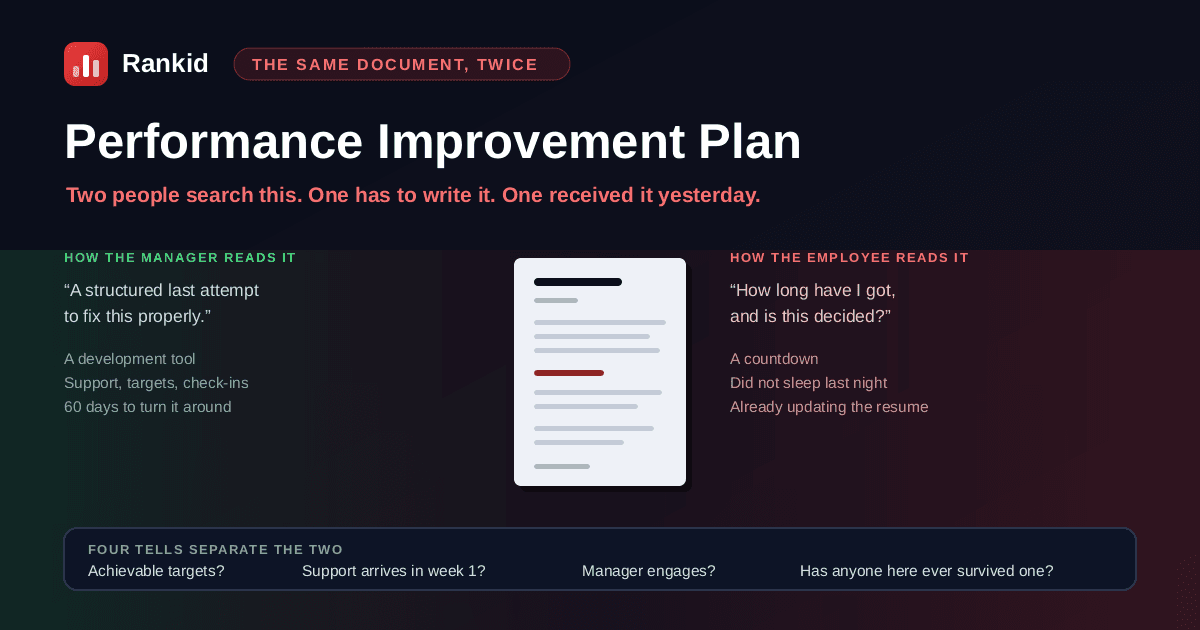
Two different people search for this phrase. One is a manager who has been told to have a performance improvement plan written by Friday and has never written one. The other was handed one yesterday afternoon and did not sleep, and wants to know what it really means. This covers both, including the honest answer to the second question, which is not the answer most HR content gives.
Quick answer
Quick answer: a PIP is a written plan stating where performance falls short, the measurable standard required, the support provided, the timeline, and the consequence if the bar is not met. Seven components, 30 to 90 days, weekly check-ins. Does it mean you are being fired? Not always, but it depends on the company, and four tells give it away: whether the targets are achievable, whether the promised support arrives in week one, whether your manager engages, and whether anyone here has ever survived one. If you received one: do not sign in the meeting, ask for 48 hours, and respond in writing.
What is a PIP at work?
A performance improvement plan is a written document stating where someone's performance falls short of the requirements of their role, what must change, how the change will be measured, what support the company will provide, over what period, and what happens if the standard is not met.
The acronym collides with a lot: personal injury protection in insurance, the Python package installer, the personal independence payment in UK benefits. In a workplace conversation it means performance improvement plan, and the first thing worth establishing is whether it is a formal stagein your company's documented performance process or an informal coaching document. Those are different things with different consequences. Ask, and ask for the answer in writing.
The defining feature of a usable PIP is specificity. A plan that says communication needs to improve is not a plan, it is a complaint with a deadline attached. And nothing in it should be information the employee is hearing for the first time. A PIP that contains a surprise is evidence of a management failure that predates it.
Does a PIP mean you are getting fired?
Here is the honest version. There are two kinds of PIP in circulation, they look almost identical on paper, and the difference is whether the outcome was decided before the document was written.
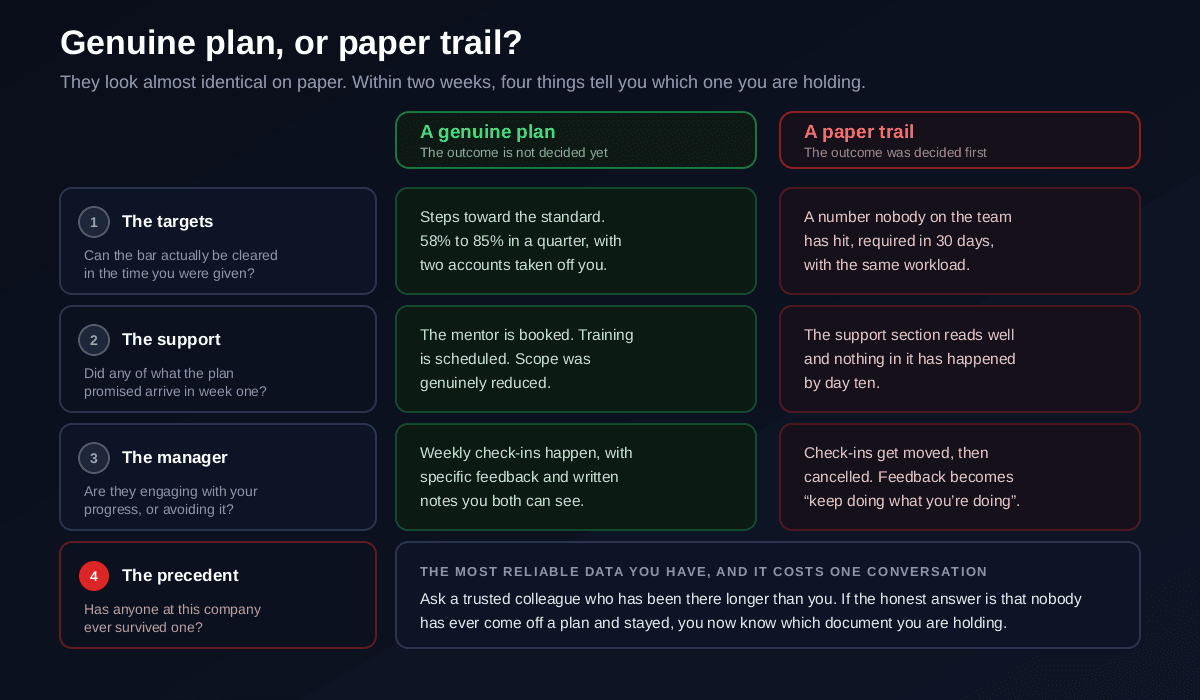
In companies that use PIPs as a genuine performance tool, a meaningful share of people complete them and stay. In companies that use them as documentation, the plan exists to build a defensible record for a decision already made. Industry content tends to insist only the first kind exists. It does not.
You can usually tell which one you are holding within two weeks, from four tells:
- Are the targets achievable in the time given? A number nobody in the team has hit, required in 30 days, is not a target. It is a record being created.
- Does the promised support actually arrive? The plan names training, a mentor, reduced scope, manager hours. Week one tells you whether any of it was real.
- Does your manager engage with your progress? Genuine plans involve someone who wants the outcome to change. Paper trails involve someone who has gone quiet.
- Has anyone here ever survived one? Ask a trusted colleague. This is the single most reliable piece of data available to you, and it takes one conversation.
If you are the manager reading this
What goes in a PIP: the seven components
Seven parts, and the whole document lives or dies on one of them: whether the standard is written specifically enough that two people could independently agree at the end whether it was met.
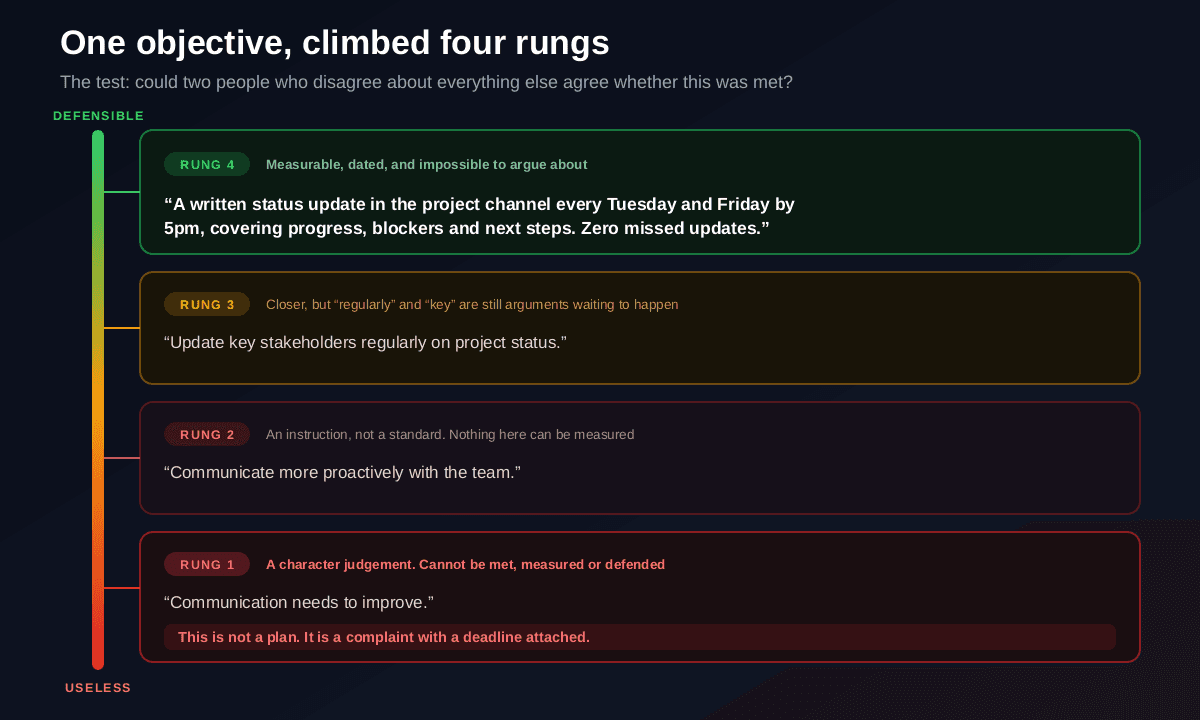
- The specific gaps.Observable facts with dates and examples, not character judgements. Not "lacks attention to detail" but "the March and April reports were submitted with errors in the revenue figures, corrected on 14 March and 11 April".
- The standard required. A number, or a verifiable outcome. This is the component that fails most often.
- The support provided. Named concretely: which training, which mentor, what scope is being removed, how many hours of your time per week.
- The timeline. Start date, end date, and the check-in dates already in the calendar.
- How it is measured, and by whom. If the measure is your subjective judgement, say so, and expect that to be the weakest part of the document.
- The consequence. Stated plainly. Ambiguity here is unkind, not merciful.
- Signatures, and space for the employee's written comments. That space matters more than it looks. A plan the employee could respond to in writing is fairer and considerably more defensible.
Performance improvement plan template
The skeleton first, then five filled examples for the situations that come up most. Replace everything in square brackets, and have HR review before it is issued.
The template
PERFORMANCE IMPROVEMENT PLAN
Employee: [name] Role: [title] Manager: [name]
Plan period: [start date] to [end date] Review dates: [dates]
1. Purpose.This plan sets out the areas in which your performance is not currently meeting the requirements of your role, the standard required, the support available to you, and how progress will be reviewed. [State whether this is a formal stage of the company's performance process.]
2. Performance concerns. [For each: the requirement, the observed shortfall with specific dates and examples, and when it was previously discussed.]
3. Required standard. [For each concern: the measurable target and the date by which it applies.]
4. Support provided. [Specific: training, mentoring, tooling, scope changes, and a named weekly one-to-one of [N] minutes with [name].]
5. Measurement. [What evidence will be reviewed, by whom, at each review date.]
6. Consequence. If the standard set out above is not met by [end date], [the outcome, stated plainly, up to and including termination of employment].
7. Acknowledgement. Employee signature and date, confirming receipt and discussion of this plan. Manager signature. HR signature.
Employee comments: [space provided]
Example: sales quota
Concern. The role requires quarterly attainment of 100 percent of quota. You achieved 61 percent in Q3 and 58 percent in Q4, against a team median of 96 percent. This was discussed on 12 October and 8 January.
Standard. Achieve a minimum of 85 percent of quota for the quarter ending [date], with at least 20 qualified discovery calls per month logged in the CRM and a pipeline of no less than 3 times remaining quota by [date].
Support. Weekly 45-minute pipeline review with [manager]. Two joint calls per week with [senior rep] for the first three weeks. Re-run of the objection-handling module by [date]. Two named accounts reassigned to reduce territory load.
Note the 85 percent. Requiring 100 percent immediately from someone at 58 percent, in a quarter, is the impossible-target failure. A plan that steps toward the standard is both fairer and far more credible.
Example: quality and errors
Concern. Six of the eleven client reports you produced between 3 February and 28 March required correction after delivery, specifically [dates and the error in each]. The role requires reports to be delivered without factual or numerical error.
Standard. From [date], zero post-delivery corrections arising from factual or numerical error across all reports produced, with the pre-delivery checklist completed and attached to each.
Support. The checklist template and a worked example. Peer review by [name] on every report for the first three weeks, reducing to spot checks thereafter. One hour of training on [tool] by [date].
Example: missed deadlines
Concern. Of the nine agreed delivery dates in the last quarter, five were missed by more than three working days: [list with dates]. In four cases the delay was communicated after the deadline had passed rather than in advance.
Standard. All agreed delivery dates met, and where a date is at risk, notification in the project channel at least two working days in advance with a revised date and the reason. Measured across all commitments in the plan period.
Support. Joint re-planning of current commitments with [manager] by [date] to confirm the existing dates are realistic. Weekly 20-minute commitment review. [Project] reassigned to reduce concurrent load.
The support line there is doing real work. If someone is missing five of nine deadlines, the possibility that the deadlines were never achievable has to be tested before you build a plan on them.
Example: collaboration and behaviour
Concern.On [date] in the [meeting], and again on [date] in [channel], you [described factually: interrupted and dismissed a colleague's contribution / responded to a review comment in terms that were personal rather than technical]. Three colleagues have raised concerns about the effect on the team's willingness to raise issues. The role requires [the specific expectation from the role definition or values].
Standard. From [date], no further instances of [the specific behaviour]. Review comments addressed to the work rather than the person. Confirmed at each check-in and through feedback from [named process].
Support. Two sessions with [coach or HR partner] by [date]. Agreed protocol for raising technical disagreement, drafted with [manager] by [date].
Behaviour plans are the hardest to write well because the temptation is to characterise the person. Describe incidents and dates, name the expectation, and keep every sentence to something a neutral reader would accept as a fact.
Example: attendance
Concern. Company policy requires [the standard]. Records show [N] unscheduled absences and [N] late starts between [dates], specifically [list]. This was discussed on [date].
Standard. For the next 30 days: present and ready to work by [time] on every scheduled day, and any absence reported to [name] through [channel] at least two hours before shift start.
Support. Confirmation of the reporting process in writing. [Where relevant: a discussion of whether a schedule adjustment would resolve the issue.]
Do this before writing an attendance plan
How long should a PIP run?
Thirty, sixty or ninety days, chosen by how long the work takes to show a result rather than by how annoyed anyone is.
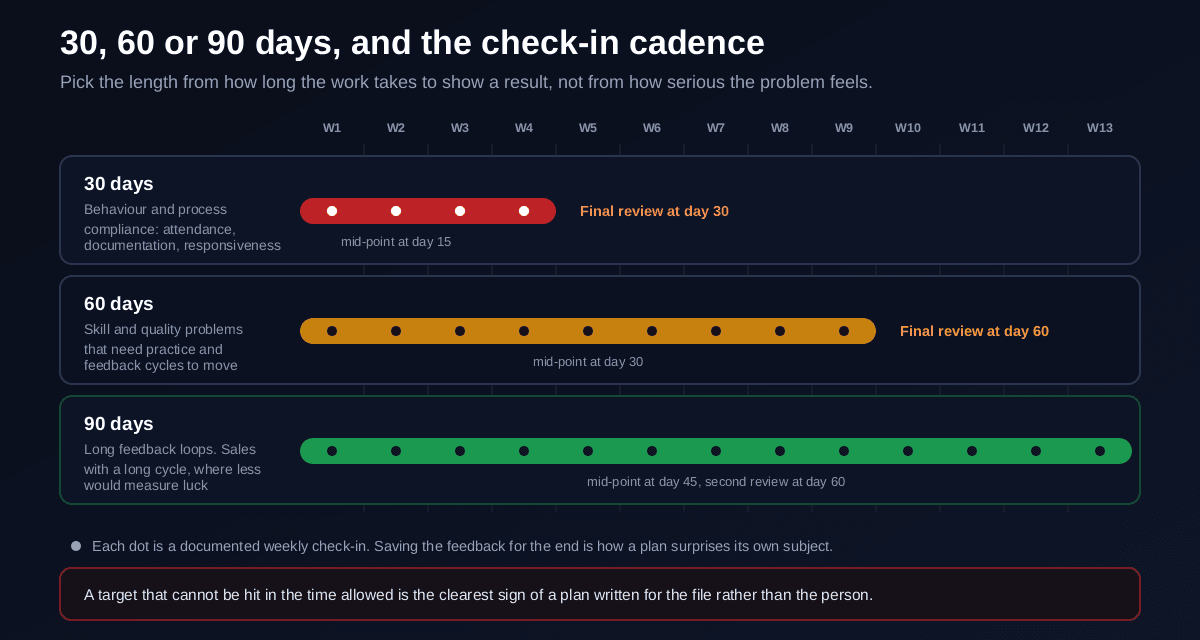
Thirty days suits behaviour and process compliance, where change is visible immediately: attendance, documentation, responsiveness, following a defined procedure.
Sixty days suits skill and quality problems that need practice and feedback cycles to move.
Ninety days suits roles with long feedback loops, most obviously sales with a long cycle, where a shorter window measures luck rather than performance.
Whatever the length, check in weekly and write down each one. Saving all the feedback for the end is how a plan produces a surprise at its own conclusion, which is precisely what it exists to prevent. If a plan is extended, get the new end date, the revised targets and the reason in writing, because an indefinitely rolling PIP is not a plan.
If you have just been put on a PIP
First, the three things not to do in the meeting: do not sign it, do not argue it, and do not resign. All three are decisions taken with adrenaline and incomplete information, and all three cost you something. Say that you take it seriously and would like 24 to 48 hours to read it properly and respond in writing. That is a normal request and a reasonable manager will grant it.
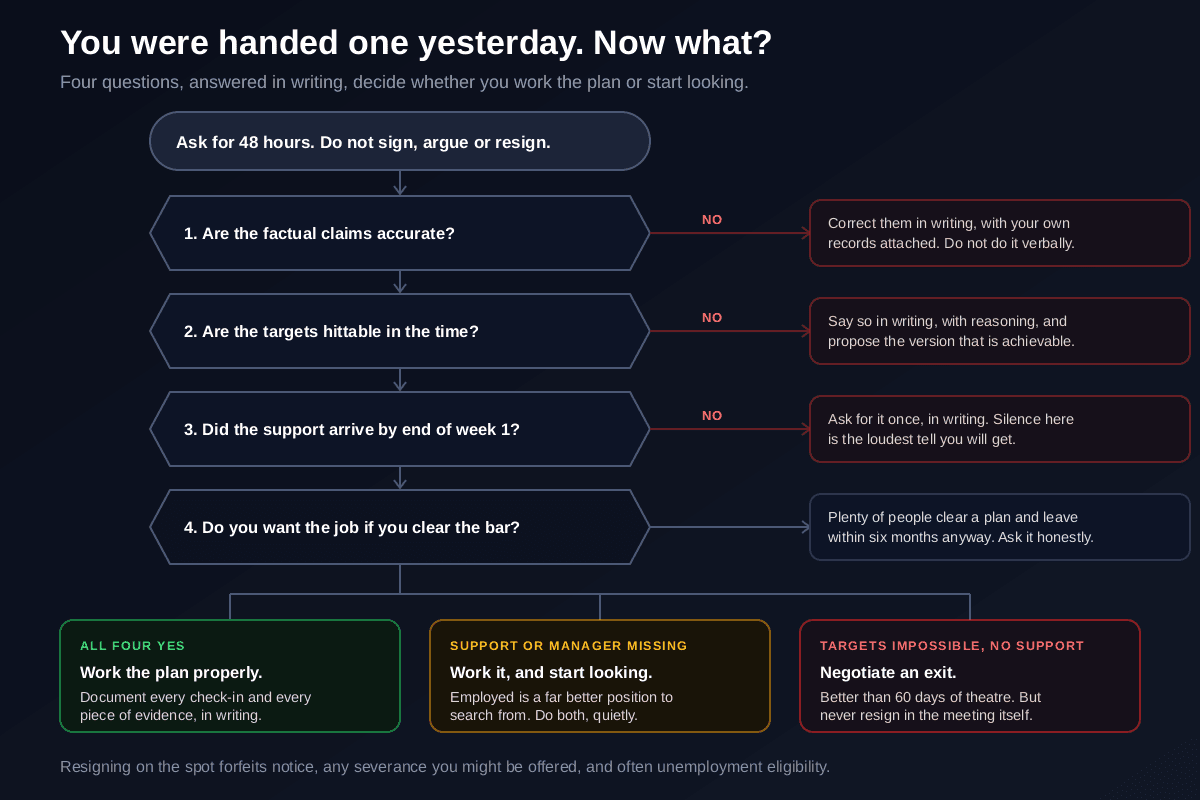
Then, in that 48 hours, do four things:
- Check every factual claim against your own records: dates, numbers, what was actually agreed and when. Note anything inaccurate, with evidence.
- Test whether each target is achievable in the period given. If one is not, say so in writing with your reasoning and propose the version that is.
- Get the support in writing. What exactly, from whom, starting when. This is the line that most often turns out to be decorative, and asking early is both reasonable and diagnostic.
- Ask the two questions. What specifically does success at the end of this look like, and is this a formal stage of a disciplinary process. Both answers in writing.
Then reply in one calm written message: accept what you accept, correct what is wrong with evidence, ask for the clarifications. That document is your protection, and it changes the dynamic more than any conversation will.
On signing:usually do, but sign as acknowledgement of receipt rather than agreement, and add your written comments first. Refusing rarely helps, since the company notes that you declined, the plan proceeds, and you lose the chance to put your account in the same file. If the form's wording goes beyond receipt and has you agreeing the failures occurred, ask for it to be amended, and if it is not, write that you sign as acknowledgement of receipt only.
On whether to stay: two separate questions. Is the bar clearable, and do you want the job if you clear it. A significant number of people complete a PIP and leave within six months anyway, because the relationship did not recover. If either answer is no, the pragmatic move is to work the plan while quietly starting a search, since being employed is a much better position to search from and resigning gives up any severance you might be offered. Our guides to explaining your reason for leaving and writing a resignation letter cover the next step if it comes to that.
The mistakes that make a PIP indefensible
- Targets nobody could hit in the time.The clearest signal that the outcome was decided first, and the fastest way to lose the document's credibility.
- Information that is new to the employee. A PIP containing a surprise documents a management failure alongside a performance one.
- Adjectives instead of facts."Unprofessional", "not a team player", "lacks urgency". None of these can be measured, met or defended.
- Support promised and not delivered. If the plan names a mentor who never appears, the plan was not followed by the company either.
- Inconsistency. One person on a plan for what others do freely is the evidence a claim is built from.
- Bad timing, unexamined. A plan landing just after a complaint, a leave request or a disclosure will be read against that sequence. If the decision predates the event, the file needs to show it.
- No check-ins. Weekly, documented. A plan reviewed once, at the end, was never a plan.
- A reason that changes. The PIP, the file and any eventual termination letter must tell one consistent story.
- An extension with no new end date. A rolling PIP is limbo, and it is worse for everyone than a decision.
A PIP in month four is usually a hiring problem wearing a performance costume
If plans keep landing on the same role, the pattern is upstream: a job description describing different work, or a screen that filtered on the wrong evidence. Upload your applicant batch and paste the job description, and Rankid scores every candidate 0 to 100 against the role's real requirements, showing what each one evidences and what they are missing. Up to 200 resumes per batch, first 5 free, no signup.
Score your applicant pool freeWhen the PIP is not the problem
If performance plans keep appearing in the same role, or consistently at month three or four, the plan is treating a symptom. Three upstream causes account for most of it: a job description that described different work from the actual job, a hiring process that never tested the thing the role really requires, or an onboarding period that never produced a written standard the person could aim at.
Each has a cheaper fix than a PIP. Our guides to writing a job description, interview scorecards and employee onboarding cover the three, and the onboarding one matters most here: a new hire who never received a written 30-day goal has not been given a standard to miss. If you want the development conversation to work instead, a 30-60-90 day plan written with the person is a far better instrument than a plan written about them.
Key takeaways
- A PIP states the gap, the measurable standard, the support, the timeline, the measurement and the consequence. Seven components, and specificity is the one that matters.
- Nothing in a PIP should be new information to the employee.
- 30 days for behaviour and process, 60 for skill and quality, 90 for long feedback loops like sales.
- Weekly documented check-ins. A plan reviewed only at the end was never a plan.
- Four tells of a paper trail: impossible targets, support that never arrives, a manager who goes quiet, and nobody at the company who has ever survived one.
- If you received one: do not sign, argue or resign in the meeting. Ask for 48 hours and respond in writing.
- Sign as acknowledgement of receipt, not agreement, and add your own written comments.
- Yes, you can be fired during a PIP. It creates no contract for the plan period.
- Strip protected absence out of any attendance count before writing the plan.
- If plans keep landing on the same role, the problem is the job description, the screen or the onboarding standard.
The test of a performance improvement plan is simple and worth applying before you issue one: at the end of the period, could two people who disagree about everything else look at this document and the evidence and reach the same conclusion about whether the bar was cleared? If yes, it is a plan. If no, it is a paper trail, and everyone involved can tell. And if these keep arriving in the same role, look upstream instead: paste the job description and your shortlist into Rankid's bulk resume screening and check what the evidence actually supported before the person ever started.
Frequently asked questions
What is a performance improvement plan?
A performance improvement plan, almost always shortened to PIP, is a written document that states where an employee's performance is falling short of the requirements of their role, what specifically must change, how the change will be measured, what support the company will provide, over what period, and what happens if the standard is not met. In its intended form it is a structured last attempt to fix a performance problem before the relationship ends, and it should contain nothing the employee is hearing for the first time. Its defining feature is specificity: a PIP that says communication needs to improve is not a plan, it is a complaint with a deadline attached. A usable one names the behaviour, the measurable target, the review dates and the consequence, so that at the end of the period both people can look at the same document and agree on whether the bar was cleared.
What does PIP stand for at work?
At work, PIP stands for performance improvement plan. The acronym collides with several unrelated things, which is why people search for the meaning specifically: in insurance it means personal injury protection, in Python it is the package installer, and in UK benefits it is the personal independence payment. In a workplace conversation, if your manager or HR uses the term PIP, they mean a formal performance improvement plan, and the important thing to establish immediately is whether it is a formal stage in your company's documented disciplinary or performance process or an informal coaching document. That distinction determines what happens next, whether it goes in your personnel file, and whether the company considers it a step towards termination. Ask directly, and ask for the answer in writing.
Does a PIP mean you are getting fired?
Not always, but the honest answer is that it depends heavily on the company, and the industry line that a PIP is purely developmental is not reliable. In organisations that use PIPs as a genuine performance tool, a meaningful share of people complete them and stay, and the plan does what it is supposed to do. In organisations that use them as documentation, the outcome is decided before the document is written and the PIP exists to create a defensible record for a termination that is already planned. You can usually tell which one you are in from four tells: whether the targets are achievable in the time given, whether the support named in the plan actually materialises in week one, whether your manager engages with your progress or goes quiet, and whether anyone else who went on a PIP in this company is still employed. Ask that last question of a trusted colleague. The answer is the most reliable data available to you.
How long should a performance improvement plan last?
Thirty, sixty or ninety days, and the right choice depends on how long the work itself takes to show a result rather than on how serious the problem is. Thirty days suits behaviours and process compliance where change is visible immediately, such as attendance, documentation, or responsiveness. Sixty days suits skill or quality problems that need practice and feedback cycles. Ninety days suits roles with long feedback loops, most obviously sales with a long cycle, where a shorter window would be measuring luck rather than performance. The period must be long enough that clearing the bar is genuinely possible, because a target that cannot be hit in the time allowed is the single clearest sign of a plan written for the file rather than for the person. Whatever the length, schedule check-ins weekly rather than saving everything for the end, and document each one.
What should a performance improvement plan include?
Seven components. The specific performance gaps, described as observable facts with dates and examples rather than as character judgements. The standard required, expressed as a measurable target with a number or a clearly verifiable outcome. The support the company will provide, named concretely: training, shadowing, a mentor, reduced scope, tooling, or a specific number of manager hours. The timeline, with a start date, an end date and scheduled check-in dates. How progress will be measured and who measures it. The consequence if the standard is not met, stated plainly. And a signature block for the employee, the manager and HR, with space for the employee to add their own written comments. That last space matters more than it looks, because a plan the employee has been able to respond to in writing is both fairer and far more defensible.
How should you respond to a performance improvement plan?
Do not sign it in the meeting, do not argue it in the meeting, and do not agree verbally to anything. Say that you take it seriously and would like 24 to 48 hours to read it properly and respond in writing, which is a normal and reasonable request. Then do four things. Check every factual claim against your own records and note anything inaccurate. Test whether each target is actually achievable in the time given, and if it is not, say so in writing with your reasoning. Confirm in writing what support was promised and by when. And ask the two questions that matter most: what specifically does success at the end of this period look like, and is this a formal stage of a disciplinary process. Reply in one calm written message that accepts the parts you accept, corrects what is wrong with evidence, and asks for the clarifications. That document is your protection.
Should you sign a performance improvement plan?
Usually yes, but sign it as an acknowledgement of receipt rather than as an admission that everything in it is true, and add your own written comments before you do. Signing generally confirms only that you have received and discussed the document, and many forms say exactly that above the signature line. Refusing to sign rarely helps: the company can simply note that you declined, the plan proceeds regardless, and you lose the opportunity to put your own account in the same file. The better approach is to write next to your signature that you are acknowledging receipt, and to attach a short factual response where you disagree. If the form contains language that goes beyond receipt, for example an explicit agreement that the described failures occurred, ask for that wording to be amended, and if it is not amended, say in writing that you sign as acknowledgement of receipt only.
Can you be fired during a performance improvement plan?
Yes. In an at-will employment relationship a PIP does not create a contract for the duration of the plan, and it does not oblige the employer to wait until the end date before acting. In practice most employers do run the period out, because cutting a plan short undermines the very record the PIP was created to build, but there are common exceptions: a separate incident of misconduct, a restructure or layoff that removes the role entirely, or a performance failure severe enough that continuing is untenable. The reverse also happens, where the plan is extended rather than closed, which can be genuine or can be a way of deferring a decision. If you are told the plan is being extended, ask for the new end date, the revised targets and the reason in writing, because an indefinitely rolling PIP is not a plan.
What makes a performance improvement plan legally risky for an employer?
Four things, and none of them is having a PIP process. Inconsistency: putting one person on a plan for conduct that others do the same thing without consequence is the evidence a discrimination or retaliation claim is built from. Timing: a plan that appears shortly after a protected activity such as a complaint, a leave request, a disability disclosure or a pregnancy announcement will be examined on that sequence regardless of the underlying merits. Impossibility: targets that cannot be met in the time allowed suggest the outcome was predetermined, which undermines the document's entire purpose. And contradiction, where the plan says one thing and the personnel file, the last performance review or the eventual termination letter says another. The fix for all four is the same: document contemporaneously, apply the process consistently, set achievable targets, and make sure the reason never changes between documents. This is general information rather than legal advice.
How do you write a performance improvement plan as a manager?
Start by writing down what specifically would have to be different in ninety days for you to consider this resolved, in numbers where numbers exist. If you cannot answer that, you are not ready to write the plan, and the honest next step is a direct conversation rather than a document. Then convert each gap into an observable fact with a date and an example, set a target that is measurable and genuinely achievable, name the support you will actually deliver, put the check-ins in the calendar before the meeting rather than after, and state the consequence plainly. Have HR review it before it is issued. Two rules do most of the work: nothing in the plan should be new information to the employee, and every sentence should be something you could show a neutral third party who would agree it is a fact rather than an opinion.
What does a performance improvement plan for attendance look like?
Attendance plans are the most straightforward to write because the data is objective, and the most important thing is to handle the legally protected categories correctly before you begin. State the policy, quote the record with dates, and set a clear forward standard, for example that the employee will be at their workstation and ready to work by the shift start time on every scheduled day for the next 30 days, with any absence reported through the defined channel at least two hours in advance. What you must do first is separate out protected absence. Leave covered by family and medical leave legislation, disability-related absence that may require accommodation, jury service, and legally protected sick leave in the many jurisdictions that mandate it cannot be counted against someone in a discipline process. Ask HR to review the record and strip the protected days out before the plan is written, because a plan built on a count that includes protected leave is worse than no plan at all.
Is it better to quit or go through a PIP?
Treat it as a decision with two separate questions rather than an emotional one. First, is the bar clearable: are the targets achievable, is the promised support real, and is your manager engaging with your progress. Second, do you want the job if you clear it, because a significant number of people complete a PIP successfully and then leave within six months anyway, having discovered that the relationship did not recover. If the answer to the first is yes and the second is yes, work the plan seriously and document everything. If either answer is no, the pragmatic move is to work the plan while quietly starting a search, since being employed is a materially better position to job hunt from and a resignation gives up any severance you might otherwise be offered. What you should not do is resign in the meeting, which forfeits notice, any severance, and often unemployment eligibility.