How to Write a Career Change Resume (Examples + Template, 2026)
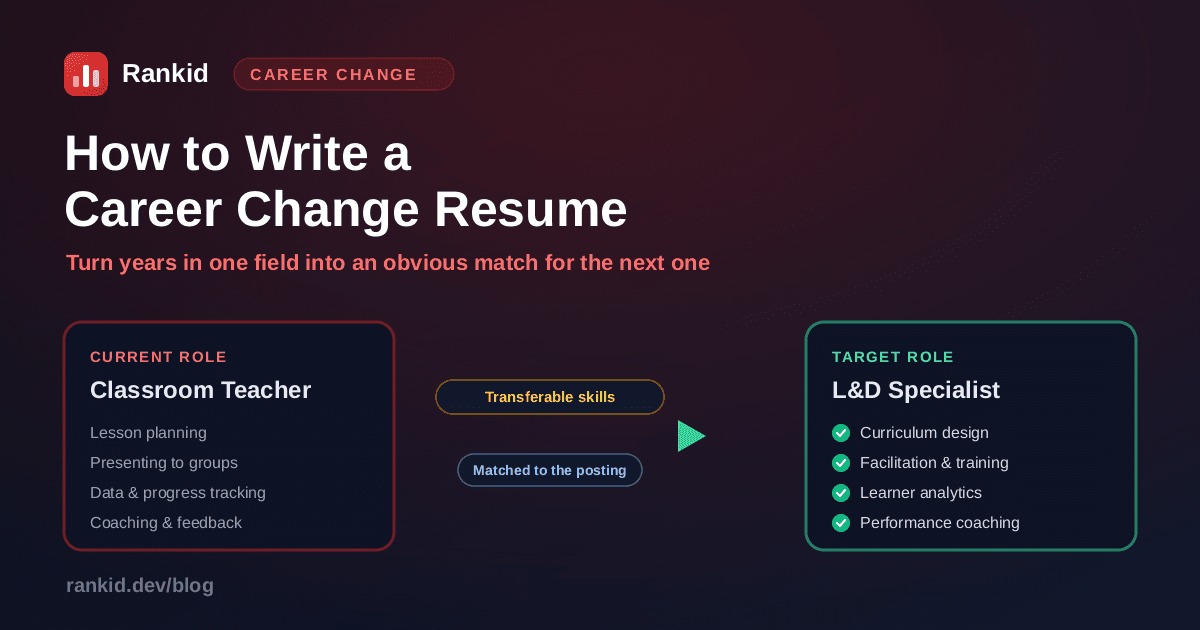
Changing careers feels like starting over, but on paper it should not. A career change resume is not an admission that you lack experience, it is an argument that the experience you already have transfers to the role you want. The mistake most career changers make is leading with a job title that does not match the posting and hoping the recruiter reads far enough to connect the dots. They usually do not. This guide shows you how to write a career change resume that makes the match obvious in the first few lines: the format to use, a career change resume summary formula with examples, how to translate your old-field experience into the new role's language, and how to make sure it passes the applicant tracking system so a human actually gets to your story.
Quick answer
Start by reframing the pivot as a match, not a gap
A recruiter scanning a career change resume is asking one silent question: does this person's background actually fit the role, or are they hoping to be trained from scratch? Everything you do on the page should answer that question before it is asked. That is the whole job of a career change resume, and it is a different job than a normal resume, which only has to prove you did work that clearly matches.
The good news is that most career changes are far less of a leap than they look. A teacher moving into learning and development already designs curriculum, facilitates groups, and tracks progress data. A retail manager moving into operations already forecasts, manages a team, and hits targets under pressure. A journalist moving into content marketing already researches, interviews, writes to a deadline, and understands an audience. The skills transfer; what has to change is the vocabulary and the emphasis. Your resume's job is to do that translation for the reader so they do not have to.
Use a combination format, not a functional one
The format question trips up almost every career changer, because the internet often recommends a "functional" resume that groups everything under skill headings and hides your dates and employers. Avoid the extreme version. Recruiters read a dateless functional resume as an attempt to hide something, and applicant tracking systems frequently parse it badly, dropping your history into the void. What you want instead is a combination or hybrid format.
- Contact header and target headline.Your name, contact details, and a one-line headline naming the role you are moving into, for example "Educator moving into Learning & Development."
- Career change summary. Two to four lines that name the pivot up front. This is the most important block on the page, and we break down the exact formula below.
- Core skills.A short, scannable list of the transferable skills the posting asks for, using the posting's own words. This front-loads your match before the reader reaches a job history in a different field.
- Work experience, reverse-chronological. Your real history with dates and employers intact, but with the bullet points rewritten to emphasize what transfers. Keeping this section conventional is what keeps the resume credible and ATS-friendly.
- Education, certifications, and projects. Especially any courses, certificates, or side projects you have taken on to bridge into the new field. These are proof you are already moving, not just hoping.
The combination format gives you the best of both: your skills and target lead the page, but your history stays visible and parseable. It is the safest, most recruiter-trusted structure for a career change, and it is what the examples in this guide assume.
Write a career change summary with the three-part formula
The summary is where a career change resume is won or lost. In the first two to four lines, you either name the pivot clearly or you leave the reader confused about why your last title does not match the job. Use this three-part formula and the confusion disappears.
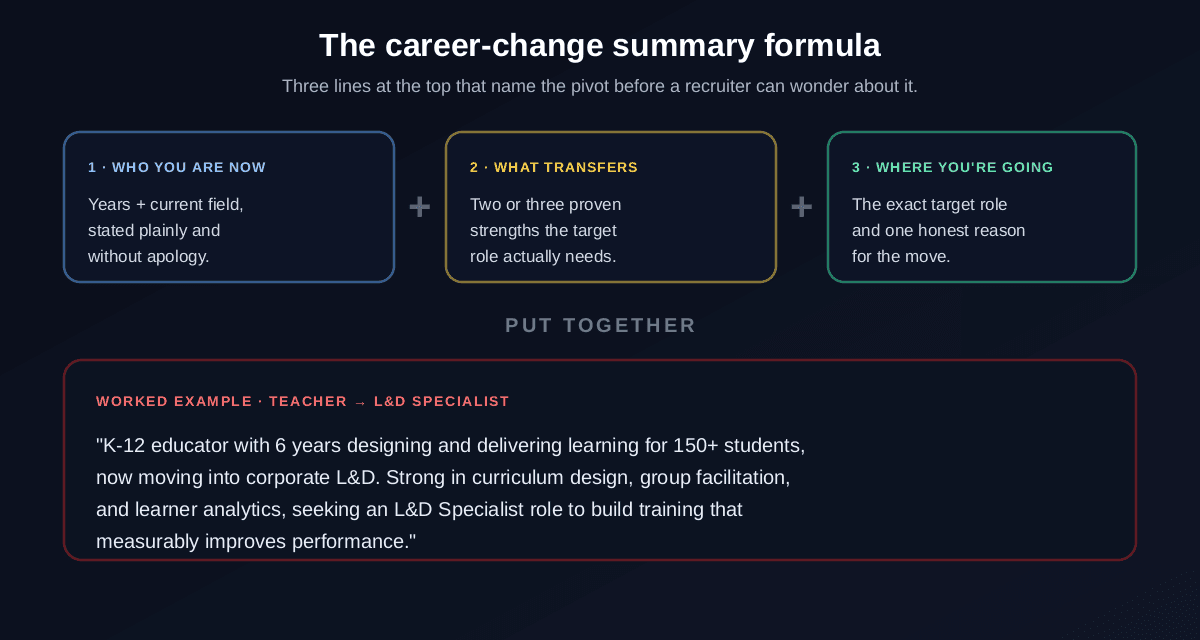
- Who you are now.Your years of experience and your current field, stated plainly and without apology. "K-12 educator with 6 years" is a strength, not something to hide.
- What transfers.Two or three proven strengths that the target role actually needs, pulled straight from the job posting. This is where you signal "I already do the core of this job."
- Where you are going. The exact target role and one honest reason for the move. Naming the role tells both the recruiter and the ATS what to match you against.
Put together, a strong career change summary reads like this: "K-12 educator with 6 years designing and delivering learning for 150-plus students, now moving into corporate L&D. Strong in curriculum design, facilitation, and learner analytics, seeking an L&D Specialist role to build training that measurably improves performance." In three lines the reader knows where you came from, what you bring, and where you are headed. That is the entire purpose of the block.
Summary, not objective
Translate your experience into the new field's language
This is the core skill of career-change writing, and it is where most resumes fall short. Recruiters and hiring software do not need you to have held the exact job before. They need to see the underlying skill, described in the words their field uses. So take each real bullet from your current work, find the transferable skill inside it, and rewrite it in the target role's vocabulary, keeping the facts identical.
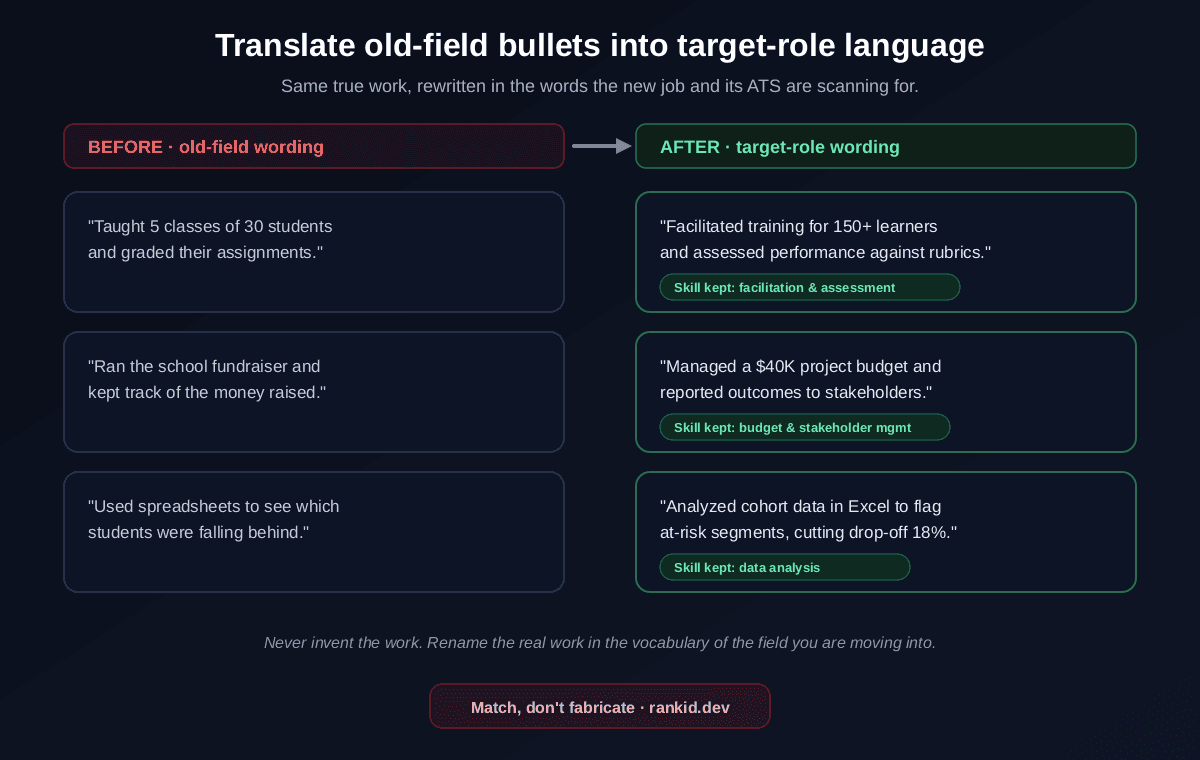
Notice what changes and what does not. The work is completely real in every "after" version: the teacher genuinely ran a fundraiser, genuinely tracked student data, genuinely delivered lessons. What changed is the framing, from the vocabulary of a classroom to the vocabulary of a workplace and a job posting. That is legitimate and expected. What is not legitimate is inventing responsibilities you never had. The line is simple: rename the real work, never fabricate new work.
To do this well, work backwards from the posting. List the skills and keywords it asks for, then find the bullet in your history that proves each one and rewrite it to name that skill. Strong verbs make the translation land, so borrow from our list of resume action verbs when you rewrite. And choose which skills to lead with by reading the posting, not a generic list, using the approach in our guide to the skills to put on a resume.
How to write a career change resume, step by step
Here is the full process, in order. Follow it and you will end up with a focused, credible resume that reads like a match for the new role rather than a leftover from the old one.
Read the target job description and extract its requirements
Before you touch your resume, list the skills, tools, and keywords the posting repeats or emphasizes. These are the requirements you have to prove and the exact terms the ATS will match against. Everything downstream is built to hit this list.
Choose a combination format and set the section order
Lead with your header and headline, then summary, then a core-skills block, then reverse-chronological experience, then education and certifications. This puts your transferable match at the top while keeping your history visible and parseable.
Write the three-part summary
Use the formula above: who you are now, what transfers, where you are going. Name the target role explicitly. If a recruiter reads only this block, they should already understand the pivot and see the fit.
Build the core-skills block from the posting
List the transferable skills the job asks for, in the posting's own words, and only ones you can genuinely back up. This is the fastest way to raise your keyword match for the ATS and to signal relevance to a human skimming the page.
Rewrite your experience bullets into the new vocabulary
Go through your work history and translate each relevant bullet into the target field's language, backed by a number. Shrink or cut duties that do not transfer so the page emphasizes what matters for the new role. Keep dates and employers intact.
Add proof that you are already moving
Include any courses, certifications, volunteering, freelance work, or side projects in the new field. A single relevant certificate or project tells a recruiter this is a deliberate, prepared move, not a shot in the dark.
Tailor and test before every application
A career change resume is never "done," because each posting emphasizes different skills. Reorder your skills and reword your summary for each role, then test the match against that specific posting before you send it.
See which of your skills already match the new role
Switching careers? Paste your resume and a job posting from the field you are moving into, and Rankid shows the exact transferable skills you already match, the keywords you are missing, and a 0 to 100 match score, so you know your pivot reads as a fit before you apply. Your first check is free, no signup.
Check your resume freeMake sure it passes the ATS despite a different job title
The applicant tracking system is a bigger hurdle for career changers than for anyone else. Many systems score a resume on how well its skills and keywords overlap with the job description, and when your previous titles do not obviously match the role, that overlap is exactly what carries you. If your resume does not name the skills the posting asks for, the system can rank you below less-qualified applicants who simply used the right words, and no human ever sees the story you built.
Two things protect you here:
- Mirror the posting's language. Use the exact skills, tools, and terms from the job description in your summary, skills block, and bullets. Those are the keywords the ATS scans for, and matching them honestly is how a career changer gets found.
- Keep the format parser-friendly. A clean single-column layout, standard headings, and normal bullets parse reliably. Avoid tables, columns, graphics, and especially the dateless functional format. See our checklist for an ATS-friendly resume.
Because your titles do not do the matching for you, testing is not optional. The most reliable way to know your career change resume works is to check how well your resume matches the job description before applying, so you can see the skills you match, add the ones you honestly have, and confirm you are clearing the filter. Understanding what a good resume match score looks like tells you when your pivot version is strong enough to send.
How long and how far back should it go?
Keep a career change resume to one page if you have under roughly ten years of experience, and two pages at most if you have more. The instinct to include every job you have ever held works against you here, because unrelated roles dilute the match. Feature the experience that transfers, summarize or shorten the rest, and do not feel obligated to detail a job from fifteen years ago that has nothing to do with where you are going. Our guide to how long a resume should be covers the length rules in detail, and they apply doubly when you are pivoting: relevance beats completeness.
Common career change resume mistakes to avoid
- Burying the pivot. If the reader has to reach your third bullet to understand why you are applying, you have already lost most recruiters. Name the target role in the headline and summary.
- Using a dateless functional format. It looks like you are hiding something and it breaks in many ATS parsers. Use a combination format that keeps your history visible.
- Keeping old-field jargon.Terms that made sense in your last industry can read as noise in the new one. Translate them into the target field's vocabulary.
- Listing duties instead of transferable results."Responsible for lesson planning" is a duty. "Designed and delivered curriculum for 150-plus learners" is a transferable, quantified result. Aim for the second.
- Sending one generic version everywhere.A career changer's resume has to be tailored per posting, because each role emphasizes different transferable skills. Tailoring is what turns your pivot into an obvious match. Our guide to tailoring your resume to the job description walks through the process.
- Fabricating experience to fill the gap. Reframing real work is fine; inventing work you never did is not. It is easy to verify and it collapses in interviews. If you feel the urge to invent, that is a sign to widen what counts, the same way you would on a resume with no experience.
Key takeaways
- A career change resume's job is to make the pivot read as a match, not a gap, in the first few lines.
- Use a combination (hybrid) format that leads with summary and skills, then keeps your dated work history visible.
- Write a three-part summary: who you are now, what transfers, and the exact role you want.
- Translate each relevant bullet into the target field's vocabulary and back it with a number. Rename real work, never fabricate.
- Mirror the posting's keywords so the ATS matches you despite a different job title.
- Feature relevant experience and shorten the rest. Relevance beats completeness when you are pivoting.
- Tailor and test the resume against each specific posting with Rankid before you apply.
A career change is not a fresh start on paper, it is a translation. You already have the skills; the work is to name them in the language of the field you are entering, lead with them, and prove them with results. Use a combination format, open with a three-part summary that states the pivot outright, rewrite your experience into the target role's vocabulary, and mirror the posting so the ATS matches you. When your pivot version is ready, paste it and the job description into Rankid's free resume checker to see your match score and the transferable skills you match versus miss, so your career change resume goes out looking like an obvious fit.
Frequently asked questions
How do you write a resume for a career change?
Write it around transferable skills and proof of results, not job titles. Start by reading the target job description closely and listing the skills and keywords it asks for. Then map your real experience to those requirements: the same work you already did, described in the vocabulary of the new field. Lead with a short career change summary that names your current field, the strengths that transfer, and the exact role you are targeting, so a recruiter understands the pivot in the first three lines. Use a combination (hybrid) format that puts a skills and summary section near the top, before your reverse-chronological work history. Quantify achievements with numbers, mirror the posting's keywords so the applicant tracking system matches you, and cut or shrink the parts of your history that are not relevant to where you are going. The goal is to make the reader see a match, not a gap.
What is the best resume format for a career change?
A combination or hybrid format is usually best for a career change. It opens with a summary and a skills section, which lets your transferable abilities do the talking before the reader gets to a job history in a different field, then follows with your work experience in reverse-chronological order so the resume still looks conventional and passes the ATS. A purely functional resume, which hides dates and companies entirely, is tempting for career changers but it is a red flag to many recruiters and often parses badly in applicant tracking systems, so avoid the extreme version. The combination format gives you the benefit of leading with skills without looking like you are hiding your history.
What should a career change resume summary say?
A strong career change summary has three parts in two to four lines: who you are now (your years and current field, stated plainly), what transfers (two or three proven strengths the target role needs), and where you are going (the exact target role and one honest reason for the move). For example: 'K-12 educator with 6 years designing and delivering learning for 150-plus students, now moving into corporate L&D. Strong in curriculum design, facilitation, and learner analytics, seeking an L&D Specialist role to build training that measurably improves performance.' Naming the pivot up front is the point. If you leave the reader to guess why a teacher is applying for an L&D role, many will move on before they reach your experience.
How do I show transferable skills on a resume when I have no experience in the new field?
You translate the experience you do have into the language of the field you are entering, and you back each claim with a result. Take a real bullet from your current field, identify the underlying skill, and rewrite it using the target role's terms. 'Ran the school fundraiser and tracked the money' becomes 'Managed a 40,000 dollar project budget and reported outcomes to stakeholders.' The work is identical and true; only the framing changed. Do this for every bullet that maps to a requirement in the job posting, prioritize the skills the posting names most, and support them with numbers wherever you can. You are not inventing experience, you are naming the transferable skill that was always there in words the new industry recognizes.
Should I use a resume objective or a summary for a career change?
Use a summary, not an old-style objective. A dated objective ('Seeking a challenging role where I can grow') talks about what you want and adds nothing. A career change summary talks about what you bring and where you are aiming, which is exactly the context a recruiter needs when your last job title does not match the role. If you want to state your target explicitly, fold it into the summary's final clause ('seeking an L&D Specialist role') rather than writing a separate objective line. That gives you the intent-signalling benefit of an objective without the outdated format.
Do career change resumes still need to pass the ATS?
Yes, and it matters even more for career changers. Because your job titles do not obviously match the role, an applicant tracking system that scores resumes on keyword and skills overlap can rank you low before a human ever sees the story you are trying to tell. That is why mirroring the posting's exact skills and terms in your summary and skills section is essential, why you should keep the layout to a clean single column with no graphics or tables, and why a functional format that strips out dates can hurt you. The fix is to test your resume against the specific job description before applying, so you can see which required skills you match and which you should add honestly. You can run your resume and the posting through Rankid's free resume checker to see the extracted text, a 0 to 100 match score, and your matched versus missing skills.