Candidate Sourcing: Strategies, Channels and Tools That Fill a Shortlist (2026)
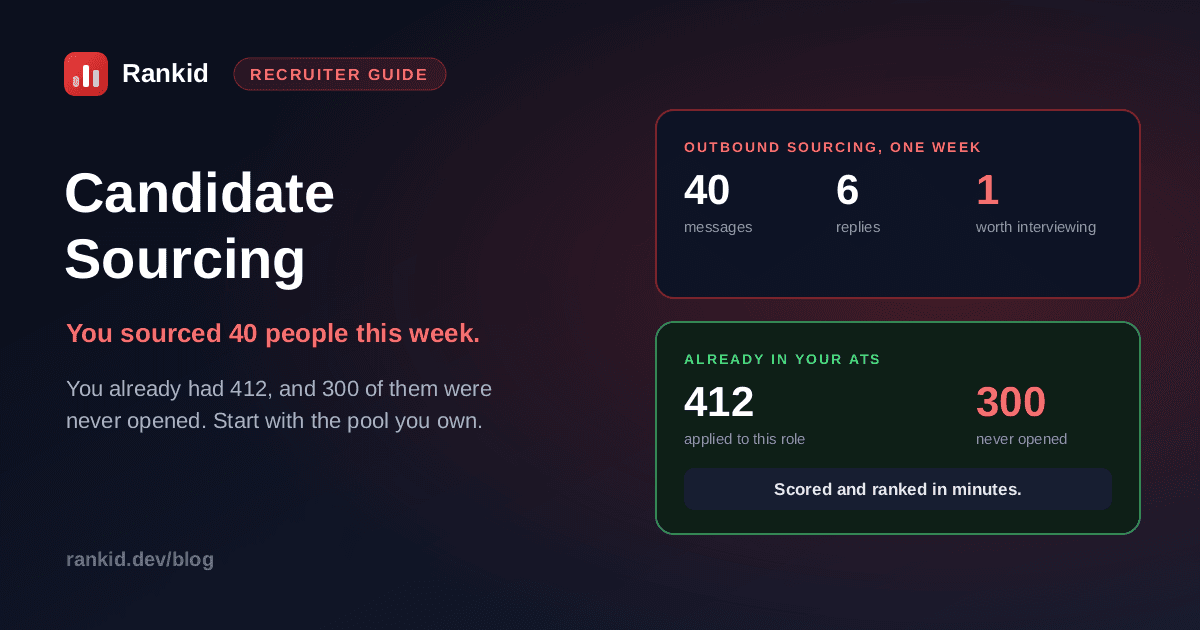
The sourcing week has a familiar shape. Build a search string, skim 300 profiles down to 40, write 40 messages personal enough to be worth answering, wait, chase, and end up with six replies and two people who are genuinely interested. It is real work and it produces real hires. It is also, for most teams, the second-cheapest way to find the candidate they needed, because the same recruiter has 412 applications for that role sitting in their own system, and roughly 300 of them were never opened.
Quick answer
What is candidate sourcing?
Candidate sourcing is the practice of actively finding and engaging potential candidates instead of waiting for them to find you. It covers searching profile databases and professional networks, working referral requests, mining your own records for people who applied before, and writing the outreach that converts a name on a screen into a conversation. It stops where recruiting starts: the moment someone becomes an interested, active candidate, sourcing has done its job.
Sourcing versus recruiting is worth pinning down because the two failures look nothing alike. A sourcing problem is not enough qualified people in the funnel. A recruiting problem is plenty of people in the funnel and no shortlist coming out of it. They demand opposite responses, and the expensive mistake, which this article is largely about, is treating the second as the first. When a role feels stuck, the reflex is to go and find more people. Sometimes that is right. Often the people are already there.
The question to ask before sourcing anything
Active vs passive candidate sourcing
Active candidates are people who applied or are looking. Passive candidates are people who are not looking and are not applying anywhere, found by searching and contacted individually. The usual argument for passive sourcing is that those candidates are not in anyone else's process, so you are not competing on speed. That is true. What gets left out is the arithmetic.
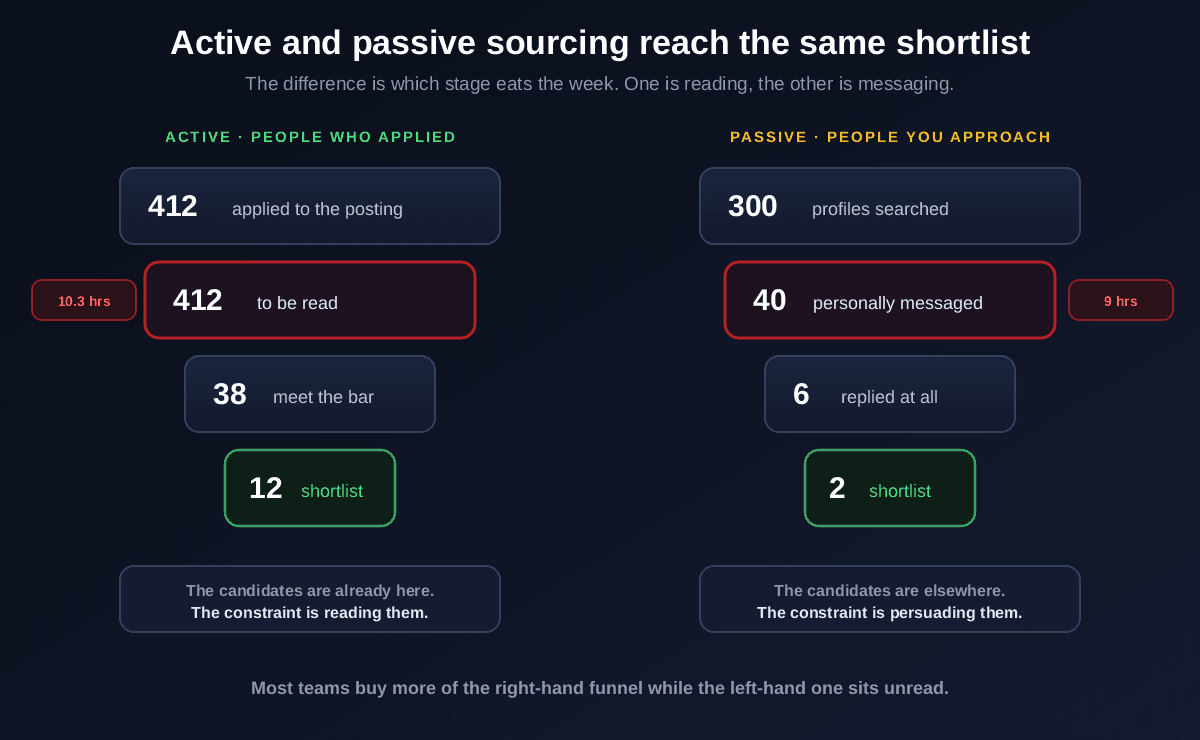
Both funnels consume roughly a working day and a half of recruiter time. The difference is what that time buys. Reading an applicant pool converts at a high rate, because everyone in it has already decided they want the job, so the only question is fit. Outbound converts at a low rate, because every person you reach has to be persuaded that they want a job they were not looking for, and most of them will simply not reply. Neither is better in the abstract. What is true is that outbound is the more expensive of the two per shortlisted candidate, and it is the one teams reach for first.
Passive sourcing earns its cost in specific situations: genuinely scarce skills, senior roles where the qualified population is small, competitive markets where everyone qualified is employed, and confidential replacements you cannot advertise. Outside those, the constraint on your shortlist is almost always reading, not finding, which is the same bottleneck we traced through high-volume recruiting.
Candidate sourcing channels, ranked by what they cost
Channel lists usually get ordered by how modern they feel. Ordering them by effort per shortlisted candidate is more useful, and it reshuffles the list considerably.
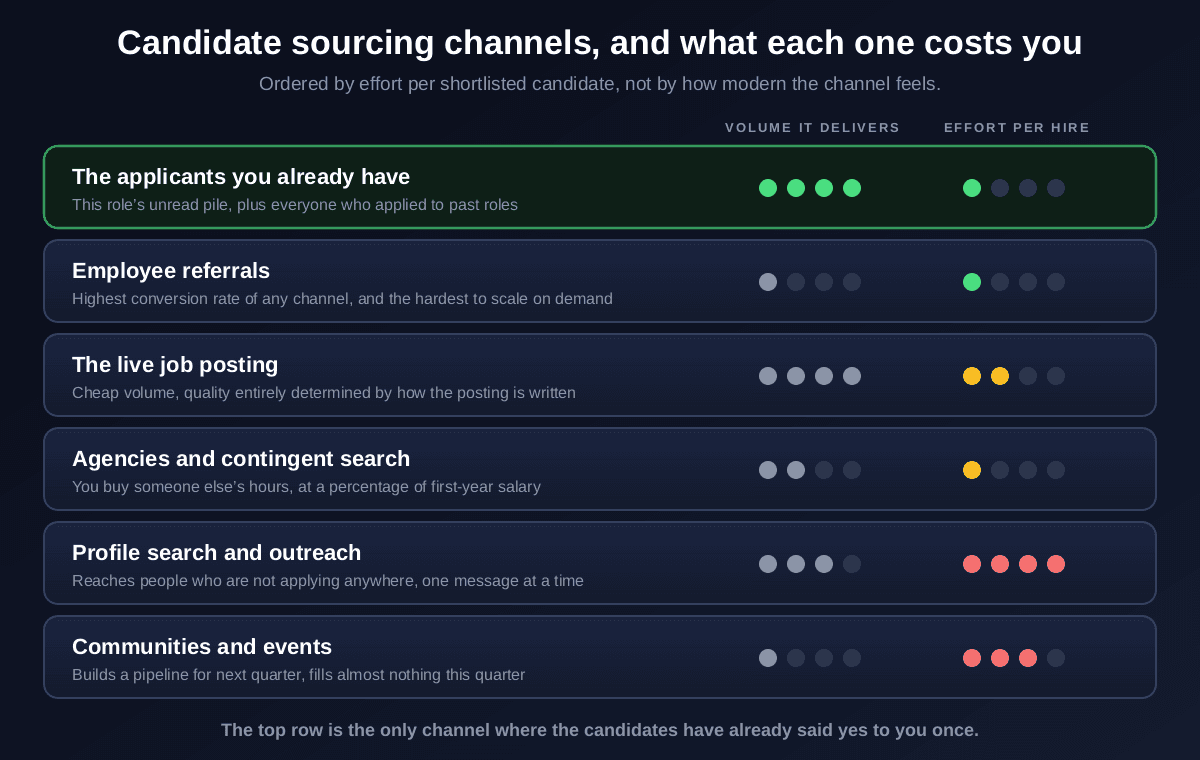
- The applicants you already have.This role's unread pile plus everyone who applied to previous roles. The only channel where the candidates have already said yes to you once, and the only one that costs nothing per candidate to reach.
- Employee referrals. The highest-converting channel by a wide margin, and the one you cannot turn up on demand. Worth systematising with specific asks rather than broadcast emails.
- The live job posting. Cheap volume whose quality is set entirely by the writing. A posting with six real must-haves produces a screenable pool; one with twenty aspirational bullets produces noise you pay for later in reading time. See how to write a job description.
- Agencies and contingent search.You are buying someone else's sourcing hours at a percentage of first-year salary. Rational for hard roles, expensive as a default, and worth reserving for what your own channels have demonstrably failed to supply.
- Profile search and direct outreach. Reaches people no other channel reaches. Also the highest recruiter-hours-per-hire of anything on this list, which is precisely why it should not be step one.
- Communities and events. Builds relationships and pipeline for future quarters. Almost never fills the req that is open right now, and pretending otherwise is how sourcing time disappears without anything to show for it.
Start with the pool you already own
Every company with an applicant tracking system is sitting on a private candidate database that cost real money to build, and almost nobody searches it. It contains people who applied to this role and were never reached, and people who applied to earlier roles, were entirely capable, and lost to someone marginally stronger. Those candidates are still real, still findable, and already know who you are.
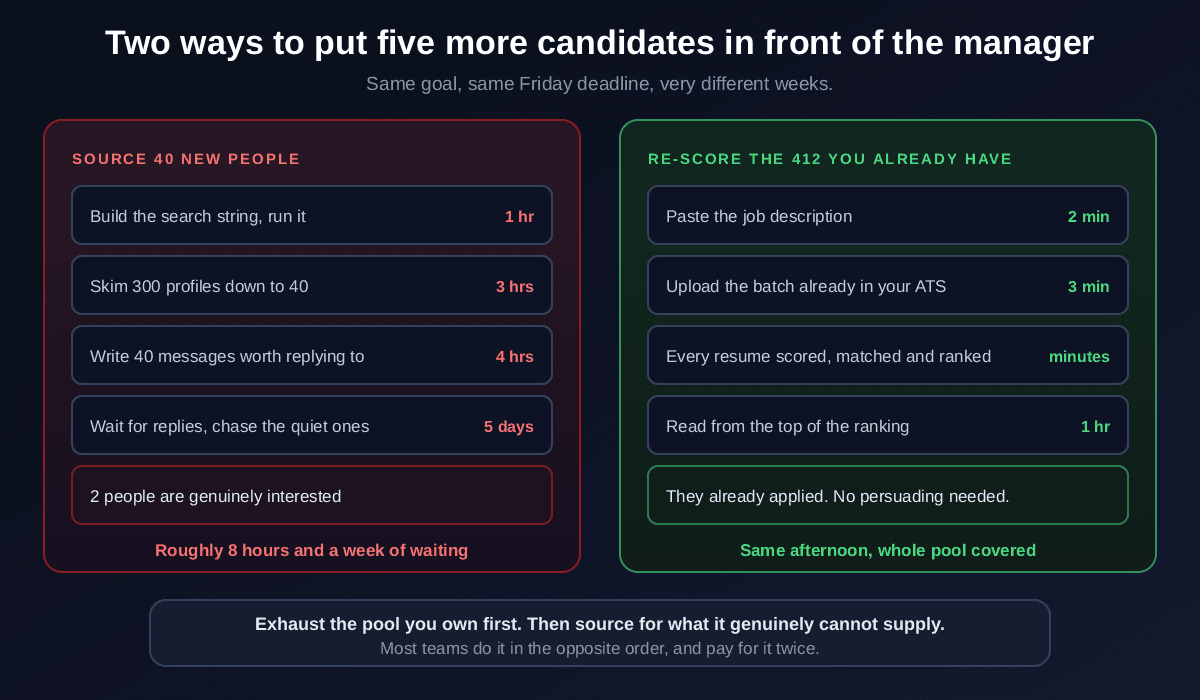
The reason this channel goes unused is not that recruiters are unaware of it. It is that an applicant database is unsearchable in any useful sense. Keyword search over stored resumes returns whoever happened to use your exact phrasing, which systematically favours the candidates who optimised their wording over the ones who did the work, a failure mode we documented in resume parsing. Opening 400 old resumes individually is not a real option either. So the pool stays theoretical.
What makes it practical is scoring rather than searching: take the new job description, run the whole stored batch against it, and get every past applicant ranked by fit with their matched and missing skills spelled out. That converts a dead archive into a ranked shortlist in the time it takes to make coffee, and it does it for people who have already applied to your company at least once, which is the single strongest signal any sourcing channel can offer.
Search the candidates you already have
Paste the new job description, upload the resumes already sitting in your system, and every past applicant comes back scored 0 to 100 with the skills they match and miss. The cheapest sourcing channel you own, made usable. First 5 resumes free, no signup.
Score your pool freeCandidate sourcing strategies that survive a real week
Source against criteria, not against a job title
Titles mean different things at different companies, so searching for them returns the wrong people confidently. Source against the two or three capabilities the role actually depends on, which should already be written down on the requisition. If they are not written down, that is the first hour of sourcing work, not a detail to sort out later.
Exhaust the free channels before you buy anything
Re-score the existing pool, then make a specific referral ask, then look at your live applicants. This takes an afternoon and it frequently ends the search. Only what those three cannot supply is a genuine outbound sourcing problem worth a week of messaging.
Time-box outbound and measure it honestly
Decide up front how many hours this role gets and what reply rate would make it worth continuing. Outbound sourcing expands to fill whatever time it is given, and without a number attached it is impossible to tell a channel that is working from one that feels productive.
Build one search string properly rather than ten quickly
Ten minutes constructing a precise boolean string saves hours of skimming irrelevant profiles. Start narrow and widen deliberately, noting which loosened term produced the useful results, so the string is reusable for the next role in the same family.
Keep a warm list instead of restarting each req
Everyone who replied politely but was not available, and everyone who reached a final stage and lost, belongs on a list you actually contact when a relevant role opens. This is the cheapest pipeline in recruiting and it is almost always allowed to evaporate.
How to actually search: boolean, in practice
Boolean search means combining terms with operators to get precision instead of volume. The operators that do the work are AND, OR, NOT, quotation marks for exact phrases and parentheses for grouping. A worked example for the data analyst role used throughout this article:
- Start from the must-haves:
("data analyst" OR "analytics engineer") AND (SQL AND dbt). Two titles because the same work is titled differently across companies, two tools because those were the actual requirements. - Exclude the noise: add
NOT (recruiter OR "hiring")to drop the recruiters and job postings that mention your keywords because they are advertising the same role. - Widen one term at a time: if the result set is too small, replace
dbtwith(dbt OR "data build tool" OR Airflow)and see what that adds. Widening everything at once tells you nothing about which term was too strict. - Search the evidence, not the label: people describe outcomes more consistently than they describe themselves, so terms drawn from the work, such as
"dimensional model", often outperform a title search.
The mirror image of this is worth understanding too: candidates optimise their profiles to be found by exactly these searches, which is what we teach on the other side of the table in how to get found by recruiters on LinkedIn. Knowing how that optimisation works tells you which parts of a profile carry signal and which are just keyword placement.
Sourcing outreach that gets replies
Most sourcing messages fail for the same reason most rejection emails fail: they are addressed to a category rather than a person. Passive candidates receive a lot of these, and the filter they apply is instant and unforgiving.
- Prove you read something. One specific line about their actual work, not their job title, is the entire difference between a reply and a delete. If you cannot find anything specific to say, they were not sourced, they were scraped.
- Lead with the role, not the company story. What the job is, what it owns, the one thing that makes it interesting. Company mission paragraphs are read by nobody who was not already interested.
- Include the salary range. It filters instantly and honestly, and it signals that you are not going to waste four rounds of their time before mentioning a number.
- Ask for something small.A reply, not a commitment. “Worth a conversation?” converts far better than a request to apply through a portal.
- Follow up once, then stop. One follow-up is professional persistence. Four is a sequence, and people can tell the difference.
The same standard applies to the people who came to you. A candidate who applied and heard nothing for five weeks is not a warm lead any more, no matter how good the outreach is when it finally arrives, which is why sourcing quality and candidate experience are the same discipline seen from two ends.
Candidate sourcing tools and software
This category is sold as one thing and is really four, which matters because three of the four make your reading problem larger.
- Profile search platforms. Query large databases of professional profiles. They help you find people. They do not help you decide between them.
- Extensions and contact aggregators. Pull contact details and consolidate profiles across sites. Convenience tooling for outbound, and legitimately useful if outbound is genuinely your constraint.
- Outreach and sequencing tools. Send and follow up at scale. Increase message volume, which increases replies, which increases the number of conversations you have to have. Useful, but note the direction: more input, not less work.
- Screening and ranking tools. Evaluate candidates you already have and tell you who to contact first. The only category that reduces the load rather than adding to it, which is why it belongs at the start of a sourcing stack rather than the end. This is what Rankid's bulk resume screening does: up to 200 resumes per batch scored against the job description with matched and missing skills per candidate.
The buying question
Sourcing metrics worth tracking
- Source of hire. Which channel produced the people you actually hired, tracked over a year rather than per req. It routinely contradicts where the sourcing hours went.
- Hours per shortlisted candidate, by channel. The number that makes channel decisions obvious and the one nobody records.
- Outreach reply rate. Measured per campaign and per role family. A falling reply rate usually means your messages became a template.
- Sourced-to-interview rate. How many sourced candidates survive first contact. Low numbers mean you are sourcing against titles rather than criteria.
- Pool re-engagement rate. How many hires came from people already in your database. Near zero means an asset you paid for is not being used.
Candidate sourcing mistakes to avoid
- Sourcing to fix a screening problem. If the existing pool is unread, new candidates join the back of the same queue. This is the most common and most expensive mistake in the whole discipline.
- Sourcing before the criteria exist. Without agreed must-haves you are searching for a job title, and the shortlist will be argued rather than agreed. Fix it with defined screening criteria first.
- Treating the applicant database as an archive. It is a candidate pool that already opted in. Search it every time a role opens, not never.
- Letting outbound run untimed. Sourcing feels productive at every moment, which is exactly why it needs a budget of hours and a reply-rate threshold attached.
- Personalising the first line and nothing else. Candidates recognise a merge field followed by a template, and it reads worse than an honestly generic note.
- Sourcing for skills you excluded in the posting. If your requirements filter out capable people, sourcing is you paying to go and find the candidates your own posting turned away, which is the loop described in skills-based hiring.
Key takeaways
- Candidate sourcing is finding and engaging people rather than waiting for applications, and it ends where recruiting begins.
- Active and passive sourcing reach the same shortlist: inbound is limited by reading, outbound by persuading.
- Passive sourcing earns its cost for scarce skills, senior roles and confidential replacements, and rarely elsewhere.
- Rank channels by effort per shortlisted candidate, not by novelty.
- Your existing applicant pool is the cheapest channel you own and the least used, because databases are unsearchable in practice.
- Source against the two or three real must-haves from the requisition, never against a job title.
- Three of the four sourcing tool categories increase your reading load. Only ranking reduces it.
- Rankid scores up to 200 resumes per batch against your job description, first 5 free with no signup.
Bottom line: sourcing is a real skill and some roles genuinely cannot be filled without it, but it is the most expensive tool in the box and most teams reach for it first. Before you spend a week finding 40 strangers, spend an afternoon on the several hundred people who already applied to you, ranked against what this role actually needs. Run your existing pool through Rankid's bulk resume screening tool, see who was in there all along, and save the outbound hours for the roles that truly need them.
Frequently asked questions
What is candidate sourcing?
Candidate sourcing is the work of finding and engaging potential candidates for a role rather than waiting for them to apply. In practice it covers searching profile databases and professional networks, working referrals, re-engaging people who applied to you before, and writing the outreach that turns a name into a conversation. It sits at the top of the recruiting funnel and ends the moment someone becomes an active candidate in your process. Sourcing is often treated as synonymous with cold outreach to people who are not job hunting, but that is only one of its channels, and usually not the cheapest one available to you.
What is passive candidate sourcing?
Passive candidate sourcing means approaching people who are not currently looking for a job and are not applying anywhere. They are found by searching professional profiles, code repositories, conference speaker lists, published work and your own past applicant records, then contacted individually. The appeal is that passive candidates are not in anyone else's hiring process, so you are not competing on speed with four other employers. The cost is conversion: most people you message will not reply, and the ones who do need persuading rather than assessing, so the same shortlist takes considerably more recruiter hours than working an inbound pool does.
What is the difference between sourcing and recruiting?
Sourcing is finding and interesting people. Recruiting is everything that happens once they are interested: screening, interviewing, assessing, closing and offer management. In larger teams these are separate jobs, with sourcers building pipelines that recruiters then convert, and in smaller teams one person does both and the sourcing quietly loses to whatever is more urgent. The distinction matters practically because they fail differently: a sourcing problem shows up as not enough qualified people in the funnel, while a recruiting problem shows up as plenty of people in the funnel and no shortlist coming out of it.
What are the best candidate sourcing channels?
Ranked by effort per shortlisted candidate rather than by novelty: your existing applicant pool first, because those people already applied to you and cost nothing to reach; then employee referrals, which convert best but cannot be scaled on demand; then your live job posting, which delivers volume cheaply and whose quality depends entirely on how the posting is written; then agencies, where you buy someone else's hours at a percentage of salary; then profile search and direct outreach, which reaches people no other channel can but costs the most recruiter time per hire; and finally communities and events, which build pipeline for future quarters rather than filling anything this one.
How do you source candidates for free?
Three channels cost nothing but time. First, re-screen your own applicant database, including people who applied to previous roles, because a strong candidate for last quarter's role is often a strong candidate for this one. Second, run a specific referral request to the team rather than a generic all-company email, naming the exact role and the two or three skills that matter. Third, use free profile search and public sources such as professional networks, open-source contributions and community directories. The first of these is the most overlooked and usually the largest, because it is the only channel where the candidates have already expressed interest in working for you.
What is boolean search for recruiters?
Boolean search is the use of operators such as AND, OR, NOT, quotation marks and parentheses to build precise search strings against a profile database or search engine. A practical example is ("data analyst" OR "analytics engineer") AND (SQL AND dbt) NOT recruiter, which finds people with either title who mention both tools while excluding recruiters who list those words in their own postings. The technique matters because untargeted searches return thousands of loosely relevant profiles that then have to be skimmed manually. Build the string from the must-have criteria on the requisition rather than from the job title alone, since titles vary wildly between companies for the same work.
What candidate sourcing software do recruiters use?
The category splits into four types that are often marketed as one. Profile search platforms let you query large databases of professional profiles. Sourcing extensions and aggregators pull contact details and consolidate profiles from several sites. Outreach and sequencing tools send and follow up on messages at scale. Screening and ranking tools evaluate the candidates you have already collected and tell you who is worth contacting first. The first three help you find and reach more people. Only the fourth reduces the reading load those people create, which is usually the actual constraint on how fast a shortlist appears.
Can you source candidates from your existing applicant database?
Yes, and it is normally the highest-return sourcing you can do. Most applicant databases contain hundreds or thousands of people who applied to earlier roles, were perfectly capable, and were passed over because someone else was slightly stronger or because nobody reached the bottom of the pile. Rankid makes that pool searchable in the only way that matters: paste the new job description, upload the batch of resumes you already hold, and every candidate is scored 0 to 100 with the skills they match and miss. Your first 5 resumes are free with no signup, and you can score up to 200 resumes per batch after that.