CV vs Resume: The Real Difference and Which One to Send (2026)
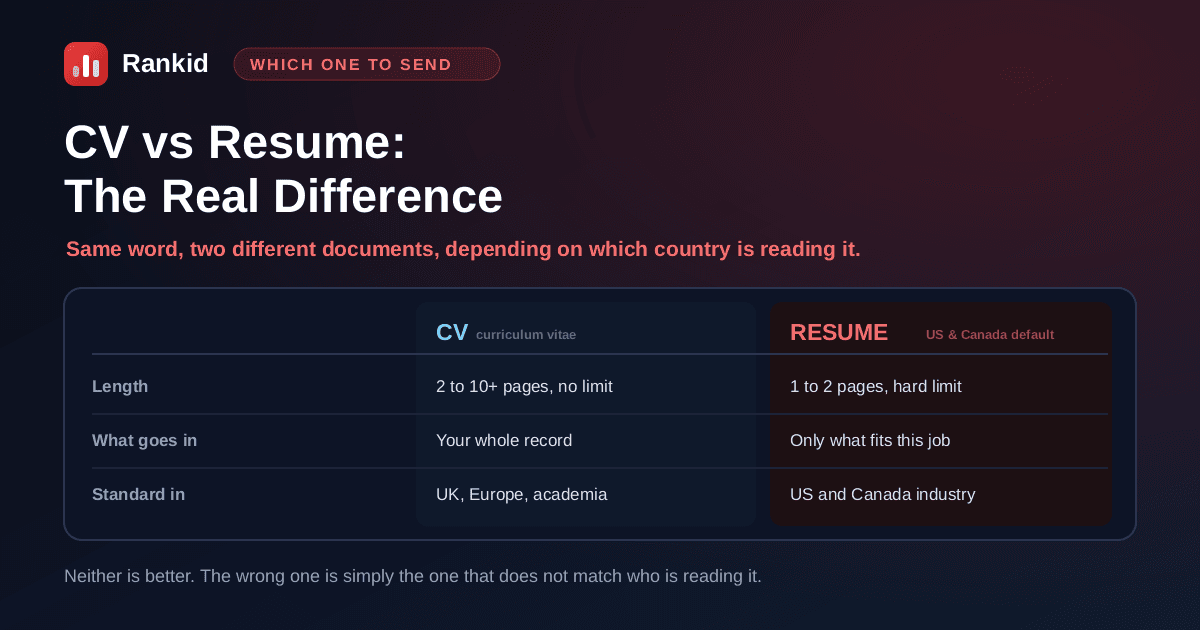
Almost every guide answers this the same way: a CV is long and detailed, a resume is short and targeted. That is accurate in the United States and misleading nearly everywhere else, because in the UK, Ireland, Australia, India, Nigeria, South Africa and most of Europe, a CV is a resume. Same document, different word. Which means the real question is not what the two terms mean in a dictionary, it is which document the person reading your application expects to receive. Here is how to get that right, including the five fields you need to strip off a European CV before you apply in the US.
Quick answer
In the US and Canada, a resume is one to two pages tailored to a job, and a CV is a long academic record used for university and research roles. Almost everywhere else, CV is just the local word for a resume, and two pages is still the expectation. So a British employer asking for your CV wants your resume. The only case where the two are truly different documents is academia, in any country. When a posting is ambiguous, send the concise version.
What is the difference between a CV and a resume?
There are two honest answers, and which one applies to you depends on where you are applying.
In the United States and Canada, they are different documents. A resume is a marketing document: one to two pages, written for a specific job, containing only the experience and skills that help you win that job. A CV, short for curriculum vitae, is a complete scholarly record: unlimited length, organised by category, listing every publication, grant, conference talk and course taught. Industry hiring uses resumes. Universities, research institutes and some medical and public sector roles use CVs.
Everywhere else, CV is simply the word for a resume. In the UK, Ireland, Australia, New Zealand, most of continental Europe, India, Nigeria, South Africa and the Gulf, people say CV where an American says resume, and they mean the same two page document. A recruiter in Manchester asking for your CV is not expecting a publication list. They want the thing you already have.
This is why so much advice on this topic feels contradictory. Articles written for a US audience describe a real distinction between two document types. Articles written for a UK or European audience describe a naming convention. Both are correct in their own context, and neither tells you what to do when you are applying across borders.
The only rule you actually need
What "CV" means, region by region
Since the term is regional, the useful version of this comparison is not CV against resume, it is country against country. Find where you are applying.
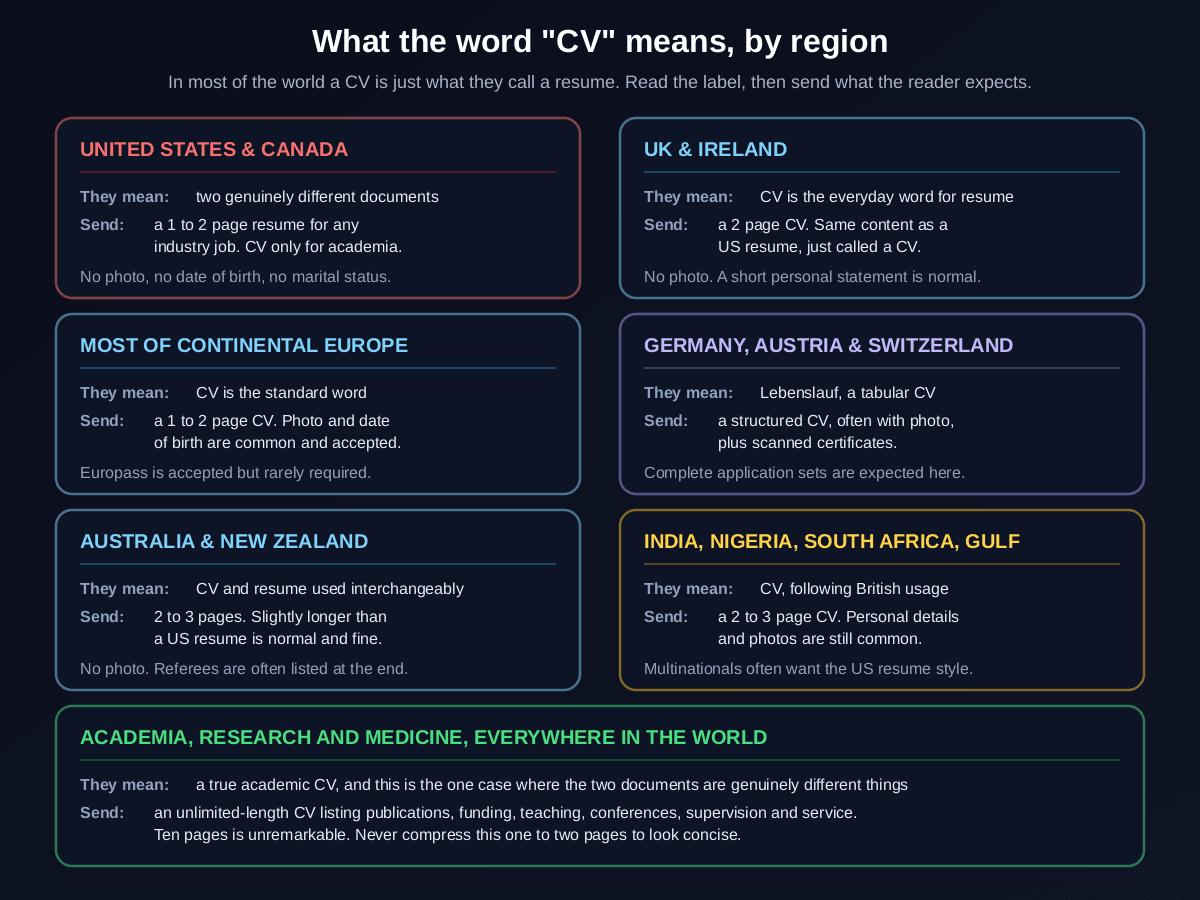
A few details in that breakdown are worth spelling out, because they are the ones that trip people up most often.
- Germany, Austria and Switzerland expect a Lebenslauf, a tabular CV that is typically accompanied by a full application set including scanned copies of degree certificates and references from previous employers. Sending only a two page document can read as an incomplete application.
- Australia and New Zealand use both words interchangeably and tolerate slightly more length than the US, commonly two to three pages, often with referees named at the end rather than withheld.
- Multinationals complicate the signal. A global company hiring into a US office may still use British English in its posting. Follow the office location and the hiring market rather than the spelling.
- The Gulf states and parts of Asia follow British usage but frequently still expect personal details and a photo, particularly at smaller local employers, while the regional arms of multinationals usually prefer the US resume style.
CV vs resume, side by side
Where the two genuinely diverge, meaning a US industry resume against a true academic CV, here is what actually changes. This is the comparison to use if you are deciding what to build rather than what to call it.
- Length. Resume: one to two pages, firmly. Academic CV: no limit, and four to ten pages is normal early in a research career. Our guide to how long a resume should be covers the resume side in detail.
- Purpose. Resume: persuade someone to interview you for one specific role. CV: document your complete record so an assessor can score it against stated requirements.
- Tailoring. Resume: rewritten for every application. CV: largely static, appended to over time, with a cover letter doing the tailoring instead.
- Ordering. Resume: reverse-chronological experience, most relevant first, and typically only the last ten to fifteen years in detail. CV: grouped by category, with education and publications usually above employment.
- How achievements are written. Resume: bullets that lead with a verb and land on a number, as in quantifying achievements. CV: full citations and complete lists, without metrics or persuasion.
- What gets omitted. Resume: anything that does not help you win this job. CV: nothing. Completeness is the point.
- Personal details. US resume: name, city, email, phone, LinkedIn, and nothing more. Continental European CV: often a photo, date of birth and nationality as well.
- Who reads it first. Resume: a recruiter skimming, often after a software screening step. Academic CV: a committee of specialists reading closely, usually with no automated filter at all.
Whichever one you call it, check it against the job first
Paste your resume or CV and the job description into Rankid's free checker. You will get a 0 to 100 match score, the skills and keywords you have covered, and the requirements you are missing, so you know the document fits the role before you send it.
Check your match freeCan I send a resume when they asked for a CV?
In most of the world, yes, and you barely need to change a thing. If a UK, Irish, Australian, European, Indian or African employer asks for your CV, the one to two page document you already have is the right one. Rename the file, consider letting it run to a comfortable two pages, and add a short personal statement at the top if that is the local convention. Nothing else needs to change.
The exception is a genuine academic or research application, and there the answer is no. A search committee is required to assess your publications, funding and teaching, so a two page summary is not a shorter version of what they asked for, it is a document missing the sections they are scoring. If you are applying to a university, a research institute or a grant-funded lab, build the academic CV properly and keep it as a separate file from your industry resume.
Going the other way, sending a ten page CV to a US corporate recruiter, is the more damaging mistake and the more common one among candidates relocating to North America. It does not read as thorough. It reads as someone who has not applied in this market before, which is exactly the impression you are trying to avoid when you are already applying from abroad.
The academic CV: the one real exception
If you are applying for a faculty post, a postdoc, a research fellowship, a clinical academic role or a grant, this is the document you need, and it follows none of the rules above. Build it by category rather than by job:
- Education and degrees, including thesis titles and supervisors
- Peer-reviewed publications, in full citation format, with your position in the author list intact
- Books, chapters, and other non-journal outputs
- Conference presentations, invited talks and posters
- Grants and funding awarded, with amounts, funder and your role
- Teaching experience, courses designed and taught, and teaching evaluations if strong
- Students supervised, at each level
- Peer review, editorial roles and professional service
- Awards, honours and fellowships
- Technical, laboratory, language and methodological skills
Nothing here gets trimmed for length, and no bullet needs a metric attached. Completeness is the qualification. The one piece of resume discipline that still applies is ordering: put the categories the specific call cares most about nearer the top, so a teaching-focused post leads with teaching and a research post leads with publications and funding.
Converting a European CV into a US resume
This is the practical task behind most searches on this topic, and it is smaller than people expect. The content of your career does not change. What changes is the header, the length and a handful of conventions.
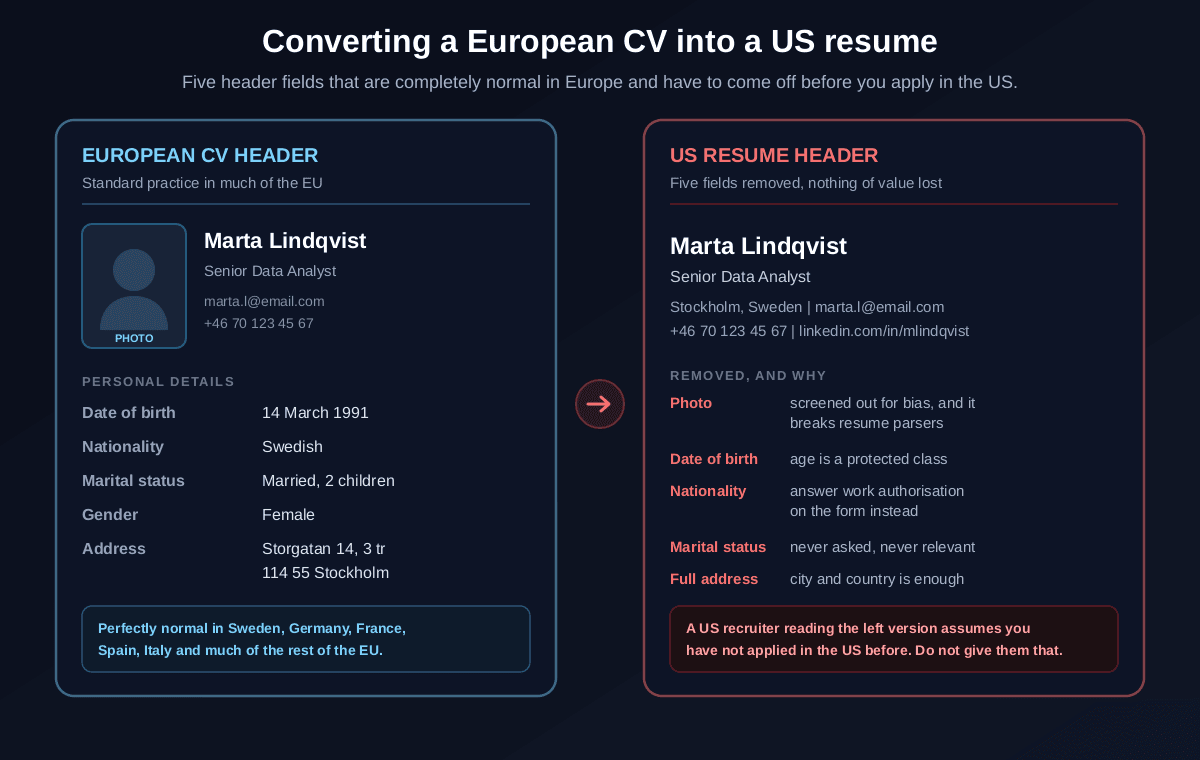
Five fields come off, and none of them were doing any work for you in a US application:
- The photo. US and UK employers avoid photos to reduce discrimination risk, and some recruiters discard resumes that include one. There is also a mechanical problem: images, and especially images inside headers or text boxes, are a common cause of parsing failure, so your work history can arrive empty. Our guide to an ATS-friendly resume covers the layout rules.
- Date of birth. Age is a protected characteristic in the US, and volunteering it invites a bias you gain nothing from.
- Nationality. Work authorisation is a legitimate question, but it belongs in the application form where it is asked directly, not on your resume.
- Marital status, gender and family details. Never asked, never relevant, and their presence signals unfamiliarity with the market.
- Your full street address. City and country is the modern standard, and a full address is both unnecessary and a small privacy cost.
Then three things get added or sharpened:
- A tailored professional summary in place of a generic personal statement, written for the specific role.
- Metrics on your achievements. European CVs lean more descriptive, listing responsibilities; US resumes expect outcomes with numbers attached.
- The posting's own vocabulary. US screening is keyword-driven, so mirror the terms the job description uses, which our guide to resume keywords walks through.
One more file-level detail
What about the Europass CV?
Europass is the European Union's standardised CV format, generated through a free online tool, and it exists to make qualifications comparable across member states. It is genuinely useful in a narrow set of situations: EU institution roles, some public sector and academic applications, mobility and exchange programmes, and countries where an employer explicitly requests it.
Outside those cases it is usually the weaker choice. The template is rigid, it produces a long document with heavy tables and fixed section ordering, it strips out the persuasive structure that makes a resume work, and its table-based layout parses poorly in most applicant tracking systems. Every Europass CV also looks identical, which removes any advantage from writing a better one. Use it when it is asked for by name, and use a normal tailored document otherwise.
How to tell which one a posting actually wants
Find the office location, not the company headquarters
The hiring market sets the convention. A German company hiring in Chicago runs a US process, and a US company hiring in Munich runs a German one. Look at where the role sits, not where the logo comes from.
Read the application instructions literally
If it names a document, a length, or a set of attachments, that instruction outranks every general rule in this article. Postings that ask for "a CV of no more than two pages" have just told you they mean a resume.
Identify the sector
University, research institute, hospital academic post, or grant application means an academic CV, in any country. Anything else, including industry research roles at private companies, means a resume.
When it is ambiguous, send the short one
A recruiter who wants more can ask, and often will. A recruiter handed ten unexpected pages just moves to the next candidate. The concise document is the safer default in every non-academic context.
Match the content to the posting before you send
The label matters far less than whether the document evidences what the role asks for. Score it against the job description with Rankid's free resume checker and confirm the requirements come back matched, then read what a good match score looks like to judge the result.
Does an ATS handle a CV differently from a resume?
No. There is no separate mode, and no system checks which word you used. It parses whatever file you upload into structured fields, then lets a recruiter search and rank against the role, which is the process described in our piece on AI resume screening. What does change your outcome are the formatting habits that travel with each document type.
The European CV conventions are the risky ones. Photos, two-column and tabular layouts, contact details tucked into a document header, and personal information blocks are precisely the features that break parsing, and a parsing failure means your experience arrives blank or scrambled no matter how strong it is. Length is the second factor: a long document spreads your matching keywords across far more text, so you rank lower in the searches recruiters actually run inside the system. If you want to know which platforms are strict about this, the applicant tracking systems list covers the ones you will meet.
The fix is the same in either dialect: single column, real text, conventional headings, and content that mirrors the posting. Then confirm it works rather than assuming, which is what tailoring to the job description and a match score are for.
Key takeaways
- In the US and Canada, a resume is 1 to 2 pages for industry and a CV is an unlimited academic record.
- In the UK, Ireland, Australia, Europe, India, Nigeria and South Africa, CV is simply the local word for a resume.
- Academia is the one context worldwide where a CV is genuinely a different document, and length there is expected.
- Applying in the US from Europe? Strip the photo, date of birth, nationality, marital status and full address.
- Photos and tabular two-column layouts are among the most common causes of resume parsing failure.
- Use Europass only when an employer asks for it by name; its table-heavy format parses badly elsewhere.
- When a posting is ambiguous, send the concise document. A recruiter who wants more detail will ask.
- The label matters less than the match. Score your document against the job with Rankid before you send it.
So, CV vs resume. In North America they are two different documents and you need to know which world you are applying into. In the rest of the world they are two words for the same two pages. The candidates who get this wrong are rarely the ones who misread a definition, they are the ones who sent a document built for a different reader: a ten page record to someone with six seconds, or a tight summary to a committee scoring a publication list. Work out who is reading, build for them, and then close the loop: paste your document and the job description into Rankid's free resume checker to confirm it actually matches the role, whatever you decide to call the file.
Frequently asked questions
What is the difference between a CV and a resume?
It depends entirely on who is asking. In the United States and Canada they are two different documents: a resume is a one to two page marketing document tailored to a specific job, while a CV is a long, complete academic record listing publications, funding, teaching and conference talks, used almost exclusively for university, research and some medical roles. Everywhere else in the English-speaking world, including the UK, Ireland, Australia, New Zealand, India, Nigeria and South Africa, plus most of continental Europe, CV is simply the everyday word for the document Americans call a resume. A British employer asking for your CV wants two pages, not ten. So the practical answer is that the difference is regional vocabulary in most of the world, and a genuine difference in document type only in North America and only for academia.
Are a CV and a resume the same thing?
Outside North America, yes, in everyday usage they are the same thing. A recruiter in London, Dublin, Berlin, Sydney, Lagos, Mumbai or Cape Town who asks for your CV is asking for a concise summary of your career, normally two pages, which is exactly what an American would call a resume. Inside the United States and Canada they are not the same thing, and treating them as interchangeable is where the mistake happens: sending a ten page academic-style CV to a US corporate recruiter reads as a failure to understand the market, and sending a two page resume to a US academic search committee looks underqualified because it omits the publications and funding record they are required to assess. Read the job posting, note which country the employer is in, and match the document to that context rather than to the label.
Can I use a resume as a CV?
In most of the world, yes, and you barely need to change anything. If a UK, Irish, Australian, European, Indian or African employer asks for a CV, your existing one to two page resume is already the right document, so you can rename the file and send it. Consider stretching to two or three pages, since brevity is prized less outside the US, and add a short personal statement at the top if that is the local convention. The one case where the answer is no is a genuine academic or research application, in North America or anywhere else. There a CV must be a complete scholarly record with publications, grants, teaching, conference presentations, supervision and service, and no amount of reformatting turns a two page resume into that document. If you are applying to a university, build the academic CV properly and keep it separate from your industry resume.
Do employers prefer a CV or a resume?
Employers prefer whichever one they asked for, and the posting almost always tells you. The reliable signals are the country the role is in, the wording of the application instructions, and the sector. A US corporate posting saying 'submit your resume' wants one to two tailored pages. A UK or EU posting saying 'send your CV' wants roughly the same content under a different name. A university, hospital, research institute or grant-funded lab wants a full academic CV regardless of country. Where a posting is ambiguous, for example a multinational hiring into a US office but using British English, default to the concise one to two page document, because a recruiter who wanted more detail can always ask for it, while a recruiter buried in ten pages usually just moves on.
Is a CV or a resume better?
Neither is better, and the framing is the problem. They are different tools for different readers, so the only meaningful question is which one matches the person about to read it. A resume is better when a recruiter has hundreds of applications and seconds per document, because it puts the relevant evidence on page one and leaves out everything that does not help. A CV is better when an assessor is required to evaluate your complete record, as in academic hiring, clinical appointments, grant applications and some senior public sector roles, where omitting your publications or funding history would be a genuine gap. The document that loses is the mismatched one: a long CV to a busy corporate recruiter, or a short resume to a committee scoring you against a list of required scholarly outputs.
How long should a CV be compared to a resume?
A resume is one to two pages, and that is a firm ceiling in the US and Canada, with one page normal under roughly ten years of experience. A CV in the British or European sense is typically two pages and rarely more than three, so it is only marginally longer than a US resume despite the different name. A true academic CV has no page limit at all: four to ten pages is ordinary for an early-career researcher, and senior academics routinely run twenty pages or more because the publication list alone fills several. The mistake to avoid in both directions is padding a resume to look substantial, and compressing an academic CV to look concise. Length should follow what the reader is required to assess.
Should a CV include a photo?
It depends on the country, and getting this wrong is one of the most visible errors in international applications. In much of continental Europe, including Germany, Austria, Switzerland, France, Spain and Italy, a professional headshot is conventional and its absence can look incomplete. In the United States, Canada, the United Kingdom and Ireland you should not include one. US and UK employers actively avoid photos to reduce discrimination risk, some applicant tracking systems and recruiters discard resumes containing them, and images add a further practical problem: a photo placed in a header or a text box frequently breaks resume parsing, so your work history can arrive scrambled or empty. The same regional logic applies to date of birth, nationality, marital status and gender, all normal on a European CV and all fields you should strip before applying in the US, Canada or the UK.
What is an academic CV and how is it different?
An academic CV is a complete, unabridged record of your scholarly output, and it is the one document that genuinely differs from a resume rather than just being a different word for it. It is organised by category rather than by job: education and degrees, then peer-reviewed publications, then conference presentations, grants and funding awarded, teaching experience and courses taught, students supervised, peer review and editorial work, professional service and committee membership, awards, and technical or laboratory skills. Nothing is cut for length, because a search committee or grant panel is scoring you against required outputs and a missing publication list reads as a missing qualification. Achievements are listed in full citation format rather than summarised into bullets with metrics, which is the opposite of how a good industry resume is written.
Does an ATS treat a CV differently from a resume?
No applicant tracking system has a separate mode for the two, since it simply parses whatever document you upload into structured fields and lets a recruiter search and rank against the role. What does change your outcome is the formatting conventions that travel with each document type. European CV features such as a photo, a tabular two-column layout, contact details inside a header, and personal information blocks are exactly the elements that cause parsing failures, so your experience can arrive blank or out of order. Length matters indirectly too: a ten page document dilutes the keywords that match the posting across far more text, which weakens you in a recruiter's search results. Whichever label you use, submit a single-column, text-based file with standard headings, and check how it scores against the actual job description before you send it.