The Four-Day Work Week in 2026: What the Trials Really Found, and How to Get One
Few workplace ideas have been tested as often, or come back with results as consistent, as the four-day work week. Company after company tries it, burnout drops, resignations fall, output holds, and most never go back. So why do so many attempts fail, and why are so many employers still sceptical? Part of the answer is that "four-day week" means five different things, and most of the evidence is about only one of them. Here's what the biggest trials actually found, where it's being tested in 2026, the honest caveats, and how to pitch a pilot your boss can say yes to.
Quick answer
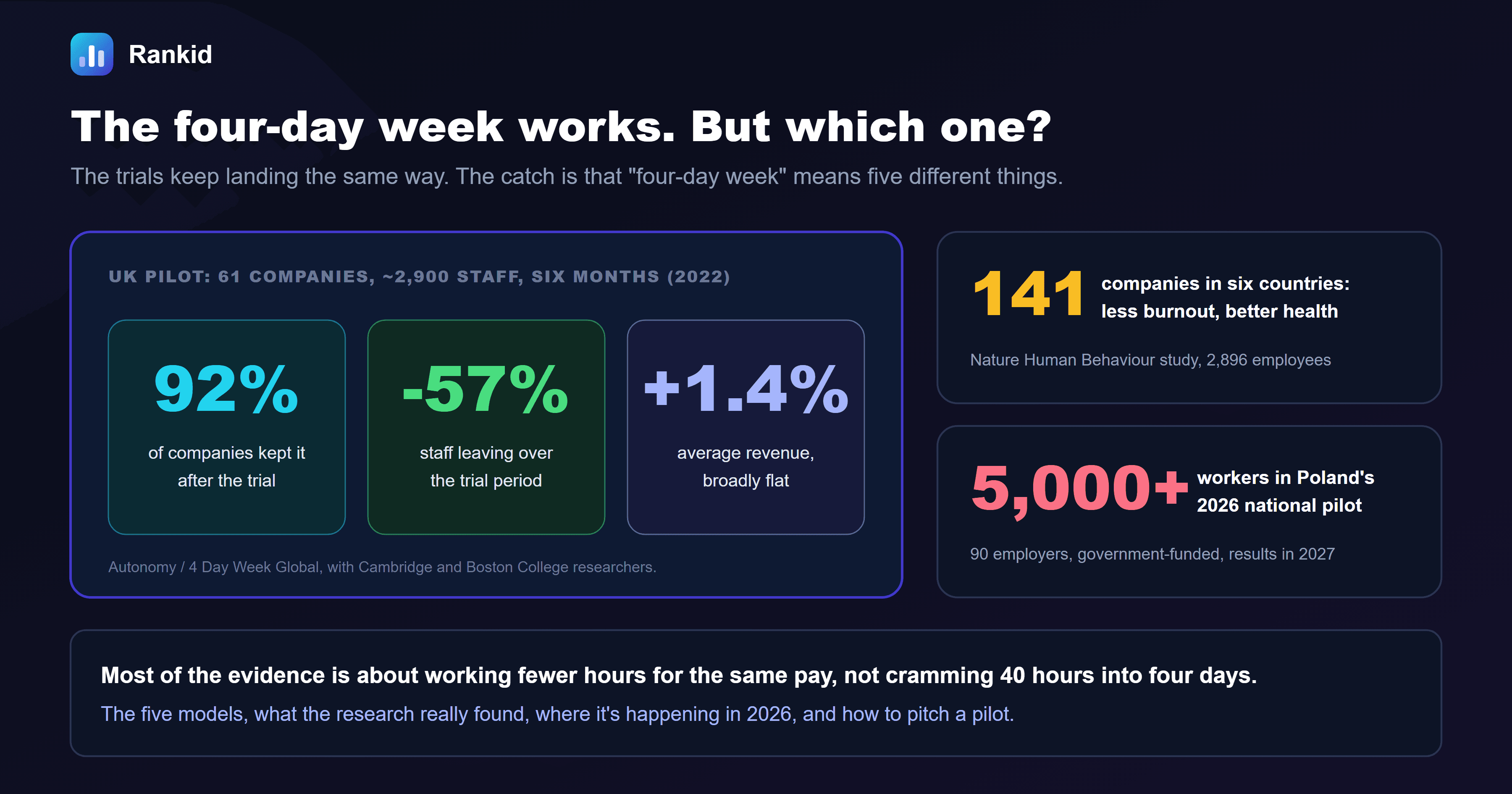
Quick answer: the evidence is strong for one specific version, the 100-80-100 model (100% pay, 80% of the time, 100% of the output). In the UK pilot, 92% of companies kept it, resignations fell 57% and revenue held steady. A 2025 Nature Human Behaviour study of 141 companies and 2,896 employees found lower burnout and better health. Compressed 4x10 weeks are a different thing. The caveats: companies volunteered, and data is mostly self-reported. To get one, pitch a time-boxed pilot with clear output metrics, not a request for Fridays off.
Five things people mean by "a four-day week"
Before arguing for or against a four-day week, agree which one you mean. They have very different effects.
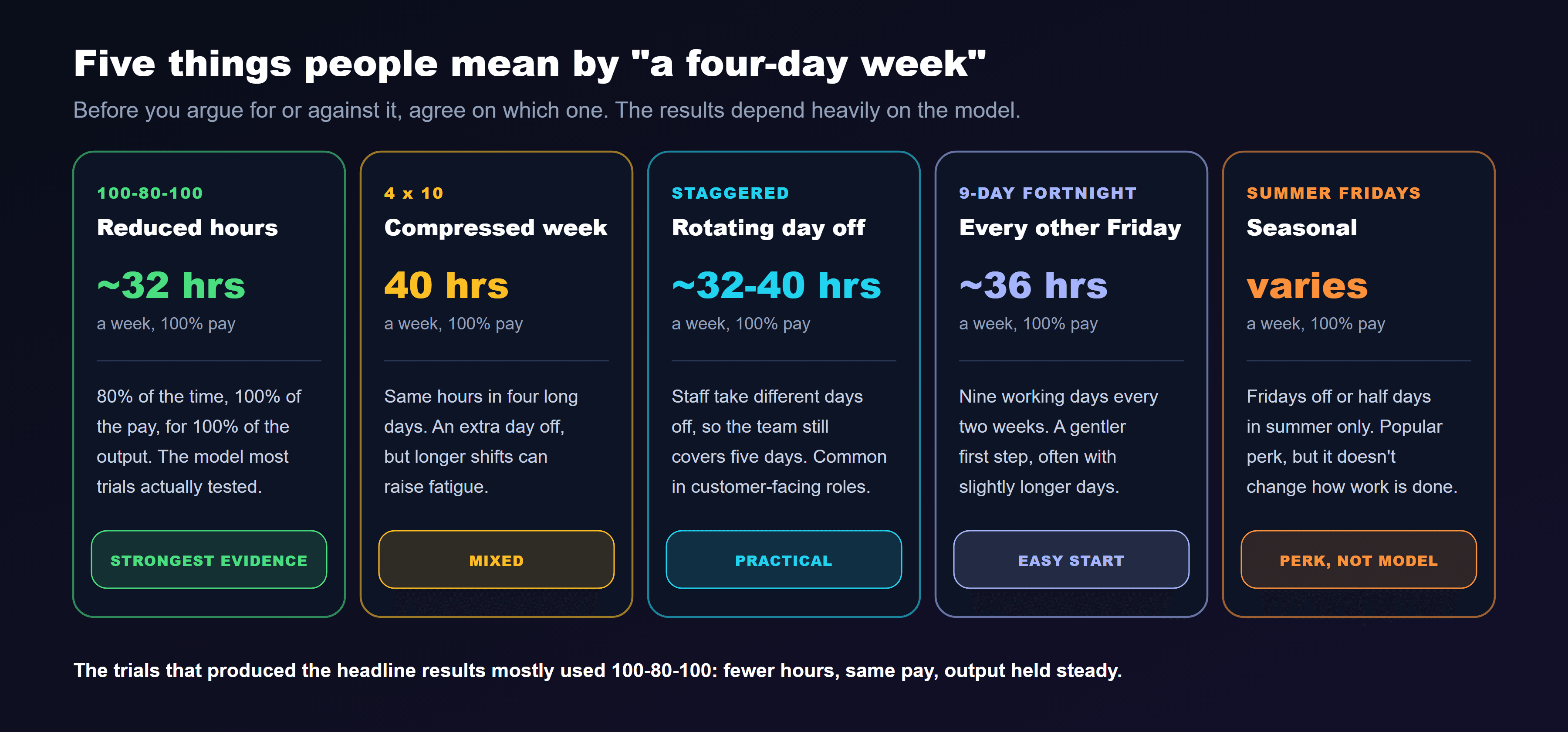
- 100-80-100 (reduced hours). Around 32 hours a week, full pay, output maintained. This is what the big trials tested, and where the strongest evidence is.
- Compressed week (4x10).The same 40 hours in four long days. You get a day off, but ten-hour days can raise fatigue and clash with childcare. It's a scheduling change, not a reduction.
- Staggered or rotating. Everyone works four days, but different people take different days off, so the team still covers five. This is how many customer-facing teams make it work.
- 9-day fortnight. Every other Friday off, sometimes with slightly longer days. A gentler, popular first step.
- Summer Fridays.A seasonal perk. Welcome, but it doesn't change how work gets done, so it doesn't produce the same results.
The real secret is not the day off
What the biggest trials actually found
The UK pilot (2022). Sixty-one companies with about 2,900 employees ran a six-month trial coordinated by 4 Day Week Global with researchers from Cambridge and Boston College, and reported by the think tank Autonomy. At the end, 56 of the 61 (92%) continued, with 18 making it permanent. Revenue rose 1.4% on average across responding companies, weighted by size, which is broadly flat, while the number of staff leaving fell 57% over the trial period. And 71% of employees reported lower burnout.
The six-country study (2025). Published in Nature Human Behaviour, this was the largest controlled study so far: 2,896 employees at 141 organisations in the US, Canada, the UK, Ireland, Australia and New Zealand, compared against control companies that kept their normal schedules. After six months of reduced hours with no pay cut, workers reported lower burnout, higher job satisfaction and better mental and physical health. Three things explained the gains: better sleep, less fatigue and higher self-rated work ability. People whose hours fell the most, by eight hours or more, improved the most, and about 90% of the companies kept going.
Why does that matter for employers and not just employees? Burnout drives turnover, and turnover is expensive. Our guide to employee turnover rate shows how quickly the costs add up.
Where the four-day week is being tested
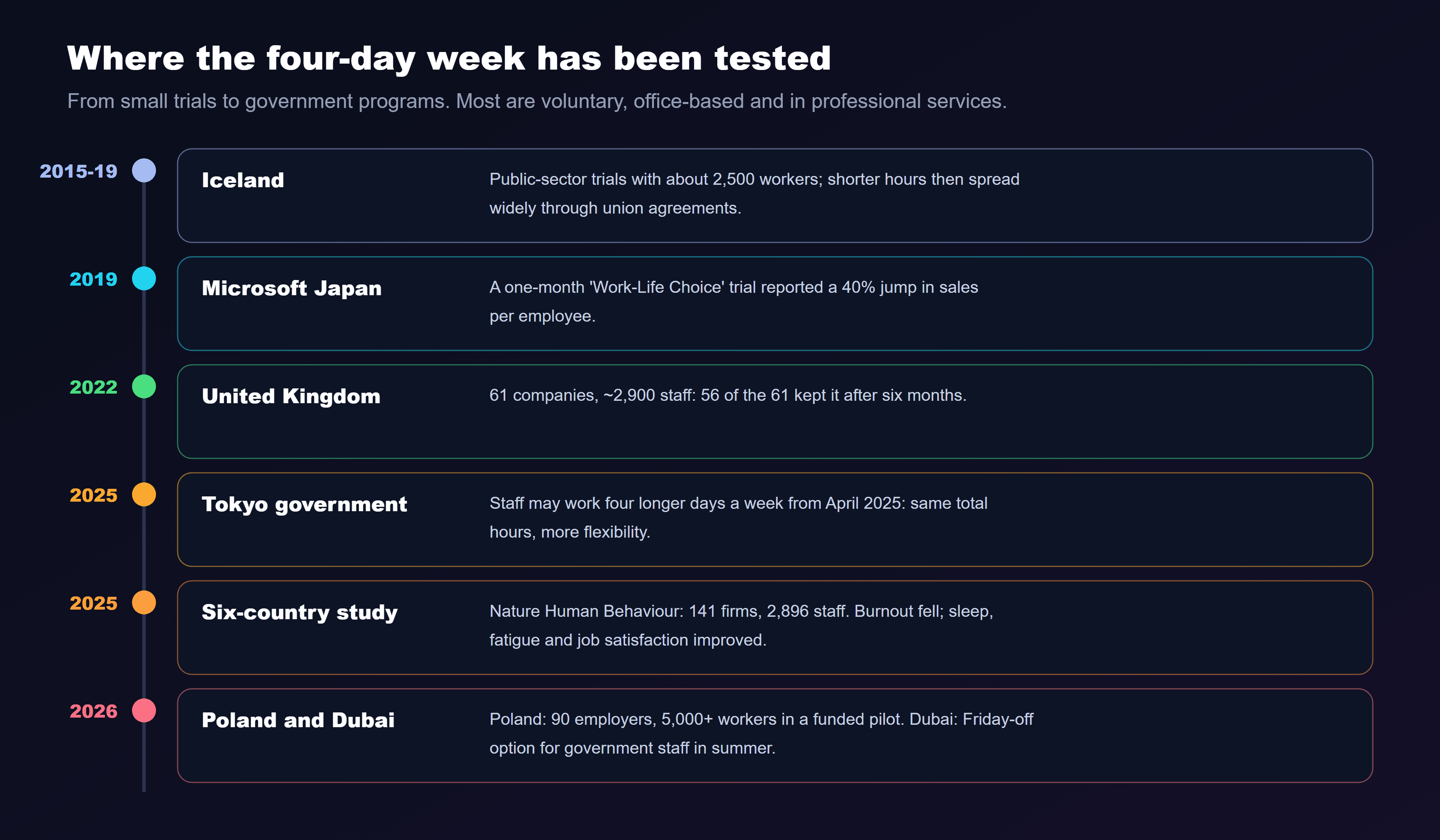
- Iceland (2015 to 2019). Public-sector trials with about 2,500 workers moved to shorter weeks without pay cuts, and shorter hours then spread widely through union agreements.
- Microsoft Japan (2019). A one-month trial reported a roughly 40% jump in sales per employee. It was short and a single company, but it made headlines worldwide.
- Tokyo (from April 2025).The metropolitan government lets staff work four longer days, keeping total hours the same, as part of efforts to support families. It's closer to a compressed week than a reduction.
- Poland (2026). A government-funded pilot launched on January 1, 2026, with about 90 employers and more than 5,000 workers testing four-day weeks, shorter days or extra leave without pay cuts. Results are due in 2027.
- Dubai (summer 2026). Eligible government employees could again choose a schedule with Fridays off between late June and early September.
In the US there's no legal requirement, and proposals for a 32-hour standard workweek haven't passed. Four-day weeks here remain employer choices, which is why knowing how to pitch one matters.
The honest caveats
- Volunteers, not a random sample. Companies chose to take part, so they were probably better suited, and more motivated, than average.
- Self-reported outcomes. Well-being was measured with surveys rather than objective health tests, and company financial data was reported by the companies themselves.
- Mostly office work. Most participants worked in professional services and knowledge work in English-speaking countries. Manufacturing, healthcare and retail face harder coverage problems.
- Intensity can rise. Some employees find four compressed days more stressful. The redesign of work, not just the schedule, decides which way it goes.
How to pitch a four-day week to your boss
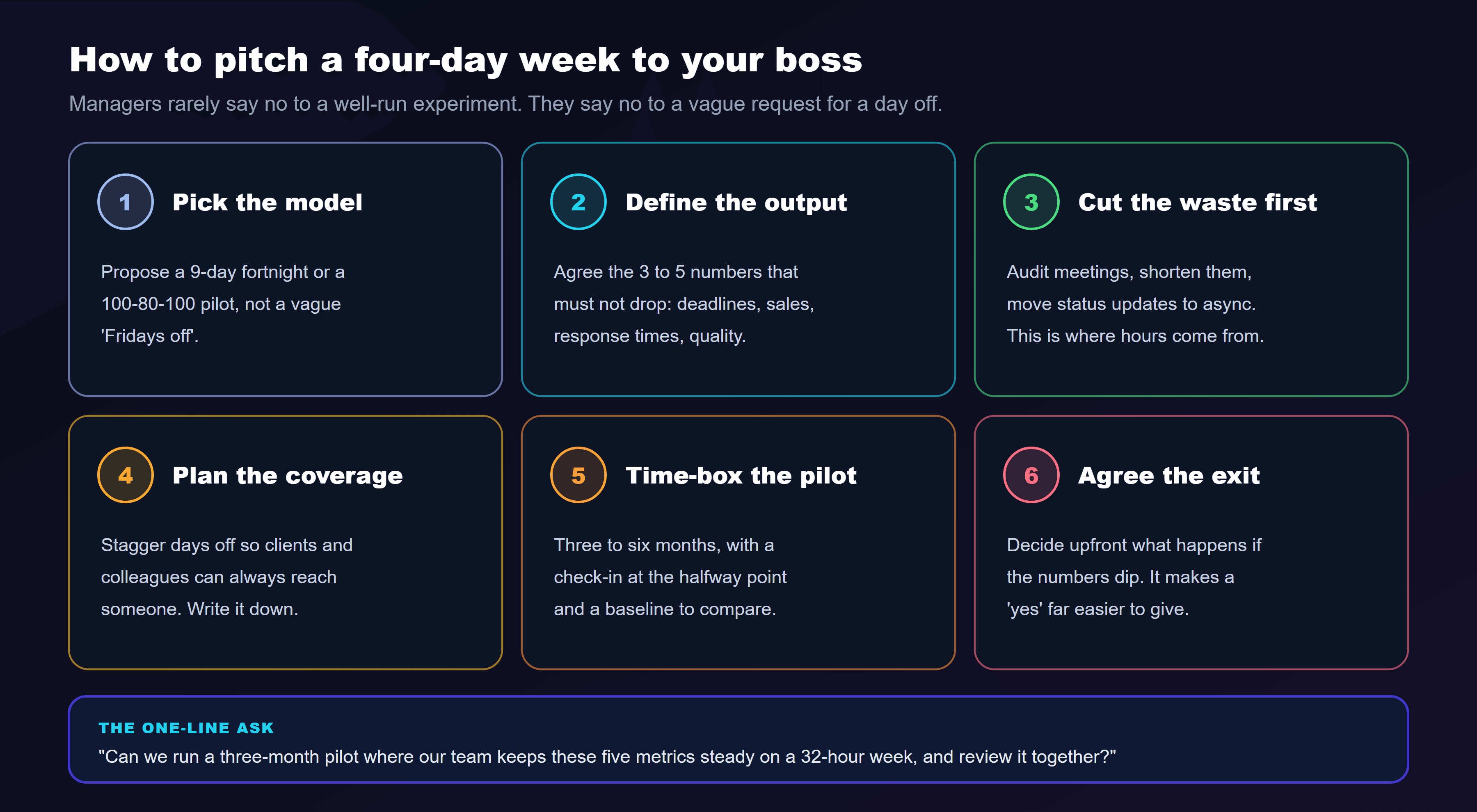
Managers rarely refuse a well-designed experiment with clear success measures. They refuse a vague request for a day off. Here's how to make it the former.
Pick a specific model
Define the output that must not drop
Show where the hours come from
Solve coverage in writing
Time-box it
Agree the exit criteria
If you're the manager
How to find a job with a four-day week
Four-day-week employers are still a small minority, so they're competitive. Search for "4-day week," "32-hour week," "9-day fortnight" and "reduced hours" on job boards, check specialist four-day-week job boards, and read benefits pages carefully. In interviews, ask which model they use, whether it's guaranteed or seasonal, and how coverage works. Then make your application count, because these postings attract far more applicants than usual.
Four-day-week jobs are competitive. Match them precisely
Paste your resume and a four-day-week job posting into Rankid for a free 0-100 match score and the exact requirements you meet and miss, so your application stands out in a crowded pile. No signup required.
Check your match score freeFor employers: running a pilot that sticks
- Redesign before you reduce. Cut meetings, clarify priorities and remove low-value work first. The schedule change is the last step, not the first.
- Measure what matters. Track output, customer outcomes, turnover and well-being against a baseline, not hours at desks.
- Design for coverage. Stagger days off in client-facing teams and document response commitments.
- Watch hiring and retention. A four-day week is a strong recruiting message. Put it in your job descriptions and use it in your talent acquisition strategy.
- Be clear about what's guaranteed.If it's a pilot, say so. Taking a benefit away later without warning damages trust more than never offering it.
Offering a four-day week? Expect more applicants
Rankid scores every resume against your job description on a consistent 0-100 scale and shows the exact requirements each candidate matched and missed, so you can handle the extra volume a four-day week attracts without slowing down. First 5 resumes free, no signup.
Try bulk screening freeFrequently asked questions
What is a four-day work week?
A four-day work week usually means working four days instead of five without a cut in pay. The most studied version is the '100-80-100' model: 100% of the pay for 80% of the time, in exchange for maintaining 100% of the output. It's different from a compressed week, where people work the same 40 hours in four longer days.
Does the four-day work week actually work?
In the trials so far, mostly yes. In the 2022 UK pilot, 56 of 61 companies kept the four-day week afterwards, resignations fell 57% over the trial and revenue held broadly steady. A 2025 study in Nature Human Behaviour covering 2,896 employees at 141 companies in six countries found lower burnout, higher job satisfaction and better mental and physical health, and about 90% of companies continued. The main caveat is that companies volunteered, so they were likely well suited to it.
What did the Nature Human Behaviour four-day week study find?
The study followed 2,896 employees at 141 organisations in six countries (the US, Canada, the UK, Ireland, Australia and New Zealand) through six-month trials of reduced hours with no pay cut, compared with a group of control companies. Workers reported less burnout, higher job satisfaction, and better mental and physical health. The improvements were explained by better sleep, less fatigue and higher self-rated work ability, and they were larger for people whose hours fell the most.
Is a compressed 4x10 schedule the same as a four-day week?
Not really. A 4x10 schedule keeps 40 hours but squeezes them into four 10-hour days. You gain a day off, but longer days can increase fatigue and make childcare harder. Most of the headline four-day-week research tested reduced hours, typically around 32 a week, with the same pay, so its results don't automatically apply to compressed schedules.
What are the disadvantages of a four-day work week?
It can be hard to apply in roles that need continuous coverage, such as customer support, healthcare or retail, without staggering days off or hiring more people. Some employees feel more intensity during the four days, and meetings have to be cut ruthlessly for it to work. The evidence also comes mostly from volunteer companies in professional services in English-speaking countries, relying on self-reported data, so results may not transfer everywhere.
Which countries are testing a four-day week in 2026?
Poland launched a government-funded pilot in January 2026 with about 90 employers and more than 5,000 workers testing shorter hours, with results due in 2027. Dubai again offered eligible government staff a Friday-off summer schedule in 2026. Tokyo's metropolitan government has allowed staff to work four longer days since April 2025. Earlier landmark trials ran in Iceland, the UK, and across several other countries.
Do companies lose money with a four-day week?
In the published trials, generally not. UK pilot companies' revenue rose 1.4% on average over the trial period, weighted by size, and many reported savings from lower turnover and recruitment costs. Results depend on the business, however, and companies that simply cut a day without changing how work is organised are more likely to struggle.
How do I ask my boss for a four-day week?
Propose a time-boxed experiment, not a perk. Pick a specific model, such as a 9-day fortnight or a 32-hour week, agree three to five output metrics that must not drop, show how you'll cut low-value work like unnecessary meetings, plan coverage so people can always reach someone, suggest a three to six month pilot with a review, and agree in advance what happens if results dip.
Is there a law for a four-day week in the US?
No. US federal law doesn't require a four-day or 32-hour week, and proposals to reduce the standard overtime threshold to 32 hours have not passed. For now, four-day weeks in the US are employer choices. Some other countries are experimenting through government-funded pilots or public-sector programs.
How can I find jobs with a four-day week?
Search job boards for terms like '4-day week', '32-hour week', '9-day fortnight' and 'reduced hours', check specialist four-day-week job boards, and look at company benefits pages. In interviews, ask how the schedule works in practice: which day is off, whether it's guaranteed or seasonal, and how coverage is handled.
Key takeaways
- 'Four-day week' covers five models: 100-80-100 reduced hours, compressed 4x10, staggered days off, the 9-day fortnight and summer Fridays. The strongest evidence is for 100-80-100.
- In the 2022 UK pilot, 56 of 61 companies (92%) kept the four-day week, resignations fell 57% and revenue rose 1.4% on average, broadly flat.
- A 2025 Nature Human Behaviour study of 2,896 employees at 141 organisations in six countries found lower burnout, higher satisfaction and better health, explained by better sleep, less fatigue and higher work ability.
- Compressed 40-hour weeks are a different thing, and the headline research doesn't automatically apply to them.
- In 2026, Poland is running a government-funded pilot with 90 employers and 5,000+ workers, Dubai offered summer Fridays off to government staff, and Tokyo lets staff work four longer days.
- The caveats are real: volunteer companies, self-reported data and mostly office-based work.
- Pitch a pilot, not a perk: pick a model, define output metrics, cut low-value work, plan coverage, time-box it and agree exit criteria.
- Employers that succeed redesign work first, measure output and retention, and are clear about what's guaranteed.
Frequently asked questions
What is a four-day work week?
A four-day work week usually means working four days instead of five without a cut in pay. The most studied version is the '100-80-100' model: 100% of the pay for 80% of the time, in exchange for maintaining 100% of the output. It's different from a compressed week, where people work the same 40 hours in four longer days.
Does the four-day work week actually work?
In the trials so far, mostly yes. In the 2022 UK pilot, 56 of 61 companies kept the four-day week afterwards, resignations fell 57% over the trial and revenue held broadly steady. A 2025 study in Nature Human Behaviour covering 2,896 employees at 141 companies in six countries found lower burnout, higher job satisfaction and better mental and physical health, and about 90% of companies continued. The main caveat is that companies volunteered, so they were likely well suited to it.
What did the Nature Human Behaviour four-day week study find?
The study followed 2,896 employees at 141 organisations in six countries (the US, Canada, the UK, Ireland, Australia and New Zealand) through six-month trials of reduced hours with no pay cut, compared with a group of control companies. Workers reported less burnout, higher job satisfaction, and better mental and physical health. The improvements were explained by better sleep, less fatigue and higher self-rated work ability, and they were larger for people whose hours fell the most.
Is a compressed 4x10 schedule the same as a four-day week?
Not really. A 4x10 schedule keeps 40 hours but squeezes them into four 10-hour days. You gain a day off, but longer days can increase fatigue and make childcare harder. Most of the headline four-day-week research tested reduced hours, typically around 32 a week, with the same pay, so its results don't automatically apply to compressed schedules.
What are the disadvantages of a four-day work week?
It can be hard to apply in roles that need continuous coverage, such as customer support, healthcare or retail, without staggering days off or hiring more people. Some employees feel more intensity during the four days, and meetings have to be cut ruthlessly for it to work. The evidence also comes mostly from volunteer companies in professional services in English-speaking countries, relying on self-reported data, so results may not transfer everywhere.
Which countries are testing a four-day week in 2026?
Poland launched a government-funded pilot in January 2026 with about 90 employers and more than 5,000 workers testing shorter hours, with results due in 2027. Dubai again offered eligible government staff a Friday-off summer schedule in 2026. Tokyo's metropolitan government has allowed staff to work four longer days since April 2025. Earlier landmark trials ran in Iceland, the UK, and across several other countries.
Do companies lose money with a four-day week?
In the published trials, generally not. UK pilot companies' revenue rose 1.4% on average over the trial period, weighted by size, and many reported savings from lower turnover and recruitment costs. Results depend on the business, however, and companies that simply cut a day without changing how work is organised are more likely to struggle.
How do I ask my boss for a four-day week?
Propose a time-boxed experiment, not a perk. Pick a specific model, such as a 9-day fortnight or a 32-hour week, agree three to five output metrics that must not drop, show how you'll cut low-value work like unnecessary meetings, plan coverage so people can always reach someone, suggest a three to six month pilot with a review, and agree in advance what happens if results dip.
Is there a law for a four-day week in the US?
No. US federal law doesn't require a four-day or 32-hour week, and proposals to reduce the standard overtime threshold to 32 hours have not passed. For now, four-day weeks in the US are employer choices. Some other countries are experimenting through government-funded pilots or public-sector programs.
How can I find jobs with a four-day week?
Search job boards for terms like '4-day week', '32-hour week', '9-day fortnight' and 'reduced hours', check specialist four-day-week job boards, and look at company benefits pages. In interviews, ask how the schedule works in practice: which day is off, whether it's guaranteed or seasonal, and how coverage is handled.