Exit Interviews: 20 Questions That Get Real Answers, a Template, and What to Do With the Data (2026)
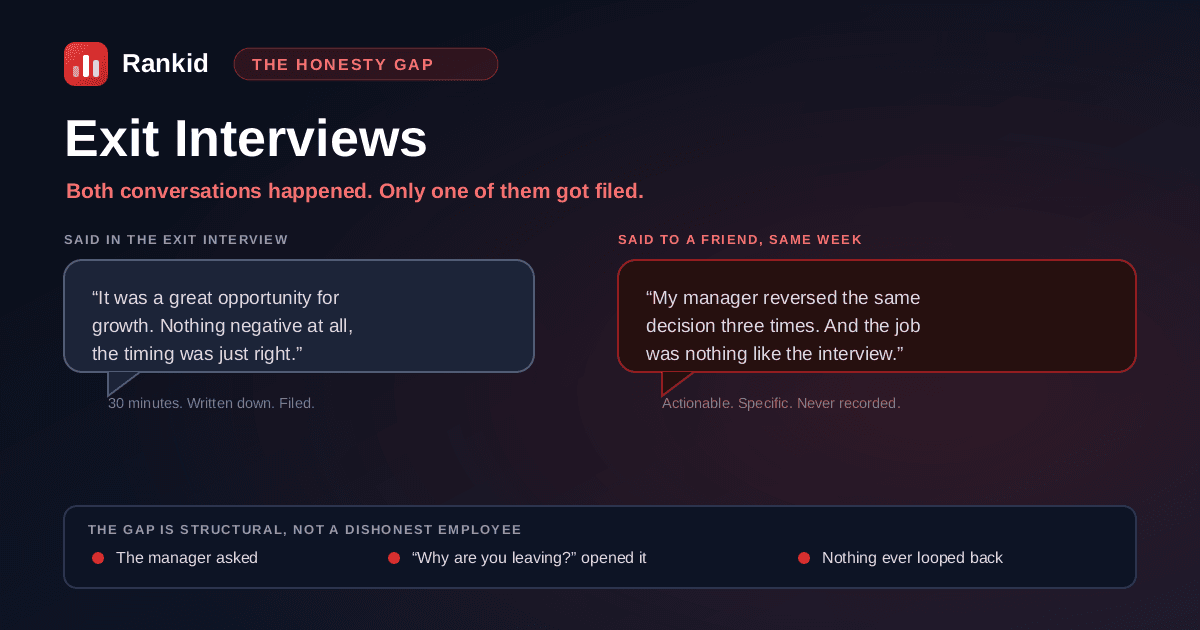
Somebody resigns. HR books 30 minutes, asks why they are leaving, and writes down "growth opportunity". The same week, that person tells a friend it was their manager, or that the job turned out to be nothing like the interview described. Both conversations happened. Only one got filed, and it was the one with no information in it. That gap is not caused by dishonest employees. It is caused by three structural choices most companies make without noticing.
Quick answer
Quick answer: an exit interview is a structured conversation held two to five days before the last day to understand why someone is leaving. Three things decide whether it produces anything: who asks (not the direct manager), what you ask(open with "when did you first start thinking about leaving", not "why are you leaving"), and what happens next (code every exit into fixed themes, review quarterly, commit to one change, tell the remaining team). If you are the one leaving: be truthful, be selective, and decide what you want from the conversation before you walk in.
What is an exit interview?
An exit interview is a structured conversation with a departing employee, held shortly before their last day, to understand why they are leaving and what could have been done differently. The stated purpose is improvement: finding the patterns behind departures so the causes get fixed before they cost more people.
It quietly does three other jobs, and being honest about them helps you design it better:
- It closes the relationship civilly. Which matters for rehiring, for referrals, and for what this person says about you for the next five years.
- It surfaces operational risk. The undocumented process, the vendor relationship one person holds, the account nobody else can access.
- It occasionally surfaces something serious. Harassment or a safety issue that never came through any other channel. That function alone justifies running these properly.
One exit interview tells you almost nothing. Twenty, coded consistently, tell you something you cannot get any other way: whether people are leaving one manager or an entire function, whether pay is the real driver or the safe answer, and whether the job people quit resembles the job you advertised.
Why most exit interviews produce nothing usable
Three structural failures, and none of them is about asking the wrong questions.
The wrong person asks. In a large share of departures the manager relationship is part of the reason. Asking that manager to collect the feedback guarantees the polite version.
The opening question invites a script."Why are you leaving?" is the one question every departing employee has already rehearsed an answer to. It gets you the rehearsed answer.
Nothing loops back. Notes get written, filed, and never aggregated. Twelve people name the same manager across eighteen months and nobody ever sees the twelve together. This is the failure that matters most, and it is the cheapest to fix.
Who should conduct it, and when
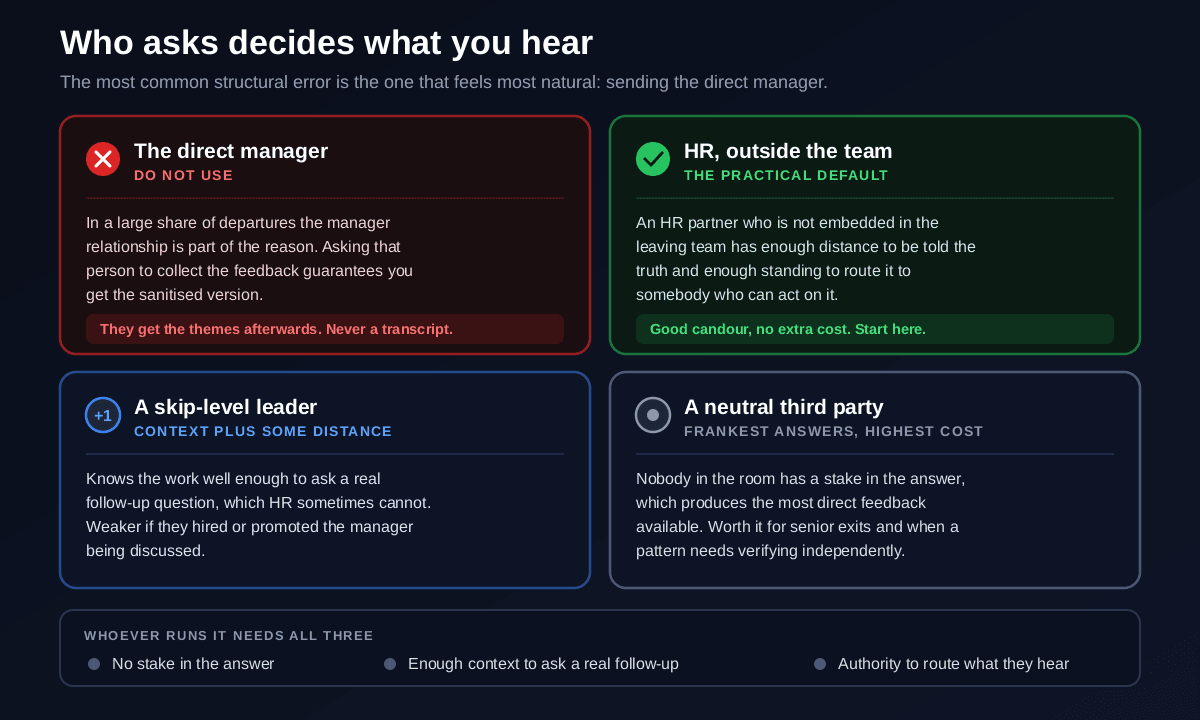
Whoever runs it needs three things: no stake in the answer, enough context to ask a real follow-up question, and the authority to route what they hear to someone who can act. The manager gets the themes afterwards, framed as patterns rather than quotes, and never a transcript.
On timing: two to five days before the last day. Earlier and the person is still inside the relationship and still guarding what they say. On the final afternoon and you get a rushed conversation between goodbyes. Keep the last day for the practical checklist.
The follow-up almost nobody runs
20 exit interview questions that get real answers
Ask around twelve of these in the room and follow up properly rather than marching through a list. The order matters more than the wording: open with what changed, not with why they are leaving.
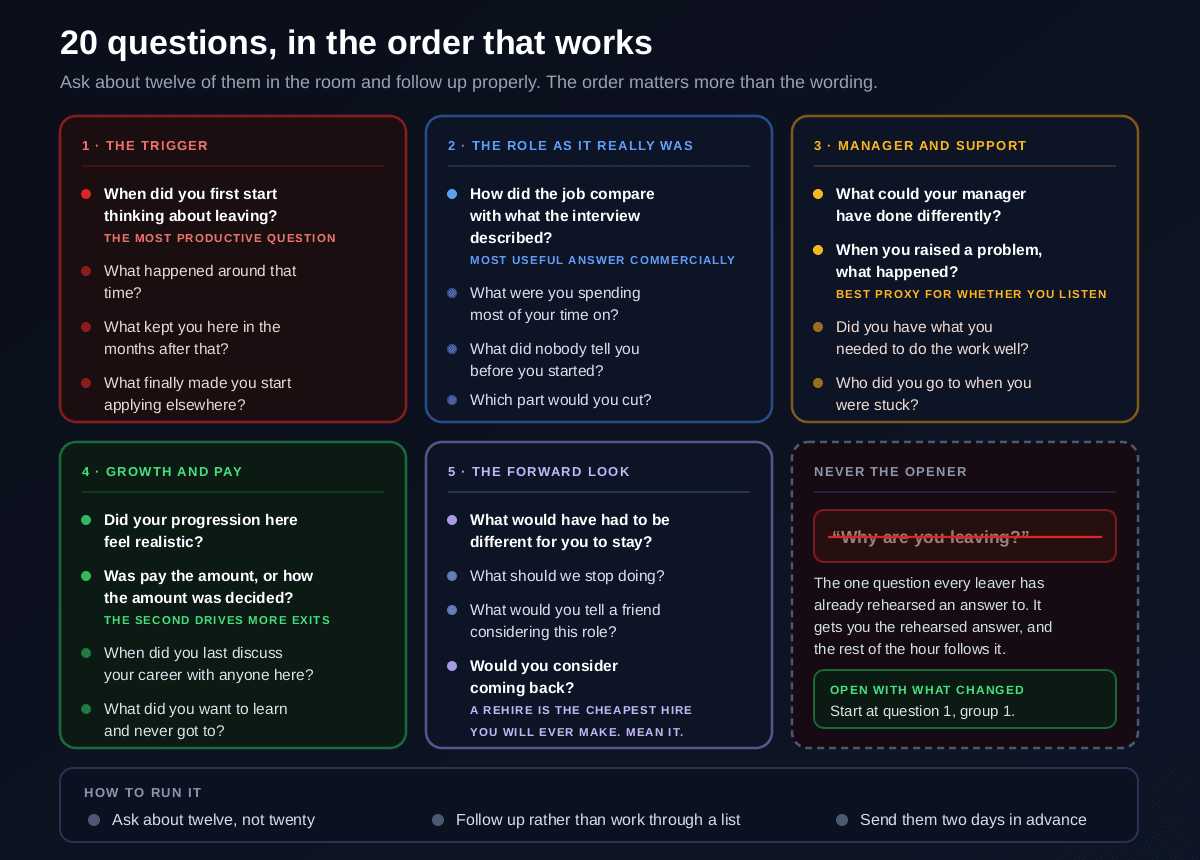
The trigger. The single most productive question in the whole set is when did you first start thinking about leaving? The answer is almost always months before the resignation and frequently a specific, nameable incident. That incident is the thing you can actually fix. Follow it with what happened around that time? and what kept you here for the months after it?
The role. How did the job compare with what you understood it to be in the interview? This one is the most commercially useful question you can ask, because a gap here is a hiring problem you can close cheaply. Then what were you spending most of your time on? and what did nobody tell you before you started?
The manager and support. What could your manager have done differently? Did you have what you needed to do the work well? When you raised a problem, what happened? That last one is the best proxy for whether your organisation actually listens, and the answers are usually specific.
Growth and pay. Did your progression here feel realistic? Was compensation a factor, and if it was, was it the amount or how it was decided? That distinction matters: perceived unfairness in the process drives more exits than the absolute number does.
The forward look. What would have had to be different for you to stay? What should we stop doing? What would you tell a friend considering this role? Would you consider coming back? That final question is worth asking sincerely, because a rehire is the cheapest hire you will ever make.
One technique worth stealing
Exit interview template and form
Two parts: a script for the conversation and a form for the record. Keep the form short enough that themes can be coded from it consistently.
The opening, said out loud
"Thanks for doing this. The purpose is to understand what we could do better, and it genuinely does get used: we review the themes across all departures each quarter and pick something to change. Two things before we start. Individual comments are not attributed to you, and your manager will see themes rather than quotes. The exception is that if you raise anything about harassment, discrimination or safety, I have to escalate it, and I will tell you if that happens. Nothing here affects your final pay, your reference or anything else you are owed. You can skip any question. Is it all right if I take notes?"
Every clause in that paragraph is doing work. Naming the confidentiality limits up front is what makes the rest of it credible.
The form: what to record
Employee, role, team, manager, hire date, last day, tenure. Departure type: [resignation / retirement / end of contract / involuntary]. Next destination: [competitor / same industry / different industry / same role elsewhere / career change / not disclosed]. Interviewer, date, format.
Primary reason (choose one): [compensation / progression and growth / manager and leadership / workload and hours / role differed from expectations / team and culture / commute or location or flexibility / personal or relocation / job security / other]
Contributing factors (choose up to two from the same list).
Trigger point: [when they first considered leaving, and the incident if named]
Would rehire: [yes / no / with reservations] Open to returning: [yes / no / maybe]
Escalation required: [none / harassment or discrimination / safety / policy breach / legal]
Knowledge transfer risk: [what only this person holds, and who now owns it]
Verbatim comments: [two or three quotes, recorded without attribution in the reported version]
The forced single choice for primary reason is what makes quarterly analysis possible. Free-text-only forms are why most exit interview data never gets used: prose cannot be counted.
The separate offboarding checklist
Property returned and access revoked at the agreed time. Final pay date and vacation treatment confirmed. Benefits end date and continuation coverage explained. Knowledge transfer session held and documented. Handover owner named for each responsibility. Forwarding and out-of-office set. Who answers a future employment verification request, and what they confirm.
Run this on a different day from the feedback conversation. Mixing them means the person is thinking about their laptop and their last payslip while you are asking about culture. The final pay and property mechanics are covered in our guide to termination letters, which apply to voluntary exits too.
Exit interview analysis: turning answers into one change
This is the section that separates a process from a ritual, and it is where nearly every organisation stops.
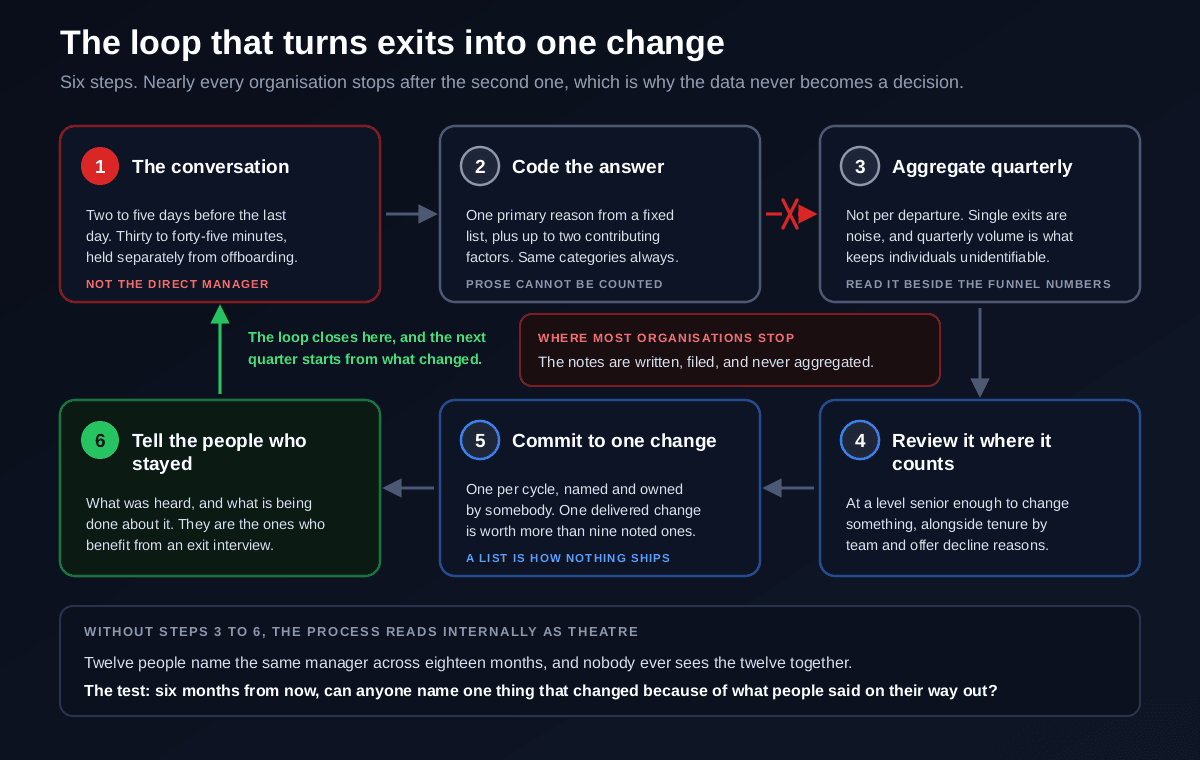
Code every exit against a fixed short list. Same categories every time, one primary reason, maximum two contributing factors. Comparable data beats rich data here.
Aggregate quarterly, not per departure. Individual exits are noise. Patterns need volume, and quarterly reporting also solves the anonymity problem: with enough responses, nobody is identifiable.
Read it next to your funnel numbers.An exit theme of "the role was not what I was told" alongside a short average tenure in one team is a hiring problem, not a retention problem. Our guides to recruitment metrics and cost per hire cover the numbers to put beside it.
Commit to one change per cycle. One delivered change is worth more than nine noted ones, and it is the only version anyone will believe.
Then close the loop out loud. Tell the remaining team what was heard and what is being done about it. The people who benefit from an exit interview are the ones who stayed, and without this step the whole process reads internally as theatre. This is the same principle as candidate experience at the front of the funnel: feedback nobody sees acted on stops arriving.
Stay interviews: the same questions, six months earlier
A stay interview asks nearly the same questions of people who are not leaving, which makes it strictly more valuable, because the answers can still change the outcome. An exit interview is an autopsy. A stay interview is a check-up.
Stay interview questions that work: what does a good day here look like? What would make you start looking? Do you have what you need to do your best work? Does your progression here feel realistic? What should we stop doing? What is one thing that would make this a better place to work for you specifically?
Run them once or twice a year, and specifically at the moments people reconsider: after a reorganisation, a missed promotion, a manager change, or the end of a big project. Keep them separate from performance reviews, because a conversation that affects a rating is not a conversation where people tell you the truth. Our guide to self-evaluations covers the appraisal conversation, which this is deliberately not.
The rule that decides whether stay interviews work
If you are the one leaving: how honest should you be?
Start with a question that is not about honesty at all: what do you want from this conversation? The answer determines everything else.
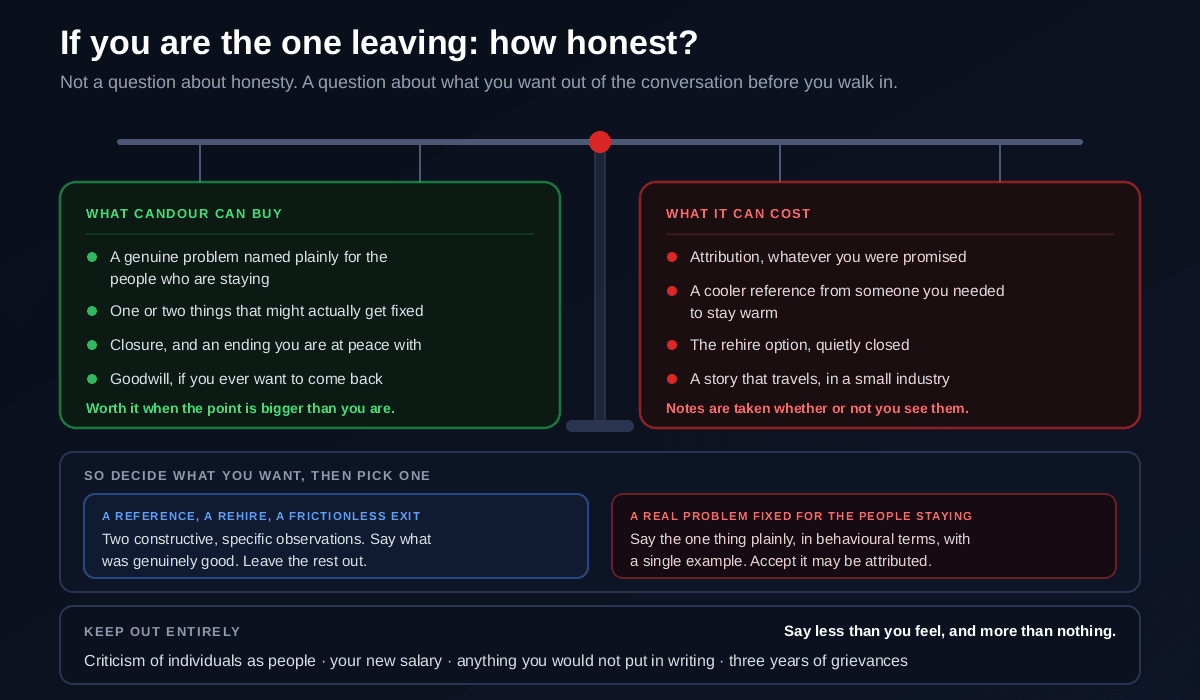
If you want a reference, a rehire option, or a frictionless exit: keep it constructive, specific and short. Give one or two observations that would genuinely help, say what was good, and leave.
If you want a real problem addressed for the people staying: say the specific thing plainly, in behavioural terms, with one example, and accept that it may be attributed to you whatever you were promised. That trade can be entirely worth making. Make it knowingly rather than accidentally.
What is almost never worth it is emotional honesty: venting, settling scores, or listing three years of grievances. It rarely changes anything, it is the version that gets repeated, and this industry is smaller than it looks. Say less than you feel and more than nothing.
Four things to keep out entirely:
- Criticism of individuals as people."He is incompetent" gets repeated as gossip. "Decisions were reversed three times on the March project without explanation" gets acted on.
- Your new salary, or comparisons with your new employer. It reads as gloating and gives away information for nothing.
- Anything you would not put in writing. Notes are taken whether or not you see them.
- The full historical list. Volume dilutes the one point you actually want heard.
Do you have to attend? Almost never. It is voluntary in the overwhelming majority of cases, declining is not misconduct, and it must not affect your final pay or references. If someone implies otherwise, that is information about the organisation. A short written answer to two or three questions is a reasonable middle path. And if something serious happened, put it in writing rather than saying it in a room, and expect that the employer then has an obligation to investigate rather than to keep it quiet. Our guides to writing a resignation letter and explaining your reason for leaving cover the wording for everything around it.
The mistakes that waste the whole exercise
- The direct manager runs it. The most common error, and it determines the answers before the first question.
- Opening with "why are you leaving?" The one question everyone has pre-answered.
- Free text only. Prose cannot be counted, so it never becomes a pattern.
- Held on the last afternoon. Between goodbyes, with a laptop to hand back.
- Mixed with the offboarding checklist. Nobody reflects on culture while sorting out their final payslip.
- Promising confidentiality you cannot keep. Name the escalation exceptions at the start or lose credibility later.
- Sharing verbatim quotes with the manager. One attributed quote ends candour for everyone who leaves after this person.
- Only interviewing voluntary leavers. Involuntary exits and, separately, the people who nearly left and stayed, hold the other half of the picture.
- Never closing the loop. Feedback nobody sees acted on stops arriving. This is the one that kills the process.
If exits cluster on 'the job was not what I was told', that is a hiring fix
The most useful exit interview answer is how the job compared with what the interview described, and a gap there is cheaper to fix at the front of the funnel than anywhere else. Upload your applicant batch and paste the job description, and Rankid scores every candidate 0 to 100 against the role's real requirements so the shortlist matches the actual work. Up to 200 resumes per batch, first 5 free, no signup.
Score your applicant pool freeReading exits backwards into the hire
The most commercially useful theme in any exit dataset is the one about expectations. When people leave saying the job was not what they were told, three upstream documents are usually responsible: a job description describing an aspiration rather than the work, an interview process that never tested the thing the role actually demands, which an interview scorecard fixes, and an onboarding period that never produced a written standard the person could aim at.
Exits that cluster in the first six months are nearly always one of those three rather than a retention problem in the ordinary sense. Exits after three years are usually about progression. The distinction is worth making, because the two need completely different fixes and only the second one is what most retention programmes actually address.
Key takeaways
- Three things decide whether an exit interview works: who asks, what you open with, and whether anything loops back.
- Not the direct manager. An HR partner outside the team is the usual practical answer; a neutral third party gets the frankest answers.
- Two to five days before the last day, 30 to 45 minutes, separate from the offboarding checklist.
- Open with 'when did you first start thinking about leaving', not 'why are you leaving'.
- Ask how the job compared with what the interview described. It is the most commercially useful answer in the set.
- Force one primary reason from a fixed list. Prose cannot be counted and therefore never becomes a pattern.
- Aggregate quarterly, commit to one change per cycle, and tell the remaining team what changed.
- Name the confidentiality exceptions out loud at the start: harassment, discrimination and safety must be escalated.
- A follow-up three to six months after someone leaves gets markedly more direct answers, and almost nobody does it.
- Stay interviews beat exit interviews, but only if something visible changes afterwards.
- If you are leaving: decide what you want from the conversation first. Be truthful, specific and selective, and never vent.
The whole exercise comes down to one test: six months from now, will anyone be able to name a thing that changed because of what people said on their way out? If not, the questions were never the problem. Fix the loop first, then the questions, then the interviewer. And when the theme that keeps coming back is that the job was not the job people were sold, the cheapest fix sits at the other end of the funnel entirely: paste your job description and shortlist into Rankid's bulk resume screening and check that the people you are hiring match the work as it actually exists.
Frequently asked questions
What is an exit interview?
An exit interview is a structured conversation with an employee who is leaving, held shortly before their last day, to understand why they are going and what the organisation could have done differently. Its stated purpose is improvement: identifying patterns in why people leave so that the causes can be fixed before they cost more departures. In practice it serves three other functions too, which is worth being honest about. It closes the relationship on a civil note, which matters for rehiring and for what the person says about you afterwards. It surfaces operational risk, such as undocumented knowledge or an account that only one person manages. And it occasionally surfaces something serious, such as harassment, that nobody had reported through any other channel. That last function alone justifies running them properly.
What is the purpose of an exit interview?
The purpose is to convert an individual departure into information the organisation can act on. A single exit interview tells you very little, because one person's reasons are specific to them and are usually partly about circumstances you cannot control. Twenty exit interviews, coded consistently into themes, tell you something you cannot get anywhere else: whether people are leaving one manager or the whole function, whether pay is genuinely the driver or the thing people say because it is safe, and whether the job people leave resembles the job that was advertised. The secondary purposes are practical: knowledge transfer before the person walks out, recovery of property and access, an accurate record of the reason for leaving, and a graceful ending that keeps a good leaver rehirable.
Are exit interviews confidential?
Treat them as confidential in the sense that individual comments are not repeated with your name attached, and not confidential in the sense of privileged or legally protected. What is actually true varies by employer and you are entitled to ask directly: who will read this, will my name be attached, and will my manager see it. A well-run process anonymises individual feedback and only reports themes upward once there are enough responses that no single person is identifiable, which usually means reporting quarterly rather than per departure. Two exceptions override any confidentiality promise, and a good interviewer says so at the start: allegations of harassment, discrimination, safety breaches or illegality must be escalated and investigated, and anything relevant to active litigation may be disclosable. If you want something kept out of a written record entirely, say that before you say the thing.
Should you be honest in an exit interview?
Be truthful, be selective, and calibrate to what you actually want out of it. The useful test is to ask what you want from this conversation. If the answer is a reference, a rehire option, or an unblocked final payment, keep it constructive and specific and leave out anything that reads as a grievance. If the answer is that you want a genuine problem addressed for the people staying, then say the specific thing plainly, in behavioural terms, with an example, and understand that it may be attributed to you regardless of what you were promised. What is almost never worth it is emotional honesty: venting about individuals, settling scores, or listing every grievance from three years. It rarely changes anything, it is the version that gets repeated, and the recruiting world is smaller than it looks. Say less than you feel and more than nothing.
Do you have to do an exit interview?
Almost never. Exit interviews are voluntary in the overwhelming majority of cases, and declining one is not misconduct and should not affect your final pay, your references or anything you are owed. If someone suggests otherwise, that is a warning sign about the organisation rather than a legal position. A few situations are different in substance: a contractual obligation, a regulated handover in some financial or safety-critical roles, or a knowledge transfer session that is really an operational handover rather than a feedback conversation. If you would rather not sit through one but do want to be helpful, a short written response to two or three specific questions is a reasonable middle path. If you do decline, decline warmly and without explanation, because a curt refusal is itself a piece of feedback people remember.
Who should conduct an exit interview?
Not the direct manager, which is the single most common structural error. In a large share of departures the manager relationship is part of the reason, and asking that person to collect the feedback guarantees the sanitised version. The better options in order of candour are a neutral third party, which produces the frankest answers and costs the most, a skip-level leader, who has context and some distance, or an HR partner who is not embedded in the leaving team, which is the usual practical answer. Whoever runs it needs three things: no stake in the answer, enough context to ask a real follow-up question, and the authority to route what they hear to somebody who can act. The manager should get the themes afterwards, framed as patterns rather than quotes, and never a transcript.
When should an exit interview happen?
Two to five days before the last day is the sweet spot for the main conversation. Too early and the person is still inside the relationship, still negotiating their exit, and still guarding what they say. Too late, meaning the final afternoon, and you get a rushed conversation squeezed between goodbyes, with the person mentally already gone. The last day should be reserved for the practical checklist rather than the feedback. The genuinely underused option is a follow-up three to six months after they have left, when there is nothing left to protect and no reference at stake. Answers at that distance are markedly more direct, and a short email or a ten-minute call is usually enough. Very few organisations do this, which is exactly why it produces information the others do not have.
What questions should you ask in an exit interview?
Open with what changed rather than why they are leaving, because the second question invites the prepared answer and the first invites a story. The most productive single question is when did you first start thinking about leaving, because it locates the actual trigger, which is almost always months before the resignation and frequently a specific incident. Then cover: what would have had to be different for you to stay, what the job turned out to be versus what you were told in the interview, what your manager could have done differently, whether you had what you needed to do the work, whether you felt your progression was realistic, and what you would tell a friend considering this role. Close with two forward-looking ones: what should we stop doing, and would you consider coming back. Ask no more than about twelve in the room, and follow up rather than working through a list.
What should you not say in an exit interview?
Avoid four categories. Personal criticism of individuals, which converts a useful point into a grievance and gets repeated as gossip rather than acted on. Comparisons with your new employer, including the salary, because it reads as gloating and gives away negotiating information for no benefit. Anything you would not put in writing, since notes are taken whether or not you see them. And accumulated grievances from years back, because volume dilutes the one point you actually want heard. The version that works is one or two specific, behavioural, example-backed observations delivered calmly, plus genuine appreciation for what was good. If something serious happened, such as harassment or a safety issue, that is a different conversation: say it clearly, in writing, and understand that the employer then has an obligation to investigate rather than to keep it confidential.
How long should an exit interview take?
Thirty to forty-five minutes for the feedback conversation, held separately from the administrative offboarding. Anything under twenty minutes cannot get past the prepared answers, because the useful material almost always arrives after the second or third follow-up question rather than in the first response. Anything beyond an hour tends to drift into either therapy or grievance, neither of which produces something actionable. Keep the practical checklist, meaning property, access, final pay, benefits and knowledge transfer, in a separate session on a different day, because mixing them means the person is thinking about their laptop and their last payslip while you are asking about culture. Send the questions in advance if you want considered answers rather than reflexive ones, which is unusual and works well.
What do companies actually do with exit interview data?
In most organisations, very little, and that is the real failure rather than the questions being wrong. The pattern is that notes are written, filed, and never aggregated, so twelve people cite the same manager over eighteen months and nobody ever sees the twelve together. A working process has four parts. Code every exit against a fixed short list of themes, so that responses are comparable rather than prose. Review the themes quarterly at a level senior enough to change something, alongside the numbers from your funnel. Commit to one change per cycle rather than a list, because one delivered change is worth more than nine noted ones. And close the loop by telling the remaining team what was heard and what is being done, since the people who benefit from an exit interview are the ones who stayed. Without the fourth part, the process reads internally as theatre.
What is a stay interview, and how is it different?
A stay interview asks nearly the same questions of people who are not leaving, and it is more valuable than an exit interview for the obvious reason that the answers can still change the outcome. The format is a short, separate, non-appraisal conversation, ideally not part of a performance review, covering what makes a good day here, what would make you consider looking elsewhere, whether you have what you need, whether your progression feels realistic, and what should stop. Run them at genuine intervals, once or twice a year and around the moments where people reconsider, such as after a reorganisation, a missed promotion or a manager change. Two rules make the difference: the manager should not run it if the manager might be the issue, and something visible has to change afterwards, because a stay interview that produces no action teaches people that speaking up is pointless and accelerates the exit it was meant to prevent.