Talent Acquisition Strategy: Framework, Process, and How It Differs from Recruitment (2026)
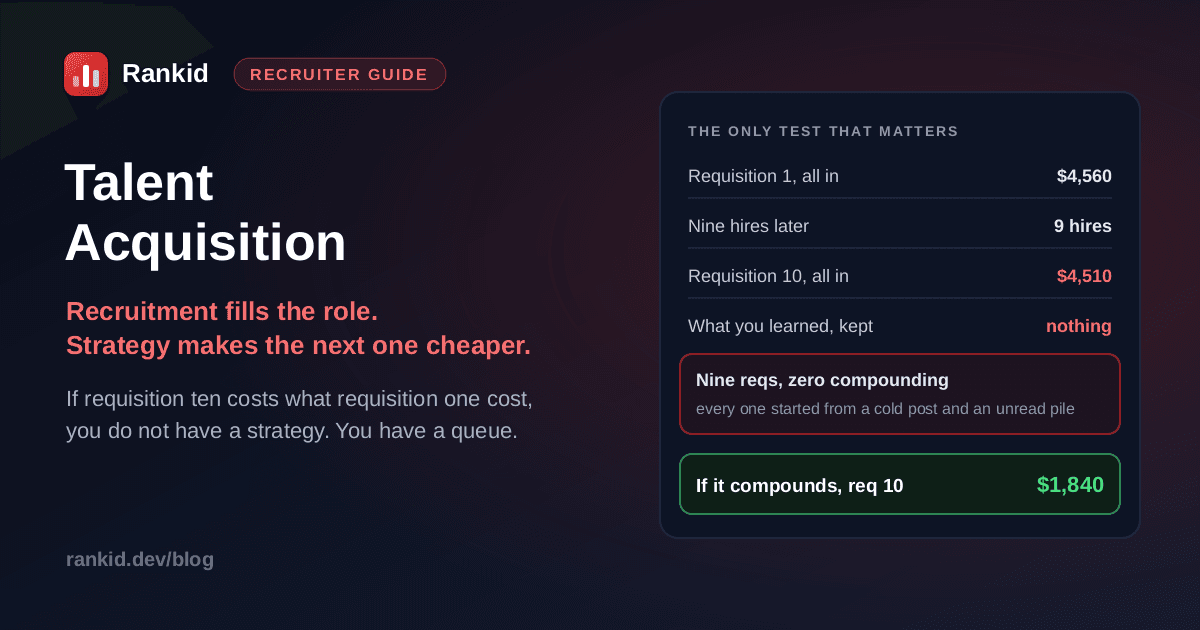
Here is a question that sorts real talent acquisition from recruitment with a better job title. Pull the cost and the cycle time for the first requisition your team filled this year, then pull the same numbers for the tenth. If they are roughly the same, then nine hires produced no durable advantage at all. Every one started from a blank job post, a cold advertising spend, and a pile of applications that got read until the week ran out.
Quick answer
What is talent acquisition?
Talent acquisition is the ongoing function of finding, evaluating and hiring the people an organisation needs, run as a repeatable system rather than a sequence of unrelated searches. It spans workforce forecasting, employer positioning, sourcing, evaluation, interviewing and offers.
Most definitions stop there, and they are not wrong so much as incomplete, because that list also describes recruitment. The part that actually distinguishes talent acquisition is what persists between requisitions: the requirements profiles you can reuse, the channel data that tells you where to spend, the pool of candidates you have already evaluated, and the interviewers who now score consistently. Talent acquisition is not a wider set of activities. It is the same activities performed so they accumulate.
Talent acquisition vs recruitment: the difference that matters
The usual framing is that recruitment is tactical and reactive while talent acquisition is strategic and proactive, which is true and almost useless, because nobody can act on it. The operational version is much sharper: recruitment restarts, talent acquisition accumulates. Plot cost per hire across ten requisitions and the difference stops being a matter of vocabulary.
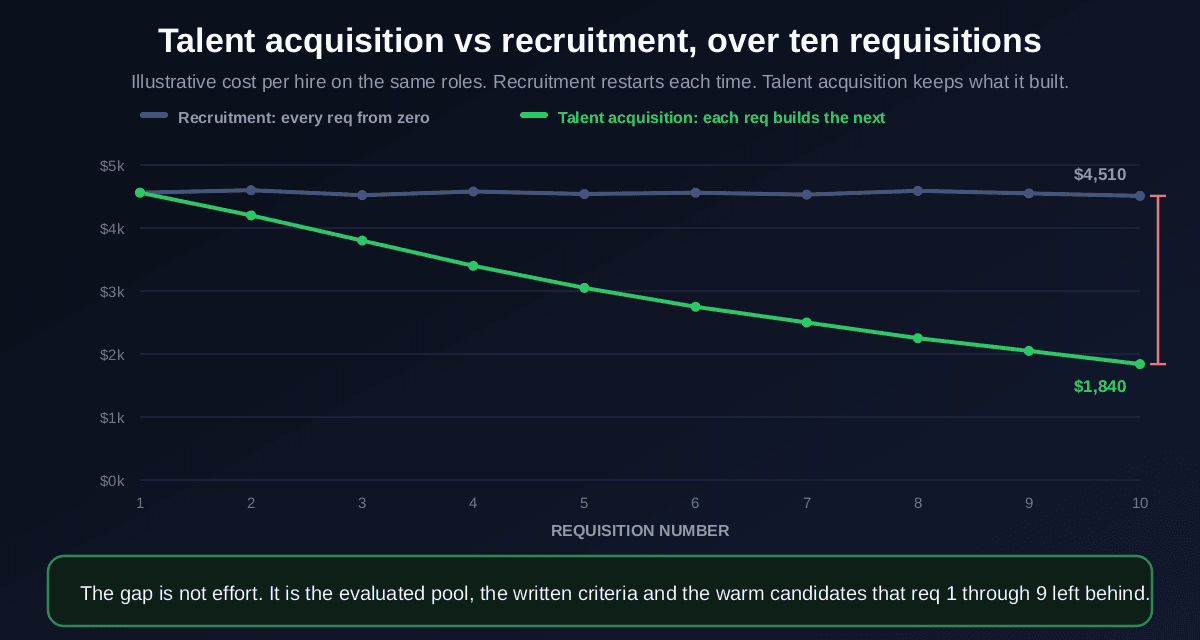
Those figures are illustrative rather than benchmarks, and the shape is the point. The flat line is not a team working less hard. It is often a team working extremely hard on a process where nothing carries forward. Each req gets a new posting written from scratch, a new advertising push, and a fresh pile that gets triaged rather than evaluated, so requisition nine begins in exactly the same position as requisition one.
The declining line comes from three specific reuses, not from general efficiency. The requirements profile already exists, so definition takes an hour instead of a week. The channel mix is known, so spend goes where it worked. And a pool of already-evaluated candidates exists, so a meaningful share of shortlists come from people who were assessed months ago rather than from a cold advertising cycle. The mechanics of that third one are covered in talent pipeline.
The test, stated once
A talent acquisition strategy framework in five layers
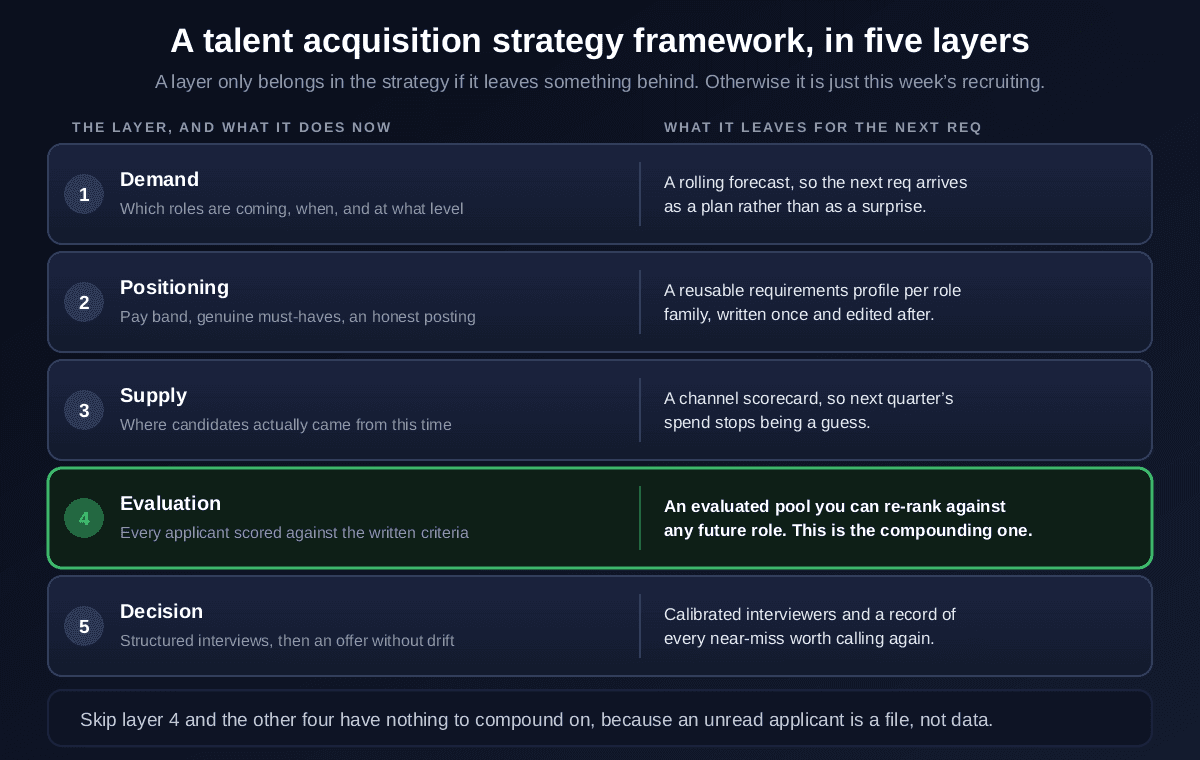
Most strategy documents in this space are lists of good intentions. The discipline that makes one usable is to require every layer to produce something reusable. If a line in your strategy leaves no artefact behind, it is an activity, and activities belong in a work plan rather than a strategy.
Demand: know what is coming
Which roles, when, at what level, and with what budget. A rolling forecast covering the next two to four quarters turns requisitions from surprises into scheduled work, and it is the only way sourcing can ever start before the req opens. The method is in workforce planning, and the approval mechanics in job requisition.
Leaves behind: a forecast you correct rather than recreate.
Positioning: define the role once, properly
Pay band, genuine must-haves separated from preferences, and an honest description of the work. Write it as a requirements profile for the role family, not just a posting for this opening, so the next time the role opens you are editing rather than starting. See how to write a job description.
Leaves behind: a reusable requirements profile per role family.
Supply: find out where candidates actually came from
Not where you spent, where the hires came from. Most teams cannot answer this per channel, which is why the same budget gets repeated annually. Track cost and yield per source for one quarter and the following quarter's plan writes itself. Channel detail is in candidate sourcing, and the internal channel most teams underuse in internal recruitment.
Leaves behind: a channel scorecard, so spend stops being a guess.
Evaluation: score everyone against the written criteria
Every applicant, against the same criteria, with the result retained. This is the layer that produces the compounding asset and the layer that gets done partially, because reading four hundred applications by hand does not fit in a week. Partial evaluation is not a smaller version of evaluation; it produces no usable record at all. Covered in how to screen resumes in bulk and resume screening criteria.
Leaves behind: an evaluated pool you can re-rank against any future role.
Decision: structure it, then move fast
Fixed questions, named scorers, independent scoring before discussion, and an offer that goes out before your strongest candidate accepts elsewhere. See interview questions to ask candidates and the screening interview guide.
Leaves behind: calibrated interviewers and a record of every near-miss worth calling again.
Build the layer everything else compounds on
Upload your full applicant batch and paste the job description. Rankid scores every candidate 0 to 100 against the role's criteria, with the skills and keywords each one matches and misses, so you finish each requisition with an evaluated pool instead of a folder of unread files. Up to 200 resumes per batch, and your first 5 are free with no signup.
Evaluate your whole pool freeWhy layer four is the one that decides whether anything compounds
The other four layers all depend on having evaluated candidates, and this is easy to miss because it sounds like a detail of screening rather than a structural point.
Consider what each layer inherits. Your channel scorecard is only meaningful if you know which applicants from each source were actually any good, which requires having assessed them. Your requirements profile improves across requisitions only if you can see which requirements predicted success, which requires scores you kept. Your pipeline is re-rankable only if the people in it were evaluated in the first place. A pool of unread applications supports none of this. Those candidates are not data about your market, your channels or your criteria. They are files.
And the arithmetic is why this happens rather than any lack of intent. A careful read is about ninety seconds. Four hundred applicants is roughly ten hours, which is over half the recruiter time on the entire requisition and the only portion that scales with applicant volume, as shown in cost per hire and high-volume recruiting. Nobody carrying six open reqs finds those hours, so the reading stops around applicant forty and the rest of the pool never becomes anything. Removing that constraint is the single highest-leverage change available, which is the argument made in detail in recruitment automation.
Rank, retain, decide
A talent acquisition strategy template you can actually fill in
Two pages, six sections. Longer documents do not get updated, and a strategy nobody updates is a historical record.
- 1. Role forecast. Roles expected over the next two to four quarters, with level, headcount and rough timing. Marked as estimates, reviewed monthly.
- 2. Requirements profiles. One per recurring role family. Must-haves, preferences, pay band, and the outcomes the role owns in its first ninety days.
- 3. Channel plan. Each source you used last quarter, what it cost, how many hires it produced, and whether it stays.
- 4. Evaluation standard. A stated commitment that every applicant is scored against the written criteria, plus where the scores are retained and who reviews the borderline band. Include the rule that nobody is rejected by software alone.
- 5. Interview structure. Fixed questions per role family, named scorers, and the rule that scoring happens before discussion.
- 6. Metrics and review cadence. The numbers below, reviewed quarterly, with the explicit question: is this getting cheaper?
If your strategy also covers hiring across countries, the same framework holds and layer two multiplies: a global talent acquisition strategy is mostly a set of local requirements profiles and pay bands under one evaluation standard, rather than a different framework. Similarly, a diversity dimension belongs inside layers two and four rather than as a separate initiative, because that is where it acts.
Metrics that show whether it is compounding
Read trend, not level. A single quarter's cost per hire says almost nothing; the direction across four says everything.
- Cost and time per hire, by role family, across requisitions. The headline evidence. Flat means nothing is carrying forward.
- Share of applicants actually evaluated. Should be at or near 100 percent. This is the leading indicator for everything else, and it is usually the number that reveals the real problem.
- Reuse rate. The share of hires sourced from a previously evaluated pool rather than a fresh advertising cycle. The most diagnostic metric here and the one almost nobody tracks.
- Internal fill rate. Rising as you get better at seeing the people you already employ.
- Requirements profile reuse. How often a new req starts from an existing profile versus a blank document. Crude, and it correlates with everything.
Where talent acquisition strategies fail
- Renaming the team. Recruitment coordinators become talent acquisition partners, the process does not change, and req ten costs what req one cost.
- Optimising attraction before evaluation. More applications into an unchanged screen produces a larger unread pile and a worse candidate experience, not better hires.
- A strategy that produces no artefacts. If you cannot point at a forecast, a profile, a scorecard and an evaluated pool, the document is a description of activity.
- Measuring level instead of trend.Reporting this quarter's cost per hire without comparing it to the last four hides exactly the thing you are trying to establish.
- Letting the pool go stale. An evaluated pool decays. Re-score it against each new role rather than trusting a rank assigned to a different job a year ago.
Key takeaways
- Recruitment fills a role; talent acquisition is recruitment done so the next role is cheaper to fill.
- The test is simple: does requisition ten cost less than requisition one in the same role family?
- Build the strategy in five layers: demand, positioning, supply, evaluation, decision.
- A layer belongs in the strategy only if it leaves a reusable artefact behind.
- Layer four decides everything, because an unread applicant is a file rather than data.
- Track trend not level: cost per hire across reqs, share of applicants evaluated, and reuse rate.
- Rankid scores up to 200 resumes per batch against one job description. First 5 free, no signup.
Bottom line: nearly every team already performs all five layers of talent acquisition. The difference between a function and a queue is whether those layers leave anything behind, and that hinges on a single unglamorous constraint, which is whether you can afford to evaluate everybody who applied. Fix that and the rest starts accumulating on its own: profiles get sharper, channels get clearer, pools get deeper, and requisition ten finally costs less than requisition one. Score your next full applicant batch with Rankid and start the pool your next req will draw from.
Frequently asked questions
What is talent acquisition?
Talent acquisition is the ongoing function of finding, evaluating and hiring the people an organisation needs, run as a repeatable system rather than a series of one-off searches. It covers workforce forecasting, employer positioning, sourcing, evaluation, interviewing and offers, and it includes the parts that outlast any single requisition: the requirements profiles, the channel data, the evaluated candidate pool and the calibrated interviewers. The distinguishing feature is not scope, it is persistence. Talent acquisition is recruitment done in a way that leaves something behind.
What is the difference between talent acquisition and recruitment?
Recruitment is the act of filling an open role. Talent acquisition is the system that makes filling roles progressively easier. In practice the difference shows up in one number: whether your tenth requisition costs less than your first. Recruitment restarts each time, with a fresh job post, a cold advertising spend and a pile of applications that gets read until the week runs out. Talent acquisition reuses a requirements profile, a known channel mix and a pool of candidates already evaluated against similar criteria. Both fill the role. Only one gets cheaper.
What is a talent acquisition strategy?
A talent acquisition strategy is a written plan covering which roles you expect to hire, how you will position them, where candidates will come from, how every applicant will be evaluated, and how decisions get made, plus what each of those activities will leave behind for the next requisition. The last clause is what makes it a strategy rather than a description of your week. A useful test for any line in the document is to ask what artefact it produces: a forecast, a requirements profile, a channel scorecard, an evaluated pool, a calibrated panel. If a line produces nothing reusable, it is an activity, not a strategy.
What are the stages of the talent acquisition process?
Commonly six: workforce planning to establish what is actually needed, requisition and role definition to fix the requirements and pay band, sourcing and attraction to bring candidates in, evaluation to score every applicant against the written criteria, interviewing and selection to make the decision, and offer plus onboarding to close it. The stage most often skipped in practice is evaluation, or rather it is done partially, because reading several hundred applications by hand does not fit inside anyone's week. Partial evaluation is what quietly prevents the whole process from compounding.
What should a talent acquisition strategy template include?
Six sections. A rolling role forecast covering the next two to four quarters. A requirements profile per recurring role family, separating genuine must-haves from preferences. A channel plan with the cost and yield of each source you actually used last quarter. An evaluation standard stating that every applicant is scored against the written criteria and how the results are retained. An interview structure with fixed questions and named scorers. And a metrics section including cost and time per hire, share of applicants actually evaluated, and internal fill rate. Keep it to two pages so it stays current.
How do you improve a talent acquisition process?
Find the stage consuming the most hours and fix that first, which is almost always evaluation. On a requisition with 400 applicants, screening is around ten hours of reading at 90 seconds each, comfortably over half the total recruiter time on the role, and it is the only stage that grows with applicant volume. Automating scoring so the whole pool is evaluated in one pass reclaims most of that time and simultaneously produces the artefact everything else compounds on. Improving sourcing or interviewing before fixing evaluation tends to produce more applications nobody reads.
What metrics show a talent acquisition strategy is working?
Look for trend rather than level. Cost and time per hire should fall across successive requisitions in the same role family, which is the direct evidence of compounding. Share of applicants actually evaluated should be at or near 100 percent, because a partially read pool cannot compound. Internal fill rate should rise as you get better at seeing your own people. Reuse rate, meaning the share of hires that came from a previously evaluated pool rather than a fresh advertising cycle, is the single most diagnostic number and almost nobody tracks it.
Do small teams need a talent acquisition strategy?
The compounding argument matters more at small scale, not less, because a small team feels the cost of restarting most acutely. You do not need a document or a dedicated function. Write one requirements profile for the role you hire most often, evaluate every applicant against it rather than reading until you run out of time, and keep the scores. That is a talent acquisition strategy in three sentences, and it is enough to make the second hire in that role materially cheaper than the first.