One-on-One Meetings: Agenda Template, Questions, and How Skip-Levels Fit In (2026)
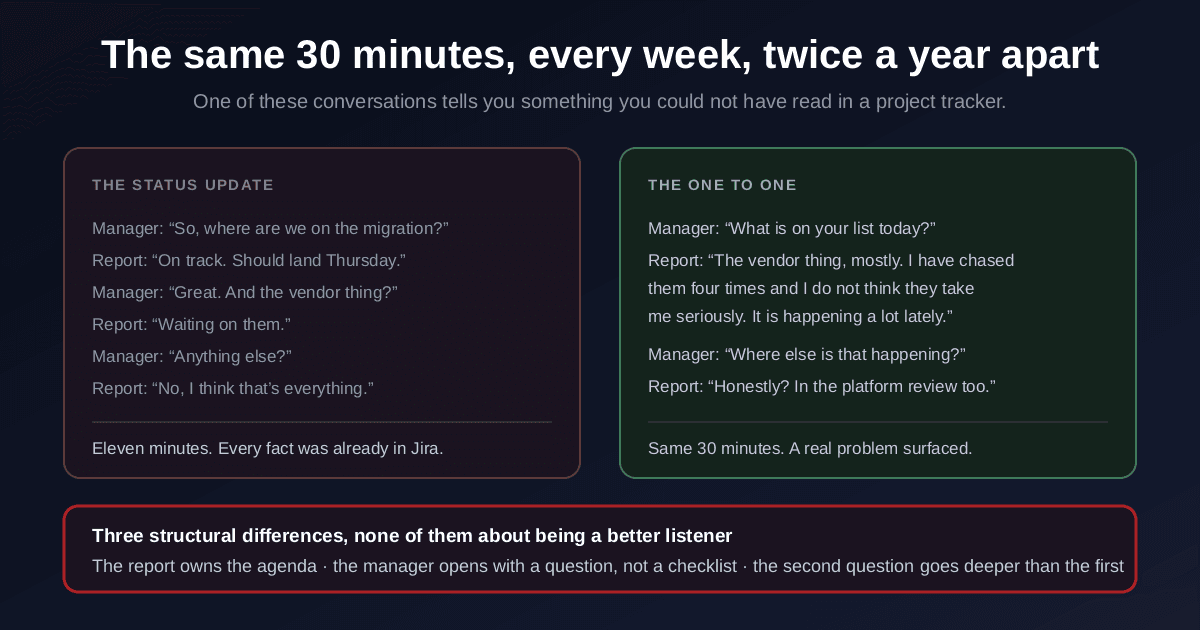
Two managers, same company, same weekly 30-minute slot. The first asks where we are on the migration, hears that it is on track for Thursday, asks about the vendor, hears that they are waiting, asks if there is anything else, hears no, and gets eleven minutes back. Every fact in that conversation was already in Jira. The second asks what is on your list today, and finds out that a vendor has been stonewalling one of their best people for a month, that the person has started to think it is about them, and that the same thing is happening in the platform review. Same half hour. The difference is not that one of them is a better listener.
Quick answer
Quick answer: a one-on-one is a recurring private conversation for the things that do not appear in a tracker. Weekly, 25 to 30 minutes, and the report owns the agenda.Five blocks: their agenda (10 min), blockers (5), your context and feedback (5), growth once a month (5), actions in writing (5). Open with "what is on your list today?" and then be quiet. The technique that makes it work is asking the second question, because "fine" is the end of the first one. A skip-levelis a different meeting with your manager's manager: once or twice a year, scheduled openly, themes shared back but never quotes.
What is a one-on-one meeting?
A one-on-one, written variously as a 1:1 or 1 on 1, is a recurring private conversation between a manager and a direct report. It exists for the things that surface nowhere else: friction, ambiguity, frustration, ambition, and the early signals of a problem that has not happened yet.
That definition rules out what most of them become. If everything discussed could have been read in a project tracker, the meeting added nothing the tracker did not already contain, and both people will correctly feel it was a waste.
The cleanest diagnostic is who sets the agenda. In a working 1:1, the report brings most of the content and the manager brings context, feedback and priorities. In a status update, the manager works down a checklist and the report answers. There is no third option, and the drift is always in the same direction.
The one-on-one meeting agenda template
Five blocks in 30 minutes. The order is the design: whatever is discussed first establishes what the meeting is for.
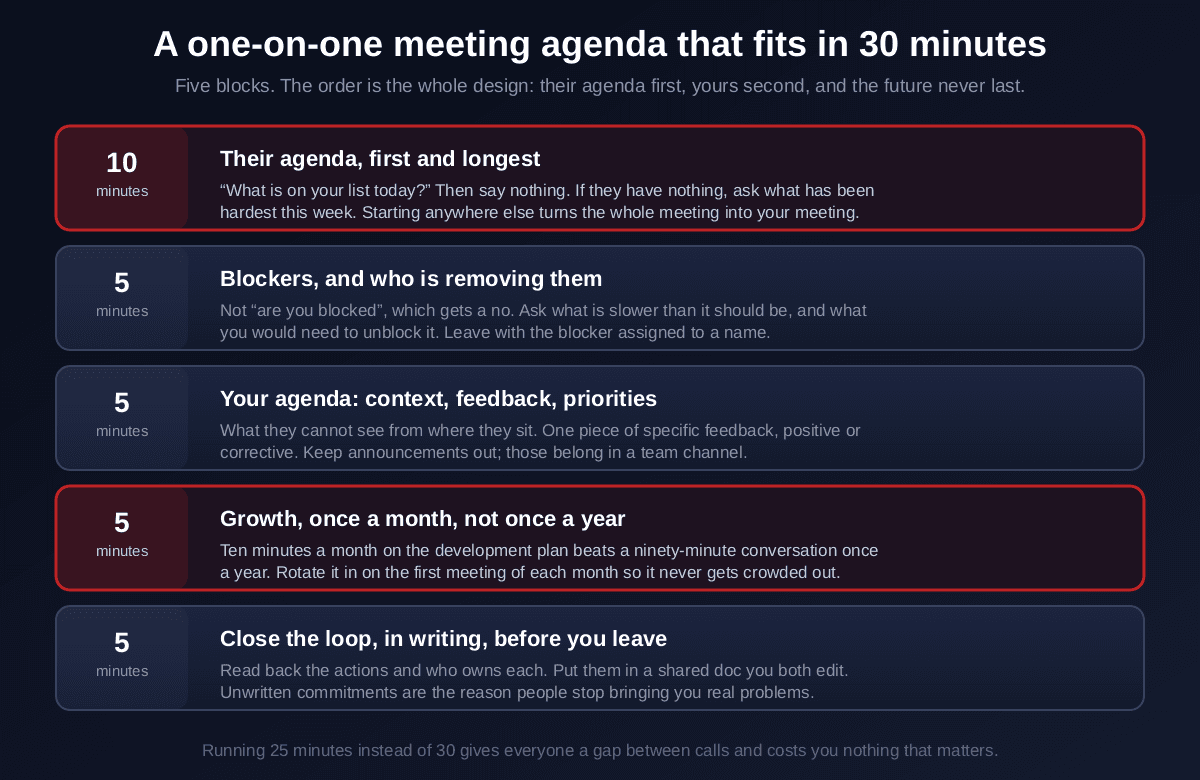
Their agenda comes first and gets the most time.Open with "what is on your list today?" and then say nothing. If they genuinely have nothing, ask what has been hardest this week rather than filling the gap yourself. Starting anywhere else converts the meeting into your meeting permanently, and it is very hard to convert back.
Ask about blockers in the right shape."Are you blocked?" reliably gets a no, because it sounds like an accusation of not coping. "What is slower than it should be?" gets an answer. Then finish the block by assigning the blocker to a name, which is usually yours.
Your agenda is context and feedback, not announcements. Things they cannot see from where they sit, one specific piece of feedback, and priorities. Company news belongs in a team channel; using a scarce private conversation to broadcast is a waste of the only slot you have.
Growth goes in monthly, not annually. Ten minutes a month on the development plan beats a ninety-minute conversation once a year, because the annual version competes with a rating and the monthly version does not.
Close the loop in writing before anyone leaves. Read back the actions and who owns each, into a doc you both edit. Unwritten commitments that get forgotten are the single most reliable way to teach someone to stop bringing you real problems.
One-on-one meeting questions
Ask two or three, not twelve. A list worked through in order is an interrogation, and it produces the answers people give to interrogations.
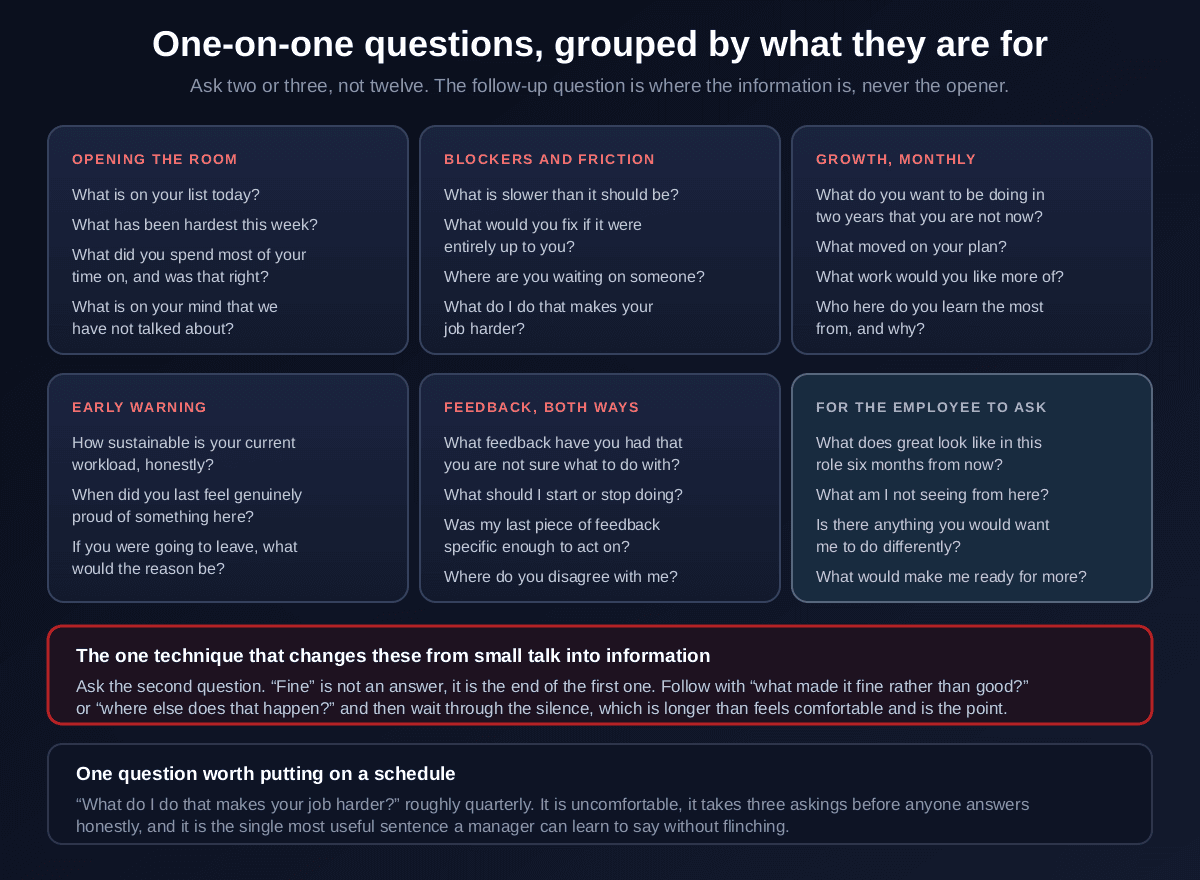
The technique that matters is the second question."Fine" is not an answer, it is the end of the first one. Follow it with "what made it fine rather than good?" or "where else does that happen?" and then wait. The silence will feel longer than is comfortable, and the thing that arrives after it is the reason the meeting exists.
The question worth putting on a schedule
A few of these questions do double duty as early warning. How sustainable is your current workload, honestly? and when did you last feel genuinely proud of something here? tend to surface the conditions that show up months later in your turnover numbers, and they are considerably cheaper to hear now than in an exit interview.
How often, and how long?
Weekly, 25 to 30 minutes, as a default. Frequency should track tenure and rate of change, not seniority, which is the variable most organisations accidentally use.
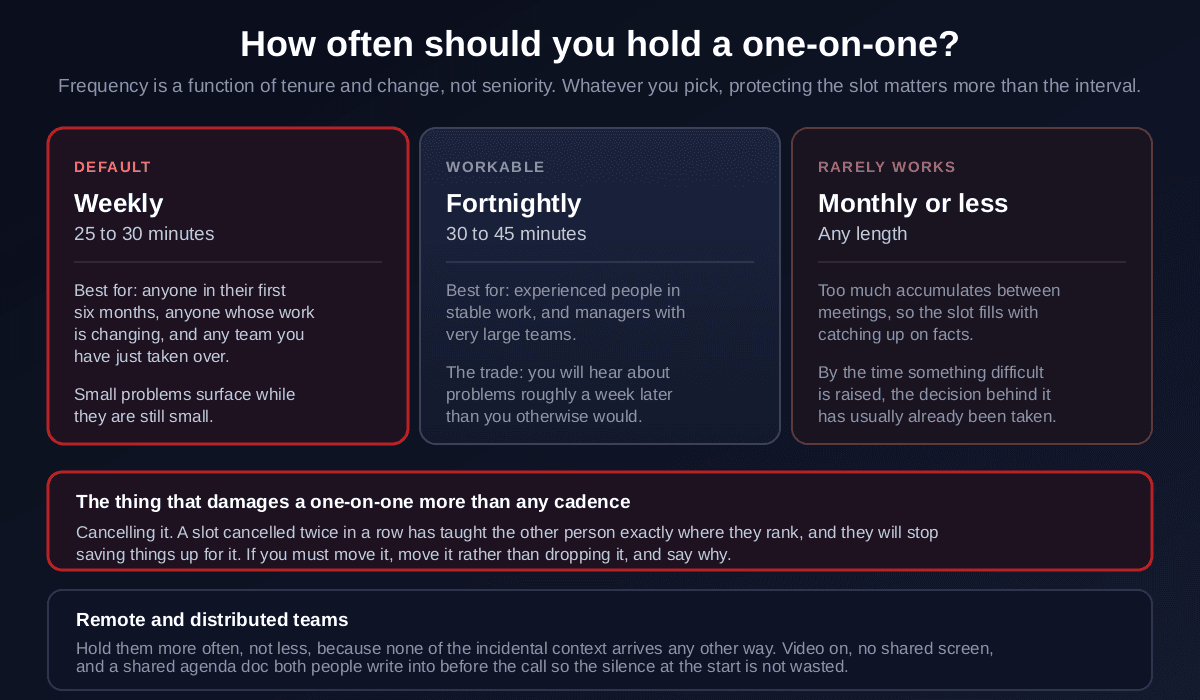
Cancelling does more damage than any cadence choice. A slot cancelled twice in a row has told the other person exactly where they rank, and they will stop saving things up for it. If you have to, move it rather than dropping it, and say why. The cost of this is invisible until somebody resigns and you realise you had not had a real conversation with them since March.
The first one-on-one with a new employee
Whether they are new to the company or you are new to them, spend this one on how you will work together rather than on the work.
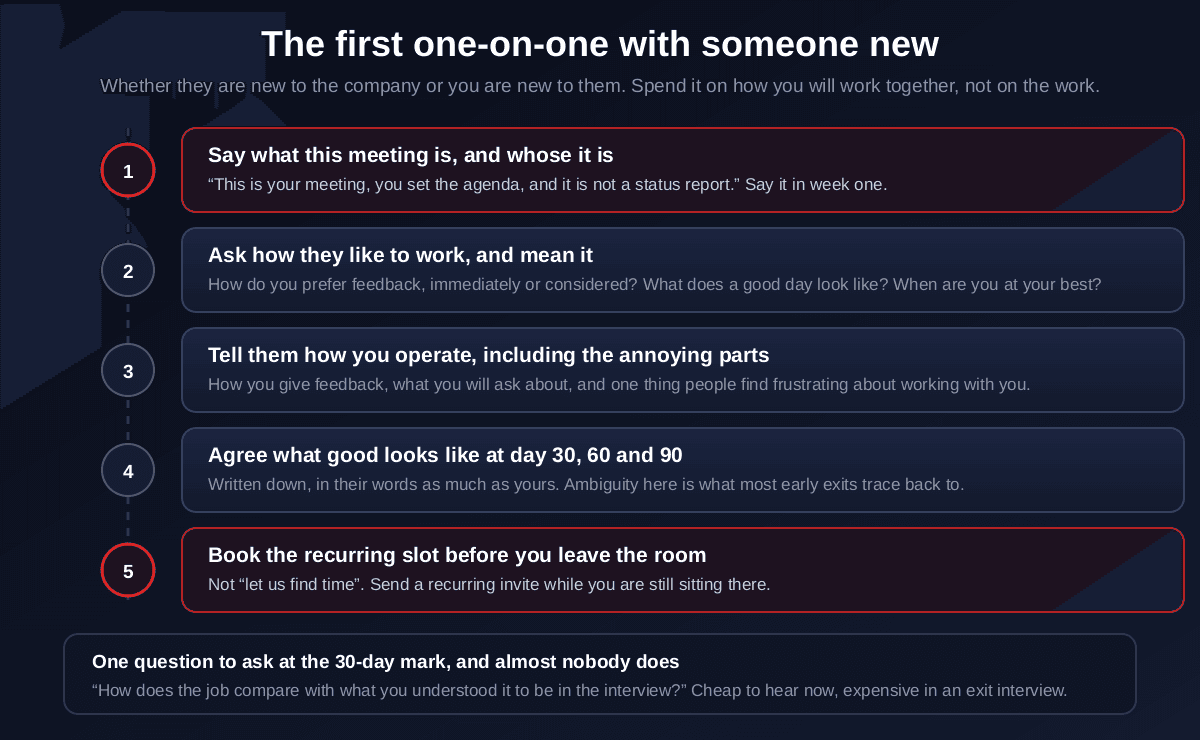
Step three is the one people skip and the one that buys the most credibility. Naming a specific thing others find frustrating about working with you does more than any amount of stated openness, because it demonstrates the behaviour instead of promising it.
Step four connects directly to whether this hire is still around next year. Agreeing what good looks like at day 30, 60 and 90 in writing is the same discipline as a 30-60-90 day plan, and the ambiguity it removes is what a large share of early exits trace back to.
The 30-day question almost nobody asks
If you are the report: what to ask your manager
The meeting is nominally yours and most people arrive with nothing, which is how it becomes a status update by default. Four questions carry most of the value.
- "What does great look like in this role six months from now?" The fastest way to find out whether your picture of the job matches theirs. Mismatches here are common and expensive.
- "What am I not seeing from where I sit?" Asks for context rather than reassurance, and usually gets it.
- "Is there anything you would want me to do differently?" A lower-stakes way to request corrective feedback than asking for a formal review, and far easier for a conflict-averse manager to answer.
- "What would make me ready for more?" Turns a vague ambition into a next step, and it pairs naturally with bringing a development plan of your own.
Beyond the questions, one habit outperforms all of them: bring a short list every week. A report who consistently arrives with three things gets a materially more useful manager than one who waits to be asked, and the difference compounds over a couple of years.
Skip-level meetings
A skip-level meetingis a conversation with your manager's manager, skipping the level between. Done as a routine it is one of the better information sources a senior leader has. Done occasionally and quietly, it corrodes trust in two directions at once.
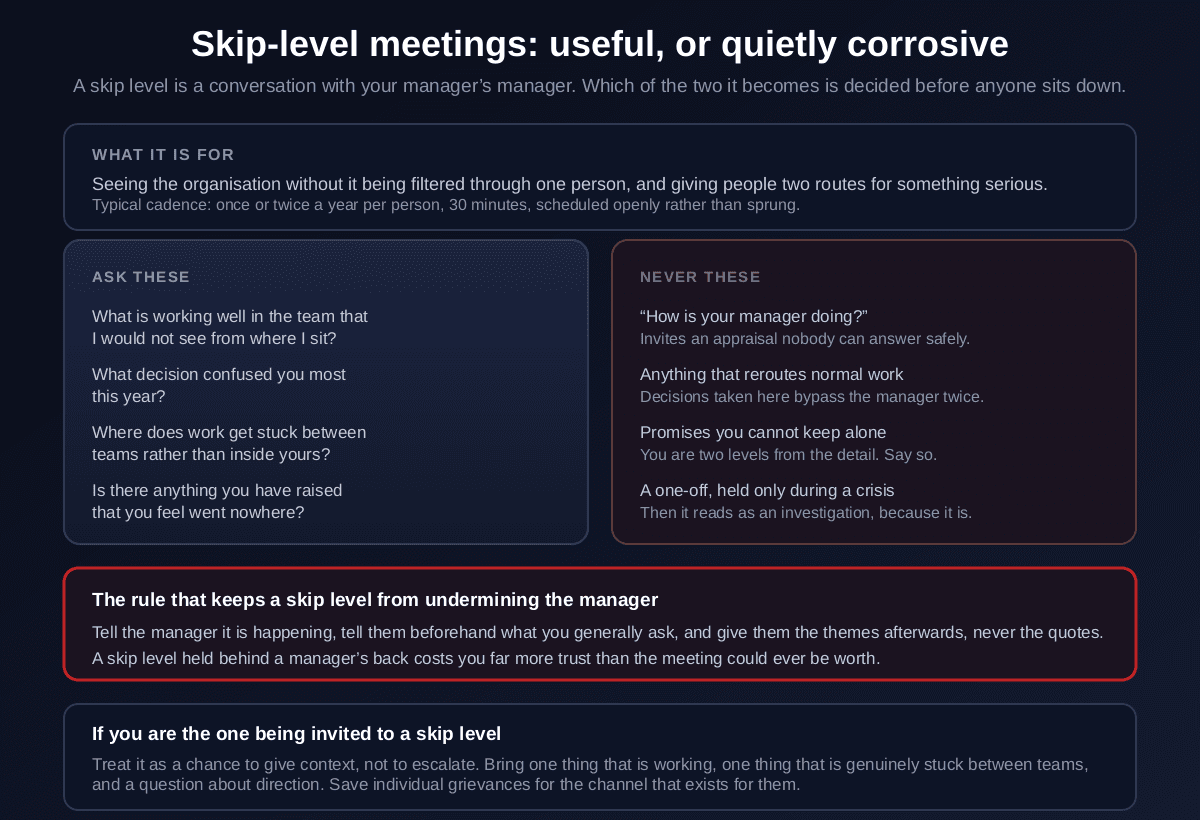
Ask about the system, not the person in between. The most productive question in the set is is there anything you have raised that you feel went nowhere?, because it locates the places where feedback enters your organisation and quietly disappears. The question to never ask is how is your manager doing?, which invites an appraisal nobody can answer safely and puts the employee in an impossible spot.
Three rules keep it from undermining the manager. Tell them it is happening and roughly what you ask, beforehand. Give them the themes afterwards, framed as patterns, never the quotes. And route anything actionable back through them rather than acting directly, with the obvious exception of things that should not go through them at all, meaning harassment, safety or similar, which go to the channel that exists for them.
The framing matters as much as the mechanics. A skip level is for context, not an appeal court. Once people learn they can relitigate ordinary decisions one level up, the manager's authority erodes and you will spend longer repairing that than the information was worth. This is the same balance that makes structured processes work elsewhere: the value comes from the routine, not from the exception.
The 30-day question keeps pointing back at the shortlist
When new hires say the job is not what the interview described, the fix sits at the front of the funnel rather than in the meeting. Upload your applicant batch and paste the job description, and Rankid scores every candidate 0 to 100 against the role's real requirements, so the people you hire match the work as it actually exists. Up to 200 resumes per batch, first 5 free, no signup.
Score your applicant pool freeNotes, follow-through, and what happens between meetings
Keep a shared running document that both people edit. It solves two problems at once: the meeting that opens with awkward silence because nobody remembered their items, and the far more damaging one below.
The failure that ends candour is a manager who agrees to remove a blocker and then forgets. Once, and the report notices. Twice, and they quietly stop raising things, and from that point you are running a status update whether you have noticed or not. Nothing else in this article matters as much as closing the loop on what you said you would do.
One boundary worth holding: do not keep performance notes in the shared doc. Those belong in your own records. Someone discovering an assessment of themselves in a file they thought was collaborative is a breach of trust that does not get repaired, and it is entirely avoidable.
Remote and distributed one-on-ones
Hold them more often, not less. In an office you notice that someone is having a bad week without anyone saying so. Remotely, that information does not exist unless the meeting creates it, and the first indication can be a resignation.
- Video on, screen share off. The moment a screen is shared the conversation becomes a work review, which is the exact thing you were trying to avoid.
- The shared agenda doc matters more here. There is no corridor in which to mention a small thing, so items have to have somewhere to accumulate.
- Be deliberate about the first two minutes. Remote calls start abruptly, with none of the walk-to-the-room conversation that lets people warm up before saying something difficult.
The mistakes that turn a 1:1 into a waste of 30 minutes
- Running it as a status update. Duplicates the tracker and teaches both people the meeting is pointless.
- Opening with your agenda. Establishes whose meeting it is, permanently.
- Cancelling it. The most damaging single act available to you here.
- Filling the silence. The useful answer arrives after the pause that feels too long.
- Never asking a second question.Every answer stops at "fine", and you conclude everything is fine.
- Saving growth for the annual review. Where it has to compete with a rating and loses.
- Taking no notes, then forgetting an action. Quietly ends the flow of real problems.
- Using it to deliver team announcements. A waste of the only private slot you have.
- First corrective feedback given in a formal review. Turns a small correction into a surprise, and surprises in reviews cost trust out of all proportion to the substance. Our guide to performance reviews covers why nothing in one should ever be new.
Key takeaways
- A one-on-one is for what does not appear in a tracker. If every fact was already in Jira, it was a status update.
- The report owns the agenda. Whatever is discussed first decides whose meeting it is, and the drift is always towards the manager's.
- Weekly, 25 to 30 minutes, as a default. Frequency tracks tenure and change, not seniority.
- Five blocks: their agenda (10), blockers (5), your context and feedback (5), growth monthly (5), actions in writing (5).
- Ask 'what is slower than it should be', not 'are you blocked'. The second phrasing reliably gets a no.
- Ask the second question. 'Fine' is the end of the first one, not an answer.
- 'What do I do that makes your job harder?' quarterly. Expect two non-answers before a real one.
- In the first 1:1, say out loud whose meeting it is, and book the recurring slot before you leave the room.
- Ask at 30 days how the job compares with the interview. Cheap now, expensive in an exit interview.
- A skip-level is once or twice a year, scheduled openly. Ask about the system, never 'how is your manager doing?'.
- Skip-level rules: tell the manager beforehand, share themes afterwards, never quotes, and route actions back through them.
- Cancelling twice in a row teaches someone where they rank. Move it rather than dropping it.
Every one-on-one comes down to one test you can apply on the way out: did I learn something I could not have read somewhere else? If the answer is no for three weeks running, the problem is not the person on the other side of the table, it is that the meeting has quietly become a report. Give the agenda back, open with a question, and wait longer than feels comfortable. And when what you keep hearing at the 30-day mark is that the job is not the one the interview described, that is a hiring signal rather than a management one: paste the job description and your applicant batch into Rankid's bulk resume screening and check that the shortlist matches the work as it actually exists.
Frequently asked questions
What is a one-on-one meeting?
A one-on-one, often written as a 1:1 or 1 on 1, is a recurring private conversation between a manager and someone who reports to them. Its purpose is the things that do not surface anywhere else: friction, ambiguity, frustration, ambition and the early signals of a problem. That definition rules out what most 1:1s actually become, which is a verbal status report. If everything discussed could have been read in a project tracker, the meeting produced nothing that the tracker did not already contain, and it will feel like a waste to both people because it was. The clearest way to tell the two apart is who sets the agenda. In a working one-on-one the report brings most of the content and the manager brings context, feedback and priorities. In a status update the manager works down a checklist and the report answers. Same 30 minutes, entirely different output.
What should a one-on-one meeting agenda include?
Five blocks inside 30 minutes, and the order matters more than the content. Ten minutes on their agenda, opened with what is on your list today and then genuine silence. Five minutes on blockers, asked as what is slower than it should be rather than are you blocked, because the second phrasing reliably gets a no. Five minutes on your agenda: context they cannot see from where they sit, one piece of specific feedback, and priorities. Five minutes on growth, rotated in on the first meeting of each month rather than saved for an annual conversation. Five minutes to close the loop in writing, reading back the actions and who owns each. Starting with your agenda rather than theirs is the single most common structural error, because whatever is discussed first sets what the meeting is for, and once it is your meeting they stop bringing things to it.
What questions should you ask in a one-on-one?
Ask two or three, not twelve, and treat the follow-up as the real question. Good openers: what is on your list today, what has been hardest this week, and what did you spend most of your time on and was that right. For friction: what is slower than it should be, where are you waiting on someone, and what do I do that makes your job harder. For growth, monthly: what do you want to be doing in two years that you are not doing now, and what work would you like more of. As an early warning: how sustainable is your current workload honestly, and when did you last feel genuinely proud of something here. The technique that turns any of these from small talk into information is asking the second question. Fine is not an answer, it is the end of the first one. Follow with what made it fine rather than good, or where else does that happen, and then wait through a silence that is longer than feels comfortable.
How often should you have one-on-ones, and how long should they be?
Weekly for 25 to 30 minutes is the right default, and frequency should track tenure and rate of change rather than seniority. Weekly is close to mandatory for anyone in their first six months, anyone whose work is changing, and any team you have just taken over, because at that frequency small problems surface while they are still small. Fortnightly for 30 to 45 minutes works for experienced people in stable work and for managers carrying very large teams, with the accepted trade that you will hear about problems roughly a week later than you otherwise would. Monthly or less rarely works: too much accumulates between meetings, so the slot fills up with catching up on facts, and by the time anything difficult is raised the decision behind it has usually already been taken. Running 25 minutes rather than 30 gives everyone a gap between calls and costs nothing that matters.
What should you do in the first one-on-one with a new employee?
Spend it on how the two of you will work together rather than on the work itself. Five things. Say what the meeting is and whose it is, out loud, in week one: this is your meeting, you set the agenda, and it is not a status report, because otherwise they will assume the opposite and be right most of the time. Ask how they like to work, including how they prefer feedback and when they are at their best. Tell them how you operate, including one thing people find frustrating about working with you, which buys more credibility than any amount of openness in the abstract. Agree what good looks like at day 30, 60 and 90, written down in their words as much as yours. And book the recurring slot before you leave the room, as an actual recurring invite rather than a promise to find time, because every week it is not booked makes it less likely to exist at all.
What is a skip-level meeting?
A skip-level meeting is a conversation between an employee and their manager's manager, skipping the level in between. It exists to do two things a normal reporting line cannot: let a leader see the organisation without it being filtered through one person, and give people a second route for something serious. Typical cadence is once or twice a year per person, around 30 minutes, scheduled openly as part of a normal rhythm. That last point does most of the work. A skip level that only ever happens during a crisis reads as an investigation, because in practice that is what it is. Run as a routine, it is one of the better sources of information a senior leader has. Run occasionally and secretly, it corrodes trust in both directions at once, and the manager who finds out afterwards is entitled to be uneasy about it.
What questions should you ask in a skip-level meeting?
Ask about the system, not about the person in between. Good questions: what is working well in the team that I would not see from where I sit, what decision confused you most this year, where does work get stuck between teams rather than inside yours, and is there anything you have raised that you feel went nowhere. That last one is the most productive question in the set, because it locates the places where feedback enters the organisation and disappears. The question to avoid is how is your manager doing, which invites an appraisal that nobody can answer safely and puts the employee in an impossible position. Also avoid taking decisions in the room, because a decision made in a skip level bypasses the manager twice, once in the making and once in the telling, and avoid promising anything you cannot deliver two levels away from the detail.
How do you run a skip-level without undermining the manager?
Three rules, and they are not optional. Tell the manager the meetings are happening and roughly what you ask, before they happen rather than afterwards. Give them the themes afterwards, framed as patterns, and never the quotes, because one attributed remark ends candour for everyone who comes after. And route anything actionable back through the manager rather than acting on it directly, unless what you heard is precisely the sort of thing that should not go back through them, meaning harassment, safety or something similar, in which case it goes to the channel that exists for it. Beyond the mechanics there is a framing point: the purpose is context, not an appeal court. If people start using skip levels to relitigate ordinary decisions, the manager's authority erodes and you will spend more time repairing that than you gained from the information.
What questions should an employee ask their manager in a one-on-one?
Bring your own agenda, because the meeting is nominally yours and most people arrive with nothing. Four questions carry most of the value. What does great look like in this role six months from now, which is the fastest way to find out whether your idea of the job matches theirs. What am I not seeing from where I sit, which asks for context rather than reassurance and usually gets it. Is there anything you would want me to do differently, which is a lower-stakes way of asking for corrective feedback than requesting a formal review. And what would make me ready for more, which is the question that turns a vague ambition into something with a next step. Beyond the questions, one habit matters more than any of them: bring a short list every week. A report who consistently arrives with three things gets a materially better manager than one who waits to be asked.
Should you take notes in a one-on-one?
Yes, in a document both people can edit, and write the actions down before the meeting ends. The failure mode this prevents is the most corrosive thing in the whole practice: a manager who agrees to remove a blocker and then forgets. It happens once and the report notices. It happens twice and they quietly stop raising things, and from then on you are running a status update whether you realise it or not. A shared running doc also solves the problem of the meeting that starts with awkward silence, because both people can add items during the week when they think of them rather than trying to remember on the day. Keep it to agenda items, decisions and actions. Do not keep performance notes in a shared 1:1 doc: those belong in your own records, and discovering them in a shared file is a genuine breach of trust that people do not forgive.
How should one-on-ones work for remote teams?
Hold them more often rather than less, because none of the incidental context that colocated teams absorb in passing arrives any other way. In an office you notice someone is having a bad week; remotely you find out in a resignation. Three practical adjustments help. Video on, since tone alone strips out most of what you are trying to read, but no shared screen, because the moment a screen is shared the meeting becomes a work review. Keep a shared agenda doc that both people write into during the week, which matters more remotely because you cannot catch someone in a corridor to mention a small thing. And be deliberate about the first two minutes, since remote calls start abruptly with none of the walk-to-the-room conversation that lets people warm up before saying something difficult.
What are the most common one-on-one meeting mistakes?
Nine recur constantly. Running it as a status update, which duplicates the tracker. Opening with your agenda, which permanently makes it your meeting. Cancelling it, which is the most damaging of all: a slot cancelled twice in a row has told the other person exactly where they rank. Filling silence, because the useful answer usually arrives after the pause that feels too long. Never asking a second question, so every answer stops at fine. Saving growth for the annual review, at which point it competes with a rating. Taking no notes and forgetting an agreed action, which quietly teaches people to stop raising things. Using it to deliver news that belongs in a team channel. And giving the first piece of corrective feedback in a formal review rather than in a 1:1, which turns a small correction into a surprise, and surprises in reviews damage trust out of all proportion to the substance.