Employee Onboarding: The Process, a 90-Day Checklist, and the Half That Happens Before Day One (2026)
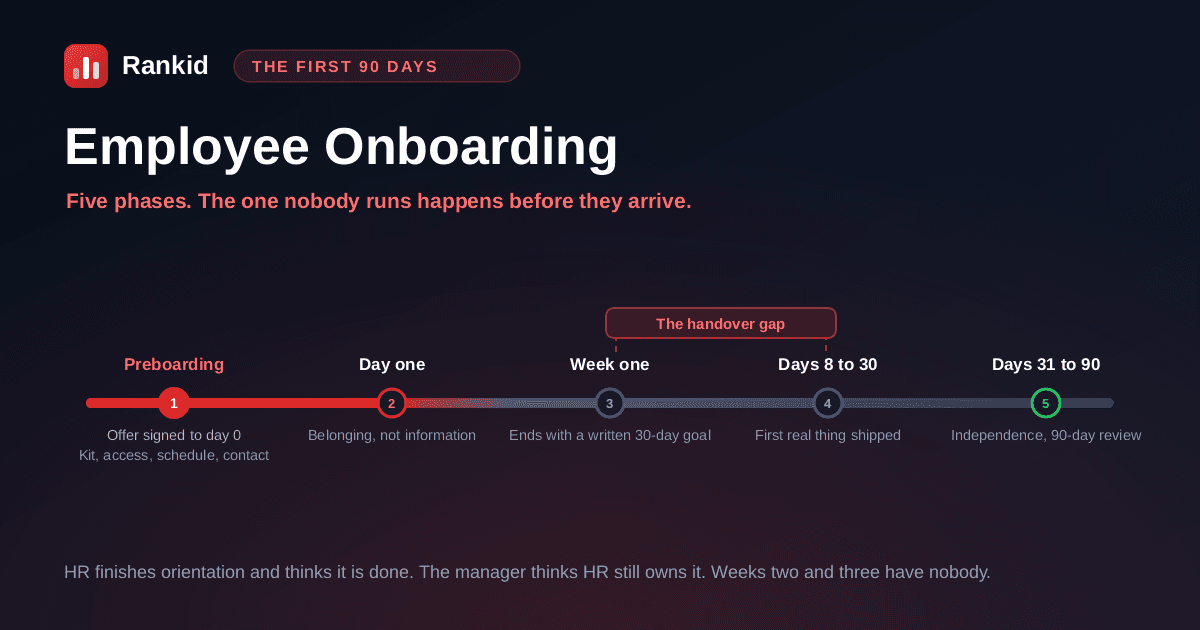
Most companies believe employee onboarding starts on day one. By day one, the two things that actually predict whether someone stays have already been settled: whether their first week contains a job or just a series of introductions, and whether you hired the right person in the first place. Onboarding is not a welcome pack and it is not an orientation session. It is a 90-day process with five phases, and the phase almost nobody runs happens in the week before the person arrives.
Quick answer
Quick answer: employee onboarding is the structured process of moving someone from a signed offer to fully productive, normally over at least 90 days. It has five phases: preboarding, day one, week one, days 8 to 30, and days 31 to 90. Orientation is one event inside onboarding, not a synonym for it. HR owns compliance and orientation, IT owns access, and the hiring manager owns everything that decides whether the person succeeds. The three failures that matter: nothing was ready on day one, nobody owned weeks two and three, and the manager was absent in month one.
What is employee onboarding?
Employee onboarding is the process of taking someone from a signed offer to genuinely productive and settled in the role. The word comes from bringing someone on board a ship, and it now gets used well beyond HR: software companies onboard users, banks onboard clients under KYC rules, agencies onboard accounts. The common thread is a defined sequence that moves someone from outside a system to competent inside it.
Applied to a new employee, it is four jobs stacked on top of each other:
- Administrative. Paperwork, payroll, equipment, accounts, access. The part every company does, because it has deadlines attached.
- Informational. How the company works, who does what, where things live, what the acronyms mean.
- Role. What this person owns, what good looks like at 30 and 90 days, what their first real piece of work is.
- Social. Knowing enough people that asking a basic question is not intimidating. The one that most affects whether someone stays, and the one nobody schedules.
Companies reliably execute the first and neglect the fourth. That mismatch is why the most common new hire experience is a smooth, well-organised first day followed by three weeks of quietly not knowing what they were supposed to be doing.
If you are the new hire: does onboarding mean you got the job?
Onboarding vs orientation: not the same thing
Orientation is an event. Onboarding is a process, and orientation is one part of it. Conflating the two is the single most consequential structural error in this whole subject, because a company that believes they are synonyms also believes onboarding is finished on the afternoon orientation ends.
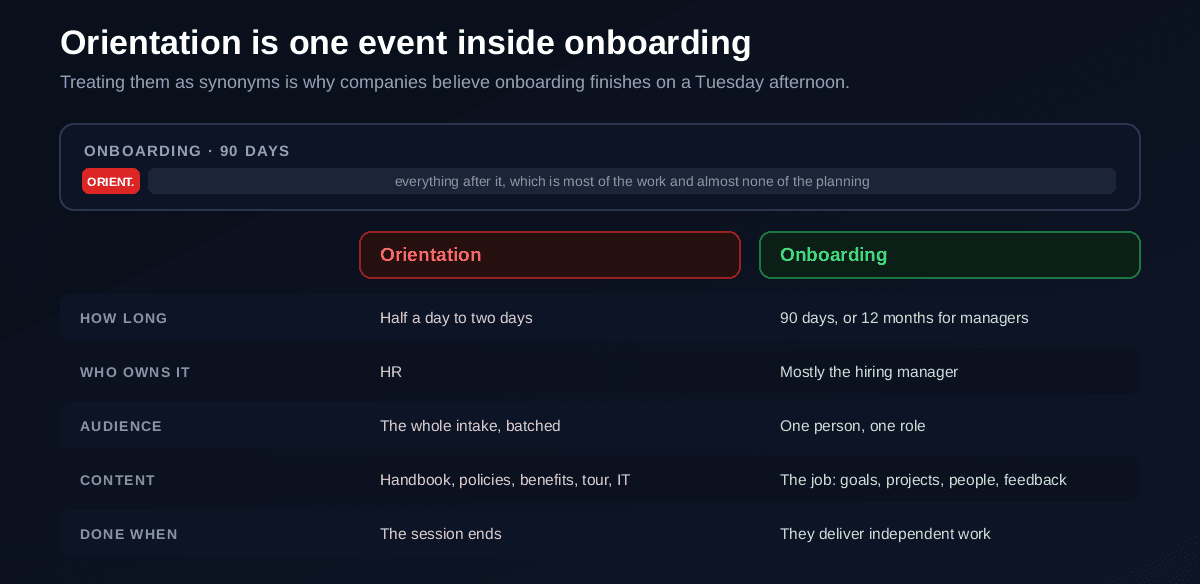
Orientation is generic by design. The same handbook, policies, benefits enrolment, tour and IT session works for everyone in an intake, which is exactly why it can be batched and run by HR. Onboarding is mostly role-specific and therefore mostly cannot be: the first project, the eight people this particular job depends on, the first feedback conversation, the 30-day goals. Those belong to the hiring manager and they cannot be delegated to a deck.
The employee onboarding process: five phases
Five phases, and the handover between phase two and phase three is where onboarding quietly stops in most organisations.
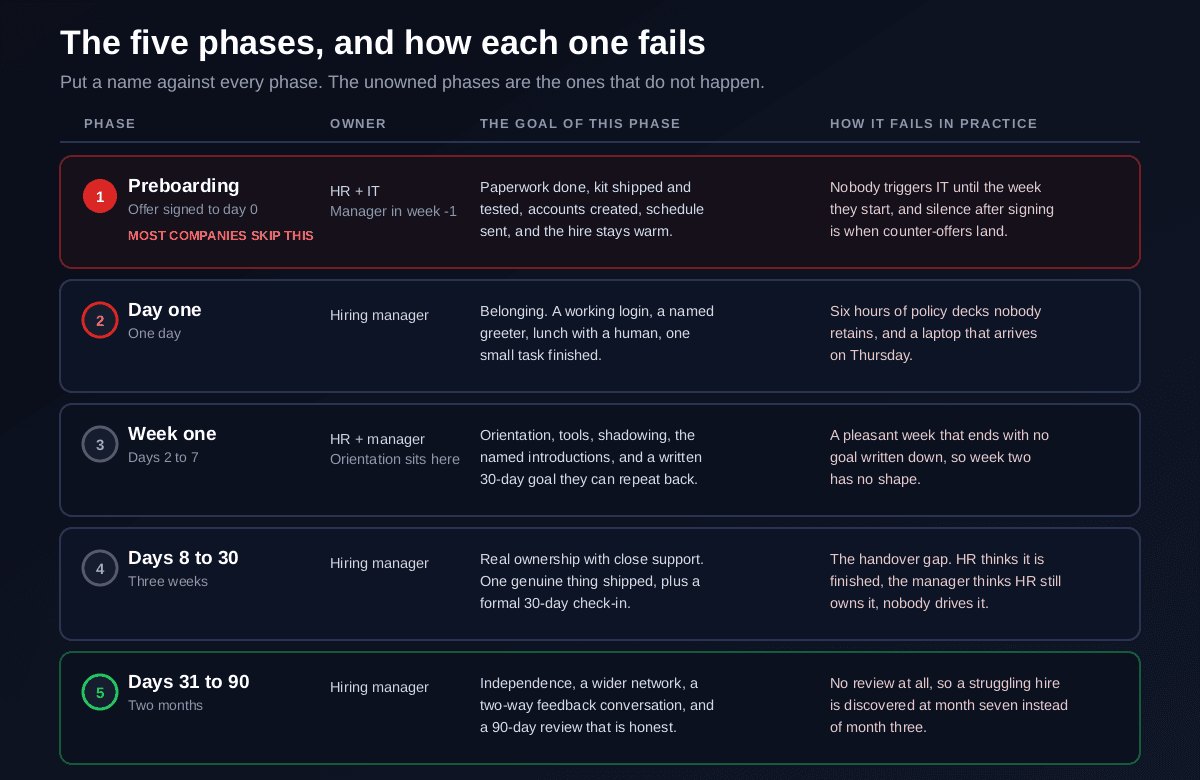
Preboarding: offer signed to the day before day one
The highest-leverage phase and the one most companies do not run at all. Paperwork completed in advance, equipment ordered early enough to arrive before the start date, accounts requested so they exist on day one, the first-week schedule sent, an introduction to the team and the buddy, and a real human check-in from the hiring manager in the final week.
It also has a protective function that recruiting teams underrate. The gap between signing and starting is exactly when counter-offers and second thoughts arrive, and silence during it is what makes a signed candidate reachable again. A laptop that works on day one is not logistics. It is the first thing the company has said about itself.
Day one: belonging, not information
Nearly nothing said on day one is retained, so stop trying. The whole checklist is: the laptop works and the accounts exist before they log in, a named person is expecting them at a specific time, the manager spends real time with them rather than a rushed fifteen minutes, they meet their buddy, they eat lunch with a human being, they complete one small real task, and they leave knowing exactly what tomorrow looks like.
The handbook, the policy deck and most systems training are better on day two or three. Day one is for deciding they made the right call.
Week one: orientation, tools, and a written 30-day goal
Orientation belongs here, alongside the tools, some shadowing, and the introductions the job depends on. The thing that separates a good week one from a pleasant one is that it ends with a written 30-day goal the new hire could repeat back to you. If they cannot say what they are supposed to have achieved by day 30, week two has no shape.
Days 8 to 30: real ownership with close support
The shift from watching to doing. A first piece of genuine work shipped, however small, because nothing else creates the feeling of belonging that finishing something does. Frequent short check-ins rather than a single long one, and a formal 30-day conversation covering what is going well, what is confusing, and what has turned out to be different from what they were told in the interview. That last question is uncomfortable and it is the most useful one you will ask.
Days 31 to 90: independence and a wider network
Structure thins out into a rhythm: clear goals, regular one-to-ones, a widening set of relationships beyond the immediate team, and a first feedback conversation that runs in both directions. The 90-day review confirms the person is on track and, in the cases where they are not, does so early enough to be fixable. A written plan makes this phase far easier to run, and our guide to the 30-60-90 day plan covers the version written after someone starts rather than the one written to win the interview.
The handover gap
The employee onboarding checklist
Four columns, because the useful unit is not a single list but four lists with different owners and deadlines. Copy this, delete what does not apply, and put a name against every line.
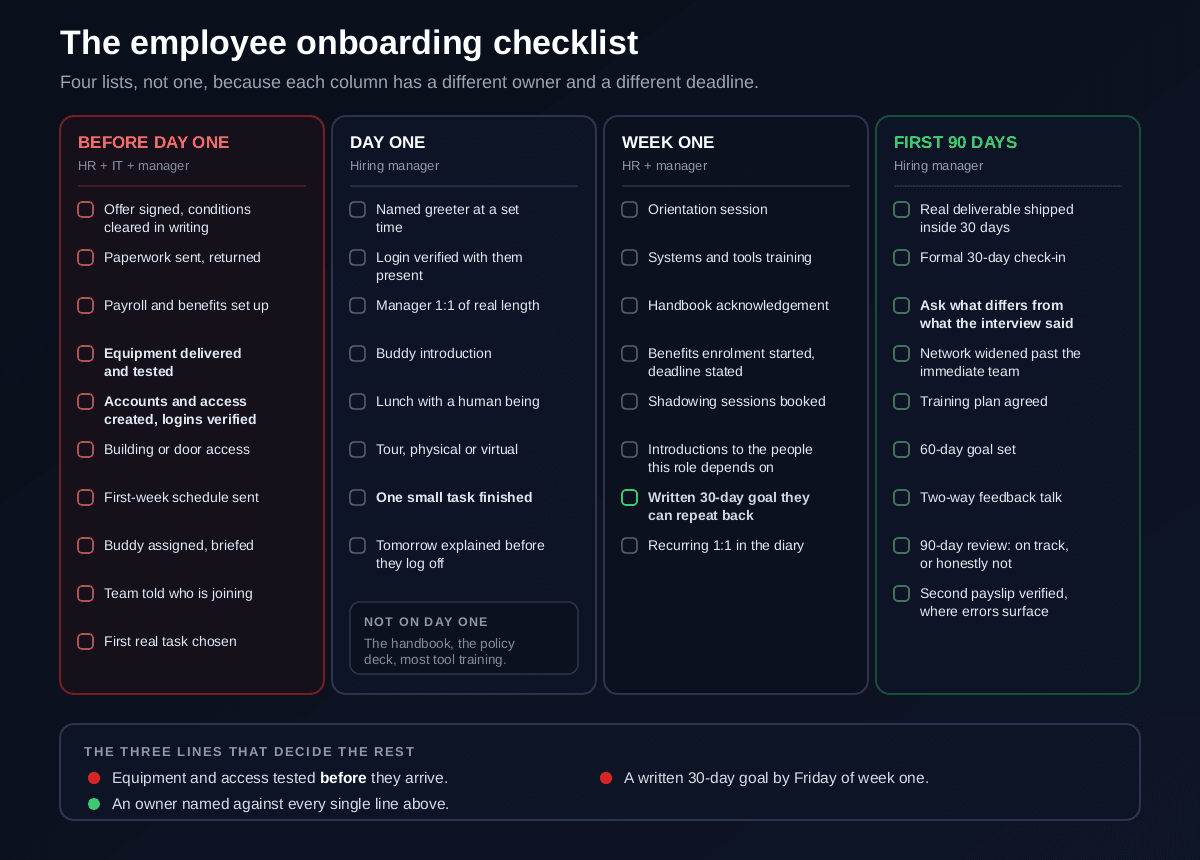
Before day one (HR, IT, manager). Offer signed and countersigned, contingencies cleared in writing. Paperwork sent and returned. Payroll and benefits set up. Equipment ordered, delivered and tested. Accounts, email, and tool access created and confirmed working. Building or door access arranged. First-week schedule written and sent. Buddy assigned and briefed. Team told who is joining, when, and what they will own. Desk or workspace ready. First task chosen.
Day one (manager). Named greeter at a specific time. Login verified with the person present. Manager one-to-one of real length. Buddy introduction. Lunch with someone. Tour, physical or virtual. One small completed task. Tomorrow explained before they leave.
Week one (HR and manager). Orientation. Systems and tools training. Handbook acknowledgement. Benefits enrolment started with its deadline stated. Shadowing sessions booked. Introductions to the specific people this role depends on, by name. Written 30-day goal agreed. Recurring one-to-one in the calendar.
First 90 days (manager). First real deliverable shipped inside 30 days. Formal 30-day check-in including what has turned out differently from the interview. Introductions widened beyond the immediate team. Training or certification plan agreed. 60-day goal set. Two-way feedback conversation. 90-day review with a clear statement of whether the person is on track. Benefits and payroll verified as correct, because the second payslip is where errors surface.
New hire paperwork: what is required, and by when
This is the part with statutory deadlines attached, so it is worth separating what the law requires from what your company wants.
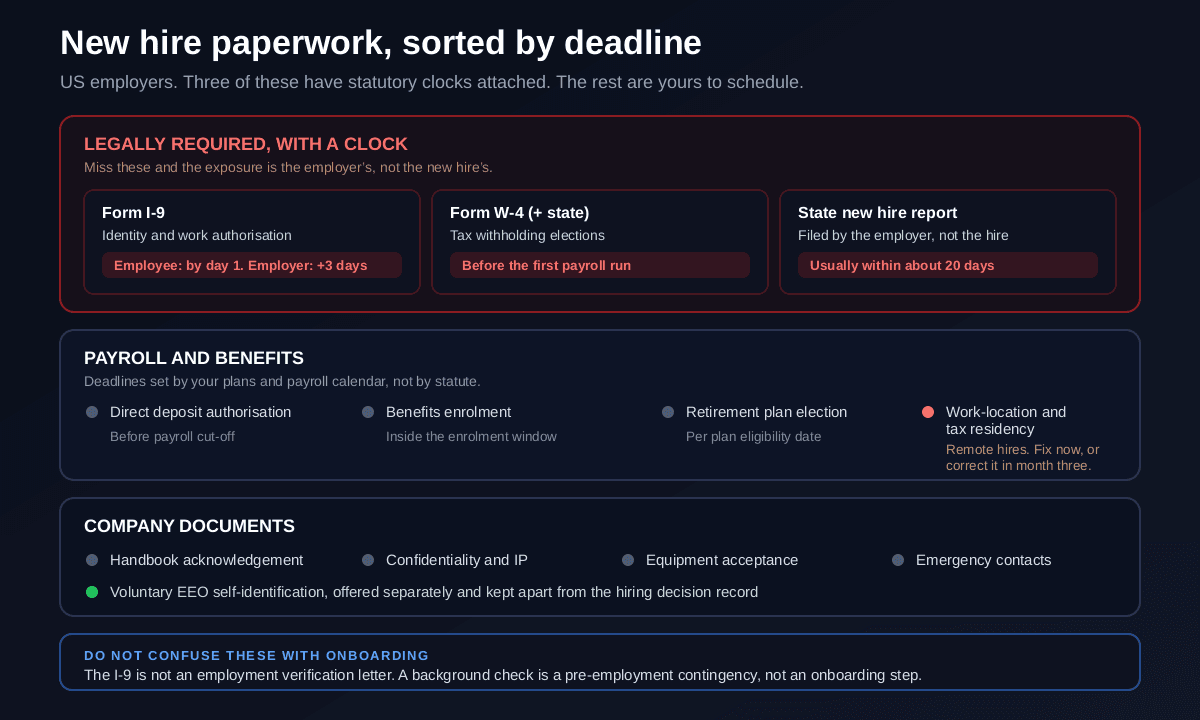
Legally required, US. Form I-9 verifies identity and work authorisation: the employee section is completed no later than the first day of work, and the employer section within three business days of the start date. Form W-4 sets federal withholding and must be in place before the first payroll run, with the state equivalent where one exists. New hire reporting to the state directory is an employer obligation, generally within about 20 days. E-Verify participation is required for some employers and optional for others.
Payroll and benefits. Direct deposit authorisation, benefits enrolment inside its window, retirement plan enrolment, and any tax residency or work-location declarations for remote hires, which is the detail that most often turns into a payroll correction three months later.
Company documents. Handbook acknowledgement, confidentiality and intellectual property agreement, equipment acceptance, emergency contacts, and role-specific items such as licence or certification verification. Voluntary EEO self-identification is offered separately and kept apart from the hiring decision record.
Two things people confuse with onboarding paperwork
How long should onboarding last?
Ninety days is the floor, and 12 months is right for managers and complex specialist roles. The 90-day number is not arbitrary. It is roughly how long it takes to deliver visible independent work in a professional role, and it lines up with the natural checkpoints at 30, 60 and 90 days.
What changes across the period is density, not presence. Preboarding and week one are heavily scheduled. Weeks two to four are a mix of shadowing and first real tasks. From day 30 the structure should be a rhythm of goals and check-ins rather than sessions. Onboarding that ends after week one leaves people in the worst possible position, which is knowing where the coffee is and not knowing what they own.
If you are the new hire asking how long onboarding takes, the paperwork portion is normally one to three days, and it is the part that ends. The rest is the first quarter of your job.
Remote onboarding: what changes
Everything an office teaches by accident has to be written down or scheduled. Equipment and access must work before day one, because a remote joiner with a broken login has nobody to turn to and no visible way to ask. Introductions become a deliberate sequence of short calls across two weeks rather than an incidental accumulation. Documentation replaces overheard context. And a daily short check-in in week one, tapering to weekly, replaces the manager who would otherwise be visible across a desk. Our guide to hiring remote employees covers the process and the jurisdiction traps around this in more depth.
Why onboarding fails, and why it is often not an onboarding problem
Four causes, and only one of them is about the programme.
- Nothing was ready. No laptop, no accounts, no desk, no first task. It tells a new hire on day one that their arrival was not planned for, and that impression is expensive to reverse.
- The handover gap. Orientation ends, HR considers onboarding delivered, the manager assumes HR still owns it, and weeks two and three have nobody driving them.
- An absent manager in month one. The strongest single predictor of an early exit, and usually caused by a manager who was hiring because they were overloaded in the first place.
- The wrong hire. The one nobody wants to name. Where the role and the person were mismatched from the start, onboarding is being asked to fix a selection problem, and it cannot.
That last cause is worth taking seriously before you rebuild a programme that may not be broken. If new hires keep struggling in the same way in the same role, the pattern is usually upstream: a job description describing a different job, a screen that filtered on the wrong evidence, or interviews that never tested the thing the work actually requires. An interview scorecard and a consistent screen against the real requirements do more for 90-day retention than any welcome pack.
Most onboarding failures were decided at the screening stage
Before you rebuild the onboarding programme, check whether you are onboarding the right people. Upload your applicant batch and paste the job description, and Rankid scores every candidate 0 to 100 against the role's actual requirements, listing what each one matches and misses. Up to 200 resumes per batch, first 5 free, no signup.
Score your applicant pool freeOnboarding metrics worth tracking
Four numbers tell you almost everything, and each one points at a different broken thing:
- Time to productivity. Days until the person delivers independent work at the expected standard, judged by the manager against the 30 and 90-day goals. Rising numbers usually mean unclear ownership, not slow learners.
- 90-day and 12-month retention. An exit inside 90 days is nearly always a hiring or expectation-setting failure rather than a performance one.
- New hire satisfaction at day 7 and day 30. Two short surveys beat one long one, and the gap between them is the most diagnostic figure in onboarding: high at day 7 and low at day 30 is the handover gap, precisely.
- Onboarding completion rate. The share of new hires whose checklist was actually completed on time. Usually far lower than anyone assumes, and it is the cheapest thing on this list to fix.
These sit alongside the funnel metrics upstream of them. Our guides to recruitment metrics and cost per hire cover those, and candidate experiencecovers the stage immediately before this one, which is where a new hire's expectations were set.
Key takeaways
- Employee onboarding is a 90-day process, not a day or a week. Orientation is one event inside it.
- Five phases: preboarding, day one, week one, days 8 to 30, days 31 to 90.
- Preboarding is the highest-leverage phase and the one most companies skip entirely.
- Day one is for belonging, not information. Almost nothing said on day one is retained.
- Week one must end with a written 30-day goal the new hire could repeat back to you.
- Name an owner for every phase. The handover gap between HR and the manager is where onboarding stops.
- US paperwork with hard deadlines: I-9 employee section by day one and employer section within three business days, W-4 before first payroll, state new hire reporting within about 20 days.
- Track day-7 and day-30 satisfaction. High then low is the handover gap, exactly.
- If new hires keep failing in the same role, the problem is upstream in screening, not in the welcome pack.
The version of this that works is not elaborate. Send the paperwork and the equipment before they start, make sure the laptop logs in on the first morning, put a named human in front of them, end week one with a written 30-day goal, and hold the 30 and 90-day conversations you already have in the calendar. Then check the thing upstream of all of it, because no onboarding programme rescues a hire that was decided on the wrong evidence: paste the job description and your shortlist into Rankid's bulk resume screening and see how each candidate scores against what the role actually needs.
Frequently asked questions
What is employee onboarding?
Employee onboarding is the structured process of taking someone from a signed offer to fully productive and settled in the role, and it normally runs for at least 90 days rather than for a day or a week. It has four jobs stacked on top of each other: the administrative one, meaning paperwork, payroll, equipment and system access; the informational one, meaning how the company works, who does what, and where things live; the role one, meaning what good performance looks like and what this person specifically owns; and the social one, meaning knowing enough people that asking a question is not intimidating. Companies almost always execute the first well and the fourth badly, which is why so many new hires describe a smooth first day followed by three weeks of not knowing what they were supposed to be doing.
What does onboarding mean?
In a hiring context, onboarding means integrating a new employee into an organisation, covering both the formalities of becoming an employee and the practical business of becoming effective at the job. The word is borrowed from the idea of bringing someone on board a ship, and it is now used well beyond HR: software companies talk about onboarding users, banks talk about onboarding clients under KYC rules, and agencies talk about onboarding accounts. The common thread is a defined sequence that moves someone from outside a system to competent inside it. When it refers to employees, the ordinary scope is the period from offer acceptance through roughly the first 90 days, though many organisations extend the formal programme to a full year for managers and specialist roles.
What is the difference between onboarding and orientation?
Orientation is an event; onboarding is a process, and orientation is one part of it. Orientation is the session, usually half a day to two days, where a new group gets the introduction to the company: the handbook, the policies, the benefits enrolment, the fire exits, the tour, the IT setup. It is largely identical for everyone who joins in the same intake and it is typically owned by HR. Onboarding is the 90-day arc around it, most of which is role-specific and owned by the hiring manager: the first project, the first feedback conversation, the introductions to the eight people this particular job depends on, the first month's goals. Treating them as the same thing is the single most common structural error, because it means a company believes onboarding is finished on the day orientation ends.
How long should employee onboarding last?
Plan for 90 days as the floor and 12 months for managers or complex specialist roles. The 90-day figure is not arbitrary: it is roughly how long it takes for someone to deliver visible independent work in a professional role, and it aligns with the natural review points at day 30, day 60 and day 90. Onboarding that stops after week one leaves people in the worst position, which is knowing where the coffee is and not knowing what they own. What changes over the period is the density: preboarding and week one are heavily scheduled, weeks two to four are a mix of shadowing and first tasks, and from day 30 onward the structure should be mostly a rhythm of check-ins and clear goals rather than sessions. From the new hire's own perspective, the paperwork portion of onboarding usually takes one to three days.
What are the phases of employee onboarding?
Five, and the first one is the one most companies skip. Preboarding runs from offer acceptance to the day before the start date, and it covers paperwork, equipment ordering, accounts, and staying in contact so the person does not go quiet and accept a counter-offer. Day one is about belonging rather than information: a working laptop, a named person expecting them, lunch with someone, and one small completed task. Week one adds orientation, the tools, shadowing, and a written 30-day goal. Days 8 to 30 shift to real ownership with close support, a first piece of real work shipped, and a formal 30-day check-in. Days 31 to 90 move to independence, a wider network, a first feedback conversation in both directions, and a 90-day review that confirms the person is on track. The handover from HR to the hiring manager sits between phase two and phase three, and it is where onboarding most often silently stops.
What is preboarding?
Preboarding is everything you do between the signed offer and the first day, and it is the highest-leverage part of onboarding because it is where you both remove day-one friction and protect the hire. Practically it means completing paperwork in advance, ordering and shipping equipment early enough to arrive before the start date, requesting accounts and access so they exist on day one, sending the first-week schedule so the person knows what they are walking into, an introduction to the team and to their onboarding buddy, and a genuine human check-in from the hiring manager in the final week. The protective function matters as much as the practical one: the period between signing and starting is exactly when counter-offers and second thoughts arrive, and silence during it is what makes a signed candidate reachable. A new hire who arrives to a working laptop and a schedule has been told something about the company that no orientation deck can say.
What paperwork does a new hire need to complete?
In the United States, three things are non-negotiable and time-bound. Form I-9 verifies identity and work authorisation: the employee section is completed no later than the first day of work, and the employer section within three business days of the start date. Form W-4 determines federal tax withholding and must be in place before the first payroll run, alongside the state equivalent where one exists. And new hire reporting to the state directory is a legal obligation on the employer, usually within about 20 days. Beyond those, expect direct deposit authorisation, benefits enrolment with its own deadline, emergency contacts, an employee handbook acknowledgement, and role-specific items such as a confidentiality and intellectual property agreement or a licence verification. Voluntary self-identification for EEO purposes is offered separately and must be kept apart from the hiring decision record.
Does onboarding mean you got the job?
If a company has invited you to onboarding, then in almost every case yes, the job is yours, because onboarding is what happens after an offer has been accepted rather than as part of the selection process. Two things cause confusion. First, some employers use the word loosely for pre-employment steps such as completing a background check portal or uploading documents, which happen while the offer is still contingent. Second, an offer can remain conditional until named contingencies clear, and those conditions run in parallel with early onboarding paperwork. The practical test is whether you have a written offer that you have accepted, and whether it still lists conditions. Until you have written confirmation that all conditions have cleared, do not resign from your current job, even if HR has already sent you a laptop and a first-week schedule.
What should a new employee do on their first day?
The best first days are deliberately light on information and heavy on belonging, because almost nothing said on day one is retained. From the employer's side, the checklist is short: the laptop works and the accounts exist before they log in, a named person greets them at a specific time, the manager spends real time with them rather than fifteen rushed minutes, they meet their onboarding buddy, they have lunch with a human being, they leave having completed one small real task, and they know exactly what tomorrow looks like. From the new employee's side, the useful behaviours are writing down every name and acronym, asking what success at 30 days looks like, and confirming who to go to with different kinds of question. Everything else, including the handbook and most of the systems training, is better on day two or three.
What is an onboarding buddy?
An onboarding buddy is a peer, deliberately not the new hire's manager, assigned to answer the questions people are reluctant to ask upward. That distinction is the whole point: a new joiner will not ask their manager what an internal acronym means, whether a meeting is optional, or whether it is normal to feel lost in week two, but they will ask a peer. A good buddy is a competent person one or two levels adjacent, not necessarily the most senior available, and the role works best with light structure: a first-day introduction, a standing weekly coffee for the first month, and a clear brief that they are not responsible for training or for evaluating the person. Buddy programmes are cheap and consistently rank among the highest-rated parts of onboarding in employee surveys, largely because they shorten the time before someone feels safe asking a basic question.
How do you onboard a remote employee?
Assume nothing will be absorbed by proximity and write down what an office would have taught by accident. Three things carry most of the weight. Equipment and access must arrive and work before day one, because a remote new hire with a broken login has nobody to turn to and no visible way to ask. Introductions have to be scheduled rather than incidental, which usually means a deliberate sequence of short one-to-one calls across the first two weeks instead of an all-hands introduction. And documentation replaces overheard context, so decisions, norms and the answers to obvious questions need to exist in writing. Add a daily short check-in for the first week, taper to weekly, and be explicit about working hours, response-time expectations and which channel is for what.
Why does employee onboarding fail?
Usually for one of four reasons, and only one of them is about the onboarding programme itself. The most common is that nothing was ready: no laptop, no accounts, no desk, no first task, which tells a new hire on day one that their arrival was not planned for. The second is the handover gap, where HR completes orientation, considers onboarding done, and the hiring manager assumes HR is still running it, so weeks two and three contain no owner and no plan. The third is an absent manager during the first month, which is the strongest single predictor of an early exit. The fourth, and the least discussed, is that the role and the person were mismatched from the start, in which case onboarding is being asked to fix a selection problem it cannot fix. Any diagnosis that stops at the programme without checking the handover and the hire will keep producing the same result.
Who owns employee onboarding?
It is shared, and writing down the split is what makes it work. HR owns compliance, paperwork, orientation, benefits enrolment, and the process itself, including the checklist and the reminders that make it happen consistently. IT owns equipment, accounts and access, and needs a trigger the moment an offer is signed rather than the week of the start date. The hiring manager owns everything that determines whether the person succeeds: the first-week schedule, the 30-day goals, the introductions, the first real task, the check-ins, and the 90-day review. The buddy owns the informal questions. The most common failure mode in practice is that everyone assumes the hiring manager's portion belongs to HR, which is how a company ends up with excellent orientation and new hires who spend week three guessing.