How to Handle Multiple Job Offers at Once (Without Burning a Single Bridge) (2026)
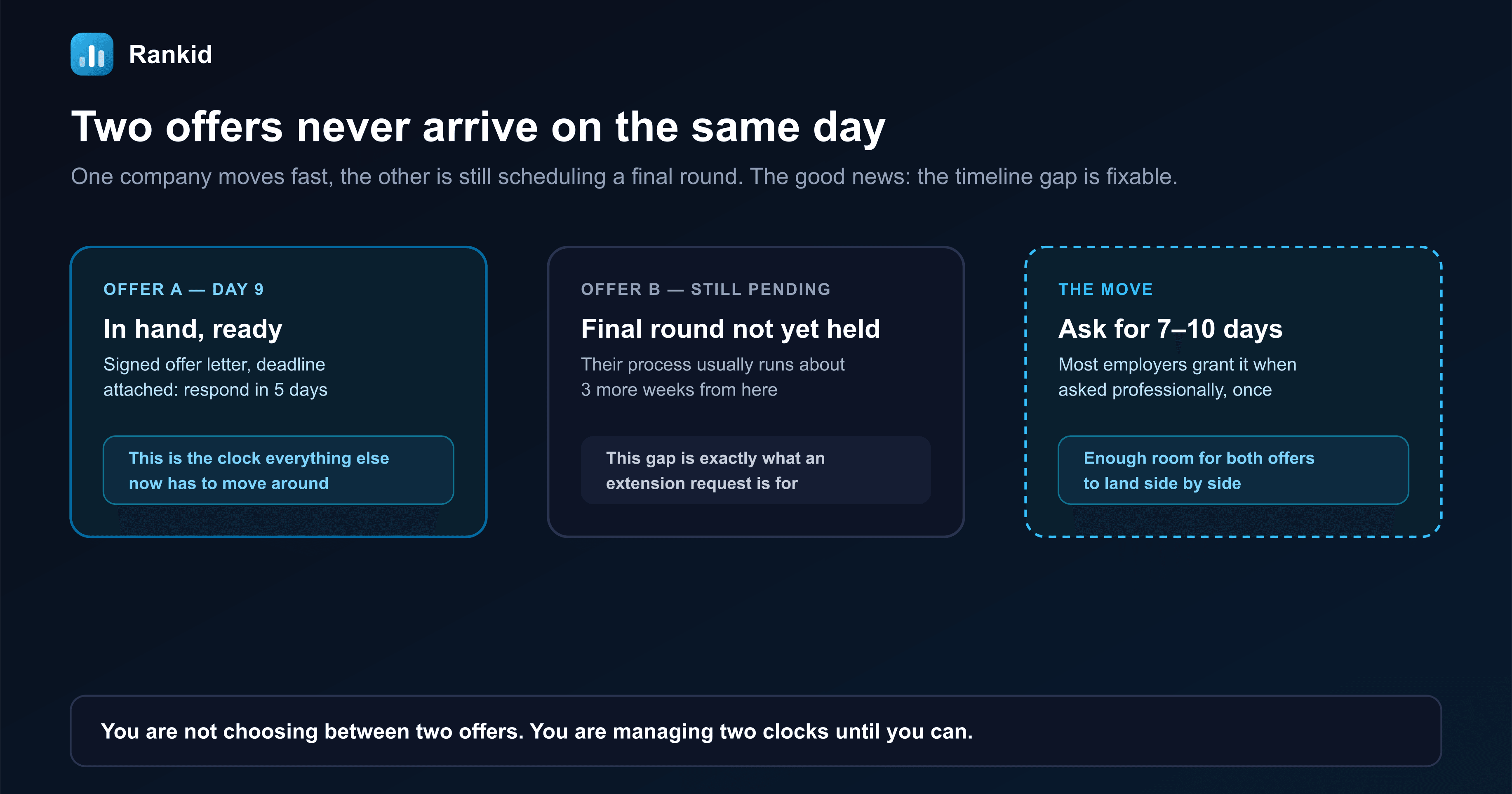
Offer A landed Tuesday with a five-day deadline attached. Offer B is a company you actually prefer slightly more, and their final round isn't even scheduled yet. This isn't really a decision between two job offers, not yet. It's a timing problem, and unlike most timing problems in a job search, this one has a well-known, professional fix that most candidates simply don't think to ask for.
Quick answer
Quick answer: before comparing offers, close the timeline gap. Ask the faster-moving employer for a 7 to 10 day extensionwith a specific reason and a specific new date — most employers grant this when asked professionally, before the original deadline. Once both offers can actually be compared, look past base salary to bonus, equity, benefits, growth ceiling, and manager or team stability. Real competing offers are legitimate leverage; invented ones are a bad bet with a bad payout.
Why offers rarely land on the same day
Companies run interview processes at wildly different speeds, and it has almost nothing to do with how much they want you. A startup with a lean hiring committee can go from final interview to signed offer in 48 hours. A larger company with a multi-stage approval chain, a compensation committee, or a background check requirement built into the offer stage can easily take three to four weeks longer for the exact same role level. Neither pace tells you anything about which company values you more.
The practical result is that the first offer to arrive is almost never the best offer, it's just the fastest process. Treating it as a final answer before the slower offer has had a fair chance to materialize is one of the most common, avoidable mistakes in a job search with more than one live option.
The one-sentence reframe
The first move: buy time without sounding like you're stalling
Requesting a deadline extension is one of the most normal, low-risk moves in a job search, and it is requested far more often than most candidates realize. The key is timing and specificity: ask before the original deadline, not after, and attach a real date rather than a vague reason.
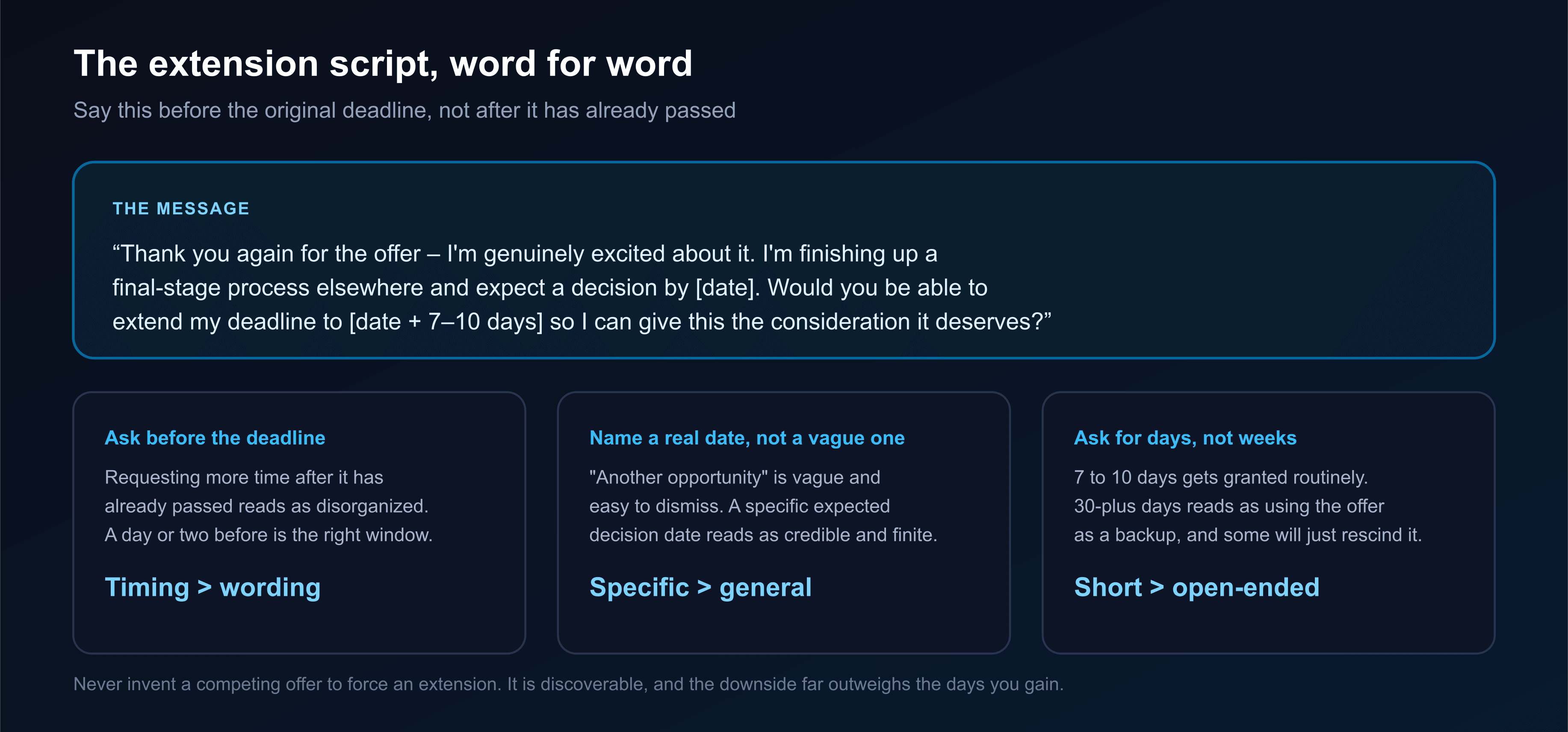
- Ask before the deadline, ideally a day or two ahead. A request made after the deadline has already passed reads as disorganized rather than considerate of their process.
- Name a specific date."I expect a decision by the 24th" is concrete and easy to act on. "I'm weighing another opportunity" with no timeline is easy to dismiss.
- Ask for days, not weeks.Seven to ten days gets granted routinely. Thirty-plus days starts to look like you're using the offer as a fallback rather than genuinely deciding.
What to actually compare once both offers are in hand
Base salary is the easiest number to compare, which is exactly why it tends to get over-weighted relative to everything else that determines what a job is actually like to have.
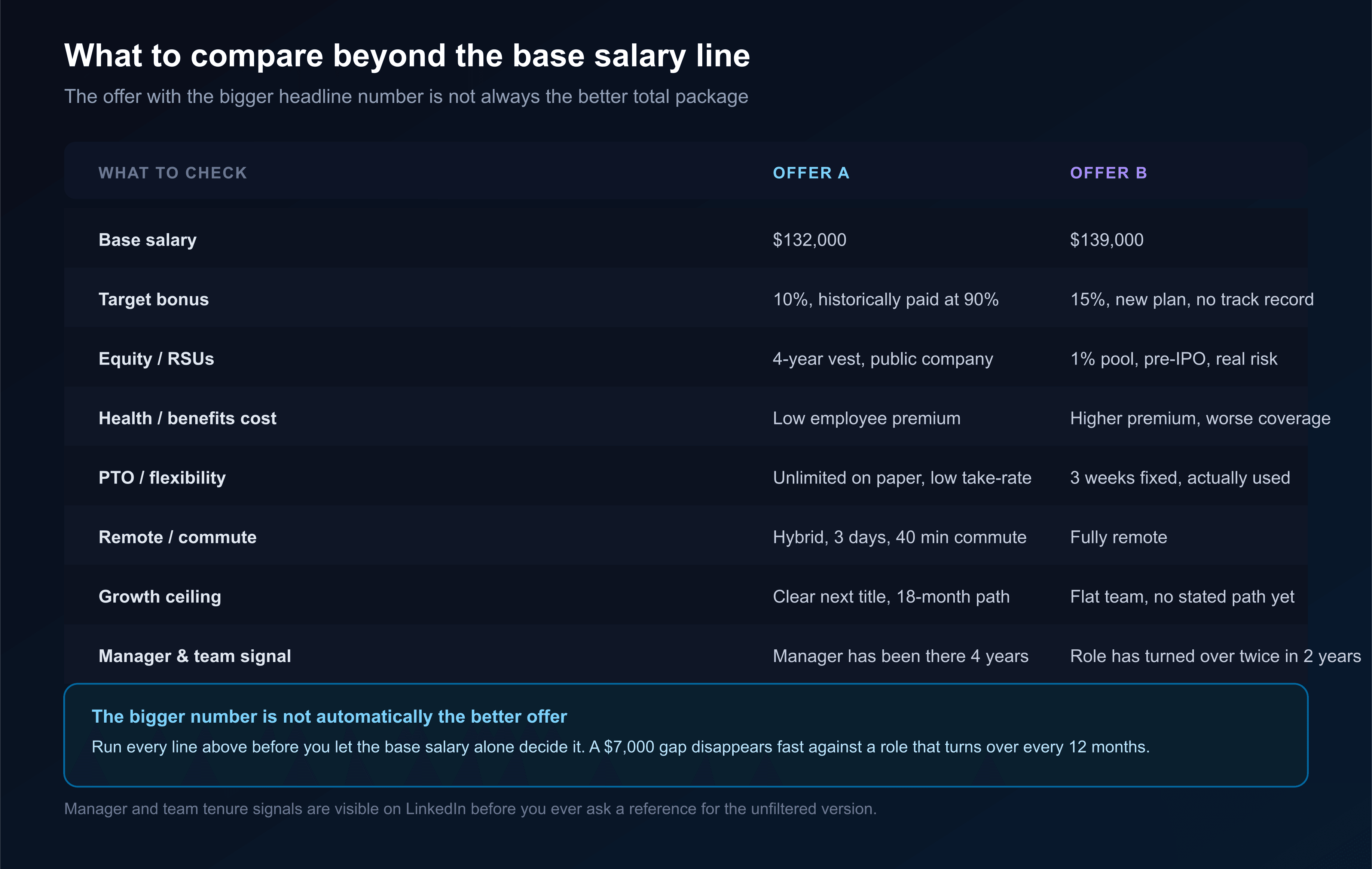
A $7,000 base salary gap can disappear fast against a role with a stronger bonus track record, better equity terms, or a team that hasn't turned over in years. Manager and team tenure in particular is worth checking directly; it's visible on LinkedIn before you ever ask a reference for the unfiltered version, and a role that has changed hands twice in two years is telling you something the interview loop won't.
Before you sign anywhere, make sure the fit is real on paper too
Paste your resume against each job description in Rankid for a free 0-100 match score and the specific requirements you're strongest and weakest against. It's a fast way to sanity-check which role you're genuinely best positioned to grow in, not just which one pays more today.
Check your match score freeUsing one offer as leverage on the other, honestly
A real competing offer is legitimate, useful leverage. An implied or invented one is a bet with a bad payout structure: modest upside if it works, real damage to your credibility if it doesn't.
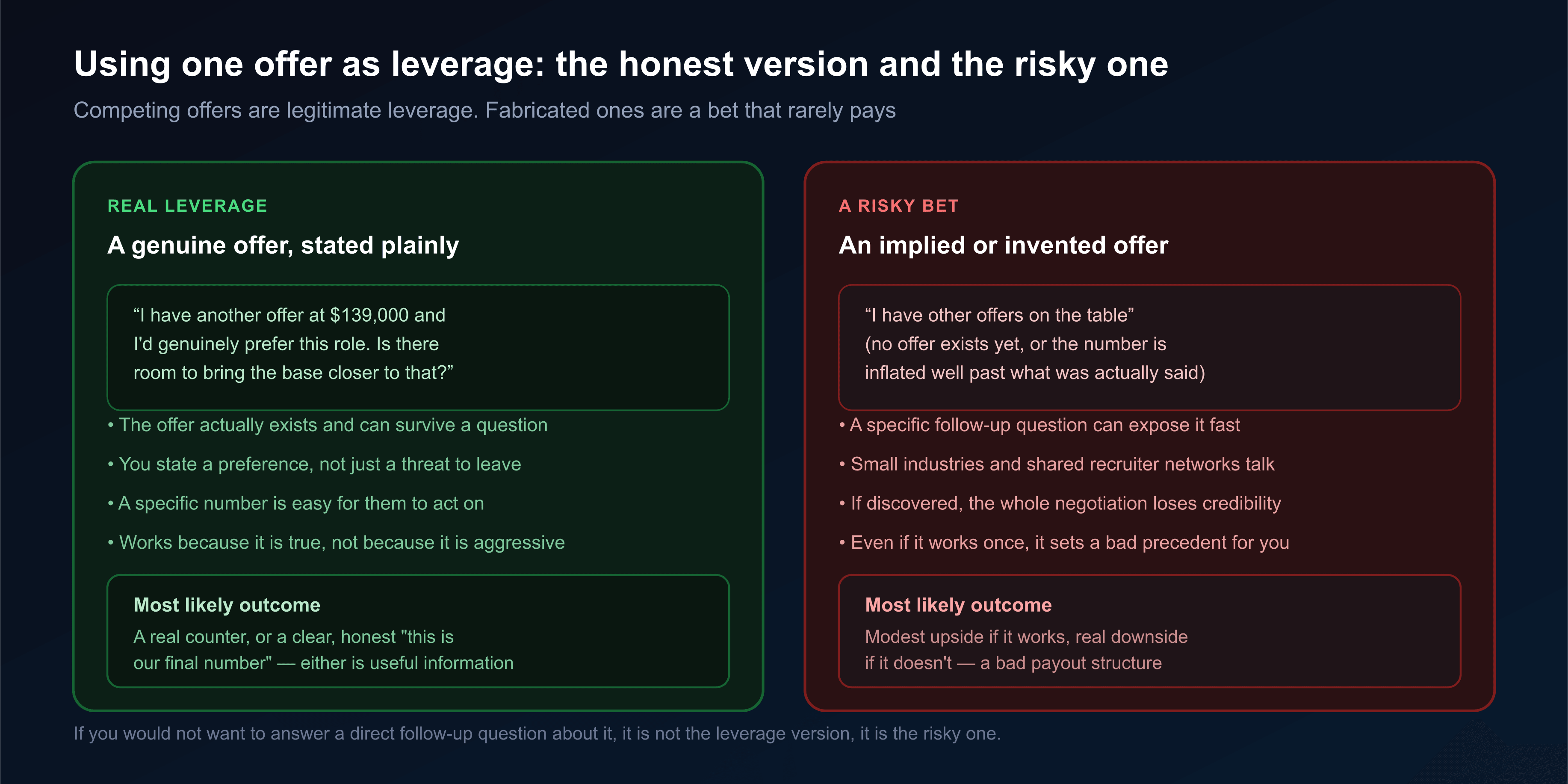
The test is simple: if you would not want to answer a direct follow-up question about the offer you're referencing, it's not the honest version. See our guide on negotiating salary for wording that applies whether or not a second offer is involved, and our guide on counteroffers when you resignfor the related but different situation of a current employer trying to keep you after you've already accepted somewhere else.
A short process for when the offers are genuinely close
Request the extension first, before you do anything else
Run the full comparison, not just the salary line
Check what's checkable about the manager and team
Name the two or three factors that matter most to you specifically
Decide, then move fast in both directions
Declining gracefully, without closing the door
Recruiters and hiring managers move between companies more than the job market feels like it should allow, and a graceful decline today keeps a real door open for later.
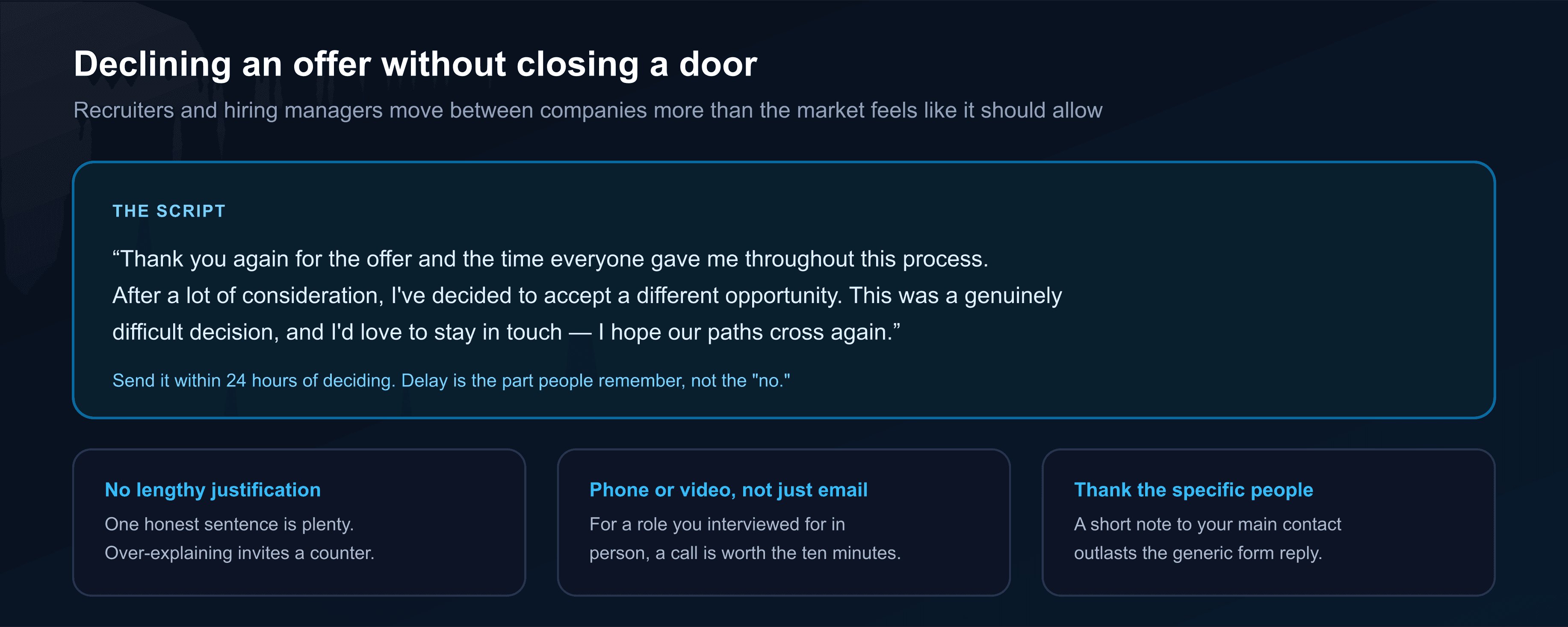
Send it within 24 hours of deciding; delay, not the "no" itself, is what people tend to remember. For the role you do accept, our guide on responding to a job offercovers the next steps once you've said yes, including what to confirm in writing before your start date.
For employers: losing candidates to timeline is a process problem, not a candidate problem
If your team keeps losing strong finalists to a faster-moving competitor, it's worth checking whether the losses are about compensation at all, or simply about speed. A candidate juggling multiple processes will rationally take the offer that's actually in hand over the one that's still "probably coming," even when they'd have preferred your role. Our guides on the hiring process and recruitment metrics that diagnose a slow funnel cover how to find where a loop is losing candidates to timing rather than fit, and our offer letter template covers how to make the offer itself move faster once a decision has been made internally.
A slow screening stage is often the hidden reason your offer arrives last
Upload the applicant pool and the job description. Rankid scores every resume 0 to 100 against the real requirements with the evidence attached, so your team gets to a shortlist and an offer while the candidate still has multiple options open. First 5 resumes free, no signup.
Try bulk screening freeFrequently asked questions
How much extra time can I reasonably ask for on a job offer deadline?
Seven to ten additional days is a common, reasonable ask that most employers will grant when you request it professionally and before the original deadline passes, not after. For a senior role, a relocation, or an offer that involves a spouse or family decision, two to three weeks is sometimes appropriate and rarely raises objections if you explain why. Asking for 30-plus days, or leaving the request open-ended without a specific new date, is far more likely to be declined or to read as using the offer as a backup plan.
What should I actually say when asking for more time?
Be specific and honest about the shape of your situation without over-explaining it. Something like: "Thank you again for the offer, I'm genuinely excited about it. I'm finishing up a final-stage process elsewhere and expect a decision by [date]. Would you be able to extend my deadline to [date plus 7-10 days] so I can give this the consideration it deserves?" Naming a specific date, rather than a vague "another opportunity," makes the request easy to evaluate and grant.
Do I have to tell an employer I have another offer?
No, but it's often useful to your case when you're asking for either time or money, as long as it's true. You don't need to name the company or share the exact number unless you want to, but stating plainly that you're weighing a competing process gives the employer a concrete reason to move faster or negotiate, rather than leaving them to guess why you're hesitating.
Is it okay to use one job offer to negotiate a better deal from another company?
Yes, and it's one of the most legitimate forms of leverage in a job search, as long as the offer is real and you represent it accurately. Something like "I have another offer at $139,000 and would genuinely prefer this role; is there room to bring the base closer to that?" states a real fact and a real preference, which most hiring managers can act on directly. The line you shouldn't cross is inventing an offer that doesn't exist or significantly inflating the number on a real one.
What happens if a company finds out I exaggerated or invented a competing offer?
It can cost you the offer entirely, and even when it doesn't, it damages your credibility for any future negotiation with that company. Recruiters and hiring managers move between companies more than the job market feels like it should allow, and many industries are small enough that a fabricated offer is more discoverable than people expect, especially if a specific follow-up question exposes an inconsistency. The realistic upside of the bluff is modest; the downside if it's caught is not.
Should I compare job offers by base salary alone?
No. Base salary is the easiest number to compare, which is exactly why it gets over-weighted. Bonus structure and whether it's historically paid out at target, equity type and vesting schedule, benefits cost to you personally, real PTO usage versus a policy on paper, remote or hybrid flexibility, the growth ceiling in the role, and signals about manager and team stability all meaningfully affect what an offer is actually worth to you day to day. A smaller base salary with a lower-turnover team and real growth path frequently outperforms a larger one attached to a role that turns over every year.
How do I evaluate manager quality or team stability before accepting an offer?
Check what's checkable before you rely on gut feeling alone. LinkedIn tenure for the manager and the team gives you a rough signal for free: a manager who has been in place for years and a team with low visible turnover is a different bet than a role that has changed hands twice in two years. Ask directly in a final interview how long the team has been together and why the role is open. And if you're offered reference calls with current employees, take them, and ask what they'd tell a friend considering the same offer.
How do I decline an offer without damaging the relationship?
Move quickly once you've decided, keep the message brief and warm, thank the specific people who invested time in you, and avoid a long justification, which tends to invite a counteroffer conversation nobody asked for. A short call or video message, not just an email, is worth the ten minutes for a role you interviewed for in person. See our guide on how to write a resignation letter for the same tone applied to leaving a current job.
Can I go back to a company after declining their offer if the other job doesn't work out?
Sometimes, and it happens more often than people assume, especially if you declined gracefully and stayed in touch. It is never guaranteed, since the role may already be filled, but a warm, professional decline leaves that door meaningfully more open than a rushed or unclear one. This is part of why the tone of a decline matters even when you're confident in your choice.
What if both offers extend their deadlines and I still can't decide?
At that point the decision usually isn't missing information, it's a genuine values trade-off, and more time rarely resolves that on its own. Write down the two or three factors that matter most to you specifically, not a generic checklist, and force a comparison on just those. If you're still stuck after that, a slightly worse outcome decided quickly is often better for your career than an excellent outcome decided so slowly that both employers lose confidence in you.
Does asking for a deadline extension make me look indecisive?
Not when it's done professionally, with a specific reason and a specific new date attached. Most experienced hiring managers have seen this request many times and don't read it as weakness; they read the way you make the request, meaning whether it's confident and specific or vague and apologetic, as a small preview of how you handle pressure on the job.
How does this look from the employer's side when a candidate is juggling multiple offers?
It's frequently a signal that your hiring process is simply slower than a competitor's, not that the candidate is being difficult. If you're consistently losing strong candidates to timeline, not to compensation, the fix is usually structural: compressing the interview loop, giving a clear decision date up front, or empowering whoever runs the final round to make an offer without an extra approval cycle. Our guides on the hiring process and recruitment metrics cover how to diagnose where a slow loop is actually losing candidates.
Key takeaways
- Job offers rarely arrive on the same timeline. The first offer to land is usually just the fastest process, not necessarily the best one.
- Requesting a 7-10 day extension before the original deadline is normal and usually granted; asking after the deadline or for 30-plus days often isn't.
- Name a specific expected decision date in your extension request rather than a vague reason. Specificity is what makes the ask easy to grant.
- Compare total compensation, not just base salary: bonus payout history, equity terms, benefits cost, real PTO usage, growth ceiling, and manager or team tenure.
- A real competing offer is legitimate leverage when stated plainly with a real number. An invented or inflated one is a bad bet if it's discovered.
- Check manager and team tenure on LinkedIn and through reference calls; a role that's turned over repeatedly is telling you something the interview won't.
- Decide on the two or three factors that matter most to you specifically once the offers are genuinely close, rather than re-litigating everything.
- Decline gracefully and quickly: a brief, warm message with no lengthy justification, sent within 24 hours of deciding, keeps the door open for later.
- Employers losing strong candidates to timing, not compensation, usually have a structural speed problem in the hiring process worth fixing directly.
Frequently asked questions
How much extra time can I reasonably ask for on a job offer deadline?
Seven to ten additional days is a common, reasonable ask that most employers will grant when you request it professionally and before the original deadline passes, not after. For a senior role, a relocation, or an offer that involves a spouse or family decision, two to three weeks is sometimes appropriate and rarely raises objections if you explain why. Asking for 30-plus days, or leaving the request open-ended without a specific new date, is far more likely to be declined or to read as using the offer as a backup plan.
What should I actually say when asking for more time?
Be specific and honest about the shape of your situation without over-explaining it. Something like: "Thank you again for the offer, I'm genuinely excited about it. I'm finishing up a final-stage process elsewhere and expect a decision by [date]. Would you be able to extend my deadline to [date plus 7-10 days] so I can give this the consideration it deserves?" Naming a specific date, rather than a vague "another opportunity," makes the request easy to evaluate and grant.
Do I have to tell an employer I have another offer?
No, but it's often useful to your case when you're asking for either time or money, as long as it's true. You don't need to name the company or share the exact number unless you want to, but stating plainly that you're weighing a competing process gives the employer a concrete reason to move faster or negotiate, rather than leaving them to guess why you're hesitating.
Is it okay to use one job offer to negotiate a better deal from another company?
Yes, and it's one of the most legitimate forms of leverage in a job search, as long as the offer is real and you represent it accurately. Something like "I have another offer at $139,000 and would genuinely prefer this role; is there room to bring the base closer to that?" states a real fact and a real preference, which most hiring managers can act on directly. The line you shouldn't cross is inventing an offer that doesn't exist or significantly inflating the number on a real one.
What happens if a company finds out I exaggerated or invented a competing offer?
It can cost you the offer entirely, and even when it doesn't, it damages your credibility for any future negotiation with that company. Recruiters and hiring managers move between companies more than the job market feels like it should allow, and many industries are small enough that a fabricated offer is more discoverable than people expect, especially if a specific follow-up question exposes an inconsistency. The realistic upside of the bluff is modest; the downside if it's caught is not.
Should I compare job offers by base salary alone?
No. Base salary is the easiest number to compare, which is exactly why it gets over-weighted. Bonus structure and whether it's historically paid out at target, equity type and vesting schedule, benefits cost to you personally, real PTO usage versus a policy on paper, remote or hybrid flexibility, the growth ceiling in the role, and signals about manager and team stability all meaningfully affect what an offer is actually worth to you day to day. A smaller base salary with a lower-turnover team and real growth path frequently outperforms a larger one attached to a role that turns over every year.
How do I evaluate manager quality or team stability before accepting an offer?
Check what's checkable before you rely on gut feeling alone. LinkedIn tenure for the manager and the team gives you a rough signal for free: a manager who has been in place for years and a team with low visible turnover is a different bet than a role that has changed hands twice in two years. Ask directly in a final interview how long the team has been together and why the role is open. And if you're offered reference calls with current employees, take them, and ask what they'd tell a friend considering the same offer.
How do I decline an offer without damaging the relationship?
Move quickly once you've decided, keep the message brief and warm, thank the specific people who invested time in you, and avoid a long justification, which tends to invite a counteroffer conversation nobody asked for. A short call or video message, not just an email, is worth the ten minutes for a role you interviewed for in person. See our guide on how to write a resignation letter for the same tone applied to leaving a current job.
Can I go back to a company after declining their offer if the other job doesn't work out?
Sometimes, and it happens more often than people assume, especially if you declined gracefully and stayed in touch. It is never guaranteed, since the role may already be filled, but a warm, professional decline leaves that door meaningfully more open than a rushed or unclear one. This is part of why the tone of a decline matters even when you're confident in your choice.
What if both offers extend their deadlines and I still can't decide?
At that point the decision usually isn't missing information, it's a genuine values trade-off, and more time rarely resolves that on its own. Write down the two or three factors that matter most to you specifically, not a generic checklist, and force a comparison on just those. If you're still stuck after that, a slightly worse outcome decided quickly is often better for your career than an excellent outcome decided so slowly that both employers lose confidence in you.
Does asking for a deadline extension make me look indecisive?
Not when it's done professionally, with a specific reason and a specific new date attached. Most experienced hiring managers have seen this request many times and don't read it as weakness; they read the way you make the request, meaning whether it's confident and specific or vague and apologetic, as a small preview of how you handle pressure on the job.
How does this look from the employer's side when a candidate is juggling multiple offers?
It's frequently a signal that your hiring process is simply slower than a competitor's, not that the candidate is being difficult. If you're consistently losing strong candidates to timeline, not to compensation, the fix is usually structural: compressing the interview loop, giving a clear decision date up front, or empowering whoever runs the final round to make an offer without an extra approval cycle. Our guides on the hiring process and recruitment metrics cover how to diagnose where a slow loop is actually losing candidates.