The Hiring Process: 9 Stages, Who Owns Each, and the One That Eats Your Timeline (2026)
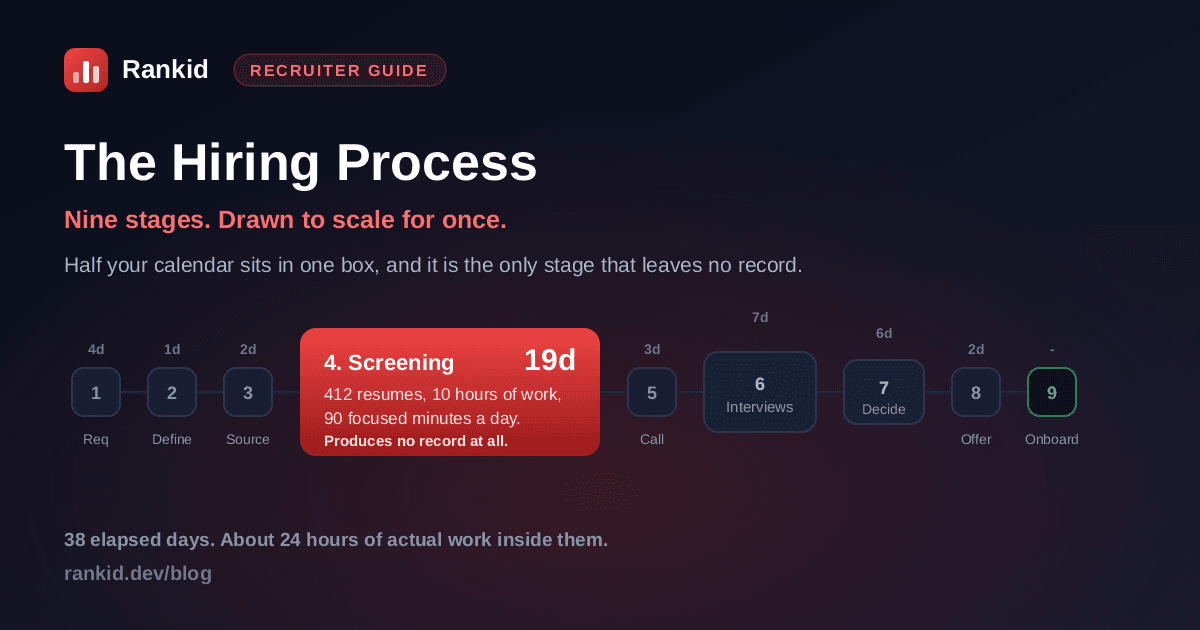
Search for the hiring process and you get the same picture everywhere: five to nine tidy boxes in a row, each the same size, arrows in between. It is a useful diagram of the order things happen in and a misleading diagram of everything else, because the stages are nothing like equal. On a typical 38-day requisition, one stage quietly consumes about half the calendar, generates no document, closes no ticket, and appears on the flowchart as a box the same size as “send the offer”.
Quick answer
What is the hiring process, and how does it work?
The hiring process is the sequence of stages an organisation runs to go from “we need someone” to “someone is doing the job”. Nine stages covers it end to end:
People also ask how this differs from the recruitment process, and mostly it does not. The two terms are used interchangeably by everyone involved. Where a distinction is drawn, recruitment means the front half that attracts and identifies candidates, and hiring means the back half that selects and onboards one. That line only matters operationally when different parties own the halves, for example an agency running sourcing and screening while your team runs interviews onward, in which case the handoff point needs a defined owner and a defined artefact passed across it.
The count of stages is the least important thing about it
Where the 38 days actually go
The most useful thing you can do to a hiring process diagram is redraw it to scale, separating two numbers that get conflated constantly: working time, meaning hours of actual effort, and elapsed time, meaning days on the calendar. Every stage has both, and the ratio between them tells you what kind of problem you have.
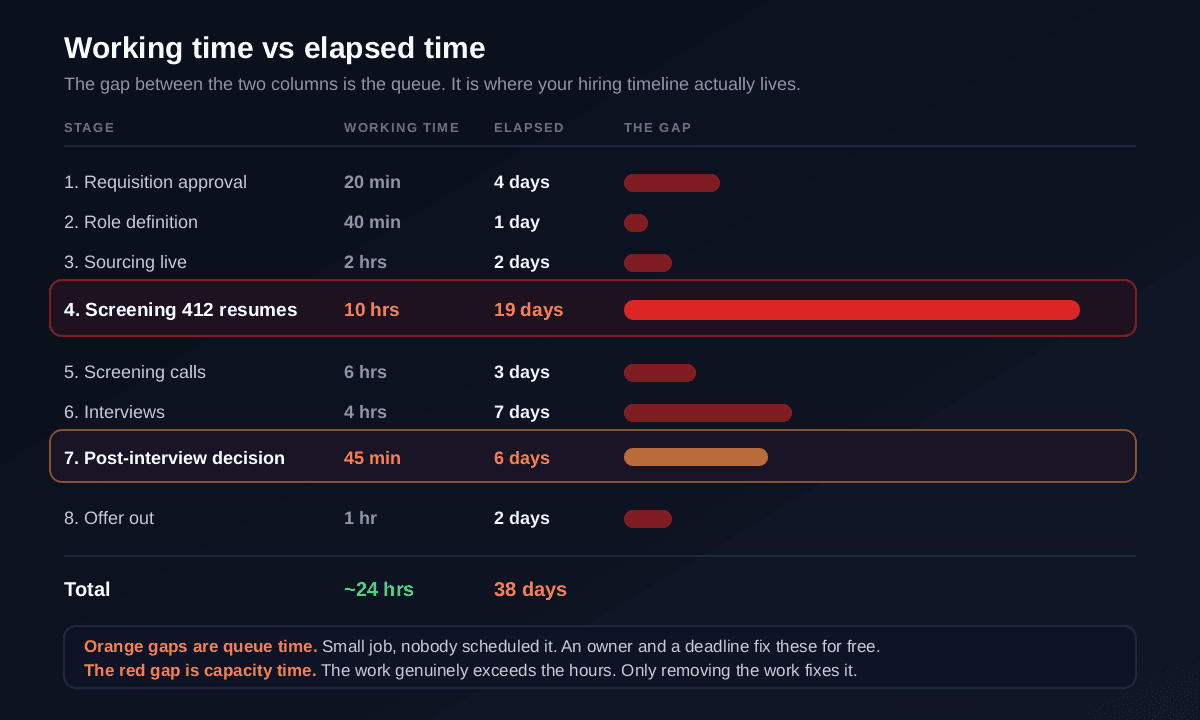
Roughly 24 hours of genuine work, spread across 38 days. That gap is not laziness and it is not mysterious. It has exactly two causes, and they need opposite fixes:
- Queue time. The work is small but nobody has scheduled the moment to do it. Requisition approval takes twenty minutes and waits four days for a manager to open the tab. The fix is a deadline and an owner, and it is nearly free.
- Capacity time. The work genuinely exceeds the hours available. Screening 412 applicants at 90 seconds each is ten hours of concentrated attention for someone carrying five other requisitions. No deadline fixes this, because the constraint is real. Only removing the work does.
Almost every hiring process improvement effort fails by applying the first fix to the second problem. Adding an SLA to a stage that is genuinely over capacity does not speed it up. It just moves the failure from “late” to “done partially and reported as complete”.
The nine stages, with owner, decision and failure mode
Requisition approval (owner: hiring manager, then finance)
The decision: is this role funded and open? The failure: nobody knows it is waiting. This stage is pure queue time, and the fix is a named approver with a three-day deadline. Getting the paperwork right also sets up everything downstream, which is the case made in the job requisition guide.
Role definition and criteria (owner: recruiter plus hiring manager)
The decision: what does success in this job require, and how will we measure it? The failure, and it is the most consequential one in the entire process: this stage gets skipped, and the criteria then get invented separately at screening, at interview and at the debrief. Twenty minutes here sets the criteria that every later stage reuses. Write the job description and the scorecard in the same sitting.
Sourcing and advertising (owner: recruiter)
The decision: where will the right people see this? The failure: measuring channels by applications rather than by hires, which funds whichever board sends the most volume regardless of quality. Channel selection and outbound approaches are covered in candidate sourcing, and the cheapest channel is usually the one in your existing pipeline.
Screening (owner: recruiter): the stage that eats the timeline
The decision: who gets a conversation? The failure: the pile is bigger than the hours, so the shortlist gets built from whoever applied first. This is the capacity stage, and everything about it is covered below and in how to screen resumes in bulk.
Screening call (owner: recruiter)
The decision: does what the resume claims hold up, and do the practicalities work? The failure: a call with no structure that confirms the resume rather than testing it. Fifteen minutes is enough if the questions are chosen in advance, per the screening interview guide.
Interviews (owner: hiring manager and panel)
The decision: can they do the job, rated against the criteria from stage two? The failure: scheduling. Interviews are rarely slow because of the interviews. They are slow because five calendars need to intersect. Batch them into fixed weekly slots rather than negotiating each one. Question sets in interview questions to ask candidates.
Decision and checks (owner: hiring manager)
The decision: who, and does everything verify? The failure, and this is the sneakiest stage in the process: the decision exists in everyone's head within a day, but no meeting is scheduled to say it out loud, so a 45-minute conversation takes six calendar days. Book the debrief before the interviews happen. References and background checks run in parallel, not after, and their realistic duration is in how long a background check takes.
Offer (owner: recruiter and hiring manager)
The decision: what are we offering, and did they accept? The failure: discovering the compensation range only at this point. Agree the band at stage one. Meanwhile everyone not selected should be hearing from you within 48 hours, using these rejection templates, rather than waiting for the signature.
Onboarding (owner: hiring manager and HR)
The decision: are they productive, and did we hire well? The failure: treating the accepted offer as the finish line, so nothing ever feeds back into whether stage two's criteria predicted anything. A structured 30-60-90 day plan is what closes that loop.
The ownership map, and the three stages nobody owns
Run this exercise on your own process before changing anything. Write the nine stages down the side and put a single name against each. Not a team, a person. The stages where you hesitate are your bottlenecks, and they are remarkably consistent across organisations.
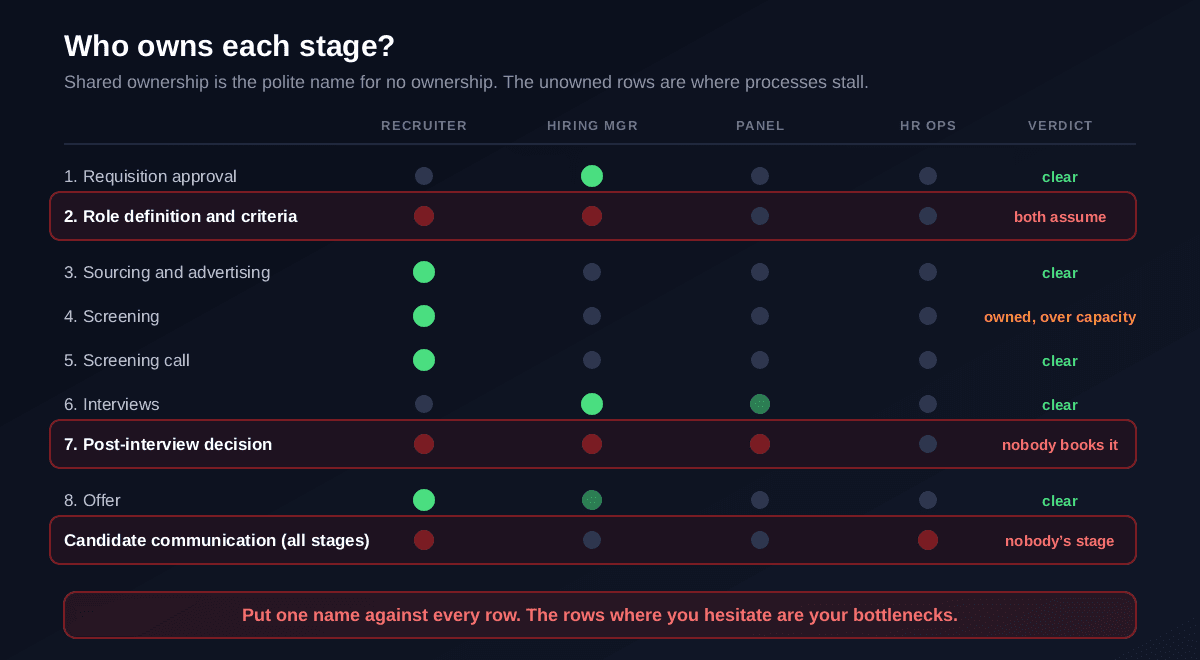
Shared ownership is the polite name for no ownership. The three stages that most often lack a single name are role definition, where the recruiter assumes the hiring manager has decided and the hiring manager assumes the recruiter will ask; the post-interview decision, where everyone has an opinion and nobody has the calendar invite; and candidate communication, which is nobody's stage in most processes and is therefore the one that produces the candidate experience you are known for.
Stage four in detail, because it is half your timeline
Screening deserves separate treatment because it is the only stage whose workload scales with applicant volume rather than with the number of open roles. Every other stage costs roughly the same whether 40 or 400 people apply. Screening does not, and applicant volumes have gone in one direction for years.
The arithmetic is unforgiving and worth doing explicitly:
- 412 applications, at a careful 90 seconds each, is just over 10 hours.
- A recruiter on five requisitions has perhaps 90 focused minutes a day after calls, scheduling, intake meetings and coordination.
- That is seven working days of nothing else, which is why in practice the reading stops somewhere around applicant 40 and the shortlist is built from what was read.
The consequence is not just a slow stage. It is that 372 people were skipped rather than rejected, which means no decision about them exists anywhere, your screen-to-interview rate is computed on a sample chosen by arrival order, and you cannot answer whether the right candidate applied. This is the coverage problem quantified in recruitment metrics, and it is the reason this one stage distorts everything reported downstream of it.
Turn the 19-day stage into a same-day one
Upload the whole applicant batch and paste the job description. Rankid scores every candidate 0 to 100 against the role's criteria, with the skills and keywords each one matches and misses, so the screening stage produces a ranked, complete, documented shortlist in one pass instead of two weeks of fragments. Up to 200 resumes per batch, first 5 free, no signup.
Screen your whole pool freeFull cycle recruiting: when one person owns all nine
Full cycle recruiting, also called full desk or end-to-end recruitment, means a single recruiter owns every stage of a requisition rather than passing candidates between a sourcer, a screener and a coordinator. It is the default in small companies and agencies, and increasingly common elsewhere.
The case for it is real: nothing is lost in handoffs, the candidate deals with one human throughout, and the person who wrote the criteria is the person applying them. The structural weakness is equally real. In a full cycle model, the recruiter's slowest stage becomes the requisition's ceiling, and since screening is the only stage that scales with applicant volume, it becomes the ceiling for almost everyone. A full desk recruiter with four open roles and 1,500 combined applicants is not going to out-discipline that arithmetic.
This is why the automate-or-not question has a clear answer at this specific stage and a much murkier one elsewhere. Volume-scaling, criteria-driven, evidence-producing work is where tooling belongs; judgement calls and human conversations are not. That boundary is drawn properly in recruitment automation.
A hiring process template you can copy
One row per stage. Fill in the four columns, agree it once with your hiring manager at kickoff, and the process stops being a diagram and starts being a contract.
- Stage. One of the nine above.
- Owner. One person, named. Never a team.
- Decision produced. What is true at the end that was not true at the start. If you cannot write this, the stage is a ritual.
- Deadline. Working days, starting when the previous stage ends.
Reasonable starting deadlines, totalling around 30 days:
- Requisition approval: 3 days. Role definition: 2 days.
- Sourcing live: 2 days. Screening every applicant: 5 days.
- Screening calls: 5 days. Interviews: 10 days.
- Decision and checks: 3 days. Offer out: 2 days.
Deadlines start when the work arrives, not when the process ends
Seven ways hiring processes break
- Criteria defined three times. Once at screening, once at interview, once at the debrief, all different. Define them at stage two and reuse them.
- The unscheduled decision. Everyone knows the answer within a day; the meeting to say it is six days out. Book the debrief before the interviews.
- Adding SLAs to a capacity problem. A deadline on a stage that is genuinely over capacity converts lateness into partial completion reported as done.
- Sequential checks. References and background checks run alongside the offer conversation, not after it.
- Compensation discovered at the offer. Agree the band at requisition approval or expect to lose finalists at the last stage.
- No feedback loop. Nothing connects the criteria to how the hire performed, so the process cannot improve, only churn. See cost per hire for the trend view that makes improvement visible.
- Measuring the process by its end date. Time to fill is one number over nine stages, so it tells you that something is slow and never which thing.
Auditing your hiring process in an afternoon
Pull the last three closed requisitions
Comparable roles if possible. Three is enough to see a pattern and few enough to actually finish.
For each stage, record four facts
Owner, decision produced, start date, end date. Most of this is reconstructible from your ATS timestamps and calendar invites in about an hour per requisition.
Estimate working time and subtract
Beside each elapsed duration, write how many hours of actual work the stage contained. The difference is queue. Rank the stages by that gap.
Fix the queues first, then the capacity
Queue gaps close with an owner and a deadline, which costs nothing and usually recovers a week. What remains after that is your real constraint, and on nearly every audit it is the screening stage.
Key takeaways
- The hiring process is nine stages, and drawing them as equal boxes is the reason most process fixes miss.
- Every stage needs three things explicit: one named owner, the decision it produces, and a deadline.
- Separate elapsed time from working time. About 24 hours of real work typically spreads across 38 days.
- Queue gaps close with an owner and a deadline. Capacity gaps only close by removing work.
- Screening is the only stage whose workload scales with applicant volume, which is why it is half the timeline.
- The three stages that usually lack a single owner: role definition, the post-interview decision, and candidate communication.
- In full cycle recruiting, the recruiter's slowest stage becomes the whole requisition's ceiling.
- Rankid scores up to 200 resumes per batch against one job description. First 5 free, no signup.
Bottom line: the hiring process is not really nine steps, it is nine queues, and the diagram everyone publishes hides that by drawing them the same size. Redraw yours to scale, put one name and one deadline against every box, and the picture stops being a description of what should happen and starts pointing at the two or three places where your calendar is actually going. Compress the longest stage with Rankid and take the fortnight back.
Frequently asked questions
How does the hiring process work?
It runs in nine stages: approving the requisition, defining the role and its criteria, sourcing and advertising, screening the applicants, a screening call, interviews, the decision and reference or background checks, the offer, and onboarding. What guides usually leave out is that the stages are wildly unequal in duration. Approval and offer are decisions that take minutes once someone is actually looking at them, while screening is the stage where a few hundred applications meet a recruiter carrying five other requisitions, and it routinely absorbs more elapsed time than every other stage combined. Any useful picture of the process shows the stages sized by how long they actually take rather than as equal boxes in a row.
What are the steps in the hiring process?
Requisition approval, role definition and criteria, sourcing, resume screening, screening call, interviews, decision and checks, offer, and onboarding. Some models compress this to five or seven by merging sourcing with advertising and checks with the offer, which is fine, since the count matters far less than three things being explicit for each stage: who owns it, what decision it produces, and how long it is allowed to take. A process fails at the stages where those three questions have no agreed answer, which is most commonly role definition at the front and the decision stage at the back.
What is the difference between the hiring process and the recruitment process?
In everyday use they are the same thing, and no candidate or hiring manager distinguishes them. Where people do draw a line, recruitment refers to the stages that attract and identify candidates, meaning sourcing, advertising and screening, while hiring covers selecting and bringing someone on, meaning interviews, offer and onboarding. Recruitment is then the front half of hiring. The distinction is only worth making if it changes something operationally, such as when an agency or an RPO owns the front half and your team owns the back half, in which case the handoff point needs to be defined explicitly.
What is full cycle recruiting?
Full cycle recruiting, also called full desk or end-to-end recruitment, means one recruiter owns every stage for a requisition, from intake with the hiring manager through sourcing, screening, interview coordination, offer and close, rather than passing candidates between specialists. The advantage is that context never gets lost in a handoff and the candidate deals with one person throughout. The cost is that the recruiter's weakest stage becomes the whole requisition's ceiling, and screening is usually that stage, because it is the only part of the cycle whose workload scales with applicant volume rather than with the number of open roles.
How long should the hiring process take?
Set a target per stage rather than one number for the whole thing, because an overall figure hides where the time actually goes. Reasonable internal targets are 3 days for requisition approval, 2 days for role definition, 5 days for screening every applicant, 5 days for screening calls, 10 days for interviews, 3 days for the decision and checks and 2 days for the offer, which lands around 30 days end to end. Most organisations sit closer to 40 or 50 days, and the overrun is rarely spread evenly. It concentrates in screening and in the decision stage, which are also the two stages nobody has explicitly given a deadline to.
Which stage of the hiring process takes the longest?
Resume screening, by a wide margin, and it is worth being clear about why, because it is not that reading a resume is slow. A careful evaluation against a job takes roughly 90 seconds, so 400 applicants is around 10 hours of concentrated work, and a recruiter carrying several requisitions does not have 10 uninterrupted hours. The work therefore gets done in fragments across two or three weeks, or it stops partway and a shortlist is built from whatever was read. Either way, the elapsed time of that stage is enormous relative to the working time inside it, which is the single most useful distinction to make when auditing a hiring process.
How do you audit your hiring process?
Take your last three closed requisitions and, for each stage, write down four things: who owned it, what decision it produced, the date it started and the date it ended. Two patterns show up almost immediately. First, stages with no named owner take the longest, and the decision stage after final interviews is usually the worst offender. Second, the gap between elapsed time and working time will be dramatic somewhere, and that gap is your queue rather than your workload. Fix the stages where a decision existed but nobody had scheduled the moment to make it, then fix the stage where the queue is genuinely larger than the capacity.
How many applicants should you screen before shortlisting?
All of them, and the reason is measurement rather than fairness alone. If you shortlist from the first 40 of 412 applications, your shortlist is a sample chosen by the order applications arrived and by whoever ran out of time, not by fit, and every downstream conversion rate you calculate describes that sample rather than your pool. Partial screening also removes your ability to answer the most basic question about a requisition, which is whether the right person applied at all. If reading everyone is not possible by hand, that is a capacity constraint to remove rather than a standard to lower.