Should You Accept a Counteroffer? What Actually Happens After You Say Yes (2026)
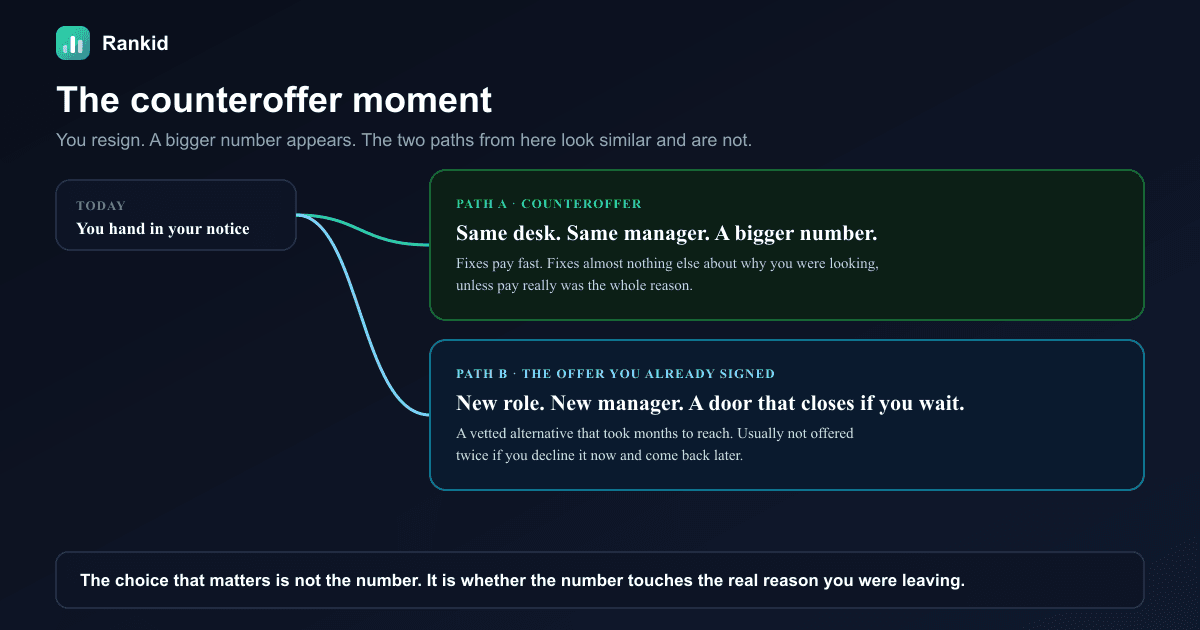
You hand in your notice, expecting a handshake and a start date for your last day. Instead your manager asks for twenty-four hours, comes back with a number bigger than the offer in your inbox, and suddenly a decision you thought was already made is open again. It feels like winning. Whether it actually is depends on a question almost nobody stops to ask in the moment: does the money fix the reason you started looking in the first place?
Quick answer
Quick answer: a counteroffer almost always fixes pay and almost never fixes the reason you were leaving, because those are usually different things. Before you answer, name the real reason in one sentence, then check whether the number on the table touches it. The often-repeated claim that "80% of people who accept a counteroffer leave within six months" is not a verified statistic, but the more careful industry data still shows a large share, commonly cited around a third, leaving again within about a year, which is reason enough to slow down before you say yes.
What a counteroffer actually is
A counterofferis your current employer's attempt to keep you after you have resigned or signaled you are about to, usually in the form of more money, sometimes bundled with a promotion, a title change, or a promise about future scope. It is not evidence that you are irreplaceable. It is evidence that replacing you right now, this quarter, would be expensive and disruptive, which is a much more common and much less flattering thing to be true.
Counteroffers have become routine rather than exceptional. Industry salary-guide surveys in recent years have put the share of employers who extend one to a departing employee they want to keep somewhere in the 70 to 85 percent range, depending on the year and the survey. If you resign from almost any mid-size or larger employer today, expect the conversation to happen. That alone should recalibrate how special the gesture feels.
The one sentence to write down before the meeting
What actually happens to people who say yes
The number you will see quoted constantly is that 80 percent of people who accept a counteroffer leave within six months, and 90 percent leave within a year. It is worth saying plainly: that specific figure has no traceable original study behind it, it has circulated in career advice for decades in slightly different forms, and it is frequently repeated by recruiters who have an obvious professional interest in you not staying. Treat it as a widely repeated industry claim, not a verified statistic.
What is better grounded is less dramatic but still meaningful: recent salary-guide and recruiter surveys have found that a large majority of employers now make counteroffers routinely, and that a substantial share of the people who accept, commonly cited around a third, are gone again within roughly a year regardless. That is a real, sizeable failure rate even without the inflated headline number attached to it.
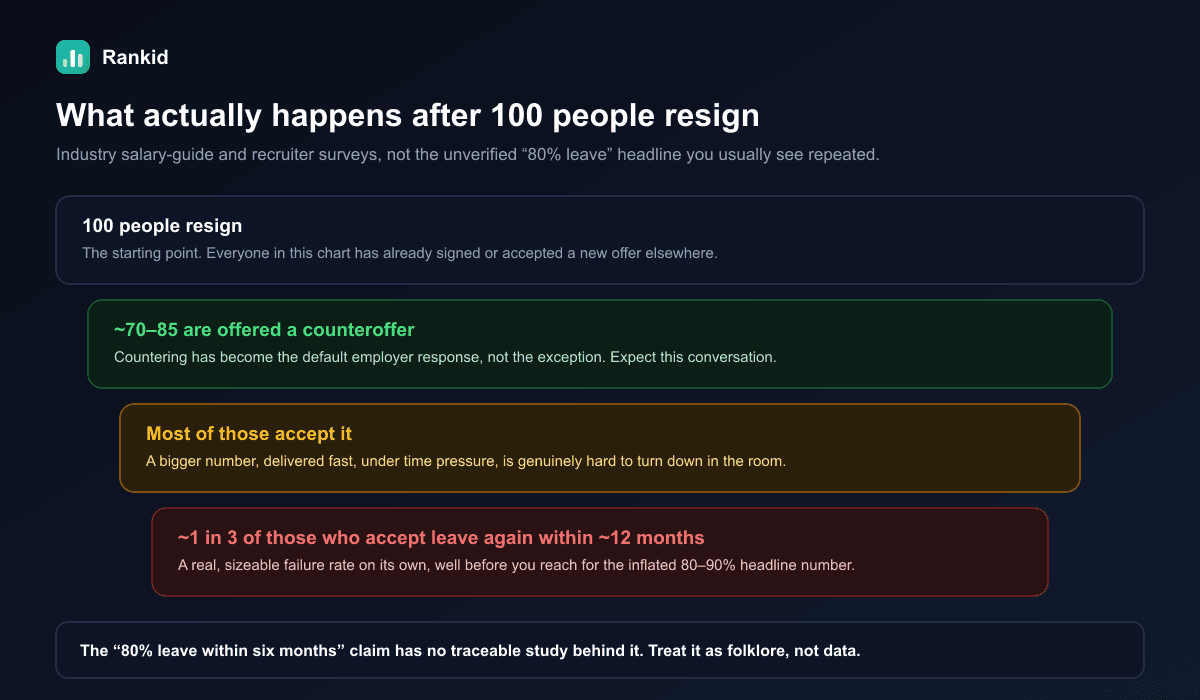
The honest takeaway is not a scare number, it is a mechanism: counteroffers are good at fixing pay and bad at fixing everything else, and most reasons people job hunt are not pay.
The real test: does the money fix the reason you were leaving
People leave jobs for a short list of recurring reasons, and only one of them reliably responds to a bigger paycheck. Run your own reason against this before you decide.
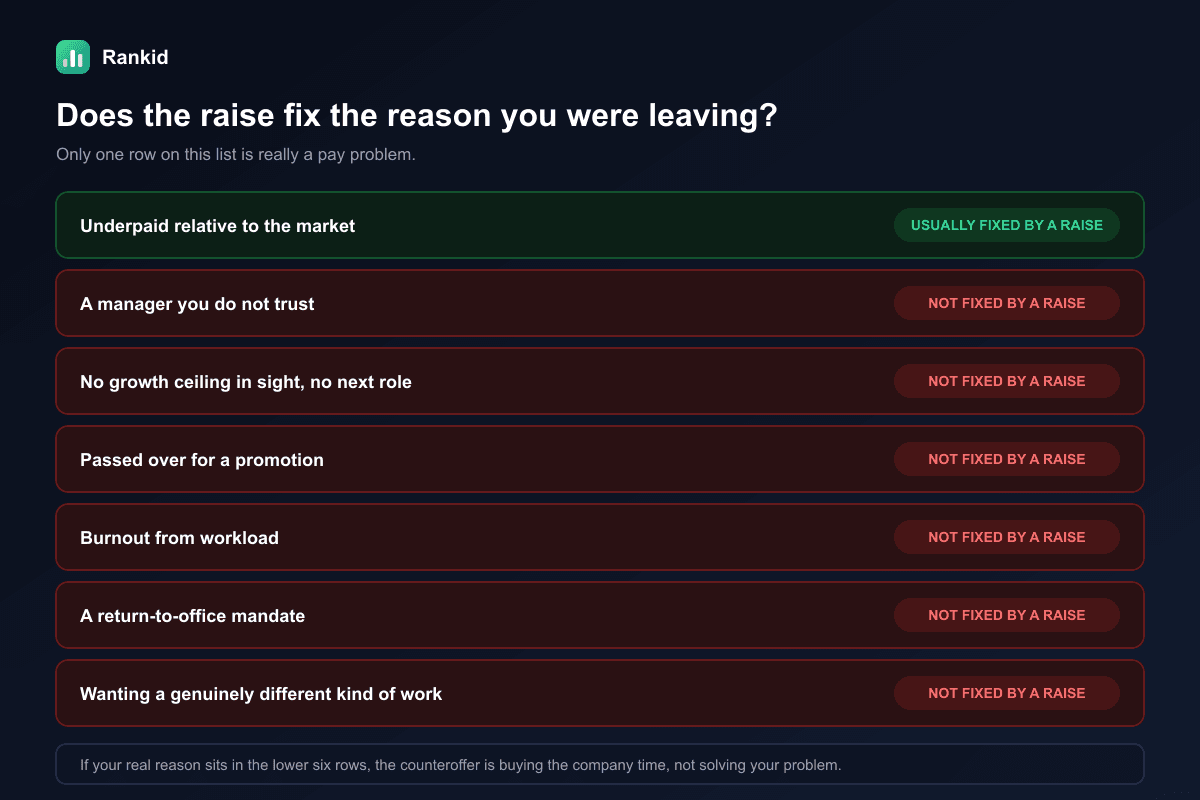
Notice that only the top row is a pay problem. Everything below it is a structural, relational, or directional problem that a raise papers over for a while and then stops covering. If your honest reason sits anywhere in that lower group, the counteroffer is buying the company time, not solving your problem, and the clock it is buying tends to run out in months, not years.
- Ask what changes on Monday, not eventually. A number is concrete. A promise about future scope, a future promotion, or a future manager change is not, until it has a date attached.
- Separate a real correction from a delay tactic. A real correction usually comes with more than money: a scope change, a reporting change, or a written plan. A delay tactic is just the number.
- Watch for the quiet double job. A promotion offered without anyone hired to backfill your old responsibilities is not a promotion, it is two roles paid as one.
How to evaluate the counteroffer in the moment
You usually have less time than it feels like you should, because the meeting is designed to move fast. Use a short, repeatable process instead of deciding on the spot.
Say thank you, then ask for time
Write down your actual reason for leaving, before you look at the number
Check the reason against the counter, line by line
Ask what happens if you say no to the counter and change your mind later
Decide, then close the loop quickly either way
If you decide to go, make sure the resume that got the offer is the one you send
A lot of people accept the new offer with the same resume they used six months ago, before the accomplishments that made the counteroffer conversation happen at all. Paste your resume and the job description into Rankid for a free 0-100 match score and the exact keywords you're still missing before day one.
Check your match score freeWhat to say, either way
The words matter less than the shape: be direct, be brief, and do not leave the door open to a conversation you have already had. See our guides on negotiating a new offer and responding to a job offer for the wording that applies to the other side of this conversation, the company you might be joining.
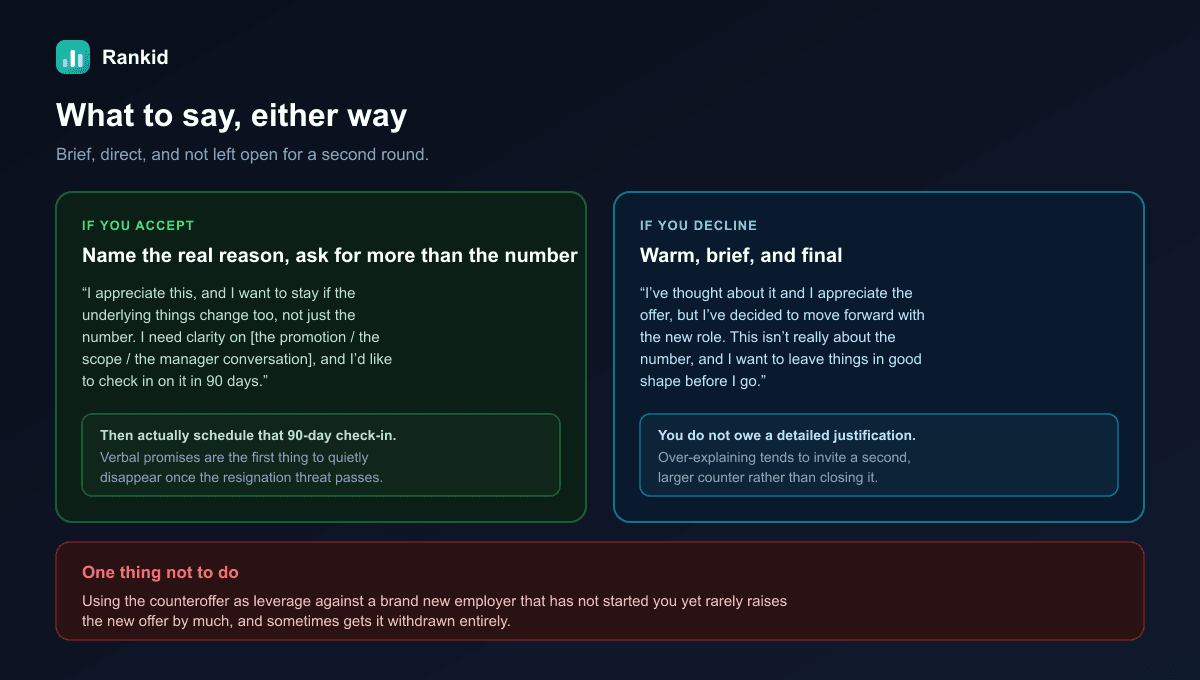
If you decide to stay, put the parts of the counter that are not the salary number in writing somewhere, even a short follow-up email summarizing what was agreed. Verbal promises about scope or promotion are the first thing that quietly disappears once the resignation threat has passed. If you decide to go, resist the urge to use the counteroffer as leverage against the company that has not started you yet: it rarely raises the new offer by much and it sometimes gets it withdrawn entirely, because it signals you might run the same play again in two years. Keep your notice period and resignation letter clean and professional regardless of which way you decide, since the relationship you are managing either way is your own reputation.
The two risks of accepting that rarely get named out loud
Accepting is not automatically the wrong move, but it carries two costs that are easy to underweight in the moment because they do not show up on the same day as the raise.
The first is a flight-risk perception some managers quietly form and rarely say out loud: you were prepared to leave, and that can shape who gets first consideration for the next stretch project or promotion cycle, even without a single explicit word about it. The second is opportunity cost: the outside offer was a real, vetted alternative that took months of effort to reach, and once declined it is usually gone, sometimes permanently, if you end up leaving anyway a year later with less goodwill and a colder market. Neither risk means always say no. It means the decision should be paid for with an honest answer about whether the underlying job changes, not with the relief of avoiding an awkward conversation with people you have not met yet.
For managers: when a counteroffer works, and when it just delays the same resignation
The instinct to counter is understandable. Replacing someone costs real money in recruiting time, a vacant seat, and the ramp time of whoever comes next, on top of the institutional knowledge that leaves immediately. But a counteroffer that only addresses the number is frequently just an expensive way to postpone the same conversation by a year.
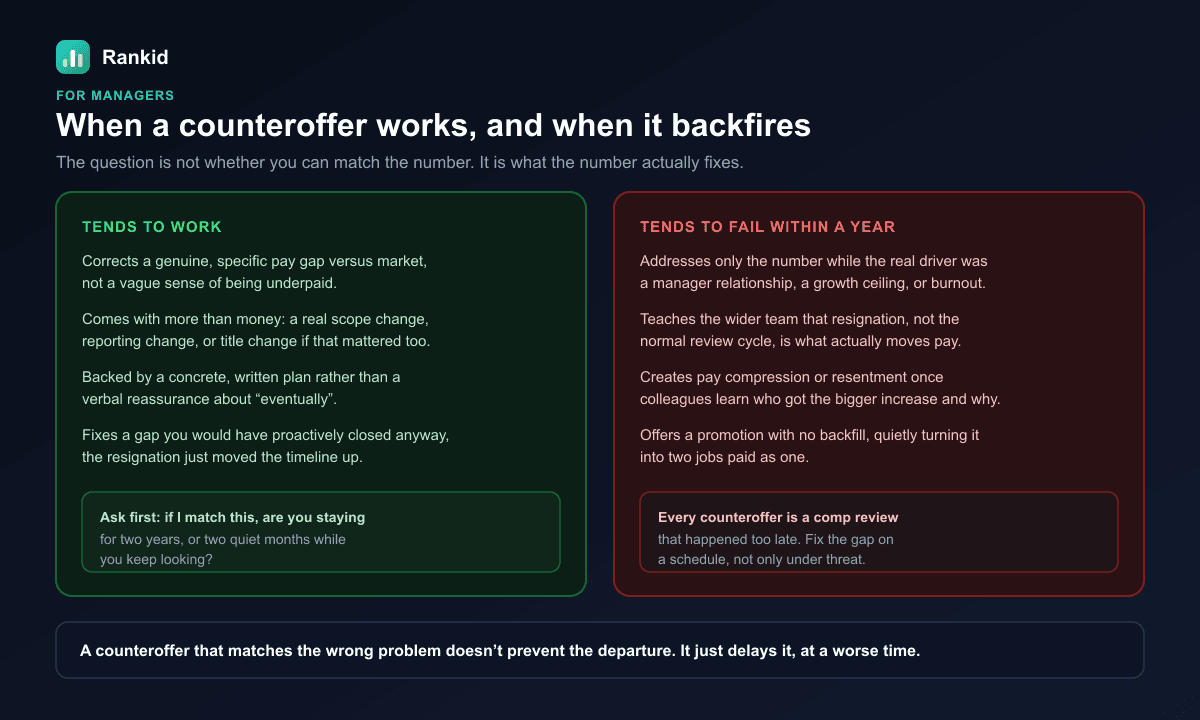
Three failure modes recur. Countering only the number when the real driver was the manager relationship or the growth ceiling just delays a departure that was already decided. Countering generously enough that colleagues find out creates a quiet incentive for the rest of the team to learn that resignation, not the normal review cycle, is what actually moves pay, which is a very expensive lesson to teach by accident. And offering a promotion without backfilling the person's existing responsibilities turns a retention win into a burnout problem with a delay on it.
The better instinct is to ask one honest question before reaching for the number: if I match this, are you staying for two years, or staying for two quiet months while you keep looking. Then treat the resignation as what it usually is, a comp or growth conversation that happened too late, and fix the underlying gap on a schedule rather than only in response to a threat. Our guides on employee turnover and exit interviews cover how to catch the pattern before the next resignation letter, and our guide to job hopping covers how candidates who have taken this route before tend to explain it at their next interview.
Rebuilding a role after a departure you couldn't counter your way out of?
Upload the applicants and the job description. Rankid scores every candidate against the real requirements and shows the evidence behind each score, so the replacement search moves fast without repeating the last hire's mismatch. First 5 resumes free, no signup.
Try bulk screening freeFrequently asked questions
What percentage of employees who accept a counteroffer actually leave within a year?
You will see the number 80 percent everywhere, usually attached to a claim that 80 percent of people who accept a counteroffer leave within six months and 90 percent leave within a year. Treat that specific figure with real skepticism. It has circulated in career advice for decades with no traceable original study behind it, and it gets repeated by recruiters who have an obvious incentive to discourage you from staying. What is better grounded: industry salary-guide surveys have found that a large majority of employers, commonly cited in the 70 to 85 percent range, now extend a counteroffer to a departing employee they want to keep, and that a meaningful share of the people who accept, often cited around a third, are gone again within about 12 months anyway. That is a real and sizeable failure rate even without the inflated headline number, and it is consistent with the underlying point everyone is reaching for: a raise alone frequently does not fix whatever made you start looking.
Why do employers make counteroffers at all if they so often fail?
Because the alternative is worse in the short term, even when the counteroffer is worse in the long term. Replacing you costs real money and real time: recruiting fees or hours, a vacant seat, onboarding and ramp for whoever replaces you, and the knowledge you walk out the door with immediately. A counteroffer is often the cheapest, fastest lever a manager can pull to avoid all of that this quarter. It is rarely a statement about your irreplaceability and much more often a statement about how expensive and disruptive it would be to replace you right now. Both things can be true: you can be genuinely valued and still primarily be getting a counteroffer because your manager does not want the headache of a vacancy this month.
Does a counteroffer fix the reason I was job hunting in the first place?
Almost never, and this is the single most useful question you can ask yourself before answering. Money is one input into job satisfaction, not the whole formula. If you were leaving because of a manager you do not trust, a role with no growth ceiling in sight, being passed over for a promotion, burnout from workload, a return-to-office mandate, or simply wanting a different kind of work, a bigger number on the same job, under the same manager, in the same structure, does not touch any of that. It just raises the price of staying unhappy. A counteroffer genuinely fixes things only in the narrower case where the honest answer to 'why are you leaving' really was pay, and the company is correcting a real gap rather than buying time.
What should I say if I decide to accept the counteroffer?
Be honest about your reasons and specific about what needs to change beyond the number, because the money was never really the whole ask. Something like: 'I appreciate this, and I want to stay if the underlying things change too, not just the number. I need clarity on the path to [the promotion, the new scope, the manager conversation] we've discussed, and I'd like to check in on it in 90 days.' Then actually schedule that 90-day check-in rather than letting it evaporate into goodwill. Accepting silently, on the assumption that the raise alone signals everything is fixed, is how people end up back at square one in eight months having burned the other offer for nothing.
What should I say to decline the counteroffer and confirm I'm leaving?
Keep it short, warm, and final, because a counteroffer conversation that drags on becomes a negotiation nobody agreed to have twice. Something like: 'I've thought about it and I appreciate the offer, but I've decided to move forward with the new role. This isn't really about the number, and I want to leave things in good shape before I go.' You do not owe a detailed justification, and over-explaining tends to invite a second, larger counter rather than closing the conversation. If pressed, one honest sentence about the real reason is more useful to both of you than a diplomatic non-answer, but you are not obligated to provide one.
Do I have to tell my new employer that I got a counteroffer?
No, and in most cases you should not treat it as leverage against them. Using a counteroffer from your current employer to extract more from a company that has not even had you start yet is a fast way to make a new employer nervous about your commitment before day one, and some will simply withdraw the offer rather than get drawn into a bidding war for someone who might do this again in two years. If you are genuinely torn, it is fine to be honest that you are weighing an internal retention conversation, without turning it into a negotiating tactic. If you decide to stay and decline the new offer, do that quickly and courteously. Recruiters and hiring managers remember who left them stranded after a signed offer, and the professional network in most industries is smaller than it looks.
Is accepting a counteroffer bad for my career long term?
Not automatically, but it carries two risks worth weighing honestly. The first is the flight-risk perception: some managers quietly file away that you were prepared to leave, and it can shape how much they invest in your development or how first they think of you for the next stretch opportunity, even if nobody says this out loud. The second is opportunity cost: the outside offer represented a real, vetted alternative that took effort to reach, and once you decline it that specific door is usually closed, sometimes permanently. Neither risk means you should always turn a counter down. It means the decision should rest on whether the underlying job actually improves, not on the comfort of avoiding a hard conversation with a company you have not started at yet.
What if my employer counters with a promotion instead of just money?
Ask what specifically changes on Monday, not eventually. A verbal promise of a future promotion, without a title change, a scope change, or a documented timeline, is a retention tool dressed as career development, and it is the single easiest counteroffer to walk back once the resignation threat has passed. A real counter-promotion comes with a new title or a clear written timeline, a defined change in scope or reports, and ideally a comp adjustment that reflects the new level rather than a token increase on the old one. Watch for the specific trap where the promotion arrives without anyone being hired to backfill your old responsibilities, which quietly turns a promotion into two jobs paid as one.
Should I ask for a counteroffer on purpose to get a raise, without really planning to leave?
This is a much riskier play than it looks, and most experienced managers can tell the difference between a genuine resignation and a leverage move, especially if there is no actual signed offer behind it. If you are caught bluffing, or if the company simply calls it by accepting your resignation on the spot, you have damaged trust for a raise you did not even secure. If you do have a genuine offer in hand and your current employer counters unprompted, that is a legitimate market signal you are allowed to use in a direct salary conversation. But manufacturing an external offer, or implying one that does not exist, purely as an internal negotiating tactic is a bet with a bad payout structure: modest upside, and a real chance of damaging the relationship or losing the job you were pretending to leave.
As a manager, when does a counteroffer actually work?
When it corrects a real and specific gap rather than papering over one. It tends to work when the person's stated reason genuinely was pay relative to the market, when the counter comes with more than money, such as a real scope or reporting change if that was also a factor, when you can back it with a concrete plan rather than vague reassurance, and when you would have proactively fixed this gap anyway had they not resigned. It tends to fail, often within a year, when it addresses only the number while the actual driver was a manager relationship, a growth ceiling, or burnout, because none of those improve just because the paycheck did.
As a manager, when does a counteroffer backfire?
Three ways, all common. First, it can normalize resignation as the only channel that gets a raise heard, teaching your best people that the annual review process does not move without a threat attached, which quietly trains the wrong behavior across the team. Second, it can create internal pay compression or resentment if colleagues later learn someone got a meaningfully bigger increase simply for threatening to leave. Third, and most often fatal, it delays rather than solves the departure: the person stays for a year on the money, the underlying reason never gets addressed, and you lose them anyway, except now with less notice and at a worse time, because the search that would have overlapped their notice period already happened and closed elsewhere.
What should a manager do instead of, or in addition to, a counteroffer?
Ask one honest question before reaching for the checkbook: if I match this, are you staying for two years, or are you staying for two months while you look again quietly? Then address the real driver directly rather than assuming money covers it. If it is pay, fix the number and check whether the gap exists for others on the team too, because a resignation is often the first visible symptom of a broader band problem rather than an isolated case. If it is growth, scope, or management, those need their own concrete plan with dates attached, independent of the raise. And build the habit of running comp and growth conversations on a schedule rather than waiting for a resignation letter to force one, because by definition every counteroffer conversation is a comp review that happened too late.
Key takeaways
- A counteroffer almost always fixes pay. It almost never fixes the actual reason you started looking, which is usually something else.
- The claim that 80% of people who accept a counteroffer leave within six months is not a verified statistic. Treat it as a widely repeated industry claim rather than sourced fact.
- Better-grounded surveys still show roughly a third of people who accept leave again within about a year, which is reason enough to slow down.
- Write down your real reason for leaving before you look at the counter number, so the money does not quietly rewrite your memory of why you were job hunting.
- A verbal promotion promise with no title change, scope change, or backfill plan is the easiest counteroffer to walk back once the resignation threat has passed.
- Take 24 to 48 hours before answering. A meeting designed to force an instant decision is itself information about how this would go again next year.
- If you accept, get anything beyond the salary number in writing and schedule a real follow-up check-in, not just a handshake.
- If you decline, keep it brief and final. Using a counteroffer as leverage against a company that hasn't started you yet often backfires.
- Accepting carries two quiet costs: a flight-risk perception some managers never say out loud, and the loss of a vetted outside offer that took months to reach.
- Employers: a counteroffer that addresses only money while the real driver was a manager, a growth ceiling, or burnout usually just delays the same resignation.
Frequently asked questions
What percentage of employees who accept a counteroffer actually leave within a year?
You will see the number 80 percent everywhere, usually attached to a claim that 80 percent of people who accept a counteroffer leave within six months and 90 percent leave within a year. Treat that specific figure with real skepticism. It has circulated in career advice for decades with no traceable original study behind it, and it gets repeated by recruiters who have an obvious incentive to discourage you from staying. What is better grounded: industry salary-guide surveys have found that a large majority of employers, commonly cited in the 70 to 85 percent range, now extend a counteroffer to a departing employee they want to keep, and that a meaningful share of the people who accept, often cited around a third, are gone again within about 12 months anyway. That is a real and sizeable failure rate even without the inflated headline number, and it is consistent with the underlying point everyone is reaching for: a raise alone frequently does not fix whatever made you start looking.
Why do employers make counteroffers at all if they so often fail?
Because the alternative is worse in the short term, even when the counteroffer is worse in the long term. Replacing you costs real money and real time: recruiting fees or hours, a vacant seat, onboarding and ramp for whoever replaces you, and the knowledge you walk out the door with immediately. A counteroffer is often the cheapest, fastest lever a manager can pull to avoid all of that this quarter. It is rarely a statement about your irreplaceability and much more often a statement about how expensive and disruptive it would be to replace you right now. Both things can be true: you can be genuinely valued and still primarily be getting a counteroffer because your manager does not want the headache of a vacancy this month.
Does a counteroffer fix the reason I was job hunting in the first place?
Almost never, and this is the single most useful question you can ask yourself before answering. Money is one input into job satisfaction, not the whole formula. If you were leaving because of a manager you do not trust, a role with no growth ceiling in sight, being passed over for a promotion, burnout from workload, a return-to-office mandate, or simply wanting a different kind of work, a bigger number on the same job, under the same manager, in the same structure, does not touch any of that. It just raises the price of staying unhappy. A counteroffer genuinely fixes things only in the narrower case where the honest answer to 'why are you leaving' really was pay, and the company is correcting a real gap rather than buying time.
What should I say if I decide to accept the counteroffer?
Be honest about your reasons and specific about what needs to change beyond the number, because the money was never really the whole ask. Something like: 'I appreciate this, and I want to stay if the underlying things change too, not just the number. I need clarity on the path to [the promotion, the new scope, the manager conversation] we've discussed, and I'd like to check in on it in 90 days.' Then actually schedule that 90-day check-in rather than letting it evaporate into goodwill. Accepting silently, on the assumption that the raise alone signals everything is fixed, is how people end up back at square one in eight months having burned the other offer for nothing.
What should I say to decline the counteroffer and confirm I'm leaving?
Keep it short, warm, and final, because a counteroffer conversation that drags on becomes a negotiation nobody agreed to have twice. Something like: 'I've thought about it and I appreciate the offer, but I've decided to move forward with the new role. This isn't really about the number, and I want to leave things in good shape before I go.' You do not owe a detailed justification, and over-explaining tends to invite a second, larger counter rather than closing the conversation. If pressed, one honest sentence about the real reason is more useful to both of you than a diplomatic non-answer, but you are not obligated to provide one.
Do I have to tell my new employer that I got a counteroffer?
No, and in most cases you should not treat it as leverage against them. Using a counteroffer from your current employer to extract more from a company that has not even had you start yet is a fast way to make a new employer nervous about your commitment before day one, and some will simply withdraw the offer rather than get drawn into a bidding war for someone who might do this again in two years. If you are genuinely torn, it is fine to be honest that you are weighing an internal retention conversation, without turning it into a negotiating tactic. If you decide to stay and decline the new offer, do that quickly and courteously. Recruiters and hiring managers remember who left them stranded after a signed offer, and the professional network in most industries is smaller than it looks.
Is accepting a counteroffer bad for my career long term?
Not automatically, but it carries two risks worth weighing honestly. The first is the flight-risk perception: some managers quietly file away that you were prepared to leave, and it can shape how much they invest in your development or how first they think of you for the next stretch opportunity, even if nobody says this out loud. The second is opportunity cost: the outside offer represented a real, vetted alternative that took effort to reach, and once you decline it that specific door is usually closed, sometimes permanently. Neither risk means you should always turn a counter down. It means the decision should rest on whether the underlying job actually improves, not on the comfort of avoiding a hard conversation with a company you have not started at yet.
What if my employer counters with a promotion instead of just money?
Ask what specifically changes on Monday, not eventually. A verbal promise of a future promotion, without a title change, a scope change, or a documented timeline, is a retention tool dressed as career development, and it is the single easiest counteroffer to walk back once the resignation threat has passed. A real counter-promotion comes with a new title or a clear written timeline, a defined change in scope or reports, and ideally a comp adjustment that reflects the new level rather than a token increase on the old one. Watch for the specific trap where the promotion arrives without anyone being hired to backfill your old responsibilities, which quietly turns a promotion into two jobs paid as one.
Should I ask for a counteroffer on purpose to get a raise, without really planning to leave?
This is a much riskier play than it looks, and most experienced managers can tell the difference between a genuine resignation and a leverage move, especially if there is no actual signed offer behind it. If you are caught bluffing, or if the company simply calls it by accepting your resignation on the spot, you have damaged trust for a raise you did not even secure. If you do have a genuine offer in hand and your current employer counters unprompted, that is a legitimate market signal you are allowed to use in a direct salary conversation. But manufacturing an external offer, or implying one that does not exist, purely as an internal negotiating tactic is a bet with a bad payout structure: modest upside, and a real chance of damaging the relationship or losing the job you were pretending to leave.
As a manager, when does a counteroffer actually work?
When it corrects a real and specific gap rather than papering over one. It tends to work when the person's stated reason genuinely was pay relative to the market, when the counter comes with more than money, such as a real scope or reporting change if that was also a factor, when you can back it with a concrete plan rather than vague reassurance, and when you would have proactively fixed this gap anyway had they not resigned. It tends to fail, often within a year, when it addresses only the number while the actual driver was a manager relationship, a growth ceiling, or burnout, because none of those improve just because the paycheck did.
As a manager, when does a counteroffer backfire?
Three ways, all common. First, it can normalize resignation as the only channel that gets a raise heard, teaching your best people that the annual review process does not move without a threat attached, which quietly trains the wrong behavior across the team. Second, it can create internal pay compression or resentment if colleagues later learn someone got a meaningfully bigger increase simply for threatening to leave. Third, and most often fatal, it delays rather than solves the departure: the person stays for a year on the money, the underlying reason never gets addressed, and you lose them anyway, except now with less notice and at a worse time, because the search that would have overlapped their notice period already happened and closed elsewhere.
What should a manager do instead of, or in addition to, a counteroffer?
Ask one honest question before reaching for the checkbook: if I match this, are you staying for two years, or are you staying for two months while you look again quietly? Then address the real driver directly rather than assuming money covers it. If it is pay, fix the number and check whether the gap exists for others on the team too, because a resignation is often the first visible symptom of a broader band problem rather than an isolated case. If it is growth, scope, or management, those need their own concrete plan with dates attached, independent of the raise. And build the habit of running comp and growth conversations on a schedule rather than waiting for a resignation letter to force one, because by definition every counteroffer conversation is a comp review that happened too late.