Individual Development Plan (IDP): Template, Examples, and How to Write One That Survives (2026)
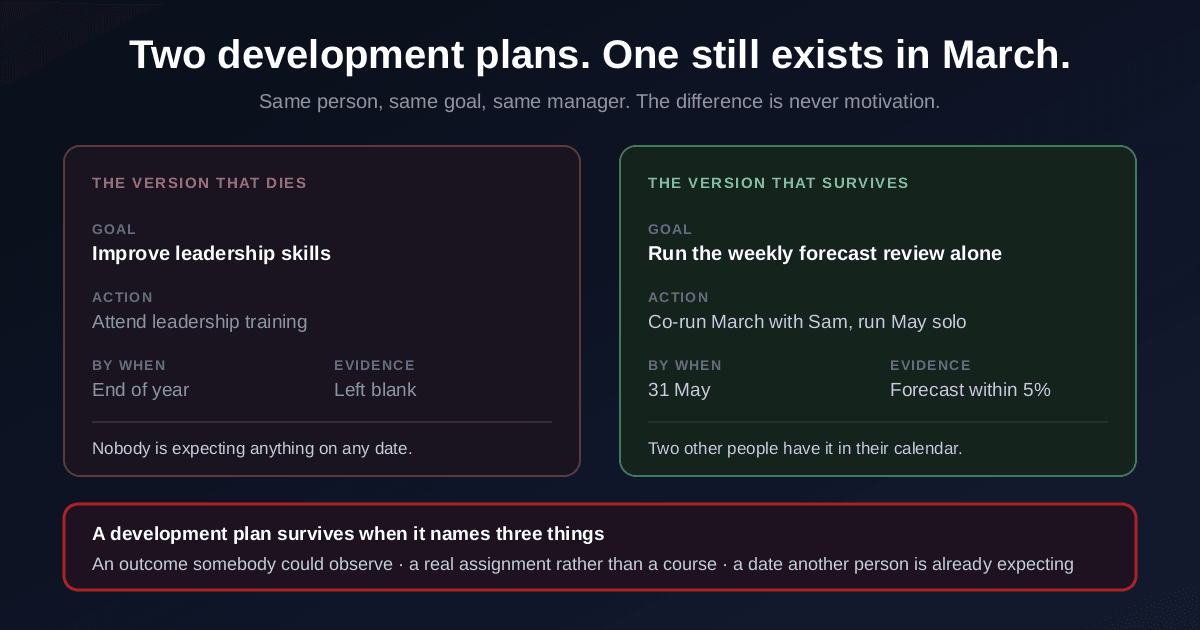
Two people at the same company got a development plan in January. The first says: improve leadership skills, attend leadership training, by end of year. The second says: able to run the weekly forecast review alone by 31 May, co-run March with Sam, run May solo, evidence is three reviews unaided with the forecast landing within five percent. By March the first plan has not been opened since it was written and the second one is halfway done. Same manager, same goal underneath, same amount of good intention. The difference is entirely structural, and it is fixable in about twenty minutes.
Quick answer
Quick answer: an individual development plan (IDP) is a short agreement about what someone will get better at over the next 6 to 18 months, owned by the employee and enabled by the manager. Two or three goals maximum. Each needs seven fields, and the three that decide whether it survives are evidence (what will be observably true), support (whose time, what budget), and a monthly review date. Write the assignment first and the course last. And an IDP is not a PIP: one builds on a standard being met, the other restores one that is not.
What is an individual development plan?
An individual development plan, almost always shortened to IDP, is a short written agreement between an employee and their manager covering what that person will get better at over the next six to eighteen months, how, and how both of them will know it worked.
The ownership is the part organisations get backwards. The employee owns the plan; the manager enables it. When the manager writes it, it becomes a set of instructions to comply with rather than ambitions to pursue, and compliance is the first thing to go when a quarter gets busy.
The manager's half of the deal is concrete, and it is three things:
- Provide the assignments. Usually by giving away work they currently do, or arranging exposure the employee could not get on their own.
- Provide the named support. The access, the budget, the introduction, the protected time.
- Turn up to the monthly review. Ten minutes. This is the part that tells everyone whether any of it was serious.
IDP vs PDP vs career development plan vs PIP
Four terms, constantly used interchangeably, and only three of them belong in the same family. Getting the fourth confused with the others is genuinely costly.
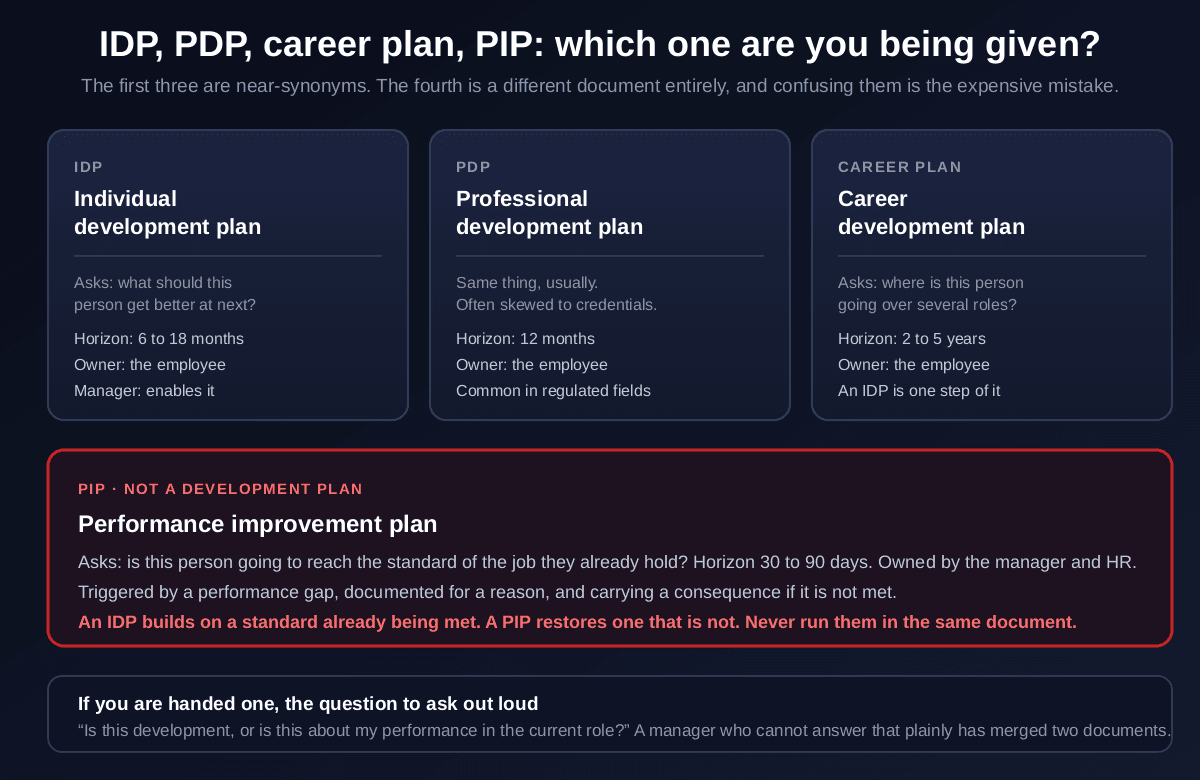
IDP and PDP are, in most companies, the same document with a different letterhead. Professional development plans lean a little harder on credentials and are more common in regulated professions where continuing development hours must be logged, but the structure is identical.
A career development plan is genuinely different in scope: two to five years, across several roles, asking where somebody is heading rather than what they should get better at next. The clean way to hold both is that the career plan is the direction and the IDP is the current leg. If someone asks you to write one and the term is ambiguous, ask what horizon it covers. That answer alone tells you which document is wanted.
A performance improvement plan is the opposite of all three. An IDP builds on a standard already being met. A PIP restores one that is not: 30 to 90 days, owned by the manager and HR, triggered by a documented gap, and carrying a consequence.
If you are handed something ambiguous, ask out loud
The individual development plan template, field by field
Seven fields per goal, two or three goals maximum. Five goals do not get five times the attention; they get roughly the same total attention divided into pieces too small to move anything.
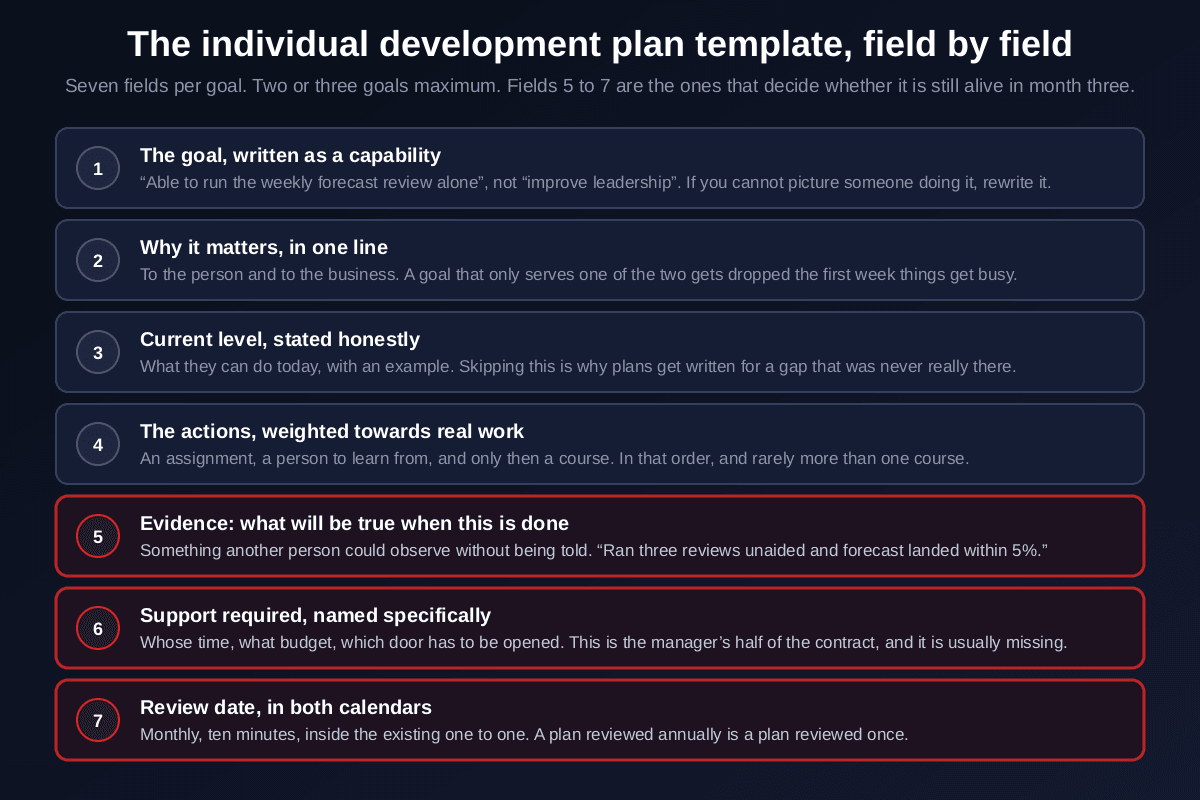
Everyone builds the first four fields. Evidence, support and review date are the three that get left off, and they are the three doing the actual work.
Evidencemakes completion falsifiable. Without it, "improve leadership" can be declared done or not done by anybody, at any time, with equal justification.
Supportis the manager's signature on the contract. A plan with an empty support field has quietly become the employee's problem alone, which is exactly what they suspected when they were asked to write it.
Review date converts a document into a recurring obligation. Ten minutes inside an existing one to one is enough. A plan reviewed annually is a plan reviewed once.
Why "attend a course" is usually the wrong action
The 70-20-10 model suggests capability comes roughly 70 percent from doing challenging work, 20 percent from learning directly from other people, and 10 percent from formal training. The precise numbers are a heuristic rather than a measured law, and anyone quoting them to two decimal places is overselling. The ordering, though, is the useful part.
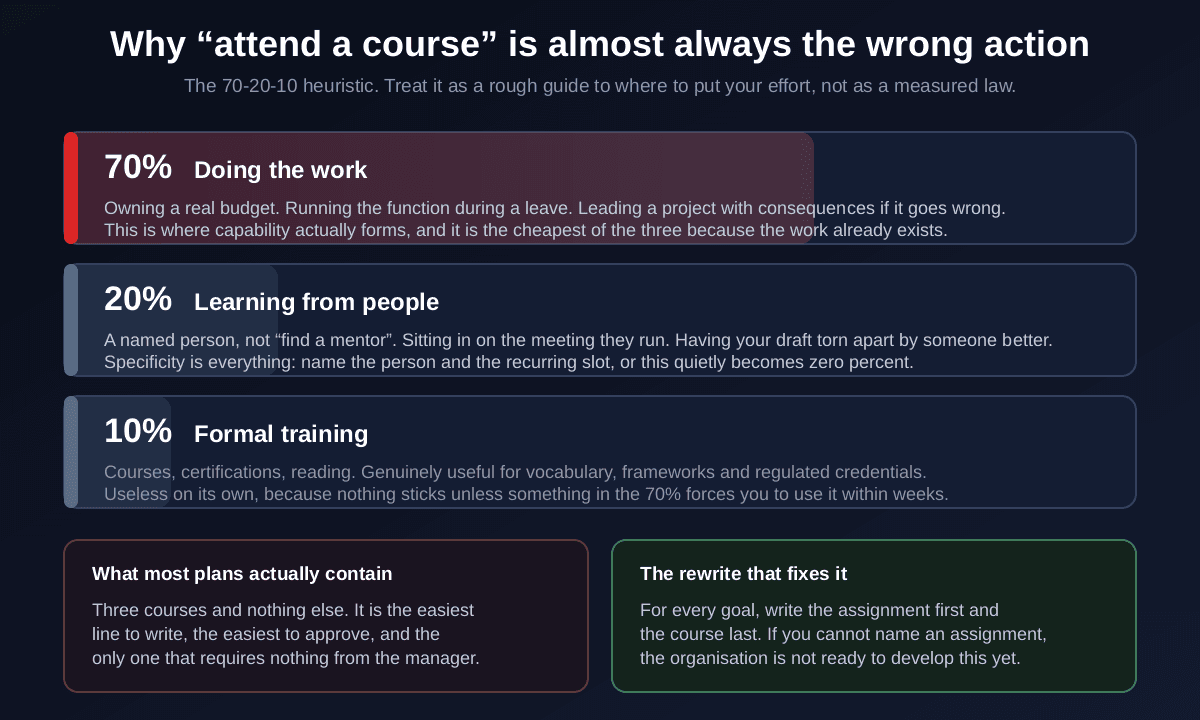
Most real development plans consist of three courses and nothing else, and the reason is structural rather than lazy. A course is the easiest line to write, the easiest to get approved, and the only option that requires nothing from the manager after the budget is signed. Assignments require someone to give away work, arrange exposure, and accept the risk that it goes imperfectly the first time.
Formal training is genuinely useful for vocabulary, frameworks and regulated credentials. It just does not survive on its own: almost nothing sticks unless something in the day job forces the person to use it within a few weeks of learning it.
The rewrite rule
How to write one, step by step
Start from a destination, not a skill list
Find the gap using real evidence
Pick two gaps, not five
Write each as an observable capability
Attach a real assignment to each
Name the evidence, the support and the date
Put a ten-minute review in an existing meeting
Development goals that can actually be checked
One test decides everything: could somebody who was not in the room tell whether this happened? If not, it is an intention, not a goal. That test eliminates most of what appears on real plans.
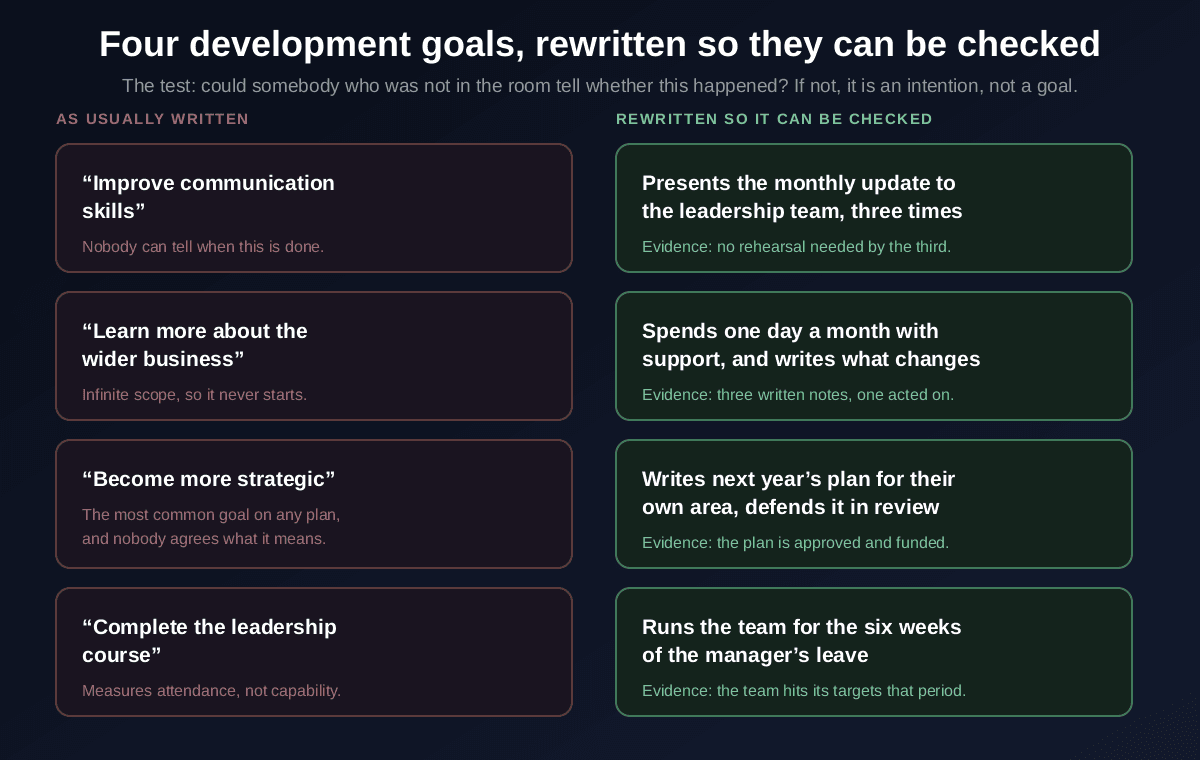
Two of those rewrites deserve a comment. "Become more strategic"is the single most common goal on any development plan and almost nobody can define it, which is why it recurs year after year on the same person's plan. Replace it with the most strategic thing that role can actually do: write the plan for their own area and defend it.
"Complete the leadership course" is worse than vague, it is precise about the wrong thing. It measures attendance. The rewrite measures whether the capability exists, which is a different question with a different answer.
Individual development plan examples
Three worked examples across different roles and different ambitions, including one for somebody who explicitly does not want to be a manager.
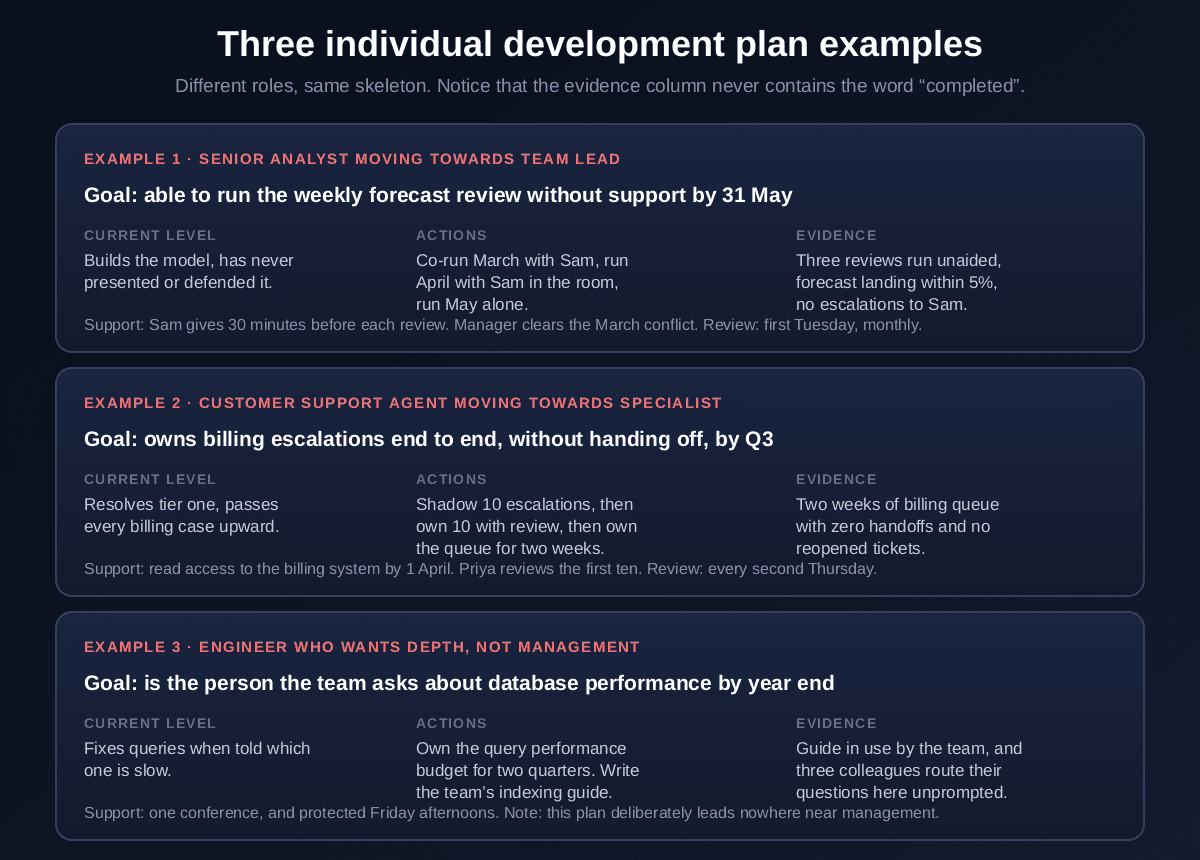
The third example is the one most organisations do not write, and it matters. Not everybody wants management, and a development plan that assumes upward movement is the only direction pushes excellent specialists into roles they did not want and are not suited to. You lose the specialist and gain a reluctant manager. Depth is a legitimate destination and deserves the same seven fields, which is a point our guide to succession planning makes about the 9-box grid as well.
Notice what the evidence column never says: completed. Completion is an attendance record. Evidence is a description of what the world looks like when the capability exists.
Running the conversation, for managers
The conversation fails in a predictable way: the manager asks "so what do you want to develop?", gets a polite non-answer, and fills the silence by suggesting a course. Three fixes.
Send one question in advance. Not the form. One question: what work do you want to be doing in two years that you are not doing now? People give considered answers to questions they have had time to think about, and reflexive ones to questions sprung on them.
Keep it out of the performance review. A conversation that feeds a rating is a conversation where people manage their answers, and naming a real weakness becomes irrational. Our guide to self-evaluations covers the appraisal conversation, which this one is deliberately not.
Commit to your half in the room.Name the assignment you will provide and the support you will arrange, out loud, with a date. If you cannot, say so and say why. An honest "I cannot get you that this quarter, so let us pick a different goal" is worth far more than a plan that quietly depends on something you were never going to deliver.
Build your plan from what the destination role actually requires
The fastest way to find a real development gap is to compare what you can evidence today against a live posting for the job you want next. Paste your resume and that job description into Rankid and you get a 0 to 100 match score, the requirements you already meet, and the exact ones you do not. That list is your development plan's first draft. Free, no signup.
Find your gaps freeWriting your own when nobody offers you one
Most people never get handed a development plan. Write one anyway; the self-authored version is usually better, because it starts from something you actually want rather than a form somebody has to fill in.
The method is the same as above with one change: your evidence for the gap comes from the outside market rather than an internal level definition. Pull three postings for the role you want in two years, list what they require, and mark honestly which you could evidence today with a specific example. What is left is your plan, and it will be considerably more concrete than anything self-reflection produces. If most of the gap is in how you describe what you already do rather than what you can do, that is a different and much faster fix, covered in our guides to checking your resume against a job description and writing a resume summary.
Then bring it to your manager as a proposal rather than a request. "I would like to be able to run the forecast review by May, here is how I would get there, and what I need from you is thirty minutes of Sam's time before each one" is a very different conversation from "what is my development plan?". The first is hard to refuse and easy to say yes to. The second puts the work on somebody who has eight other people to think about.
One honest caveat
The mistakes that kill development plans
- Five goals instead of two. The attention does not scale with the count. It just gets divided into pieces too small to move anything.
- Goals written as adjectives. More strategic, better communicator, stronger leader. Unfalsifiable, therefore unfinishable.
- Actions that are entirely courses. The line that requires nothing from anyone after approval.
- No evidence field. Nobody can say whether it was reached, so nobody asks.
- No named support.Silently makes the plan the employee's problem alone.
- Annual review only. Guarantees the plan is remembered exactly twice.
- Merged with the performance review. Turns it into a conversation where naming a real weakness is against your interests.
- Confused with a PIP. The most damaging one, and it destroys trust in the whole process for everyone who hears about it.
- Written for the current role rather than the wanted work. The subtle one. Thorough, well-meant, and it develops somebody perfectly for the job they were already doing well.
Why this shows up in your turnover numbers
Development plans correlate with retention, but not in the way the correlation is usually sold. The document keeps nobody. What keeps people is visible movement, and the plan is only the mechanism that makes movement legible.
Lack of progression is one of the most common reasons people leave, and it concentrates at the two-to-four year mark, when someone is good at their job and can no longer see what comes next. That pattern shows up clearly if you split your employee turnover rate by tenure band, and it is a different problem from the first-year exits that trace back to hiring.
The warning is that a plan producing no movement is worse than no plan, because it converts a vague dissatisfaction into a specific and evidenced one: they wrote it down and then nothing happened. That is a sentence that turns up in exit interviews constantly. The honest measure of a development programme is not how many plans exist. It is how many people can name something that changed for them because of one.
Key takeaways
- An IDP is a 6 to 18 month agreement on capability, owned by the employee and enabled by the manager. Backwards ownership is why most plans die.
- Two or three goals maximum. Five goals do not get five times the attention.
- Seven fields per goal. Evidence, named support and a monthly review date are the three that get skipped and the three that matter.
- An IDP is not a PIP. One builds on a standard being met, the other restores one that is not. Never merge them.
- A career development plan is 2 to 5 years and several roles. The IDP is the current leg of it.
- 70-20-10 is a heuristic, but the ordering holds: write the assignment first and the course last.
- The goal test: could somebody who was not in the room tell whether it happened? If not, it is an intention.
- Evidence should never say 'completed'. Completion measures attendance, not capability.
- Write plans for people who want depth, not only for people who want management.
- Keep it out of the performance review. Ratings make people manage their answers.
- No employer plan? Write your own from three real job postings for the role you want in two years.
- A plan that produces no movement is worse than no plan, because it turns vague dissatisfaction into an evidenced grievance.
Every development plan comes down to one question you can ask in month three: what has actually changed for this person since we wrote it? If the answer is a completed course and nothing else, the plan was a document. If the answer is that they now run a meeting they could not run in January, it was a plan. Start from where you want to be rather than from a skills list, and if you want the fastest possible first draft of the gap, paste your resume and a live posting for that next role into Rankid's resume checker and let the missing requirements write it for you.
Frequently asked questions
What is an individual development plan?
An individual development plan, usually shortened to IDP, is a short written agreement between an employee and their manager about what that person is going to get better at over the next six to eighteen months, how they are going to do it, and how both of them will know it worked. It is owned by the employee and enabled by the manager, which is the opposite of how most organisations run it. A working IDP is not a wish list of skills. It names two or three capabilities in terms concrete enough that somebody else could observe them, attaches a real assignment to each rather than a training course, states what evidence will exist when the goal is met, names the support the manager has to provide, and sets a monthly review date that sits inside an existing meeting. Anything less than that is a document rather than a plan, and it typically stops being referred to within about six weeks of being written.
What is the difference between an IDP, a PDP and a career development plan?
In most organisations the first two are the same document with different letterheads. An individual development plan and a professional development plan both cover a six to eighteen month horizon, both belong to the employee, and both should focus on capability rather than credentials, although PDPs tend to skew towards certifications and are more common in regulated professions where continuing professional development hours have to be logged. A career development plan is genuinely different in scope: it looks two to five years out and across several roles rather than one, and asks where somebody is heading rather than what they should get better at next. The clean way to hold all three together is to treat the career plan as the direction and the IDP as the current leg of the journey. If you are being asked to write one and the term is ambiguous, ask what horizon it covers, because that single answer tells you which document you are actually being asked for.
What is the difference between a development plan and a performance improvement plan?
They are opposites, and confusing them is the single most expensive mistake in this area. An individual development plan builds on a standard that is already being met: the person is doing their job well and the plan is about what comes next. A performance improvement plan addresses a standard that is not being met in the job the person already holds. The differences run all the way through. A PIP typically runs 30 to 90 days rather than a year, it is owned by the manager and HR rather than the employee, it is triggered by a documented performance gap, and it carries a consequence if the standard is not reached. If a manager hands you something labelled a development plan that reads like a list of deficiencies with a short deadline, you are entitled to ask directly whether this is development or a performance conversation. A manager who cannot answer that plainly has merged two documents that must stay apart.
What should be included in an individual development plan template?
Seven fields per goal, and no more than two or three goals in total. First, the goal written as a capability someone could observe, so not improve leadership but able to run the weekly forecast review without support. Second, why it matters, in one line, to both the person and the business, because a goal serving only one of the two gets dropped the first busy week. Third, the current level stated honestly with an example. Fourth, the actions, weighted heavily towards real work rather than courses. Fifth, the evidence: what will be true and observable when this is done. Sixth, the support required, named specifically, meaning whose time, what budget and which door has to be opened, since this is the manager's half of the contract and it is the field most often left blank. Seventh, a review date that lives in both calendars. Fields five to seven are what decide whether the plan is still alive in month three.
What is the 70-20-10 model, and why does it matter for development plans?
70-20-10 is a rule of thumb suggesting that most capability comes from doing challenging work, roughly 70 percent, a meaningful share from learning directly from other people, roughly 20 percent, and a small share from formal training, roughly 10 percent. The exact numbers are a heuristic rather than a measured law and should not be treated as precise, but the ordering is the useful part and it points at the most common failure in development planning. Most plans consist of three courses and nothing else, because a course is the easiest line to write, the easiest to get approved, and the only option that requires nothing from the manager afterwards. Formal training is genuinely useful for vocabulary, frameworks and regulated credentials, but very little of it survives unless something in the day job forces the person to apply it within weeks. The practical rule that follows: for every goal, write the assignment first and the course last. If you cannot name an assignment, the organisation is not ready to develop that capability yet.
What are some good individual development plan examples?
The strongest examples share a shape rather than a subject. A senior analyst moving towards team lead: goal, able to run the weekly forecast review without support by 31 May; actions, co-run March with a named colleague, run April with them in the room, run May alone; evidence, three reviews run unaided with the forecast landing within five percent and no escalations. A support agent moving towards specialist: goal, owns billing escalations end to end without handing off by Q3; actions, shadow ten escalations, own ten with review, then hold the queue for two weeks; evidence, two weeks of the billing queue with zero handoffs and no reopened tickets. An engineer who wants depth rather than management: goal, is the person the team asks about database performance by year end; actions, own the query performance budget for two quarters and write the team's indexing guide; evidence, the guide is in use and colleagues route questions there unprompted. Notice that the evidence never contains the word completed.
How do you write development goals that are actually measurable?
Apply one test: could somebody who was not in the room tell whether this happened? If not, it is an intention rather than a goal. That test kills most of what appears on real plans. Improve communication skills becomes presents the monthly update to the leadership team three times, with the evidence being that no rehearsal is needed by the third. Learn more about the wider business, which has infinite scope and therefore never starts, becomes spends one day a month with a named team and writes up what should change, evidenced by three written notes with one acted on. Become more strategic, the most common goal on any plan and the one nobody defines, becomes writes next year's plan for their own area and defends it in review, evidenced by the plan being approved and funded. And complete the leadership course, which measures attendance rather than capability, becomes runs the team for the six weeks of the manager's leave, evidenced by the team hitting its targets in that period.
Who is responsible for an individual development plan?
The employee owns it and the manager enables it, and getting this backwards is why so many plans are written once and never opened again. If the manager writes the plan, it becomes a set of instructions the employee complies with rather than a set of ambitions they pursue, and compliance evaporates the moment the quarter gets busy. The manager's actual job has three parts and all three are concrete. Provide the assignments, which usually means giving away work the manager currently does or finding exposure the employee could not arrange alone. Provide the support named in the plan, meaning the access, the budget, the introduction or the protected time. And show up to the monthly review, which is the part that signals whether any of it was serious. An organisation where employees write plans and managers never deliver their half teaches people that the process is decorative, and they stop investing in it within a cycle or two.
How often should a development plan be reviewed?
Monthly, for about ten minutes, inside a meeting that already exists. The instinct is to review development annually alongside the performance cycle, and that is exactly the cadence that guarantees a plan is remembered twice: once when it is written and once when somebody realises nothing happened. Ten minutes a month is enough because the questions are short. What moved since last time, what is blocking it, and is this still the right goal given what has changed. Roughly twice a year the answer to that last question should be no for at least one goal, and rewriting it is a sign the process is working rather than a failure of planning. Keep the review separate from performance ratings. A conversation that feeds a rating is a conversation where people manage their answers, which is the same reason a development plan and a performance improvement plan should never share a document.
How do I write my own development plan if my employer does not offer one?
Write it anyway, and do not wait to be asked, because the version you write for yourself is usually better than the one you would have been handed. Start from a concrete destination rather than a skill list: name a role or a kind of work you want to be doing in about two years, then find two or three job postings for it and read what they actually require. The gap between those requirements and what you can evidence today is your plan, and it is far more specific than anything introspection produces. Pick the two gaps that are both largest and closeable in your current job, write them as observable capabilities, and attach an assignment to each that exists inside your present role, since asking for a stretch project is much easier than asking for a promotion. Then bring it to your manager as a proposal rather than a request. A specific ask, with the business reason attached and the support you need named, is very hard to say no to and is a different conversation from asking what my development plan is.
Do development plans actually reduce turnover?
They correlate strongly with retention, but the direction of the effect is worth understanding, because the plan itself is not what keeps anybody. Lack of visible progression is one of the most common reasons people leave, particularly at the two to four year mark when someone is good at their job and can no longer see what comes next. A development plan addresses that only if it produces visible change, which means real assignments, real exposure and occasional real promotions. A plan that generates a document and no movement is worse than no plan at all, because it converts a vague dissatisfaction into a specific, evidenced grievance: they wrote it down and then nothing happened. That is why the support and review-date fields matter more than the goals, and why the honest test of a development programme is not how many plans exist but how many people can name something that changed for them because of one.
What are the most common mistakes in individual development plans?
Eight recur constantly. Too many goals, so five compete for the attention that two would have received. Goals written as adjectives rather than observable capabilities, which makes completion unfalsifiable. Actions that are entirely courses, because that is the only line requiring nothing from the manager. No evidence field, so nobody can say whether the goal was reached. No named support, which quietly makes the plan the employee's problem alone. Annual review only, guaranteeing it is remembered twice. Merging it with the performance review, which makes it a conversation where people manage their answers rather than name real weaknesses. And the one underneath all the others: a plan written for the role the employee already has rather than the work they want to be doing, which is thorough, well-intentioned, and develops somebody perfectly for the job they were already doing well.