Resume Format: Chronological vs Functional vs Combination (Which One Actually Passes ATS, 2026)
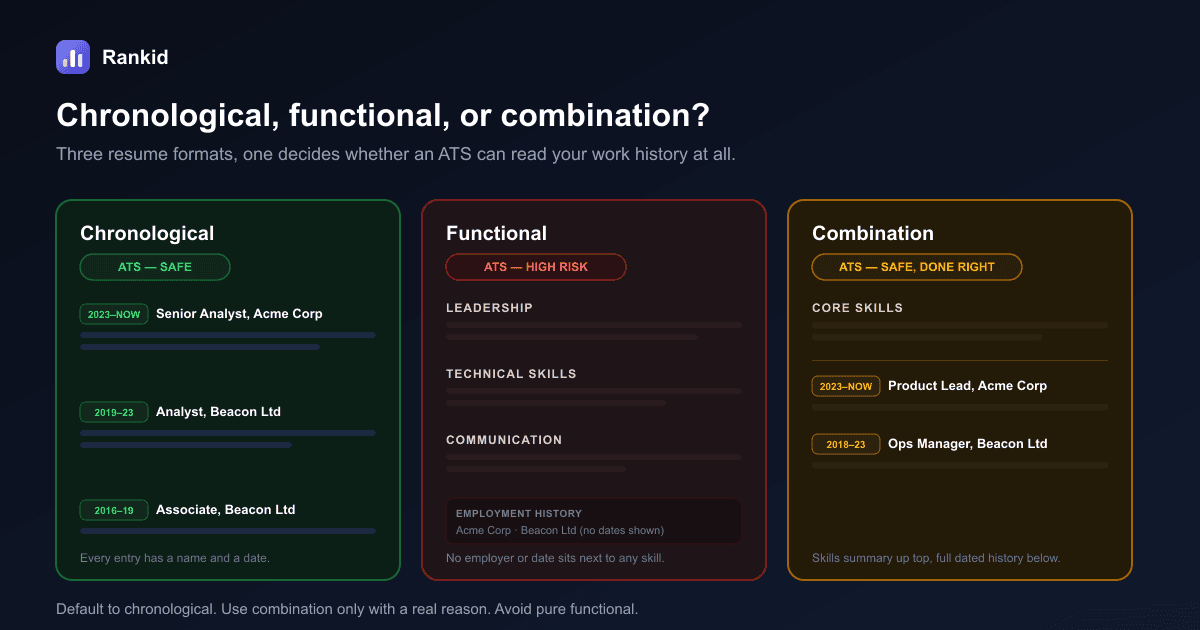
Three resumes can describe the exact same career and get three completely different receptions, and the difference has nothing to do with the work itself. It comes down to which of three formats you chose: chronological, functional, or combination. One of them is what nearly every applicant tracking system and every recruiter expects by default. One of them was built decades ago to solve a problem it does not actually solve, and now sets off the exact suspicion it was designed to avoid, while quietly breaking the software reading it. Here is what each format actually does once it leaves your hands.
Quick answer
Quick answer: use a reverse-chronological resume unless you have a specific reason not to. It is what ATS parsers read most reliably and what recruiters expect by default. A functional resume groups experience under skill headings instead of dated jobs, which frequently breaks parsing entirely and reads as evasive to a human. A combination resume adds a short skills summary in front of a full, dated work history, and is the only safe alternative, for career changers, long re-entries, and military transitions, as long as the dated history never disappears.
The three formats, defined properly
Chronological, almost always meaning reverse-chronological in practice, lists your work history starting with your most recent role and working backward. Every entry leads with an employer name and a date range, followed by a title and bullet points. It is the format nearly every resume template defaults to, and the one both software and people expect to see.
Functional, sometimes called skills-based, abandons that structure. Instead of organizing by employer and date, it groups your experience under skill categories, things like Leadership, Technical Skills, or Communication, with accomplishments listed underneath each heading regardless of which job they happened at. Your actual employment history gets compressed into a short, often dateless list near the bottom, if it appears at all.
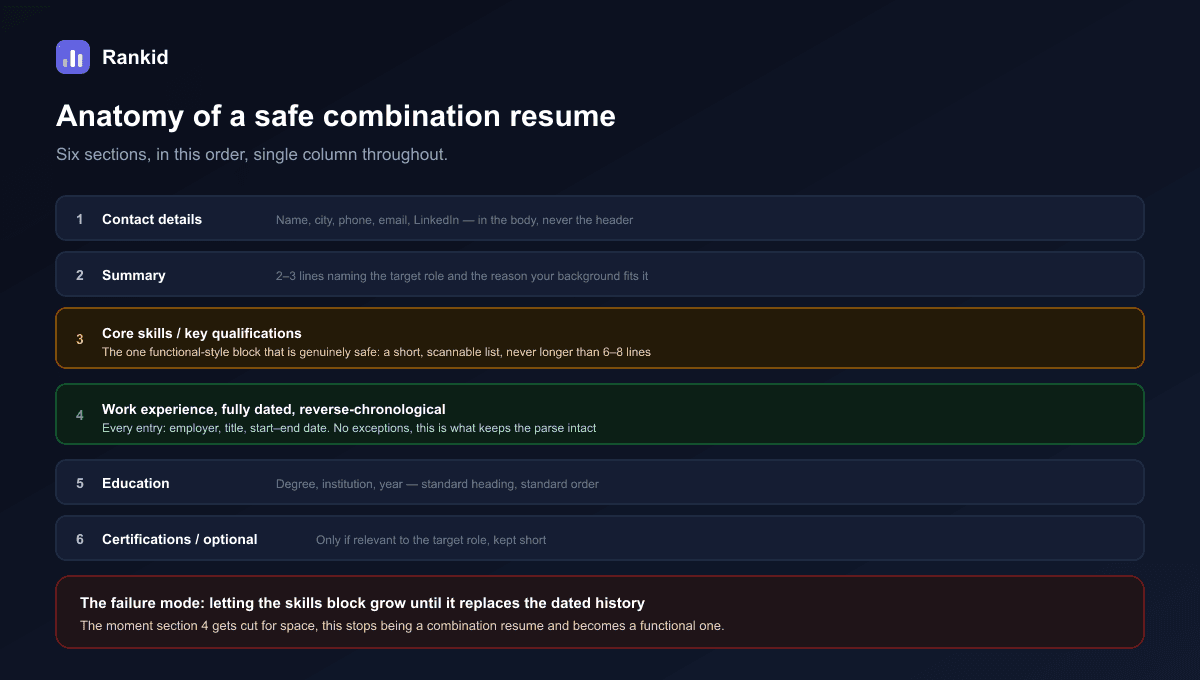
Combination, also called hybrid, keeps the full reverse-chronological work history intact and adds one thing in front of it: a short skills or core-qualifications summary, usually right after your professional summary and before your dated history begins. Nothing about your employment timeline gets hidden or compressed. It is additive, not a replacement.
The format question is really a structure question
The three formats, side by side
Run the same five questions against all three and one column loses on almost every row. This is not a three-way tie with different trade-offs, it is a warning about one specific choice.
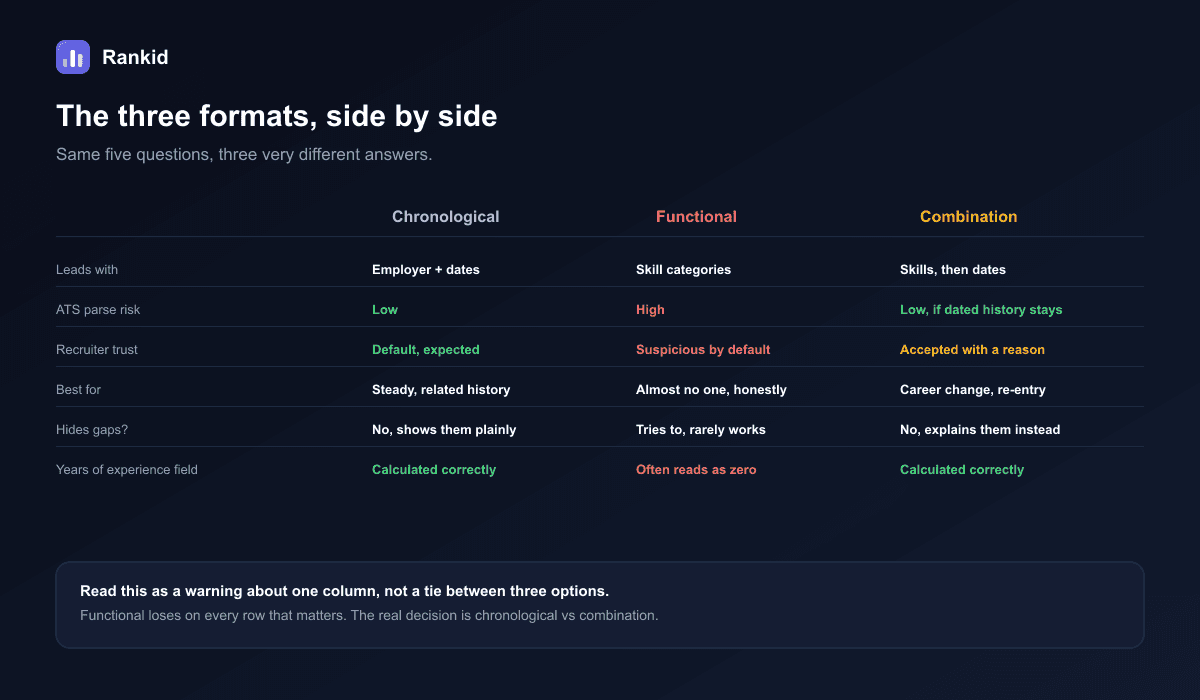
Notice that functional does not lose on one row and win on another. It loses on parse risk, recruiter trust, and the calculated years-of-experience field, and it does not even reliably achieve the one thing it exists to do, which is hide a gap. The real decision most people are actually making is chronological versus combination.
How a functional resume actually breaks an ATS, mechanically
“It confuses the software” is true but not specific enough to act on. Here is exactly what happens, using the same career told two ways.
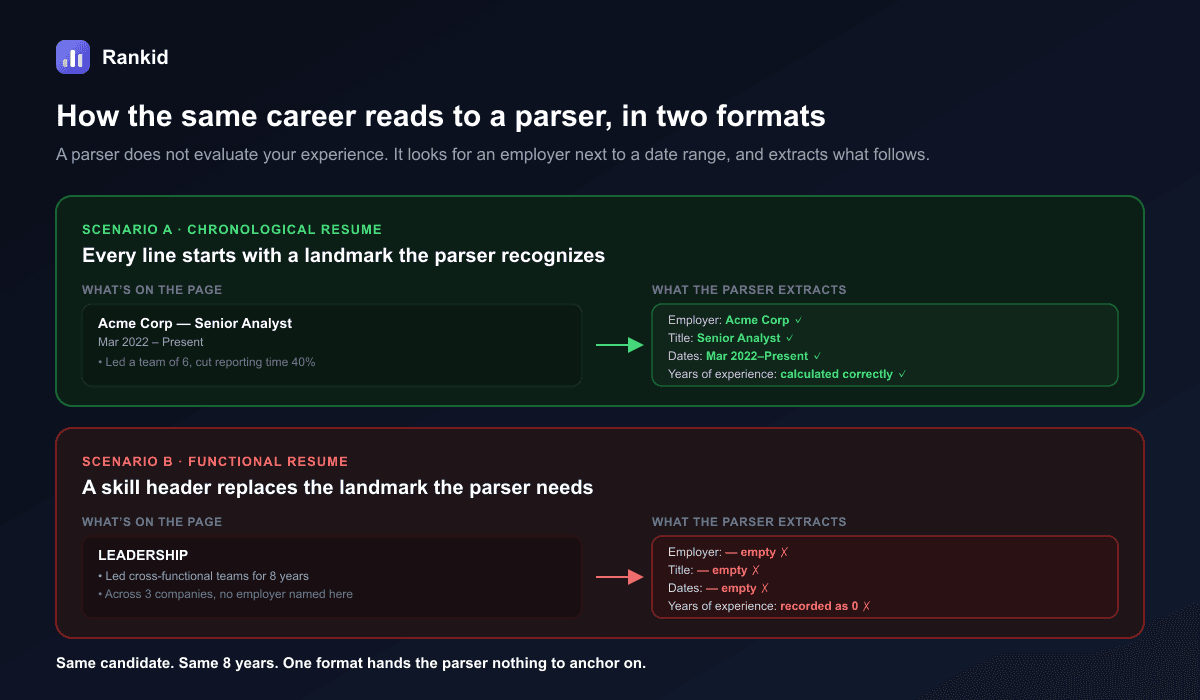
An ATS parser does not evaluate your experience the way a person does. It scans for a pattern it recognizes, most commonly an employer name sitting directly next to a date range, and treats that as the start of a new job entry. Everything indented underneath gets attributed to that employer and that time period. A chronological resume hands the parser that landmark on every single entry.
A functional resume replaces the landmark with a skill category heading, which has no employer and no date attached. The parser has nothing to anchor on, so the employer field, the title field and the date field commonly come back empty, not because the information is not on the page, but because the structure never told the software where to find it. And because years of experience is typically a calculated field built on date ranges, a resume with no anchored dates can report zero years of experience for someone with a decade of real work behind them. This is the same underlying mechanism covered in more depth in our guide to how resume parsing works, and it is worth reading if you want the full five-stage pipeline rather than just this one failure mode.
Why recruiters flag functional resumes on sight
The parsing problem is only half of it. Even a functional resume that somehow parses cleanly still runs into a second, entirely human obstacle: recruiters recognize the format, and the association is not neutral.
The functional format was popularized specifically as a way to obscure employment gaps and frequent job changes, by removing the chronology that would reveal them. Anyone who has screened resumes for more than a few months has seen enough of them to know exactly why the format exists, and the instinctive read is not this person has strong skills, it is this person is hiding their timeline, and I should find out why before I move them forward. That is the opposite of the intended effect, and it invites more scrutiny than a plain, accurately-dated resume with one honest sentence about a gap ever would.
A functional resume rarely hides what it means to hide
Who should actually use each format
This is a smaller decision than it feels like. Most people belong in the first row below, and knowing you belong there is itself useful, because it means you can stop worrying about this entirely.
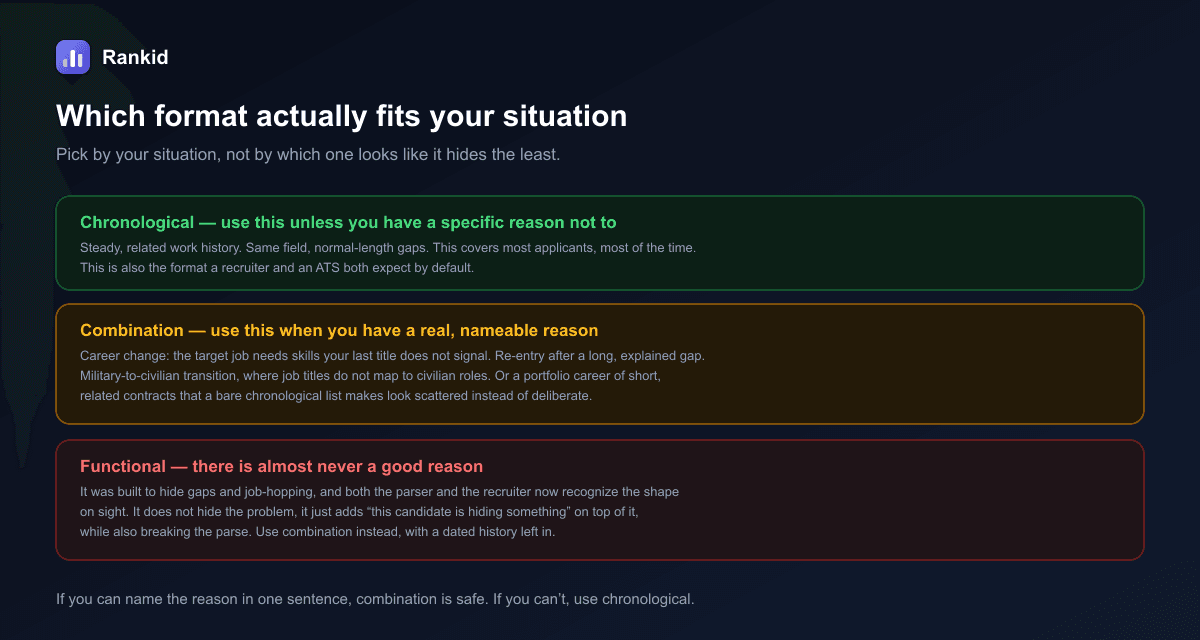
The test that matters is whether you can name your reason for leading with skills in one plain sentence. “I am moving from teaching into instructional design and my last title doesn't signal that” is a real reason. “I don't want them to see my gap” is not a reason to change format, it is a reason to write one sentence about the gap. If your situation involves a genuine career pivot, see our guide to writing a career change resume, and if you are starting with little to no work history at all, a combination format is rarely the fix either; see writing a resume with no experience instead.
How to build a combination resume that stays safe
A combination resume only works because it keeps everything a chronological resume has and adds a short summary in front of it. The moment that discipline slips, it quietly turns back into a functional resume with a different name.
Keep the skills block short, on purpose
Never let the dated history shrink to make room
Make the skills section earn its place with the same keywords
Stay single column throughout
Test it against a real job description before you send it
Check that your format actually parses before you apply
Paste your resume and a target job description into Rankid. You'll see a 0 to 100 match score and exactly which skills and keywords the parser read, so a format problem shows up as a gap you can see and fix, not a silence you can't explain. First check is free, no signup.
Check your resume freeFormat type and column layout are two different risks
It is worth separating these clearly, because they get bundled together constantly and the fixes are different. A functional resume breaks parsing because of what information it leaves out and how it is organized: no dated landmarks for the parser to key off. A multi-column layout breaks parsing because of how the page gets read: many parsers read left to right across the full page width, so a two-column design can interleave unrelated sections into nonsense even when every fact is technically present somewhere on the page.
You can have a chronological resume that still parses badly because it is laid out in two columns. You can have a perfectly single-column resume that still parses badly because it is functional. Fix both independently: single column, and reverse-chronological or combination. If you are also unsure whether PDF or Word survives the parse better for your target ATS, our PDF vs Word resume guide covers that separately, and it compounds with format choice rather than replacing it.
For recruiters: what a functional resume in your pipeline actually means
Seeing a functional resume land in your queue is not usually a signal about the candidate's quality. It is more often a signal that they read outdated career advice, sometimes years out of date, that told them this format would help. Screening it out on sight punishes people for a formatting choice rather than a qualifications gap, and some of them are exactly the candidate you want.
The more durable fix sits earlier in your process than a per-resume judgment call. Screening software that scores what a candidate has actually done, rather than relying purely on a parser successfully locating a dated title, keeps a mis-formatted resume from a strong candidate from being silently buried by a structural quirk that has nothing to do with their ability to do the job. That is a process fix, not a per-candidate exception you have to remember to make.
Stop losing strong candidates to a formatting choice
Upload a batch of resumes and your job description. Rankid scores every candidate against the real requirements and shows the evidence behind each score, so a mis-formatted resume from a genuinely strong candidate does not silently sink to the bottom of your ranking. First 5 resumes free, no signup.
Try bulk screening freeIf you already have a functional resume, converting it back
- Keep every skill, move it into a job entry. A leadership accomplishment happened at a specific employer during a specific date range. Put it there, as a bullet point under that role, rather than under an abstract heading.
- Rebuild the dated history first, then decide if you still need a summary. Once your accomplishments sit under real employers and real dates, you may find you do not need a separate skills block at all, or only a short one.
- Do not delete detail to make it fit one page. A resume that has lost its dated structure and now also loses detail for length is worse on both counts. Trim less relevant older roles instead; see how far back a resume should go.
- Check the result parses the way you expect. The whole point of doing this conversion is a clean parse, so confirm it rather than assuming the rebuild worked.
Frequently asked questions
What is the difference between a chronological, functional and combination resume?
A chronological resume (more precisely reverse-chronological) lists your work history starting with your most recent role, with each entry led by an employer name and a date range. A functional resume drops that structure and instead groups your experience under skill categories, such as Leadership or Technical Skills, with your actual jobs and dates pushed to a short list at the bottom or omitted entirely. A combination resume, also called a hybrid, keeps the dated, reverse-chronological work history but adds a short skills summary near the top, so you get the skimmability of a functional resume without losing the dates a parser and a recruiter both need. The names describe what leads the page: chronological leads with dates, functional leads with skills, combination leads with skills but still delivers dates immediately after.
Can an ATS read a functional resume?
Poorly, and often not at all for the fields that matter. An ATS parser works by looking for a pattern it recognizes: typically an employer name sitting next to a date range, which it treats as the start of a job entry. A functional resume replaces that pattern with a skill category heading like Communication or Project Management, which has no employer and no date attached to it. The parser has nothing to anchor on, so it frequently records an empty employer field, an empty title field, and no usable date range. Because years of experience is usually calculated from date ranges, a resume with no anchored dates can come back showing zero years of experience for someone with a decade of work behind them. The content is on the page. The structure just never told the software where to find it.
Why do recruiters dislike functional resumes?
Because the format has one well-known origin story: it was popularized specifically as a way to hide employment gaps and frequent job changes, by burying the chronology that would reveal them. Recruiters who have screened resumes for more than a few months learn to recognize the shape on sight, and the instinctive reaction is not neutral, it is suspicious. A functional resume does not read as this person has strong skills. It reads as this person is hiding their timeline, which invites exactly the scrutiny it was meant to avoid. The irony is that most people who reach for a functional format do not actually have anything alarming to hide, they just have a gap or a career pivot that a plain chronological list explains perfectly well with one added sentence.
Is a combination resume the same as a functional resume?
No, and conflating them is the most common mistake people make when trying to solve the same problem a functional resume was meant to solve. A combination resume keeps every element of a chronological resume, employer names, job titles and full date ranges, in the standard order. It adds one thing on top: a short skills or core-qualifications summary placed near the beginning, usually right after your professional summary and before the dated history. The dates never disappear. That single design choice is what keeps a combination resume both ATS-safe and recruiter-safe. The moment the skills section grows long enough to replace the dated history rather than sit in front of it, it has quietly become a functional resume wearing a different name.
Who should actually use a combination resume?
A smaller group than believes they should. It genuinely helps career changers, where your most recent job title does not signal the skills a new field needs, so a short skills summary gives the reader the right frame before they hit your history. It helps people re-entering the workforce after a long, explained gap, where leading with current, relevant skills is more useful than leading with a role from several years ago. It helps a military-to-civilian transition, where job titles do not map cleanly to civilian role names and a translated skills summary does real work. And it can help a portfolio career of several short, related contracts that would otherwise read as scattered rather than deliberate. Outside of those cases, reverse-chronological alone usually serves you better, because it is the format both software and people expect by default.
Does a resume gap mean I need a functional resume?
Almost never, and this is the single most common reason people reach for the wrong format. A gap of a few months rarely needs any special handling at all: dates alone tell a recruiter nothing damaging, and a plain chronological resume with accurate dates draws no more attention than anyone else's. A longer gap is better handled with one honest sentence in your summary or cover letter, not with a format designed to obscure the entire timeline. Switching your whole resume to functional to manage one gap is a disproportionate fix that creates a second, larger problem: now every job you have ever held looks undated, not just the one period you were actually trying to explain. See our guide on explaining employment gaps for the sentence-length version of this fix.
What is the safest resume format if I am not sure?
Reverse-chronological, in a single column, with standard section headings. It is the format applicant tracking systems parse most reliably, the format recruiters read fastest because it matches what they expect, and the format that requires no explanation or justification from you. It is also the default assumption in almost every resume template, every parsing engine, and every piece of hiring software built in the last decade, which means using it means one less thing that can go wrong before a human ever reads your qualifications. Reach for combination only when you can name a specific, concrete reason a skills-first layout serves you better, and skip functional formats entirely.
Will a two-column resume template break parsing the same way a functional resume does?
It is a related but separate problem, and worth being precise about because people often bundle the two together. A functional resume breaks parsing because of what information it omits and how it is organized: no dated landmarks. A multi-column layout breaks parsing because of how the page is read: most parsers read left to right across the full page width, so a two-column design can interleave text from unrelated sections into nonsense, even if every fact is technically present somewhere on the page. You can have a chronological resume that still parses badly because it uses two columns, and you can have a single-column resume that still parses badly because it is functional. Fix both: single column, and reverse-chronological. Our guide to building an ATS-friendly resume covers the column and layout side in full.
Does resume format matter if a real recruiter reads it instead of software?
Yes, differently. Assume a human reads every resume that reaches a shortlist, but assume software decides which resumes reach that shortlist in the first place at any company receiving more than a handful of applications. Format has to survive both readers. A recruiter scanning by eye forms a judgment in seconds and, fairly or not, associates a functional layout with something being hidden, which chronological and combination resumes do not trigger. So the format decision is not really software versus human, it is passing an automated first pass and then not raising a flag on the second one, and chronological and combination formats are the only two that reliably do both.
How do I convert a functional resume back to chronological without losing my strongest skills?
Keep the skills, move them. Take whatever categories organized your functional resume, Leadership, Technical Skills, whatever they were, and fold the specific accomplishments underneath each one into the actual job entry where that work happened, as bullet points. A leadership accomplishment did not happen in the abstract, it happened at a specific employer during a specific date range, so put it there. What you are left with is a chronological resume where the bullets underneath each role are already skills-focused, which is a stronger structure than either the pure chronological or pure functional version, because the reader gets the skill and the proof of where and when you demonstrated it in the same line.
Should a recruiter or ATS admin actively screen out functional resumes?
Screening one out on sight is too blunt, because a small number of candidates using it have a genuinely good reason and simply followed outdated advice, and rejecting the format punishes them for a formatting choice rather than a qualification gap. The better fix sits earlier in the pipeline: use screening software that scores what a candidate has actually done rather than relying on a parser's ability to locate a dated title, so a mis-formatted resume from a strong candidate is not silently buried by a structural quirk. That is a solvable process problem, not a candidate problem, and it is worth fixing directly rather than adding a format-based rejection rule that will misfire on real people.
Do combination resumes ever backfire?
Yes, in one specific and common way: when the skills section grows past a short, scannable summary and starts absorbing detail that belongs in the work history underneath it. At that point the reader experiences the same disorientation a functional resume causes, a wall of claims with no attached timeline, even though the dated section is technically still there further down the page. The fix is a hard limit: keep the skills or core-qualifications block to somewhere around six to eight lines, treat it as a preview of what is coming, not a replacement for it, and make sure the dated history immediately follows rather than getting pushed below the fold.
Key takeaways
- Default to reverse-chronological. It is what both ATS parsers and recruiters expect, and it requires no justification from you.
- A functional resume replaces the employer-and-date landmark a parser needs, which frequently returns empty employer, title and date fields and a years-of-experience of zero.
- Recruiters recognize the functional format on sight and associate it with hiding a gap or job-hopping, which invites more scrutiny, not less.
- A combination resume is safe only as long as the dated work history stays fully intact underneath a short skills summary, not replaced by it.
- Combination genuinely helps career changers, long re-entries, military-to-civilian transitions, and portfolio careers of short related contracts.
- Most resume gaps need one honest sentence, not a full format change. Switching format to hide one gap makes every role on the resume look undated.
- Column layout and format type are separate risks. A chronological resume in two columns can still parse badly; fix both independently.
- If converting a functional resume back, move each accomplishment into the specific job entry where it actually happened, then confirm it parses.
- Recruiters: a functional resume in your pipeline usually signals outdated advice, not a weak candidate. Score on real evidence rather than screening the format out.
- Test the actual parse before you apply. A format that looks clean to your eye can still fail to register the way you intend.
Frequently asked questions
What is the difference between a chronological, functional and combination resume?
A chronological resume (more precisely reverse-chronological) lists your work history starting with your most recent role, with each entry led by an employer name and a date range. A functional resume drops that structure and instead groups your experience under skill categories, such as Leadership or Technical Skills, with your actual jobs and dates pushed to a short list at the bottom or omitted entirely. A combination resume, also called a hybrid, keeps the dated, reverse-chronological work history but adds a short skills summary near the top, so you get the skimmability of a functional resume without losing the dates a parser and a recruiter both need. The names describe what leads the page: chronological leads with dates, functional leads with skills, combination leads with skills but still delivers dates immediately after.
Can an ATS read a functional resume?
Poorly, and often not at all for the fields that matter. An ATS parser works by looking for a pattern it recognizes: typically an employer name sitting next to a date range, which it treats as the start of a job entry. A functional resume replaces that pattern with a skill category heading like Communication or Project Management, which has no employer and no date attached to it. The parser has nothing to anchor on, so it frequently records an empty employer field, an empty title field, and no usable date range. Because years of experience is usually calculated from date ranges, a resume with no anchored dates can come back showing zero years of experience for someone with a decade of work behind them. The content is on the page. The structure just never told the software where to find it.
Why do recruiters dislike functional resumes?
Because the format has one well-known origin story: it was popularized specifically as a way to hide employment gaps and frequent job changes, by burying the chronology that would reveal them. Recruiters who have screened resumes for more than a few months learn to recognize the shape on sight, and the instinctive reaction is not neutral, it is suspicious. A functional resume does not read as this person has strong skills. It reads as this person is hiding their timeline, which invites exactly the scrutiny it was meant to avoid. The irony is that most people who reach for a functional format do not actually have anything alarming to hide, they just have a gap or a career pivot that a plain chronological list explains perfectly well with one added sentence.
Is a combination resume the same as a functional resume?
No, and conflating them is the most common mistake people make when trying to solve the same problem a functional resume was meant to solve. A combination resume keeps every element of a chronological resume, employer names, job titles and full date ranges, in the standard order. It adds one thing on top: a short skills or core-qualifications summary placed near the beginning, usually right after your professional summary and before the dated history. The dates never disappear. That single design choice is what keeps a combination resume both ATS-safe and recruiter-safe. The moment the skills section grows long enough to replace the dated history rather than sit in front of it, it has quietly become a functional resume wearing a different name.
Who should actually use a combination resume?
A smaller group than believes they should. It genuinely helps career changers, where your most recent job title does not signal the skills a new field needs, so a short skills summary gives the reader the right frame before they hit your history. It helps people re-entering the workforce after a long, explained gap, where leading with current, relevant skills is more useful than leading with a role from several years ago. It helps a military-to-civilian transition, where job titles do not map cleanly to civilian role names and a translated skills summary does real work. And it can help a portfolio career of several short, related contracts that would otherwise read as scattered rather than deliberate. Outside of those cases, reverse-chronological alone usually serves you better, because it is the format both software and people expect by default.
Does a resume gap mean I need a functional resume?
Almost never, and this is the single most common reason people reach for the wrong format. A gap of a few months rarely needs any special handling at all: dates alone tell a recruiter nothing damaging, and a plain chronological resume with accurate dates draws no more attention than anyone else's. A longer gap is better handled with one honest sentence in your summary or cover letter, not with a format designed to obscure the entire timeline. Switching your whole resume to functional to manage one gap is a disproportionate fix that creates a second, larger problem: now every job you have ever held looks undated, not just the one period you were actually trying to explain. See our guide on explaining employment gaps for the sentence-length version of this fix.
What is the safest resume format if I am not sure?
Reverse-chronological, in a single column, with standard section headings. It is the format applicant tracking systems parse most reliably, the format recruiters read fastest because it matches what they expect, and the format that requires no explanation or justification from you. It is also the default assumption in almost every resume template, every parsing engine, and every piece of hiring software built in the last decade, which means using it means one less thing that can go wrong before a human ever reads your qualifications. Reach for combination only when you can name a specific, concrete reason a skills-first layout serves you better, and skip functional formats entirely.
Will a two-column resume template break parsing the same way a functional resume does?
It is a related but separate problem, and worth being precise about because people often bundle the two together. A functional resume breaks parsing because of what information it omits and how it is organized: no dated landmarks. A multi-column layout breaks parsing because of how the page is read: most parsers read left to right across the full page width, so a two-column design can interleave text from unrelated sections into nonsense, even if every fact is technically present somewhere on the page. You can have a chronological resume that still parses badly because it uses two columns, and you can have a single-column resume that still parses badly because it is functional. Fix both: single column, and reverse-chronological. Our guide to building an ATS-friendly resume covers the column and layout side in full.
Does resume format matter if a real recruiter reads it instead of software?
Yes, differently. Assume a human reads every resume that reaches a shortlist, but assume software decides which resumes reach that shortlist in the first place at any company receiving more than a handful of applications. Format has to survive both readers. A recruiter scanning by eye forms a judgment in seconds and, fairly or not, associates a functional layout with something being hidden, which chronological and combination resumes do not trigger. So the format decision is not really software versus human, it is passing an automated first pass and then not raising a flag on the second one, and chronological and combination formats are the only two that reliably do both.
How do I convert a functional resume back to chronological without losing my strongest skills?
Keep the skills, move them. Take whatever categories organized your functional resume, Leadership, Technical Skills, whatever they were, and fold the specific accomplishments underneath each one into the actual job entry where that work happened, as bullet points. A leadership accomplishment did not happen in the abstract, it happened at a specific employer during a specific date range, so put it there. What you are left with is a chronological resume where the bullets underneath each role are already skills-focused, which is a stronger structure than either the pure chronological or pure functional version, because the reader gets the skill and the proof of where and when you demonstrated it in the same line.
Should a recruiter or ATS admin actively screen out functional resumes?
Screening one out on sight is too blunt, because a small number of candidates using it have a genuinely good reason and simply followed outdated advice, and rejecting the format punishes them for a formatting choice rather than a qualification gap. The better fix sits earlier in the pipeline: use screening software that scores what a candidate has actually done rather than relying on a parser's ability to locate a dated title, so a mis-formatted resume from a strong candidate is not silently buried by a structural quirk. That is a solvable process problem, not a candidate problem, and it is worth fixing directly rather than adding a format-based rejection rule that will misfire on real people.
Do combination resumes ever backfire?
Yes, in one specific and common way: when the skills section grows past a short, scannable summary and starts absorbing detail that belongs in the work history underneath it. At that point the reader experiences the same disorientation a functional resume causes, a wall of claims with no attached timeline, even though the dated section is technically still there further down the page. The fix is a hard limit: keep the skills or core-qualifications block to somewhere around six to eight lines, treat it as a preview of what is coming, not a replacement for it, and make sure the dated history immediately follows rather than getting pushed below the fold.