Screening Interview: 20 Questions and a 15-Minute Structure That Filters (2026)
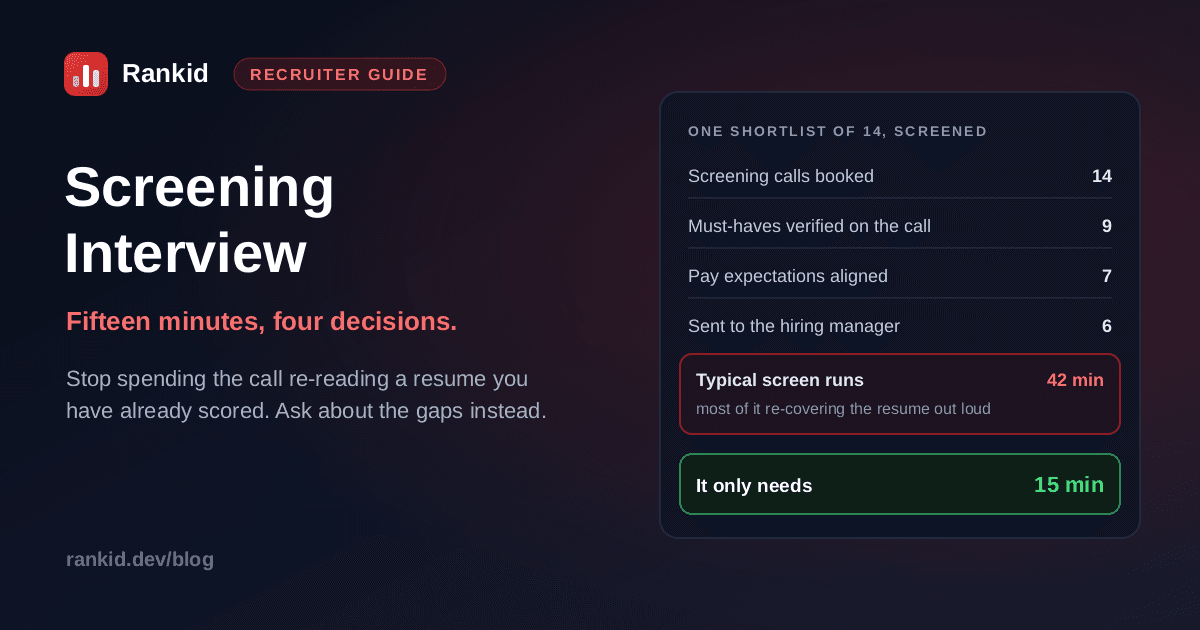
The average recruiter screening call runs a little over 40 minutes, and a startling amount of that time is spent asking a candidate to say out loud what is already written on the resume in front of you. Then everyone hangs up, and the notes say something like “seemed good, strong communicator.” That call filtered nobody. A screening interview has one job, and once you name it properly the whole thing collapses to fifteen minutes.
Quick answer
What is a screening interview?
A screening interview is a short first conversation, normally 15 to 30 minutes by phone or video, run by a recruiter to decide whether a candidate moves on to a full interview. It sits between two other steps: it comes after the resume screen has produced a shortlist, and before the hiring manager spends an hour with anyone.
The critical thing to be clear about is that a screen is a filter, not an evaluation. You are not trying to assess the whole person, predict their performance, or reach a hiring view. You are answering four narrow questions: do the must-have requirements actually check out, is there real evidence they can do the core work, do pay and logistics line up, and are they genuinely interested? Four yes answers means advance. Any firm no means stop, and you have saved the hiring manager an hour.
Why screens balloon to 40 minutes
Screening interview vs phone screen vs pre-screening
These terms get used interchangeably and, for practical purposes, they are the same stage. If you are trying to work out whether a phone screen, a phone screening interview, a screening call and a pre-screening interview are different things: they are not, and no candidate or hiring manager will thank you for insisting otherwise. The distinctions that do carry meaning are these:
- Format. A phone screen is by definition a call. A screening interview may be video, which some teams prefer for roles where presence matters and others avoid because it adds scheduling friction and needless nerves at a stage that is meant to be low stakes.
- Who runs it. A recruiter screen checks requirements, pay and interest. A technical screening interview is run by an engineer or specialist and goes deeper on skill, usually 45 to 60 minutes, and it belongs after the recruiter screen rather than instead of it.
- Pre-screening. Occasionally used for the automated questionnaire on the application form rather than a live conversation. If that is what your ATS means by pre-screening, treat it as part of the application, not as a screen.
Who should get a screening call, and how to prepare in two minutes
Here is the part that determines whether the rest of this guide is easy or impossible. A screening interview is only efficient if two things are true before you dial: you are calling the right people, and you already know what you need from each one.
Both come from the same place. If you have scored every applicant against the job description rather than skimming the pile, you get a ranked shortlist and, for each candidate, the specific requirements they match and the ones they do not evidence. That second list is the agenda for the call.
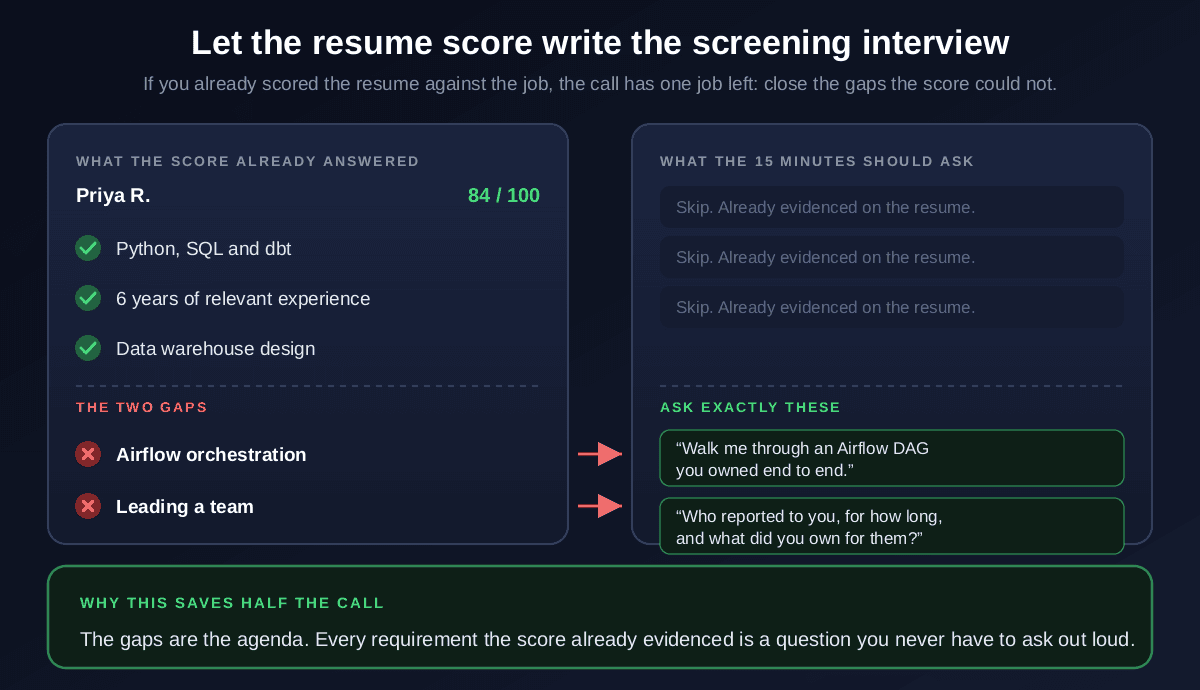
A candidate who scored 84 with Python, SQL and six years of relevant experience already evidenced does not need to be asked about any of those. Asking anyway is the single biggest waste of screening time, and it quietly signals that nobody read the application. What that candidate needs to be asked about is the two things the resume did not show. That is a two-minute prep and a much shorter call.
This is also what fixes the volume problem. Screening is only affordable if the shortlist is right, and a shortlist built by reading the first forty resumes is not. The upstream mechanics are in how to screen resumes in bulk and how to shortlist candidates, and the per-candidate matched and missing breakdown comes from bulk resume analysis.
The 15-minute screening interview structure
Use the same structure for every candidate on the shortlist. That is not bureaucracy, it is the only thing that makes two calls comparable a week later when you are deciding who advances.
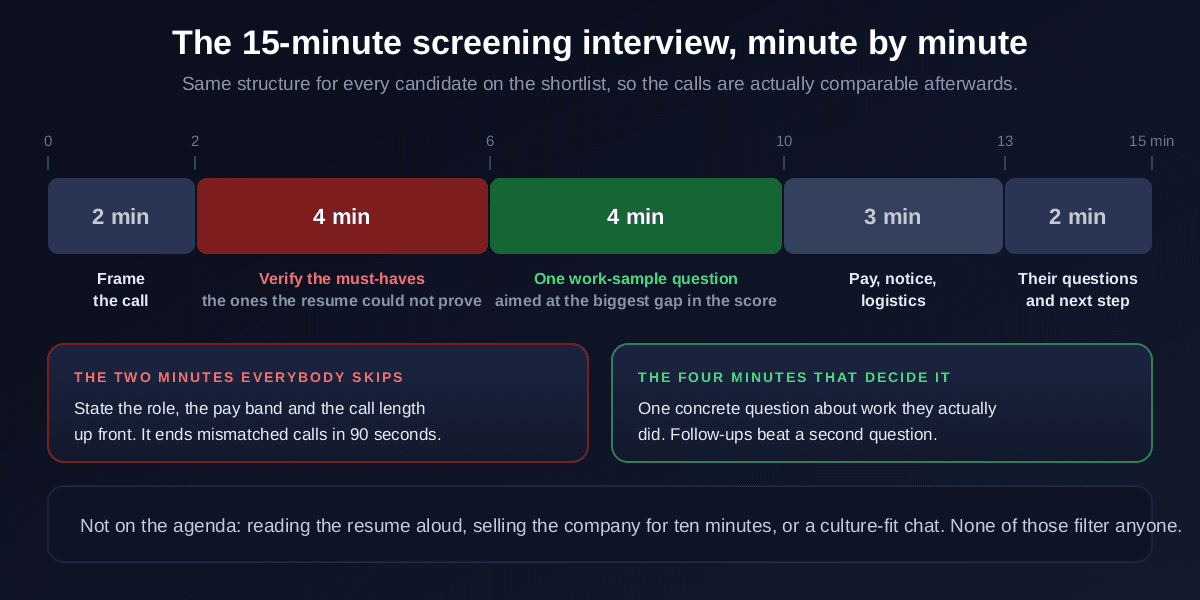
Frame the call in two minutes
Say what the role is, what the pay band is, how long the call will take and what happens next. Stating the band up front feels uncomfortable the first few times and then becomes the most valuable ninety seconds in your process, because a candidate whose expectation is double your ceiling can say so immediately instead of at minute 38.
Verify the must-haves the resume could not prove
Work through only the requirements that were unclear or missing in the score. Certifications, licences, work authorisation, specific tools, the level of ownership behind a job title. Keep each one to a direct question and a short answer. If a must-have is genuinely absent, you can end the call warmly at minute six and both of you have had a good outcome.
Ask one work-sample question
One, not five. Pick the biggest gap in the score and ask the candidate to walk you through something real they did in that area, then follow up twice on the specifics: what they owned personally, what went wrong, what they would change. Depth beats breadth here. A single question taken three layers down tells you far more than four questions answered at the surface, and it is much harder to answer from a script.
Settle pay, notice and logistics
Pay expectation, notice period, location or work model, and any hard constraints on start date. Ask for their expectation rather than their current salary, which is banned in a growing number of US states including California, New York and Colorado, and is a poor question in the places where it is still legal.
Their questions, then a concrete next step
Leave two minutes. What they ask is genuinely informative, and vague endings are a leading cause of candidates going cold. Tell them what happens next and by when, then actually do it. This is the cheapest candidate experience win available to you.
20 screening interview questions to ask candidates
Pick from these rather than asking all twenty. A screen should use roughly eight to ten questions total, weighted towards the gaps in that specific candidate's score.
Confirming the basics (ask only what the resume left unclear)
- “What are you looking for in your next role?”
- “Are you authorised to work in [location], and do you need sponsorship now or later?”
- “Your last title was [X]. What did that actually cover day to day?”
- “Which parts of your current job would you want more of, and which less?”
Verifying a must-have the resume could not prove
- “The role needs [tool or method]. Where have you used it, and how recently?”
- “Who reported to you, for how long, and what did you own for them?”
- “Do you hold [certification or licence] currently, and when does it renew?”
- “How much of your [X] experience was hands-on versus overseeing someone else doing it?”
The work-sample probe (choose one, then follow up twice)
- “Walk me through a [project type] you owned end to end. What was your specific part?”
- “Tell me about a time that work went wrong. What did you change afterwards?”
- “What is the hardest [domain] problem you have solved, and why was it hard?”
- “If you joined and hit [common failure mode] in month one, how would you approach it?”
Motivation for this role specifically
- “What made you apply to this one?”
- “What would make you turn down an offer from us?”
- “Where else are you in a process, and how far along?”
- “What would need to be true in this job for you to still be here in two years?”
Pay, notice and logistics
- “The band is [X to Y]. Does that work for you?”
- “What is your notice period, and is any of it negotiable?”
- “The role is [onsite / hybrid / remote] from [location]. Any issue with that?”
- “Is there anything that would stop you starting by [date]?”
Follow-ups beat more questions
Know the gaps before you dial
Upload your applicant batch and paste the job description. Rankid scores every candidate 0 to 100 and shows exactly which requirements each one matches and misses, so your screening list and your question list arrive at the same time. Up to 200 resumes per batch, and your first 5 are free with no signup.
Build your screening shortlist freeWhat never to ask in a screening interview
- Anything that invites protected information. Age, marital or family status, pregnancy plans, religion, disability, national origin. This includes the friendly-sounding versions: asking where someone is originally from, or whether they have kids at the local school, is the same question with a smile on it.
- Salary history.Banned in a growing list of US states and jurisdictions, and a bad question everywhere else because it anchors your offer to someone else's past decision. Ask for their expectation against your stated band.
- Anything the resume already answered. The most common failure and the most expensive one, because it costs you the minutes you needed for the real gaps.
- Culture-fit chat.“Would I want to get a drink with this person” is not a filter, it is a bias amplifier with a friendly name. If a behaviour genuinely matters for the role, turn it into a specific question about past work and ask everyone the same one.
How to record a screen so candidates stay comparable
The point of a shared structure is that the calls can be compared afterwards. That only works if you record verdicts per requirement rather than an overall impression. For each must-have, mark one of three states and write a single line of evidence next to it:
- Evidenced. They described concrete, first-hand work in that area.
- Unclear. They claimed it but could not go a layer deeper. Flag for the hiring manager rather than rejecting on it.
- Missing. Genuinely not there, and it is a must-have rather than a preference.
“Seemed strong” is not a record and cannot be defended a week later. Per-requirement verdicts also matter for fairness, because the screen is a real decision point where pass rates between groups can diverge without anyone noticing. Check it the same way you would check the resume stage, using the four-fifths calculation in adverse impact. If you want the deeper, structured version of this for the hiring manager round, that is covered in interview questions to ask candidates.
How many screens, and what should convert
Useful rough shape for a single hire: 6 to 10 screening calls, 3 to 4 hiring manager interviews, 1 offer. Around 60 to 70 percent of screens advancing is healthy. Well outside that range, the number is telling you something about a different stage:
- Advancing under 40 percent. Your shortlist is the problem, not your screening. Candidates are reaching the call who should have been filtered on paper, which usually means the resume review was a skim rather than a measurement against the job.
- Advancing over 85 percent. The screen is not filtering. Either you are cutting too hard at the resume stage and only calling certainties, or the call has no real questions in it and everyone passes by default.
- Screens taking over 30 minutes. Almost always the missing-agenda problem. Prep from the score, keep the structure, and the time falls on its own.
One more number worth tracking: the share of your shortlist you actually manage to screen. When volume is high this quietly drops, and the people who never get called are not the weakest, they are the ones lowest in the pile when the week ran out. That failure mode, and the wider throughput math behind it, is covered in high-volume recruiting.
Key takeaways
- A screening interview is a filter, not an evaluation: verify must-haves, get one piece of work evidence, check pay and logistics, confirm interest.
- Screening interview, phone screen, screening call and pre-screening interview all mean the same stage.
- Fifteen minutes is enough. Screens hit 40 minutes when the recruiter has no agenda and re-reads the resume aloud.
- Prep from the resume score: the requirements it could not evidence are exactly the questions worth asking.
- Use eight to ten questions, and take one work-sample answer three follow-ups deep rather than asking more questions.
- Record a verdict per requirement (evidenced, unclear, missing) so calls stay comparable and defensible.
- Rankid scores up to 200 resumes per batch and shows what each candidate matches and misses. First 5 free, no signup.
Bottom line: the screening interview is the cheapest filter in your process and the one most often wasted. It gets wasted for a single reason, which is that recruiters walk into it without knowing what they need to find out. Fix that upstream by measuring every applicant against the job before you build the shortlist, and the call stops being a forty-minute tour of a document you have already read. It becomes fifteen focused minutes closing two specific gaps. Score your next applicant batch with Rankid and let the gaps write your questions for you.
Frequently asked questions
What is a screening interview?
A screening interview is a short first conversation, usually 15 to 30 minutes by phone or video, run by a recruiter to confirm whether a shortlisted candidate should move on to a full interview. It is a filter, not an evaluation of everything about the person. Its job is narrow: verify the must-have requirements the resume could not prove, check that pay expectations and logistics line up, confirm the candidate is genuinely interested, and get one piece of real evidence that they can do the core work. Anything beyond that belongs in the hiring manager interview.
What questions are asked in a screening interview?
A good screening interview covers five things in order: a quick frame of the role and pay band, verification of the must-haves the resume left ambiguous, one concrete work-sample question about something the candidate actually did, motivation for this specific role, and logistics like notice period, location and start date. Typical questions include asking a candidate to walk through a project they owned end to end, who reported to them and for how long, what their pay expectation is, and why this role rather than the many others they could apply to. Avoid trivia and avoid re-asking anything the resume already answered.
What is the difference between a screening interview and a phone screen?
In practice there is no meaningful difference. Screening interview, phone screen, phone screening interview, screening call and pre-screening interview all refer to the same stage: the short recruiter-led conversation between the resume review and the hiring manager interview. The only distinctions worth noting are format and who runs it. A phone screen is by definition a call, while a screening interview may be video. A technical screening interview is a variant run by an engineer or specialist rather than a recruiter, and it goes deeper on skills. The purpose is identical in every case.
How long should a screening interview be?
Fifteen minutes is enough for most roles, and 30 should be the ceiling. Screens drift to 40 minutes or more when the recruiter uses the call to re-read the resume aloud and sell the company at length, neither of which filters anyone. A tight structure is roughly 2 minutes framing the role and pay band, 4 minutes verifying the must-haves, 4 minutes on one work-sample question, 3 minutes on pay and logistics, and 2 minutes for the candidate's questions and next steps. Shorter screens also let you run more of them, which matters when the shortlist is large.
How many candidates should you screen per hire?
A common pattern is 6 to 10 screening calls per hire, feeding roughly 3 to 4 hiring manager interviews and 1 offer. If you are screening far more than that, the problem is usually upstream: the shortlist was built by skimming rather than by measuring candidates against the job, so the screen is doing filtering work that should have happened at the resume stage. If you are screening far fewer, you may be cutting too aggressively on paper and should look at the middle band of your ranking before dismissing it.
What should you never ask in a screening interview?
Two categories. First, anything unlawful or that invites protected information: age, marital or family status, pregnancy plans, religion, disability, national origin, and in many US jurisdictions salary history, which is banned in states including California, New York and Colorado. Ask for a pay expectation instead. Second, anything the resume already answered. Re-asking a candidate to list their last three jobs wastes the minutes you needed for the actual gaps, and it signals you did not read their application, which is one of the fastest ways to lose a strong candidate's interest.
How do you score a screening interview fairly?
Ask every candidate on the shortlist the same core questions in the same order, and record a verdict per requirement rather than an overall gut impression. Three states per must-have work well: evidenced, unclear, or missing. Write one line of evidence beside each. This keeps calls comparable, which is the whole reason for a structure, and it gives you something defensible when a hiring manager asks why one candidate advanced and another did not. Consistency at this stage also matters for adverse impact, since the screen is a decision point where pass rates by group can quietly diverge.
Can AI replace the screening interview?
It can replace the preparation for it, not the call itself. Scoring every resume against the job description tells you who is worth screening and exactly which requirements each candidate has not evidenced, which is what turns a rambling 40-minute call into a targeted 15-minute one. What automation should not do is conduct the conversation or decide the outcome. The screen exists partly to catch what documents cannot show, and it is also the candidate's first human impression of your company, which is worth protecting.