Adverse Impact in Hiring: The Four-Fifths Rule and How to Calculate It (2026)
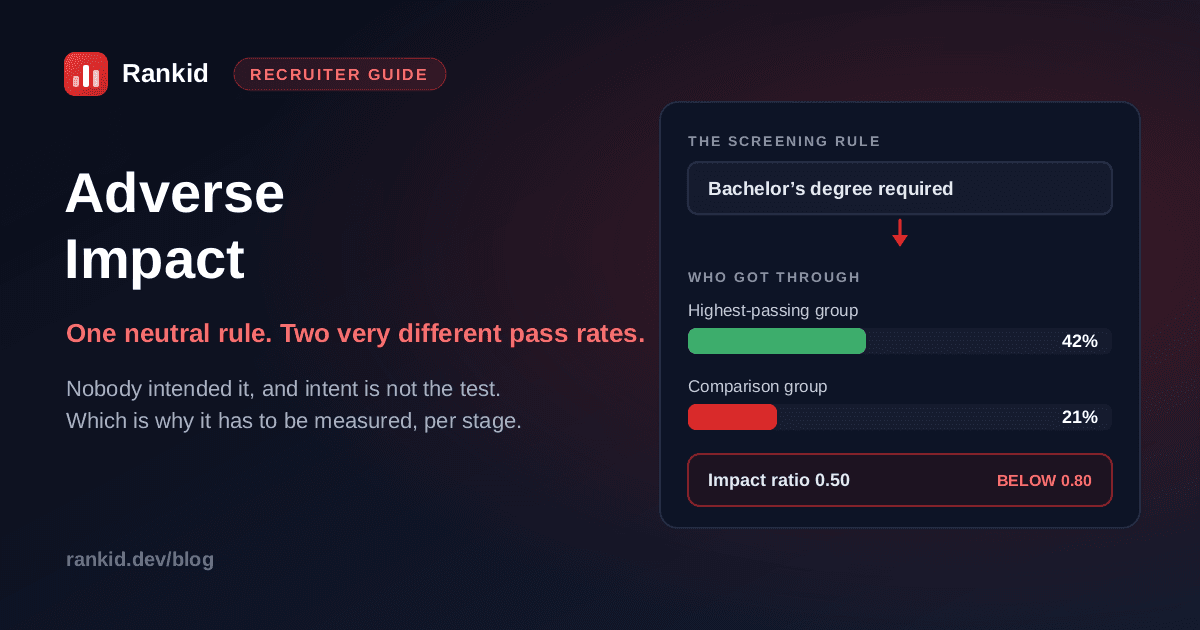
Nobody in the room objected to the requirement. It had been on the job description for years, it was applied to all 412 applicants identically, and not one person involved intended to disadvantage anybody. Then someone ran the numbers on who made it past the resume screen and found one group passing at 42 percent and another at 21 percent. That is adverse impact, and the striking thing about it is that everything above this sentence can be true at the same time. Intent is not the test. The outcome is.
Quick answer
Not legal advice
What is adverse impact?
Adverse impact is what happens when a practice that is neutral on its face produces substantially unequal selection rates between groups. The requirement, test or screening rule is applied to everyone in the same way. People from different groups pass it at meaningfully different rates. That gap is the adverse impact, regardless of what anyone intended.
The reason this concept exists at all is that most modern hiring discrimination does not look like discrimination from the inside. It looks like a requirement that sounded reasonable when someone added it, has been on the template ever since, and correlates with something other than the ability to do the job. Nobody has to be acting in bad faith for the outcome to be a problem, which is precisely why the check is statistical rather than intentional.
Adverse impact, disparate impact and disparate treatment
Three terms, two concepts. It is worth being precise, because they get used loosely and they point at genuinely different failures.
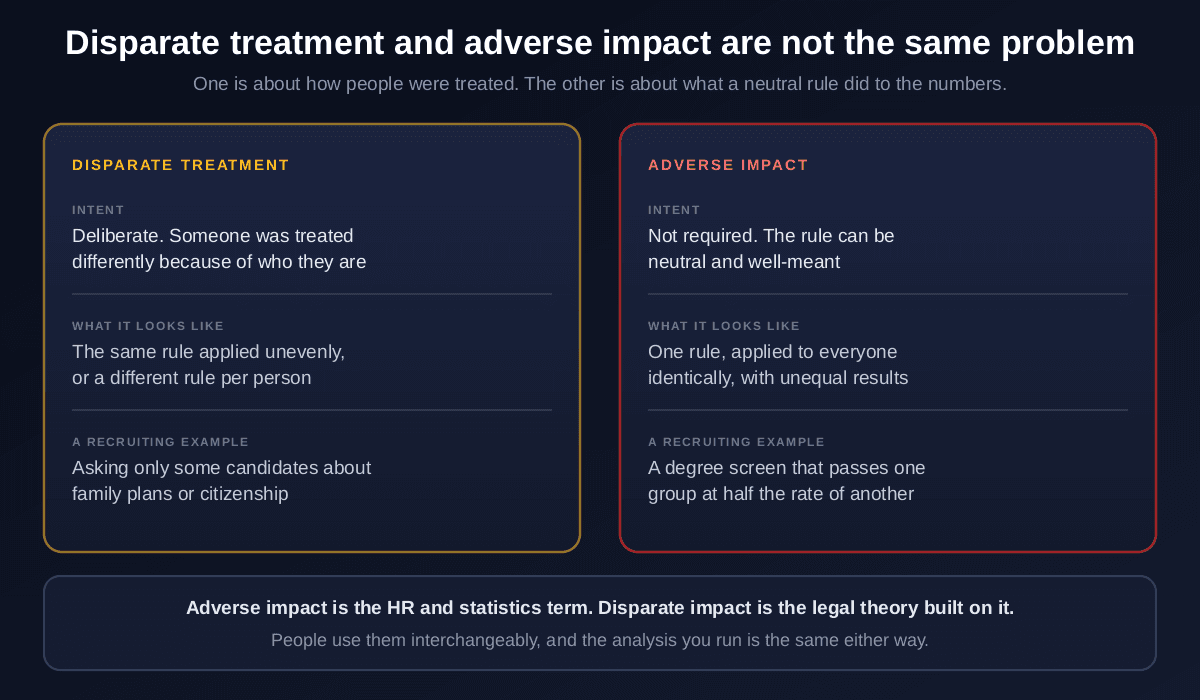
Disparate treatment is intentional. Someone was handled differently because of who they are: a question asked only of certain candidates, a standard applied more strictly to one person. It is proved with evidence about how people were treated.
Adverse impact requires no intent at all. One rule, applied uniformly, produces unequal results. It is proved with statistics about selection rates.
Disparate impact is, in practice, the same thing as adverse impact under a different name. Adverse impact is the term you meet in HR reporting and selection-testing work; disparate impact is the legal theory of liability that sits on top of it. If someone asks you the difference, the honest answer is that it is mostly vocabulary, and the analysis you run does not change.
The practical consequence is that a hiring process can be scrupulously free of disparate treatment, with every candidate asked the same questions by well-trained interviewers, and still be producing adverse impact at a stage nobody is looking at.
The four-fifths rule, and how to calculate adverse impact
The standard screening test comes from the federal Uniform Guidelines on Employee Selection Procedures and is known as the four-fifths rule or the 80 percent rule. It is four steps and one division.
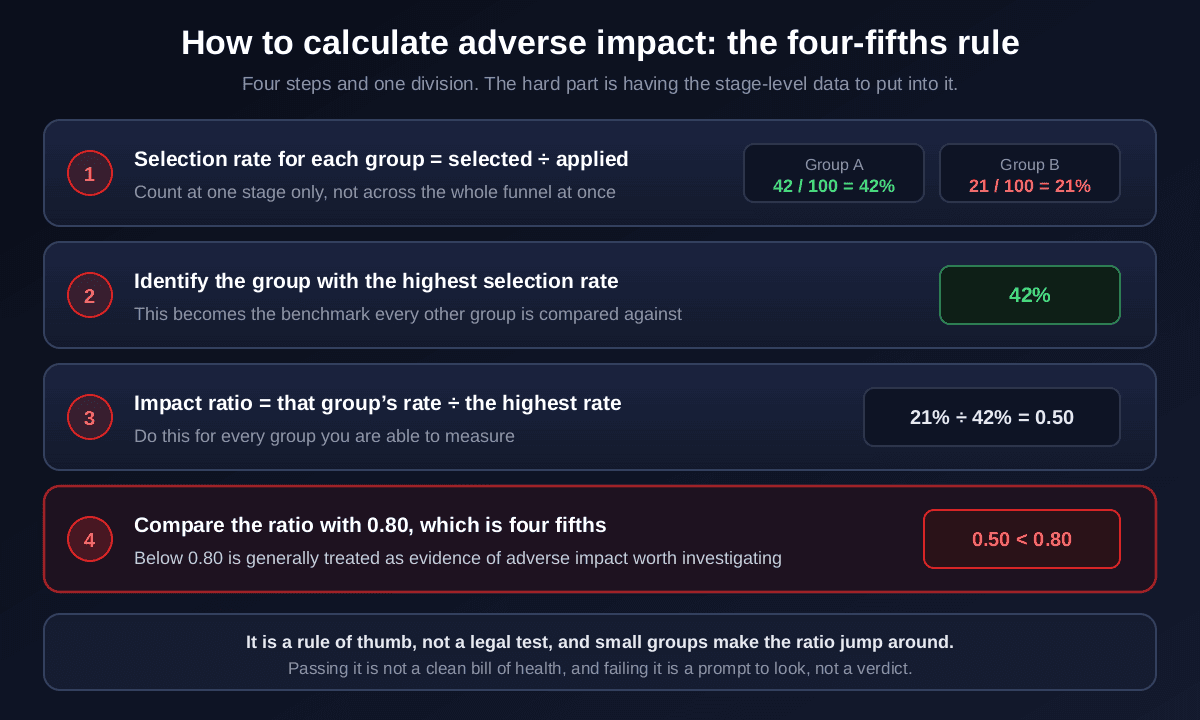
- Selection rate per group. Number selected divided by number who applied, calculated at one stage. If 100 people from a group reached the resume screen and 42 passed, the rate is 42 percent.
- Find the highest rate. Whichever group passed at the greatest rate becomes the benchmark. It is not fixed to any particular group in advance.
- Impact ratio.Each group's rate divided by the highest rate. A group passing at 21 percent against a benchmark of 42 percent gives 0.50.
- Compare with 0.80. Ratios below four fifths are generally treated as evidence of adverse impact worth investigating.
Two honest caveats, because this number gets over-read in both directions. The rule is a heuristic, not a legal verdict: enforcement and litigation also involve tests of statistical significance, and with small applicant numbers the ratio swings wildly, since a couple of people moving between outcomes can drag it across the line. Equally, clearing 0.80 is not a clean bill of health. It means this particular check did not flag this particular stage.
Measure it stage by stage, not end to end
The most common analytical mistake is comparing hires against total applicants. That produces one blended number that tells you something is wrong without telling you where, and it frequently hides the problem entirely.
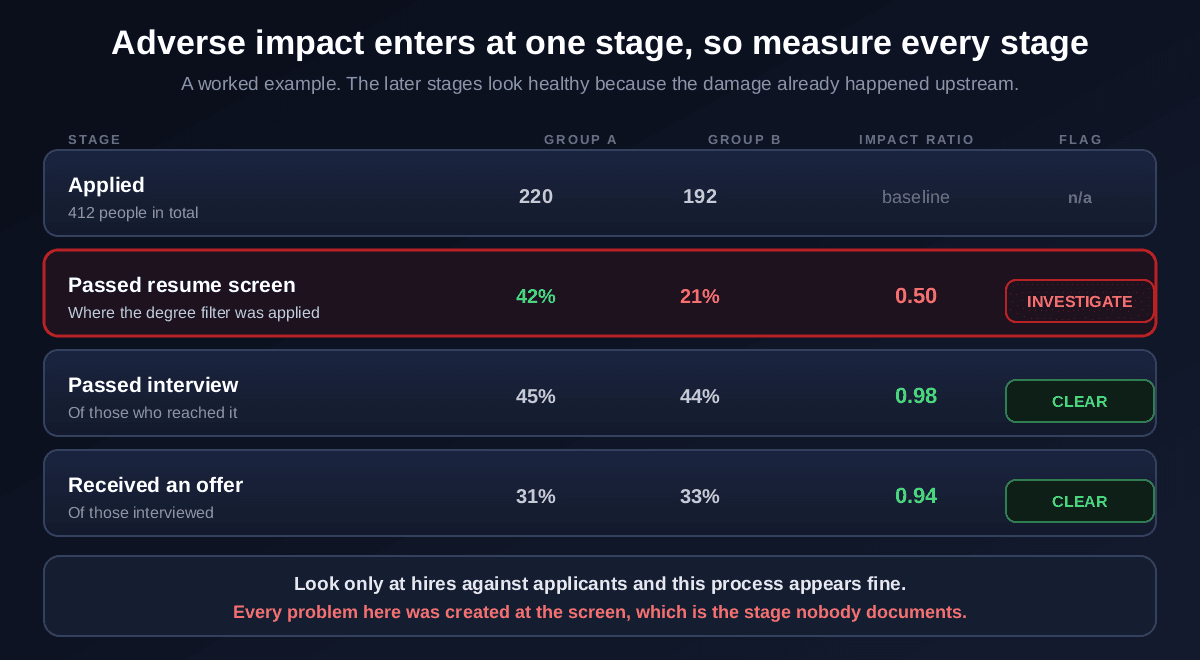
Look at that table for a moment. The interview stage is clean. The offer stage is clean. Interviewers are being consistent and hiring managers are deciding evenly between the people in front of them. Everything downstream of the resume screen looks like a well-run process, because it is one. The entire effect was created at a single stage, by a single criterion, weeks before any human had a conversation with anybody.
This is the general pattern. Adverse impact usually enters at the cheapest, fastest, least documented stage of hiring, which is the resume screen, and then every later stage faithfully carries it forward while looking blameless in isolation.
Where adverse impact comes from in resume screening
These are the usual culprits. None of them is automatically unlawful, and several can be perfectly justifiable for particular roles. All of them should be able to survive the question: can we show this is necessary for the job?
- Degree requirements. The best-documented source. Educational attainment is not distributed evenly, so a requirement that is neutral in form is rarely neutral in effect. If the degree is standing in for a specific capability, screen for the capability, which is the whole argument in skills-based hiring.
- Minimum years of experience. A blunt proxy that penalises career breaks, which fall unevenly, particularly on people who took time out for caring responsibilities.
- Employer and school prestige. Scanning for recognisable names measures access to those institutions at least as much as it measures ability.
- Continuous employment history. Treating gaps as a negative screens on life circumstances rather than on capability. The candidate-side view of this is explaining employment gaps, and the recruiter-side lesson is that a gap is not evidence about the work.
- Location and postcode filters. Convenient, and in some labour markets closely correlated with demographics.
- Keyword filters that auto-reject. These reject on phrasing rather than capability, and phrasing correlates with who has been coached on resume writing. The mechanics are in resume parsing.
- Unstructured human judgement under time pressure. The default when no criteria exist. It produces different standards at hour two and hour thirty, and leaves no record of what was applied to whom.
Why an unread pile is the hardest thing to defend
Here is the part that connects adverse impact to how screening actually works at volume. To run any of the analysis above, you need to know what was applied to each applicant. A stage that produced decisions has data. A stage where 300 of 412 resumes were never opened, and the rest were assessed against criteria that lived in somebody's head, produced no data at all.
That is not merely an analytics inconvenience. If the effective determinant of whether an application was read was the order it arrived in and how tired the reader was, then the process has no articulable standard behind it. There is nothing to validate, nothing to explain to a hiring manager, and nothing to show anyone who asks how candidates were evaluated. The absence of a defined, consistently applied criterion is itself the exposure.
The uncomfortable comparison
Screen the whole pool against criteria you can point to
Paste the job description, upload every resume, and each candidate comes back scored 0 to 100 with the specific requirements they match and miss. Every applicant evaluated on the same basis, with the reasons attached. First 5 resumes free, no signup.
Screen a batch freeHow to screen at volume without creating adverse impact
Define the criteria before applications open
Three to six testable must-haves, written on the requisition and agreed with the hiring manager. Criteria invented while looking at candidates are the ones that end up shaped by the candidates.
Apply the necessity test to every requirement
For each line, ask what evidence would satisfy it and why the job genuinely requires it. Anything that fails that test is decoration, and decoration is where adverse impact hides. Cut it, or move it to a nice-to-have that informs ranking rather than exclusion.
Rank rather than auto-reject
Hard filters make binary decisions on single attributes, which is exactly the shape that generates impact ratios below 0.80. Ranking lets a candidate who is strong on four criteria and light on one still be seen, and the practical difference to your shortlist is usually significant. See resume screening criteria for how to weight them.
Score every applicant, not just the top of the pile
Coverage is a fairness property, not only an efficiency one. If everyone is evaluated on the same basis, arrival time stops being a hidden selection criterion, and you get a complete dataset for the analysis rather than a partial one.
Keep a human on every advance-or-reject decision
Use scoring to order and explain the pool, then have a person make the calls, especially in the borderline band where transferable experience lives. This matters both for decision quality and because meaningful human review is exactly what a scrutinised process needs to be able to demonstrate.
Run the numbers after every requisition closes
Selection rates by stage, impact ratios against the highest-passing group, and a note of anything below 0.80. It takes a few minutes when the data exists, and the trend across several requisitions is far more informative than any single one.
Job-relatedness: the defence that actually matters
Finding adverse impact does not mean a practice must be abandoned. Under the disparate impact framework, a practice that produces adverse impact can still be lawful if the employer shows it is job-related for the position and consistent with business necessity, and even then a challenger may point to an equally effective alternative with less impact.
Translated into recruiting terms, three questions decide whether a criterion survives:
- Can you articulate what it measures? Not what it correlates with. What ability does it establish?
- Can you show the job needs that ability? Ideally from an analysis of the work rather than from tradition or from what the last posting said.
- Is there a less exclusionary way to measure the same thing? This is where most proxies fail. If a degree stands in for statistical literacy, screening for statistical literacy directly is both more accurate and less exclusionary, which makes the proxy hard to justify.
That third question is why documenting your criteria is worth the effort. A ranked, explained screening decision, with the matched and missing requirements attached to each candidate, is an answer to all three questions. A shortlist that emerged from an afternoon of skimming is not.
What to monitor, and how often
- Selection rates by stage, by requisition. Application to screen, screen to interview, interview to offer, offer to acceptance. The stage view is the entire point.
- Impact ratios against the highest-passing group, reviewed per role family rather than per individual req where numbers are small, because tiny samples produce noisy ratios.
- Which criterion drove each rejection. If your screening records the reason, you can identify the specific requirement creating the gap instead of guessing at the stage.
- Aggregate trends over time. A single requisition rarely proves anything. The same criterion flagging across six requisitions is a finding.
- Coverage. What share of applicants were actually evaluated. A stage with 25 percent coverage cannot be analysed honestly, whatever the ratios say, which ties this directly to candidate experience and to whether anyone ever got an answer.
Adverse impact mistakes to avoid
- Only comparing hires with applicants. One blended ratio hides which stage created the gap, and the gap is nearly always created at one stage.
- Treating 0.80 as a pass mark. It is a prompt to investigate, not a certificate. Ratios just above the line on a criterion you cannot justify are still worth fixing.
- Running the analysis on tiny samples and drawing conclusions. With 12 applicants per group, one person changes everything.
- Assuming automation removes the issue. Consistent application of a criterion with adverse impact produces adverse impact consistently. What automation adds is the record.
- Assuming a manual screen is safer. It is simply unmeasured, which is a different thing from being fair, and it is much harder to explain afterwards.
- Fixing the number instead of the criterion. Adjusting who gets through to make a ratio look better, rather than removing an unjustified requirement, creates a new and more serious problem. Fix the rule, not the arithmetic.
- Never writing the criteria down. An undocumented standard cannot be validated, defended or improved, and it is the most common state of affairs in high-volume recruiting.
Key takeaways
- Adverse impact is a neutral practice producing substantially unequal selection rates. Intent is not part of the test.
- Disparate treatment is intentional and proved with evidence; adverse impact is unintentional and proved with statistics.
- Adverse impact and disparate impact describe the same phenomenon in HR and legal vocabulary respectively.
- The four-fifths rule: selection rate per group, divide by the highest rate, flag any impact ratio below 0.80.
- Measure per stage. The resume screen usually creates the gap while later stages look clean.
- Degree requirements, minimum years, prestige and employment gaps are the most common sources in screening.
- An unread pile cannot be analysed or defended, because no articulable standard was applied to it.
- Rankid scores up to 200 resumes per batch against your job description with reasons attached, first 5 free with no signup.
Bottom line: adverse impact is not a question of anyone's character, and treating it as one is why it goes unexamined for years. It is a measurement, it lives at a specific stage, and the stage is almost always the resume screen, where criteria are vaguest and coverage is worst. Define what the job genuinely requires, apply it to every applicant on the same basis, keep the reasons, and run the ratios when the requisition closes. Start with the screening half: put your next batch through Rankid's bulk resume screening tool and get every candidate scored against the same stated criteria, with the matches and gaps written down for each one.
Frequently asked questions
What is adverse impact?
Adverse impact is when a neutral employment practice, applied the same way to everyone, ends up selecting people from one group at a substantially lower rate than another. The classic example is a requirement or test that everybody takes under identical conditions but that different groups pass at very different rates. What makes it distinct from ordinary discrimination is that intent is irrelevant: the practice can be well-meant, uniformly applied and still produce adverse impact, because the measure is the outcome rather than the motive. That is why it has to be detected statistically, by comparing selection rates, rather than by asking whether anyone meant any harm.
What is the four-fifths rule?
The four-fifths rule, also called the 80 percent rule, is the rule of thumb from the federal Uniform Guidelines on Employee Selection Procedures used to flag possible adverse impact. It says that if the selection rate for any group is less than four fifths, or 80 percent, of the selection rate of the group with the highest rate, that difference is generally regarded by enforcement agencies as evidence of adverse impact. It is a screening heuristic rather than a legal test. Small applicant counts make the ratio unstable, and clearing 0.80 does not by itself prove a practice is lawful or fair.
How do you calculate adverse impact?
Four steps at a single stage of your process. First, calculate the selection rate for each group by dividing the number selected by the number who applied at that stage. Second, identify the group with the highest selection rate. Third, divide each other group's rate by that highest rate to get the impact ratio. Fourth, compare each ratio with 0.80. If one group passes at 21 percent and the highest group passes at 42 percent, the ratio is 0.50, which is below the threshold and warrants investigation. Calculate this stage by stage rather than only comparing hires with total applicants, because a single stage is usually responsible.
What is the difference between adverse impact and disparate impact?
In everyday practice they refer to the same phenomenon and are used interchangeably. The distinction is one of vocabulary and context: adverse impact is the HR, statistics and selection-testing term for a practice producing unequal selection rates, while disparate impact is the legal theory of liability under which such a practice can be challenged. You will typically see adverse impact in a compliance report or a validation study and disparate impact in a court opinion or statute. The analysis you actually run, comparing selection rates and applying the four-fifths rule, is identical either way.
What is the difference between disparate impact and disparate treatment?
Disparate treatment means people were treated differently because of a protected characteristic, which is intentional discrimination: asking only some candidates about their family plans, or applying a stricter standard to one group. Disparate impact means one neutral rule was applied to everyone identically and produced substantially unequal outcomes, with no intent required. They are proved differently too. Disparate treatment is shown through evidence of how people were handled, while disparate impact is shown through statistics on selection rates. A hiring process can be completely free of the first and still create the second.
What is an example of adverse impact in hiring?
A degree requirement is the standard example. Applied uniformly to every applicant, it is neutral on its face, but degree attainment is not evenly distributed, so the requirement can pass one group at roughly half the rate of another and produce an impact ratio around 0.50. Other common sources in resume screening are minimum years of experience, which disadvantages anyone with a career break; employer or school prestige, which encodes access rather than ability; continuous employment history; and location or postcode filters, which can act as proxies for demographic characteristics in some labour markets.
Does AI or automated resume screening create adverse impact?
It can, and it can also make adverse impact visible for the first time. Automation does not invent bias, it applies whatever criteria it is given consistently and at scale, so a criterion that carries adverse impact will produce it faster and more uniformly than a tired human would. The genuine advantage is measurability: an automated stage produces a record of what was applied to every applicant, which is the raw material an adverse impact analysis needs. A manual screen where 300 resumes were never opened cannot be analysed at all. Neither approach removes the obligation to monitor outcomes and to keep human review over decisions.
How do you screen hundreds of applicants without creating adverse impact?
Score everyone against the same job-related criteria, defined in advance, and keep a record of what each decision was based on. That means defining three to six testable must-haves before applications open, cutting requirements nobody can justify as necessary for the job, scoring the whole pool rather than reading until time runs out, keeping a human on every advance-or-reject decision, and calculating selection rates by stage afterwards. Rankid supports the scoring half: paste the job description, upload the batch, and each candidate comes back rated 0 to 100 with the matched and missing requirements behind the score, first 5 free with no signup.