Talent Pipeline: How to Build and Manage One That Actually Fills Roles (2026)
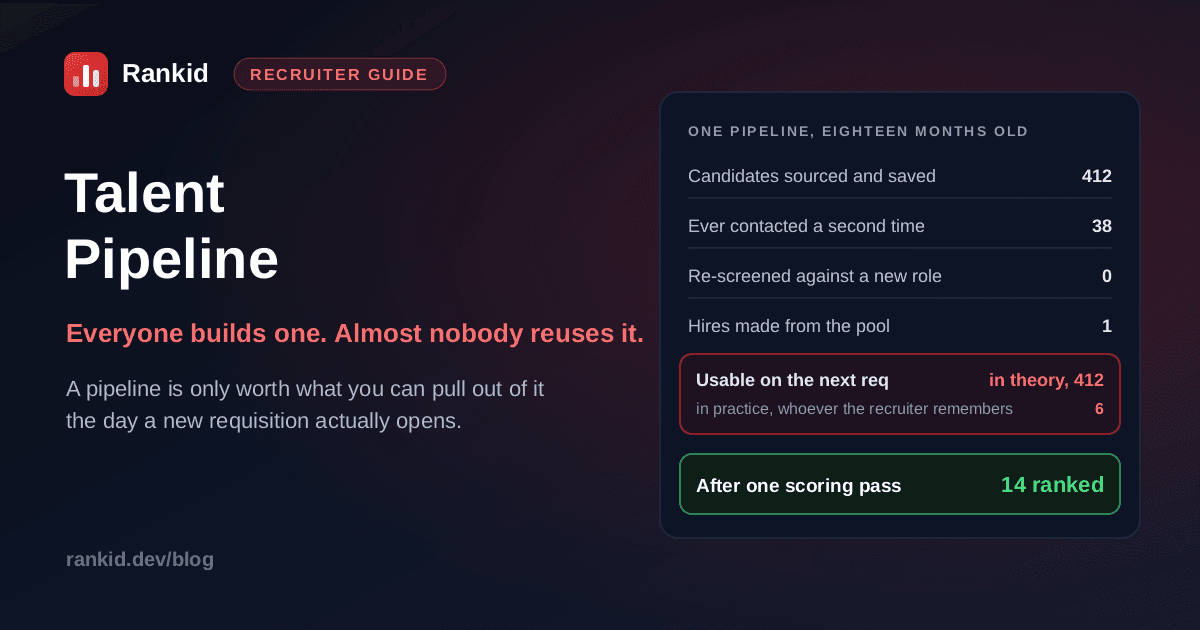
Ask a recruiting team whether they have a talent pipeline and almost all of them will say yes. Ask when they last hired someone out of it and the room goes quiet. The profiles are there, tagged and saved and backed up, and yet when a requisition opens on Monday the first instinct is still to write a job ad and wait for strangers. That gap between having candidates and being able to use them is the whole subject of this guide.
Quick answer
What is a talent pipeline?
A talent pipeline is a group of candidates you have already identified who are organised by how ready they are to be hired for a particular kind of role. The load-bearing word is organised. A thousand saved profiles with no stage, no recency and no measured fit is raw material, not a pipeline, in the same way that a warehouse of unsorted parts is not an inventory.
You will sometimes see this called a talent acquisition pipeline, talent pipelining, or simply pipelining, and the underlying concept is borrowed straight from sales: instead of starting every deal from a cold list, you maintain relationships with people who already know you and you keep track of where each one stands. Applied to hiring, the promise is that the next requisition starts from a warm ranked list rather than from zero.
The practical test is worth stating plainly, because it cuts through most of the advice on this topic. A talent pipeline is real if you can answer one question in under an hour: a role just opened, who in our existing pool should we contact first, and why? If answering that means a recruiter reading through hundreds of stored resumes, you do not have a pipeline yet. You have a folder with good intentions attached to it.
Talent pool vs talent pipeline: what is the difference?
These two terms get used interchangeably and they should not be. The distinction is not academic, it explains exactly why so much sourcing effort produces so few hires.
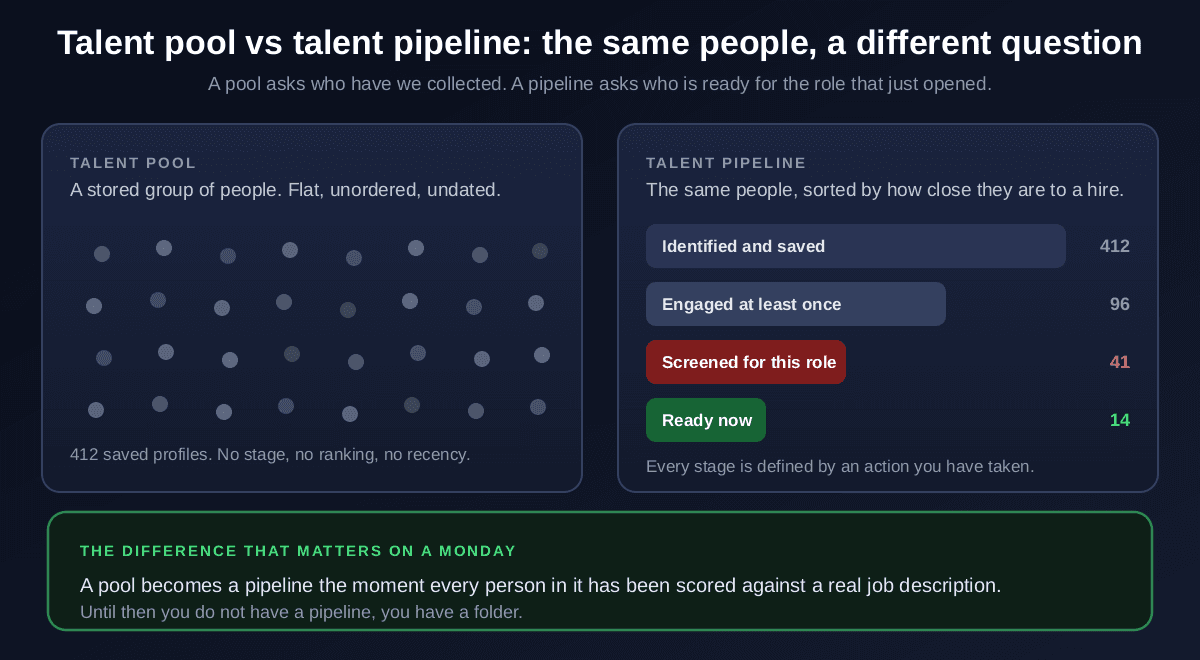
- A talent pool is storage. Every past applicant, sourced profile, referral, event contact and silver medalist you have kept. It is flat and unordered by design. Its value is potential value.
- A talent pipeline is order. The same people, grouped by stage against a role: identified, engaged, screened, ready to interview. Its value is realised value, because each stage corresponds to something you have actually done.
Put the two side by side and the transition between them becomes obvious. A pool becomes a pipeline the moment every person in it has been measured against a real job description. Before that measurement, the only ordering available to you is the recruiter's memory, which in practice surfaces the six candidates who happened to be memorable and buries the other four hundred.
If you only remember one line from this guide
Why most talent pipelines quietly die
Almost no team abandons its pipeline on purpose. It dies of arithmetic. Suppose you have kept 384 resumes for an analyst-shaped role across the past two years, a very ordinary number for a team that has been sourcing diligently. A new requisition opens. To use that pool properly you would need to re-read all 384 against the new posting, because the last role was not this role: the seniority moved, the stack changed, the must-haves shifted.
At ninety seconds per resume, a fast and slightly generous pace for a real evaluation, that is nine and a half hours of uninterrupted reading. No recruiter carrying five other open requisitions has nine and a half hours, so the honest thing happens instead: they skim the twenty most recent entries, remember a couple of strong people, post the job, and wait for strangers. The pool was never rejected. It was simply never affordable to open.
This is the same cost trap that shows up in cost per hire, where screening hours are the largest invisible line item, and in high-volume recruiting, where the reading simply never finishes. Every pipeline strategy that ignores the re-reading cost ends the same way, no matter how good the sourcing was that filled it.
How to build a talent pipeline, step by step
Here is a talent pipeline framework that survives contact with an actual hiring week. It is deliberately narrow, because the most common failure in pipeline development is trying to pipeline every role at once.
Pick the two or three roles worth pipelining
Pipelining pays off on repetition, so it only makes sense for roles you hire more than once: the support rep, the field technician, the mid-level engineer, the account executive. A role you fill once every four years will not repay the maintenance. Look at your last two years of hiring, find the titles that recur, and pipeline those. Everything else can be handled with normal sourcing when it comes up.
Write a reusable requirements profile for each one
For each pipelined role, write down the requirements that stay stable across openings: the core skills, the tools, the seniority band, the kind of relevant experience that predicts success. Separate must-haves from nice-to-haves now, while you are calm, rather than in the rush of a live req. This becomes the fixed standard you measure entrants against, and it is the difference between a pipeline and a pile. Our resume screening criteria guide covers how to write criteria that actually discriminate between candidates.
Fill it from what you already own before you buy anything
The cheapest pipeline candidates are the ones you have already paid for. Start with past applicants who scored well but lost to someone stronger, the silver medalists, then referrals, then anyone from previous sourcing pushes. Only after that reach for new candidate sourcing channels. Teams routinely spend on job ads while sitting on a few hundred qualified people who already applied to them once, which is the most expensive way to run a pipeline that exists.
Screen people on the way in, not on the way out
Every candidate who enters the pipeline should be scored against the requirements profile at the moment they enter, and the result stored with them. This is what makes the pipeline usable later: you are not saving a document, you are saving a document plus a measured judgement about it. It costs almost nothing at entry because you are handling one person, and it saves the nine-hour re-read later.
Keep contact warm at a cadence you can actually sustain
A quarterly note that is genuinely useful beats a monthly newsletter nobody opens. Share something real: a team update, a relevant opening, an honest note that you are keeping them in mind for the next round. Be specific about why you kept them. The whole advantage of a pipeline over a cold post is that these people already know you, and that advantage decays if the only message they ever get is an automated one. This is the same logic behind good candidate experience, applied to people you did not hire.
Re-score the whole pool every time a requisition opens
This is the step that separates a living pipeline from an archive, and it is the one almost everybody skips. The entry score told you how someone matched the role family; it cannot tell you how they match the specific job that opened today. Before you write the ad, run the entire pool against the live job description and read the ranking. Doing this by hand is what makes it impossible, and doing it in one automated pass is what makes it routine.
Turn your existing talent pool into a ranked shortlist
Upload the resumes you have already collected and paste the job description for the role that just opened. Rankid scores every candidate 0 to 100 by fit, with the skills and keywords each one matches and misses, so a pool you have not touched in a year becomes a ranked shortlist in minutes. Your first 5 resumes are free, no signup needed.
Re-score your talent pool freeHow to manage a talent pool so it stays worth having
Building the pool is the easy half. Talent pool management is what determines whether it is an asset in eighteen months or a liability you are slightly embarrassed by. A few rules carry most of the weight:
- Tag on entry, not later. Every profile needs a source, a date and a role family at minimum. Retro-tagging four hundred records is a project nobody ever funds, so make it part of the moment a candidate is saved.
- Set an explicit staleness rule. Pick a window, commonly six to twelve months, after which a profile is treated as unconfirmed until the candidate re-engages. People change jobs, change fields and change their minds, and a two-year-old profile presented as current is how you end up emailing someone about a role they outgrew.
- Prune honestly. Remove duplicates, remove anyone who asked to be removed, and remove profiles you would not actually contact. A smaller pool you trust beats a large one you avoid opening.
- Respect consent and retention. Keeping candidate data indefinitely because it might be useful is both a legal exposure and a trust problem. Tell people you are keeping them in your pipeline, tell them how to leave, and hold to a retention window.
- Keep it re-rankable. The single most valuable property of a pool is that you can evaluate all of it against a new role quickly. If your storage makes bulk export or bulk evaluation painful, that friction will eventually kill the pool, no matter how good the contents are.
Watch the composition, not just the size
How to reactivate your pipeline when a new role opens
This is the moment the whole investment either pays off or does not. A requisition is approved, the hiring manager wants names this week, and you have several hundred people already sitting in your pool. Here is what the two available paths actually look like.
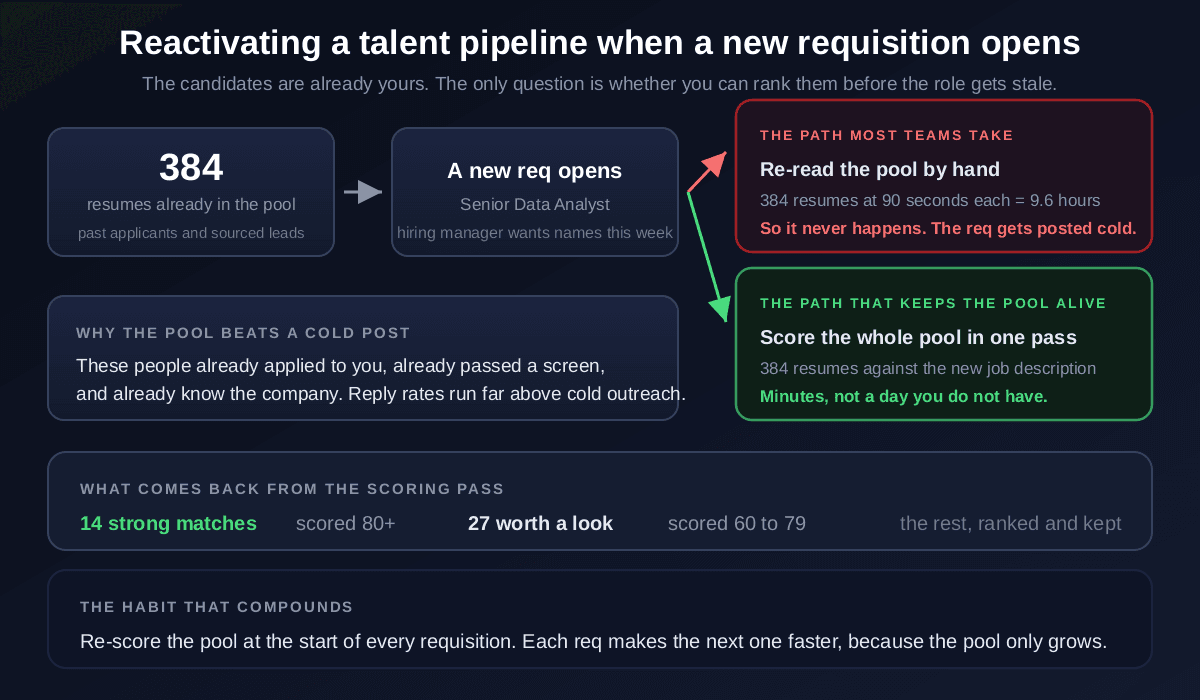
The manual path is the one most teams take by default, and it fails on time rather than on judgement. The scored path treats the pool the way you would treat a fresh batch of applicants: upload everything, paste the live job description, and let the whole group be parsed and rated against it in a single pass. What comes back is not a yes or no, it is an ordering, with the matched and missing requirements attached to each candidate so you can see why someone ranked where they did. That reasoning is what makes the shortlist defensible when a hiring manager asks why these fourteen names and not others.
Two things make pipeline candidates worth prioritising over a cold post. They convert better, because they already applied to you or spoke to you and do not need to be sold on the company from scratch. And they arrive faster, because you skip the days spent writing an ad, waiting for it to circulate and waiting for applications to accumulate. Those are days straight off your time to fill. The mechanics of running a batch like this are the same as any other bulk screen, covered in how to screen resumes in bulk, and the per-candidate reasoning behind each score is what bulk resume analysis exists to surface.
One caution worth stating: re-scoring is for prioritising who you read and contact first, never for silently discarding the bottom of the list. Someone who scored poorly against last year's role may be an excellent match for this one, which is precisely the argument for re-scoring rather than trusting the old rank. Keep a person on the final call, and read the middle band before you close it.
Talent pipeline metrics worth tracking
Most pipeline reporting measures the wrong thing, which is size. A pool of ten thousand unscreened profiles is a worse asset than eighty screened and recently contacted candidates for a role you hire four times a year. Track readiness and yield instead:
- Pipeline depth by role family. How many screened, non-stale candidates exist for each role you actually pipeline. Count screened people, not stored rows.
- Pipeline hire rate. The share of hires that came from the existing pool rather than a fresh post. This is the headline number, and for most teams it starts near zero, which is the point.
- Reactivation reply rate. What share of contacted pipeline candidates respond, compared with cold outreach. If the gap is small, your warming cadence is not doing its job.
- Time from req open to first shortlist. The clearest measure of whether the pipeline is real. A working pipeline produces names on day one or two, not week three.
- Staleness ratio. The proportion of the pool past your refresh window. Left unwatched, this quietly climbs until the pool is technically large and practically empty.
Size the pipeline backwards from these numbers rather than picking a target headcount. If roughly one in ten screened candidates reaches interview and one in four interviewed candidates accepts an offer, one hire needs about forty genuinely screened people. That arithmetic is far more useful than a goal of a thousand profiles, and it connects the pipeline to the capacity questions covered in workforce planning.
What talent pipeline software actually needs to do
There is a large market of tools that promise pipeline management, and it is worth being precise about which job you are hiring a tool for. Three capabilities matter, and most products are strong at the first and weak at the second.
- Structured storage. Candidates saved with source, date, role family and status, so the pool can be filtered rather than only scrolled. Applicant tracking systems generally do this well, and it is the reason your ATS should stay the system of record.
- Bulk re-evaluation against a new role. The ability to take the whole stored group and rank it against a job description that did not exist when those candidates were saved. Keyword filters approximate this and miss people who described the same skill differently, a failure mode explained in resume parsing. This is the capability that actually determines whether a pool gets used.
- Visible reasoning. A ranking you cannot explain is a ranking you cannot defend. The tool should show the skills and keywords each candidate matches and misses, so the shortlist survives a conversation with the hiring manager.
In practice most teams end up pairing the two: the ATS holds the pipeline, and a scoring tool ranks it against each new requisition. Rankid handles the second job, scoring up to 200 resumes per batch against one job description, which is usually enough to run an entire role family's pool in a sitting or two.
Mistakes that turn a pipeline into a graveyard
- Pipelining every role. Maintenance is the constraint. Three well-kept pipelines beat twelve neglected ones, and the twelve will all be stale within a year.
- Collecting without screening. A saved resume with no evaluation attached is a future nine-hour reading job you have scheduled for yourself.
- Confusing a newsletter with a relationship. Broadcast email keeps a list warm in theory and nobody warm in practice. Specificity is what people respond to.
- Never re-scoring. Ranking candidates once, against the role they originally applied to, and then treating that rank as permanent. Roles change more than people do.
- Measuring the pool by its size. It is the most quotable number and the least informative one. Report depth of screened candidates and pipeline hire rate instead.
- Letting the requisition start from scratch anyway. The most common failure of all. Make re-scoring the pool a required first step on the job requisition checklist, before the ad budget is released, or it will keep being skipped.
Key takeaways
- A talent pool is stored candidates; a talent pipeline is those candidates sorted by readiness for a role.
- Pipelines die from the cost of re-reading, not from bad sourcing: 384 saved resumes is roughly 9.6 hours of manual review.
- Only pipeline the two or three roles you hire repeatedly, and write a reusable requirements profile for each.
- Fill the pipeline from past applicants and silver medalists before paying for new sourcing.
- Screen candidates on entry and re-score the entire pool against the live job description whenever a req opens.
- Measure screened depth, pipeline hire rate and time to first shortlist, not the number of stored profiles.
- Rankid scores up to 200 resumes per batch against one job description, and your first 5 are free with no signup.
Bottom line: the value of a talent pipeline is not in collecting people, it is in being able to rank them the morning a role opens. Every other part of pipeline management, the tagging, the warming, the pruning, exists to protect that one capability. If re-ranking your pool is affordable, the pipeline compounds, because every requisition leaves it larger and better understood than before. If it is not, the pool grows quietly for two years and gets opened once. Run your existing talent pool through Rankid against your next open role and find out how many of the people you already have were the right answer all along.
Frequently asked questions
What is a talent pipeline?
A talent pipeline is a group of candidates you have already identified who are sorted by how close they are to being hired for a specific kind of role. The important word is sorted. A list of people you have collected is only raw material; it becomes a pipeline when each person has a known stage, a known level of interest, and a known fit against the work you actually hire for. That is why the practical test of a talent pipeline is not how many profiles it contains, it is how quickly you can produce a ranked shortlist from it when a requisition opens.
What is the difference between a talent pool and a talent pipeline?
A talent pool is a stored group of candidates: past applicants, sourced profiles, referrals and silver medalists sitting in your ATS or a spreadsheet. It is flat and unordered. A talent pipeline is that same group organised by readiness for a particular role, so you know who is warm, who has been screened, and who could be interviewed this week. In short, a pool answers who have we collected, and a pipeline answers who is ready for the job that just opened. A pool becomes a pipeline the moment everyone in it has been scored against a real job description.
How do you build a talent pipeline?
Build it in six steps. First, define the two or three recurring roles worth pipelining rather than trying to pipeline everything. Second, write a reusable requirements profile for each one so you have a fixed standard to measure against. Third, feed the pipeline from the sources you already have, starting with past applicants and silver medalists before you spend money on new sourcing. Fourth, screen everyone who enters against that requirements profile so entries arrive pre-qualified instead of pre-ignored. Fifth, keep contact warm at a realistic cadence. Sixth, and most importantly, re-score the whole pool against the live job description every time a requisition opens, because a pipeline that is never re-ranked decays into a folder.
How do you manage a talent pool so it stays useful?
Treat it as a working asset with maintenance, not an archive. Give every entry a source, a date and the role family it belongs to, so you can filter later. Set a refresh rule, commonly every six to twelve months, after which a profile is treated as stale until reconfirmed. Prune duplicates and anyone who has asked to be removed. Keep the pool honest about consent and data retention. Above all, build one recurring habit: at the start of every new requisition, re-score the entire pool against that specific job description before you spend a dollar on advertising. Managing a talent pool is mostly about keeping it re-rankable, because a pool you cannot re-rank is a pool you will never open.
Can AI tools automate talent pipeline management?
They can automate the expensive part, which is the re-reading. The reason talent pools go unused is that comparing hundreds of stored resumes against a new job description is hours of work that never fits in a recruiter's week. Scoring tools remove that bottleneck by parsing every saved resume and rating each one against the live posting on skills, keywords, seniority and relevant experience, so a stale pool becomes a ranked shortlist in minutes. What they should not automate is the decision. Use the ranking to prioritise who you read and contact first, and keep a person deciding who actually moves forward.
How many candidates should a talent pipeline have?
Depth matters far more than headcount, so there is no universal number. A useful way to size it is backwards from your own conversion rates: if roughly one in ten screened candidates reaches an interview and one in four interviewed candidates gets an offer, then a single hire needs about forty genuinely screened people in the pipeline. Ten thousand unscreened profiles will not produce that hire, while eighty well-screened and recently contacted candidates for a role you hire repeatedly usually will. Measure the pipeline by how many people are actually ready, not by how many rows are in the database.
What should talent pipeline software actually do?
It needs to do three things well. It must store candidates with enough structure that you can filter by role family, source and recency. It must let you re-evaluate the whole stored group against a new job description in one pass rather than one profile at a time. And it must show the reasoning behind each ranking, the skills and keywords a candidate matches and misses, so you can defend a shortlist to a hiring manager. Most applicant tracking systems handle storage well and re-evaluation poorly, which is why teams commonly pair their ATS as the system of record with a scoring tool that ranks the batch against each new role.
Is it worth building a talent pipeline for a small team?
Often it is worth more to a small team than a large one, because a small team feels the cost of starting from zero on every role most sharply. You do not need a formal programme. Pick the one role you hire most often, keep every past applicant who scored well against it, and re-score that group first whenever the role reopens. Even a pool of sixty previous applicants for a repeat role usually beats a cold job post on both speed and reply rate, since those candidates already applied to you once and already know the company.