The STAR Method for Interviews: The Time Split, 8 Example Answers, and a Cheat Sheet (2026)
Two candidates, same week, same role, and functionally the same story: a payments bug found shortly before a trading peak. Both used the STAR method. Both named all four parts. One got the offer and the other got a rejection with the note "could not tell what he personally did". The difference was not the framework, because both had it. The difference was that one of them spent 40 seconds explaining who the VP was, and said "we" seven times in the part where the interviewer was trying to work out what he had actually decided. Almost everyone who fails a behavioural interview already knows what STAR stands for.
Quick answer
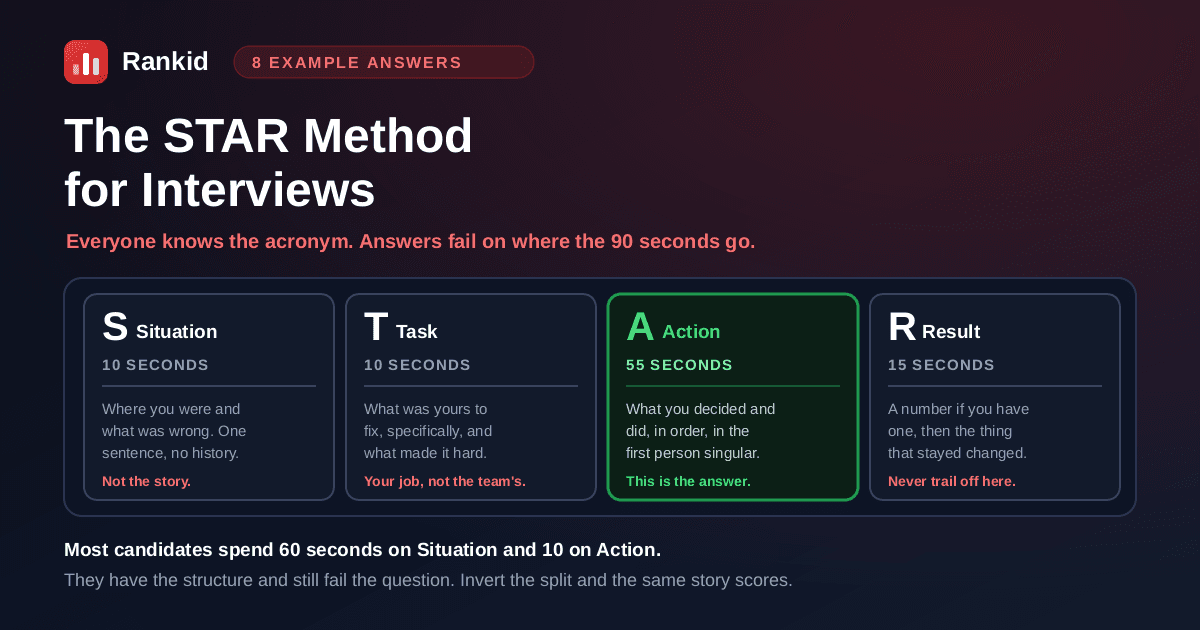
Quick answer: the STAR method is Situation, Task, Action, Result, a four-part shape for answering behavioural interview questions. The acronym is the easy half. In a 90 second answer, spend 10 seconds on Situation, 10 on Task, 55 on Action and 15 on Result, keep every verb in the Action section in the first person singular, name one decision with the reason attached, and finish on a number rather than trailing off. Prepare six stories, not sixty answers, and never say the word STAR out loud in the room.
What is the STAR method?
The STAR method is a four-part structure for answering behavioural interview questions, the ones that begin tell me about a time or describe a situation where. It stands for Situation, Task, Action, Result, and it exists for one reason: those questions are asking for evidence rather than opinion, and evidence needs a shape or it becomes a ramble with a job history attached.
Each part is answering a specific question the interviewer has not said out loud.
- Situation. Where were you and what was wrong? One sentence. The interviewer needs just enough to follow the rest, and no more.
- Task. What was yours to do about it, and what made that hard? The constraint is the part that makes everything after it worth hearing.
- Action. What did you personally decide and do, in order? This is the answer. Everything else is packaging around it.
- Result. What changed, and what is still true because of it? A number if you have one, and a consequence that outlived the deadline.
You may also see it written as STARR or STAR-L, with a Reflection or Learning step added at the end. That fifth step matters for exactly one question type, which is anything about a failure or a mistake, and we come back to it below. For every other behavioural question, four parts is the whole method.
The half of the method nobody teaches
Where the 90 seconds actually go
A STAR answer that gives roughly equal time to all four parts fails, and it fails for a structural reason. Two of the four things an interviewer is rating come out of the Action section alone. If you have spent 40 seconds on the setup, you have handed them a quarter of an answer and used up their attention getting there.
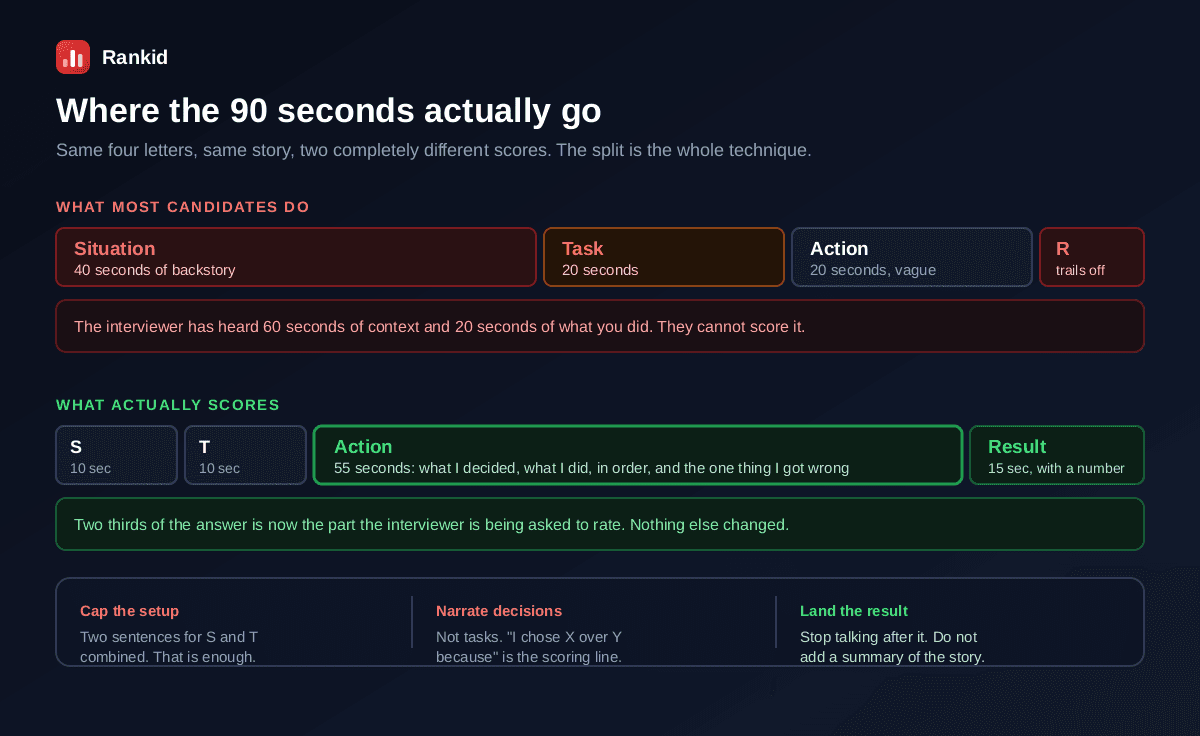
Target 90 seconds, treat two minutes as the ceiling. Inside that: about 10 seconds of Situation, 10 of Task, 55 of Action, 15 of Result. Two sentences total for the setup is a reliable working rule, and if you are still establishing context at the 20 second mark, you have already lost the answer.
The other direction is a real failure mode too. Under about 45 seconds usually means the story contains no detail, and an answer with no detail in it reads as though it did not quite happen. If you genuinely run out of material, stop rather than padding, and offer more: "I can take you further into how I diagnosed that if it is useful." That reads as confidence. Filler does not.
One story, told twice
The clearest way to see what the split does is to hold the facts constant and change only the proportions. Below is the same incident, told the way most people tell it and then rebuilt. Nothing was added. Nothing was invented. The second version simply spends its time in the place that gets scored.
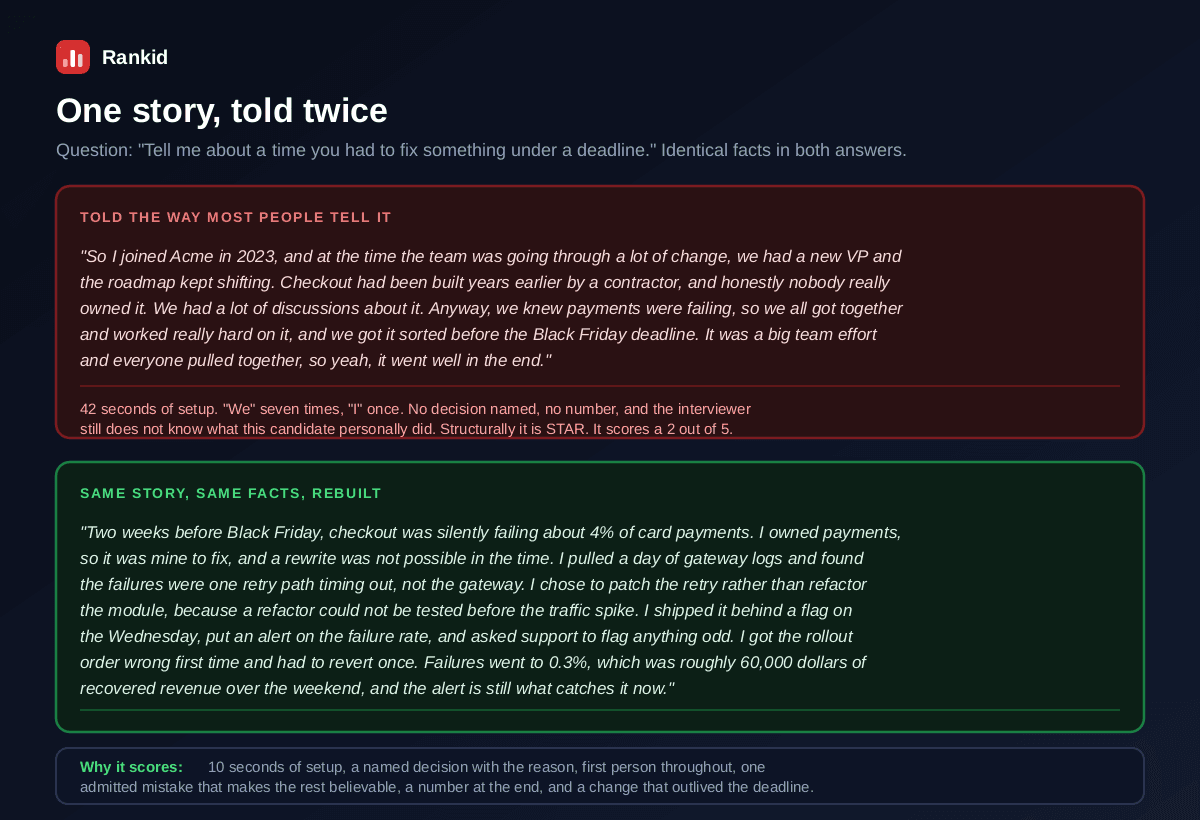
Four things changed, and they are the four things worth practising.
- The setup got cut to one sentence."Two weeks before Black Friday, checkout was silently failing about 4% of card payments." The interviewer does not need the org chart or the contractor who built it in 2019.
- A decision got named, with its reason."I chose to patch the retry rather than refactor the module, because a refactor could not be tested before the traffic spike." This single sentence is worth more than four additional actions, because it is the only kind of sentence that demonstrates judgement.
- Every verb became first person. I pulled, I found, I chose, I shipped, I asked. The facts were always true. The first version simply hid them.
- One mistake was admitted."I got the rollout order wrong first time and had to revert once." Counter-intuitively this raises the score, because a story with no friction in it sounds reconstructed, and an unprompted admission signals someone who tracks their own errors.
The "we" problem
If you fix one thing from this article, fix this one. Saying wein the Action section is the most common reason a technically correct STAR answer scores badly, and it is almost never a deliberate choice. Candidates do it because it feels modest, because their workplace really is collaborative, and because saying "I" eleven times in a row feels boastful when you rehearse it.
From the other side of the table it lands very differently. The interviewer is filling in a box marked ownership. "We decided to rebuild the retry logic and we shipped it before the deadline" gives them nothing to write, because they cannot tell whether you led that work, argued against it, or watched it from two desks away. Faced with an unscoreable answer they either probe, which costs you time you wanted for a second story, or mark it neutral and move on.
The pronoun audit, which takes four minutes
There is one legitimate exception. If the honest answer is that you influenced rather than executed, say that precisely instead of hiding behind the plural: "I did not write the migration, I made the case for doing it in two phases and got the vendor to agree to the timeline." That is a clear, scoreable action. It is the vague collective that costs you, not the modesty.
What the interviewer is actually writing down
A trained interviewer is not ticking off the letters of an acronym. They are filling in a small number of rated boxes while you talk, usually on a structured interview scorecard agreed before the process started. Knowing what those boxes are tells you exactly where to spend your 90 seconds.
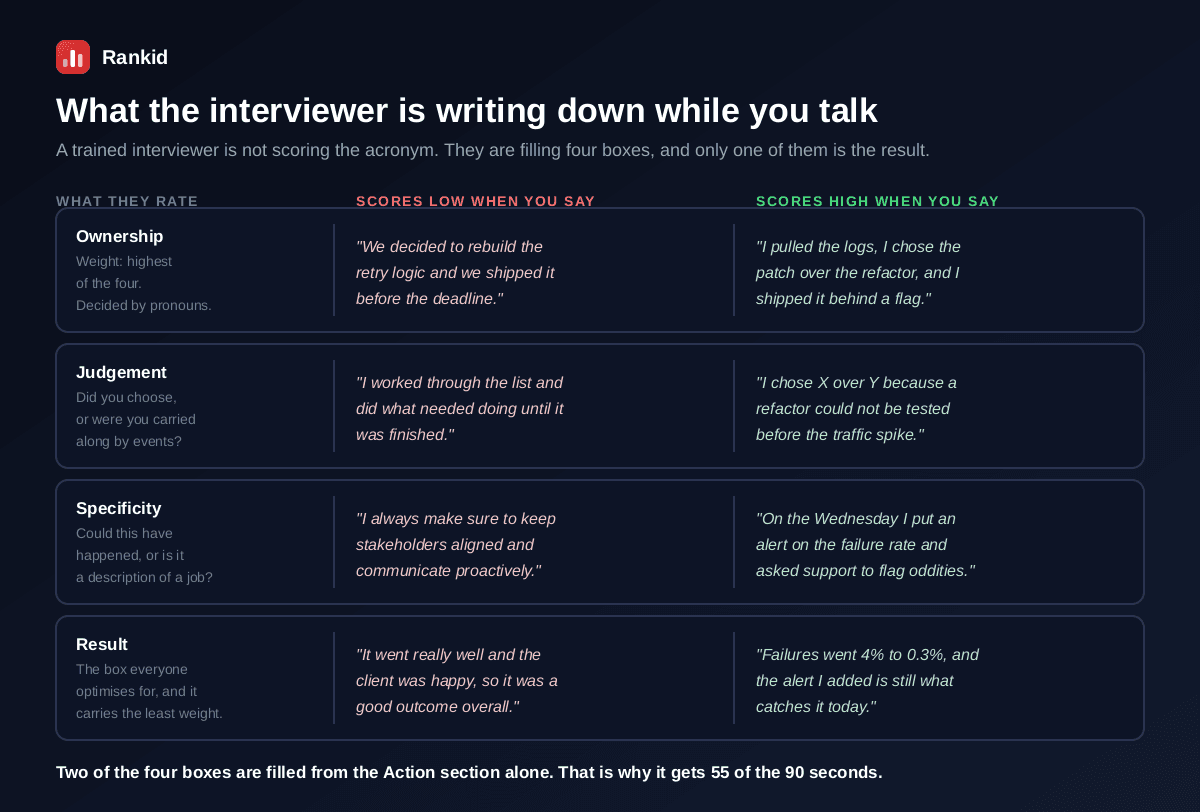
Note the weighting, because it is the opposite of how most people prepare. Result carries the least weight of the four, and it is the box candidates optimise for hardest, hunting for an impressive number and then rushing everything that led to it. Ownership and judgement carry the most, and both are filled entirely from the Action section. That is the arithmetic behind giving Action 55 of the 90 seconds.
The specificity row deserves a note of its own, because it catches a whole category of answer that sounds professional. "I always make sure to keep stakeholders aligned and communicate proactively"is not a STAR answer at all, it is a self-description wearing one. The test is whether what you said could have a date attached to it. "On the Wednesday I put an alert on the failure rate" passes. "I always make sure to" cannot pass, because habits do not have dates.
Eight STAR method example answers
These are compressed to their skeletons so the shape is visible, and every one is built on the same six-story principle: a handful of real events, angled differently. Read them for structure rather than content, then rebuild each one from your own material.
"Tell me about a time you handled a tight deadline."
S+T (2 sentences). Two weeks before our biggest trading weekend, checkout was silently failing about 4% of card payments. I owned payments, so it was mine, and a rewrite was not testable in the time.
A. I pulled a day of gateway logs and found the failures were one retry path timing out rather than the gateway itself. I chose to patch the retry instead of refactoring the module, because a refactor could not be tested before the spike. I shipped it behind a flag, added an alert on the failure rate, and asked support to flag anything odd. I got the rollout order wrong first time and had to revert once.
R. Failures went from 4% to 0.3%, roughly 60,000 dollars of recovered revenue over the weekend, and that alert is still what catches it today.
"Tell me about a time you disagreed with your manager."
S+T. My manager wanted to launch a pricing change in the same week as a large migration. I thought the overlap would make any problem impossible to attribute, and I had to either raise it or own the consequences quietly.
A. I asked for 15 minutes rather than arguing in the channel. I brought the two previous launches where overlapping changes had cost us a week of diagnosis, and I proposed a two-week gap rather than cancelling anything, because I wanted to change the sequencing and not the plan. When she pushed back on the quarter-end target, I offered to take the migration date forward instead so the launch date stayed fixed.
R. We moved the migration up nine days, the launch went out on the original date, and a checkout regression that appeared afterwards took an afternoon to attribute rather than a week. She has asked me to sanity-check sequencing on the two releases since.
Why this scores: it is a real disagreement with a real disagreement in it, the candidate proposes rather than objects, and the manager is not made into a villain.
"Tell me about a time you led without authority."
S+T. Three teams were each building their own CSV export and none of us owned the others. I had no mandate to consolidate anything, and I could see we were about to ship three formats to the same customers.
A. I wrote a one-page comparison of the three implementations and what a customer with all three would experience, then took it to each lead individually before ever raising it in a group, because I wanted objections in private where they were cheap. I offered to do the merge work myself rather than asking anyone to give up headcount. I chose the format that was hardest for my own team, deliberately, because it removed the argument that I was optimising for myself.
R. One export shipped instead of three, about three weeks of duplicated work stopped, and the one-pager became how we handle overlapping work now.
"Tell me about a time you failed." (use CARL here)
C. I owned a supplier migration with a hard contractual cut-off date.
A. I built the plan around the technical work and treated data validation as a final step rather than a parallel one, because the sample I checked early looked clean. Two weeks out, a fuller check showed about 12% of historical records had a field the new system rejected. I escalated the same day rather than trying to absorb it, and I asked for the cut-off to move.
R. We missed the date by 11 days and paid roughly 8,000 dollars in overlap fees. That was my call and my planning error.
L. I now validate against the full dataset in week one of any migration, never a sample, and I put the data check on the critical path in the plan itself. On the next two migrations that check found problems in week one both times, which is exactly the point.
Why this scores: the failure is real, the cost is named without softening, ownership is explicit, and the learning has evidence that it stuck.
"Tell me about a time you dealt with a difficult customer or stakeholder."
S+T. Our second largest account threatened to leave over a billing error that had overcharged them for four months. I picked up the relationship two days before that call, so I had no history and no credibility with them.
A. I did not defend anything on the first call, I asked them to walk me through what they had been told each time they raised it, and I wrote it down. I found they had reported it three times and been closed out twice. I chose to lead with the process failure rather than the refund, because the money was never really the complaint. I gave them a fixed date for the refund and a named person, me, and I sent a summary within the hour so they had it in writing.
R. They renewed six weeks later. I also added a rule that any billing dispute reopened twice gets escalated automatically, which caught two more accounts that quarter.
"Tell me about a time you had to learn something quickly."
S+T. Our only analyst left three days before a board reporting cycle and I had never used the warehouse or written SQL beyond selects. The pack had to go out on time regardless.
A.I decided not to learn the tool properly and instead to reproduce exactly four numbers, which was the smallest thing that would work. I read her saved queries rather than documentation, because the queries told me what the business definitions actually were. I rebuilt the four figures, then deliberately checked them against last quarter's pack rather than trusting my own output, and found I had double counted refunds.
R. The pack went out on time with correct numbers, and I wrote down the four definitions, which is what the new analyst was handed in her first week.
"Tell me about a time you prioritised, or chose what not to do."
S+T. I inherited a roadmap with 14 committed items for a quarter that realistically held six. Every one had been promised to someone.
A. I sized all 14 roughly rather than precisely, because precision would have taken two weeks I did not have. I chose to cut by evidence of demand rather than by who had asked, which meant telling our largest internal stakeholder that his item was not in. I went to him first, before publishing anything, and I gave him the alternative of a smaller version in the same quarter. I wrote down the reason next to each cut so the list could be argued with.
R. Seven of the six-item plan shipped, nothing slipped into the following quarter, and the written reasons meant the two escalations that came were about the criteria rather than about me.
"Tell me about your greatest achievement."
S+T. Onboarding was losing about 60% of new signups before they ever completed setup, and nobody owned the flow because it sat between marketing and product. I asked for it.
A. I watched nine recorded sessions before changing anything, which told me the drop was concentrated at one screen that asked for information we did not need until later. I chose to move that field rather than redesign the flow, because I wanted one variable and a clean read. I shipped it as a split test, then made two further cuts on the same evidence.
R. Setup completion went from 41% to 62% over a quarter, which held for the following two quarters. The bigger result is that watching sessions before changing anything is now how the team starts every flow change.
Notice what all eight have in common
The same evidence has to survive the resume screen first
A STAR answer only helps if you get the interview. Paste your resume and the job description into Rankid and you will get a 0 to 100 match score, the requirements you have evidenced, and the ones the screen cannot see. First check is free, no signup.
Check your resume freeWhich questions are STAR questions, and which are not
Forcing a four-part narrative onto a question that did not ask for a story is a recognisable tell, and it produces laboured answers to questions that wanted a position. The trigger is simple: if the question contains a past-tense specific event, it is a STAR question.
Use STAR for these. Tell me about a time you... Describe a situation where... Give me an example of... Walk me through how you handled... When have you had to... What is the most difficult X you have faced?
Do not use STAR for these. Tell me about yourself, why do you want to work here, why should we hire you, what are your salary expectations, where do you see yourself in five years, what is your greatest weakness, and why are you leaving. These ask for a position, a preference or a piece of self-assessment. A weakness answer does have a shape, but it is name it, then describe the system you built so it stops mattering, which is not STAR.
The borderline case worth planning for
STAR, CAR, SOAR, PAR and CARL
These are the same skeleton with a different emphasis, and the choice between them matters far less than people searching for the "best" one assume. Pick by what the question is testing and by how much room you have.
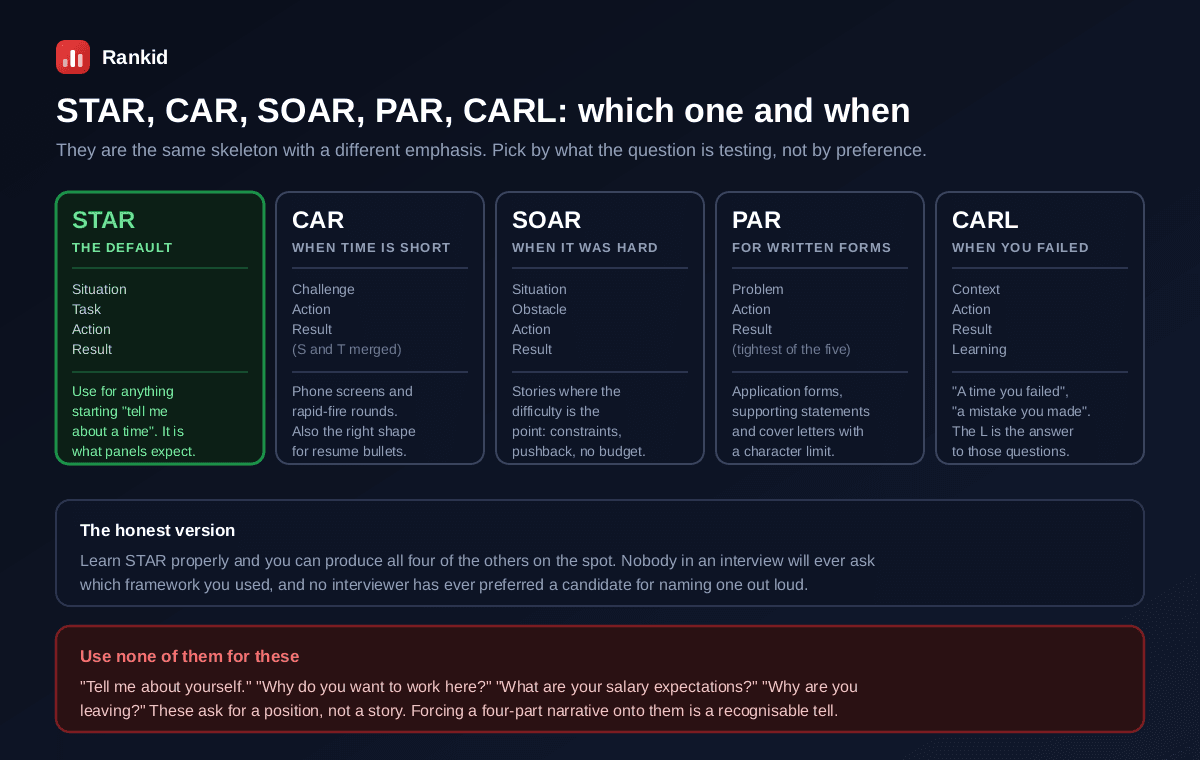
The practical guidance is short. STAR is your default for live interviews, because panels are trained on it and the Task step is what establishes that the work was yours. CAR is better when you have less room, which means phone screens, a screening interview where the recruiter clearly wants pace, and resume bullets. SOAR suits stories where the obstacle rather than the assignment is the interesting part. PAR is the tightest and belongs in written application forms and cover letters with a character limit. CARL is for failures, and the Learning step is the answer to that question rather than a decoration on it.
Learn STAR properly and you can generate any of the other four on the spot, which is the honest reason not to spend time choosing between them. No interviewer has ever asked which framework a candidate used.
The STAR method on your resume
The most common misuse of STAR is not in interviews at all, it is on the page. A spoken answer is 90 seconds. A resume bullet gets about six seconds of a recruiter's attention, so the instruction is compress, do not narrate.
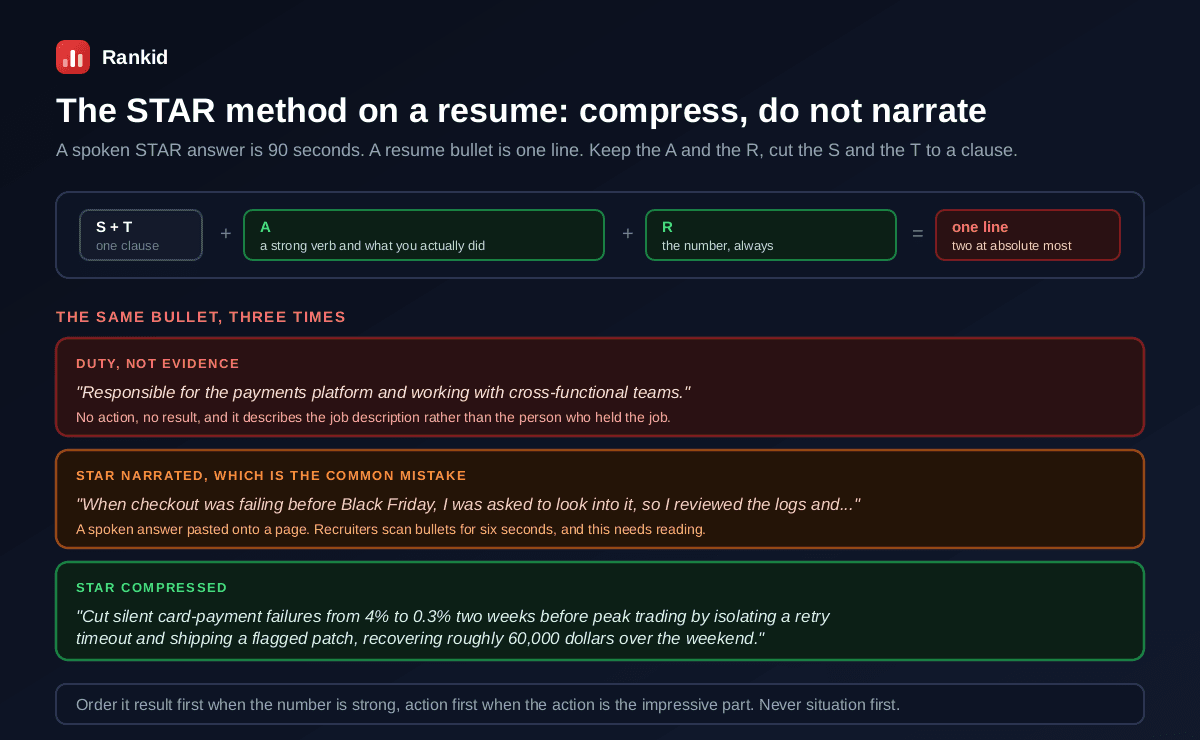
Keep the Action and the Result in full. Cut Situation and Task down to a single subordinate clause, which in practice is almost always the constraint or the timing, because that is the only part of the setup a scanning reader gets value from. Then choose your opening by whichever half is stronger: lead with the result when the number is the impressive thing, and lead with the action verb when the action is. Never lead with the situation, which is what produces bullets that read like a job description rather than a person.
Two adjacent guides do the rest of this job properly: how to quantify achievements on a resume covers finding a number when you think you do not have one, and tailoring your resume to a job description covers choosing which of your compressed stories belongs on the page for a given role. A useful side effect of doing this: the bullets you write become the story bank you interview from, so the work is not duplicated.
How to practise it in 40 minutes
Reading about STAR does almost nothing, because the failure modes are all delivery. Forty minutes out loud fixes more than four hours of notes.
Ten minutes: write six stories as bullets, not scripts
Ten minutes: add the decision sentence to each
Ten minutes: record two of them and audit the pronouns
Ten minutes: rehearse the endings alone
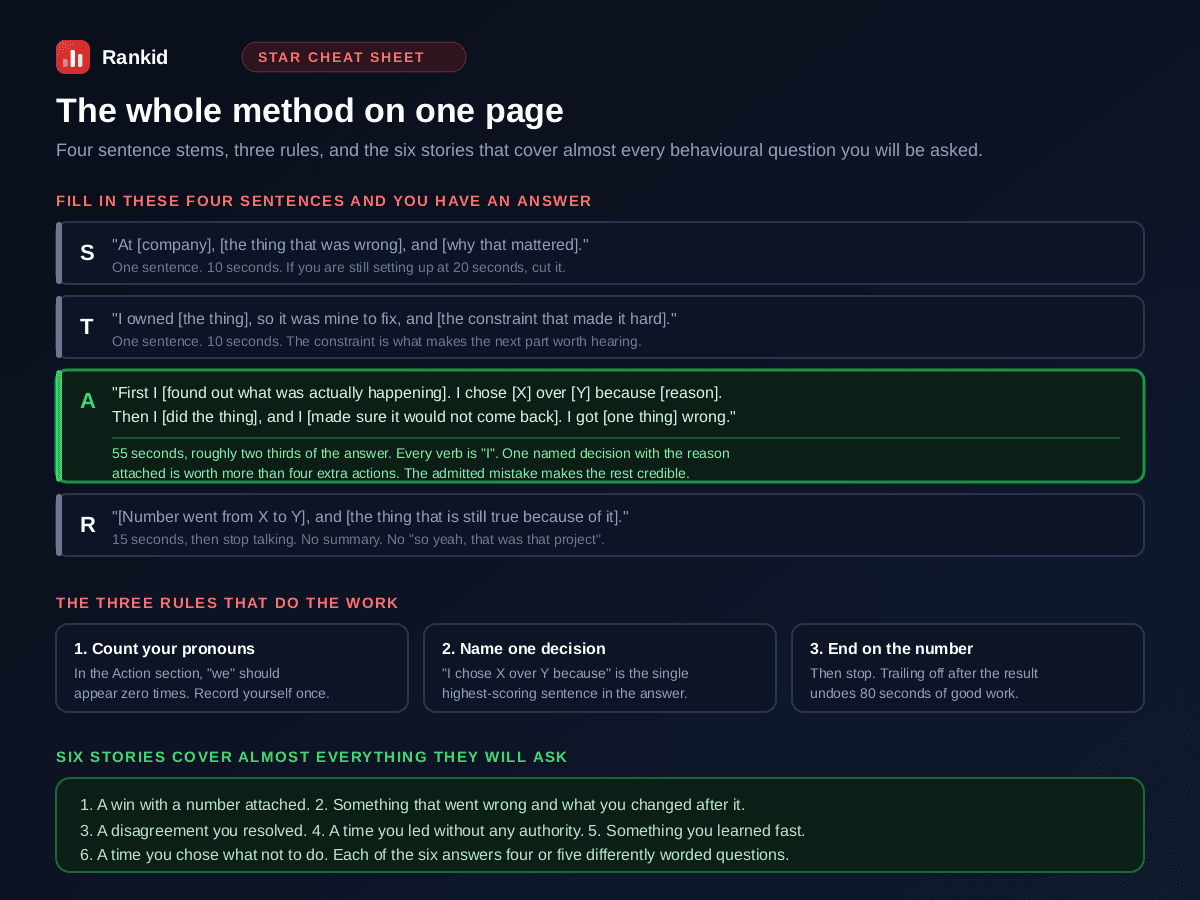
The STAR method cheat sheet
Everything above compressed to one page: four sentence stems you can fill in, the three rules that do most of the work, and the six stories. This is what to look at for two minutes before you join the call.
Mistakes that sink a technically correct STAR answer
- Saying "we" in the Action section. The big one. The interviewer cannot fill the ownership box, so the answer scores neutral no matter how good the work was.
- A 40 second Situation. You have spent the attention budget on context and will narrate your actual contribution to someone who has stopped listening.
- Listing tasks instead of naming decisions."I did this, then this, then this" is a timeline. Judgement only shows up where an alternative was rejected.
- Announcing the framework."I will use STAR for this" converts a story into a performance, and signposting each part as you go does the same thing more slowly.
- No Result, or a feeling as the Result."It went really well and everyone was happy" is not an outcome. Something changed and stayed changed, or the story does not finish.
- Trailing off after the Result.Adding "so yeah, that was that project" undoes 80 seconds of good work. Land the number and stop.
- A frictionless story. Answers where nothing went wrong sound reconstructed. One admitted error raises the score rather than lowering it.
- A fake failure. Caring too much, working too hard, being a perfectionist. Every interviewer has heard these and codes them as evasion.
- Reusing one story with the same interviewer. It signals a single good example rather than a body of work, and the second telling always sounds thinner.
- Forcing STAR onto opinion questions.A four-part narrative in response to "why do you want to work here" is the clearest sign in the room that someone has been revising a technique.
- A story older than about five years, unless it is genuinely your strongest and you say why you have reached back for it.
- Never asking anything back. Behavioural rounds usually close with your turn, and the questions you ask in an interview are scored too, on most scorecards explicitly.
Key takeaways
- STAR is Situation, Task, Action, Result: a shape for behavioural questions, which ask for evidence rather than opinion.
- Knowing the acronym distinguishes nobody. Knowing the time split is the actual skill.
- In a 90 second answer: about 10 seconds Situation, 10 Task, 55 Action, 15 Result. Two sentences for the whole setup.
- Ownership and judgement are the two heaviest scored dimensions, and both come out of the Action section alone.
- Result carries the least weight of the four, which is the opposite of how most candidates prepare.
- Say 'we' zero times inside the Action section. Record yourself once and count them.
- 'I chose X rather than Y, because Z' is the single highest-scoring sentence available to you.
- One admitted mistake raises the score. A frictionless story sounds reconstructed.
- Prepare six stories as bullets, not sixty scripted answers. Each one flexes to four or five questions.
- Use CARL for failure questions, CAR for phone screens and resume bullets, PAR for written forms with a limit.
- Do not use any of them for tell me about yourself, why us, salary expectations or why you are leaving.
- On a resume, compress rather than narrate: one clause of setup, the action, and the number.
- Never say the word STAR out loud in the room. The structure is meant to be invisible.
The whole method reduces to one question you can ask of any answer you are about to give: can the interviewer tell what I personally decided? If yes, the structure was good enough. If no, no amount of correct acronym will save it, which is why the two candidates at the top of this article got different outcomes from the same story. Build your six stories, put a decision sentence in each, record one of them, and then make sure the evidence survives the screen that comes first: paste your resume and the job description into Rankid's resume checker to see which of your achievements a recruiter can actually find, and read why am I not getting interviews if the behavioural round is not the stage you are losing at.
Frequently asked questions
What is the STAR method?
The STAR method is a four-part structure for answering behavioural interview questions: Situation, Task, Action, Result. You name where you were and what was wrong, what specifically was yours to fix, what you personally did about it, and what measurably changed. It exists because behavioural questions are asking for evidence rather than opinion, and evidence needs a shape or it turns into a ramble. The part almost every guide leaves out is the proportion. A STAR answer that gives equal time to all four parts fails, because the interviewer is scoring the Action section and you have given them a quarter of an answer. Situation and Task together should take about 20 seconds of a 90 second answer, Action should take roughly 55, and Result about 15. Learning the acronym takes 30 seconds. Learning the split is the actual skill.
What does STAR stand for?
Situation, Task, Action, Result. Situation is the context: where you were and what was going wrong, in one sentence. Task is what was specifically yours to do about it, plus the constraint that made it hard, which is what makes the rest worth listening to. Action is what you personally decided and did, in order, in the first person singular, and it is the longest and most heavily weighted part by a wide margin. Result is what changed, ideally with a number, plus the thing that stayed true afterwards. Some interviewers and some universities teach it as STARR or STAR-L with a Reflection or Learning step bolted on the end, which matters for one specific question type: anything asking about a failure or a mistake. For every other behavioural question the four original parts are enough.
How long should a STAR answer be?
Aim for 90 seconds, and treat two minutes as the hard ceiling. Inside that 90 seconds, allocate roughly 10 seconds to Situation, 10 to Task, 55 to Action, and 15 to Result. The most common failure in behavioural interviews is not a missing part of the acronym, it is spending 40 or 50 seconds on the setup, which leaves you narrating your Action while the interviewer has already stopped listening and started waiting for a gap. Under about 45 seconds usually means the story has no detail in it and reads as though it did not really happen. If you genuinely finish early, stop rather than padding, and offer to go deeper: "I can take you further into how I diagnosed that if it is useful." Time yourself out loud once with a stopwatch and you will fix more than any amount of rereading does.
What is the most common STAR method mistake?
Saying "we" during the Action section. It is the single most common reason a structurally perfect STAR answer scores badly, and candidates do it because it feels modest and because most workplaces genuinely are collaborative. The problem is that the interviewer is trying to fill a box marked ownership, and "we decided to rebuild the retry logic" gives them nothing to write down. They cannot tell whether you led that work, argued against it, or watched it happen from two desks away. Record yourself answering one behavioural question and count the pronouns in the Action section. In a strong answer, "we" appears zero times there. Use "we" freely in Situation, where the team context is genuinely relevant, then switch deliberately to "I" the moment you start describing what was done, and switch back for the Result if the win was shared.
Can I tell the interviewer I am using the STAR method?
No, and it is a surprisingly common instinct. Announcing "I am going to answer this using STAR" tells the interviewer you are performing a technique rather than remembering something that happened to you, and it makes every subsequent word sound rehearsed. Nobody has ever been hired for naming a framework out loud. The structure is supposed to be invisible: the interviewer should experience a clear, well-ordered story and never think about the scaffolding underneath it. The same applies to signposting each part as you go. Do not say "so that was the situation, now the task". A well-built STAR answer sounds like a person who is good at explaining things, which is itself a signal you want to send.
What if my story has no numbers for the Result?
Use a qualitative result with a durable consequence attached, and never skip the Result. Plenty of real work does not produce a metric, particularly in support, operations, education, healthcare and early-career roles. What every result does have is a state that changed and stayed changed, and that is what the interviewer is listening for. "The handover doc I wrote is still what new starters are given" is a genuine result. So is "the client renewed", "my manager moved the process to the whole team", "the complaint was closed without escalation", or "we stopped getting that ticket". Two things do not work: a result that is only a feeling, such as everyone being much happier, and no result at all, which is the version where the candidate trails off with "and yeah, it went fine". Approximate numbers are also acceptable if you flag them as approximate: roughly a third, about two hours a week, somewhere around 40 tickets a month.
How many STAR stories should I prepare?
Six, and it is worth understanding why the number is that small. Interviewers ask the same handful of underlying things in dozens of different wordings, so preparing an answer per question is both impossible and unnecessary. Six stories that cover a win with a number attached, something that went wrong and what you changed after it, a disagreement you resolved, a time you led without authority, something you had to learn fast, and a time you chose what not to do will between them answer almost anything behavioural. Each story flexes to answer four or five differently worded questions, because the same events can be told as a leadership story or a prioritisation story depending on which part you emphasise. Prepare the stories as bullet points, never as scripts, since memorised scripts collapse the moment the wording changes.
How do you use the STAR method for a time you failed?
Use CARL instead, which is STAR with a Learning step on the end and the emphasis shifted. For failure questions the Result is deliberately not the point, because the honest result was that it went wrong, and the interviewer already knows that from the question. What they are testing is whether you can describe a genuine failure without either minimising it or falling apart, and whether anything changed in how you work afterwards. So give the context briefly, describe what you actually did including the decision that turned out to be wrong, state the real consequence without softening it, then spend the last third on what you changed and the evidence that the change stuck. Two traps. Do not pick a fake failure such as caring too much or working too hard, which reads as a dodge. And do not pick a failure caused entirely by someone else, because a story where you were the victim answers a different question from the one you were asked.
Does the STAR method work for technical interviews?
Yes for the behavioural portion, which almost every technical loop contains, and no for the parts where you are solving a problem live. In a coding, system design or case round the interviewer is watching you think, and narrating a four-part story about a past project instead of engaging with the problem in front of you is a mistake. Where STAR does apply is the round explicitly about your past work: tell me about a hard bug, tell me about a system you designed, tell me about a technical disagreement. In those, technical candidates make one specific error. They spend 50 seconds on architecture and context, which is comfortable ground, and 20 on their own decisions. Keep the architecture to the minimum needed to make the decision legible, then spend the bulk of the time on what you chose, the alternative you rejected, and why. Amazon-style loops are the strictest version of this, since answers are mapped directly to leadership principles and a story without a clear owner scores nothing.
How do you use the STAR method on a resume?
Compress it, do not narrate it. A spoken STAR answer is 90 seconds; a resume bullet is one line that gets about six seconds of attention. Keep the Action and the Result in full, and cut Situation and Task down to a single subordinate clause, which in practice usually means the constraint or the timing. "Cut silent card-payment failures from 4% to 0.3% two weeks before peak trading by isolating a retry timeout and shipping a flagged patch" carries the whole story in one line: the constraint, the action, the number. Lead with the result when the number is the impressive part, and lead with the action when the action is. Never lead with the situation, which is what produces bullets that read like job descriptions. The mistake to avoid is pasting a spoken answer onto the page, which is what "When checkout was failing, I was asked to look into it, so I reviewed the logs and..." is, and it is unreadable at scanning speed.
What is the difference between the STAR and CAR methods?
CAR merges Situation and Task into a single Challenge, so it is the same skeleton with the setup compressed. Use STAR as your default for live interviews, since panels are trained on it and expect the Task step to establish what was yours specifically. Use CAR when you have less room: phone screens, rapid-fire rounds where the interviewer clearly wants pace, and resume bullets, where CAR is genuinely the better shape. The related variants split the same way. SOAR replaces Task with Obstacle, and suits stories where the difficulty rather than the assignment is the point, such as no budget or organisational pushback. PAR is the tightest and works well for written application forms and supporting statements with a character limit. CARL adds Learning and is for failure questions. If you learn STAR properly you can produce any of the others on the spot, and no interviewer will ever ask which one you used.
How do you use the STAR method with no work experience?
Change where the stories come from, not the structure. Behavioural questions test judgement under constraint, and coursework, a dissertation, a society committee, a sports team, a part-time retail job, a volunteering shift, a side project or a family responsibility all contain genuine constraint. A retail shift where you handled an angry customer while short-staffed is a real conflict story with a real result. A group project where two people stopped contributing three weeks before the deadline is a real leadership-without-authority story. Two adjustments help. Be specific about scale rather than hiding it, since "a society of 300 members" is more credible than vague grandeur. And lean harder on the Action section than experienced candidates need to, because your evidence is thinner, so how you thought is doing more of the work than what you achieved.
Can I use the same STAR story for more than one question?
Within one interview, use each story once. Across separate rounds with different interviewers, reuse is fine and usually unavoidable. Repeating a story to the same person is the thing to avoid, because it signals that you have one good example rather than a body of work, and the second telling always sounds thinner. This is exactly why the six-story bank matters: it gives you somewhere else to go when a question lands close to one you have already used. If you genuinely need to return to the same events, say so and change the angle explicitly: "This is the migration I mentioned earlier, but the part that is relevant here is the disagreement with the vendor." Naming the reuse and then telling a genuinely different part of it is far better than pretending it is a new story, which interviewers notice immediately.