Succession Planning: The Process, the 9-Box Talent Review, and a Template That Gets Used (2026)
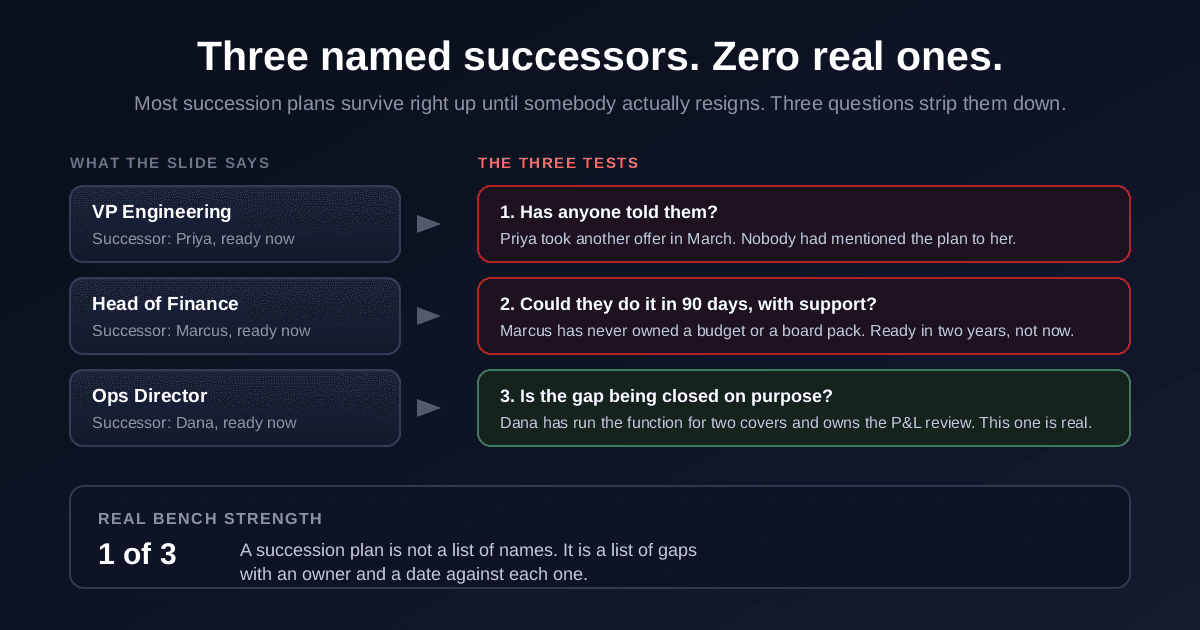
A company I will not name had three critical roles on its succession plan, each with a named successor, each marked ready now. Then the VP of Engineering resigned. The successor had accepted another offer six weeks earlier, because nobody had ever mentioned to her that she was on the plan. The second name had never run a budget or written a board paper. The third was real. One of three, and they only found out which at the worst possible moment. That is the normal state of succession planning, and it is not caused by bad intentions. It is caused by confusing a list of names with a plan.
Quick answer
Quick answer: succession planning is identifying the roles you cannot afford to leave empty, rating honestly who could fill them and when, and then closing the gap on purpose. It differs from replacement planning in one respect that decides everything: whether anything happens between reviews. Run it in seven steps, calibrate people in a 9-box talent review, rate readiness as ready now / 1 to 2 years / 3 years plus / no cover, close each gap with a real assignment rather than a course, and tell the person. Report bench strength as a trend, not a snapshot.
What is succession planning?
Succession planning is the process of identifying the roles an organisation cannot afford to leave empty, working out who could fill them and when, and closing the distance between those two things deliberately. The load-bearing word is process. A list of names against a list of jobs is not a succession plan, and the gap between the two is the subject of the next section.
A working definition, in one sentence: a succession plan is a list of gaps, each with an owner and a date. If your plan contains names but no gaps, it is documentation of an opinion.
One disambiguation before we go further
Succession planning vs replacement planning
Most organisations sincerely believe they are doing the first and are demonstrably doing the second. The distinction is not academic, because only one of the two builds any capability.
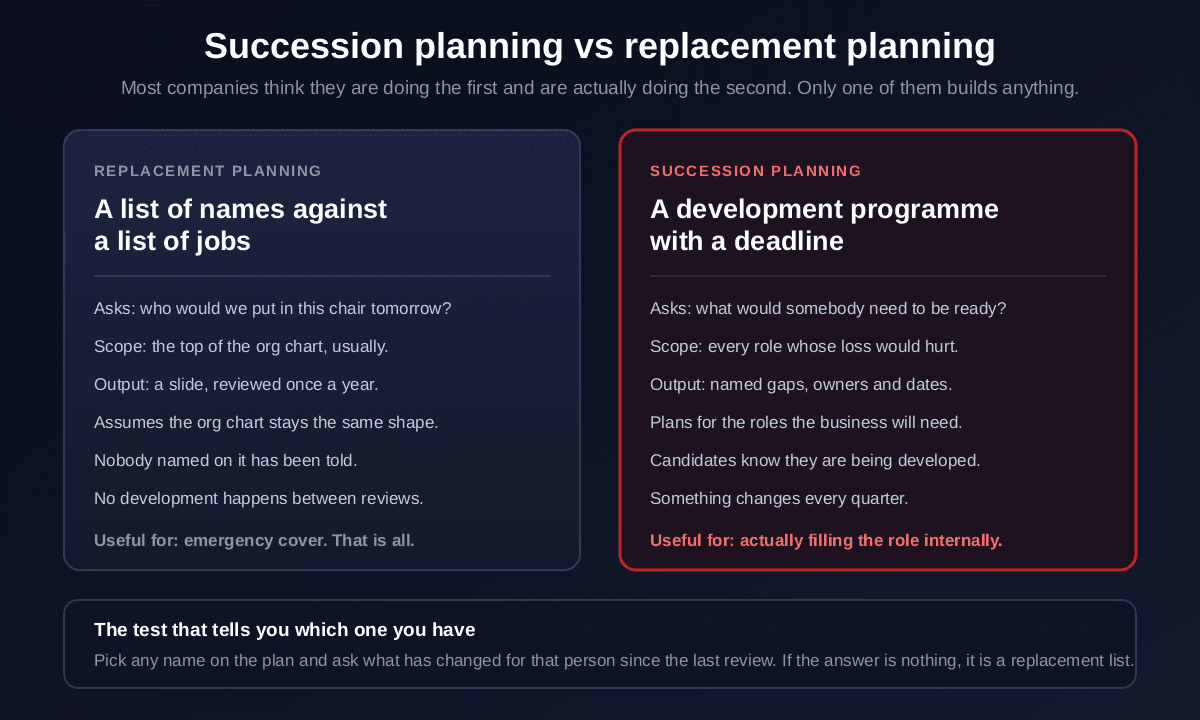
The ten-second test. Pick any name on your plan and ask what has changed for that person since the last review. Not what has changed about the plan, what has changed for them: a new responsibility, a budget, an exposure, a conversation. If the honest answer is nothing, you have a replacement list.
Replacement planning is not worthless. It is genuinely useful for emergency cover, and knowing who would hold the wheel for six weeks is worth having. It simply does not create successors, and organisations routinely mistake having the document for having the bench.
Which roles belong on the plan?
Not the org chart. Ask two questions of every role: what breaks if this person leaves next month, and how long would it take to restore. The list that falls out looks strikingly different from a seniority ranking.
- The obvious senior roles. Genuinely critical, and also the ones with the most external options, so they are usually the least urgent to worry about.
- The single-point-of-failure specialist. The only person who has closed a year-end. The engineer who wrote the billing system. The one name on a regulatory sign-off. These are the real key person risks, and they are dangerous precisely because nobody is watching them.
- The relationship holder. The account lead who personally holds your three largest clients. Their departure takes revenue with it, not just capacity.
- The role your strategy is about to create. If the plan implies a function you do not yet have, its first leader is a succession question today, not a recruiting question in eighteen months. This is where succession and workforce planning meet.
Scope it small enough to survive
The 9-box grid and the talent review
The 9-box grid is a three-by-three matrix plotting performance against potential, and the 9-box talent review is the calibrated meeting where managers place their people on it and defend the placement. Used well, it is the most useful hour in the whole succession process. Used badly, it is a labelling exercise that leaves everyone slightly worse informed.
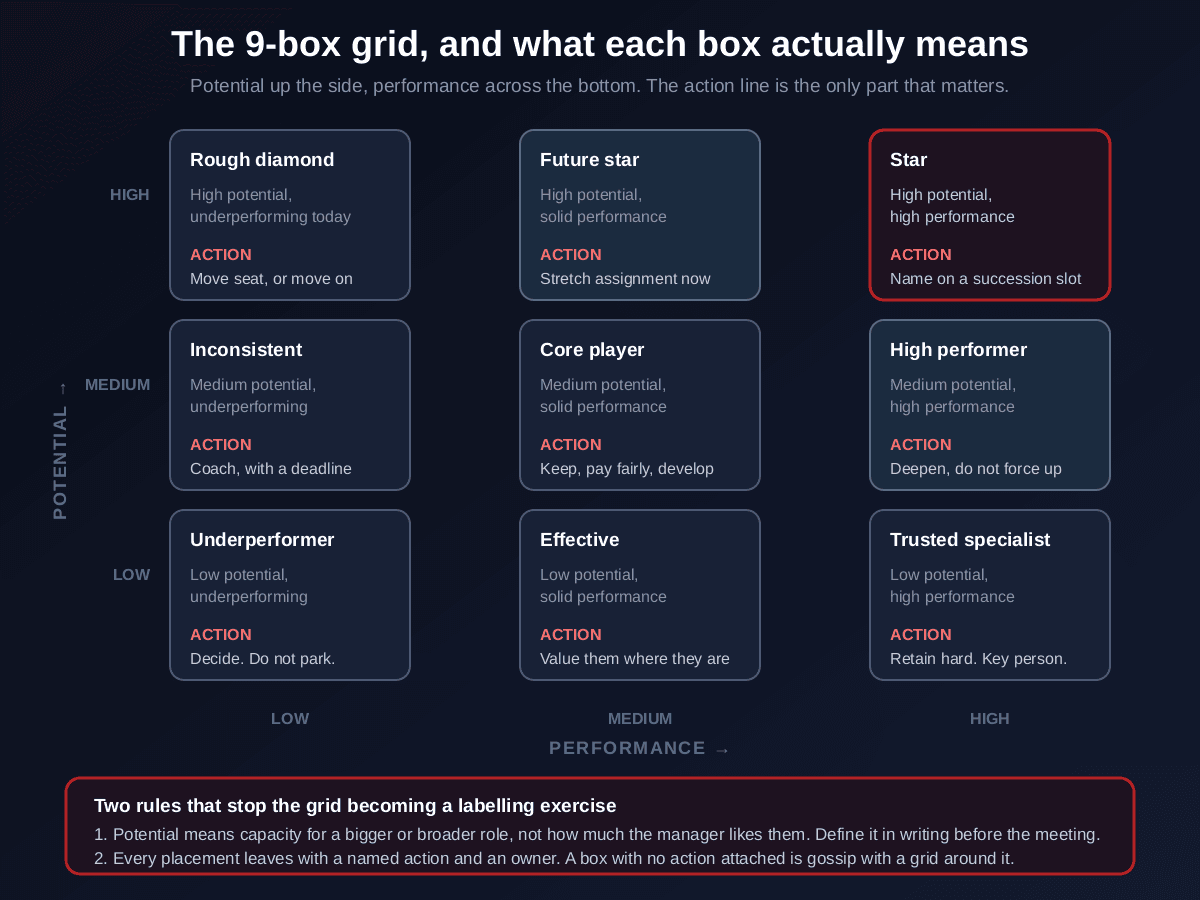
Three boxes are misread almost everywhere, and getting them right changes what you do with real people.
Rough diamond (high potential, low performance). The instinct is a performance conversation. The more common truth is the wrong seat: a strong person in work that does not use them, or under a manager who is not developing them. Move them before you manage them out, and if the move does not work you have learned something either way.
Trusted specialist (low potential, high performance). The single most damaging misreading in the grid. Low potential in this framework means limited appetite or capacity for a broader role, not low value. These people are frequently your deepest key person risks and among your most valuable employees. Retain them hard, pay them properly, and stop trying to promote them into management they never asked for.
Star (high, high). Obvious in the room and often neglected afterwards, because stars are assumed to be fine. They are the ones with the most external options. A star with no named next step is a resignation with a delay on it.
Running the meeting.Four rules do most of the work. Define potential in writing beforehand, because otherwise it silently becomes "how much I like this person". Require evidence, not adjectives: a placement is defended with something that happened, in the way a good interview scorecard forces evidence at the hiring stage. Let peers challenge placements, because calibration across managers is the entire point and a manager rating their own team in isolation is not calibration. And end every placement with a named action and an owner, or the box means nothing.
What the grid must never become
The succession planning process, step by step
Seven steps. Steps 1 and 6 are the ones organisations skip, and skipping either one converts the whole exercise back into a slide.
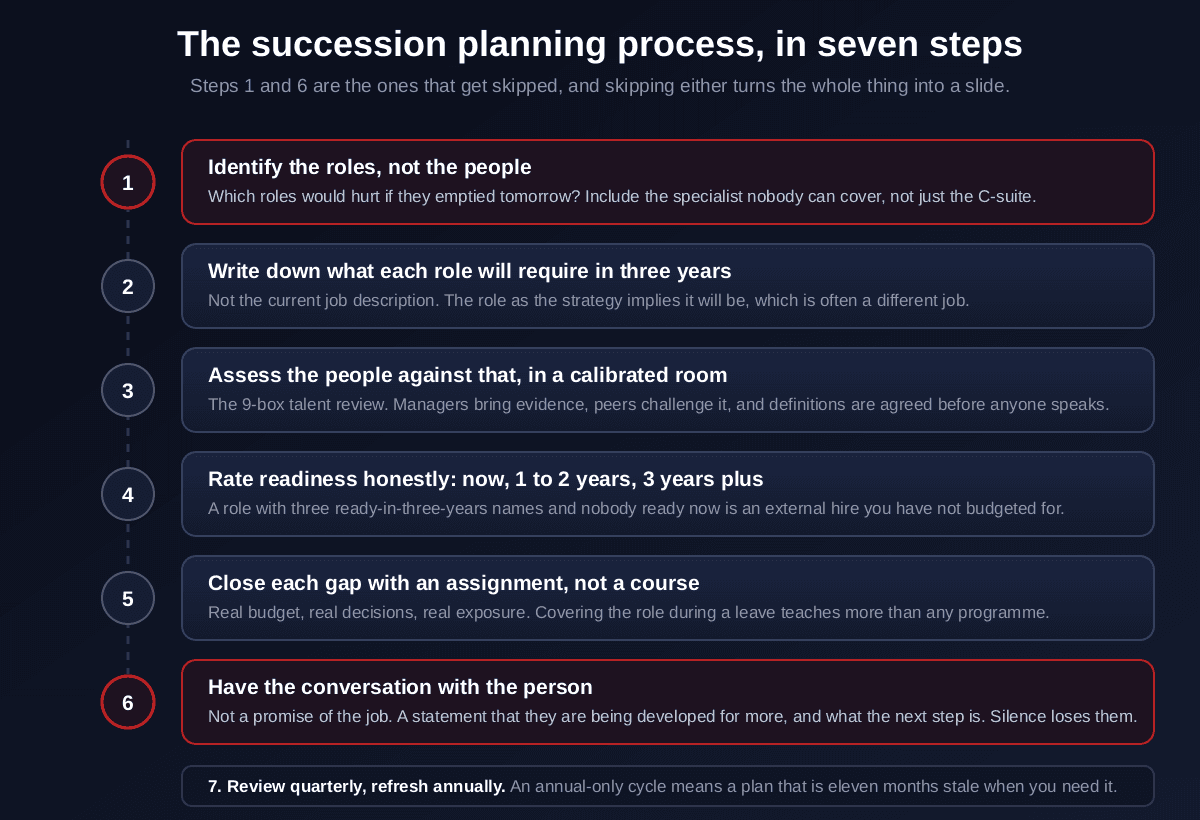
Identify the roles, not the people
Write down what each role will require in three years
Assess people against that, in a calibrated room
Rate readiness honestly
Close each gap with an assignment, not a course
Have the conversation with the person
Review quarterly, refresh annually
Readiness ratings and bench strength
Readiness bands drift upward every single review unless they are defined in writing beforehand. Left undefined, ready now quietly comes to mean well regarded, and the plan stops describing reality about eighteen months before anyone notices.
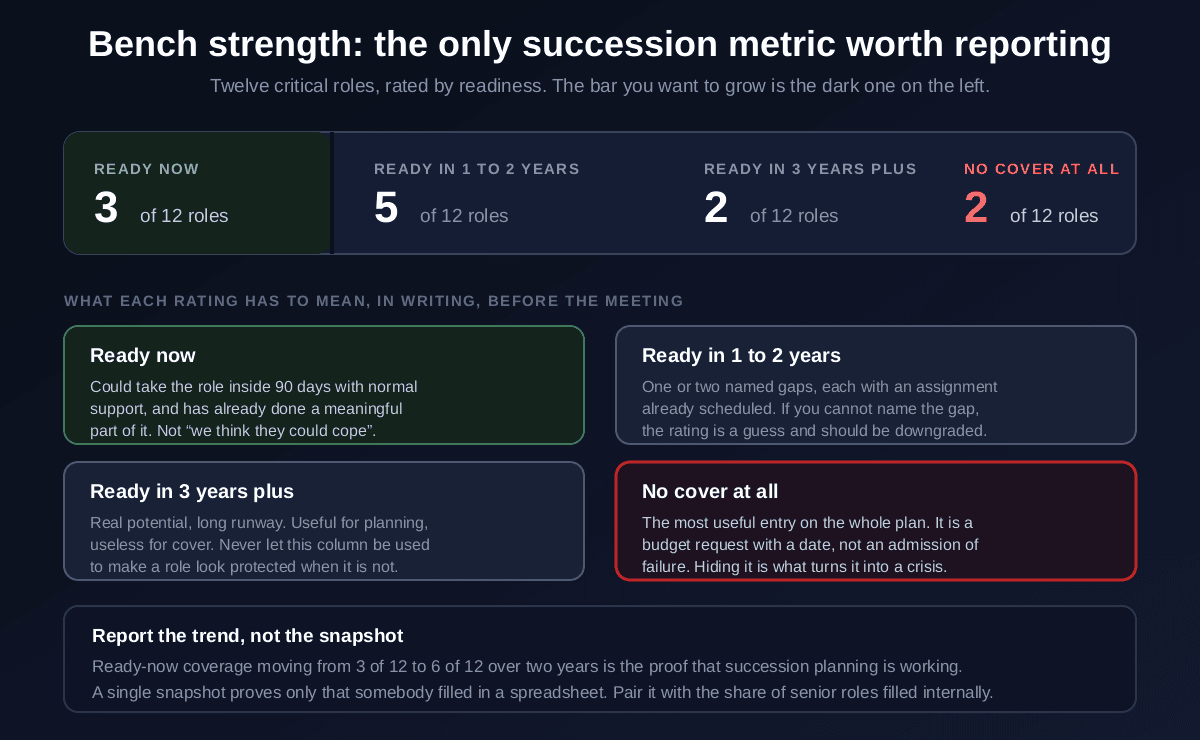
Bench strength is the share of critical roles with at least one credible internal successor, and it is the one number worth taking to a board. Three rules keep it honest.
- Express it as a fraction of roles, not a count of people. One strong candidate named against four roles is not four successors, it is a concentration risk pretending to be coverage.
- Report the trend, not the snapshot. Ready-now coverage moving from 3 of 12 to 6 of 12 over two years is evidence the process works. A single snapshot proves only that a spreadsheet got filled in.
- Publish the "no cover" count deliberately. It is the most valuable line on the sheet. It converts into a budget request today rather than a crisis in nine months, and hiding it to make the plan look complete is the single worst thing you can do with a succession process.
Pair bench strength with one outcome measure, usually the share of senior vacancies filled internally, which sits naturally alongside your other recruitment metrics and is the number that proves the plan produced something.
A succession planning template that gets used
One row per role, nine columns. Templates fail by being too elaborate, so the test for adding a column is whether a missing value in it would change a decision.
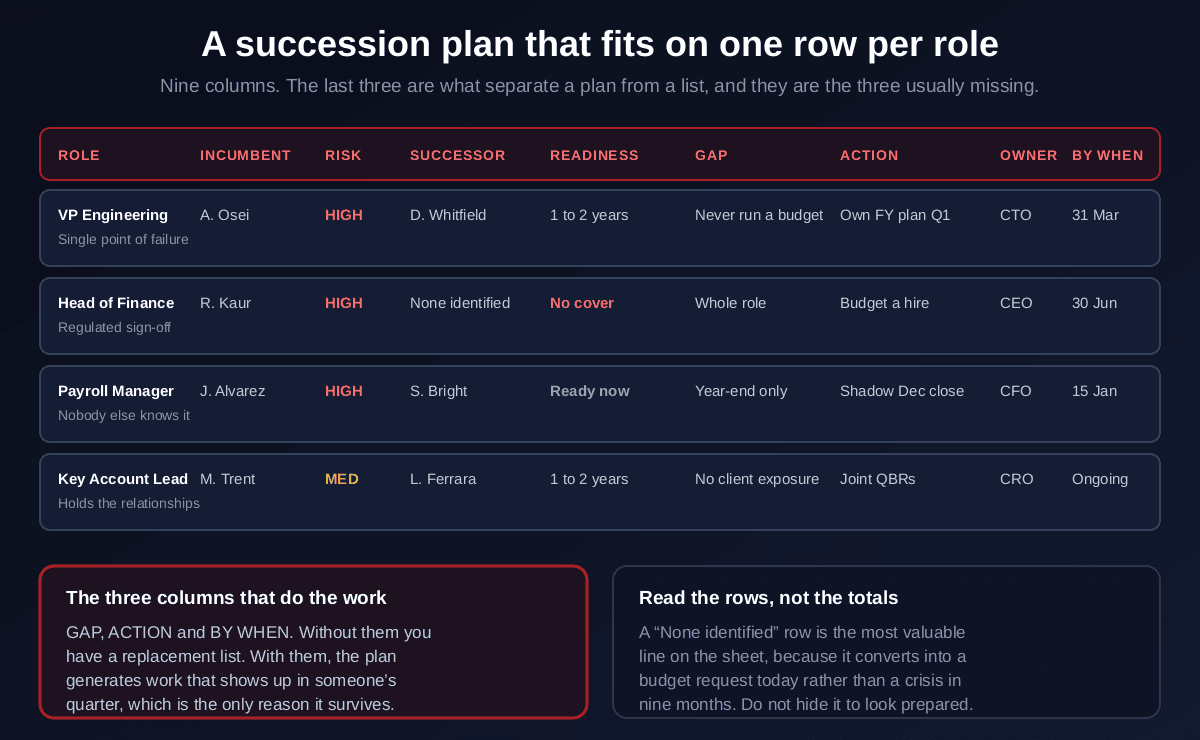
The first six columns are what everyone builds. GAP, ACTION and BY WHENare the three that almost nobody adds, and they are the entire difference between a plan and a list. They convert the document into work that appears in somebody's quarter, which is the only reason any process survives contact with a busy organisation.
Keep the emergency layer separate and short. For each critical role, one line: who holds the wheel from day one if this person is gone tomorrow, what they are authorised to decide, and where the credentials and the documentation live. That is a different question from who should eventually get the job, and merging the two is how organisations end up with neither.
How to tell someone without promising them the job
This is where most succession processes quietly die. The fear is understandable: name someone as a successor and you have created an entitlement, and if the role goes elsewhere you have manufactured a resignation.
The risk in the other direction is larger and much better evidenced by everyone's own exit data. Strong people leave because nothing visible is happening to them, and they leave without ever knowing they were on a slide. Silence does not protect you from the downside, it just relocates it somewhere you will not see it coming.
The wording that resolves the tension separates development from promise. Four sentences:
- "You are someone we are developing for bigger roles." A statement about investment, not about a vacancy.
- "Here are the two gaps I think stand between you and that." Specific, evidenced, and honest. This is also the part that makes it credible.
- "Here is the assignment that closes the first one, starting next quarter." The proof that the sentence before it was real.
- "I am not promising a specific job, because the timing depends on things neither of us controls." Said out loud, early, it protects both of you and nobody has ever resented hearing it.
Two things to avoid. Do not name a date for a role that depends on someone else resigning, because you are promising something you cannot deliver and creating an interest in a colleague's departure. And do not let it be a single conversation: an annual mention with nothing in between reads as flattery, which is why the development action and the quarterly check matter more than the announcement.
When the honest answer is 'no internal successor', the plan becomes a hire
Every succession plan produces roles with no internal cover, and those convert into external searches with a deadline attached. Upload your applicant batch and paste the job description, and Rankid scores every candidate 0 to 100 against the role's real requirements so a critical search does not turn into a resume pile. Up to 200 resumes per batch, first 5 free, no signup.
Score your applicant pool freeWhen the answer is an external hire
A succession plan that never concludes "we need to hire" is not being run honestly. Roles with no credible internal successor are normal, particularly in small companies and in functions you are building for the first time, and identifying them early is the point rather than a failure of the process.
What changes is that you are now hiring on your own timetable instead of somebody else's. That buys you:
- A budget line before the vacancy. The difference between a planned search and an emergency one is mostly whether finance heard about it first.
- A warm pipeline instead of a cold start. Twelve months of unhurried conversations, which is exactly what a talent pipeline is for.
- A screen built against the role as it will be,using the three-year requirements you wrote in step 2 rather than the outgoing incumbent's job description. Our guide to screening criteria covers how to turn those into something you can actually score against.
And when you do hire externally into a role that had internal candidates, tell them before they read it in an announcement, with the reason. Handled badly this is one of the most reliable ways to lose two people instead of filling one seat, which is a theme our guide to internal recruitment covers in more detail.
Succession planning for small businesses
Same logic, smaller scope, and considerably more acute risk, because a company of thirty people has nowhere to absorb the loss of the one person who knows how something works.
Start with three to five roles. Accept early that for several of them there is no internal successor, and treat that as the useful output it is: it tells you whether the mitigation is a hire, a documented handover, a cross-trained second person, or an outside service contract. Then prioritise documentation over development, because in a small company most key person risk is knowledge living in one head, and writing down the year-end close or the client history is faster and cheaper than growing a successor.
The one-page version that genuinely works for a small business: for each of your five most critical roles, name who covers it from day one, list the three things only the incumbent currently knows, and set a date to write each of those three down. That is not glamorous and it removes more risk per hour spent than any framework on this page.
The mistakes that hollow out a succession plan
- Limiting it to the executive team. Misses the specialists who are the real key person risks.
- Never telling the successors. The most common cause of losing the person you were counting on.
- Undefined readiness bands."Ready now" drifts into "well regarded" within two cycles.
- Confusing high performance with high potential. Promotes excellent specialists into management they did not want and are not suited to, and you lose the specialist as well.
- Closing gaps with training courses. Vocabulary, not capability. Assignments with real consequences are what develop people.
- Planning against today's job description. You will develop somebody perfectly for a role that will not exist in that form.
- One candidate named against four roles. Reads as coverage on the slide, is concentration in reality.
- Annual-only review. Eleven months stale at the moment you need it.
- Hiding the roles with no cover. To make the plan look complete, which converts a manageable gap into an emergency.
- No action between reviews. The one that subsumes all the others. At that point you are doing replacement planning and calling it succession.
Succession is a retention programme wearing a different name
The second-order effect is the one that justifies the time. A visible, functioning succession process tells everybody watching that internal progression is real here, and that is a stronger retention signal than most things a company spends money on. The reverse is equally true: filling senior roles externally while a succession plan sits in a folder teaches your strongest people exactly what the plan is worth.
It also produces information you needed regardless of whether anyone ever gets promoted. Companies that run honest talent reviews routinely discover that a whole function has no bench, that two of their best people are bored and about to leave, or that a critical process has depended on one person for six years. That is the same information you would otherwise buy expensively through an exit interview after it is too late to act, and it is closely tied to the tenure patterns in your employee turnover rate: exits after three years are usually about progression, which is precisely what succession planning is supposed to make visible.
Key takeaways
- A succession plan is a list of gaps with an owner and a date, not a list of names against jobs.
- The ten-second test: pick any name on the plan and ask what has changed for that person since the last review. Nothing means it is a replacement list.
- Scope by risk, not seniority. The payroll manager who is the only person to have closed a year-end belongs on the plan.
- Ten to fifteen roles is a maintainable scope. A sixty-role plan is a plan nobody updates.
- Use the 9-box talent review to calibrate, define potential in writing first, and attach an action to every placement.
- High performance is not high potential. Promoting a trusted specialist into management loses you the specialist.
- Define readiness bands before rating anyone, or 'ready now' drifts into 'well regarded' within two cycles.
- 'No cover at all' is the most valuable entry on the sheet. It is a budget request with a date, not a failure.
- Tell people. Develop them, name the gaps, promise no specific job. Silence loses more successors than honesty does.
- Close gaps with real assignments carrying real consequences, not with training courses.
- Report bench strength as a trend across roles, paired with the share of senior vacancies filled internally.
- Review quarterly, refresh annually. An annual-only cycle is stale exactly when you need it.
The whole discipline reduces to one question you can put to any succession plan in front of you: what work does this document create between now and the next review? If the answer is none, the names on it are a forecast rather than a plan, and forecasts do not develop anybody. Start with the roles that would genuinely hurt, be honest about the ones with no cover, and when that honesty turns into an external search, paste the three-year requirements and your applicant batch into Rankid's bulk resume screening so the shortlist is built against the role you are actually filling.
Frequently asked questions
What is succession planning?
Succession planning is the process of identifying the roles an organisation cannot afford to leave empty, working out who could fill them and when, and then closing the gap between those two things on purpose. The important word is process. A list of names against a list of jobs is not succession planning, it is replacement planning, and the difference is whether anything happens between reviews. A real succession plan produces work: a named gap for each potential successor, an assignment that closes it, an owner and a date. It also extends well beyond the executive team, because the roles that actually break an organisation are frequently mid-level and specialist, the payroll manager who is the only person who has run a year-end close, or the engineer who wrote the billing system. Note that the phrase means something quite different in a legal or financial context, where business succession planning refers to transferring ownership of a company, which is a separate discipline involving lawyers and tax advisers.
What is the difference between succession planning and replacement planning?
Replacement planning asks who we would put in this chair tomorrow. Succession planning asks what somebody would need in order to be ready for it, and then arranges for them to get it. Replacement planning is a snapshot, typically covering the top of the org chart, reviewed once a year, and assuming the organisation will still be the same shape when the vacancy arrives. Succession planning is a development programme with deadlines, covering every role whose loss would genuinely hurt, and planning against the role as the strategy implies it will be rather than as it is written today. The practical test takes ten seconds: pick any name on your plan and ask what has changed for that person since the last review. If the honest answer is nothing, you have a replacement list with a more impressive title on the cover. Replacement planning is not useless, it is genuinely valuable for emergency cover, but it builds no capability at all.
What is a 9-box grid?
The 9-box grid is a three-by-three matrix used in talent reviews that plots each employee on performance along one axis and potential along the other, producing nine categories from underperformer through core player to star. Its purpose is not the labelling, it is forcing a calibrated conversation: managers bring evidence, peers challenge the placement, and the group has to agree what the words mean before anyone is placed. The output that matters is the action attached to each box, not the box itself. High potential with low current performance usually means the wrong seat rather than the wrong person. High performance with low potential is often your most valuable specialist, and the standard mistake is promoting them out of the work they are excellent at. A box with no action attached is gossip with a grid drawn around it, which is exactly what the tool becomes in organisations that use it once a year and file the output.
How do you create a succession plan?
Seven steps. First, identify the roles rather than the people, asking which positions would genuinely hurt if they emptied tomorrow, and including specialists rather than only the C-suite. Second, write down what each of those roles will require in about three years, which is often a different job from the current description. Third, assess people against that in a calibrated room, which is what the 9-box talent review is for. Fourth, rate readiness honestly as ready now, ready in one to two years, or ready in three years or more. Fifth, close each gap with a real assignment rather than a training course, because owning a budget or covering the role during a leave teaches what no programme can. Sixth, have the conversation with the person, framed as being developed for more rather than as a promise of a specific job. Seventh, review quarterly and refresh annually. Steps one and six are the ones that get skipped, and skipping either turns the exercise back into a slide.
Which roles should be on a succession plan?
Any role where the answer to two questions is uncomfortable: what breaks if this person leaves next month, and how long would it take to restore. That test produces a list that looks nothing like an org chart. It picks up the obvious senior roles, but it also picks up the payroll manager who is the only person who has closed a year-end, the engineer who wrote the billing system, the account lead who personally holds the three largest client relationships, and the person who quietly holds a regulatory sign-off. These are key person risks, and they are more dangerous than executive vacancies precisely because nobody is watching them. A practical starting scope for a mid-sized company is ten to fifteen roles: enough to be honest about, few enough to actually maintain. A plan covering sixty roles is a plan nobody will update, and an unmaintained plan is worse than none because it creates confidence you have not earned.
How do you rate succession readiness?
Use three bands and define them in writing before anyone is rated, because undefined bands drift upward every single review. Ready now should mean this person could take the role within about 90 days with normal support and has already done a meaningful part of it, not that the group thinks they would probably cope. Ready in one to two years should require you to name one or two specific gaps, each with an assignment already scheduled; if nobody can name the gap, the rating is a guess and should be downgraded. Ready in three years or more means real potential with a long runway, which is useful for planning and useless for cover. The fourth entry is the most valuable one on the sheet: no cover at all. That is a budget request with a date attached rather than an admission of failure, and hiding it to make the plan look complete is what converts a known gap into a crisis nine months later.
What is bench strength, and how do you measure it?
Bench strength is the share of your critical roles that have at least one credible internal successor, and it is the single most useful number to report from a succession process. Express it as a fraction of roles rather than a count of people, because one strong candidate named against four different roles is not four successors, it is a concentration risk. Report the trend rather than the snapshot: ready-now coverage moving from three of twelve to six of twelve over two years is evidence that the process is doing something, while a single snapshot only proves that somebody filled in a spreadsheet. Pair it with one outcome metric, usually the share of senior vacancies filled internally, and one risk metric, the number of critical roles with no cover at all. Three numbers, tracked over time, are worth more to a board than a fifty-slide talent deck.
Should you tell someone they are on the succession plan?
Yes, and the widespread nervousness about this costs organisations more successors than it protects. The fear is that naming someone creates an entitlement, and that if the role goes elsewhere you have manufactured a resignation. The larger risk runs the other way: the strongest people leave because nothing visible is happening to them, and they leave without ever knowing they were on a slide. The wording that resolves it separates development from promise. Say that they are being developed for larger roles, name the specific gaps you are working on, name the assignment that closes the first one, and be explicit that no particular job is being promised because the timing depends on things neither of you controls. That is honest, it is motivating, and it is defensible if the role later goes to someone else. What is not defensible is silence followed by surprise when they resign.
How often should a succession plan be reviewed?
Review quarterly, refresh fully once a year. The annual-only cycle is the most common cadence and it guarantees that your plan is up to eleven months stale at the exact moment you need it, which is usually the moment somebody unexpectedly resigns. Quarterly reviews do not need to repeat the full talent review; they need to check three things only. Has anything changed about the roles, meaning new critical positions, a restructure, a role whose requirements have shifted. Has anything changed about the people, meaning departures, new joiners worth watching, and a candid update on flight risk. And did the development actions from last quarter actually happen, which is the question that keeps the whole process honest. The annual refresh is where you rerun the calibration, re-rate readiness and re-scope which roles are critical, because that list changes more than most companies expect.
Why is succession planning important?
Because the cost of an unplanned senior vacancy is paid three times over: in the external search, in the months the seat sits empty or half-covered, and in the slower ramp of someone who does not know the organisation. Internal successors start faster, cost less, and fail less often, and the act of visibly promoting from within is itself a retention mechanism for everyone watching. There is a second, less-discussed benefit. The process forces a conversation that organisations otherwise avoid, which is an honest assessment of who can actually do what. Companies that run real talent reviews discover things they needed to know anyway: that a whole function has no bench, that two of their best people are bored, that a critical process depends on one person nobody has ever backed up. Even a succession plan that never gets used pays for itself through what building it reveals.
How does succession planning work in a small business?
The same logic applies with the scope cut down, and the key person risk is usually far more acute because there are fewer people to absorb a loss. Start with three to five roles rather than fifteen. Accept that for several of them the honest answer is that no internal successor exists, which is useful information rather than a failure, because it tells you whether the mitigation is a hire, a documented handover, a cross-trained second person, or a service contract. Prioritise documentation aggressively: in a small company, most key person risk is knowledge that lives in one head, and writing down the year-end process or the client history is cheaper and faster than developing a successor. One caution about terminology. If you search this topic as a small business owner, most of what you will find is about business succession planning in the ownership sense, meaning selling or transferring the company, which is a legal and tax question for advisers rather than an HR process.
What are the most common succession planning mistakes?
Nine recur constantly. Limiting the plan to the executive team, which misses the specialists who are the real key person risks. Naming successors without ever telling them. Rating readiness with undefined bands, so that ready now quietly comes to mean well regarded. Confusing high performance with high potential, which promotes excellent specialists into management they did not want and are not suited to. Closing gaps with training courses rather than real assignments carrying real consequences. Planning against today's job description rather than what the role will require in three years. Letting one strong candidate be named against four roles, which looks like coverage and is actually concentration. Reviewing annually only, so the plan is stale when needed. And the one that undoes everything else: producing no action between reviews, at which point you are doing replacement planning and calling it succession.