Informational Interview: Questions to Ask, How to Ask, and Templates (2026)
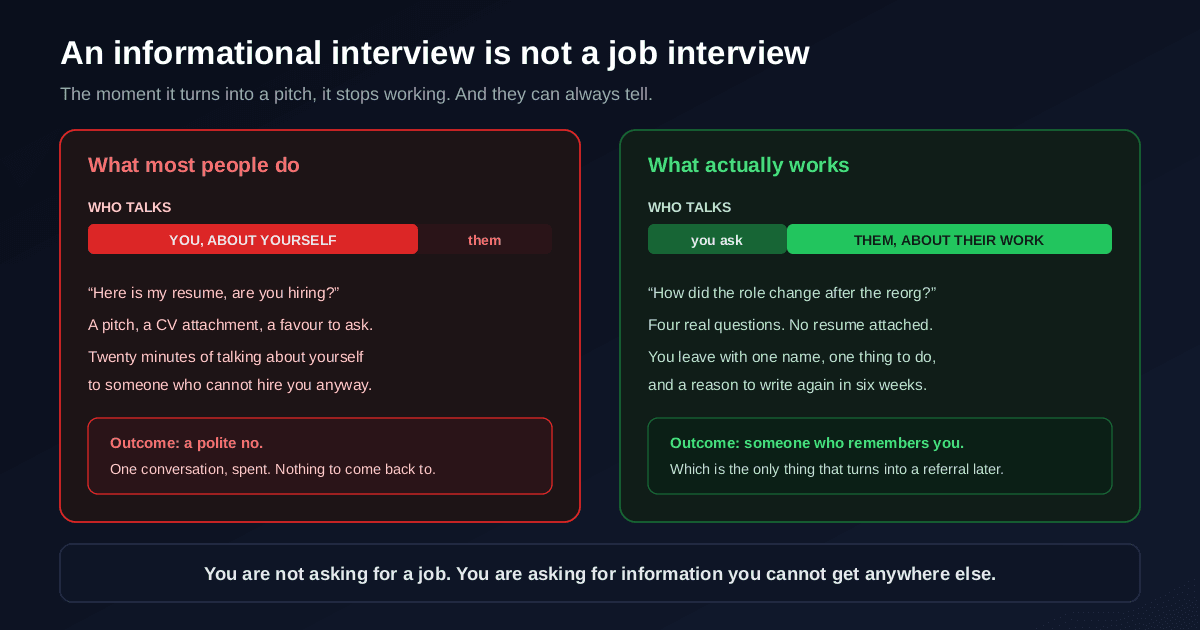
The advice to "do informational interviews" is given constantly and explained almost never, which is why most of them go the same way. You get twenty minutes with someone you admire, you spend fifteen of them talking about yourself, you ask at the end whether they know of any openings, and they say they will keep an eye out. Both of you leave politely. Nothing happens. The format is not the problem. What went wrong is that an informational interview got treated as a job interview with a friendlier name, and the two work in opposite directions.
Quick answer
Quick answer: an informational interview is a 20 to 25 minute conversation you request with someone doing work you are interested in, to learn about their role. You are not applying and they are not assessing you. You ask the questions, they do about 70% of the talking, and nobody decides anything, which is exactly why people tell you the truth. Ask for 20 minutes, name two specific questions in the request, attach no resume, and never ask for a job or a referral in the first conversation. The referral comes later, and only if you follow up properly.
What is an informational interview?
An informational interview is a short conversation you request with someone who does work you are interested in, so you can learn about their role, their team or their industry. It normally runs 20 to 25 minutes, happens over a video call or a coffee, and consists mostly of you asking questions and them answering.
The word interview is responsible for most of the failures. It makes people arrive with rehearsed answers, a resume, and the instinct to sell, none of which belong here. You will also see the same thing called an informational meeting, a career conversation, a coffee chat or a networking call, and the plainer names describe it better.
The defining feature is that nobody is making a decision. That is not a weakness of the format, it is the entire source of its value. Because there is no outcome attached, people will tell you what a job is actually like, why the last person left, what the team is struggling with, and what they would do in your position. None of that is available to you inside a hiring process, where everyone is performing for a decision.
Informational interview vs job interview
Three things are reversed, and every practical difference follows from them.
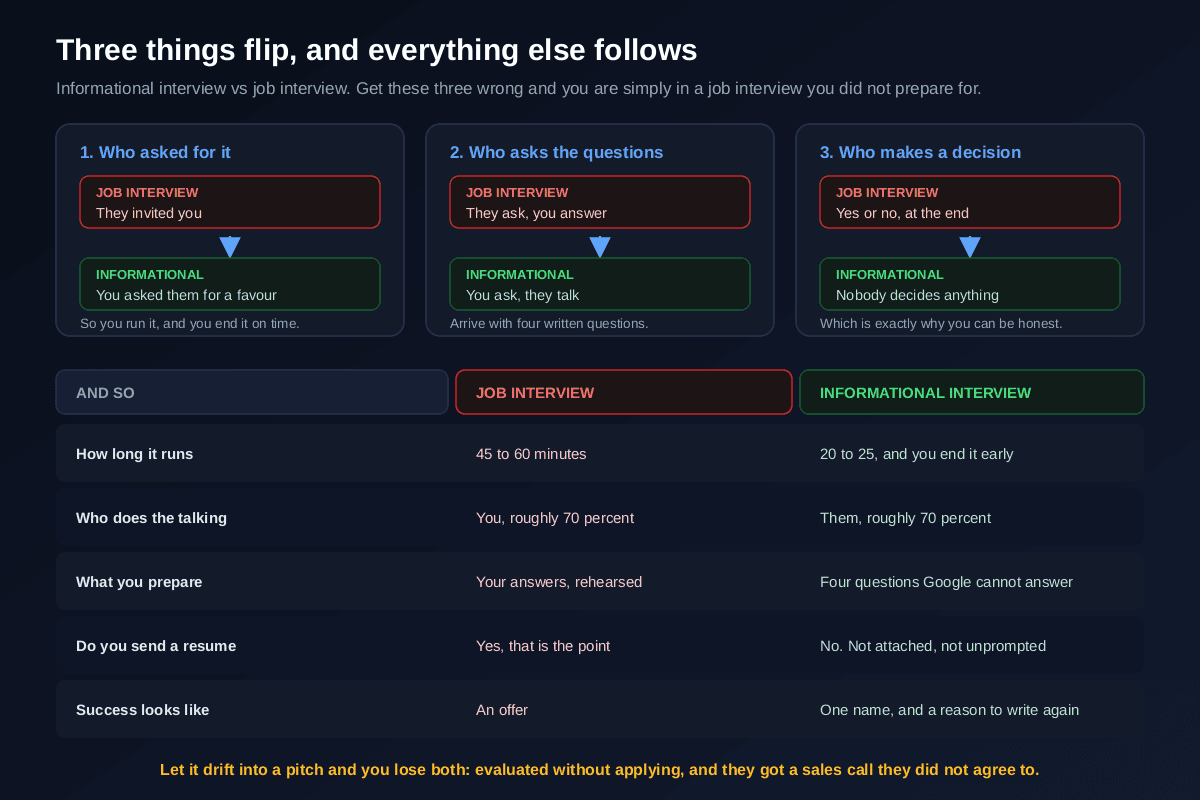
The consequences are worth stating plainly. Because you asked for the meeting, you are responsible for running it and for ending it on time. Because you ask the questions, your preparation is a list of four questions rather than a set of rehearsed stories. And because nobody decides anything, you can afford to say that you do not know whether this career is right for you, which is usually the most productive sentence available.
The drift to watch for
One hard exception. Do not request an informational interview from the hiring manager of a role you have already applied to. Whatever you call it, that conversation is a screening interview, it will be scored like one, and you will have walked into it without preparing. If you want to talk to that team, ask someone who is not in the decision.
Who should you ask for an informational interview?
Almost everyone starts at the top of the org chart, which is close to exactly backwards. Seniority is inversely correlated with both the reply rate and the usefulness of the answers, because a director three levels from the work will tell you things you could have read in a press release.
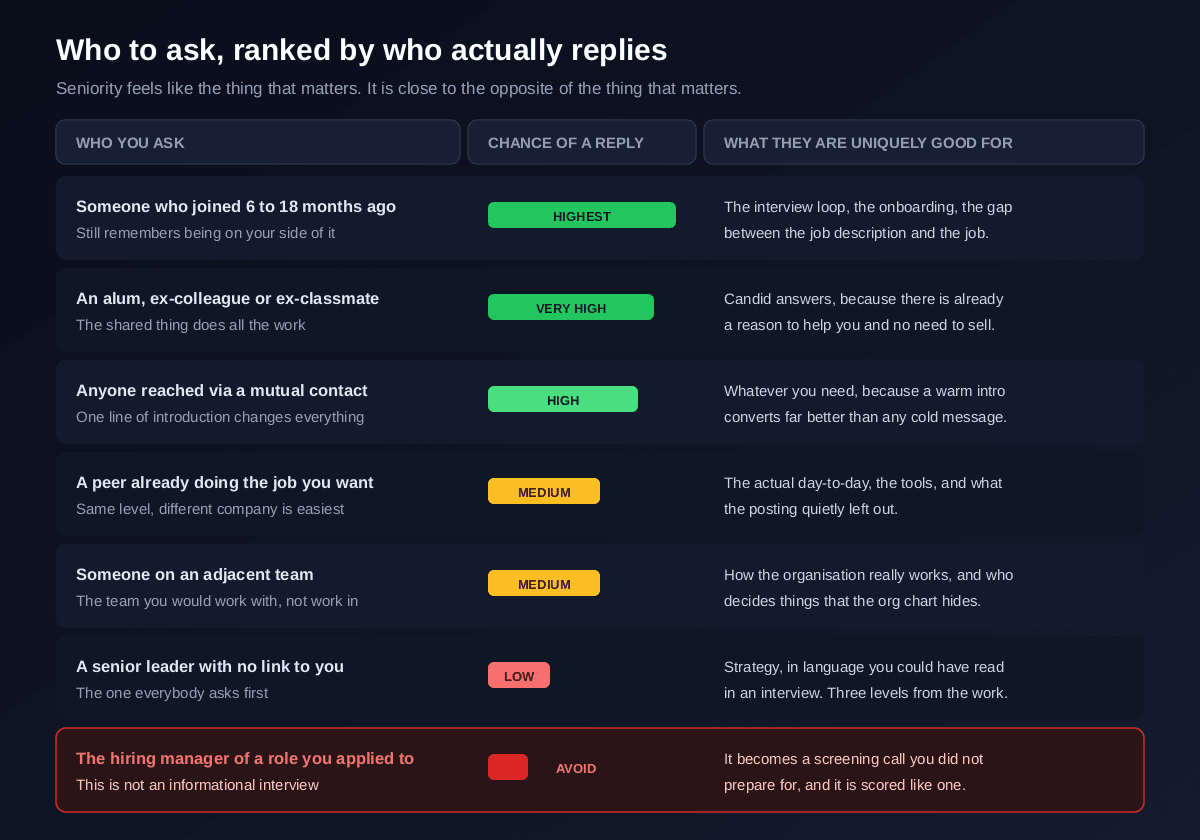
The best single target is someone who joined 6 to 18 months ago. They still remember being on your side of the process, they can describe the interview loop and the onboarding accurately, they know the gap between the job description and the job, and they are flattered rather than burdened by being asked. A director remembers none of that.
Beyond that, the thing that actually predicts a reply is a pre-existing connection: alumni from the same school, a former employer in common, or a mutual contact willing to introduce you. A warm introduction outperforms any cold message you can write, which is why the request template for asking a mutual contact matters as much as the one for asking the target. If your network is thin, making yourself findable on LinkedIn is the groundwork that makes these requests land better.
How to ask for an informational interview
The request is where this is won or lost, and it is mostly a writing problem. Around 90 words, one specific connection, two named questions, and a 20-minute ask.
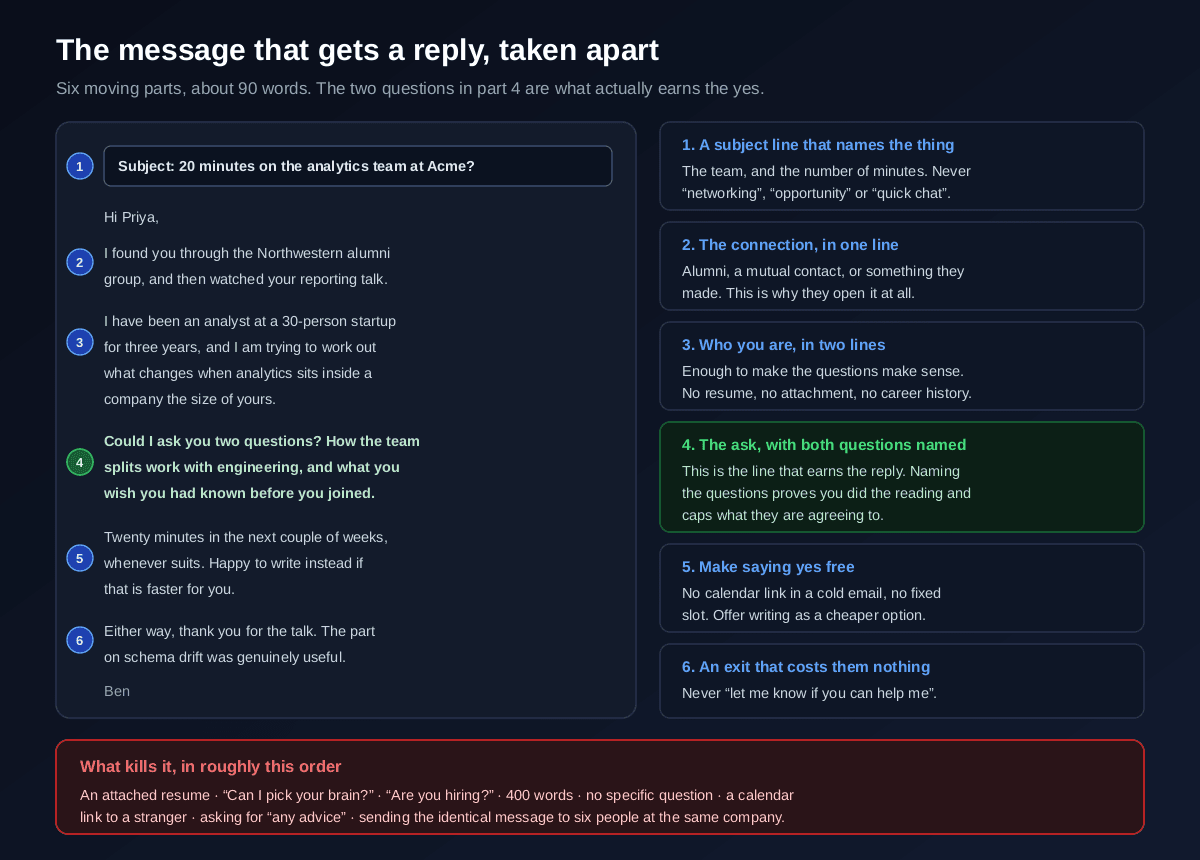
Ask for 20 minutes, not 30. Twenty fits in the gaps of a working day. Thirty requires someone to move something, and that is where requests quietly die. And name the two questions: a stranger reading "could I pick your brain about your career" cannot see the end of what they are agreeing to, whereas two concrete questions is a commitment with edges.
Template: the cold email to an alum, ex-colleague or someone whose work you saw
Subject: 20 minutes on the [team name] team at [Company]?
Hi [Name], I found you through [the specific connection: the alumni group, a mutual contact, your talk at X]. I have been a [your role] at [type of company] for [n] years, and I am trying to understand what changes when [the thing you actually want to know] happens at a company the size of yours.
Could I ask you two questions? [Question one, specific.] And [question two, specific]. Twenty minutes in the next couple of weeks, whenever suits you, and I am happy to ask in writing instead if that is faster. Either way, thank you for [the talk / the post]. The part on [specific detail] was genuinely useful.
[Your name]
Template: the LinkedIn connection request, under 300 characters
Hi [Name], fellow [school / former employer] here. I am a [role] looking at moving into [their area], and I would value 20 minutes on two things: what surprised you most in your first month, and what you would learn first if you were me. Happy to work around you. Either way, good to connect.
Keep it inside the character limit rather than sending a bare connect and following up later, because the note is the only reason a stranger accepts. If you are messaging rather than connecting, the email template above works with the greeting shortened.
Template: asking a mutual contact for the introduction
Hi [Name], a favour if it is an easy one. I am trying to learn about [area] before I apply for anything, and I noticed you are connected to [Target] at [Company]. Would you be willing to introduce us, or forward the note below? Totally fine if you would rather not, and no need to explain.
Then paste your two-question request underneath, already written, so the introduction costs them one click rather than a drafting job. This is the highest-converting version of the whole exercise, and it is the one people skip because it feels like asking two favours instead of one. It is not: you are asking for a forward.
Template: the single nudge, 7 to 10 days later
Hi [Name], I know this is easy to miss in a busy inbox, so just floating my note from last week in case it is useful to see again. Still very happy to work around whatever is easiest, and equally happy to hear that now is not a good time.
One nudge, then stop. A second nudge does not work and a third is remembered for the wrong reason. Silence on a cold request is not a rejection of you, it is an inbox.
Three phrases to cut
What questions should you ask?
Four questions, chosen for what you actually want out of the conversation, each one something a public page could not answer. Four plus follow-ups fills twenty minutes comfortably. Fourteen makes it a survey.
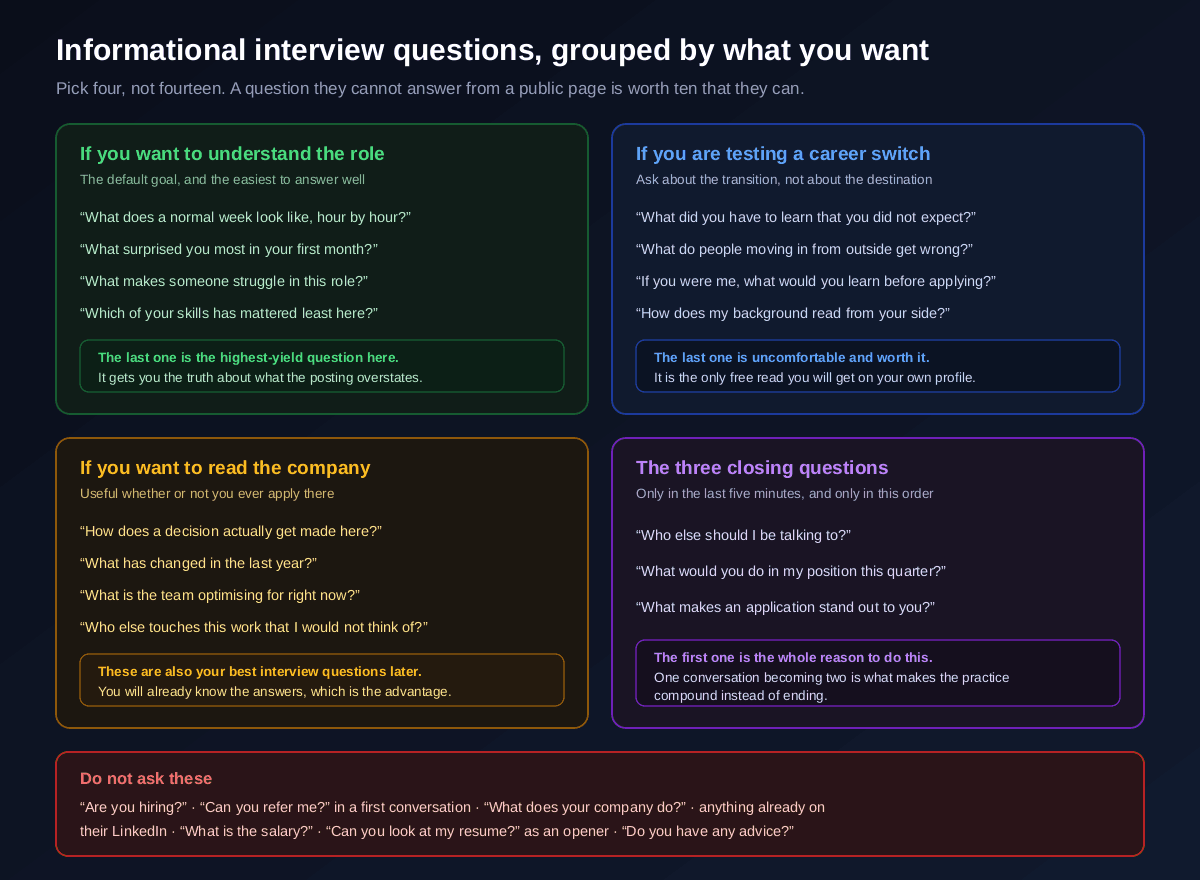
Two questions on that map are worth singling out. "Which of your skills has mattered least here?" is the most efficient question in the set, because it inverts the usual flattering framing and gets you the truth about which requirements in the job posting are decoration. And "how does my background read from your side?" is uncomfortable to ask and the only free, honest read you will ever get on your own profile, which is worth more than it costs. If the answer surprises you, that is information for your resume summary and for how you frame yourself in a career change resume.
Then there is the question that makes the whole practice compound: "who else should I be talking to?" Ask it every single time. It is the difference between doing six cold outreach cycles and doing one, then following a chain of warm introductions. If they name someone, ask whether you may mention their name when you write.
Everything you learn here also feeds directly back into hiring processes. questions to ask in an interview works far better when you already know what the honest answers sound like, and the STAR method is easier to apply when someone has told you what the job actually rewards.
How to run the 25 minutes
You asked for the meeting, so you chair it. Having a shape in mind is the difference between a conversation that earns a second one and twenty minutes of pleasant drift.
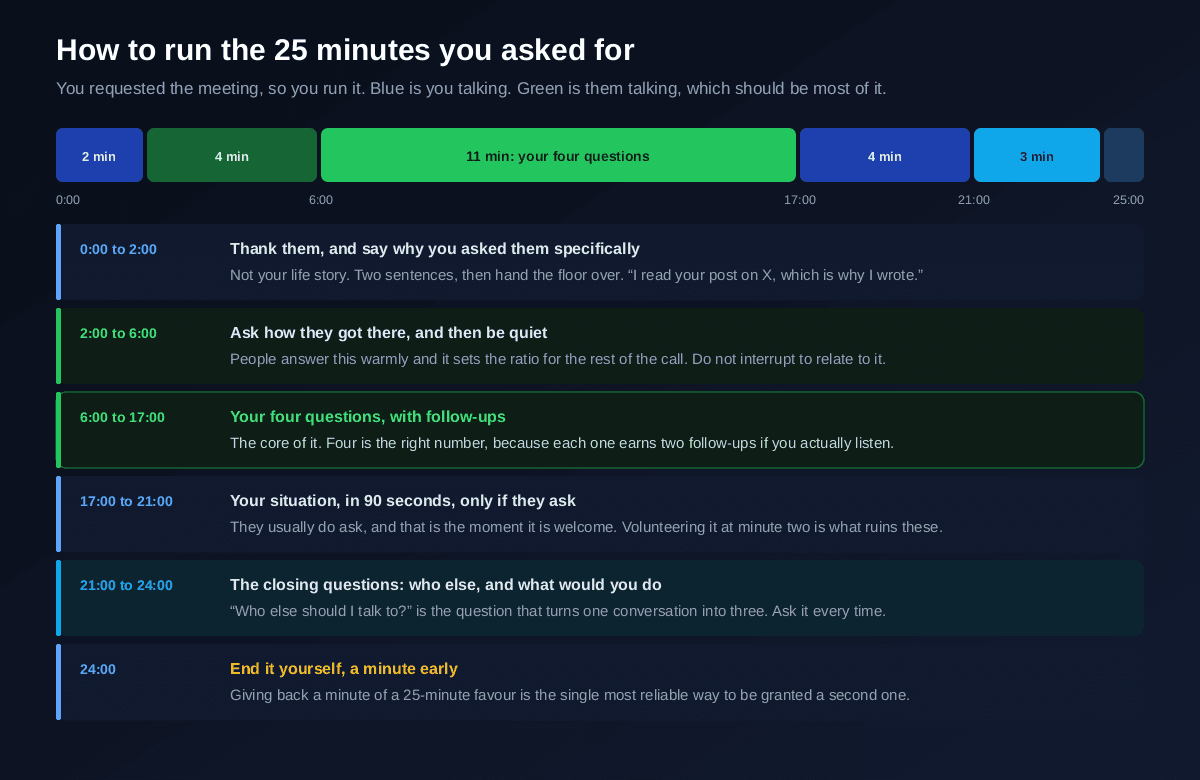
The single most counterintuitive line on that agenda is your own situation goes at minute 17, and only if they ask. They usually do ask, and at that point it is genuinely welcome, because they have context for it and they raised it. Volunteering the same ninety seconds at minute two is what turns a career conversation into a pitch, and it is the most common way these get wasted.
The second is ending early. Close it yourself at around 24 minutes, even mid-flow. Handing back a minute of a favour you requested is the most reliable way to be granted another one. Running ten minutes over is remembered as the meeting that ate someone's lunch, regardless of how good it was.
On the practical side: take notes, out loud if it is a video call, since "let me write that down" is a compliment. Do not screen-share anything. Do not record it. And keep the camera basics right, since the whole thing happens on a small window on someone else's screen: the setup advice in the one-way video interview guide applies here exactly, and preparing for a job interview covers the research you should do first, which for this purpose is about half as much.
The follow-up that actually turns into a referral
This is the part that determines whether the conversation was worth having, and it is where nearly everyone stops. One thank you note is not a relationship. Two deposits before any withdrawal is.
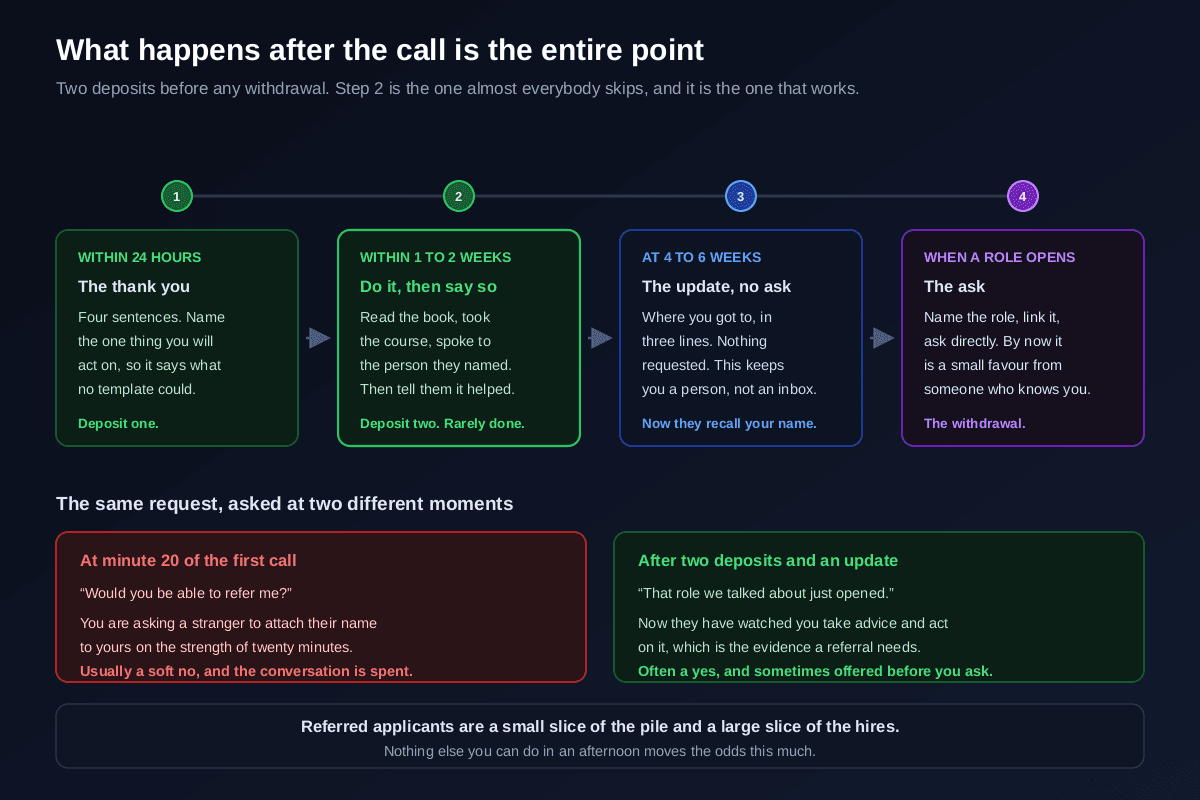
The second message is the one that works, and hardly anyone sends it. If they recommended a book, a course, a community or a person, do the thing, then send one line saying it was useful. It costs you a sentence and it changes what you are in their memory: not someone who asked for something, but someone who takes advice and acts on it. That is precisely the quality a person needs to believe about you before they will attach their own name to yours.
Template: the thank you, within 24 hours
Subject: Thank you, [topic] chat
Hi [Name], thank you for the twenty minutes. The most useful thing you said was [the specific thing], which I had genuinely not considered. I am going to [the concrete action] because of it, and I will let you know how it goes. Thanks again for the time.
Four sentences. No resume, no new question, no request. The specificity is the whole point: a note that could have been sent to anybody reads worse than no note at all. The same principle as a thank you email after an interview, applied to a favour rather than to an assessment.
Template: the referral ask, once a real role exists
Hi [Name], you probably remember we spoke in [month] about [topic]. Since then I [the thing you did, briefly]. [Company] has just posted [exact role title, linked], which is close to what we talked about. Would you be comfortable referring me, or pointing me at the right person? Completely fine if not, and either way I appreciated the earlier conversation.
Name the role and link it. A vague "let me know if anything comes up" puts the work on them and gets forgotten inside a day. And make declining easy, because a reluctant referral carries almost no weight inside a company anyway.
Do informational interviews actually lead to jobs?
Indirectly, and reliably enough to be worth the time, but effectively never from the conversation itself. Nobody ends a twenty-minute chat and invents a role. Three slower mechanisms do the work.
- Your applications get better. Knowing what a job actually involves changes which achievements you lead with, which is the same work as tailoring your resume to a job description, except you now have information the posting does not contain.
- You hear about roles earlier. Often before they are posted, and occasionally instead of them being posted, which is also a reasonable defence against ghost jobs, since a person will tell you whether a requisition is real.
- You acquire people who will refer you. Referred applicants are a small share of the application pile and a disproportionately large share of the hires at most companies. Converting cold applications into referred ones is among the highest-leverage moves available to a job seeker.
A caution worth stating, because it is a genuine failure mode: talking to people feels productive and carries no rejection risk, which makes it a comfortable substitute for applying. One conversation a week alongside your applications is a strategy. Thirty conversations and four applications is avoidance. If applications are the part that is not working, why you are not getting interviews is the more useful diagnosis.
Find out how your resume reads before you ask anyone to vouch for it
An informational interview tells you what a job actually wants. Rankid tells you whether your resume shows it. Paste in your resume and the job description for a 0-100 match score, the requirements you have evidenced, and the keywords you are missing. One check free, no signup.
Check your resume freeMistakes that waste the conversation
- Asking for a job. The fastest way to end a promising relationship. They cannot help, and now they know what the conversation was for.
- Asking for a referral in the first conversation. You are asking a near-stranger to stake their reputation on twenty minutes of evidence.
- Attaching a resume. Converts a chat into an application and makes the request much larger than it looked.
- Doing most of the talking. If you spoke for more than a third of it, you paid for information and then talked over it.
- Asking what their company does. Or anything else on their LinkedIn. It reads as not having done the reading, because it is.
- Asking about salary. That belongs in a hiring process. Keep it for the negotiation, where it is legitimate.
- Running over time. The one thing that is remembered with certainty afterwards.
- Messaging six people at one company in one week. They talk to each other, and a mail merge is obvious from the inside.
- Never following up. The most common mistake of all, and the one that wastes an otherwise good conversation entirely.
If someone asks you: why saying yes is worth 20 minutes
Most of these requests land on people who are not recruiters, and the default instinct is to feel vaguely imposed upon. It is worth twenty minutes for reasons that are not purely altruistic.
Every one of these conversations is a low-cost addition to your talent pipeline, and it is the cheapest form of candidate sourcing that exists: someone who has already chosen to learn about your team, before you have paid for a single job advert. People who have had one of these conversations apply better, arrive better informed, and self-select out earlier when the role is wrong, which saves your team the interview slots. It is also the main way internal moves and referrals actually start.
Three rules keep it sustainable. Cap it at 20 minutes and hold the cap. Be honest rather than promotional, because a candidate who joins on the strength of a sales pitch leaves within the year. And do not let it become a shadow interview: if you would consider hiring them, say so and route them into the real process, where they get prepared for, scored consistently, and treated like every other candidate. the hiring process is where that belongs, and running these chats as unofficial screens is a candidate experience problem waiting to happen.
Frequently asked questions
What is an informational interview?
An informational interview is a short conversation you request with someone who does work you are interested in, to learn about their role, their team or their industry. You are not applying for anything and they are not assessing you. It normally runs 20 to 25 minutes, happens by video call or over coffee, and consists mostly of you asking questions and them talking. The name causes most of the trouble, because the word interview makes people arrive with rehearsed answers and a resume. Nothing about the format works that way. Nobody makes a decision at the end of it, which is precisely what makes it useful: people will tell you things about a job, a company or a career path that they would never say in a hiring process, because there is no hiring process running. You will also see it called an informational meeting, a career conversation, a coffee chat, or a networking call. They are all the same thing.
How do you ask for an informational interview?
Send a short message, name a specific connection, name two specific questions, and ask for 20 minutes. Around 90 words is right, and every element earns its place. Lead with why you are writing to this person rather than to anyone else: a shared school, a former employer, a mutual contact, or something they published. Say who you are in two lines, only enough to make your questions make sense. Then make the ask concrete by naming the actual questions you want to ask, because that is the line that converts. A stranger reading 'could I pick your brain about your career' has no idea what they are agreeing to, whereas 'how your team splits work with engineering, and what you wish you had known before joining' is a twenty-minute commitment they can see the end of. Close by making it free to say yes: no calendar link in a cold email, no fixed slot, and an offer to answer in writing instead if that is easier. Do not attach a resume, do not mention open roles, and do not use the phrase pick your brain.
What questions should you ask in an informational interview?
Pick four questions that a public page could not answer, and group them by what you actually want. To understand a role, the highest-yield questions are what a normal week looks like hour by hour, what surprised them in their first month, what makes someone struggle in the job, and which of their skills has mattered least, which is the one that gets you the truth about what job postings overstate. To test a career switch, ask what they had to learn that they did not expect, what people moving in from outside typically get wrong, what they would learn before applying if they were you, and how your background reads from their side of the table. To read a company, ask how decisions actually get made, what has changed in the last year, and what the team is optimising for right now. Then close with the two that make the practice compound: who else should I be talking to, and what would you do in my position over the next quarter. Four questions plus follow-ups fills twenty minutes comfortably. Fourteen questions turns the conversation into a survey.
How long should an informational interview be?
Ask for 20 minutes, plan for 25, and end it yourself a minute early. Asking for twenty rather than thirty measurably improves your chances of a yes, because twenty minutes fits in the gaps of a normal working day and thirty requires someone to move something. In practice a good conversation often runs past the twenty, and that is fine as long as they are the one extending it: if they say they have time, take it, but never assume it. The part people get wrong is the ending. Watch the clock and close it yourself at around 24 minutes, even mid-flow, with a clear thank you and a specific next step. Handing back a minute of a favour you asked for is the single most reliable way to be granted a second one. Running ten minutes over, by contrast, is remembered as the meeting that ate someone's lunch break, no matter how good the conversation was.
Is an informational interview a job interview?
No, and the moment it becomes one you lose the advantage of both. Three things are reversed. You requested the meeting rather than being invited, so you run it and you end it. You ask the questions rather than answering them, so the preparation you need is a list of questions rather than a set of rehearsed stories. And nobody makes a decision at the end, which is what allows both of you to be honest. The trap is drift: you start pitching, they start evaluating, and now you are in an unstructured job interview you did not prepare for, with someone who was expecting a chat. If they are genuinely interested and start probing your experience, that is a good sign rather than a problem, but let them steer it there. There is one exception worth naming clearly: never request an informational interview from the hiring manager of a role you have already applied to. That is not a career conversation, it is an unscheduled screening call, and it will be remembered as one.
What should you not do in an informational interview?
Do not ask for a job, and do not ask for a referral in the first conversation. Those two account for most of the failures. Beyond that: do not talk for most of the time, since the ratio should be roughly seventy percent them, and do not volunteer your career history at minute two, because it is welcome at minute eighteen when they ask and intrusive before that. Do not attach a resume or send one unprompted. Do not ask anything answerable from their LinkedIn profile or the company's about page, which reads as not having done the reading. Do not ask about salary, which belongs in a hiring process rather than in a favour. Do not use the phrase pick your brain. Do not run over time. And do not send the same message to six people at the same company in the same week, because they talk to each other and it converts a genuine request into a mail merge.
Should you send your resume before an informational interview?
No, not unless they ask for it. An attached resume converts the request from a conversation into an application, which is the exact transformation you are trying to avoid, and it is the single most common reason a request gets a polite no. It changes what the other person thinks is being asked of them: a chat about their work costs twenty minutes, while a resume implies an evaluation, a judgment and possibly an internal referral, which is a much larger favour to accept from a stranger. Say who you are in two lines of the message instead, which is all the context your questions need. If the conversation goes well, they will frequently ask for your resume themselves, sometimes on the call and sometimes in reply to your thank you note. That is the moment to send it, because at that point it is requested rather than imposed, and it will actually be read.
Do informational interviews lead to jobs?
Indirectly, and reliably enough to be worth the effort, but almost never from the conversation itself. Nobody hangs up an informational interview and creates a job. What happens is slower and more mechanical: you learn what the role actually involves, which makes your applications and interview answers materially better; you find out about roles before or as they are posted; and you acquire people who will refer you, which is the part that moves the numbers most. Referred applicants make up a small share of applications and a disproportionately large share of hires at most companies, so converting cold applications into referred ones is one of the highest-leverage things a job seeker can do. But it is a sequence, not an event. The referral comes weeks later, after you have thanked them, acted on something they told you, and sent one update. Treating a first conversation as a referral request is what collapses the whole thing.
How do you end an informational interview?
Close it yourself, on time, with two questions and a next step. At around the 21-minute mark, say that you want to respect the time you asked for, then ask the two closing questions: who else should I be talking to, and what would you do in my position over the next few months. The first is the one that makes this practice compound, because it turns one conversation into two or three and gives you a warm introduction instead of another cold message. Ask it every single time, and if they name someone, ask whether they would mind you mentioning their name when you write. Then thank them specifically rather than generally, referencing the one thing they said that changed your thinking, and say what you are going to do about it. That sentence is what makes your thank you note easy to write and impossible to mistake for a template. Then end the call, even if there is a minute left on the clock.
What do you send after an informational interview?
A four-sentence thank you within 24 hours, and then, one to two weeks later, proof that you acted on something. The thank you is the easy half: thank them for the time, name the single most useful thing they said, say what you are going to do because of it, and stop. Do not attach a resume, do not ask a new question, and do not add a request. The second message is the one almost nobody sends, and it is the one that works. If they recommended a book, a course, a community or a person, do it, then send one line telling them it was useful. That message costs you a sentence and it changes what you are in their memory, from someone who asked for something into someone who takes advice and acts on it, which happens to be the exact quality a person needs to believe before they will attach their name to yours. A third, optional message at four to six weeks with an update and no ask keeps the relationship alive without spending it.
When can you ask for a referral after an informational interview?
Once a specific role exists, and after you have made at least two deposits. The sequence that works is: thank you within a day, evidence that you acted on their advice within a fortnight, an update at four to six weeks, and then, when an actual role opens, a direct ask that names the role and links to it. By that point you are not a stranger asking for their professional reputation, you are someone whose progress they have watched, and the ask is small. Asked at minute twenty of a first conversation, the same request is a large favour from someone with no evidence about you, and the honest answer is usually a soft no. Two details matter when you do ask. Name the specific role and link it, because a general 'let me know if anything comes up' puts the work on them and gets forgotten. And make it easy to decline, since a referral that someone gives reluctantly is worth very little inside the company anyway.
What do you wear to an informational interview?
One notch below what you would wear to an interview at that company, and never more formal than the person you are meeting. For a video call that generally means a collar or a plain jumper, in a mid-tone solid colour that behaves on a webcam. For coffee, dress as you would for a normal day in the industry you are asking about. The reasoning is not about respect, it is about signalling. Turning up to a casual twenty-minute chat in a full suit tells the other person you think this is an interview, which invites them to behave like an interviewer, and that is the one dynamic you were trying to avoid. Being visibly underdressed does the opposite kind of damage. Aim for looking like someone who could plausibly work there next month. And treat the camera basics as non-negotiable regardless of the clothes: light on your face rather than behind your head, camera at eye level, and headphones with a microphone.
How many informational interviews should you do?
For an active job search or a career change, aim for one a week and roughly six to ten in a cluster. That is enough to hear the same thing three times, which is the point at which you can tell a pattern from one person's opinion, and it is sustainable alongside actually applying for things. Fewer than about four and you are still working from anecdotes. Doing thirty is usually avoidance: talking to people feels productive and carries no rejection risk, which makes it a comfortable substitute for submitting applications, and it is a trap worth naming. Two structural notes. Send more requests than you need, because a reasonable reply rate on cold messages is well under half even when the message is good. And front-load the easy ones: alumni, former colleagues and warm introductions reply far more often than strangers, so start there while you get better at the conversation itself.
What if nobody replies to your informational interview requests?
Assume the message is the problem before assuming people are unhelpful, because in practice it usually is. Check five things in order. Are you asking people with a genuine connection to you, such as alumni, former colleagues or mutual contacts, rather than senior strangers? Are you writing to people close to the work, since someone who joined 6 to 18 months ago replies far more often and knows more that is useful to you than a director three levels up? Does your message name two specific questions, or does it ask vaguely for advice? Is it under about 120 words? And does it avoid the three things that reliably kill a request: an attached resume, any mention of open roles, and the phrase pick your brain? Then send one polite nudge after 7 to 10 days and no more, because a second nudge does not work and a third is remembered. Finally, go through mutual connections wherever you can: one line of introduction from someone they trust outperforms any cold message you can write.
Key takeaways
- An informational interview is a 20 to 25 minute conversation about someone's work. You are not applying, they are not assessing you, and nobody decides anything, which is exactly why people tell you the truth.
- Three things are reversed from a job interview: you asked for it, you ask the questions, and there is no decision. So you run it, you prepare questions rather than answers, and you can afford to be honest.
- Never request one from the hiring manager of a role you already applied to. That is a screening interview, and it will be scored like one.
- Ask people close to the work, not senior people. Someone who joined 6 to 18 months ago has the highest reply rate and the most useful detail per minute.
- A pre-existing connection predicts a reply better than anything else. Alumni, ex-colleagues and warm introductions convert far better than cold messages to strangers.
- In the request: about 90 words, one specific connection, two named questions, 20 minutes not 30, no resume attached, no mention of open roles, and never 'pick your brain'.
- Naming the two questions is the line that earns the reply, because it caps what the other person is agreeing to.
- Prepare four questions a public page could not answer. 'Which of your skills has mattered least here?' is the most efficient one in the set.
- Ask 'who else should I be talking to?' every single time. It is what turns one cold outreach into a chain of warm introductions.
- Your own situation belongs at minute 17, and only if they ask. Volunteering it at minute two is what turns a conversation into a pitch.
- End it yourself a minute early. Handing back time you asked for is the most reliable way to be granted more of it.
- Follow up twice before you ever ask for anything: a four-sentence thank you within 24 hours, then proof you acted on their advice within a fortnight. The second message is the one almost nobody sends.
- Ask for a referral only once a specific role exists, and name it with a link. Asked at minute 20 of the first call, the same request gets a soft no.
- One conversation a week alongside your applications is a strategy. Thirty conversations and four applications is avoidance with a productive feeling attached.
Frequently asked questions
What is an informational interview?
An informational interview is a short conversation you request with someone who does work you are interested in, to learn about their role, their team or their industry. You are not applying for anything and they are not assessing you. It normally runs 20 to 25 minutes, happens by video call or over coffee, and consists mostly of you asking questions and them talking. The name causes most of the trouble, because the word interview makes people arrive with rehearsed answers and a resume. Nothing about the format works that way. Nobody makes a decision at the end of it, which is precisely what makes it useful: people will tell you things about a job, a company or a career path that they would never say in a hiring process, because there is no hiring process running. You will also see it called an informational meeting, a career conversation, a coffee chat, or a networking call. They are all the same thing.
How do you ask for an informational interview?
Send a short message, name a specific connection, name two specific questions, and ask for 20 minutes. Around 90 words is right, and every element earns its place. Lead with why you are writing to this person rather than to anyone else: a shared school, a former employer, a mutual contact, or something they published. Say who you are in two lines, only enough to make your questions make sense. Then make the ask concrete by naming the actual questions you want to ask, because that is the line that converts. A stranger reading 'could I pick your brain about your career' has no idea what they are agreeing to, whereas 'how your team splits work with engineering, and what you wish you had known before joining' is a twenty-minute commitment they can see the end of. Close by making it free to say yes: no calendar link in a cold email, no fixed slot, and an offer to answer in writing instead if that is easier. Do not attach a resume, do not mention open roles, and do not use the phrase pick your brain.
What questions should you ask in an informational interview?
Pick four questions that a public page could not answer, and group them by what you actually want. To understand a role, the highest-yield questions are what a normal week looks like hour by hour, what surprised them in their first month, what makes someone struggle in the job, and which of their skills has mattered least, which is the one that gets you the truth about what job postings overstate. To test a career switch, ask what they had to learn that they did not expect, what people moving in from outside typically get wrong, what they would learn before applying if they were you, and how your background reads from their side of the table. To read a company, ask how decisions actually get made, what has changed in the last year, and what the team is optimising for right now. Then close with the two that make the practice compound: who else should I be talking to, and what would you do in my position over the next quarter. Four questions plus follow-ups fills twenty minutes comfortably. Fourteen questions turns the conversation into a survey.
How long should an informational interview be?
Ask for 20 minutes, plan for 25, and end it yourself a minute early. Asking for twenty rather than thirty measurably improves your chances of a yes, because twenty minutes fits in the gaps of a normal working day and thirty requires someone to move something. In practice a good conversation often runs past the twenty, and that is fine as long as they are the one extending it: if they say they have time, take it, but never assume it. The part people get wrong is the ending. Watch the clock and close it yourself at around 24 minutes, even mid-flow, with a clear thank you and a specific next step. Handing back a minute of a favour you asked for is the single most reliable way to be granted a second one. Running ten minutes over, by contrast, is remembered as the meeting that ate someone's lunch break, no matter how good the conversation was.
Is an informational interview a job interview?
No, and the moment it becomes one you lose the advantage of both. Three things are reversed. You requested the meeting rather than being invited, so you run it and you end it. You ask the questions rather than answering them, so the preparation you need is a list of questions rather than a set of rehearsed stories. And nobody makes a decision at the end, which is what allows both of you to be honest. The trap is drift: you start pitching, they start evaluating, and now you are in an unstructured job interview you did not prepare for, with someone who was expecting a chat. If they are genuinely interested and start probing your experience, that is a good sign rather than a problem, but let them steer it there. There is one exception worth naming clearly: never request an informational interview from the hiring manager of a role you have already applied to. That is not a career conversation, it is an unscheduled screening call, and it will be remembered as one.
What should you not do in an informational interview?
Do not ask for a job, and do not ask for a referral in the first conversation. Those two account for most of the failures. Beyond that: do not talk for most of the time, since the ratio should be roughly seventy percent them, and do not volunteer your career history at minute two, because it is welcome at minute eighteen when they ask and intrusive before that. Do not attach a resume or send one unprompted. Do not ask anything answerable from their LinkedIn profile or the company's about page, which reads as not having done the reading. Do not ask about salary, which belongs in a hiring process rather than in a favour. Do not use the phrase pick your brain. Do not run over time. And do not send the same message to six people at the same company in the same week, because they talk to each other and it converts a genuine request into a mail merge.
Should you send your resume before an informational interview?
No, not unless they ask for it. An attached resume converts the request from a conversation into an application, which is the exact transformation you are trying to avoid, and it is the single most common reason a request gets a polite no. It changes what the other person thinks is being asked of them: a chat about their work costs twenty minutes, while a resume implies an evaluation, a judgment and possibly an internal referral, which is a much larger favour to accept from a stranger. Say who you are in two lines of the message instead, which is all the context your questions need. If the conversation goes well, they will frequently ask for your resume themselves, sometimes on the call and sometimes in reply to your thank you note. That is the moment to send it, because at that point it is requested rather than imposed, and it will actually be read.
Do informational interviews lead to jobs?
Indirectly, and reliably enough to be worth the effort, but almost never from the conversation itself. Nobody hangs up an informational interview and creates a job. What happens is slower and more mechanical: you learn what the role actually involves, which makes your applications and interview answers materially better; you find out about roles before or as they are posted; and you acquire people who will refer you, which is the part that moves the numbers most. Referred applicants make up a small share of applications and a disproportionately large share of hires at most companies, so converting cold applications into referred ones is one of the highest-leverage things a job seeker can do. But it is a sequence, not an event. The referral comes weeks later, after you have thanked them, acted on something they told you, and sent one update. Treating a first conversation as a referral request is what collapses the whole thing.
How do you end an informational interview?
Close it yourself, on time, with two questions and a next step. At around the 21-minute mark, say that you want to respect the time you asked for, then ask the two closing questions: who else should I be talking to, and what would you do in my position over the next few months. The first is the one that makes this practice compound, because it turns one conversation into two or three and gives you a warm introduction instead of another cold message. Ask it every single time, and if they name someone, ask whether they would mind you mentioning their name when you write. Then thank them specifically rather than generally, referencing the one thing they said that changed your thinking, and say what you are going to do about it. That sentence is what makes your thank you note easy to write and impossible to mistake for a template. Then end the call, even if there is a minute left on the clock.
What do you send after an informational interview?
A four-sentence thank you within 24 hours, and then, one to two weeks later, proof that you acted on something. The thank you is the easy half: thank them for the time, name the single most useful thing they said, say what you are going to do because of it, and stop. Do not attach a resume, do not ask a new question, and do not add a request. The second message is the one almost nobody sends, and it is the one that works. If they recommended a book, a course, a community or a person, do it, then send one line telling them it was useful. That message costs you a sentence and it changes what you are in their memory, from someone who asked for something into someone who takes advice and acts on it, which happens to be the exact quality a person needs to believe before they will attach their name to yours. A third, optional message at four to six weeks with an update and no ask keeps the relationship alive without spending it.
When can you ask for a referral after an informational interview?
Once a specific role exists, and after you have made at least two deposits. The sequence that works is: thank you within a day, evidence that you acted on their advice within a fortnight, an update at four to six weeks, and then, when an actual role opens, a direct ask that names the role and links to it. By that point you are not a stranger asking for their professional reputation, you are someone whose progress they have watched, and the ask is small. Asked at minute twenty of a first conversation, the same request is a large favour from someone with no evidence about you, and the honest answer is usually a soft no. Two details matter when you do ask. Name the specific role and link it, because a general 'let me know if anything comes up' puts the work on them and gets forgotten. And make it easy to decline, since a referral that someone gives reluctantly is worth very little inside the company anyway.
What do you wear to an informational interview?
One notch below what you would wear to an interview at that company, and never more formal than the person you are meeting. For a video call that generally means a collar or a plain jumper, in a mid-tone solid colour that behaves on a webcam. For coffee, dress as you would for a normal day in the industry you are asking about. The reasoning is not about respect, it is about signalling. Turning up to a casual twenty-minute chat in a full suit tells the other person you think this is an interview, which invites them to behave like an interviewer, and that is the one dynamic you were trying to avoid. Being visibly underdressed does the opposite kind of damage. Aim for looking like someone who could plausibly work there next month. And treat the camera basics as non-negotiable regardless of the clothes: light on your face rather than behind your head, camera at eye level, and headphones with a microphone.
How many informational interviews should you do?
For an active job search or a career change, aim for one a week and roughly six to ten in a cluster. That is enough to hear the same thing three times, which is the point at which you can tell a pattern from one person's opinion, and it is sustainable alongside actually applying for things. Fewer than about four and you are still working from anecdotes. Doing thirty is usually avoidance: talking to people feels productive and carries no rejection risk, which makes it a comfortable substitute for submitting applications, and it is a trap worth naming. Two structural notes. Send more requests than you need, because a reasonable reply rate on cold messages is well under half even when the message is good. And front-load the easy ones: alumni, former colleagues and warm introductions reply far more often than strangers, so start there while you get better at the conversation itself.
What if nobody replies to your informational interview requests?
Assume the message is the problem before assuming people are unhelpful, because in practice it usually is. Check five things in order. Are you asking people with a genuine connection to you, such as alumni, former colleagues or mutual contacts, rather than senior strangers? Are you writing to people close to the work, since someone who joined 6 to 18 months ago replies far more often and knows more that is useful to you than a director three levels up? Does your message name two specific questions, or does it ask vaguely for advice? Is it under about 120 words? And does it avoid the three things that reliably kill a request: an attached resume, any mention of open roles, and the phrase pick your brain? Then send one polite nudge after 7 to 10 days and no more, because a second nudge does not work and a third is remembered. Finally, go through mutual connections wherever you can: one line of introduction from someone they trust outperforms any cold message you can write.