Candidate Rejection Email: 7 Templates by Stage and the Sentence That Makes Them Work (2026)
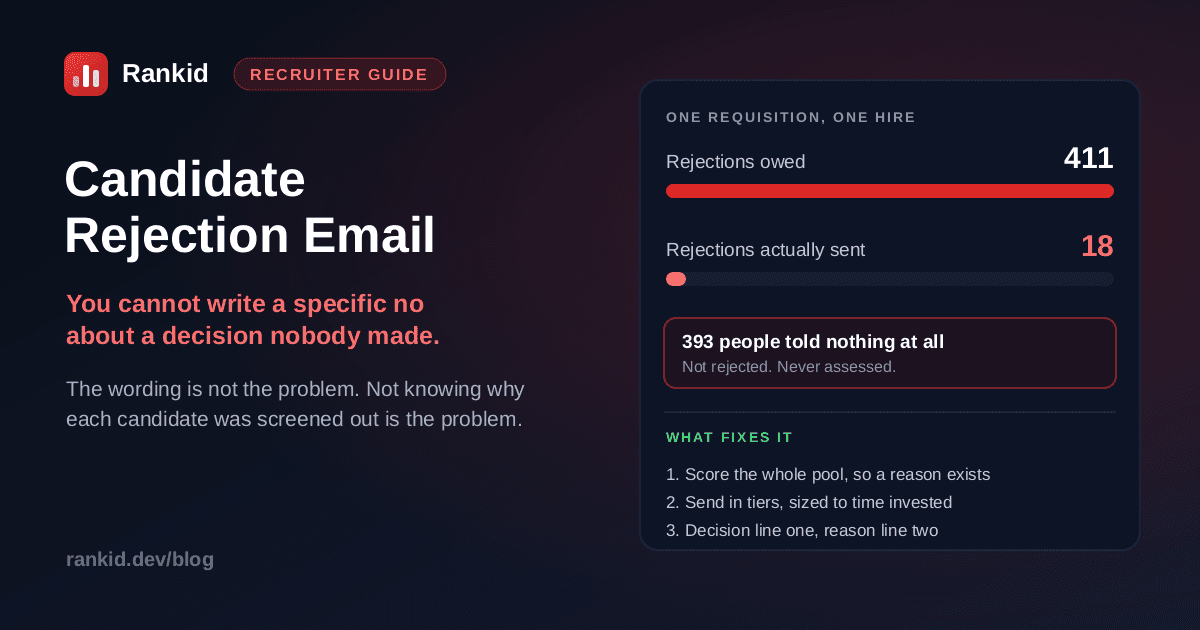
Every guide to writing a candidate rejection email assumes the hard part is the wording. It is not. The hard part is that the recruiter sitting down to write it frequently does not know why the candidate was rejected, because nobody ever evaluated them. The application arrived, the shortlist got built from the first forty resumes, the role was filled, and now there are 393 people who were never assessed and cannot be told anything specific. You cannot write a precise no about a decision that was never made, so it comes out as “we decided to move forward with other candidates”, or it never gets sent at all.
Quick answer
Why most candidate rejection emails fail
A requisition with 412 applicants and one hire owes 411 rejections. In practice a few dozen get sent, almost all to people who reached an interview, and several hundred applicants receive nothing at all. This is rarely a decision anyone made. It is what happens when the number of no answers you owe is an order of magnitude larger than the number of decisions you actually made.
Three failures follow from that, and only one of them is about writing:
- It arrives late, or never. Rejections get held until the offer is signed, so somebody screened out in week one hears in week five, if at all. The delay communicates something the wording then has to fight.
- It contains no reason, because none is known.“Other candidates more closely matched our requirements” is not evasiveness. It is usually an honest description of a comparison that never happened.
- It is generic in the ways that are noticed and personalised in the ways that are not. A correct first name on a paragraph that could go to anyone reads worse than no name at all, because it advertises the merge field.
Silence is not a softer rejection
What each candidate is actually owed
The most useful move is to stop treating rejection as one email and start treating it as four different obligations, sized to what the candidate spent. This is what makes the volume manageable: the largest tier gets the cheapest response, and the tiny tier gets the expensive one.
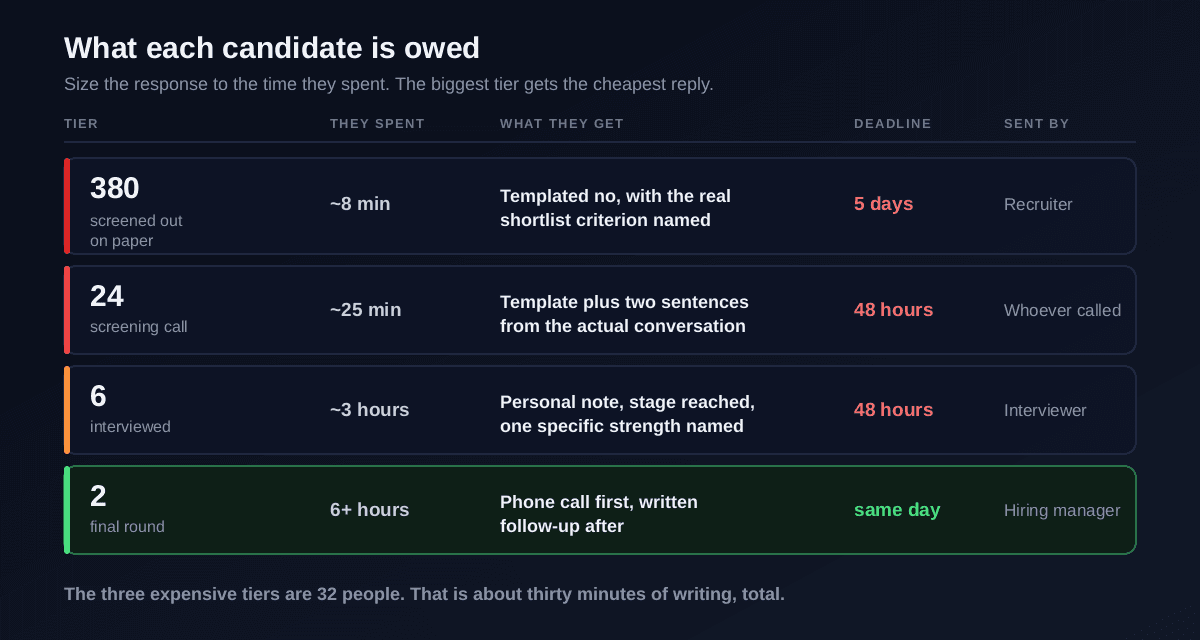
Two things fall out of this ladder that are easy to miss. The first is that the expensive tiers are small: writing a genuinely personal note to everyone who reached an interview on a typical requisition is somewhere between six and thirty minutes of work in total. Nobody is short of time for that. The second is that the enormous tier at the bottom needs to be a template, and there is nothing wrong with that, provided the template contains a real reason.
The one sentence that makes a template work
A rejection email has exactly one job beyond delivering the decision: telling the candidate what the shortlist was actually built on. That single sentence is the difference between a message that reads as a form letter and one that reads as an answer, and it costs nothing to add because the same sentence serves everybody rejected for the same reason.
The nervousness about giving reasons is misplaced, but it is not baseless. The risk lives in a specific place, and it is worth being precise about where.
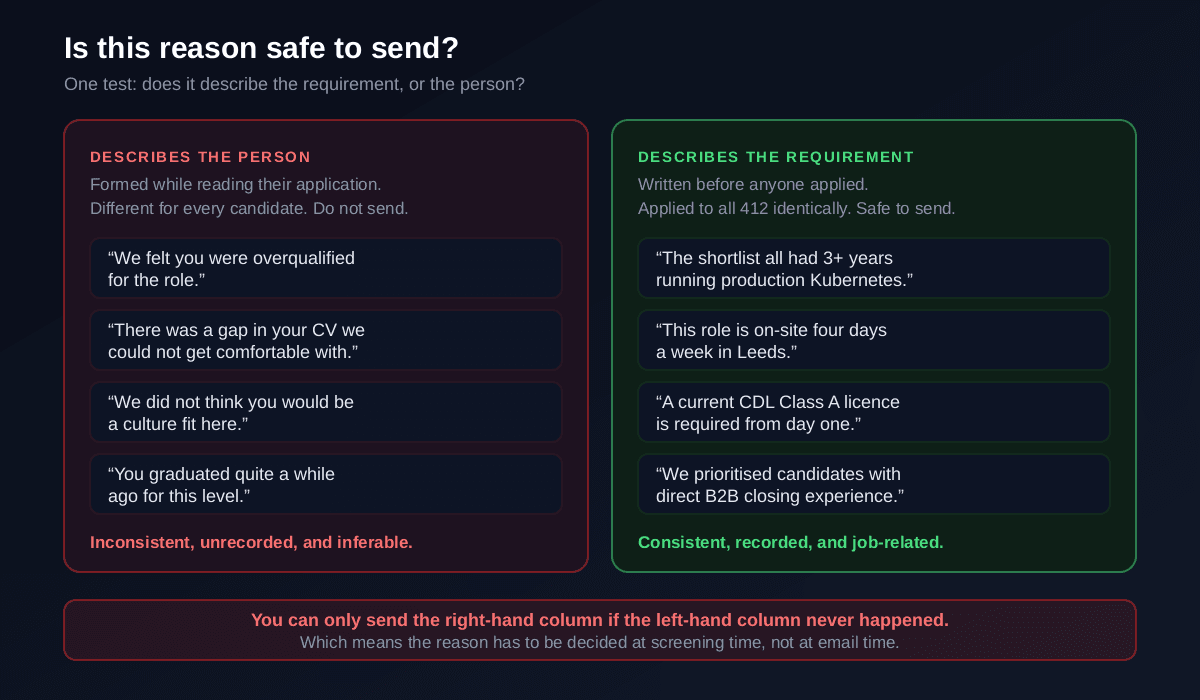
The test is simple. A safe reason describes the requirement, was written down before anyone applied, and was applied identically to every applicant. An unsafe reason describes the person, and was arrived at while looking at their particular application. The first is a criterion. The second is an impression, and an impression given in writing to hundreds of people, inconsistently, is the actual exposure that makes legal teams nervous about rejection emails.
This is the part that connects rejection quality back to screening. You can only give a consistent job-related reason if a consistent job-related evaluation happened, which is the argument in resume screening criteria and the same rubric described in the interview scorecard guide. Teams that score their pool against written criteria have a defensible sentence ready for every candidate. Teams that skim have to fall back on wording that says nothing, precisely because saying something specific would mean inventing it.
Give every no a reason you can actually stand behind
Upload your applicant batch and paste the job description. Rankid scores every candidate 0 to 100 against the role's criteria and lists the skills each one matches and misses, so nobody is left unassessed and every rejection has a specific, consistent, job-related reason attached before you write a single email. Up to 200 resumes per batch, first 5 free, no signup.
Score your applicant pool free7 candidate rejection email templates
Copy these. Replace the bracketed parts with something true. The bracketed reason is the only part that requires thought, and it is written once per requisition rather than once per candidate.
Screened out on the resume (the big tier)
Subject: Your application for [role]
“Hi [first name], thanks for applying for [role]. We are not moving forward with your application. For this role we shortlisted on [specific requirement, e.g. three or more years running production Kubernetes], and that was the deciding factor across the whole pool. I have noted your background in [genuine strength from their application] and will get in touch if something closer opens up. Thanks for the time you spent on this.”
Never assessed, requisition closed (the honest one)
“Hi [first name], the [role] position has now been filled and we are closing applications. To be straight with you, we received [number] applications and were not able to give every one a full review, so I do not want to imply your application was assessed and found wanting. If you are still interested in [company], [specific thing to do next].” Use this only while you still have an unassessed pile. It is better than a fake assessment, and it should be a temporary state rather than a permanent template.
Rejected after a screening call
“Hi [first name], thanks for making time for the call on [day]. We are not taking your application forward for [role]. The deciding factor was [specific requirement], and it came down to [one concrete thing from the conversation, e.g. most of your recent work being agency-side rather than in-house]. I appreciated [genuinely specific observation]. Good luck with the search.” Sent by whoever ran the call, within 48 hours.
Rejected after a first interview
Same shape, plus the stage reached and one thing that was strong. “You reached the [second] round out of [four], which puts you ahead of most of the field.” Candidates value knowing where they got to more than most recruiters expect, because it tells them whether to reapply.
Rejected at final round
Call first, same day. Then a short written follow-up so they have it in writing: “Following our call, confirming we have offered the [role] to another candidate. This was a close decision and it came down to [one specific factor]. What stood out about you was [specific]. I would genuinely like to talk to you about [specific kind of future role], and I will contact you directly when one opens.” Only include that last sentence if it is true.
Strong candidate, no role right now (the silver medallist)
“Hi [first name], we have filled [role], but you were one of the strongest applications we saw and I do not want to lose touch. Specifically, [reason they were strong]. We expect to be hiring for [specific role type] in [rough timeframe]. Can I contact you directly when that opens, rather than asking you to apply again?” This tier is the cheapest hiring channel you have, and it is the seed of a real talent pipeline.
Requisition cancelled or put on hold
“Hi [first name], an update on [role]: the position has been put on hold and we are not continuing the process for now. This is not a reflection of your application, and I am sorry for the time this cost you. If it reopens I will contact you directly.” Send this the day the decision is made. Candidates left hanging on a cancelled requisition is how a company acquires a reputation for ghost jobs it did not intend.
Phrases to delete from all seven
Timing: the deadline is per stage, not per requisition
The most common structural error is batching all rejections until the offer is accepted. The logic is understandable, since you want a fallback if your first choice declines. The cost is that someone screened out in week one waits five weeks for a message that was decided on day two.
- Resume stage: five business days from application. This is the point where candidates conclude they have been ignored.
- Post-screening call or interview: 48 hours from the decision, not from the end of the process.
- Final round: same day, by phone, for anyone who invested several hours.
- Runners-up you may still want: tell them the truth.“We are finalising with another candidate and I will confirm by [date]” keeps them warm honestly. Silence does not keep them warm, it just keeps them uninformed while they take another offer.
Time to first response and answer rate, meaning the share of applicants who ever receive any decision at all, are the two numbers worth putting on a dashboard here. Both are covered as process metrics in recruitment metrics, and both are usually far worse than teams assume before they are measured.
How to send 390 rejections in an afternoon
Volume is a mechanics problem with a few non-obvious rules:
- Send in tiers, not one blast. Four sends matched to the ladder above, each with its own template. One list of 411 people getting identical text is how a genuinely well-written rejection still reads as spam.
- Merge the reason, not just the name. If your pool was scored, you usually have two or three distinct rejection reasons covering almost everyone. Group by reason and send each group its own version.
- Use a human sender with a monitored reply-to. A noreply address turns a rejection into a notification and guarantees the replies you do want, from strong candidates you should keep, disappear.
- Check the send list against your interview invitations. The most damaging recruiting email error is a rejection reaching someone you meant to advance, and it happens during bulk sends.
- Be careful with auto-reject rules. Knockout questions that automatically reject on a single unvalidated answer will quietly bin qualified people at scale, and an automated rejection sent nine seconds after applying reads worse than one sent in three days. Where to draw the automation line is the subject of recruitment automation.
When a candidate replies asking why
Some will, and this is where most teams improvise, which is exactly the wrong response. Agree the policy once, as a team, and have everyone use it.
Answer with the criterion you already recorded
Two sentences: what the shortlist was built on, and where their application sat against it. Do not generate a new reason at reply time, because a second reason that differs from the first is the one genuinely risky thing you can do here.
Do not coach unless asked
Unsolicited resume advice in a rejection reply lands badly, and it invites a debate you have no time for. If they explicitly ask for feedback on their application, one specific observation is generous and sufficient.
Never compare them to the person you hired
“The candidate we chose had X” is a comparison you should not be making in writing. Describe the requirement, not the winner.
Close it politely if it escalates
One reply, one clarification, then a courteous end. “I have shared everything I can about the decision. I wish you the best with your search.” Recruiters are not obliged to litigate a hiring decision by email.
Is any of this worth the effort?
Here is the commercial case, since goodwill alone rarely wins the argument for process change. Rejected candidates are ninety-five percent or more of everyone who deals with your company as an employer. You have already paid to attract them, and if they were assessed properly you already know what they can do. That makes the rejected pool the cheapest and best-understood source of candidates you own, and it is worth more than most sourcing channels you pay for.
Two concrete returns. First, reapplication: candidates who receive a fast, specific no are substantially more likely to apply again when a role actually fits, while candidates left in silence largely do not. Second, the silver medallist. The person who came second three months ago is frequently the fastest hire available this quarter, and reaching them is a message rather than a requisition, which is the reactivation argument in talent pipeline and candidate sourcing. Neither return is available to a team whose rejected candidates were never told anything, because there is no relationship to reactivate and no record of why they were strong.
The wider version of this argument, including the four moments that decide how applying to your company feels, is in candidate experience.
Key takeaways
- A requisition with 412 applicants owes 411 rejections. Most teams send a few dozen, and the gap is capacity, not intent.
- Send in four tiers matched to the time each candidate invested, so the biggest group gets the cheapest response.
- Resume stage: 5 business days. Post-interview: 48 hours from the decision. Final round: same day, by phone.
- Put the decision in the first sentence and one job-related reason in the second. Everything else is packaging.
- A reason is safe when it describes a stated requirement applied to everyone, and risky when it describes the person.
- Never send a reason you cannot support with a record, which is why rejection quality depends on screening quality.
- Rejected candidates are 95% of everyone who deals with you as an employer, and your cheapest source for the next role.
- Rankid scores up to 200 resumes per batch against one job description. First 5 free, no signup.
Bottom line: the candidate rejection email is treated as a writing problem and solved with better adjectives, when it is really a record-keeping problem. If you know why each person was screened out, the email writes itself in six lines and can go to three hundred people without reading like it did. If you do not know, no amount of careful phrasing will hide it, and the wording everybody complains about is just an honest signal that no decision was ever made. Score your next applicant batch with Rankid and give every no a reason worth sending.
Frequently asked questions
What should a candidate rejection email say?
Four things, in about six lines. Name the specific role they applied for, state the decision plainly in the first sentence rather than burying it after a paragraph of thanks, give one real job-related reason the shortlist was built the way it was, and say what happens next, which is either nothing or a genuine offer to contact them about a specific kind of future opening. What it should not contain is a promise to keep their resume on file that you will not honour, a request for feedback on your process in the same message, or three paragraphs of praise wrapped around a no. Candidates read the first sentence and the reason. Everything else is packaging.
Is it legal to tell a candidate why they were rejected?
In general yes, and in most jurisdictions there is no obligation either to give a reason or to stay silent. The risk is not in giving a reason, it is in giving an inconsistent or non-job-related one. A reason tied to a stated requirement of the role, applied to every applicant and recorded the same way, is the most defensible thing you can send. A reason invented per candidate after the fact, or one that touches age, health, family status, national origin, or anything a protected characteristic could be inferred from, creates exposure that silence would not have. This is a documentation question rather than a communication question, and it is why teams that score applicants against written criteria can safely give reasons while teams that skim cannot.
How soon should you send a rejection email?
Match the deadline to the time the candidate invested. Applicants rejected on their resume should hear within five business days of applying, because five days is roughly when people conclude they have been ignored. Anyone who spent time on a call or an interview should hear within 48 hours of the decision, not 48 hours of the process finishing. Final-round candidates should hear the same day the decision is made, by phone first if they went through several rounds. The common failure is holding rejections until the offer is signed, which turns a two-day no into a three-week silence for people who did nothing wrong.
Should you send rejection emails to candidates you never screened?
You should, but the deeper answer is that this group should not exist. Unread applicants are not rejected, because no decision was ever made about them, which is exactly why the email is so hard to write and so often never sent. If you genuinely cannot evaluate everyone, send a short honest close-out that says the role has been filled and does not imply their application was assessed, since candidates can tell the difference and inventing an assessment that never happened is worse than admitting the queue beat you. The better fix is removing the constraint so every applicant actually gets a decision.
How do you reject a candidate after an interview?
Send it within 48 hours, from the person who interviewed them, and include one concrete thing from the conversation so it is unmistakably about them. Name the stage they reached, state the decision in the first line, give the deciding factor in one sentence, and if there was something genuinely strong, name it specifically rather than praising them in general terms. For candidates who reached a final round after several hours of interviews, call first and follow up in writing. The two minutes this costs is the difference between a candidate who reapplies and one who tells people not to.
How do you send hundreds of rejection emails without them reading as bulk?
Personalisation is not the same as merge fields. A message with a correct first name and a copied paragraph reads as automated because the content is generic, whereas a message that names the specific role and the specific criterion that decided the shortlist reads as considered even when it went to 300 people at once. So send in tiers rather than one blast, use a real human sender address with a monitored reply-to, merge in role and reason rather than just name, and never send a rejection at the same minute as an interview invitation to the same list. The prerequisite is knowing why each person was screened out, which only exists if the pool was actually evaluated.
What should you say when a rejected candidate asks why?
Answer, briefly, using the same job-related criterion you recorded at the time, and do not improvise a new reason. A good default is two sentences: what the shortlist was built on, and where their application sat against that. Do not offer coaching, do not critique their resume unless they explicitly ask for that, and do not compare them to the person you hired. Decide the policy once as a team rather than leaving each recruiter to answer ad hoc, because inconsistent explanations across candidates are the actual risk here, not the act of explaining.
Do rejection emails matter for hiring outcomes?
Yes, for a reason that is easy to underestimate: rejected candidates are the overwhelming majority of everyone who ever interacts with your company as an employer, often ninety-five percent or more of a requisition's applicants. They are also a pool you have already paid to attract and partly assessed, so they are the cheapest source for your next similar role. Candidates who receive a fast, specific no reapply at meaningfully higher rates than candidates left in silence, and the silver medallist from three months ago is frequently the fastest hire you will make this quarter.