Notice Period: What It Means, What to Write on a Job Application, and How to Shorten It (2026)
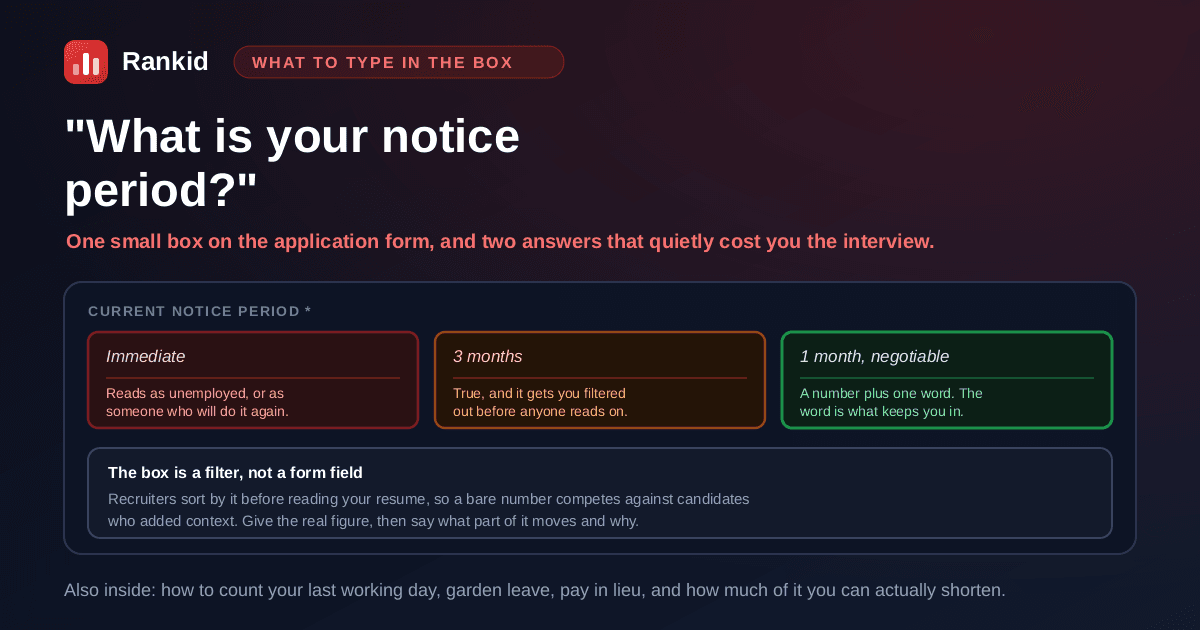
There is a small box near the end of most application forms labelled something like "current notice period". Most people type one of two things into it. Some type "immediate", believing that being available fast is an advantage. Others type the honest contractual figure, "3 months", and never hear back. Neither of them is lying, and both have just made the same mistake, because that field is not a form field. In most applicant tracking systems it is a sortable column, and it gets used to shorten a long list before anybody opens a resume.
Quick answer
Quick answer: a notice period is the time you must keep working after resigning, set by your contract. On an application form, the field is really asking how soon could you start, so give the contractual figure plus the part that moves: "3 months contractual, usually reduced to 6 weeks" beats a bare number. Notice normally starts the day afterwritten notice is accepted, weeks means calendar weeks, and you should always state the exact last working day rather than a duration. Garden leave and pay in lieu are the employer's decisions, not yours, and only pay in lieu actually frees you to start somewhere else.
What is a notice period?
A notice period is the amount of time you keep working after telling your employer you are leaving, or after they tell you your employment is ending. It is set by your employment contract, and in many countries a statutory minimum sits underneath as a floor that a contract cannot go below.
Its purpose is unglamorous and mutual. The employer gets time to hand over your work and start hiring. You get a predictable final pay date, your accrued benefits settled, and a clean exit that protects the reference. The notice period is the mechanism that stops both of those things being improvised.
The single most useful thing to understand is this: a notice period is a duration, not a date. It only becomes a date once you know when notice was given and accepted. Almost every dispute, and almost all of the confusion on application forms, comes from treating the two as interchangeable.
One disclaimer, stated plainly
"What is your notice period?" on a job application
The field is not asking about your contract for its own sake. It is asking how soon could you start if we offered you this. Recruiters use it to triage, because a role with a fixed start date makes a long-notice candidate expensive regardless of how good they are.
This is why a bare number is a weak answer. It competes against candidates who gave the same number with context attached, and context is the only thing that survives a filter. Every answer below is honest. The difference is whether it reads as a fixed obstacle or as a manageable one.
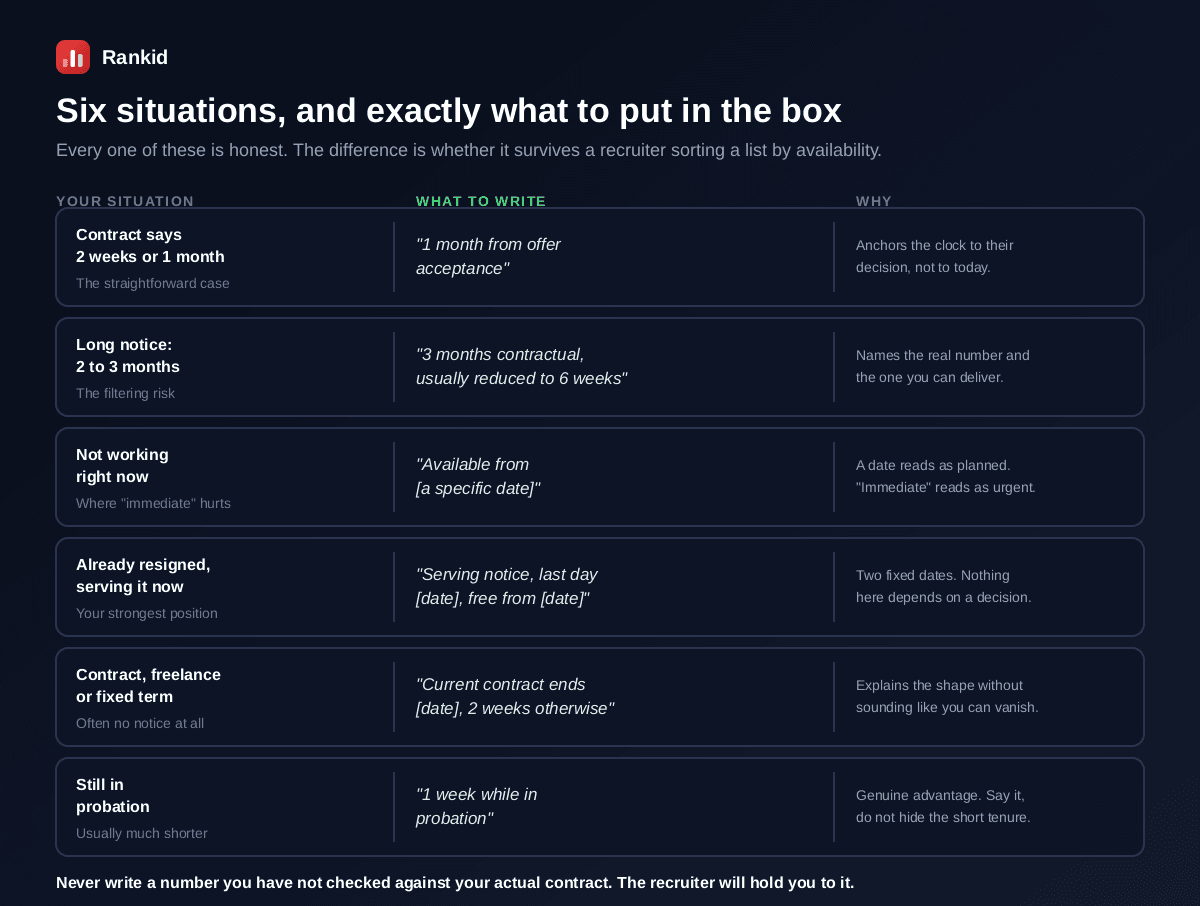
Two rules govern all six. Anchor the clock to their decision, not to today."1 month from offer acceptance" is more useful than "1 month", because it tells the recruiter the countdown starts when they act. And never write a figure you have not checked against the most recent contract or variation letter you signed. Notice periods commonly step up with promotion and tenure, so the number in your original offer letter is frequently out of date, and a recruiter will hold you to whatever you typed.
Why "immediate" can work against you
How long is a notice period?
There is no universal standard. Country sets the framework and seniority moves the number more than most people expect. Everything below is a norm rather than a rule, and your contract overrides all of it.
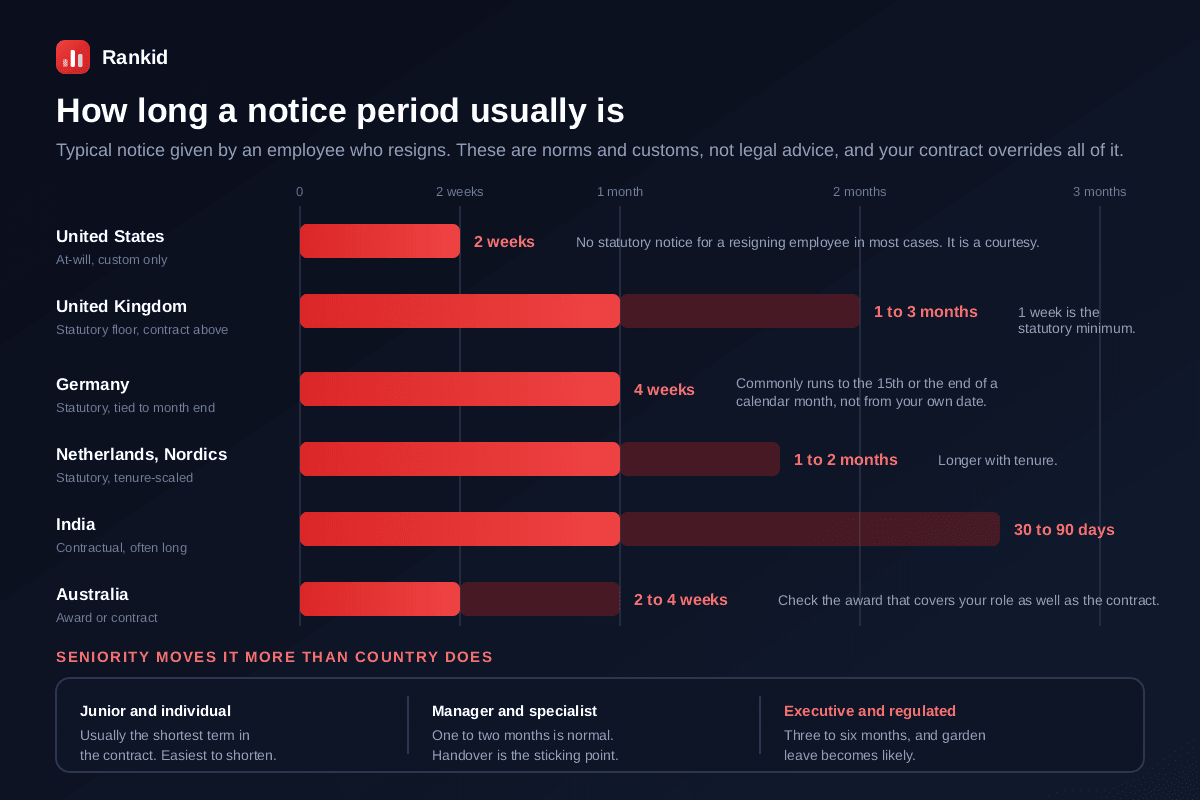
The pattern worth internalising is that the United States is the outlier, not the baseline. Much of the internet writes about notice periods from a two-week at-will perspective, which is why candidates in the UK, Europe and India find most of the advice unusable. If you are applying across borders, expect the employer's expectation to be anchored to their own norm, and say your figure without apology.
Seniority is the bigger lever. A junior individual contributor usually has the shortest term in the contract and the most room to shorten it. Managers and specialists sit at one to two months, where the handover is the real sticking point rather than the calendar. Executives and people holding regulated sign-offs routinely have three to six months, and at that level garden leave becomes likely rather than exceptional.
How to count your last working day
This is the part that costs people money. A few days of ambiguity about when notice started moves your last working day, which moves your final pay run, and can move the start date you have already promised a new employer.
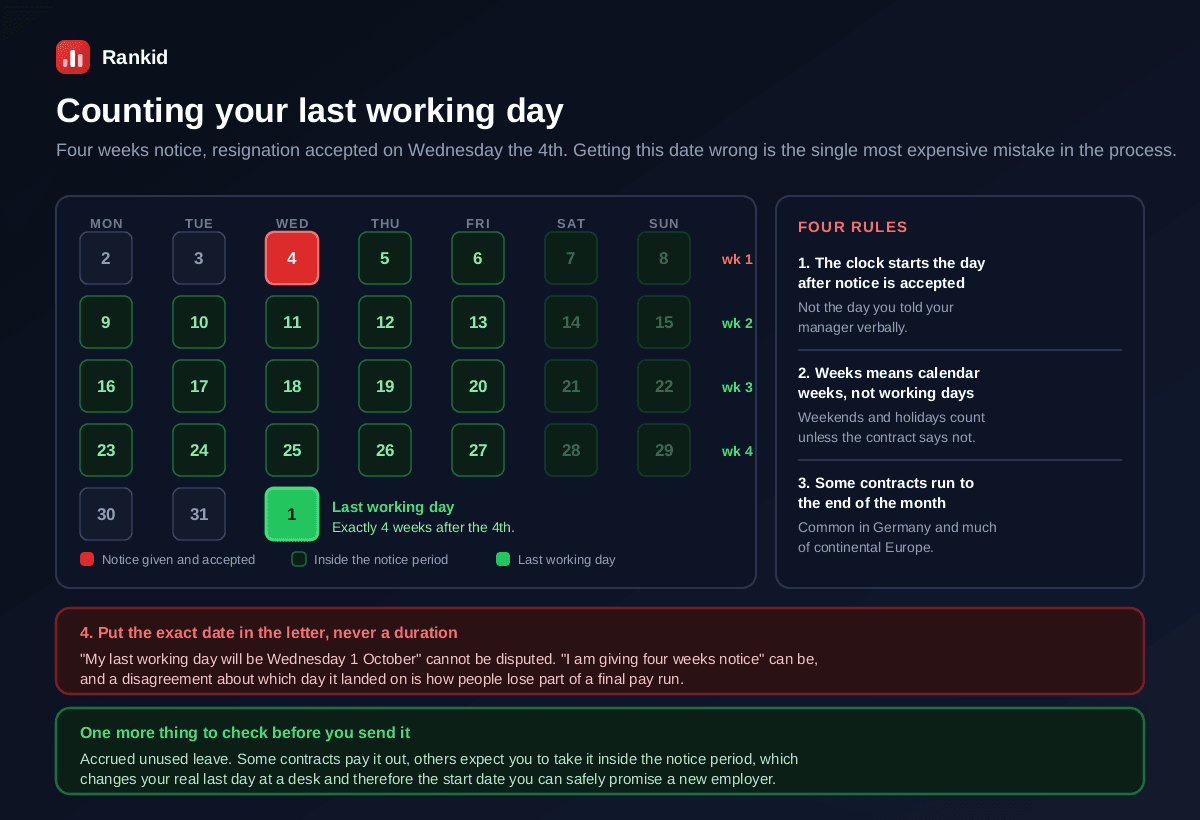
Give notice in writing the same day you have the conversation
Start counting the day after notice is accepted
Assume calendar weeks unless the contract says working days
Put the exact date in the letter, never the duration
Then check your accrued leave before you promise a start date
Notice period, garden leave, pay in lieu and availability date
These four get used interchangeably and they are not the same thing. Only one of them is what an application form is asking for, and only one of them actually frees you to start a new job early.
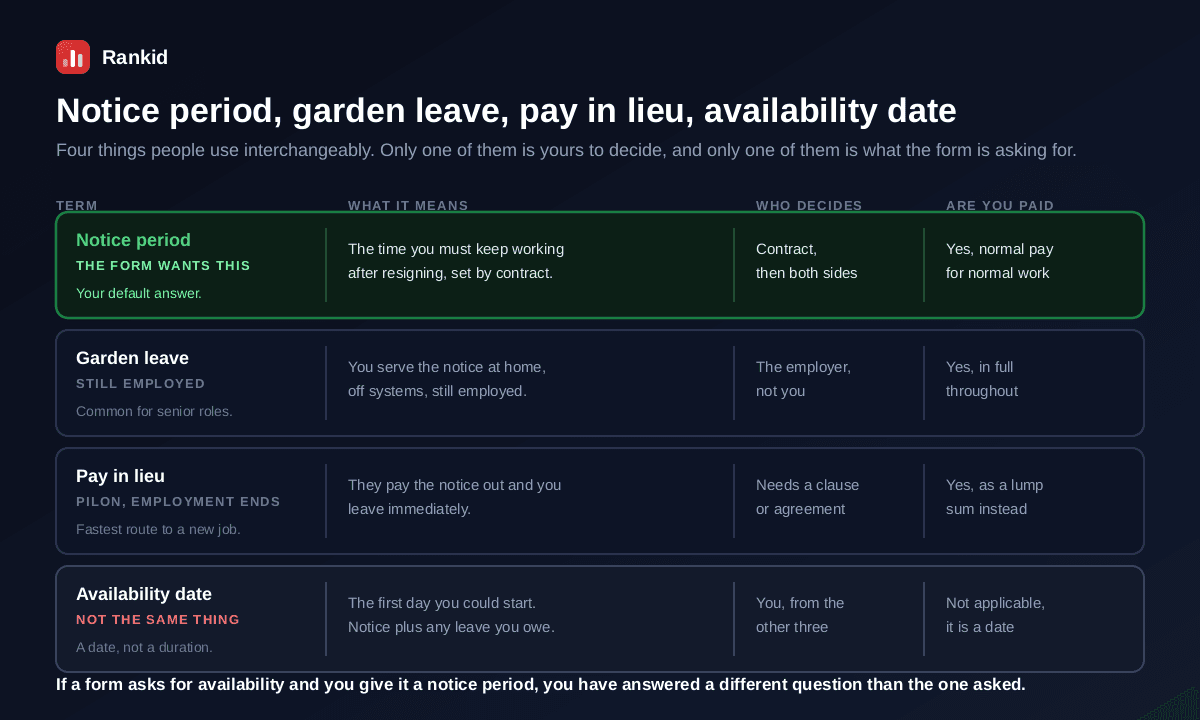
Garden leavedoes not shorten anything. You are still employed, still paid, and still bound by confidentiality and any exclusivity or non-compete terms for the whole duration. It is the employer's call, common for senior moves and moves to competitors, and the only question that matters when someone mentions it is: what is your actual last day of employment?
Pay in lieu of notice, often shortened to PILON, is the one that genuinely accelerates you, because your employment ends on the spot and you are free immediately. It normally needs a contractual clause or a separate agreement, it is usually the employer's choice rather than something you can demand, and the tax treatment differs by country and sometimes from ordinary salary. Get the agreed end date in writing, because that date and not the original notice end is what you give a new employer.
Availability date is a date, not a duration: your notice plus anything else in the way, such as leave you must take, a relocation or a visa step. If a form asks for availability and you answer with a notice period, you have answered a different question and left the recruiter doing arithmetic without a starting point.
A long notice period only matters if you clear the screen first
Getting the notice field right keeps you in the pile. Getting shortlisted is a different test. Paste your resume and the job description into Rankid for a 0 to 100 match score, the requirements you have evidenced, and the ones the screen cannot see. First check is free, no signup.
Check your resume freeHow to answer it on a screening call
Said out loud, the answer changes shape, and this is where you get back the advantage a form takes away. On a form you are one sortable row. On a call you get to add the sentence that stops a long notice being disqualifying, and you get to find out whether their start date is actually fixed.
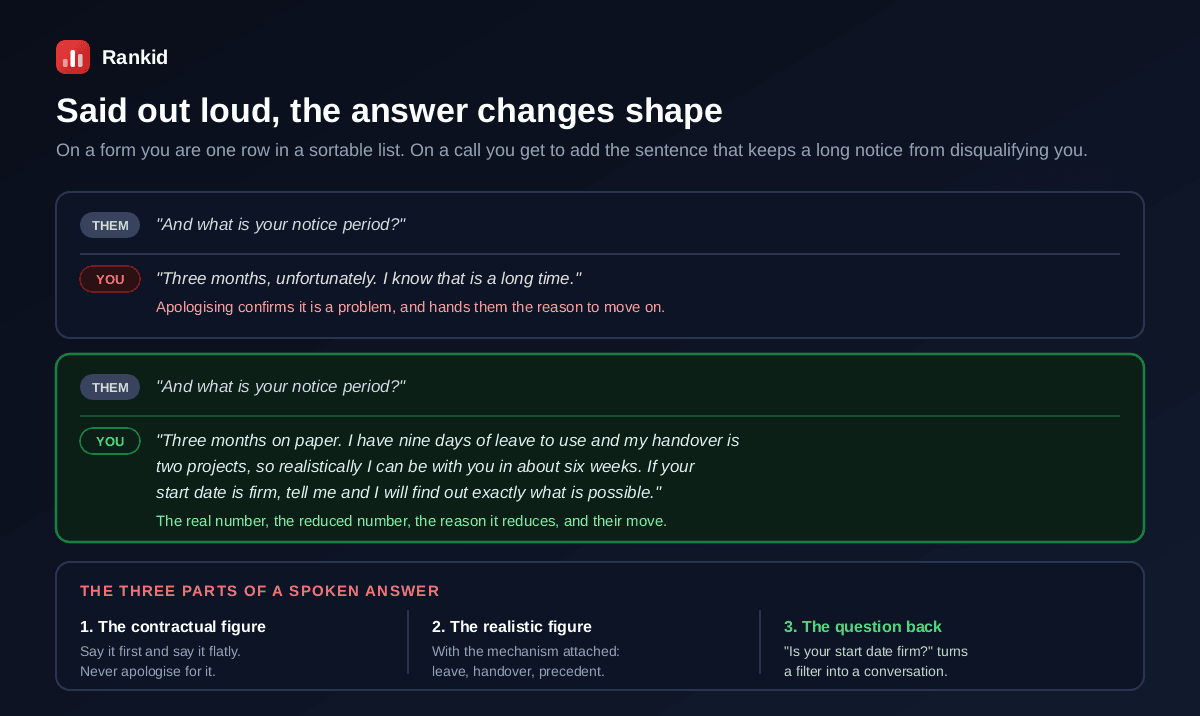
Do not apologise for the number."Three months, unfortunately" confirms that it is a problem and hands the recruiter a reason to move on. Say the contractual figure flatly, then give the realistic figure with the mechanism attached, then ask whether the start date is firm. That last question is what turns a filter into a conversation, and it is the part almost nobody does.
Logistics like this are standard content for a screening interview, alongside pay expectations and location, so it is worth having the three-part answer ready rather than improvising it. If pay comes up in the same breath, our guide to negotiating salary covers handling both without anchoring yourself low.
What actually shortens a notice period
The reliable moves are trades you offer, not requests you make. An employer enforcing a long notice is almost never doing it out of spite; they are protecting continuity. Remove the continuity risk and the calendar usually becomes negotiable.
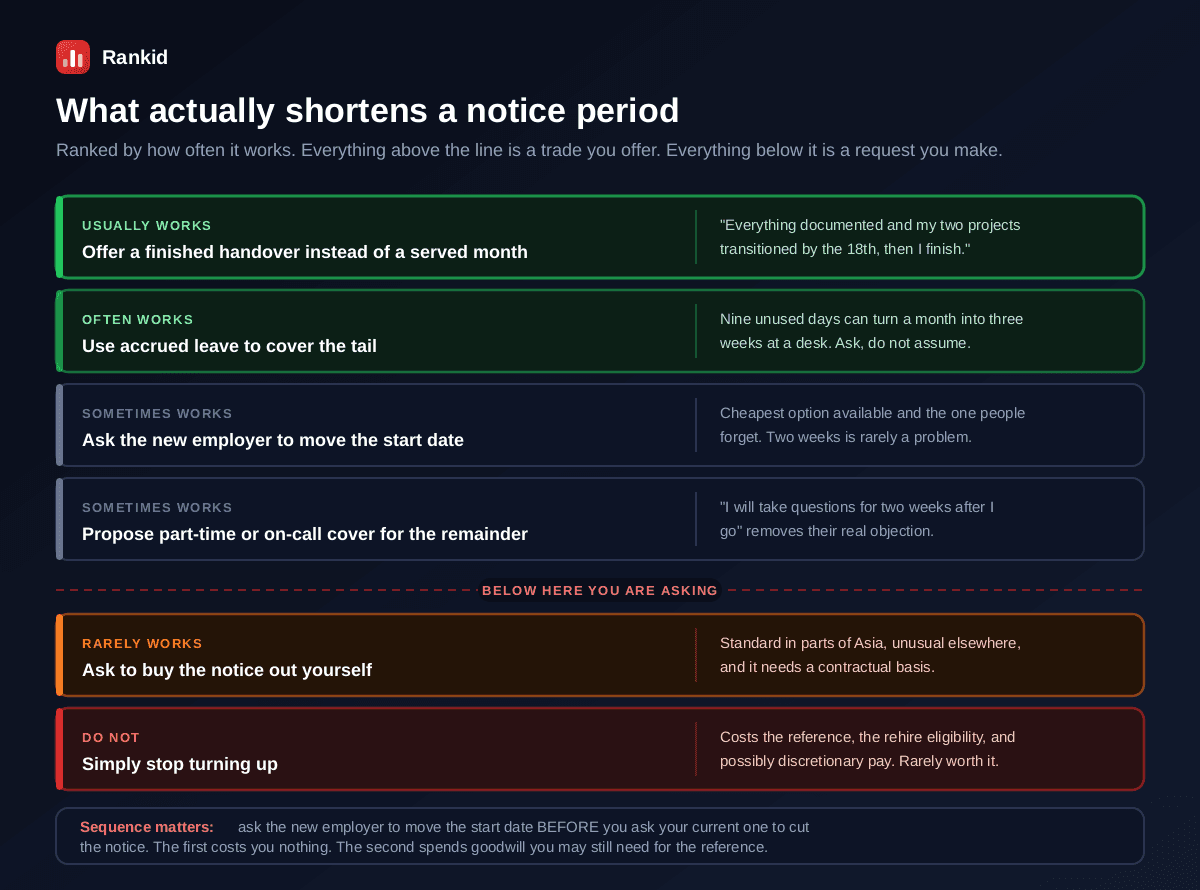
Sequence matters more than the tactics. Ask the new employer to move the start date first, because it costs you nothing and two weeks is rarely a problem for them. Only then go to your current employer, because that conversation spends goodwill you may still need for a reference. Doing it the other way round is how people end up having cut their notice for a start date that was never firm.
The strongest version of the ask is specific and dated: "Everything documented and my two projects transitioned by the 18th, then I finish" gives your manager something better than a warm body for four weeks. Where the handover is genuinely the obstacle, offering a written plan for your successor's first 30 days is often worth more than the fortnight you are trying to buy back.
What happens if you leave without serving it
The reputational cost is more certain than the legal one, and people usually worry about these in the wrong proportion.
- Under at-will employment, mostly in the US, you can generally leave. You may forfeit an accrued leave payout depending on state law and policy, and you will very likely lose the reference and rehire eligibility.
- Where notice is contractual, leaving early is a breach. Employers rarely litigate because it is slow and expensive, but they can withhold discretionary payments such as bonuses, may be entitled to recover certain costs, and will note it on your file.
- Watch the plan documents, not just the contract. Equity, bonus and relocation-repayment terms often carry service conditions or clawbacks that bite harder than the notice clause itself, and people discover this after resigning rather than before.
- Genuine reasons to leave immediately exist. Safety, harassment, health and serious family emergencies. In those cases keep the letter short and neutral, put the request about final pay in writing separately, and take proper advice rather than relying on general guidance.
The practical calculus: industries are smaller than they look, and the person you leave holding an unfinished project is quite likely to turn up as a hiring manager, a client or a reference check in five years. That, rather than any legal exposure, is the reason to serve it properly.
Notice periods during probation
Probationary notice is almost always much shorter, frequently one week and sometimes a few days, and it is usually written into the same contract clause that sets the probation length.
If you are job hunting inside probation, this is a genuine advantage and you should state it rather than hiding the short tenure. "1 week while in probation" makes you one of the fastest available candidates in the pipeline, which is worth more than the awkwardness of explaining a brief stint. Two things to check: some contracts apply the probationary notice only until probation formally ends, which can require a written confirmation employers sometimes forget to send, leaving your position ambiguous; and a small number apply a longer notice to the employee than to the employer during probation, which is unusual but worth reading for. If the short stint itself is the harder question, our guide to explaining a reason for leaving covers how to frame it in one sentence.
Notice period mistakes that cost people offers
- Writing a number you never checked. Notice steps up with promotion and tenure. The figure in your first offer letter is often wrong, and the recruiter will hold you to what you typed.
- Answering "immediate" when you are between roles. Ambiguous in a way that rarely helps. Give a date instead.
- A bare number with no qualifier. It loses to the identical number with context, because it gets filtered before anyone reads on.
- Apologising for the length on a call. It confirms the objection and invites the recruiter to move to the next candidate.
- Counting from the verbal conversation. Most contracts start the clock the day after written notice is accepted, and the difference can be a pay run.
- Writing a duration in the resignation letter. Always the exact date, or you are inviting a disagreement about which day it landed on.
- Forgetting accrued leave. Whether it is paid out or must be taken inside the notice changes your real availability, and it is the most common cause of a promised start date slipping.
- Assuming garden leave means you are free. You are still employed and still bound by your contract terms for the full duration.
- Cutting your notice before the new start date is confirmed in writing. Spending goodwill for a date that turns out to be soft.
- Resigning before the offer is unconditional. Background checks and references are still outstanding on most job offers at the point people get excited enough to resign.
The one that undoes everything else
Key takeaways
- A notice period is a duration set by your contract, not a date. It becomes a date only once notice is given and accepted.
- On an application form the field really means 'how soon could you start', and it is often a sortable column used to triage before anyone reads your resume.
- Give the contractual figure plus the part that moves: '3 months contractual, usually reduced to 6 weeks' survives a filter that '3 months' does not.
- Anchor it to their decision: '1 month from offer acceptance' beats '1 month'.
- Avoid 'immediate'. Give a specific available-from date instead, which reads as planned rather than urgent.
- The US two-week norm is the outlier, not the baseline. Seniority moves the number more than country does.
- Notice normally starts the day after written notice is accepted, and weeks means calendar weeks unless the contract says otherwise.
- Put the exact last working day in the resignation letter, never the duration.
- Check whether accrued leave is paid out or must be taken inside the notice, because it changes your real start date.
- Garden leave does not free you: you are still employed and still bound. Only pay in lieu ends employment early.
- Availability date is a date; notice period is a duration. Answer the question actually asked.
- To shorten it, offer a trade rather than make a request, and ask the new employer to move the start date first.
- Never resign against a verbal offer. Written and unconditional first, then the clock starts.
Everything above reduces to one habit: treat the notice period as information you control the framing of, rather than a fact that happens to you. Check the real figure in your most recent contract, work out the earliest date you could genuinely deliver and the mechanism that gets you there, and then use the same two numbers everywhere, on the form, on the call and in the letter. If you are filling in these fields a lot and still not reaching the interview stage, the notice period is probably not what is stopping you: paste your resume and the job description into Rankid's resume checker to see what a screen can actually find, and read why am I not getting interviews for the stages where applications usually die.
Frequently asked questions
What is a notice period?
A notice period is the amount of time you are expected to keep working after you tell your employer you are leaving, or after they tell you they are ending your employment. It is set by your employment contract, and in many countries a statutory minimum sits underneath the contract as a floor. Its purpose is practical rather than punitive: it buys the employer time to hand over your work and start hiring, and it buys you a predictable final pay date and a clean reference. The important thing to understand is that a notice period is a duration, not a date. It only becomes a date once you know when notice was given and accepted, which is where most of the confusion and nearly all of the disputes come from. Note that this article is general information about how notice periods work in practice, not legal advice, and your own contract and local law govern your situation.
What does notice period mean on a job application?
On an application form, the notice period field is asking one thing: how soon could you realistically start if we offered you this job. The employer is not interested in your contract in the abstract, they are trying to work out whether you fit the start date they have in mind. This matters because in many applicant tracking systems that field is sortable and filterable, so recruiters use it to triage a long list before reading resumes properly. A candidate with three months of notice and no context can be filtered out by someone who never opened their application. That is why the answer should not be a bare number: give the contractual figure, then add the part that moves. "3 months contractual, usually reduced to 6 weeks" survives a filter that "3 months" does not.
What should I write for notice period on an application form?
Write the real contractual figure, then one short qualifier that tells them what is actually achievable. Six situations cover almost everyone. Short contractual notice: "1 month from offer acceptance". Long notice: "3 months contractual, usually reduced to 6 weeks". Not currently working: "Available from 14 October", which reads as planned rather than urgent, whereas "immediate" can read as either unemployed or as someone who walks out. Already resigned: "Serving notice, last day 3 October, free from 6 October", which is the strongest possible answer because nothing in it depends on a decision. Freelance or fixed term: "Current contract ends 30 September, 2 weeks otherwise". Still in probation: "1 week while in probation", which is a genuine advantage worth stating. Never write a figure you have not checked against your actual contract, because the recruiter will hold you to it later.
What does current notice period mean?
It means the notice period that applies in the job you hold right now, as opposed to the one at a previous employer or the one you would have in the role you are applying for. Forms word it that way because candidates were answering with historical or hypothetical figures. There are two things worth knowing. First, your current notice period may not be the one you signed on your first day: it commonly steps up with promotion or tenure, so the figure in your original offer letter can be out of date. Check the most recent contract or variation letter you signed. Second, if you are still in a probationary period, your current notice is usually the shorter probation figure rather than the full contractual term, and that is the number to give.
How long is a standard notice period?
There is no single standard, and the two biggest variables are country and seniority. In the United States, employment is generally at will and a resigning employee usually has no statutory notice obligation at all, so two weeks is a strong custom rather than a legal requirement. In the United Kingdom, a statutory minimum of one week applies once you have been employed a month, but contractual notice of one to three months is normal. Germany has statutory notice that commonly runs to the fifteenth or the end of a calendar month rather than from your own date. The Netherlands and the Nordics typically scale with tenure, one to two months. In India, contractual notice of thirty to ninety days is common and ninety is normal in IT. Australia depends on both the contract and any award covering the role. Seniority moves it more than geography does: executives and people in regulated roles routinely have three to six months.
When does a notice period start?
In most contracts the clock starts the day after notice is given and accepted in writing, not on the day you first mention it verbally to your manager. This is the single most expensive detail in the whole process, because a few days of ambiguity at the start moves your last working day and can affect a final pay run. Three rules keep you safe. Give notice in writing on the same day you have the conversation, so there is a timestamp. Assume that weeks means calendar weeks including weekends and public holidays, unless your contract explicitly says working days. And state the exact date in the letter rather than the duration: "my last working day will be Wednesday 1 October" cannot be disputed, whereas "I am giving four weeks notice" can be. If your contract runs notice to a month end, as many European ones do, calculate against that instead.
Should I give two weeks or four weeks notice?
Give whatever your contract requires, and where nothing is specified, two weeks is the widely understood default in the United States. Going beyond the minimum is worth considering in three situations: if you manage people, if you personally hold client relationships, or if you are mid-project and leaving would visibly hurt colleagues rather than the company. In those cases the extra time buys a reference and rehire eligibility that can matter years later. Going beyond four weeks voluntarily is rarely useful, because long lame-duck periods are uncomfortable for everyone and rarely improve the handover. One caution in the other direction: do not offer more notice than you can actually serve in order to seem generous, then try to claw it back once a new employer pushes on the start date. That is worse than having given the minimum honestly at the outset.
Can I negotiate a shorter notice period?
Often yes, and what works is offering a trade rather than making a request. Ranked by how often it succeeds: offer a finished handover instead of a served month, meaning everything documented and projects transitioned by a named date; use accrued unused leave to cover the tail, which can turn a month into three weeks at a desk; ask the new employer to move the start date, which is the cheapest option available and the one people forget; and propose part-time or on-call cover after you leave, which removes the employer's real objection. Buying the notice out yourself is standard in parts of Asia and unusual elsewhere, and it needs a contractual basis. Sequence matters more than most people realise: ask the new employer to move the start date before you ask your current one to cut the notice, because the first costs you nothing and the second spends goodwill you may still need for a reference.
What happens if you do not serve your notice period?
The consequences depend on whether your notice is contractual and on where you work, and the reputational cost is usually larger and more certain than the legal one. Under at-will employment in the United States you can generally leave without notice, though you may forfeit an accrued leave payout depending on state law and company policy, and you will very likely lose the reference and any rehire eligibility. Where notice is contractual, leaving early is a breach of contract. Employers rarely pursue former employees through the courts because it is slow and expensive, but they can withhold discretionary payments such as bonuses, they may be entitled to recover certain costs, and they will note it on your file. Genuine reasons for leaving immediately do exist, including safety, harassment, health and serious family emergencies. In those cases keep the resignation letter short and neutral, and take advice rather than relying on general guidance.
What is garden leave?
Garden leave is when your employer tells you to serve your notice period away from the workplace. You stay employed, you keep receiving full pay and usually your benefits, and you are typically removed from systems, clients and internal communications. It is common for senior people, for anyone moving to a competitor, and in regulated industries. The key point for a job seeker is that garden leave does not shorten your notice period and it does not make you free to start elsewhere: you are still employed, so any exclusivity, confidentiality or non-compete terms in your contract continue to apply for the duration. It is also the employer's decision, not yours. You can ask, but you cannot elect to take it. When someone tells a recruiter they are on garden leave, the useful follow-up is always the same: what is your actual last day of employment.
What is pay in lieu of notice, or PILON?
Pay in lieu of notice means the employer pays out the notice period as a sum instead of having you work it, and your employment ends immediately rather than at the end of the notice. For a job seeker it is the fastest possible route into a new role, because unlike garden leave your employment has genuinely ended, so you are free to start elsewhere at once. It normally requires a specific clause in your contract or a separate agreement between you and the employer, and it is far more often the employer's choice than something you can demand, particularly when they would rather not have a departing person around. Two practical notes. The tax treatment of a PILON payment differs by country and sometimes from ordinary salary, so check before you assume the net figure. And get the agreed end date in writing, because that date, not the original notice end, is what you should give a new employer.
Is a notice period the same as an availability date?
No, and mixing them up is one of the most common form-filling errors. A notice period is a duration set by your contract. An availability date is a single calendar date: the first day you could actually start, which is your notice period plus anything else in the way, such as leave you are obliged to take, a relocation, a visa step or a fixed personal commitment. If a form asks for availability and you write "2 months", you have answered a different question from the one asked, and a recruiter now has to do arithmetic without knowing when you would start counting from. Where a form gives you both fields, fill them consistently. Where it gives you one, answer the question actually asked, and if you have room, give the date and the reason it is that date.
What is the notice period during probation?
It is almost always much shorter than the full contractual term, frequently one week or even a few days, and it is usually written into the same clause of the contract that sets the probation length. If you are job hunting inside a probationary period, this is a genuine advantage and you should state it plainly on application forms rather than hiding the short tenure: "1 week while in probation" makes you one of the fastest available candidates in the pipeline. Two things to check. Some contracts specify that the probationary notice applies only until the probation formally ends, which may require a written confirmation that some employers forget to send, so an unconfirmed probation can leave the position ambiguous. And a small number of contracts apply a longer notice to the employee than to the employer during probation, which is unusual but worth reading for.
Do I need to give notice in an at-will job?
Legally, usually not. At-will employment means either side can generally end the relationship at any time for any lawful reason, so a resigning employee in most US roles has no statutory notice obligation. In practice you should still give notice, because the reasons to do it are not legal ones. Two weeks is the near-universal expectation, and departing without it is remembered in a way that costs you references, rehire eligibility and professional relationships in an industry that is usually smaller than it looks. There are also exceptions to the general at-will position worth knowing about: an individual employment contract, a collective bargaining agreement, an equity or bonus plan with a service condition, or a company policy tying accrued leave payout to proper notice can all impose consequences even where the law imposes none. Read your offer letter and your handbook before you assume you can simply walk.