Job Hopping: How Long to Stay, When It Helps, and How to Explain It (2026)
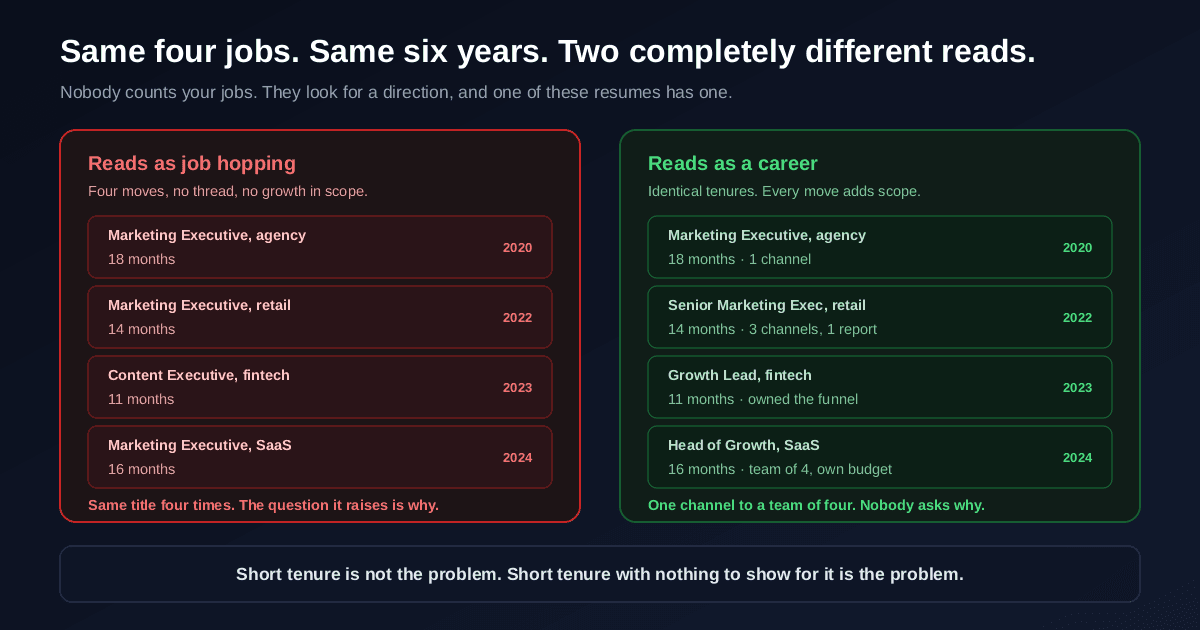
You have four jobs in six years and you have started apologising for it before anyone asks. The advice you find is not much help either, because it is mostly a number: stay two years, stay three, never leave before eighteen months. That advice is wrong in a specific and useful way. Nobody reading your resume is counting your jobs. They are looking at the shape of the last six years, and two people with identical dates and identical tenures can produce completely opposite reactions.
Quick answer
Quick answer: job hopping is a pattern, not a job count: three or more stints under about a year with no growth in scope between them. A single short job is not job hopping and costs almost nothing. How long to stay depends on the role: 12 to 18 months early career or at a startup, 2 years as a mid-level individual contributor, 3 years for a manager, 12 months in agency or contract work. Moving is usually the biggest lever you have on pay, and the trade flips at the third consecutive short stint. To explain it: reason, what you shipped, why this one is different. Forty seconds, then stop.
What is job hopping?
Job hopping is changing employers frequently, and in practice the label attaches to anyone with several stints of roughly a year or less in a row. The load-bearing word is pattern.
A single short job is not job hopping, and almost nobody treats it as such, because redundancies, bad managers and companies running out of money are ordinary events. What actually reads as job hopping is three or more consecutive stints under about a year with no visible growth in scope between them, because that is the shape that raises a real question about whether the next job also lasts ten months.
It is also far more context-dependent, and far softer, than advice written a decade ago assumes. In agency work, consulting, contracting and early-stage startups, twelve-month tenures are the norm and carry no stigma. The same record in local government reads completely differently. So the useful definition is not a number of months: it is a pattern that looks unexplained in the context of the sector you are applying to.
How long should you stay at a job?
There is no universal number, but there is a dependable one for each situation, and most of them are shorter than the standard advice.
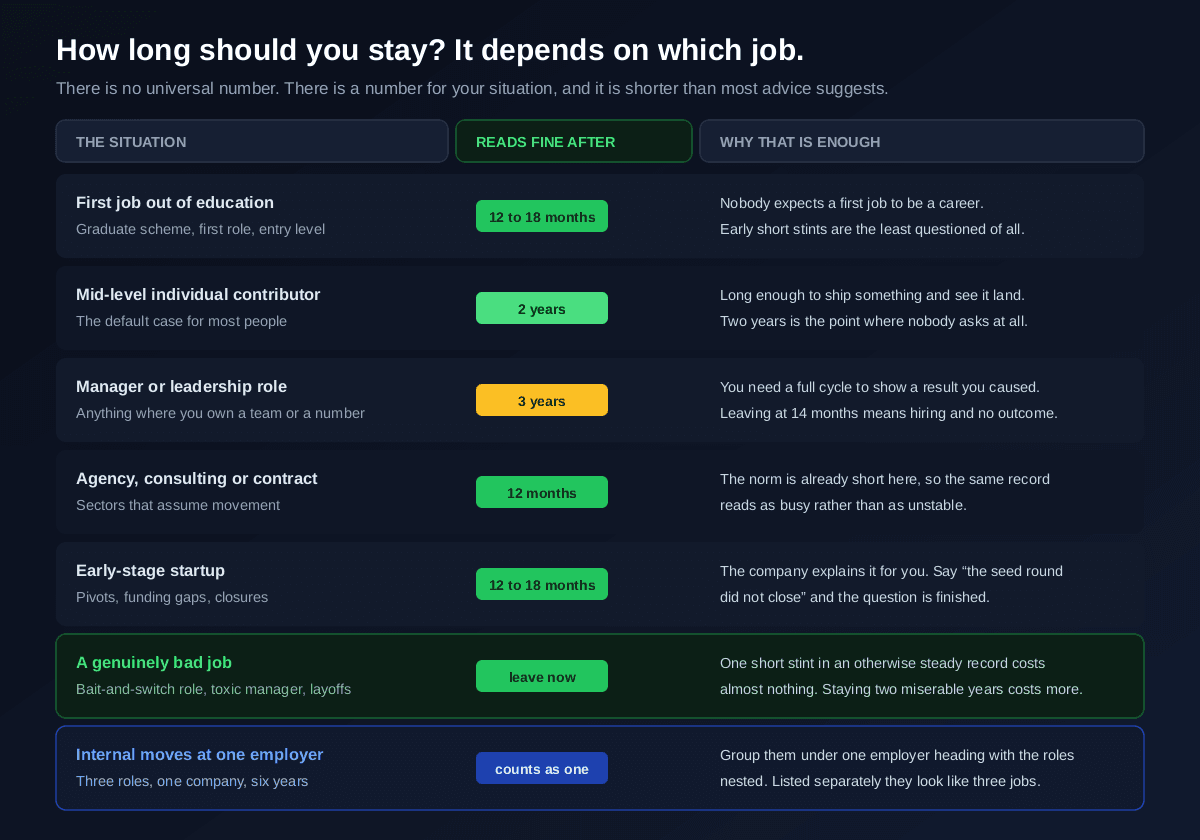
Two rows are worth reading twice. The manager row is the one people underestimate: leadership results take longer to appear than individual ones, so a manager who joins, hires two people, changes how the team works and leaves at fourteen months has produced disruption and left before anyone could tell whether it worked.
And the internal moves row is free presentation value that people routinely give away. Three roles at one employer over six years is one tenure, so group it under a single employer heading with the positions nested beneath. Listed as three separate entries, it looks like three jobs.
Calibrate against your sector, not a national average
Is job hopping bad? The honest ledger
It is a trade, not a flaw, and it is a good trade right up until it is not. Both sides of this are real and most articles only give you one of them.
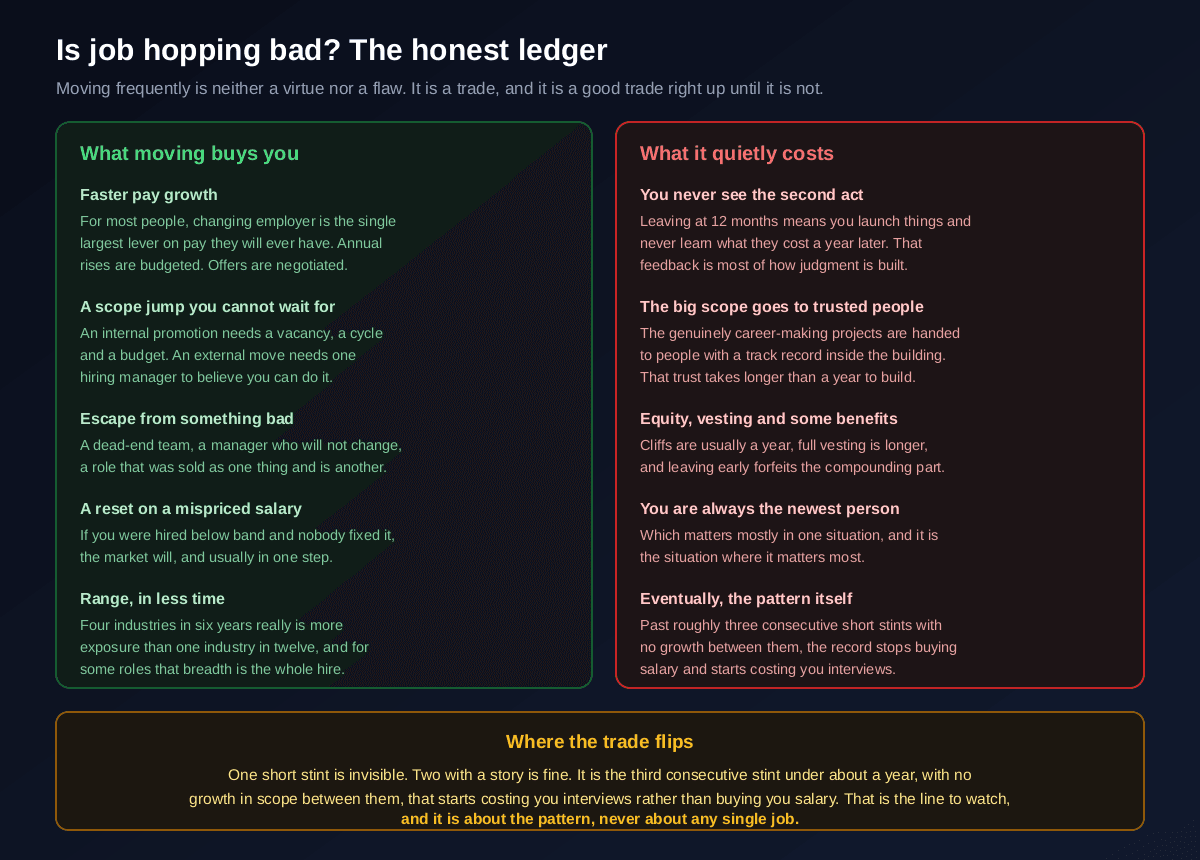
On the benefit side, the pay point is worth stating plainly because it explains why the practice persists despite all the advice against it. Internal rises come from a budget set before anyone considered you, constrained by a band and by what your peers get, and often capped as a percentage. An external offer has none of those constraints: it is priced against today's market and it is negotiated rather than allocated. That gap is the whole mechanism. See how to negotiate salary for the external side and how to ask for a raise for the internal one.
On the cost side, the underrated one is the first: leaving at twelve months means you ship things and never learn what they cost a year later, and that feedback loop is most of how judgment gets built. The effect also weakens with seniority, because senior pay leans on equity that needs time to vest, so leaving early forfeits the part that was meant to be the reward.
What recruiters actually see
Not a job count. A shape. There are effectively four, and only one of them causes real trouble.

The practical implication is the most useful thing in this article. Most people with a hopping-looking resume actually did grow, and simply failed to write it down. The titles stayed similar while the scope changed, and nothing on the page records it. Surfacing that growth, with team sizes, budgets and numbers, converts a churn read into a climb read without changing a single date.
That is the same work as quantifying achievements on a resume, applied to the specific problem of making a trajectory legible. If your resume is getting filtered before a human reads it, why your resume gets rejected and the ATS-friendly resume cover the mechanics.
Should a short job go on the resume?
Three questions, in order. Only the first has a hard answer, and it is the one people get wrong.
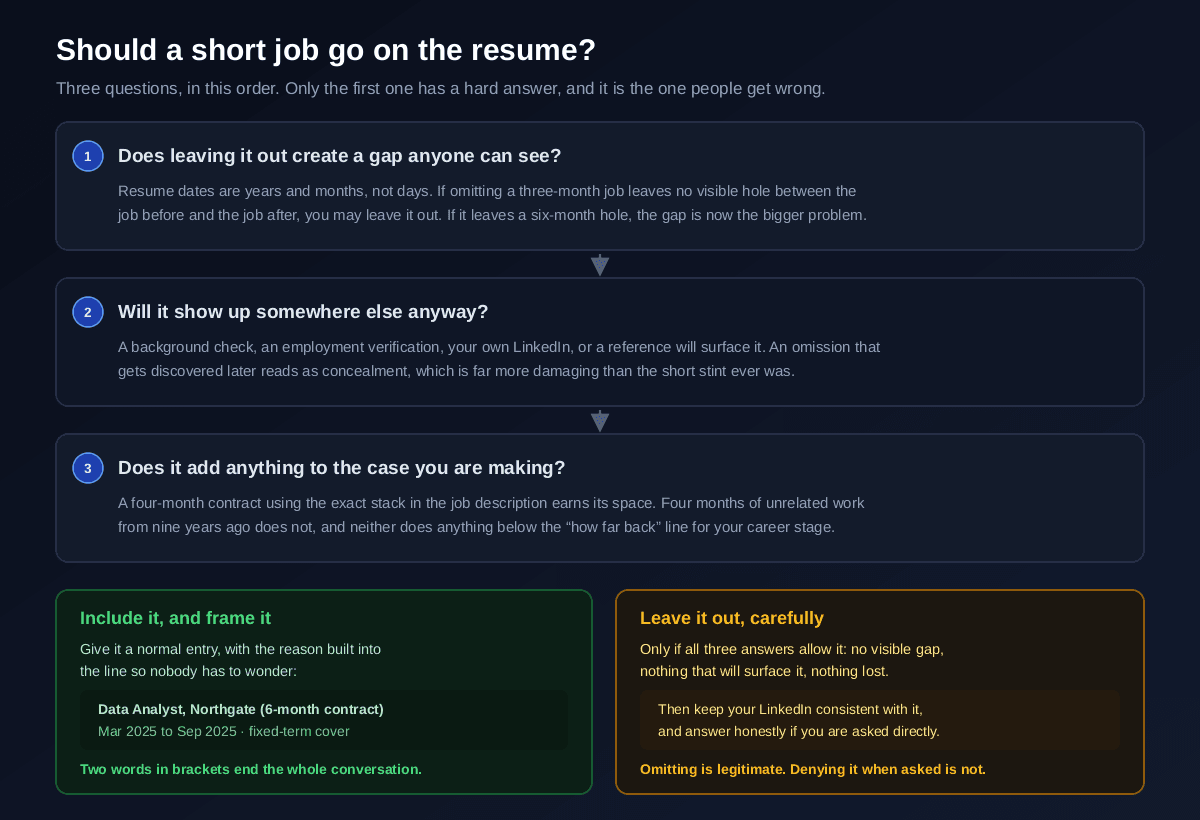
The trap is trading a short stint for an unexplained gap, which is usually worse. Resume dates are years and months rather than days, so omitting a three-month job sometimes leaves no visible hole at all, and sometimes leaves six months of silence. Explaining employment gaps covers the other side of that trade, and how far back a resume should go tells you what you can simply drop for being old rather than for being short.
When you do include it, frame it in the entry itself. Three words in brackets end the question before it is asked: (6-month contract), (fixed-term cover), (role made redundant). And note the honest boundary: choosing not to list a role is legitimate, while denying it when directly asked is not, and a reference check or employment verification may surface it either way.
Three edits that fix a hopping-looking resume
Surface the growth that is already there
Add team sizes, budgets, scope and numbers to every role, so a reader can see responsibility increasing even where the titles look similar. "Marketing Executive" twice tells them nothing. "Marketing Executive, one channel" followed by "Marketing Executive, three channels and one report" tells them everything. This is the highest-return edit available and it changes no dates.
Group what can honestly be grouped
Several roles at one employer go under one employer heading with the positions nested beneath. A run of contract work goes under a single heading such as "Independent consultant, 2023 to 2025" with the clients listed as engagements underneath. Both are honest, and both stop a record of four employers looking like a record of nine.
Do not reach for a functional resume
The skills-first format that hides dates is the standard advice for this problem and it is bad advice. Recruiters read it as evasion precisely because it is used to conceal chronology, and most applicant tracking systems parse it badly, so you lose twice. Keep reverse-chronological and fix the content instead. If the pattern is genuinely churn rather than presentation, the real fix is one stable stint, which no formatting substitutes for.
How to explain job hopping in an interview
Three parts, about forty seconds, then stop. The stopping is genuinely half of it, because the most common failure here is not a bad reason, it is a good reason followed by ninety seconds of unprompted justification.
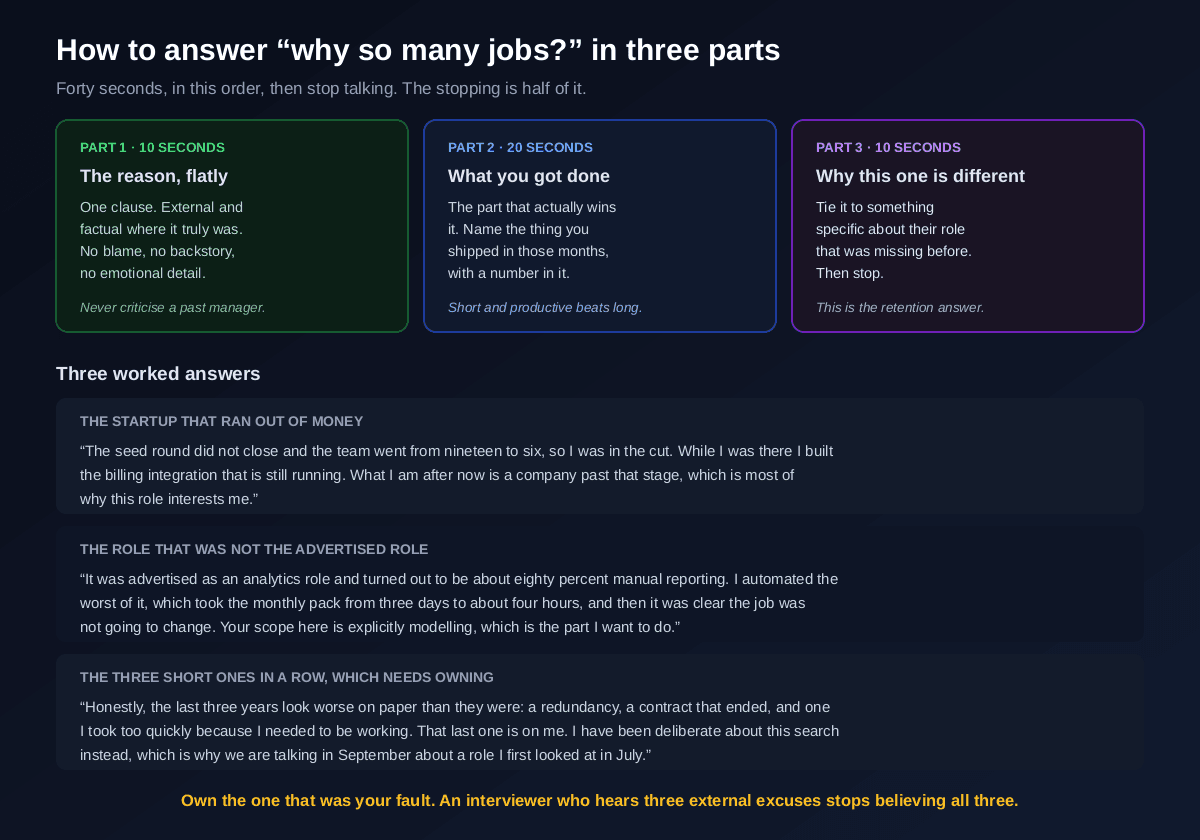
Two rules matter more than the wording. Never criticise a past manager, because the interviewer cannot verify it and will simply note that you talk about employers this way. And own the one that was your own misjudgement. An interviewer who hears three consecutive external excuses stops believing all three, whereas "that one is on me, I took it too quickly because I needed to be working" buys back credibility for the other two. It is counterintuitive and it works.
The middle part is where the answer is actually won, so prepare it like any other evidence-based answer. The STAR method gives you the structure, and reason for leaving a job covers the wording of the first part in more depth. Expect the question at the screening interview stage rather than later, since it is a filter question, and it will often arrive from a recruiter first: how to handle that conversation is in how to respond to a recruiter.
When leaving early is the right call
The instinct to stay eighteen months purely so it looks better on paper is usually wrong on the arithmetic. You spend a year of your working life to remove a question you could answer in ten seconds.
- The role is not the advertised role. Not slightly different, materially different. This gets no better by waiting, and it is the single most survivable explanation there is.
- The manager is the problem and is not changing. The most common cause of early exits, and the one least likely to resolve itself. Related reading: quiet firing.
- The company is visibly running out of runway. Leaving before the redundancy is better than leaving with it, and nobody will hold it against you.
- You are inside a probationary period. Notice is usually much shorter, which makes you one of the fastest-available candidates in any pipeline. See the probation period and notice periods.
- Your health is being affected. This one does not need a career justification.
Two honest exceptions. If your two previous roles were also short, a third does real damage, and there is genuine value in one stable stint even in a merely mediocre job, though not in a harmful one. And if you are close to a vesting cliff or a bonus date, the maths may favour a few more months. Otherwise, leave and be able to explain it, and try to line up the next role first, since searching from employment is materially easier. When you go, how to write a resignation letter keeps the exit clean.
Check whether your resume shows the growth you actually had
Most hopping-looking resumes belong to people who did grow and never wrote it down. Paste your resume and the job description into Rankid for a 0-100 match score, the requirements you have evidenced, and the keywords you are missing. One check free, no signup.
Check your resume freeFor employers: screening tenure without losing your best hires
The concern is legitimate. An early departure genuinely costs you the fee, the onboarding, the manager's months and then the whole exercise again, which is real money in cost per hire terms. The instrument almost everyone reaches for is the problem.
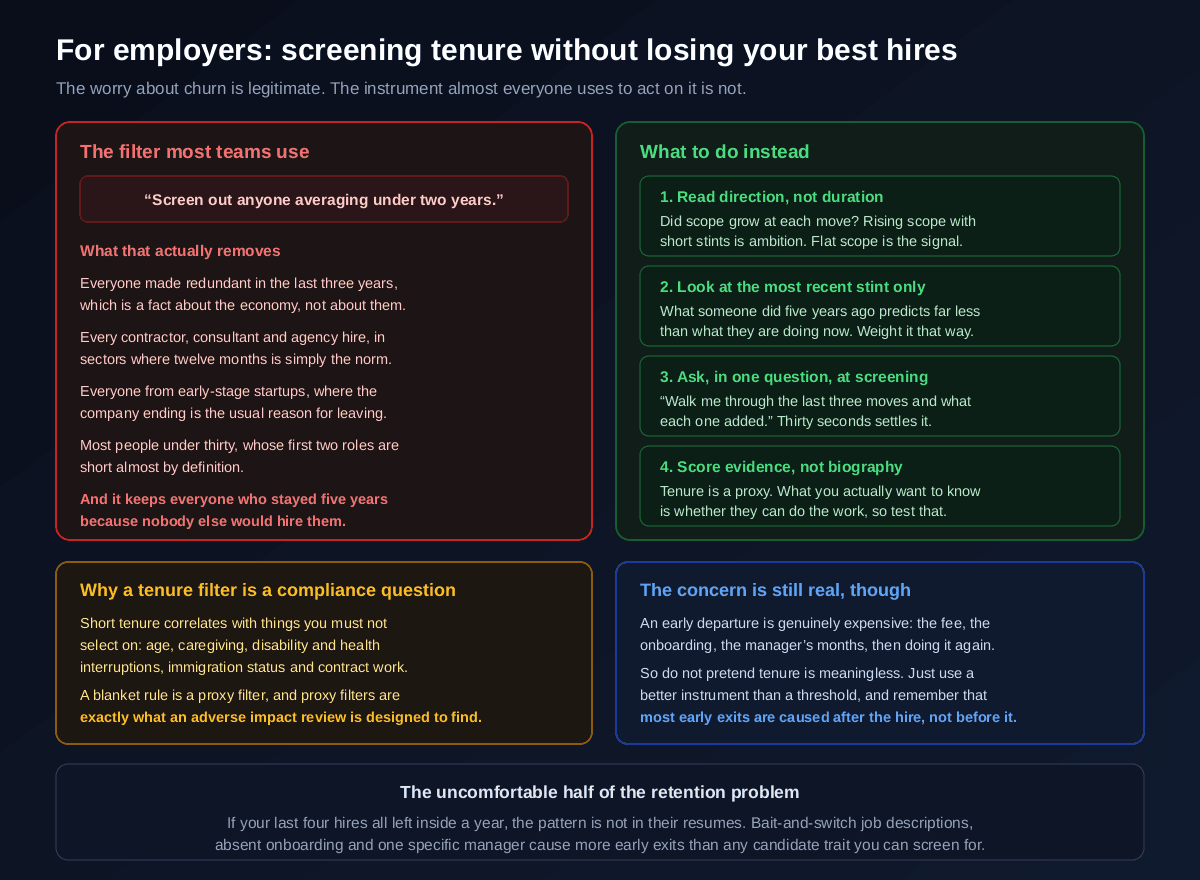
A threshold like "screen out anyone averaging under two years" is also a proxy filter, and that makes it a compliance question rather than a preference. Short tenure correlates with age, caregiving, health interruptions, immigration status and contract work, which is exactly the shape an adverse impact review exists to surface. Screen for capability instead, as in skills-based hiring, and keep your resume screening criteria tied to the work rather than to biography.
Then the uncomfortable half. If your last four hires all left inside a year, the pattern is not in their resumes. Bait-and-switch job descriptions, absent onboarding and one specific manager cause far more early exits than any candidate trait you can screen for, which is why employee turnover rate is worth measuring by manager rather than in aggregate. A serious onboarding process and an honest 30-60-90 day plan prevent more churn than any tenure filter ever will, and shortlisting candidates properly beats excluding them by rule.
Screen for evidence, not for tenure
Upload your applicants and the job description. Rankid scores every candidate against the real requirements and shows the evidence behind each score, so a strong candidate with three short stints does not get filtered out by a rule nobody reviewed. First 5 resumes free, no signup.
Try bulk screening freeFrequently asked questions
What is job hopping?
Job hopping is the pattern of changing employers frequently, and in practice the label gets attached to anyone with several stints of roughly a year or less in a row. The important word there is pattern. A single short job is not job hopping and almost nobody treats it as such, because a bad job, a redundancy or a company that ran out of money are ordinary events. What gets read as job hopping is three or more consecutive stints under about a year with no visible growth in scope between them, because that is the shape which raises a genuine question about whether the next job will also last ten months. It is also worth knowing that the label is heavily context-dependent and much softer than it was a decade ago. In agency work, consulting, contracting and early-stage startups, twelve-month tenures are simply the norm and carry no stigma at all. The same record in a sector where people stay five years reads completely differently. So the honest definition is not a number of months, it is a pattern that looks unexplained in the context of the industry you are applying to.
How long should you stay at a job?
There is no universal number, but there is a reliable one for each situation. For a first job out of education, 12 to 18 months is normal and rarely questioned by anybody. For a mid-level individual contributor, two years is the point where nobody asks at all, because it is long enough to have shipped something and seen it land. For a manager or anyone owning a team or a number, closer to three years is the bar, since you need a full cycle to show a result you actually caused rather than inherited. In agency, consulting or contract work, twelve months is completely standard. At an early-stage startup, 12 to 18 months is normal and the company usually explains the departure for you. And in a genuinely bad job, a bait-and-switch role, a toxic manager, or a team facing layoffs, the right answer is to leave when you need to, because one short stint in an otherwise steady record costs very little while two miserable years cost a great deal. One structural point people miss: several roles at the same employer count as one tenure, so group them under a single employer heading rather than listing them as separate jobs.
Is job hopping bad for your career?
It is a trade rather than a flaw, and it is a good trade up to a point. What moving frequently buys is real: for most people changing employer is the largest single lever they have on pay, because annual rises are budgeted while offers are negotiated; it delivers scope jumps that would need a vacancy, a cycle and a budget internally; it gets you out of a dead-end team or an unfixable manager; and it resets a salary that was mispriced at hire. What it quietly costs is also real and less discussed. Leaving at twelve months means you launch things and never learn what they cost a year later, and that feedback is most of how judgment gets built. The genuinely career-making projects go to people with a track record inside the building, which takes longer than a year to earn. Equity cliffs and vesting forfeit the compounding part. And you are always the newest person, which matters most in exactly the situation where it matters most. The trade flips somewhere around the third consecutive stint under a year with no growth between them, which is the point where the pattern starts costing you interviews rather than buying you salary.
How many jobs is too many on a resume?
The count is the wrong question, which is why nobody can give you a number. A resume showing six jobs in eight years where each move added scope reads as an ambitious career, and a resume showing three jobs in eight years at the same level with no progression raises more questions. What recruiters actually read is the shape of roughly the last six years, and specifically the direction: did responsibility grow at each move, or is this the same title repeatedly? So instead of counting, check your own resume for a rising line. If the last three roles show growing scope, more ownership, bigger numbers, a team appearing, then the tenures can be short and the record still reads well. If they show the same job at four companies, that is the thing to fix, either by surfacing the growth that is actually there and currently invisible, or by staying put long enough in the current role to create some. A practical rule that does help: you do not need to list everything. Anything more than about ten to fifteen years back can be compressed into a single early-career line, which removes clutter without hiding anything.
Should you put a 3-month job on your resume?
Ask three questions in order. First, does leaving it out create a gap anyone can see? Resume dates are years and months rather than days, so if omitting a three-month job leaves no visible hole between the job before and the job after, you may leave it out. If it leaves a six-month hole, you have swapped a short stint for an unexplained gap, which is usually the worse trade. Second, will it surface anyway? A background check, an employment verification, your own LinkedIn or a reference will bring it up, and an omission discovered later reads as concealment, which does far more damage than the three months ever would. Third, does it add anything? A four-month contract using the exact stack in the job description earns its place; four unrelated months from nine years ago does not. If you include it, frame it in the entry itself, because two words in brackets end the conversation before it starts: writing 'Data Analyst, Northgate (6-month contract)' tells the reader everything they were about to ask. And note the honest boundary here: choosing not to list a role is legitimate, while denying it when directly asked is not.
How do you explain job hopping in an interview?
Answer in three parts, take about forty seconds, and then stop talking. Part one is the reason, stated flatly in one clause, external and factual where it genuinely was, with no blame and no backstory: 'the seed round did not close', 'it was advertised as an analytics role and was mostly manual reporting', 'the contract ended'. Part two is what you got done anyway, and this is the part that actually wins it, so name the thing you shipped in those months with a number in it. Part three is one sentence on why this role is different, tied to something specific about their job that was missing in the last one, which is really the retention question they are asking underneath. Two rules matter more than the wording. Never criticise a past manager, because the interviewer cannot verify it and will simply note that you talk about employers this way. And if one of the moves was your own misjudgement, own that one explicitly, because an interviewer who hears three consecutive external excuses stops believing all three, whereas 'that one is on me, I took it too quickly because I needed to be working' buys back credibility for the other two.
Does job hopping increase your salary?
For most people, yes, and it is usually the largest lever available to them, which is the honest reason the practice persists despite the advice against it. The mechanism is structural rather than mysterious. Internal rises come out of a budget set before anyone considered you specifically, they are constrained by a band and by what your peers are getting, and they are frequently capped as a percentage regardless of how much your value has changed. An external offer has none of those constraints: it is priced against the market for the role today, and it is negotiated rather than allocated. That gap is what makes moving pay. Two important qualifications, though. The effect weakens as you get more senior, because senior compensation is more heavily weighted toward equity and long-term incentives that need time to vest, so leaving early forfeits the part that was supposed to be the reward. And the effect reverses once the pattern becomes the problem: a candidate on their fourth ten-month stint has fewer offers to negotiate against, which is exactly when negotiating leverage disappears.
Is it bad to leave a job after 6 months?
Once is close to free. Twice starts a pattern. A single six-month stint in an otherwise steady record is read as what it almost always is, a job that turned out to be different from the one advertised, and it takes one sentence to handle in an interview. The instinct to stay eighteen months purely so it looks better on paper is usually wrong on the arithmetic: you spend a year of your working life to remove a question you could answer in ten seconds. What changes the calculation is repetition. If your two previous roles were also short, a third short stint stops looking like circumstance and starts looking like a trait, and that is the point at which staying put has genuine value. Two practical notes if you are in a six-month job you want to leave. Try to line up the next role before resigning, since job hunting from employment is materially easier than from a gap. And if you leave inside a probationary period, your notice obligation is usually much shorter, which makes you one of the fastest-available candidates in any pipeline, and that is a genuine selling point rather than something to hide.
How do recruiters view job hopping?
Far more pragmatically than candidates fear, and they read patterns rather than counting jobs. There are effectively four shapes. The climb is short stints with rising scope, and it is almost never filtered, because each move visibly bought more responsibility. The plateau is several moves at the same level with the same title, which triggers a direct question, since the tenures are fine but the lack of movement reads as something unresolved. The churn is three or more stints under a year with no thread, and it is the only pattern that genuinely costs interviews, often before a human reads the resume at all. The escape is one short stint in an otherwise steady record, which reads as a bad job and costs almost nothing. The practical implication is that the fix is rarely about tenure and usually about making the direction visible. Most people with a hopping-looking resume actually did grow, and simply failed to write it down: the titles stayed similar while the scope changed. Surfacing that, with team sizes, budgets and numbers, converts a churn read into a climb read without changing a single date.
What is the average time people stay at a job?
Commonly cited figures put overall median employee tenure somewhere in the region of four years, with workers in their twenties and early thirties closer to two to three years, but treat all of these numbers loosely: they vary substantially by country, sector and source, and they are pulled upward by long-serving people in public sector, manufacturing and skilled trades roles. A four-year median does not mean four years is expected of you. In technology, media, agencies, startups, hospitality and retail the working norm is considerably shorter, while in government, education, healthcare and heavy industry it is considerably longer. What matters much more than any average is the norm in the specific sector you are applying to, because that is the yardstick a hiring manager is unconsciously using. A record of eighteen-month stints is unremarkable to an agency hiring manager and conspicuous to a local authority. So calibrate against your target sector rather than against a national median, and remember the general finding underneath all this: averages have drifted downward over time, and short tenure carries much less stigma than the advice written a decade ago assumes.
Does job hopping hurt you when applying for management roles?
Yes, more than it hurts an individual contributor application, and for a specific reason worth understanding. Management results take longer to appear than individual results. An engineer can ship something in three months. A manager who joins, hires two people, changes how the team works and then leaves at fourteen months has produced disruption and departed before anyone can tell whether it worked. So a hiring manager assessing you for a leadership role is looking for at least one stint long enough to contain a full cycle: you took something on, you changed it, and you were still there when the outcome landed. If your record does not have that, the way through is to be specific about the cycle you did complete rather than about the time you served. Name the thing you changed, the number that moved, and the point at which you saw it move. One completed cycle in eighteen months evidences more than three years of presence with nothing attributable. And if you genuinely have not completed one yet, that is a real argument for staying in your current role a while longer rather than for wording it more cleverly.
How do you fix a job-hopping resume?
Make the direction visible, group what can legitimately be grouped, and then stop trying to hide the dates. Three concrete moves. First, surface the growth that is already there but invisible: add team sizes, budgets, scope and numbers to each role so that a reader can see responsibility increasing even where the job titles look similar, which is the single highest-return edit available. Second, group correctly. Several roles at one employer belong under one employer heading with the positions nested underneath, and a run of contract work belongs under a single heading such as 'Independent consultant, 2023 to 2025' with the clients listed as engagements. Both are honest and both remove the appearance of many employers. Third, label the explainable ones in the entry itself, because '(6-month contract)' or '(fixed-term cover)' costs three words and pre-empts the question entirely. What does not work: functional resumes that hide dates, which recruiters read as evasion and which most applicant tracking systems parse badly. And if the pattern is genuinely churn rather than presentation, the real fix is one stable stint, which no amount of formatting substitutes for.
Should you stay at a bad job to avoid looking like a job hopper?
Almost never, and the arithmetic is worth doing explicitly. Staying an extra year in a job that is damaging you costs a year of your working life, a year of skills you are not building, a year of compounding salary you are not earning, and frequently a measurable amount of health. What it buys is the removal of one question in a future interview, a question you could answer adequately in about ten seconds. That is a bad exchange in nearly every case. There are two honest exceptions. If your two previous roles were also short, a third one does real damage, and there is genuine value in one stable stint even if the current job is mediocre, though not if it is actually harmful. And if you are close to a vesting cliff or a bonus date, the maths might favour a few more months. Otherwise, the better move is to leave and be able to explain it, since 'the role was not what was advertised, and here is what I did anyway' is a completely survivable answer, and it is far easier to deliver convincingly than two years of quiet resentment.
How should employers screen for job hopping?
Not with a tenure threshold, which is the instrument almost everyone reaches for and the one that does the most damage. A rule like 'screen out anyone averaging under two years' removes everyone made redundant in the last three years, every contractor and agency hire in sectors where twelve months is the norm, everyone from early-stage startups, and most people under thirty, while reliably keeping everyone who stayed five years because nobody else would hire them. It is also a compliance exposure, because short tenure correlates with age, caregiving, health interruptions, immigration status and contract work, which makes a blanket rule a proxy filter of exactly the kind an adverse impact review is designed to surface. Four better moves. Read direction rather than duration, since rising scope with short stints is ambition while flat scope is the actual signal. Weight the most recent stint most heavily. Ask one question at screening: 'walk me through your last three moves and what each one added', which settles it in thirty seconds. And score evidence of capability rather than biography. Then look inward: if your last four hires all left within a year, the pattern is not in their resumes.
Key takeaways
- Job hopping is a pattern, not a job count: roughly three or more stints under a year with no growth in scope between them. One short job is not job hopping.
- Nobody counts your jobs. They read the shape of the last six years, and specifically whether responsibility grew at each move.
- How long to stay depends on the role: 12 to 18 months early career or at a startup, 2 years as a mid-level IC, 3 years as a manager, 12 months in agency or contract work.
- Managers need longer because leadership results take longer to appear. Leaving at 14 months means disruption with no attributable outcome.
- Several roles at one employer count as one tenure. Group them under one employer heading or you turn one job into three.
- Moving is usually the largest lever most people have on pay, because rises are budgeted while offers are negotiated. That effect weakens with seniority.
- The trade flips at the third consecutive short stint with no growth. That is where the pattern stops buying salary and starts costing interviews.
- Four patterns: the climb (rising scope, rarely filtered), the plateau (same level, triggers questions), the churn (the only real problem), the escape (one outlier, costs nothing).
- Most hopping-looking resumes belong to people who did grow and never wrote it down. Adding scope and numbers turns a churn read into a climb read without changing a date.
- On short stints, ask three questions: does omitting it create a visible gap, will it surface anyway, does it add anything. A visible gap is usually worse than a short job.
- Label the explainable ones in the entry itself. '(6-month contract)' costs three words and ends the question.
- Do not use a functional resume to hide dates. Recruiters read it as evasion and most ATS parse it badly, so you lose twice.
- In the interview: the reason flatly, what you shipped anyway with a number, why this one is different. Forty seconds, then stop.
- Own the move that was your own misjudgement. Three consecutive external excuses and the interviewer stops believing all three.
- Staying in a bad job to protect your resume is usually a bad trade: a year of your life to remove a ten-second question.
- Employers: a tenure threshold removes the recently redundant, contractors, startup people and most under-thirties, and keeps whoever nobody else would hire. It is also a proxy filter with adverse impact exposure.
Frequently asked questions
What is job hopping?
Job hopping is the pattern of changing employers frequently, and in practice the label gets attached to anyone with several stints of roughly a year or less in a row. The important word there is pattern. A single short job is not job hopping and almost nobody treats it as such, because a bad job, a redundancy or a company that ran out of money are ordinary events. What gets read as job hopping is three or more consecutive stints under about a year with no visible growth in scope between them, because that is the shape which raises a genuine question about whether the next job will also last ten months. It is also worth knowing that the label is heavily context-dependent and much softer than it was a decade ago. In agency work, consulting, contracting and early-stage startups, twelve-month tenures are simply the norm and carry no stigma at all. The same record in a sector where people stay five years reads completely differently. So the honest definition is not a number of months, it is a pattern that looks unexplained in the context of the industry you are applying to.
How long should you stay at a job?
There is no universal number, but there is a reliable one for each situation. For a first job out of education, 12 to 18 months is normal and rarely questioned by anybody. For a mid-level individual contributor, two years is the point where nobody asks at all, because it is long enough to have shipped something and seen it land. For a manager or anyone owning a team or a number, closer to three years is the bar, since you need a full cycle to show a result you actually caused rather than inherited. In agency, consulting or contract work, twelve months is completely standard. At an early-stage startup, 12 to 18 months is normal and the company usually explains the departure for you. And in a genuinely bad job, a bait-and-switch role, a toxic manager, or a team facing layoffs, the right answer is to leave when you need to, because one short stint in an otherwise steady record costs very little while two miserable years cost a great deal. One structural point people miss: several roles at the same employer count as one tenure, so group them under a single employer heading rather than listing them as separate jobs.
Is job hopping bad for your career?
It is a trade rather than a flaw, and it is a good trade up to a point. What moving frequently buys is real: for most people changing employer is the largest single lever they have on pay, because annual rises are budgeted while offers are negotiated; it delivers scope jumps that would need a vacancy, a cycle and a budget internally; it gets you out of a dead-end team or an unfixable manager; and it resets a salary that was mispriced at hire. What it quietly costs is also real and less discussed. Leaving at twelve months means you launch things and never learn what they cost a year later, and that feedback is most of how judgment gets built. The genuinely career-making projects go to people with a track record inside the building, which takes longer than a year to earn. Equity cliffs and vesting forfeit the compounding part. And you are always the newest person, which matters most in exactly the situation where it matters most. The trade flips somewhere around the third consecutive stint under a year with no growth between them, which is the point where the pattern starts costing you interviews rather than buying you salary.
How many jobs is too many on a resume?
The count is the wrong question, which is why nobody can give you a number. A resume showing six jobs in eight years where each move added scope reads as an ambitious career, and a resume showing three jobs in eight years at the same level with no progression raises more questions. What recruiters actually read is the shape of roughly the last six years, and specifically the direction: did responsibility grow at each move, or is this the same title repeatedly? So instead of counting, check your own resume for a rising line. If the last three roles show growing scope, more ownership, bigger numbers, a team appearing, then the tenures can be short and the record still reads well. If they show the same job at four companies, that is the thing to fix, either by surfacing the growth that is actually there and currently invisible, or by staying put long enough in the current role to create some. A practical rule that does help: you do not need to list everything. Anything more than about ten to fifteen years back can be compressed into a single early-career line, which removes clutter without hiding anything.
Should you put a 3-month job on your resume?
Ask three questions in order. First, does leaving it out create a gap anyone can see? Resume dates are years and months rather than days, so if omitting a three-month job leaves no visible hole between the job before and the job after, you may leave it out. If it leaves a six-month hole, you have swapped a short stint for an unexplained gap, which is usually the worse trade. Second, will it surface anyway? A background check, an employment verification, your own LinkedIn or a reference will bring it up, and an omission discovered later reads as concealment, which does far more damage than the three months ever would. Third, does it add anything? A four-month contract using the exact stack in the job description earns its place; four unrelated months from nine years ago does not. If you include it, frame it in the entry itself, because two words in brackets end the conversation before it starts: writing 'Data Analyst, Northgate (6-month contract)' tells the reader everything they were about to ask. And note the honest boundary here: choosing not to list a role is legitimate, while denying it when directly asked is not.
How do you explain job hopping in an interview?
Answer in three parts, take about forty seconds, and then stop talking. Part one is the reason, stated flatly in one clause, external and factual where it genuinely was, with no blame and no backstory: 'the seed round did not close', 'it was advertised as an analytics role and was mostly manual reporting', 'the contract ended'. Part two is what you got done anyway, and this is the part that actually wins it, so name the thing you shipped in those months with a number in it. Part three is one sentence on why this role is different, tied to something specific about their job that was missing in the last one, which is really the retention question they are asking underneath. Two rules matter more than the wording. Never criticise a past manager, because the interviewer cannot verify it and will simply note that you talk about employers this way. And if one of the moves was your own misjudgement, own that one explicitly, because an interviewer who hears three consecutive external excuses stops believing all three, whereas 'that one is on me, I took it too quickly because I needed to be working' buys back credibility for the other two.
Does job hopping increase your salary?
For most people, yes, and it is usually the largest lever available to them, which is the honest reason the practice persists despite the advice against it. The mechanism is structural rather than mysterious. Internal rises come out of a budget set before anyone considered you specifically, they are constrained by a band and by what your peers are getting, and they are frequently capped as a percentage regardless of how much your value has changed. An external offer has none of those constraints: it is priced against the market for the role today, and it is negotiated rather than allocated. That gap is what makes moving pay. Two important qualifications, though. The effect weakens as you get more senior, because senior compensation is more heavily weighted toward equity and long-term incentives that need time to vest, so leaving early forfeits the part that was supposed to be the reward. And the effect reverses once the pattern becomes the problem: a candidate on their fourth ten-month stint has fewer offers to negotiate against, which is exactly when negotiating leverage disappears.
Is it bad to leave a job after 6 months?
Once is close to free. Twice starts a pattern. A single six-month stint in an otherwise steady record is read as what it almost always is, a job that turned out to be different from the one advertised, and it takes one sentence to handle in an interview. The instinct to stay eighteen months purely so it looks better on paper is usually wrong on the arithmetic: you spend a year of your working life to remove a question you could answer in ten seconds. What changes the calculation is repetition. If your two previous roles were also short, a third short stint stops looking like circumstance and starts looking like a trait, and that is the point at which staying put has genuine value. Two practical notes if you are in a six-month job you want to leave. Try to line up the next role before resigning, since job hunting from employment is materially easier than from a gap. And if you leave inside a probationary period, your notice obligation is usually much shorter, which makes you one of the fastest-available candidates in any pipeline, and that is a genuine selling point rather than something to hide.
How do recruiters view job hopping?
Far more pragmatically than candidates fear, and they read patterns rather than counting jobs. There are effectively four shapes. The climb is short stints with rising scope, and it is almost never filtered, because each move visibly bought more responsibility. The plateau is several moves at the same level with the same title, which triggers a direct question, since the tenures are fine but the lack of movement reads as something unresolved. The churn is three or more stints under a year with no thread, and it is the only pattern that genuinely costs interviews, often before a human reads the resume at all. The escape is one short stint in an otherwise steady record, which reads as a bad job and costs almost nothing. The practical implication is that the fix is rarely about tenure and usually about making the direction visible. Most people with a hopping-looking resume actually did grow, and simply failed to write it down: the titles stayed similar while the scope changed. Surfacing that, with team sizes, budgets and numbers, converts a churn read into a climb read without changing a single date.
What is the average time people stay at a job?
Commonly cited figures put overall median employee tenure somewhere in the region of four years, with workers in their twenties and early thirties closer to two to three years, but treat all of these numbers loosely: they vary substantially by country, sector and source, and they are pulled upward by long-serving people in public sector, manufacturing and skilled trades roles. A four-year median does not mean four years is expected of you. In technology, media, agencies, startups, hospitality and retail the working norm is considerably shorter, while in government, education, healthcare and heavy industry it is considerably longer. What matters much more than any average is the norm in the specific sector you are applying to, because that is the yardstick a hiring manager is unconsciously using. A record of eighteen-month stints is unremarkable to an agency hiring manager and conspicuous to a local authority. So calibrate against your target sector rather than against a national median, and remember the general finding underneath all this: averages have drifted downward over time, and short tenure carries much less stigma than the advice written a decade ago assumes.
Does job hopping hurt you when applying for management roles?
Yes, more than it hurts an individual contributor application, and for a specific reason worth understanding. Management results take longer to appear than individual results. An engineer can ship something in three months. A manager who joins, hires two people, changes how the team works and then leaves at fourteen months has produced disruption and departed before anyone can tell whether it worked. So a hiring manager assessing you for a leadership role is looking for at least one stint long enough to contain a full cycle: you took something on, you changed it, and you were still there when the outcome landed. If your record does not have that, the way through is to be specific about the cycle you did complete rather than about the time you served. Name the thing you changed, the number that moved, and the point at which you saw it move. One completed cycle in eighteen months evidences more than three years of presence with nothing attributable. And if you genuinely have not completed one yet, that is a real argument for staying in your current role a while longer rather than for wording it more cleverly.
How do you fix a job-hopping resume?
Make the direction visible, group what can legitimately be grouped, and then stop trying to hide the dates. Three concrete moves. First, surface the growth that is already there but invisible: add team sizes, budgets, scope and numbers to each role so that a reader can see responsibility increasing even where the job titles look similar, which is the single highest-return edit available. Second, group correctly. Several roles at one employer belong under one employer heading with the positions nested underneath, and a run of contract work belongs under a single heading such as 'Independent consultant, 2023 to 2025' with the clients listed as engagements. Both are honest and both remove the appearance of many employers. Third, label the explainable ones in the entry itself, because '(6-month contract)' or '(fixed-term cover)' costs three words and pre-empts the question entirely. What does not work: functional resumes that hide dates, which recruiters read as evasion and which most applicant tracking systems parse badly. And if the pattern is genuinely churn rather than presentation, the real fix is one stable stint, which no amount of formatting substitutes for.
Should you stay at a bad job to avoid looking like a job hopper?
Almost never, and the arithmetic is worth doing explicitly. Staying an extra year in a job that is damaging you costs a year of your working life, a year of skills you are not building, a year of compounding salary you are not earning, and frequently a measurable amount of health. What it buys is the removal of one question in a future interview, a question you could answer adequately in about ten seconds. That is a bad exchange in nearly every case. There are two honest exceptions. If your two previous roles were also short, a third one does real damage, and there is genuine value in one stable stint even if the current job is mediocre, though not if it is actually harmful. And if you are close to a vesting cliff or a bonus date, the maths might favour a few more months. Otherwise, the better move is to leave and be able to explain it, since 'the role was not what was advertised, and here is what I did anyway' is a completely survivable answer, and it is far easier to deliver convincingly than two years of quiet resentment.
How should employers screen for job hopping?
Not with a tenure threshold, which is the instrument almost everyone reaches for and the one that does the most damage. A rule like 'screen out anyone averaging under two years' removes everyone made redundant in the last three years, every contractor and agency hire in sectors where twelve months is the norm, everyone from early-stage startups, and most people under thirty, while reliably keeping everyone who stayed five years because nobody else would hire them. It is also a compliance exposure, because short tenure correlates with age, caregiving, health interruptions, immigration status and contract work, which makes a blanket rule a proxy filter of exactly the kind an adverse impact review is designed to surface. Four better moves. Read direction rather than duration, since rising scope with short stints is ambition while flat scope is the actual signal. Weight the most recent stint most heavily. Ask one question at screening: 'walk me through your last three moves and what each one added', which settles it in thirty seconds. And score evidence of capability rather than biography. Then look inward: if your last four hires all left within a year, the pattern is not in their resumes.