Job Scams in 2026: How to Spot a Fake Recruiter, Task Scam or Fake Job Offer
The message arrives on a Tuesday afternoon: a friendly recruiter, a flexible remote role, $300 a day for an hour or two of simple online work. You reply out of curiosity. Within a week you've earned $40, been paid it for real, joined a group chat of cheerful coworkers, and then been asked to deposit $500 to unlock your next set of tasks. There was never a job. There was a script, and it's one of the fastest-growing frauds in America. Here's how every major job scam works, the exact moment each one reveals itself, and a five-minute check that stops almost all of them.
Quick answer
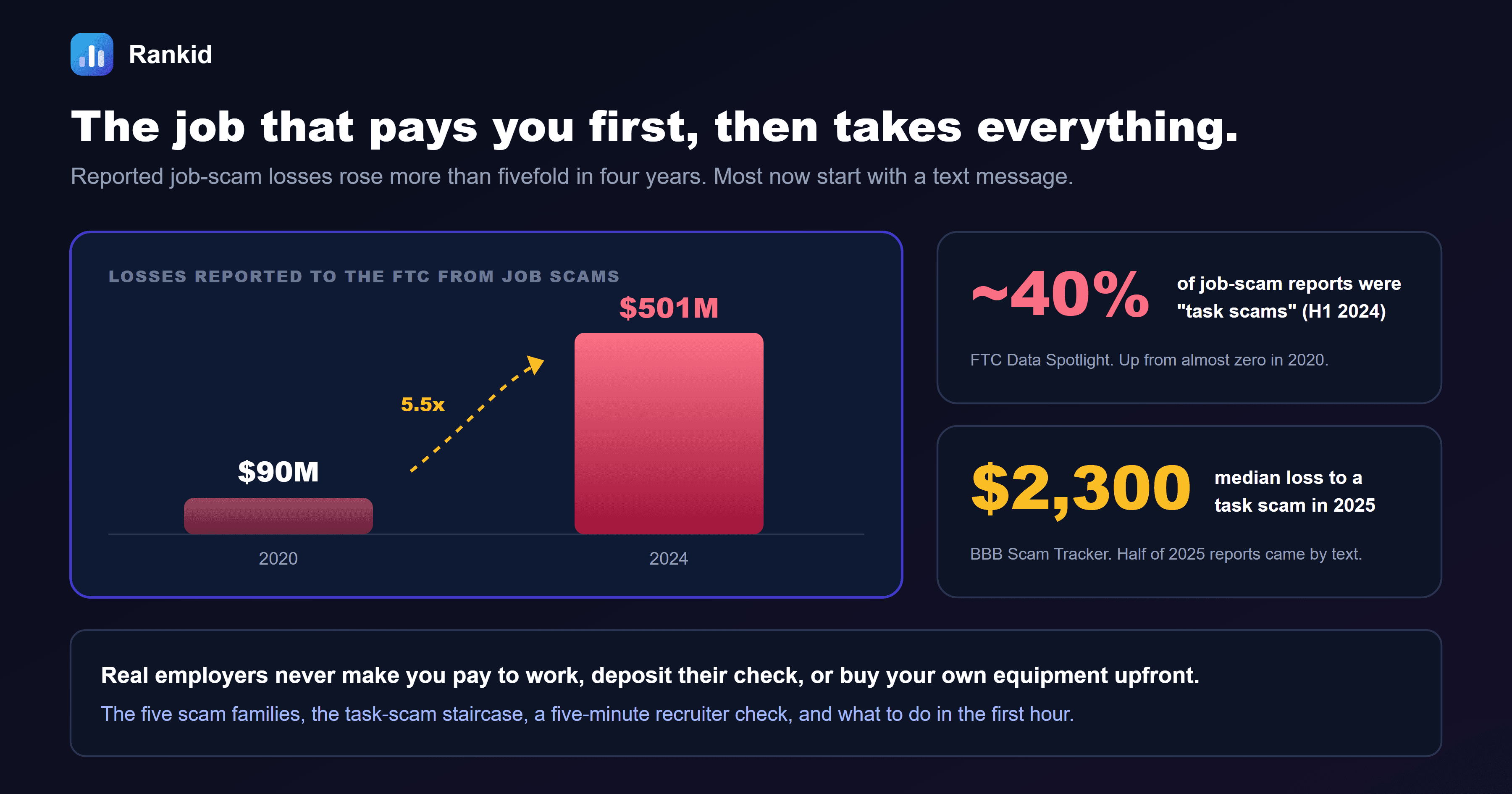
Quick answer: reported job-scam losses rose from $90 million in 2020 to $501 million in 2024 (FTC), and task scams, which pay you small amounts before demanding deposits, grew from almost nothing to about 4 in 10 job-scam reports. The universal rule: a real job never asks you to send money, deposit a check and send some back, buy equipment from its vendor, or hand over your SSN and bank login before a verified written offer. Verify any recruiter by finding the job on the company's own careers page and contacting the company through its official website. If you've already paid, call your bank within the hour.
How big the job scam problem really is
Job scams used to be a side street of consumer fraud. They're now a highway. According to the Federal Trade Commission, reports about job scams roughly tripled between 2020 and 2024, and reported losses jumped from about $90 million to $501 million. The FTC's broader "business and job opportunities" category topped $750 million in 2024, and total fraud losses reported to the FTC reached a record of about $16 billion in 2025.
The growth didn't slow in 2025. BBB Scam Tracker says employment-scam reports doubled compared with the year before, and about half of more than 23,000 employment-scam reports it received in 2025 named a text message as the way the scam arrived. And those are only the people who reported: research the BBB cites suggests fewer than 1 in 20 fraud victims report to the BBB or a government agency.
Why job seekers are such good targets
The five job-scam families
Almost every job scam falls into one of five families. They open the same way, with a plausible job, and they all flip at one identifiable moment: the ask, when money or identity starts flowing toward the scammer. Learn to spot the ask and the rest of the costume stops mattering.
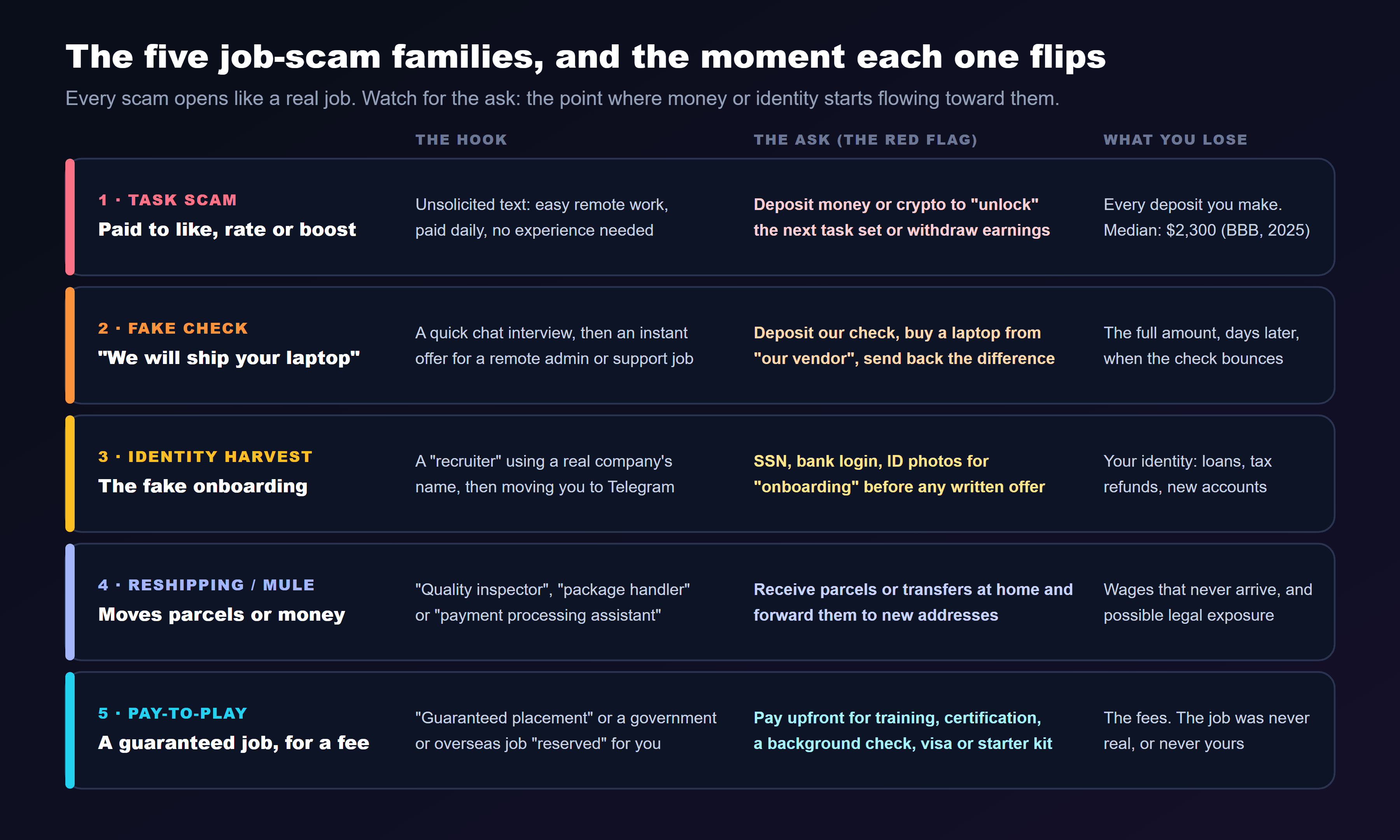
- 1. Task scams.Paid to like videos, rate products, "boost" apps or review hotels. They're the fastest-growing family and the most psychologically sophisticated, so they get their own section below.
- 2. Fake check and equipment scams.After a short chat "interview," you're hired for a remote admin, data entry or customer support role. They send a check to cover your laptop and software, which you must buy from their approved vendor, and ask you to send back any excess. Banks make deposited funds available within days, but a fake check can take much longer to bounce, and when it does, you owe the full amount.
- 3. Identity harvesting.The "recruiter" borrows a real company's name and logo and asks you to complete onboarding: your Social Security number, a photo of your driver's license, your bank login "for direct deposit," sometimes a video selfie. There's no paycheck coming. The prize is your identity.
- 4. Reshipping and money-mule jobs.Titles like "quality control inspector" or "payment processing assistant." You receive packages bought with stolen cards and reship them, or receive money and send it on. The promised wages never arrive, and you may become the traceable link in someone else's crime.
- 5. Pay-to-play.A guaranteed job or placement, a government or overseas role "reserved" for you, if you first pay for training, certification, a background check, a visa or a starter kit. Legitimate employers pay for their own background checks.
Inside a task scam: the staircase that only goes one way
Task scams deserve special attention because they break the instincts people rely on. The classic warning, "never pay to get a job," doesn't fire, because the scam starts by paying you. The FTC counted about 5,000 task-scam reports in all of 2023 and about 20,000 in just the first half of 2024, when task scams made up nearly 40% of job-scam reports. BBB data puts the median loss at about $2,300 in 2025, well above the typical job scam, and individual victims have lost tens of thousands of dollars.
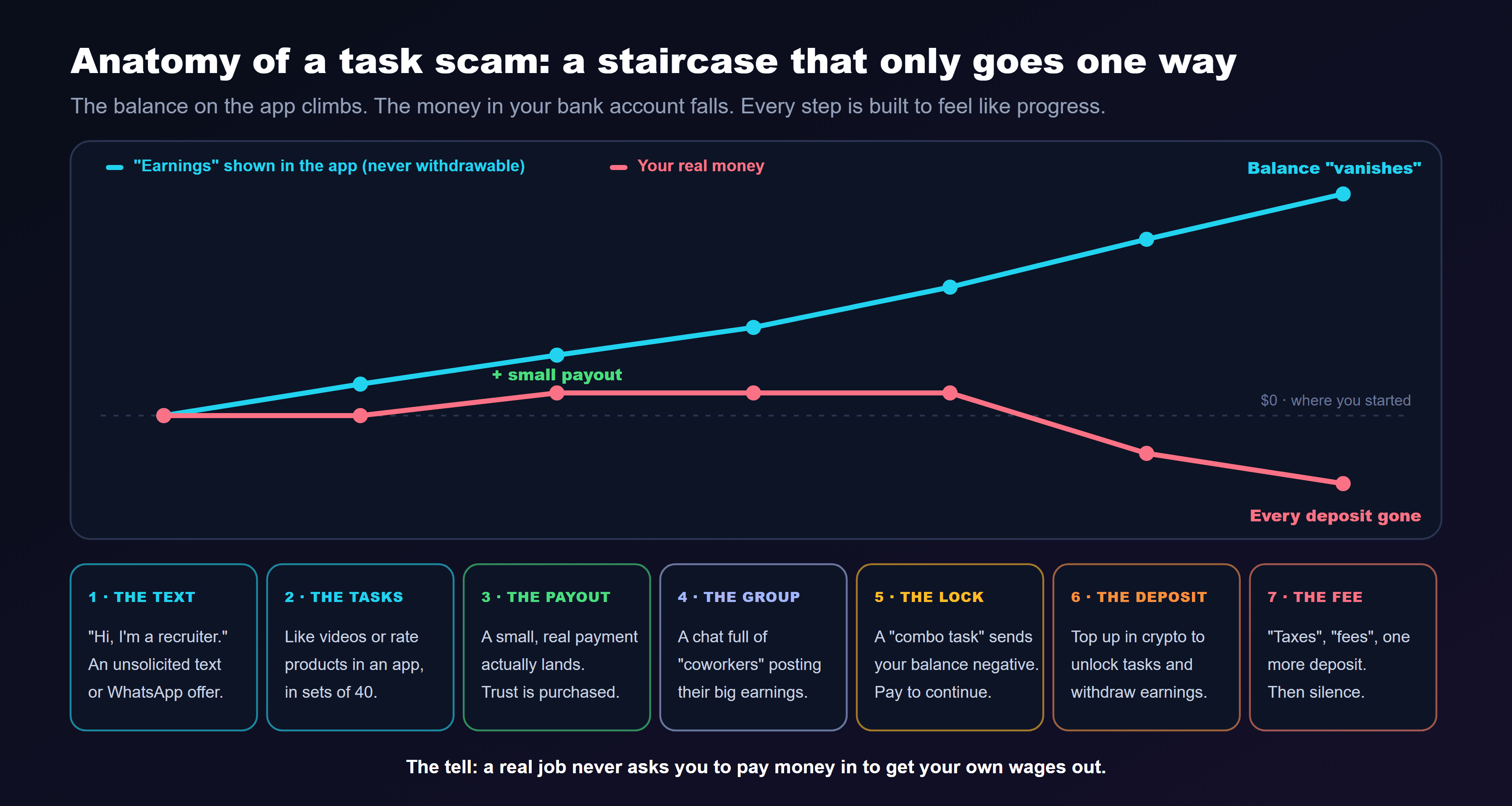
The mechanics are borrowed from mobile games, which is why the FTC calls them "gamified" job scams. Tasks come in sets, often of 40. Your balance ticks up with each click. You "level up." A small withdrawal succeeds, which is the most expensive $40 the scammer will ever spend. A group chat fills with "coworkers" posting screenshots of big payouts. Then a "combination" or "premium" task drives your balance negative, and the only way to recover your earnings is to deposit money, usually in cryptocurrency. Each deposit unlocks a bigger task and a bigger shortfall, until the final ask is a "tax" or "withdrawal fee." After that, the account is frozen and the chat goes quiet.
The one-sentence test for task scams
Real recruiter or scammer? Seven tells
Real recruiters do reach out unexpectedly, and our guide on how to respond to a recruitercovers the genuine kind. The difference isn't whether someone contacts you first. It's the pattern that follows.
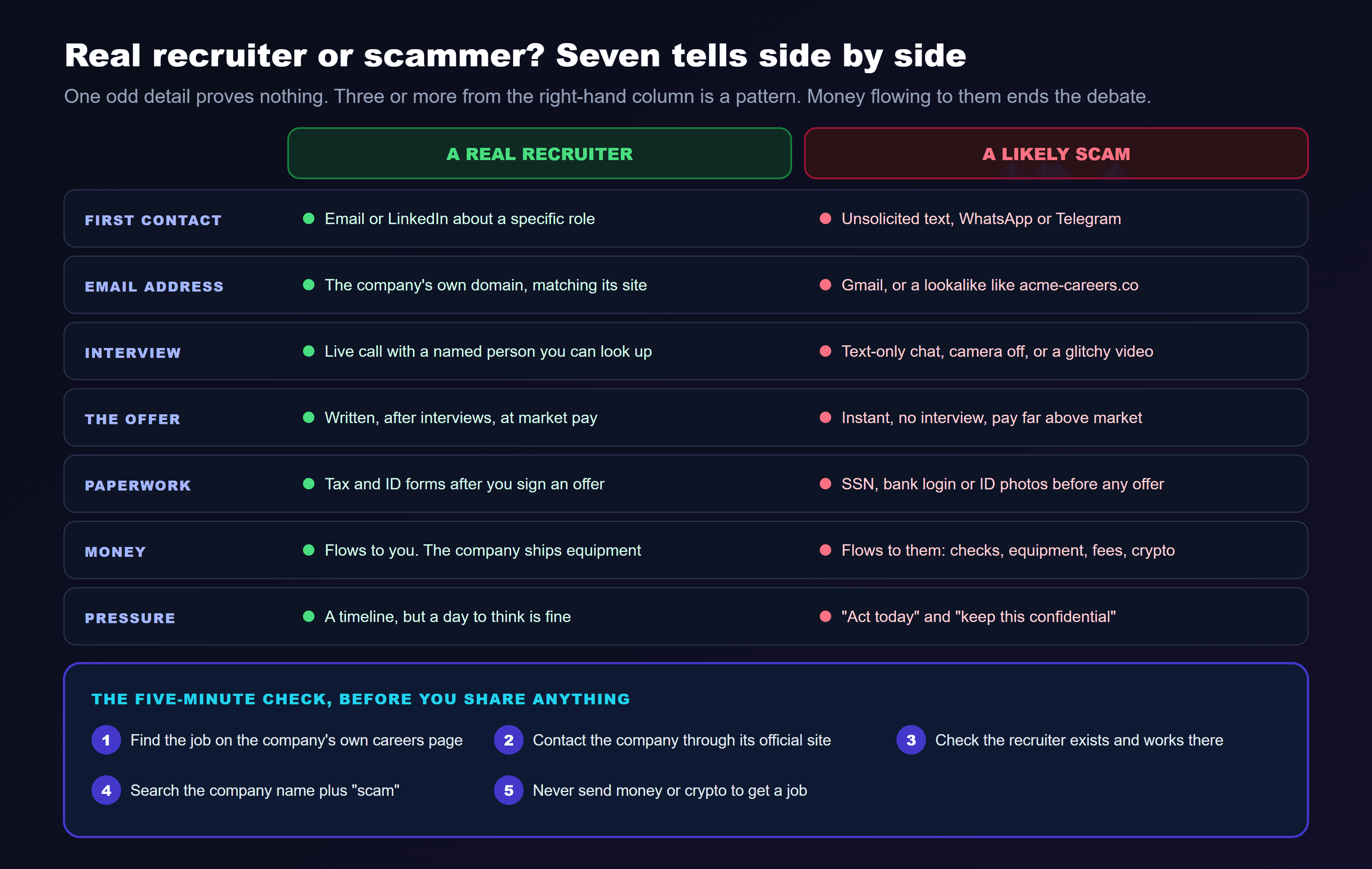
- The channel.The FTC's advice is blunt: ignore generic, unexpected texts, WhatsApp or Telegram messages about jobs. A newer twist asks you to reply "YES" rather than click a link, to slip past spam filters and confirm your number is live.
- The email address. Look past the display name to the actual domain. Free email accounts and lookalikes, a hyphen here or a swapped letter there, are red flags.
- The interview.A real process asks real questions about your experience. Scam "interviews" are often text-only chats. Some now use real-time face-swapping on video, so watch for lips out of sync, odd lighting and a camera that "won't work."
- The offer. Instant, unconditional and generous. Compare the pay to the market: our guide to responding to a job offer covers what a real one contains.
- The paperwork. Real employers collect tax and identity documents after you accept a written offer, through secure HR systems. An offer letter names the company, role, pay and start date, and you can confirm it with the company directly.
- The money. In a real job, money only ever flows to you. This tell alone is decisive.
- The pressure."We have other candidates, sign today" and "keep this confidential" are designed to stop you from asking anyone else.
The five-minute verification check
Before you share anything beyond your resume, run these five steps. They take less time than filling out one application form.
Find the job on the company's own careers page
Contact the company through its official channels
Check the recruiter is real and works there
Search the company name plus 'scam'
Refuse any request to send money or crypto
Spend your energy on real jobs you can actually win
Paste your resume and a verified job posting into Rankid for a free 0-100 match score and the exact requirements you meet and miss. Real postings have real requirements, and the better your fit, the fewer 'too good to be true' offers you'll be tempted by. No signup required.
Check your match score freeAlready scammed? What to do in the first hour
Speed matters, and shame is the scammer's best friend. These schemes fool careful, intelligent people every day. Work through this list in order.
- Stop contact and stop paying.Don't send "one last" payment to unlock your funds, and be wary of anyone who contacts you offering to recover the money for a fee. Recovery scams target recent victims.
- Call your bank or card issuer. Ask them to stop or reverse transfers and flag the fake check if you deposited one. For crypto, contact the exchange you used immediately.
- Protect your identity. If you shared your SSN or ID, place a free fraud alert or credit freeze with the credit bureaus and file a report at IdentityTheft.gov for a recovery plan.
- Secure your accounts. Change any password you shared or reused, and turn on two-factor authentication for email and banking.
- Report it.File at ReportFraud.ftc.gov, with the FBI's Internet Crime Complaint Center (IC3) if money was lost, and with the platform where the contact began. If a real company was impersonated, tell it too.
- Keep the evidence. Screenshots of messages, profiles, wallet addresses, transaction IDs and check images all help banks and investigators.
- If you forwarded packages or money, stop now.Don't forward anything else, tell your bank, and consider speaking to a lawyer.
How to job hunt safely without becoming paranoid
The goal isn't to distrust every recruiter. It's to make scams expensive for scammers and cheap for you to spot.
- Keep sensitive data off your resume. Your resume needs a city, email, phone and LinkedIn, not your full address, date of birth or ID numbers.
- Use a dedicated job-search email. It makes scam patterns easier to see and keeps your main inbox clean.
- Apply at the source.Where possible, apply through the company's own careers site.
- Slow down at the ask. The moment anyone requests money, identity documents or a move to an encrypted chat app, pause and run the five-minute check.
- Target real fit. A focused search with a tailored resume brings real interviews, which is the best defence against the desperation scammers exploit.
For employers: your brand is someone else's bait
Scammers impersonate real, well-known companies because trust is the product. You can't stop every fake profile, but you can make impersonation easy for candidates to detect, and that protects your candidate experience and your reputation.
- Publish a recruitment fraud notice. On your careers page, state how you contact candidates, which email domains you use, that you never charge fees or ask candidates to buy equipment, and how to verify a recruiter.
- Keep every real job on your own site.If a role isn't on your careers page, candidates can safely assume it isn't real.
- Run a clean, recognisable process. Consistent email templates, named interviewers and onboarding through a known HR system make fakes stand out.
- Monitor and report. Watch for lookalike domains and fake recruiter profiles, and report them to the platforms and to the FTC.
- Remember fraud runs both ways. Some fraudsters target employers instead, applying as fake job candidates. The same principle applies: verify through channels you control.
Screen real candidates quickly, and fairly
Rankid scores every resume against your job description on a consistent 0-100 scale and shows the exact requirements each candidate matched and missed, so your team spends less time sorting and more time on a clear, verifiable process candidates can trust. First 5 resumes free, no signup.
Try bulk screening freeFrequently asked questions
What is a job scam?
A job scam is a fake job offer or recruitment process used to take your money, your personal information, or your unpaid labour. Scammers pose as recruiters or employers, often using real company names, and the 'job' ends with a request to pay a fee, deposit a check and send money back, buy equipment from their vendor, hand over your Social Security number and bank details, or move packages or money for them.
How common are job scams?
Very, and growing. FTC data shows reported losses to job scams rose from about $90 million in 2020 to about $501 million in 2024, while reports roughly tripled. BBB Scam Tracker reports of employment scams doubled again in 2025. Because only a small share of victims ever report fraud, the real totals are much higher.
What is a task scam?
A task scam is a fake online job where you are paid to do simple tasks, like liking videos, rating products or 'optimising' apps, through a platform that shows your earnings climbing. You may receive a small real payment at first to build trust. Then a special task pushes your balance negative, or you are told to deposit money, usually cryptocurrency, to unlock more tasks or withdraw your earnings. The earnings were never real, and deposits are not returned. The FTC says task scams went from almost no reports in 2020 to about 4 in 10 job-scam reports in the first half of 2024.
How can I tell if a recruiter is fake?
Look for a pattern: an unsolicited text, WhatsApp or Telegram message; a personal email address or lookalike domain; an interview done entirely by text chat or with the camera off; an instant offer with pay far above market; requests for your SSN, bank login or ID photos before a written offer; and above all any request for you to send money. Verify by finding the job on the company's own careers page and contacting the company through its official website, not through contact details the recruiter gave you.
Do real employers ask you to buy equipment?
Legitimate employers either ship equipment to you directly or reimburse you through a normal expense process after you start. They don't send you a check to deposit so you can buy equipment from a vendor they choose, and they never ask you to send part of a check back. That pattern is the classic fake check scam: the check bounces days later and you owe your bank the full amount.
Is it safe to give my Social Security number to a recruiter?
Not before you have a written job offer that you have verified independently. US employers need your SSN for payroll and tax forms, and some background checks need it, but that normally happens after an offer, through the employer's own HR or onboarding system, not by text or email to a recruiter you have never verified. A request for your SSN, bank login or ID photos early in the process is one of the strongest scam signals.
Can a job interview be fake?
Yes. Scammers run text-only 'interviews' on chat apps, send fake interview documents, and in some cases use real-time face-swapping or AI avatars on video calls to impersonate real hiring managers. Signs include an interview with no real questions about your experience, glitches such as lips out of sync with speech, and a job offer at the end of a single short conversation.
What should I do if I've been scammed by a fake job?
Act within the hour if you can. Stop all contact and don't send more money, even to 'recover' what you lost. Call your bank or card issuer to stop or reverse payments. If you shared your SSN, place a free fraud alert or credit freeze with the credit bureaus and report identity theft at IdentityTheft.gov. Change passwords you shared, report the scam at ReportFraud.ftc.gov and to the FBI's IC3 if money was lost, report the profile or message to the platform, and keep screenshots of everything.
Can I get in trouble for a reshipping or payment processing job?
Possibly. Jobs that ask you to receive packages and forward them, or receive money and transfer it on, are often used to move stolen goods or launder money, and the person doing the forwarding can become the traceable link in the chain. If you think you've been drawn into one, stop immediately, don't forward anything else, and report it to your bank and to law enforcement.
Are job scams on LinkedIn and Indeed?
Yes. Scammers create fake recruiter profiles and fake company pages, and fake postings do get through on legitimate job boards, even though the platforms remove many of them. Scam messages increasingly start on a trusted site and then try to move you to WhatsApp, Telegram or Signal, where there is less moderation. A request to move the conversation off-platform early is a warning sign.
How can employers protect candidates from scammers impersonating them?
Publish a recruitment fraud notice on your careers page stating how you contact candidates, which email domains you use, and that you never charge fees or ask candidates to buy equipment. Keep every legitimate job on your own careers site, give candidates a way to verify a recruiter, monitor for lookalike domains and fake profiles, and report impersonation to the platforms and the FTC.
Key takeaways
- Reported job-scam losses rose from about $90 million in 2020 to $501 million in 2024 (FTC), and BBB employment-scam reports doubled again in 2025.
- Almost every job scam belongs to one of five families: task scams, fake check and equipment scams, identity harvesting, reshipping or money-mule jobs, and pay-to-play fees.
- Each one flips at 'the ask', the moment money or identity starts flowing to the scammer. In a real job, money only flows to you.
- Task scams pay you a little first, then demand deposits to unlock tasks or withdraw earnings. They made up about 4 in 10 job-scam reports in early 2024, with a 2025 median loss of about $2,300.
- Fake recruiters show a pattern: texts or chat apps, personal or lookalike email domains, text-only or camera-off interviews, instant offers above market, and early requests for SSN or bank details.
- Verify in five minutes: find the job on the company's careers page, contact the company through its official site, check the recruiter, search for scam reports, and never send money.
- If you've been scammed, stop paying, call your bank, freeze your credit if you shared your SSN, report to the FTC and IC3, and keep all evidence.
- Employers should publish a recruitment fraud notice, keep every real job on their own site, and run a recognisable process so impersonators stand out.
Frequently asked questions
What is a job scam?
A job scam is a fake job offer or recruitment process used to take your money, your personal information, or your unpaid labour. Scammers pose as recruiters or employers, often using real company names, and the 'job' ends with a request to pay a fee, deposit a check and send money back, buy equipment from their vendor, hand over your Social Security number and bank details, or move packages or money for them.
How common are job scams?
Very, and growing. FTC data shows reported losses to job scams rose from about $90 million in 2020 to about $501 million in 2024, while reports roughly tripled. BBB Scam Tracker reports of employment scams doubled again in 2025. Because only a small share of victims ever report fraud, the real totals are much higher.
What is a task scam?
A task scam is a fake online job where you are paid to do simple tasks, like liking videos, rating products or 'optimising' apps, through a platform that shows your earnings climbing. You may receive a small real payment at first to build trust. Then a special task pushes your balance negative, or you are told to deposit money, usually cryptocurrency, to unlock more tasks or withdraw your earnings. The earnings were never real, and deposits are not returned. The FTC says task scams went from almost no reports in 2020 to about 4 in 10 job-scam reports in the first half of 2024.
How can I tell if a recruiter is fake?
Look for a pattern: an unsolicited text, WhatsApp or Telegram message; a personal email address or lookalike domain; an interview done entirely by text chat or with the camera off; an instant offer with pay far above market; requests for your SSN, bank login or ID photos before a written offer; and above all any request for you to send money. Verify by finding the job on the company's own careers page and contacting the company through its official website, not through contact details the recruiter gave you.
Do real employers ask you to buy equipment?
Legitimate employers either ship equipment to you directly or reimburse you through a normal expense process after you start. They don't send you a check to deposit so you can buy equipment from a vendor they choose, and they never ask you to send part of a check back. That pattern is the classic fake check scam: the check bounces days later and you owe your bank the full amount.
Is it safe to give my Social Security number to a recruiter?
Not before you have a written job offer that you have verified independently. US employers need your SSN for payroll and tax forms, and some background checks need it, but that normally happens after an offer, through the employer's own HR or onboarding system, not by text or email to a recruiter you have never verified. A request for your SSN, bank login or ID photos early in the process is one of the strongest scam signals.
Can a job interview be fake?
Yes. Scammers run text-only 'interviews' on chat apps, send fake interview documents, and in some cases use real-time face-swapping or AI avatars on video calls to impersonate real hiring managers. Signs include an interview with no real questions about your experience, glitches such as lips out of sync with speech, and a job offer at the end of a single short conversation.
What should I do if I've been scammed by a fake job?
Act within the hour if you can. Stop all contact and don't send more money, even to 'recover' what you lost. Call your bank or card issuer to stop or reverse payments. If you shared your SSN, place a free fraud alert or credit freeze with the credit bureaus and report identity theft at IdentityTheft.gov. Change passwords you shared, report the scam at ReportFraud.ftc.gov and to the FBI's IC3 if money was lost, report the profile or message to the platform, and keep screenshots of everything.
Can I get in trouble for a reshipping or payment processing job?
Possibly. Jobs that ask you to receive packages and forward them, or receive money and transfer it on, are often used to move stolen goods or launder money, and the person doing the forwarding can become the traceable link in the chain. If you think you've been drawn into one, stop immediately, don't forward anything else, and report it to your bank and to law enforcement.
Are job scams on LinkedIn and Indeed?
Yes. Scammers create fake recruiter profiles and fake company pages, and fake postings do get through on legitimate job boards, even though the platforms remove many of them. Scam messages increasingly start on a trusted site and then try to move you to WhatsApp, Telegram or Signal, where there is less moderation. A request to move the conversation off-platform early is a warning sign.
How can employers protect candidates from scammers impersonating them?
Publish a recruitment fraud notice on your careers page stating how you contact candidates, which email domains you use, and that you never charge fees or ask candidates to buy equipment. Keep every legitimate job on your own careers site, give candidates a way to verify a recruiter, monitor for lookalike domains and fake profiles, and report impersonation to the platforms and the FTC.