Internal Recruitment: Advantages, Disadvantages and How to Screen Internal Candidates (2026)
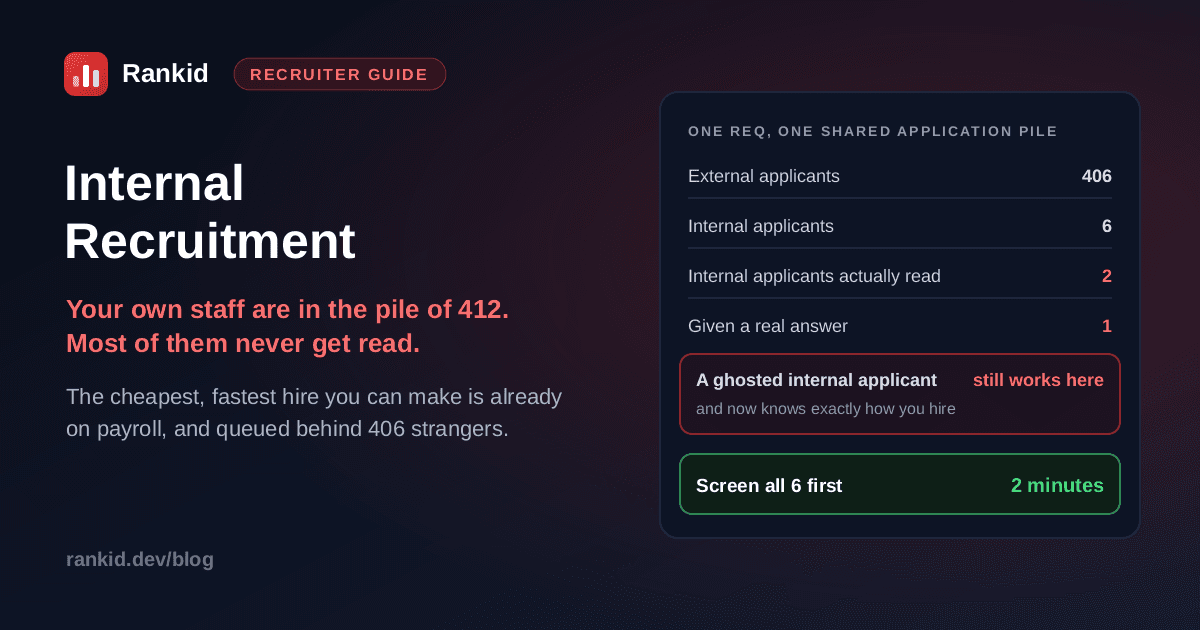
A requisition opens. Four hundred and twelve people apply, and six of them already work for you. Those six are, on paper, the most knowable candidates in the pile: you have real performance data, you know how they behave in a crisis, and you know whether their colleagues trust them. On most requisitions, two of the six get read and one gets an actual answer. That is not a strategy failure. It is an inbox failure, and it is fixable.
Quick answer
What is internal recruitment?
Internal recruitment is filling an open role with someone who already works for the organisation instead of hiring from outside. It is one half of the standard pairing of internal and external sources of recruitment, and in most companies it is the half that gets talked about more than it gets done.
The internal sources of recruitment, in the order you will meet them:
- Promotion. A move up a level, usually within the same function. The most visible form and the one everyone else in the team watches closely.
- Transfer or lateral move. A sideways move into a different team, function or location at a similar level. Underused, and often the highest-value move available because it keeps institutional knowledge while filling a genuine gap.
- Internal job posting. Advertising the role to staff before, or alongside, external advertising. The mechanism that makes the rest possible.
- Contractor, intern or fixed-term conversion. Someone already doing the work, already assessed in the most realistic way possible, and already productive.
- Rehiring former employees. Boomerang hires. They know the systems, and they left for a reason worth understanding before you re-offer.
- Employee referrals. Strictly an internal channel producing an external hire, but it usually sits in the same conversation.
For contrast, external sources of recruitment are job boards, direct sourcing, agencies, careers-page applications, events and campus hiring. Most organisations run both, and the useful question is not which is better but which you should exhaust first.
What is an internal candidate?
An internal candidate is a current employee being considered for a different role in the same organisation. Definitions usually stretch to contractors, interns and fixed-term staff, though policies vary on whether they go through the same application process.
What actually distinguishes an internal candidate is not their skills, it is your information. For an external candidate you have a document they wrote about themselves, a few hours of interviews and two references they chose. For an internal candidate you have years of observed work. That asymmetry is the entire argument for internal recruitment, and it is routinely thrown away by a process that evaluates them on the document instead.
Internal mobility vs internal recruitment
These get used interchangeably and they describe different things. Internal recruitment is an event: this role, filled from inside. Internal mobility, also called internal talent mobility, is the system that makes those events likely: roles visible to staff, skills recorded somewhere searchable, managers who do not quietly block their people from moving, and career paths that exist as more than a slide.
You can do internal recruitment occasionally while having no internal mobility at all, and that is the situation most companies are in. The tell is simple: if filling a role internally depends on a hiring manager happening to remember someone, you have anecdotes, not a system.
The blocker is usually a manager, not a policy
Internal vs external recruitment, compared
The gaps are large and consistent in direction, even though the exact numbers depend on your roles and market.
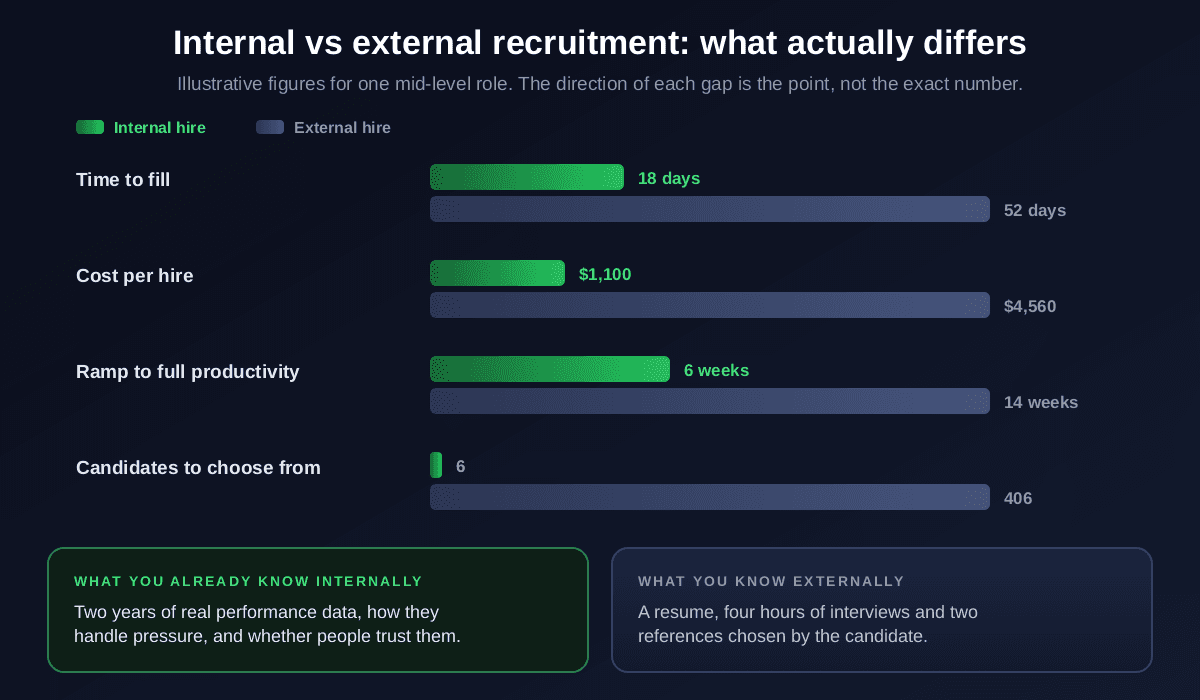
Three of those four rows favour internal hiring heavily. The fourth is the honest counterweight and it matters: your internal pool is a rounding error next to the external one. Six people versus four hundred means the single best available candidate for a specialist role is very often outside, and pretending otherwise produces mediocre internal promotions that everybody can see are mediocre.
The cost gap is worth understanding rather than just quoting. An internal hire skips advertising, agency fees and most of the screening load, and the screening load is the largest hidden line item in cost per hire. It does not skip onboarding, and it does not skip the second vacancy it creates.
Advantages of internal recruitment
- Speed. No advertising cycle, no waiting for applications to accumulate, no notice period from another employer. Weeks rather than months.
- Cost. No job ads, no agency fee, and a fraction of the screening hours.
- Lower risk. You are deciding with performance evidence rather than inference. Most bad external hires are people who interviewed well, and that failure mode largely does not exist internally.
- Faster ramp. They know the systems, the data, the politics and who to ask. Institutional knowledge is expensive to rebuild and free to move sideways.
- Retention, in both directions. The person promoted stays, and everyone watching learns that progression here is real. This is the compounding benefit and the one nobody measures.
- It fills roles your market cannot. For hard-to-hire skills, growing someone adjacent is sometimes the only route that terminates, which is where internal recruitment meets workforce planning.
Disadvantages of internal recruitment
- The pool is tiny. Six candidates is not a competitive process. Treat internal first as a sequencing decision, not a commitment to hire internally regardless.
- Every move creates another vacancy. You have relocated the hiring problem, not removed it, and often moved it to a role that is harder to backfill.
- It can narrow your thinking and your demographics. Promoting only from within reproduces the existing organisation, including whatever is already unrepresentative about it. If you rely heavily on internal hiring, check pass rates the way you would anywhere else, per adverse impact, and read it alongside diversity hiring.
- Rejection is a retention risk you created. An external candidate you reject disappears. An internal one comes to work on Monday knowing exactly how the process treated them.
- Familiarity beats evidence. The most common internal hiring failure is not overlooking people, it is advancing the one the hiring manager already knows while five others go unread. That is a screening problem wearing a relationship costume.
The failure nobody plans for: six internal applicants in a pile of 412
Here is how internal recruitment actually breaks at most companies, and it has nothing to do with strategy. Internal applicants apply through the same system as everyone else. They arrive in the same queue. A careful read is about 90 seconds, 412 people applied, and the recruiter is carrying five other requisitions, so the reading stops somewhere around resume 40. Whether your internal applicants were in the first 40 is essentially chance.
Then the same silence that external applicants get is delivered to someone who sits two floors up. The cost of that silence is completely different. An ignored external applicant is a lost opportunity. An ignored internal applicant is an employee who has now learned, from direct experience, that applying internally is a waste of time. They tell their team. Next time the role opens, nobody bothers, and the conclusion drawn upstairs is that there is no internal appetite.
The sequencing fix is nearly free
Why internal candidates lose to weaker external applicants
Even when internal applicants do get read, there is a second trap, and it is a screening artefact rather than a judgement about the person.
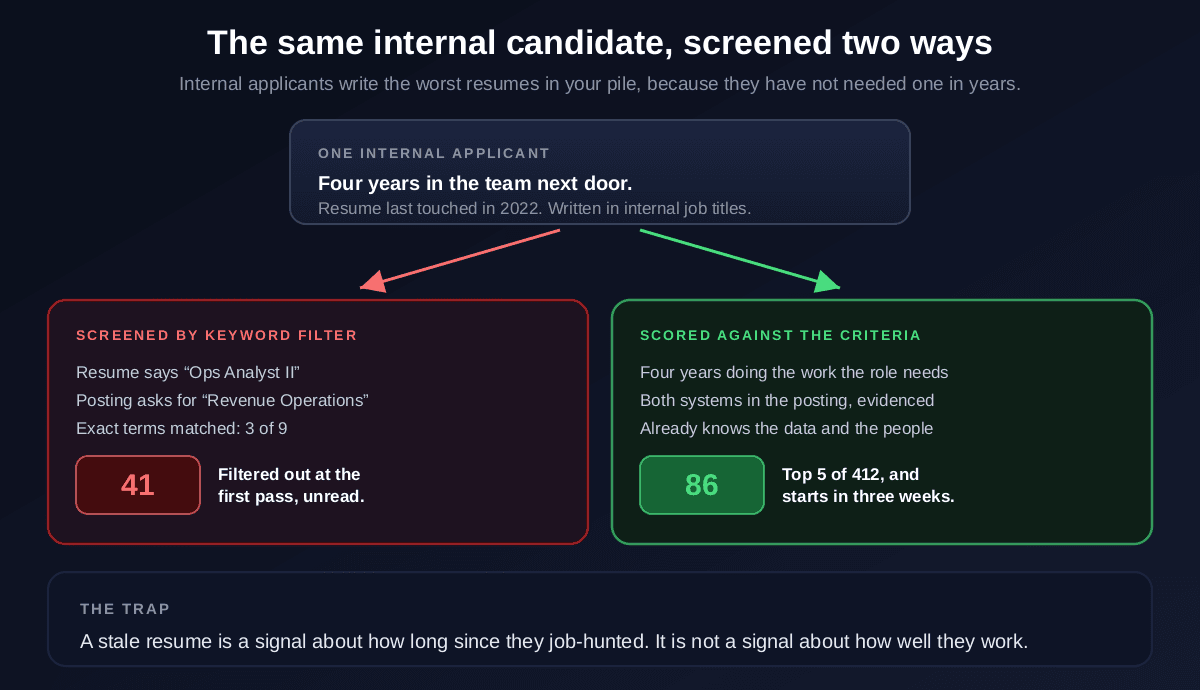
An internal candidate has not needed a resume in four years. Theirs is stale, written in internal job titles that mean nothing outside the building, and it makes no attempt to mirror the posting's language. An external candidate applying to twelve roles has a polished document tuned to exactly that phrasing. On any keyword-matching screen the external applicant wins, and the win has nothing to do with capability.
This is the same mechanism described in resume parsing, where a formatting or vocabulary mismatch can only ever push someone down a ranking. It just bites hardest on the candidates you actually have evidence about. Scoring against the role's real requirements rather than its exact wording is what removes the penalty, and it is the same discipline described in resume screening criteria.
Screen your internal applicants first, in minutes
Upload your internal applicants as their own batch and paste the job description. Rankid scores each one 0 to 100 against the role's actual requirements, with the skills they match and miss, so a stale resume written in internal job titles does not bury someone you already know can do the work. First 5 resumes free, no signup.
Score your internal candidates freeHow to run an internal hiring process people trust
Post the role internally, with the band and the criteria
Publish it where staff will actually see it, with the pay band and the real requirements, before or alongside external advertising. Vague internal postings are read as decoration for a decision already made, and once staff believe that, the programme is over. Write the requirements the same way you would externally, per how to write a job description.
Screen internal applicants as their own batch, first
Not mixed into the external pile, and not after it. Score them against the same written criteria so the outcome is based on measured fit rather than who the hiring manager already knows, and so you can explain the decision afterwards to someone who works here.
Use the same criteria, but not the same questions
Identical criteria, because that is what makes the decision defensible. Different questions, because asking someone to walk through their background when you have two years of their work is theatre. Spend the time on the gap between their current role and this one instead, using the structure in the screening interview guide.
Tell the manager before you tell the employee
Handle the current manager early. Surprises here are how you turn one internal move into two resignations, and how you teach managers to discourage their people from applying next time.
Reject internally in person, with a real reason
A conversation, before any announcement, with something specific about what was missing and what would change the answer. If you cannot name anything concrete, the decision was probably made on familiarity rather than criteria. The credibility of the whole programme rests on how the unsuccessful candidates are treated, which is the internal version of the argument in candidate experience.
Keep the near-misses somewhere you will look again
Someone who was close this time is a strong candidate for the next opening, and unlike external near-misses they are still here. Record what was missing so the next req starts from evidence rather than memory. This is the internal half of a talent pipeline.
Internal candidate interview questions
Skip the background questions and use the access you have. These get at the actual risk in an internal move, which is almost never capability and almost always the change in scope:
- “What part of this role are you least prepared for right now?”
- “What would you stop doing in your current role, and who picks it up?”
- “You have seen this team from the outside. What would you change in the first month, and what would you leave alone?”
- “This role means managing people you are currently peers with. How would you handle the first difficult conversation?”
- “Where have you already done a piece of this job, even informally?”
- “What is your read on why this role is open?”
- “If you do not get this, what do you want to happen next?”
That last one is not a courtesy question. The answer tells you whether an unsuccessful outcome is a setback or an exit, and you would rather know before the decision than after. For the wider structure behind these, see interview questions to ask candidates.
Internal mobility programmes, and what the software actually does
Internal mobility software and internal talent mobility platforms generally promise to match employees to open roles using a skills inventory. The capability is real, and the reason these projects underdeliver is almost always the same: the skills data is self-reported, entered once during rollout, and stale within a year. A matching engine over stale data produces confident nonsense.
Internal mobility best practices that do not depend on a platform, in rough order of payoff:
- Publish every role internally with the band, and mean it.
- Screen internal applicants first, as a separate batch, on written criteria.
- Answer every internal applicant personally.
- Make releasing people something managers are recognised for rather than penalised by.
- Record what was missing for near-misses, so the next opening starts from evidence.
- Set a tenure rule for eligibility that is short enough to be real, commonly 12 months.
If you do buy a platform, the thing worth testing in a trial is not the matching demo. It is whether the skills data stays current without a dedicated administrator, because that is the assumption every one of these tools rests on.
Metrics worth tracking
- Internal fill rate. The share of roles filled internally. The headline number, and for most teams it starts lower than anyone expects.
- Internal applicants read and answered. Two separate numbers, and both should be 100 percent. If they are not, nothing else on this list matters.
- Internal applications per posted role. This is your trust metric. When it falls over time, staff have concluded that applying internally does not work.
- Time to fill, internal versus external. The gap is your argument for doing more of it, in the language finance already uses.
- Retention of unsuccessful internal candidates at 12 months. The number nobody tracks and the one that tells you whether your rejections are being handled properly.
Key takeaways
- Internal recruitment is filling a role from existing staff: promotion, transfer, internal posting, contractor conversion, boomerang hires.
- Internal recruitment is the event; internal mobility is the system that makes the event likely.
- Internal hires are faster, cheaper and lower risk, but the pool is tiny and every move creates another vacancy.
- The real failure is operational: six internal applicants sit in a pile of 412 and most are never read.
- Keyword screening penalises internal candidates because their resumes are stale and use internal job titles.
- Screen internal applicants as their own batch first, on written criteria, and answer every one personally.
- Rankid scores your batch against the role's actual requirements, not its exact phrasing. First 5 free, no signup.
Bottom line: almost nobody decides against internal recruitment. They just run a process in which it cannot happen, because the people who already work there are queued behind four hundred strangers and judged on the one document they had no reason to keep current. Screen the six first, score everyone against what the role actually needs, and answer all of them like colleagues. That is most of it, and it costs about ten minutes a requisition. Run your internal applicants through Rankid on the next opening and see who you already employ.
Frequently asked questions
What is internal recruitment?
Internal recruitment is filling an open role with someone who already works for the organisation, rather than hiring from outside. It covers promotions, lateral moves between teams, transfers between locations or business units, and converting a contractor or intern into a permanent employee. It also includes employee referrals in a looser sense, since the candidate arrives through an internal channel even though the person hired is external. The practical appeal is that internal hires are faster, cheaper and far better understood than external ones, because you already have real performance evidence rather than a resume and four hours of interviews.
What is an internal candidate?
An internal candidate is a current employee who applies for, or is considered for, a different role within the same organisation. The term usually includes contractors, interns and fixed-term staff already working there, though policies differ on whether they apply through the same process. What distinguishes an internal candidate operationally is not their skills but your information: you can see how they actually perform, how they handle pressure and whether colleagues trust them, none of which any external candidate can demonstrate before you hire them.
What is the difference between internal recruitment and internal mobility?
Internal recruitment is the act of filling a specific open role from inside. Internal mobility, sometimes called internal talent mobility, is the ongoing system that makes those moves normal: visible open roles, skills recorded somewhere searchable, managers who do not block transfers, and career paths people can actually see. One is an event, the other is the infrastructure that makes the event likely. A company can do internal recruitment occasionally and still have no internal mobility, which is the situation most organisations are actually in.
What are the advantages and disadvantages of internal recruitment?
The advantages are speed, cost, certainty and retention: internal hires typically fill faster, cost a fraction of an external hire, ramp to full productivity sooner because they already know the systems and the people, and the act of promoting visibly tells everyone else that staying is worth it. The disadvantages are real too. The pool is tiny, so the best available person may simply not be inside. Every internal move creates a second vacancy, so you have not reduced your hiring load, only relocated it. It can entrench existing thinking and existing demographics. And an internal candidate who is rejected badly is a retention risk you have created yourself.
What are the internal sources of recruitment?
The usual list is promotion, which is a move up a level; transfer or lateral move, which is a sideways move to a different team, function or location; internal job posting, where roles are advertised to staff before or alongside external advertising; contractor, intern or fixed-term conversion; rehiring former employees, sometimes called boomerang hires; and employee referrals, which are an internal channel producing an external hire. External sources by contrast include job boards, direct sourcing, agencies, careers-page applications, events and campus hiring.
Should internal candidates be interviewed the same way as external ones?
Use the same criteria and the same core questions, but do not pretend you know nothing about them. The criteria have to be identical so the decision is defensible and so nobody is advanced on familiarity alone, which is the most common failure in internal hiring. What legitimately differs is the evidence available: you can look at two years of actual performance instead of relying on self-reported achievements, and you can ask far more specific questions about work you both know about. Skip the background-establishing questions and spend the time on the gap between their current role and the new one.
How do you reject an internal candidate without losing them?
Tell them yourself, in a conversation, before the decision is announced anywhere else, and give them the actual reason. An internal rejection delivered by automated email is how good employees decide to look outside, because they learn both that they did not get the role and that nobody thought they were worth a conversation. Be specific about what was missing and what would change the answer, and if you cannot name anything concrete, that is a sign the decision was made on familiarity rather than criteria. Then follow up: the credibility of your entire internal mobility programme rests on how the unsuccessful candidates are treated, not the successful ones.
Why do internal candidates often score worse than external applicants?
Because they write worse resumes, not because they are worse candidates. Someone who has not job-hunted in four years has a stale resume written in internal job titles that mean nothing outside the company, and it will not mirror the language of the posting the way a well-tailored external application does. Any screening approach based on keyword matching therefore penalises exactly the candidates you have the most evidence about. The fix is to score against the role's actual requirements rather than exact phrasing, and to screen your internal applicants before the external pile rather than after it.