Pay Transparency Laws 2026: Which States (and the EU) Require Salary Ranges, and How to Use Them
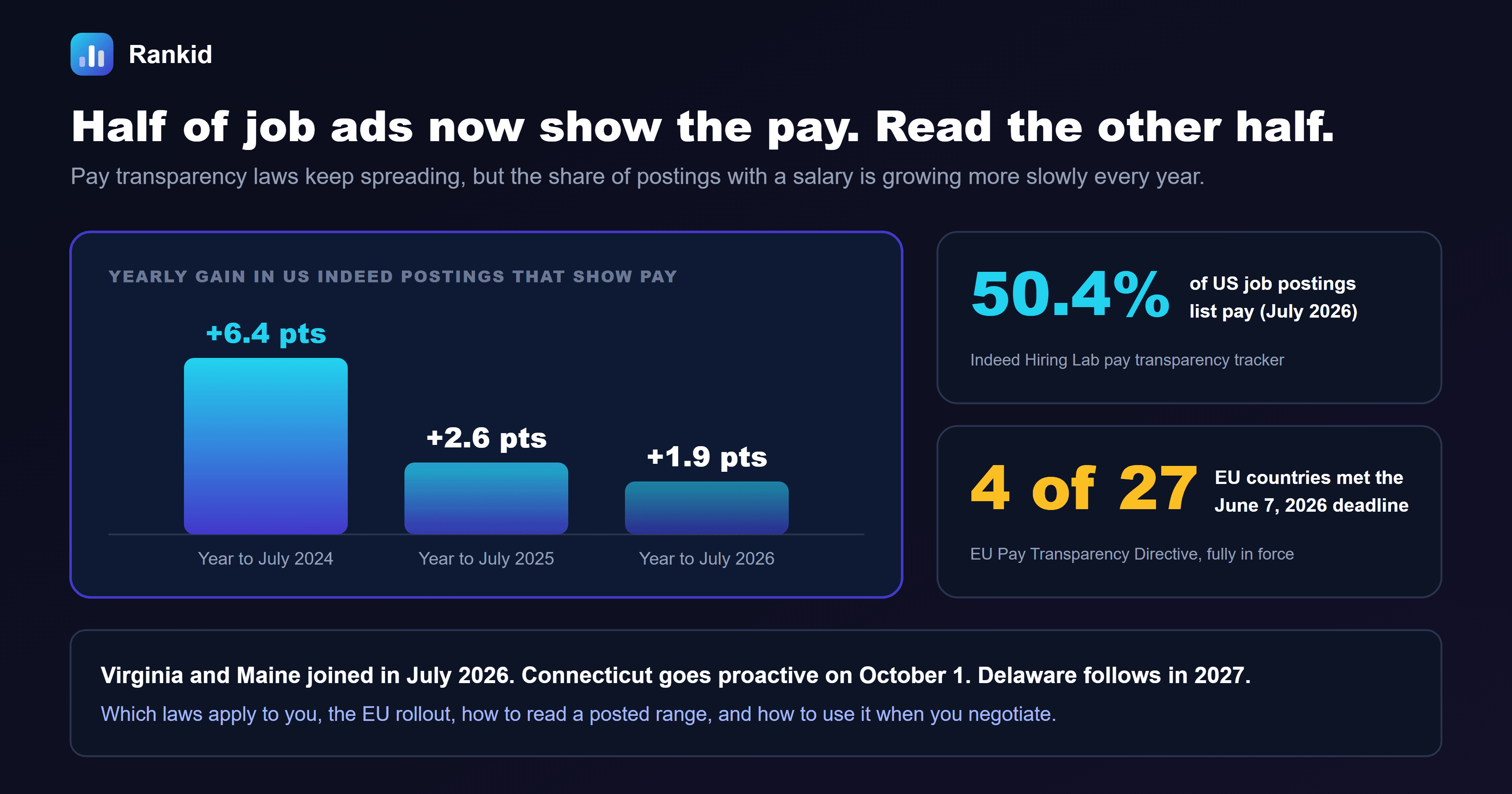
For most of working history, salary negotiations followed one rule: whoever names a number first loses. Employers knew the budget, candidates guessed, and the gap between the two quietly became company profit. Pay transparency laws are rewriting that rule one state at a time. In 2026, Virginia and Maine joined the list, Connecticut tightened its law, the EU hit its own deadline, and about half of all US job ads now show the pay. The interesting part isn't the half that shows the number. It's what the number, and the missing half, actually tell you.
Quick answer
Quick answer: as of September 2026, more than a dozen US states plus DC require a good-faith salary range in job postings, including new laws in Virginia (July 1, 2026) and Maine (July 2026), with Connecticut going proactive on October 1, 2026 and Delaware in September 2027. In the EU, only 4 of 27 countries had the Pay Transparency Directive fully in force by the June 7, 2026 deadline. About 50.4% of US postingson Indeed now list pay, but growth is slowing. If you meet the role's requirements, aim at or above the midpoint of a posted range, and ask which level a wide range covers.
What pay transparency laws actually require
"Pay transparency" covers several different obligations, and a single law can include more than one. Knowing which kind applies tells you what you're entitled to ask for.
- Range in the posting. The strongest form: a good-faith minimum and maximum in every job ad, sometimes with a description of benefits and bonuses.
- Range on request or before an offer. The employer must share the range if you ask, or at a set point such as after a first interview.
- Internal transparency. Ranges on promotion and transfer postings, or a right for current employees to request the range for their own job.
- Salary history bans.Employers can't ask what you earn now, or base your offer on it. Our guide to the salary history question covers what to say when someone asks anyway.
- Pay discussion protections. Employees can talk about their pay without retaliation. In the US, the National Labor Relations Act protects this for most private-sector workers.
Which US states require salary ranges in 2026
The map filled in faster than most people realise. Colorado went first in 2021; by the end of 2025 the list included the country's biggest labour markets; and 2026 added two new states plus a significant upgrade in Connecticut.
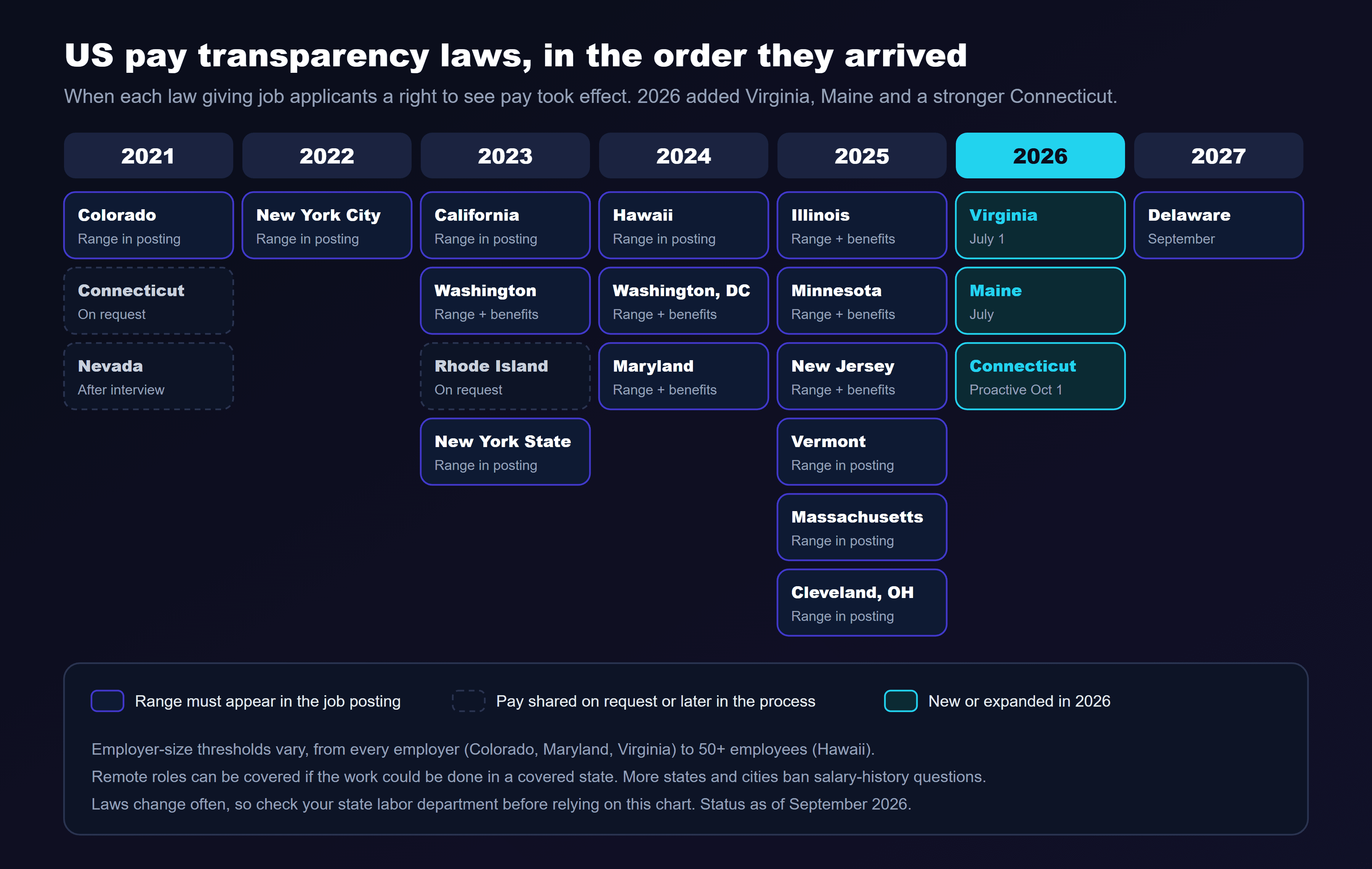
The 2026 changes, in detail:
- Virginia (July 1, 2026). Covered employers must include a good-faith wage or salary range in public and internal postings, including promotions and transfers, and may no longer ask about or rely on your pay history.
- Maine (July 2026). Employers with 10 or more employees must include a pay range in job postings, or state that a role is commission-only, and provide ranges to current employees on request.
- Connecticut (October 1, 2026). Moves from giving the range on request or at offer to proactive disclosure.
- Delaware (September 2027). Employers with more than 25 employees must post the pay range and a general description of benefits in internal and external postings, with civil penalties of $500 to $10,000.
Late 2025 was busy too: Massachusetts (25+ employees) started requiring ranges on October 29, 2025, and Cleveland's city ordinance took effect the same week, following New Jersey and Vermont earlier that year. Thresholds are the detail most people miss. Colorado, Maryland and Virginia cover essentially every employer, while Hawaii applies at 50 or more employees.
The remote-work loophole that isn't
The EU Pay Transparency Directive: deadline passed, most countries missed it
Europe's version is broader than any US state law. It covers the whole employment relationship, from the job ad to annual gender pay gap reports, and it shifts the burden of proof in pay discrimination cases onto employers. Member states had until June 7, 2026to write it into national law. Most didn't make it.
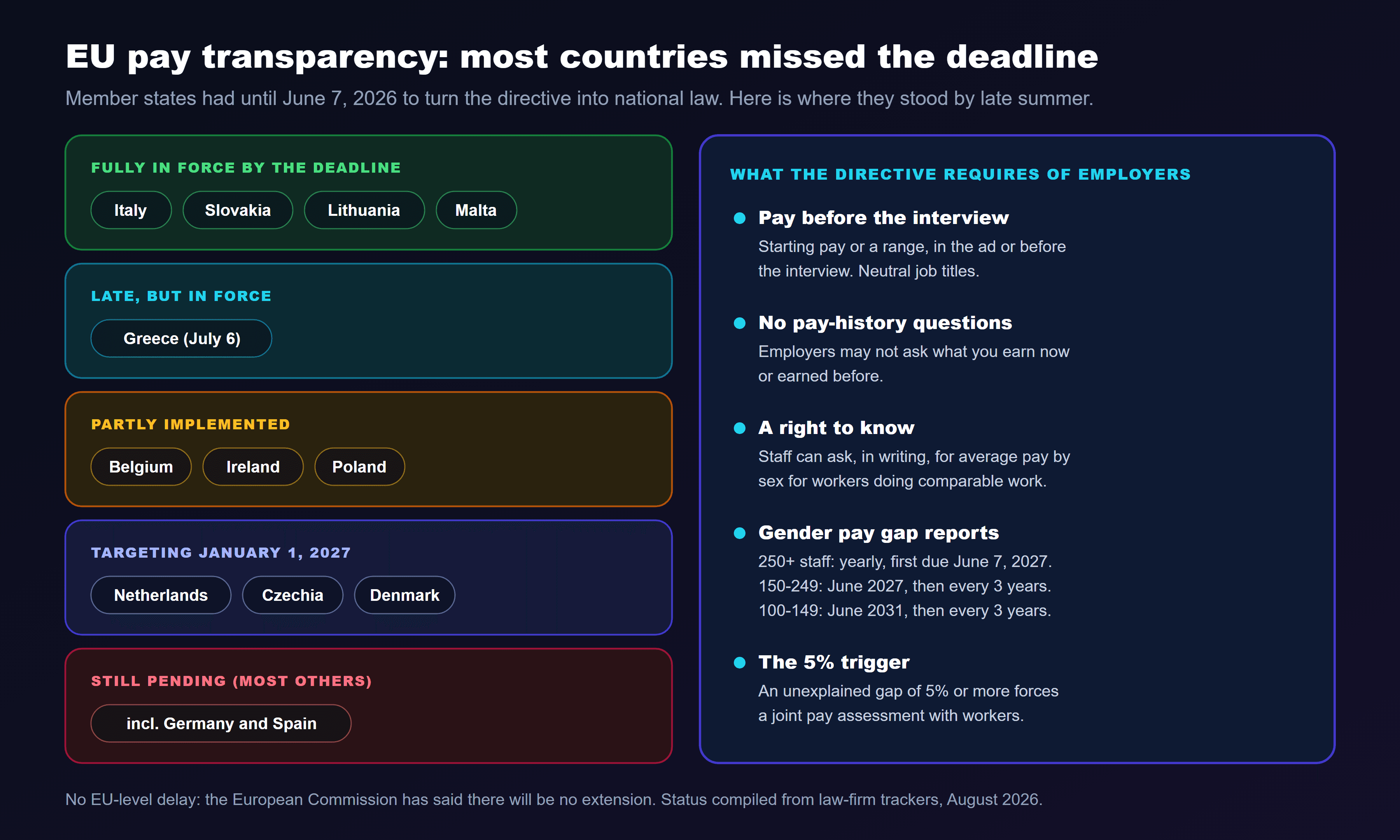
According to law-firm trackers, only Italy, Slovakia, Lithuania and Malta had full transposition in force by the deadline, with Greece following on July 6. Belgium, Ireland and Poland had partial measures. The Netherlands, Czechia and Denmark have pointed to January 1, 2027, and many others, including Germany and Spain, were still working through drafts in late summer 2026. The European Commission has been clear that there is no EU-level extension, and the reporting clock is already running: large employers must report by June 7, 2027 using 2026 pay data.
For job seekers, the practical point is simple. Even where national law lags, the direction of travel is fixed, and asking a European employer for the pay range before an interview is becoming the norm rather than a bold move. Indeed Hiring Lab found only about 12% of German and 17% of Spanish postings showed pay in 2026, against 56% in the UK, so the gap to close is large.
Why only half of US job ads show pay, and what the other half tells you
Indeed Hiring Lab's tracker found that 50.4% of US job postingsincluded pay information in July 2026. But the annual gain has shrunk three years running: 6.4 percentage points in the year to July 2024, 2.6 points to July 2025, and 1.9 points to July 2026. The easy wins are done. The remaining half is mostly roles and employers not covered by any law, plus some that are covered but haven't complied.
That means a missing range is information. In a covered state, it may be a compliance gap you can point out politely. Outside one, it often means the employer wants room to negotiate from what you reveal, which is exactly when you should ask for the budget before naming a number. And a range that is posted still needs reading carefully, because not every range is equally informative.
How to read a posted salary range
A salary range is usually the employer's budget for a role, often built from a pay band with a minimum, midpoint and maximum. If you want the full mechanics, our guide to salary bands and compa-ratio explains how companies build them. For candidates, three zones matter.
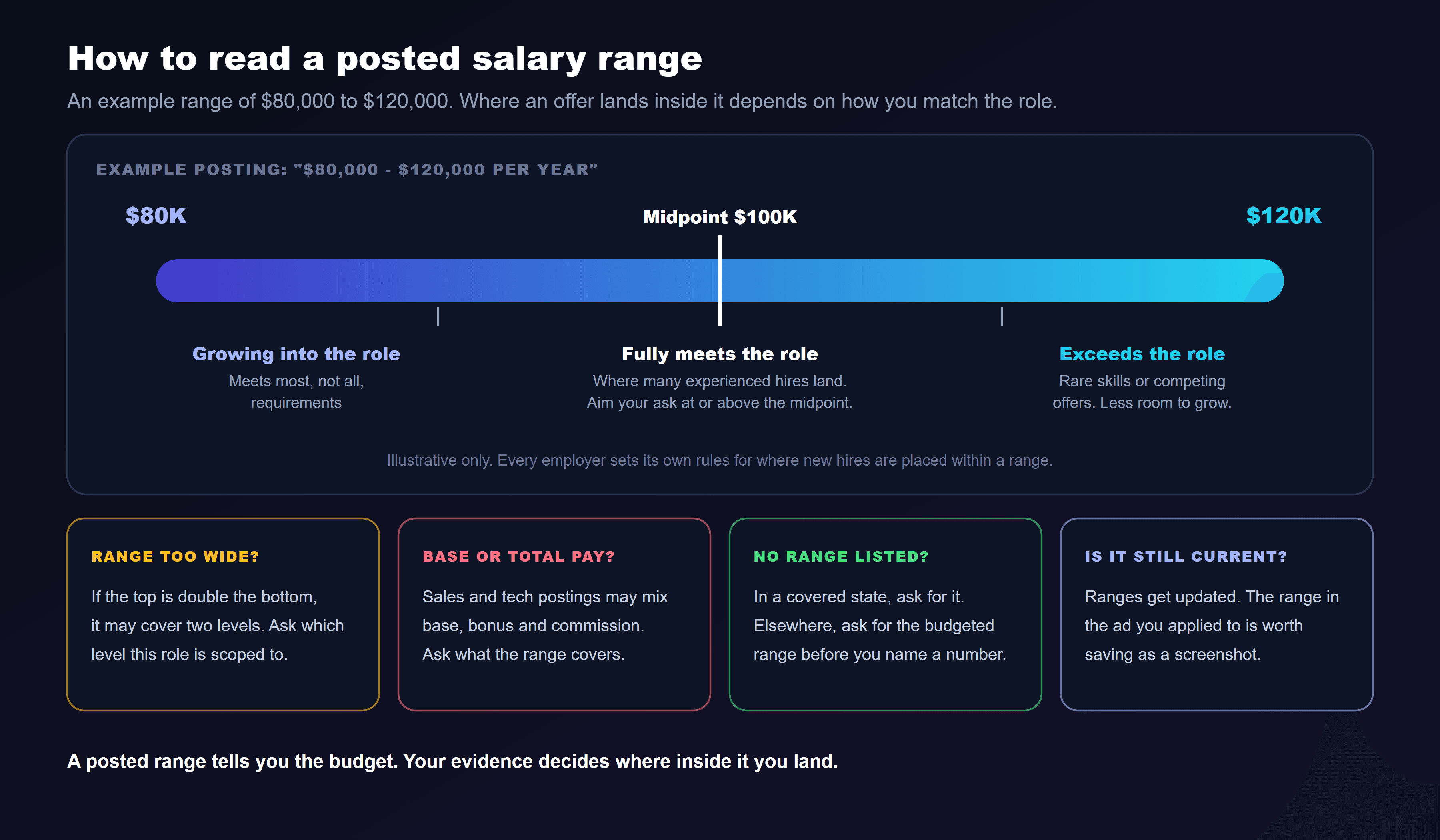
- Lower part of the range. Usually for people who meet most, but not all, of the requirements and will grow into the role.
- Around the midpoint. Commonly where fully qualified, experienced hires land. If you meet every requirement, this is a reasonable anchor.
- Upper part. For people who exceed the role, bring scarce skills or have competing offers. Landing here leaves less room for future raises within the same band.
These are typical patterns, not rules. Every employer places new hires differently, so the most useful question you can ask is simply: "How do you usually place new hires within this range?"
How to use pay transparency when you negotiate
Save the posting
Measure your fit against the requirements
Clarify what the range covers
Anchor inside the range with evidence
Negotiate the whole package
Know how well you match before you name a number
Where you land in a salary range depends on how completely you meet the role. Paste your resume and the job posting into Rankid for a free 0-100 match score and the exact requirements you meet and miss, so you can negotiate with evidence. No signup required.
Check your match score freeAlready employed? Use the new data too
Pay transparency isn't only for job seekers. When your employer posts an opening for your own job, you learn what it pays new hires. If you're below that range with equal or better performance, you have a concrete, non-confrontational basis for a conversation. Several laws, including Maine's and the EU directive, also give employees a right to request pay information. Our guide on how to ask for a raise shows how to frame it around market data rather than grievance.
For employers: a compliance and credibility checklist
The legal minimum is a good-faith range. The harder part is what happens when your current employees read your job ads.
- Map where you hire. Include remote roles that could be filled in covered states, and track upcoming dates such as Connecticut in October 2026 and Delaware in 2027.
- Build ranges from real bands. Ranges should reflect what you genuinely expect to pay. Very wide placeholder ranges invite regulator attention and candidate distrust.
- Fix compression before you post. If new-hire ranges sit above what current staff earn, employees will notice. Audit pay for comparable roles first, and budget for adjustments.
- Update your templates. Put the range, and benefits where required, into every job description, internal posting and offer letter template.
- Train recruiters and managers.Remove salary history questions from scripts and forms, and give them a consistent answer to "where in the range will I land?"
- For EU operations, start with 2026 data. Reports due in June 2027 cover 2026 pay, so you need clean data by gender, job category and pay component now.
Pair transparent pay with a transparent screen
Rankid scores every resume against your job description on a consistent 0-100 scale and shows the exact requirements each candidate matched and missed, so decisions rest on job-related evidence you can explain. First 5 resumes free, no signup.
Try bulk screening freeFrequently asked questions
What is a pay transparency law?
A pay transparency law requires employers to share pay information with job applicants, employees or both. The most common kind requires a good-faith salary or wage range in job postings. Others require employers to share the range on request, after an interview or before an offer. Many also bar employers from asking about your salary history or retaliating against employees who discuss pay.
Which states require salary ranges in job postings in 2026?
As of September 2026, states requiring pay ranges in job postings include Colorado, California, Washington, New York, Hawaii, Maryland, Illinois, Minnesota, New Jersey, Vermont, Massachusetts, Virginia (from July 1, 2026) and Maine (from July 2026), plus Washington, DC and cities such as New York City and Cleveland. Connecticut moves from pay-on-request to proactive disclosure on October 1, 2026. Nevada and Rhode Island require disclosure after an interview or on request, and Delaware's posting requirement starts in September 2027. Coverage thresholds and details vary, so check your state labor department.
Does pay transparency apply to remote jobs?
Often, yes. Several states apply their rules to remote roles that could be performed in the state, even if the employer is based elsewhere. That is why many national employers now post ranges on every remote job. If you live in a covered state and a remote posting has no range, it is reasonable to ask for it.
What is the EU Pay Transparency Directive?
It is an EU law requiring member states to give job seekers pay information before the interview, ban questions about pay history, give workers the right to request average pay by sex for comparable work, and require gender pay gap reporting for employers with 100 or more workers. Where a reported gap of 5% or more can't be justified, employers must carry out a joint pay assessment with worker representatives. Member states had until June 7, 2026 to implement it.
Which EU countries have implemented the Pay Transparency Directive?
Only a handful met the June 7, 2026 deadline in full. Law-firm trackers list Italy, Slovakia, Lithuania and Malta as fully in force by the deadline, with Greece following a month later, and Belgium, Ireland and Poland as partly implemented. Several countries, including the Netherlands, Czechia and Denmark, are targeting January 1, 2027, and many others, including Germany and Spain, were still pending in late summer 2026. The European Commission has said there will be no EU-level extension.
When do EU gender pay gap reports start?
Employers with 250 or more workers must report by June 7, 2027 on 2026 data and then every year. Employers with 150 to 249 workers also report first by June 7, 2027 and then every three years. Employers with 100 to 149 workers report first by June 7, 2031 and then every three years. National laws can set stricter rules.
Where in a salary range should I ask to be paid?
If you meet all the stated requirements, it's reasonable to aim at or above the midpoint of the posted range and support the number with evidence of your impact. If you exceed the role, with rare skills or competing offers, aim higher in the range. If you meet most but not all requirements, expect an offer nearer the lower half. Ask how the company places new hires in the range, because practices vary.
What does it mean if a salary range is very wide?
A very wide range, where the top is around double the bottom or more, often means the posting covers several levels, locations or pay components, or that the employer wants maximum flexibility. Ask which level the role is scoped to, whether the range varies by location, and whether it covers base salary only or includes bonus and commission. Some regulators require ranges to be a good-faith estimate of what the employer expects to pay.
What should I do if a job posting has no salary range?
If the job is covered by a pay transparency law, you can ask the recruiter for the range and, if it is refused, report it to the state labor agency. If no law applies, ask early and politely for the budgeted range before naming your own number. Asking isn't rude: it saves both sides time if the budget and your expectations don't overlap.
Can employers still ask about my current salary?
In many places, no. A growing number of US states and cities ban salary history questions, and the EU directive bans them across member states once implemented. Where it is allowed, you can still decline and redirect to your target range for this role. Our guide to the salary history question includes scripts.
Do pay transparency laws help current employees too?
Often, yes. Some laws require employers to include ranges on internal postings for promotions and transfers or to provide the range for your current role on request, and the EU directive gives workers a right to request pay information. New postings also reveal what the company pays new hires for your job, which can support a raise conversation if you're below the range.
Key takeaways
- Pay transparency laws range from ranges in every posting to disclosure on request, internal transparency, salary history bans and protection for discussing pay.
- More than a dozen US states plus DC now require ranges in postings. 2026 added Virginia (July 1) and Maine (July), Connecticut goes proactive on October 1, 2026, and Delaware follows in September 2027.
- Remote roles can be covered if the work could be done in a covered state, which is why many national employers now post ranges everywhere.
- Only 4 of 27 EU countries had the Pay Transparency Directive fully in force by June 7, 2026, but there is no EU-level extension, and large employers' first gender pay gap reports on 2026 data are due June 7, 2027.
- About 50.4% of US postings on Indeed showed pay in July 2026, but annual growth has slowed from 6.4 to 2.6 to 1.9 points.
- Read a range in three zones: lower for growing into the role, around the midpoint for fully qualified hires, upper for exceptional candidates. Ask how the employer places new hires.
- Negotiate by saving the posting, measuring your fit, clarifying what the range covers, anchoring with evidence and negotiating the whole package.
- Employers should build ranges from real pay bands, fix pay compression before posting, update templates, and train recruiters to drop salary history questions.
Frequently asked questions
What is a pay transparency law?
A pay transparency law requires employers to share pay information with job applicants, employees or both. The most common kind requires a good-faith salary or wage range in job postings. Others require employers to share the range on request, after an interview or before an offer. Many also bar employers from asking about your salary history or retaliating against employees who discuss pay.
Which states require salary ranges in job postings in 2026?
As of September 2026, states requiring pay ranges in job postings include Colorado, California, Washington, New York, Hawaii, Maryland, Illinois, Minnesota, New Jersey, Vermont, Massachusetts, Virginia (from July 1, 2026) and Maine (from July 2026), plus Washington, DC and cities such as New York City and Cleveland. Connecticut moves from pay-on-request to proactive disclosure on October 1, 2026. Nevada and Rhode Island require disclosure after an interview or on request, and Delaware's posting requirement starts in September 2027. Coverage thresholds and details vary, so check your state labor department.
Does pay transparency apply to remote jobs?
Often, yes. Several states apply their rules to remote roles that could be performed in the state, even if the employer is based elsewhere. That is why many national employers now post ranges on every remote job. If you live in a covered state and a remote posting has no range, it is reasonable to ask for it.
What is the EU Pay Transparency Directive?
It is an EU law requiring member states to give job seekers pay information before the interview, ban questions about pay history, give workers the right to request average pay by sex for comparable work, and require gender pay gap reporting for employers with 100 or more workers. Where a reported gap of 5% or more can't be justified, employers must carry out a joint pay assessment with worker representatives. Member states had until June 7, 2026 to implement it.
Which EU countries have implemented the Pay Transparency Directive?
Only a handful met the June 7, 2026 deadline in full. Law-firm trackers list Italy, Slovakia, Lithuania and Malta as fully in force by the deadline, with Greece following a month later, and Belgium, Ireland and Poland as partly implemented. Several countries, including the Netherlands, Czechia and Denmark, are targeting January 1, 2027, and many others, including Germany and Spain, were still pending in late summer 2026. The European Commission has said there will be no EU-level extension.
When do EU gender pay gap reports start?
Employers with 250 or more workers must report by June 7, 2027 on 2026 data and then every year. Employers with 150 to 249 workers also report first by June 7, 2027 and then every three years. Employers with 100 to 149 workers report first by June 7, 2031 and then every three years. National laws can set stricter rules.
Where in a salary range should I ask to be paid?
If you meet all the stated requirements, it's reasonable to aim at or above the midpoint of the posted range and support the number with evidence of your impact. If you exceed the role, with rare skills or competing offers, aim higher in the range. If you meet most but not all requirements, expect an offer nearer the lower half. Ask how the company places new hires in the range, because practices vary.
What does it mean if a salary range is very wide?
A very wide range, where the top is around double the bottom or more, often means the posting covers several levels, locations or pay components, or that the employer wants maximum flexibility. Ask which level the role is scoped to, whether the range varies by location, and whether it covers base salary only or includes bonus and commission. Some regulators require ranges to be a good-faith estimate of what the employer expects to pay.
What should I do if a job posting has no salary range?
If the job is covered by a pay transparency law, you can ask the recruiter for the range and, if it is refused, report it to the state labor agency. If no law applies, ask early and politely for the budgeted range before naming your own number. Asking isn't rude: it saves both sides time if the budget and your expectations don't overlap.
Can employers still ask about my current salary?
In many places, no. A growing number of US states and cities ban salary history questions, and the EU directive bans them across member states once implemented. Where it is allowed, you can still decline and redirect to your target range for this role. Our guide to the salary history question includes scripts.
Do pay transparency laws help current employees too?
Often, yes. Some laws require employers to include ranges on internal postings for promotions and transfers or to provide the range for your current role on request, and the EU directive gives workers a right to request pay information. New postings also reveal what the company pays new hires for your job, which can support a raise conversation if you're below the range.