Quiet Firing: The Signs, Whether It Is Illegal, and What to Do About It (2026)
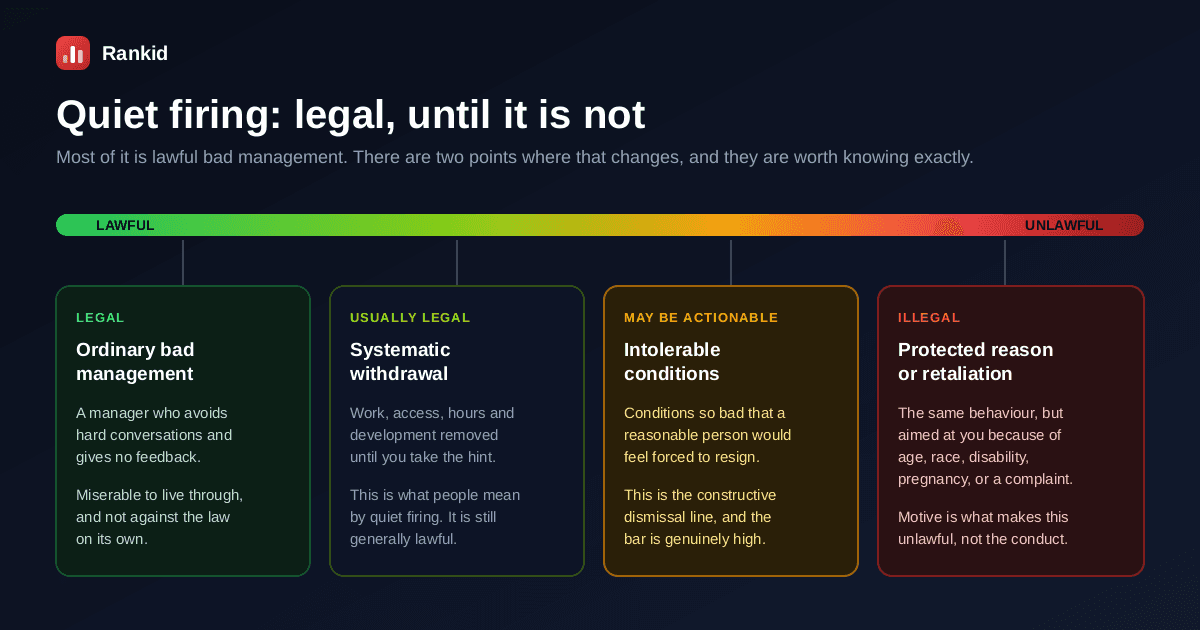
Nobody ever says it. The Atlas project goes to somebody else and there is no conversation about why. Your one-on-one gets cancelled, then cancelled again, then quietly stops appearing in the calendar. The training you were promised has no budget this year, though two colleagues went. You are still employed, still paid, still technically fine. And you have started to suspect that somebody has already decided you are leaving, and is waiting for you to work it out on your own.
Quick answer
Quick answer: quiet firing is an employer making a job worse until you resign, instead of dismissing you. It is usually legal, because bad management generally is. It becomes illegal when it is motivated by a protected characteristic or retaliation, and it may become constructive dismissal when conditions get so bad that a reasonable person would feel forced to resign. Keep a factual log, ask one direct question, and run your job search in parallel rather than after.
What is quiet firing?
Quiet firing is when an employer deliberately degrades a job until the employee resigns, rather than dismissing them directly. It operates by withdrawal rather than confrontation. Work is reassigned, access is reduced, development stops, and the person is slowly moved to the edge of the team until leaving feels like their own idea.
You will also hear it called being managed out, being frozen out, or being put on the shelf. The mechanism is the same in each: the decision has been made, and nobody intends to tell you.
Jobs get worse for plenty of innocent reasons. Budgets tighten, reorganisations reshuffle projects, a good manager leaves and is replaced by an overloaded one. What separates quiet firing from ordinary turbulence is that the deterioration is one-directional, aimed at one person, and survives every direct attempt that person makes to fix it. That last clause is the one that does the diagnostic work, and we come back to it below.
One disclaimer, stated plainly
The signs of quiet firing
Individually, every item below has an innocent explanation. That is precisely why quiet firing works. The signal is not in any single item, it is in the clustering: several at once, across more than one group, sustained over more than one quarter.
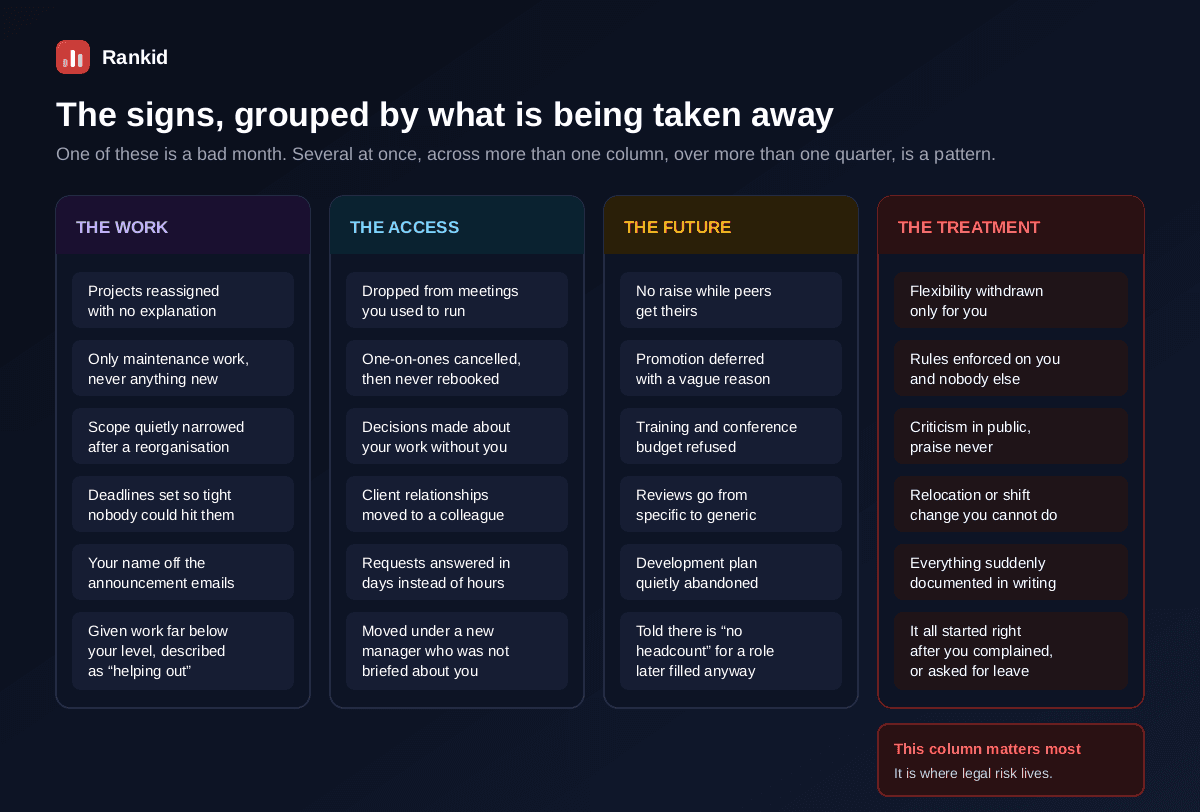
The fourth column is the one to pay closest attention to, because it is where legal risk lives. Everything in the work, the access and the future is generally lawful even when it is deliberate. Items in the treatment start to raise different questions, particularly the last one: if the whole pattern began the week after you filed a complaint, requested an accommodation or came back from protected leave, the sequence itself is the most important fact in your situation.
Quiet firing vs quiet quitting vs an honest PIP
These get used interchangeably and they are not interchangeable at all. Two questions place all four behaviours cleanly: who is pulling back, and did anybody say so out loud.
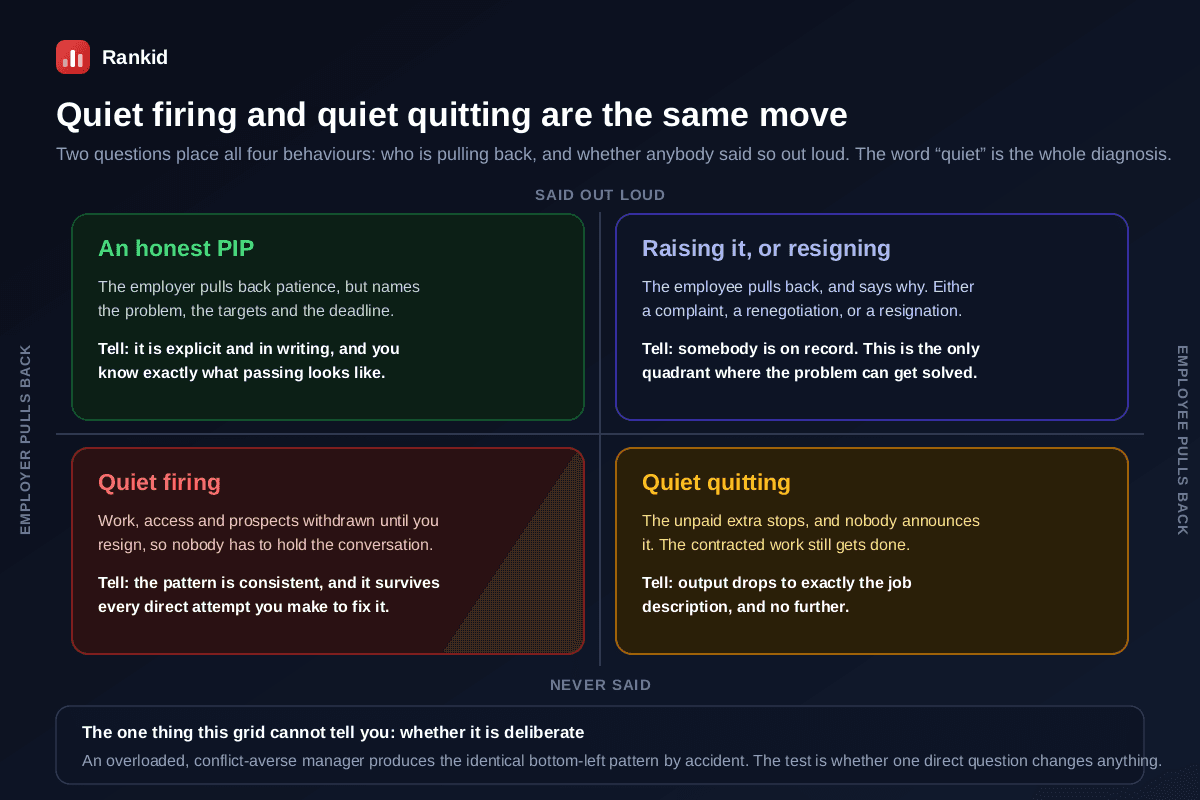
The symmetry is the point. Quiet firing and quiet quitting are the same move made by opposite parties, and the word quiet is the whole diagnosis in both. An unspoken withdrawal cannot be negotiated, because officially it is not happening. That is also why the two so reliably cause each other: a person being quietly fired starts quietly quitting, which the manager then reads as confirmation they were right.
A performance improvement plan feels much worse in the moment and is structurally much better. It names the problem, sets written targets, attaches a real deadline and tells you exactly what passing looks like. You can argue with it, meet it, or decide it is unfair and leave on your own terms. None of those options exist inside a silence.
Is quiet firing illegal?
This is what most people actually want to know, and the honest answer is: usually not. In an at-will relationship an employer can generally give you duller work, decline to promote you, refuse a raise and be a thoroughly bad manager, none of which is unlawful on its own. Three questions decide whether your specific situation is different.
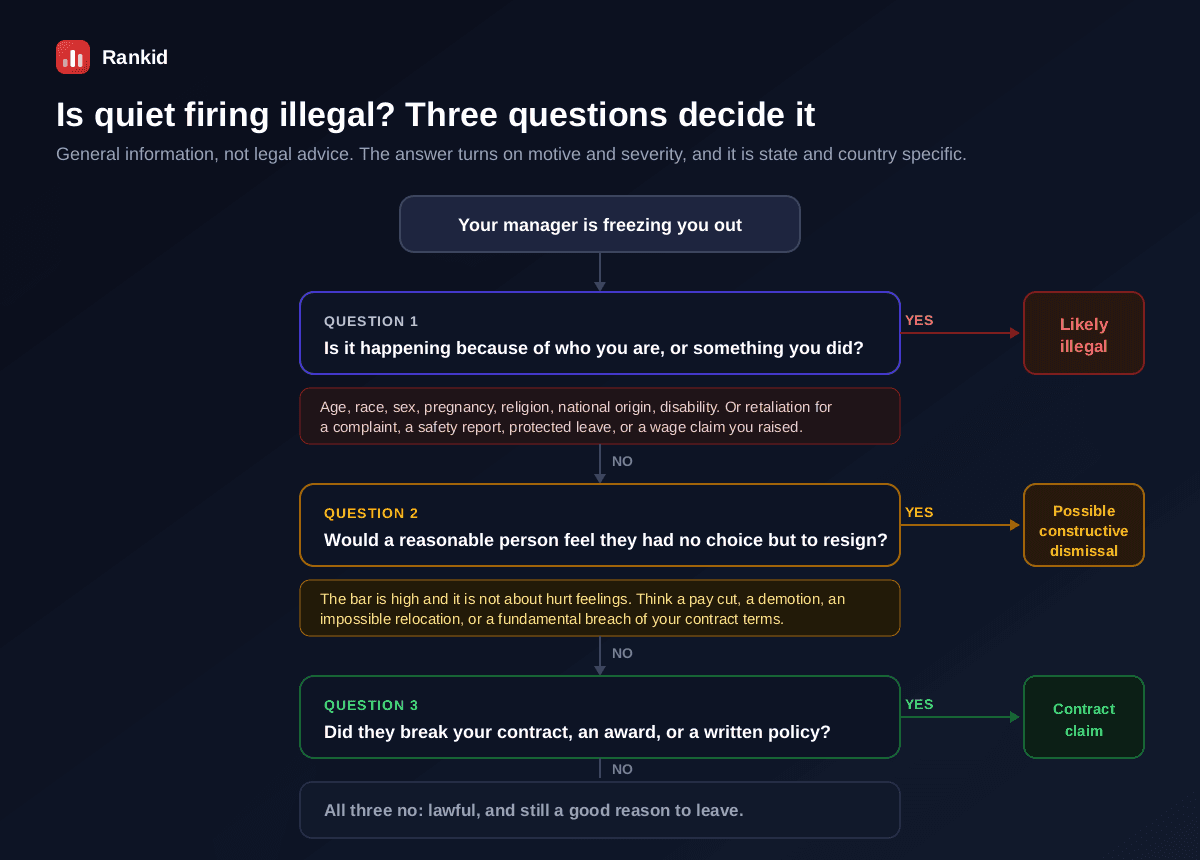
The critical idea in that chart is that motive is what makes conduct unlawful, not the conduct itself. Two managers can take identical actions, removing you from a project and declining your training request, and one is being a poor manager while the other is committing discrimination. The difference is entirely why, which is why documentation of sequence and comparison to colleagues matters so much more than documentation of how bad it felt.
On the retaliation branch specifically: protected activity is broader than most people assume. Making a good-faith complaint about discrimination, reporting a safety issue, requesting a disability accommodation, taking protected leave, raising a wage or overtime issue, or participating in someone else's investigation can all count. If the freeze-out began shortly after any of those, that timing is the single most valuable fact you have.
Constructive dismissal, and why the bar is so high
Constructive dismissal, called constructive dischargein the United States, is a doctrine that treats your resignation as a dismissal when the employer made conditions so intolerable that a reasonable person would have felt compelled to resign. It is the legal concept people are reaching for when they say they were "forced out".
The test is objective, not subjective, and that is the part most people misjudge. It is not about how bad it felt to you, it is about whether a reasonable person in your position would have had no real alternative. Being bored, sidelined, ignored or unhappy with your manager is generally nowhere near enough.
What gets closer:
- A significant unilateral pay cut, or the removal of a substantial part of your earnings.
- A demotion in all but name: same title, fundamentally reduced responsibility and standing.
- A relocation or shift change you cannot accommodate, particularly one imposed on you and not on comparable colleagues.
- A fundamental breach of your contract terms, or of an award or collective agreement.
- A sustained pattern of harassment the employer knew about and failed to address after you raised it.
Two timing traps
What to do about it: run both tracks at once
The most expensive mistake here is treating this as a choice. People spend months deciding whether to fight it or leave, and the two do not conflict in the slightest. Running both is what gives you leverage in either.
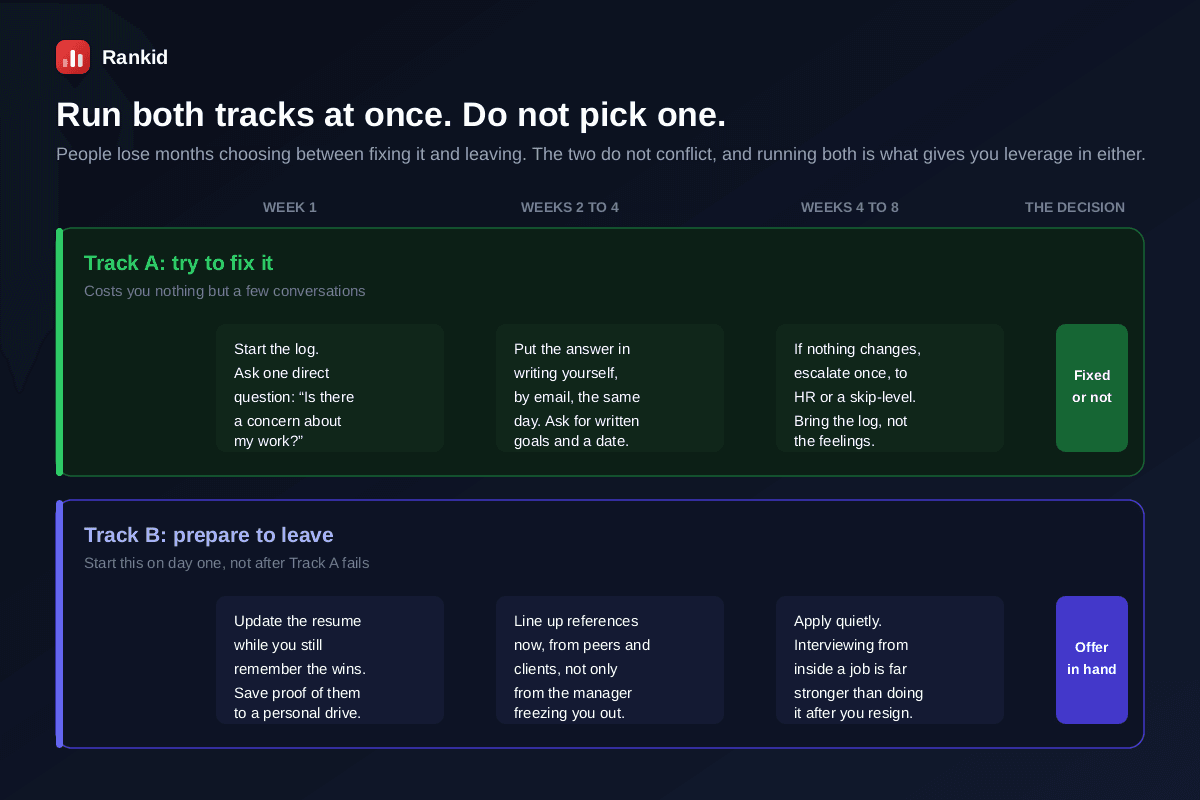
Start the log before you do anything else
Ask one direct question, then write it down yourself
Escalate once, with the log rather than the feelings
Start Track B on day one, not after Track A fails
How to keep a log that actually holds up
Most people either keep no record at all or keep the wrong kind. A log that reads as a diary is worth almost nothing. A log that reads as a record is worth a great deal, and the difference is usually whether you wrote down how you felt about it.
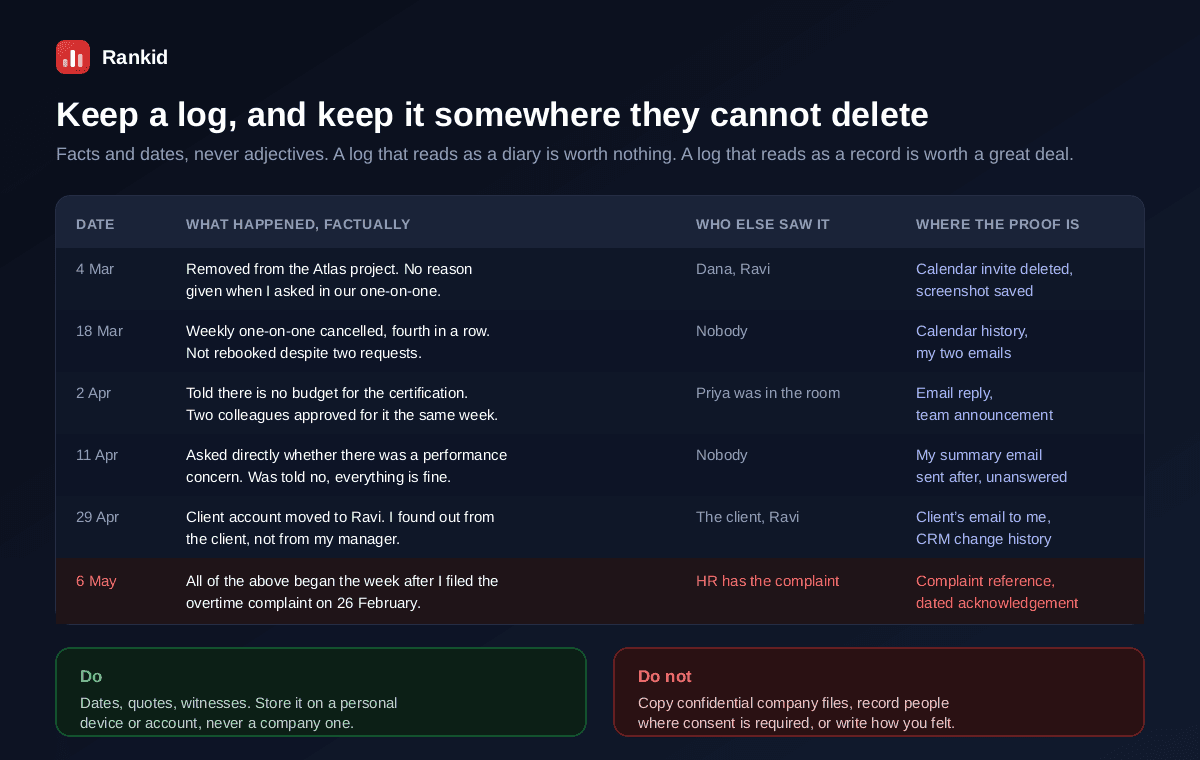
Include the boring entries. A pattern of five cancelled one-on-ones is more persuasive than one dramatic incident, because patterns are hard to explain away individually. And note the dates around any complaint, accommodation request or leave, since the gap between protected activity and the start of the treatment is often the whole case.
Three hard rules. Store it on a personal device or account, because company access disappears the instant employment does. Do notcopy confidential company files, which can turn a strong position into an indefensible one and has ended more claims than it has helped. And do not record conversations where your jurisdiction requires everyone's consent.
The one conversation worth having
There is exactly one conversation that produces useful information, and its goal is not an apology or an admission. It is to force a vague situation into a specific answer you can then put in writing.
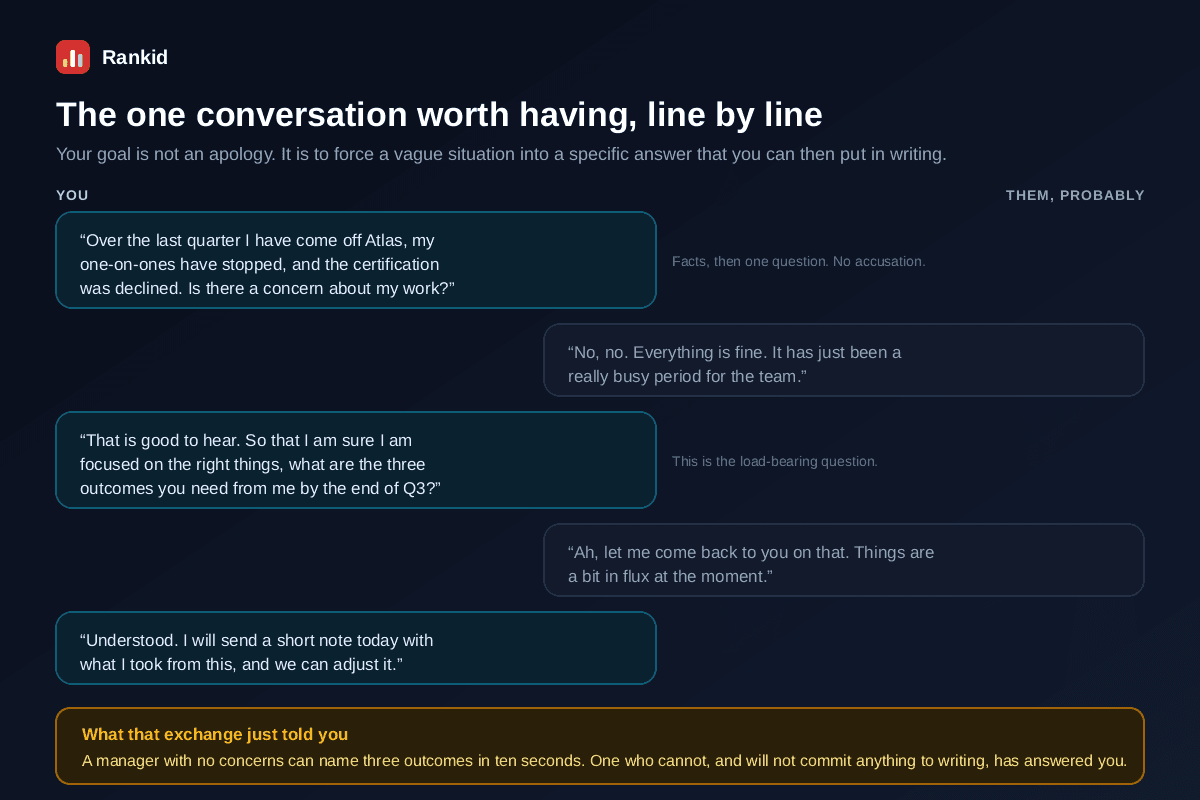
The second question is the one that does the work. A manager with no concerns can name three outcomes in ten seconds, because they think about your role every week. A manager who cannot, and who will not commit anything to writing afterwards, has answered you regardless of what they said out loud. That is your diagnostic, and it is also the test that separates deliberate quiet firing from an overloaded manager who is neglecting everybody: the accidental version usually changes after this conversation, and the deliberate one does not.
Hold it in a scheduled one-on-one rather than ambushing anybody, and send the follow-up email the same day while the detail is exact.
Should you quit, or wait to be fired?
In most cases, wait, and use the time. Three practical reasons, and one real argument on the other side.
- Unemployment. Resigning generally disqualifies you from unemployment benefits in most US states, while being dismissed for something other than misconduct generally does not. Quitting can cost you real money for a decision the employer was going to make anyway.
- Your legal position. Resigning can weaken a constructive dismissal or retaliation claim if you have one, particularly if you never put your concerns on record first.
- The job search itself. Interviewing from inside a job is measurably easier, because you negotiate from choice rather than urgency, and you never have to explain a gap that has not started yet.
- The exception: your health. If the situation is genuinely damaging you, no unemployment calculation outweighs that, and leaving is entirely legitimate.
What is almost never a good idea is resigning suddenly, in a moment of frustration, with nothing lined up, no log and no advice taken. That is precisely the outcome quiet firing is engineered to produce, and it is worth naming so you can refuse to supply it.
When you do go, go cleanly. Our resignation letter templates cover the neutral version that protects your reference, and how to answer "reason for leaving" covers the harder question of what to say about it in your next interview. The short version of that answer: describe the change in the role, not the character of your manager.
Interviewing again? Check your resume against the job first
Paste your resume and the job description into Rankid. You'll get a 0-100 match score, the skills you've matched, and the exact keywords you're missing, free. The fastest way out of a bad situation is a strong application to a better one.
Check your match score freeFor managers: the slow route costs more
Most quiet firing is not strategy. It is conflict avoidance by a manager who has never been trained to hold a direct performance conversation, sometimes made worse by an organisation that has wrapped so much process around a formal performance plan that managers quietly decide it is unusable.
There are colder motives too, and they should be named: converting a dismissal into a resignation can avoid severance, reduce unemployment exposure and keep a termination off the numbers. If that is the actual reason, the arithmetic below is worth reading twice, because it does not work.
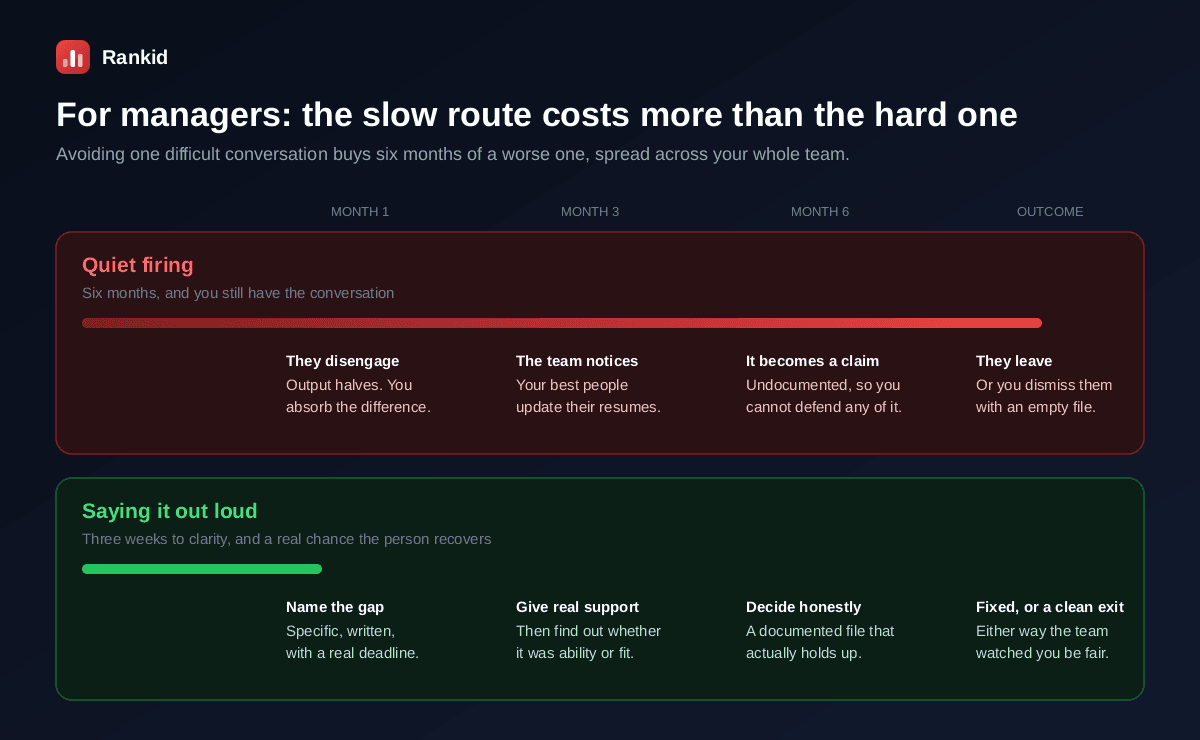
The underrated cost is the third one along the top row. Your team is watching how you treat the person you have given up on, and they are drawing conclusions about what would happen to them. Quiet firing is a retention problem disguised as a performance problem, and it shows up later in your turnover rate among the people you least wanted to lose. It also produces exactly the kind of unexplained departure that a properly run exit interview surfaces months too late.
The alternative is not complicated, it is just uncomfortable. Name the specific gap in writing with a real deadline, provide genuine support, then find out whether the problem was ability, fit, or something you caused. Either the person recovers, which happens more often than avoidant managers expect, or you reach a clean exit with a file that actually holds up. If it does come to an exit, do it properly: see termination letters and employee offboarding for the version that protects everyone, including you.
And if this keeps happening in the same team, the problem is usually upstream of the manager. Roles that were never clearly defined, hires made against a vague requirement, and interview scorecards that measured likeability rather than the actual job all produce people who were set up to struggle. Quiet firing is what a hiring mistake looks like nine months later.
Frequently asked questions
What is quiet firing?
Quiet firing is when an employer deliberately makes a job worse until the employee resigns, rather than dismissing them directly. It works by withdrawal rather than by confrontation: projects are reassigned, one-on-ones stop being rebooked, raises and promotions never arrive, training budget is refused, and the person is gradually excluded from the meetings and decisions that used to be theirs. Nobody ever says the words. The point of the tactic, from the employer's side, is to avoid a difficult conversation, avoid documenting a performance problem, and in some cases avoid severance or an unemployment claim by converting a dismissal into a resignation. It is sometimes called being managed out, being frozen out, or being put on the shelf. The defining feature is not that the job got worse, since jobs get worse for many innocent reasons, but that the deterioration is one-directional, aimed at one person, and survives every direct attempt that person makes to fix it.
What are the signs of quiet firing?
They cluster into four groups, and the grouping matters more than any single item. The work: projects reassigned without explanation, only maintenance tasks and nothing new, scope quietly narrowed after a reorganisation, impossible deadlines, your name dropped from announcements, and work far below your level described as helping out. The access: dropped from meetings you used to run, one-on-ones cancelled and never rebooked, decisions made about your work without you, client relationships moved to a colleague, requests answered in days instead of hours. The future: no raise while peers get theirs, a promotion deferred with a vague reason, training budget refused, reviews that go from specific to generic, a development plan quietly abandoned. And the treatment: flexibility withdrawn only for you, rules enforced on you and nobody else, criticism in public with praise never, a relocation or shift change you cannot accommodate, and everything suddenly documented in writing. One of these is a bad month. Several at once, across more than one group, over more than one quarter, is a pattern.
Is quiet firing illegal?
Usually not, and that surprises people. In an at-will employment relationship an employer can generally assign you less interesting work, decline to promote you, refuse a raise and be a poor manager, none of which is unlawful on its own. Three questions decide whether a specific situation crosses a line. First, is it happening because of who you are or something you did? If the withdrawal is motivated by age, race, sex, pregnancy, religion, national origin or disability, or if it is retaliation for a complaint, a safety report, protected leave or a wage claim, it is likely illegal regardless of how quietly it is done. Motive is what makes it unlawful, not the conduct itself. Second, would a reasonable person feel they had no choice but to resign? That is the constructive dismissal or constructive discharge test, and the bar is genuinely high: think a pay cut, a demotion, an impossible relocation or a fundamental breach of contract, not hurt feelings. Third, did they break your contract, an award or a written policy, which can support a contract claim. If all three are no, it is lawful, and still an excellent reason to leave. This is general information rather than legal advice, and the answer is state and country specific.
What is the difference between quiet firing and quiet quitting?
They are the same move made by opposite parties, and the word quiet is the whole diagnosis in both cases. Quiet quitting is an employee who stops doing more than the job description and does not announce it, usually after a long stretch of the extra going unrewarded. The contracted work still gets done. Quiet firing is an employer who withdraws work, access and prospects and does not announce it, hoping the employee resigns. In both cases the defining feature is that nobody said anything out loud, which is exactly why both are so corrosive: an unspoken withdrawal cannot be negotiated, because officially it is not happening. Placing them on a grid makes the symmetry obvious. If the employer pulls back and says so, that is an honest improvement plan. If the employee pulls back and says so, that is a complaint, a renegotiation or a resignation, and it is the only quadrant where the problem can actually get solved. The two silent quadrants are quiet firing and quiet quitting, and they frequently cause each other.
Can I sue for quiet firing?
There is no cause of action called quiet firing, so a claim has to be built on one of the underlying legal theories instead. In practice there are three routes. Discrimination, if the treatment is because of a protected characteristic, which normally requires filing with the relevant agency such as the EEOC in the United States before going to court, and there are strict time limits measured in months rather than years. Retaliation, if the treatment began after you engaged in a protected activity such as making a complaint, reporting a safety issue, requesting an accommodation or taking protected leave. Timing matters enormously here, which is why the date you raised something and the date the treatment started are the two most valuable facts in your log. And constructive dismissal or constructive discharge, if the conditions became so intolerable that resigning was effectively a dismissal, which is a high bar and usually only worth pursuing where it unlocks a further claim. Talk to an employment lawyer before resigning rather than after, because resigning first can weaken some of these routes and many lawyers offer a free initial consultation.
What is constructive dismissal or constructive discharge?
It is a legal doctrine that treats a resignation as a dismissal when the employer made the working conditions so intolerable that a reasonable person in the same position would have felt compelled to resign. The label differs by jurisdiction: constructive discharge is the usual term in the United States, constructive dismissal in the United Kingdom, Canada and much of the Commonwealth. The bar is deliberately high and it is objective rather than subjective, which is the part people misjudge. Being ignored, being bored, disliking your manager and losing your favourite project are generally not enough on their own. Things that get closer: a significant unilateral pay cut, a demotion in all but name, a relocation or shift change you cannot accommodate, a fundamental breach of your contract terms, or a sustained pattern of harassment the employer knew about and did not address. Two practical points. In the UK you generally must resign reasonably promptly, because continuing to work can be treated as accepting the change. And in most places you are expected to have raised the problem internally first, which is another reason to put your concerns in writing.
What should I do if I think I am being quietly fired?
Run two tracks at the same time, and do not spend a month choosing between them. Track A is trying to fix it: start a factual log, ask one direct question, put the answer in writing yourself the same day, and if nothing changes escalate once to HR or a skip-level manager with the log rather than with feelings. Track B is preparing to leave: update your resume while you still remember the wins and can still access proof of them, line up references from peers and clients rather than only from the manager freezing you out, and start applying quietly. The two do not conflict. Running both is what gives you leverage in either, because a person with an offer in hand has genuinely different options in an HR conversation than a person without one. The single most common mistake is doing Track A alone for six months, then starting Track B from a standing start after resigning in frustration, which is the weakest possible position to job hunt from.
How do I document quiet firing properly?
Keep a log with four columns: the date, what happened stated factually, who else saw it, and where the supporting proof lives. Write facts and quotes, never adjectives. A log that reads as a diary is worth almost nothing, while a log that reads as a record is worth a great deal, and the difference is usually whether you wrote how you felt about it. Include the boring entries, because a pattern of five cancelled one-on-ones is more persuasive than one dramatic incident. Note the dates around any complaint you made or leave you requested, since the sequence between a protected activity and the start of the treatment is often the single most important fact. Three rules on storage and conduct. Store it on a personal device or personal account, never a company one, because company access disappears the moment employment does. Do not copy confidential company files, which can turn your position from strong to indefensible. And do not record conversations where the law in your jurisdiction requires the consent of everyone present.
Should I quit or wait to be fired?
In most cases, wait, and use the time to find something else. Three practical reasons. Resigning generally disqualifies you from unemployment benefits in most US states, while being dismissed for something other than misconduct generally does not, so quitting can cost you real money for a decision the employer was going to make anyway. Resigning can also weaken a constructive dismissal or retaliation claim if you have one, since you have removed the dismissal from the picture without first putting your concerns on record. And job hunting is measurably easier from inside a job than from outside one, because you interview from a position of choice rather than urgency. The main argument on the other side is health. If the situation is genuinely damaging you, no unemployment calculation outweighs that, and leaving is a legitimate decision. What is rarely a good idea is resigning suddenly in a moment of frustration, with nothing lined up, no log, and no advice taken, which is precisely the outcome quiet firing is designed to produce.
Is quiet firing the same as a hostile work environment?
No, and the phrase hostile work environment is more specific in law than in everyday speech. In the United States it is a form of unlawful harassment, and it generally requires that the conduct be based on a protected characteristic such as race, sex, religion, national origin, age or disability, and that it be severe or pervasive enough to alter the conditions of employment. A manager who is cold, unfair, disorganised or simply unpleasant to everyone is not creating a hostile work environment in the legal sense, however hostile the environment feels. That distinction matters when you talk to HR: describing your situation as a hostile work environment invokes a specific legal standard you may not meet, which can make it easy for the organisation to close the matter. Describing what actually happened, in dates and facts, is stronger. If the treatment genuinely is tied to a protected characteristic, then say so plainly and get advice, because that is the version with real legal weight.
Why do managers quiet fire instead of just having the conversation?
Almost always conflict avoidance rather than strategy. Direct performance conversations are unpleasant, they require preparation and documentation, they invite disagreement, and a manager who has never been trained to hold one will reliably find a way around it. Some organisations make it worse by attaching so much process to a formal performance plan that managers treat it as unusable and drift into withdrawal instead. There are also colder motives: converting a dismissal into a resignation can avoid severance, reduce unemployment exposure and keep a termination off the numbers. It is worth naming the uncomfortable middle case too. A great deal of what people experience as quiet firing is unintentional, produced by an overloaded manager who is avoiding everyone rather than avoiding you. The behaviour looks identical from the outside, which is exactly why the direct question is so useful: an accidental version usually changes after one honest conversation, and a deliberate one does not.
What should managers do instead of quiet firing?
Say it out loud, early, and in writing. The arithmetic is not close. The quiet route takes six months, during which output halves and you absorb the difference, your best people notice and update their own resumes, you accumulate no documentation and so cannot defend the decision if it is ever challenged, and at the end of it you still have to have the conversation, only now with an empty file. The direct route takes about three weeks to clarity: name the specific gap in writing with a real deadline, provide genuine support, then find out whether the problem was ability, fit or something you caused. Either the person recovers, which happens more often than avoidant managers expect, or you reach a clean exit with a file that holds up. The part managers underrate is the audience. Your team is watching how you treat the person you have given up on, and they are drawing conclusions about what would happen to them. Being fair in public is retention work, even when the outcome is an exit.
Key takeaways
- Quiet firing is an employer degrading a job until you resign, instead of dismissing you. The tell is that the decline is one-directional, aimed at you, and survives every direct attempt you make to fix it.
- It is usually legal. Bad management generally is. Motive is what makes conduct unlawful, not the conduct itself.
- It becomes illegal when it is driven by a protected characteristic or is retaliation for a complaint, a safety report, an accommodation request or protected leave. The timing of when the treatment started is your most valuable fact.
- Constructive dismissal is an objective test, not a subjective one: would a reasonable person have felt they had no choice but to resign. Boredom and a cold manager are nowhere near the bar.
- Quiet firing and quiet quitting are the same move by opposite parties. The word 'quiet' is the diagnosis in both, because an unspoken withdrawal cannot be negotiated.
- Keep a log of facts and dates, never adjectives, stored on a personal account. Include the boring entries, because patterns persuade where single incidents do not.
- Ask one direct question, then ask what three outcomes they need from you this quarter. A manager with no concerns answers in ten seconds.
- Run the fix-it track and the job-search track in parallel from day one. Do not resign in frustration with nothing lined up, which is exactly the outcome the tactic is designed to produce.
- For managers: six months of quiet firing costs more than three weeks of an honest conversation, and your whole team is watching how you handle it.
Frequently asked questions
What is quiet firing?
Quiet firing is when an employer deliberately makes a job worse until the employee resigns, rather than dismissing them directly. It works by withdrawal rather than by confrontation: projects are reassigned, one-on-ones stop being rebooked, raises and promotions never arrive, training budget is refused, and the person is gradually excluded from the meetings and decisions that used to be theirs. Nobody ever says the words. The point of the tactic, from the employer's side, is to avoid a difficult conversation, avoid documenting a performance problem, and in some cases avoid severance or an unemployment claim by converting a dismissal into a resignation. It is sometimes called being managed out, being frozen out, or being put on the shelf. The defining feature is not that the job got worse, since jobs get worse for many innocent reasons, but that the deterioration is one-directional, aimed at one person, and survives every direct attempt that person makes to fix it.
What are the signs of quiet firing?
They cluster into four groups, and the grouping matters more than any single item. The work: projects reassigned without explanation, only maintenance tasks and nothing new, scope quietly narrowed after a reorganisation, impossible deadlines, your name dropped from announcements, and work far below your level described as helping out. The access: dropped from meetings you used to run, one-on-ones cancelled and never rebooked, decisions made about your work without you, client relationships moved to a colleague, requests answered in days instead of hours. The future: no raise while peers get theirs, a promotion deferred with a vague reason, training budget refused, reviews that go from specific to generic, a development plan quietly abandoned. And the treatment: flexibility withdrawn only for you, rules enforced on you and nobody else, criticism in public with praise never, a relocation or shift change you cannot accommodate, and everything suddenly documented in writing. One of these is a bad month. Several at once, across more than one group, over more than one quarter, is a pattern.
Is quiet firing illegal?
Usually not, and that surprises people. In an at-will employment relationship an employer can generally assign you less interesting work, decline to promote you, refuse a raise and be a poor manager, none of which is unlawful on its own. Three questions decide whether a specific situation crosses a line. First, is it happening because of who you are or something you did? If the withdrawal is motivated by age, race, sex, pregnancy, religion, national origin or disability, or if it is retaliation for a complaint, a safety report, protected leave or a wage claim, it is likely illegal regardless of how quietly it is done. Motive is what makes it unlawful, not the conduct itself. Second, would a reasonable person feel they had no choice but to resign? That is the constructive dismissal or constructive discharge test, and the bar is genuinely high: think a pay cut, a demotion, an impossible relocation or a fundamental breach of contract, not hurt feelings. Third, did they break your contract, an award or a written policy, which can support a contract claim. If all three are no, it is lawful, and still an excellent reason to leave. This is general information rather than legal advice, and the answer is state and country specific.
What is the difference between quiet firing and quiet quitting?
They are the same move made by opposite parties, and the word quiet is the whole diagnosis in both cases. Quiet quitting is an employee who stops doing more than the job description and does not announce it, usually after a long stretch of the extra going unrewarded. The contracted work still gets done. Quiet firing is an employer who withdraws work, access and prospects and does not announce it, hoping the employee resigns. In both cases the defining feature is that nobody said anything out loud, which is exactly why both are so corrosive: an unspoken withdrawal cannot be negotiated, because officially it is not happening. Placing them on a grid makes the symmetry obvious. If the employer pulls back and says so, that is an honest improvement plan. If the employee pulls back and says so, that is a complaint, a renegotiation or a resignation, and it is the only quadrant where the problem can actually get solved. The two silent quadrants are quiet firing and quiet quitting, and they frequently cause each other.
Can I sue for quiet firing?
There is no cause of action called quiet firing, so a claim has to be built on one of the underlying legal theories instead. In practice there are three routes. Discrimination, if the treatment is because of a protected characteristic, which normally requires filing with the relevant agency such as the EEOC in the United States before going to court, and there are strict time limits measured in months rather than years. Retaliation, if the treatment began after you engaged in a protected activity such as making a complaint, reporting a safety issue, requesting an accommodation or taking protected leave. Timing matters enormously here, which is why the date you raised something and the date the treatment started are the two most valuable facts in your log. And constructive dismissal or constructive discharge, if the conditions became so intolerable that resigning was effectively a dismissal, which is a high bar and usually only worth pursuing where it unlocks a further claim. Talk to an employment lawyer before resigning rather than after, because resigning first can weaken some of these routes and many lawyers offer a free initial consultation.
What is constructive dismissal or constructive discharge?
It is a legal doctrine that treats a resignation as a dismissal when the employer made the working conditions so intolerable that a reasonable person in the same position would have felt compelled to resign. The label differs by jurisdiction: constructive discharge is the usual term in the United States, constructive dismissal in the United Kingdom, Canada and much of the Commonwealth. The bar is deliberately high and it is objective rather than subjective, which is the part people misjudge. Being ignored, being bored, disliking your manager and losing your favourite project are generally not enough on their own. Things that get closer: a significant unilateral pay cut, a demotion in all but name, a relocation or shift change you cannot accommodate, a fundamental breach of your contract terms, or a sustained pattern of harassment the employer knew about and did not address. Two practical points. In the UK you generally must resign reasonably promptly, because continuing to work can be treated as accepting the change. And in most places you are expected to have raised the problem internally first, which is another reason to put your concerns in writing.
What should I do if I think I am being quietly fired?
Run two tracks at the same time, and do not spend a month choosing between them. Track A is trying to fix it: start a factual log, ask one direct question, put the answer in writing yourself the same day, and if nothing changes escalate once to HR or a skip-level manager with the log rather than with feelings. Track B is preparing to leave: update your resume while you still remember the wins and can still access proof of them, line up references from peers and clients rather than only from the manager freezing you out, and start applying quietly. The two do not conflict. Running both is what gives you leverage in either, because a person with an offer in hand has genuinely different options in an HR conversation than a person without one. The single most common mistake is doing Track A alone for six months, then starting Track B from a standing start after resigning in frustration, which is the weakest possible position to job hunt from.
How do I document quiet firing properly?
Keep a log with four columns: the date, what happened stated factually, who else saw it, and where the supporting proof lives. Write facts and quotes, never adjectives. A log that reads as a diary is worth almost nothing, while a log that reads as a record is worth a great deal, and the difference is usually whether you wrote how you felt about it. Include the boring entries, because a pattern of five cancelled one-on-ones is more persuasive than one dramatic incident. Note the dates around any complaint you made or leave you requested, since the sequence between a protected activity and the start of the treatment is often the single most important fact. Three rules on storage and conduct. Store it on a personal device or personal account, never a company one, because company access disappears the moment employment does. Do not copy confidential company files, which can turn your position from strong to indefensible. And do not record conversations where the law in your jurisdiction requires the consent of everyone present.
Should I quit or wait to be fired?
In most cases, wait, and use the time to find something else. Three practical reasons. Resigning generally disqualifies you from unemployment benefits in most US states, while being dismissed for something other than misconduct generally does not, so quitting can cost you real money for a decision the employer was going to make anyway. Resigning can also weaken a constructive dismissal or retaliation claim if you have one, since you have removed the dismissal from the picture without first putting your concerns on record. And job hunting is measurably easier from inside a job than from outside one, because you interview from a position of choice rather than urgency. The main argument on the other side is health. If the situation is genuinely damaging you, no unemployment calculation outweighs that, and leaving is a legitimate decision. What is rarely a good idea is resigning suddenly in a moment of frustration, with nothing lined up, no log, and no advice taken, which is precisely the outcome quiet firing is designed to produce.
Is quiet firing the same as a hostile work environment?
No, and the phrase hostile work environment is more specific in law than in everyday speech. In the United States it is a form of unlawful harassment, and it generally requires that the conduct be based on a protected characteristic such as race, sex, religion, national origin, age or disability, and that it be severe or pervasive enough to alter the conditions of employment. A manager who is cold, unfair, disorganised or simply unpleasant to everyone is not creating a hostile work environment in the legal sense, however hostile the environment feels. That distinction matters when you talk to HR: describing your situation as a hostile work environment invokes a specific legal standard you may not meet, which can make it easy for the organisation to close the matter. Describing what actually happened, in dates and facts, is stronger. If the treatment genuinely is tied to a protected characteristic, then say so plainly and get advice, because that is the version with real legal weight.
Why do managers quiet fire instead of just having the conversation?
Almost always conflict avoidance rather than strategy. Direct performance conversations are unpleasant, they require preparation and documentation, they invite disagreement, and a manager who has never been trained to hold one will reliably find a way around it. Some organisations make it worse by attaching so much process to a formal performance plan that managers treat it as unusable and drift into withdrawal instead. There are also colder motives: converting a dismissal into a resignation can avoid severance, reduce unemployment exposure and keep a termination off the numbers. It is worth naming the uncomfortable middle case too. A great deal of what people experience as quiet firing is unintentional, produced by an overloaded manager who is avoiding everyone rather than avoiding you. The behaviour looks identical from the outside, which is exactly why the direct question is so useful: an accidental version usually changes after one honest conversation, and a deliberate one does not.
What should managers do instead of quiet firing?
Say it out loud, early, and in writing. The arithmetic is not close. The quiet route takes six months, during which output halves and you absorb the difference, your best people notice and update their own resumes, you accumulate no documentation and so cannot defend the decision if it is ever challenged, and at the end of it you still have to have the conversation, only now with an empty file. The direct route takes about three weeks to clarity: name the specific gap in writing with a real deadline, provide genuine support, then find out whether the problem was ability, fit or something you caused. Either the person recovers, which happens more often than avoidant managers expect, or you reach a clean exit with a file that holds up. The part managers underrate is the audience. Your team is watching how you treat the person you have given up on, and they are drawing conclusions about what would happen to them. Being fair in public is retention work, even when the outcome is an exit.