Employee Offboarding: The Process, a Full Checklist, and the Access Nobody Revokes (2026)
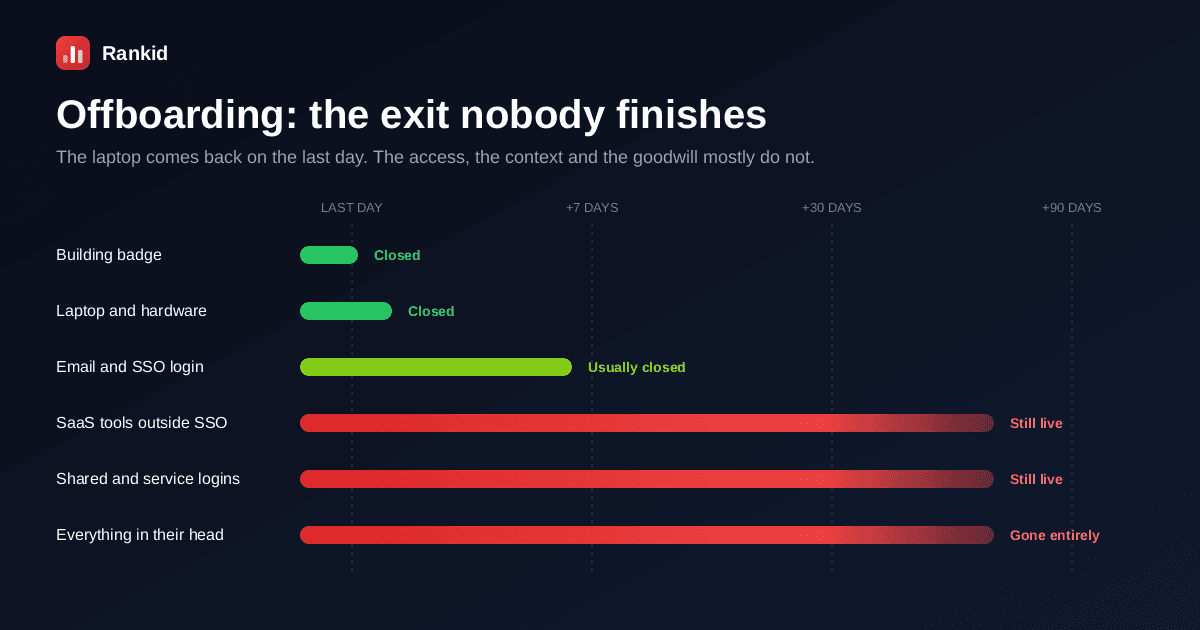
Most companies think they offboard well because the laptop comes back. It does come back, usually within a day or two, because it is a physical object that somebody is chasing. Meanwhile the marketing tool that was never wired into single sign-on is still logged in, the shared analytics password is unchanged, and the reason a particular process exists at all left the building in somebody's head and is not coming back at any price.
Quick answer
Quick answer: offboarding is the structured process for someone leaving, covering four workstreams: access and assets, knowledge transfer, pay and paperwork, and the relationship. Organise the checklist by owner and phase, not as one long list, because it fails at the handoffs. Revoke access in a specific order: inventory first, transfer ownership second, revoke identity third, rotate shared credentials fourth. And run a residual access audit at 30 days, because it always finds something.
What is offboarding?
Offboarding is the structured process a company follows when someone leaves, running from the moment notice is given to the point the person is fully separated from the organisation. It covers four workstreams that run at the same time: recovering access and assets, transferring knowledge and ownership, settling pay, benefits and paperwork, and closing the relationship without damaging it.
It applies to every kind of exit, whether the person resigned, was dismissed, was made redundant or retired, and it applies equally to contractors, agency staff and anyone else who ever held company access. That last group is where most offboarding programmes have a hole in them.
The reason offboarding gets less attention than onboarding is not that people think it matters less. It is that offboarding failures are silent. A bad onboarding shows up in week two as a confused new hire asking questions. A bad offboarding shows up in month seven, as an account nobody can explain.
Offboarding is onboarding, run backwards
If you already have an onboarding checklist, you have most of an offboarding one and probably do not realise it. Nearly every onboarding step has an exact mirror, which is the fastest way to build the list from nothing.
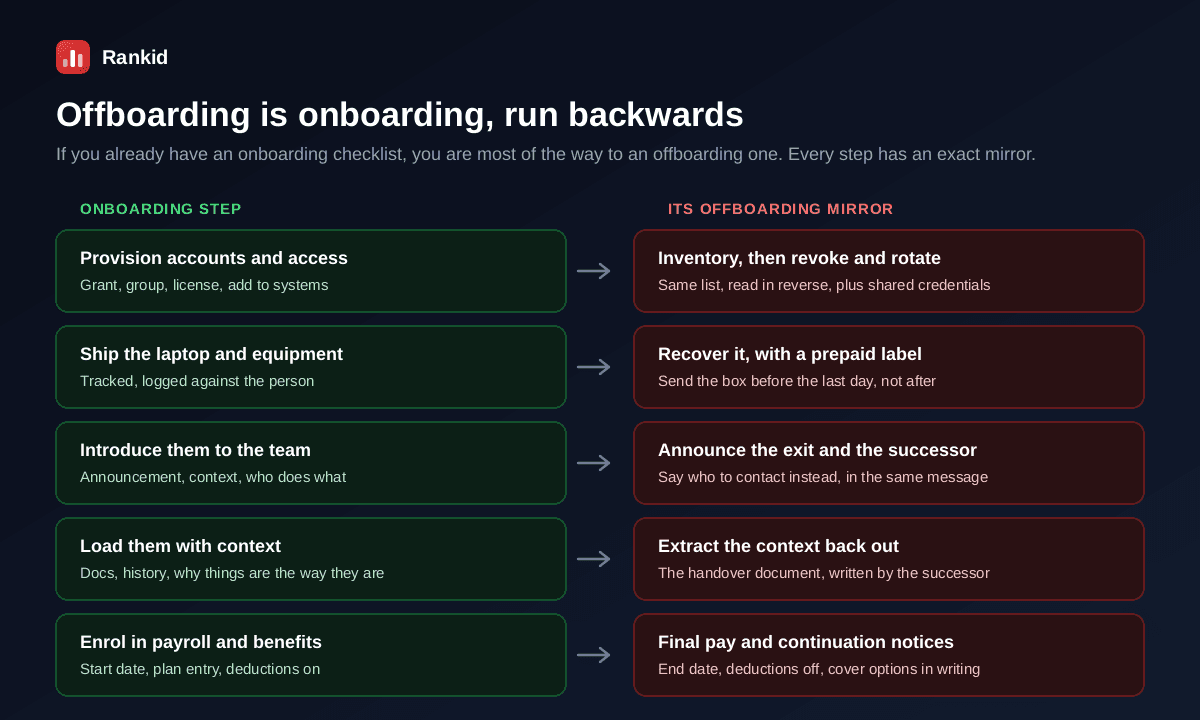
One asymmetry is worth naming, because it is where the mirror breaks. Onboarding gives access in a controlled way through one system. Offboarding has to take it back from systems the person acquired themselves, over years, without telling anyone. That is why the inventory step below matters so much and why a good onboarding process makes offboarding dramatically easier: everything provisioned deliberately is everything you can find later.
The offboarding checklist, by owner and phase
Do not write offboarding as one long list. Write it as a grid: four owners down the side, four phases across the top. This single change fixes the most common failure mode, which is not that a task was hard but that nobody was sure whose it was.
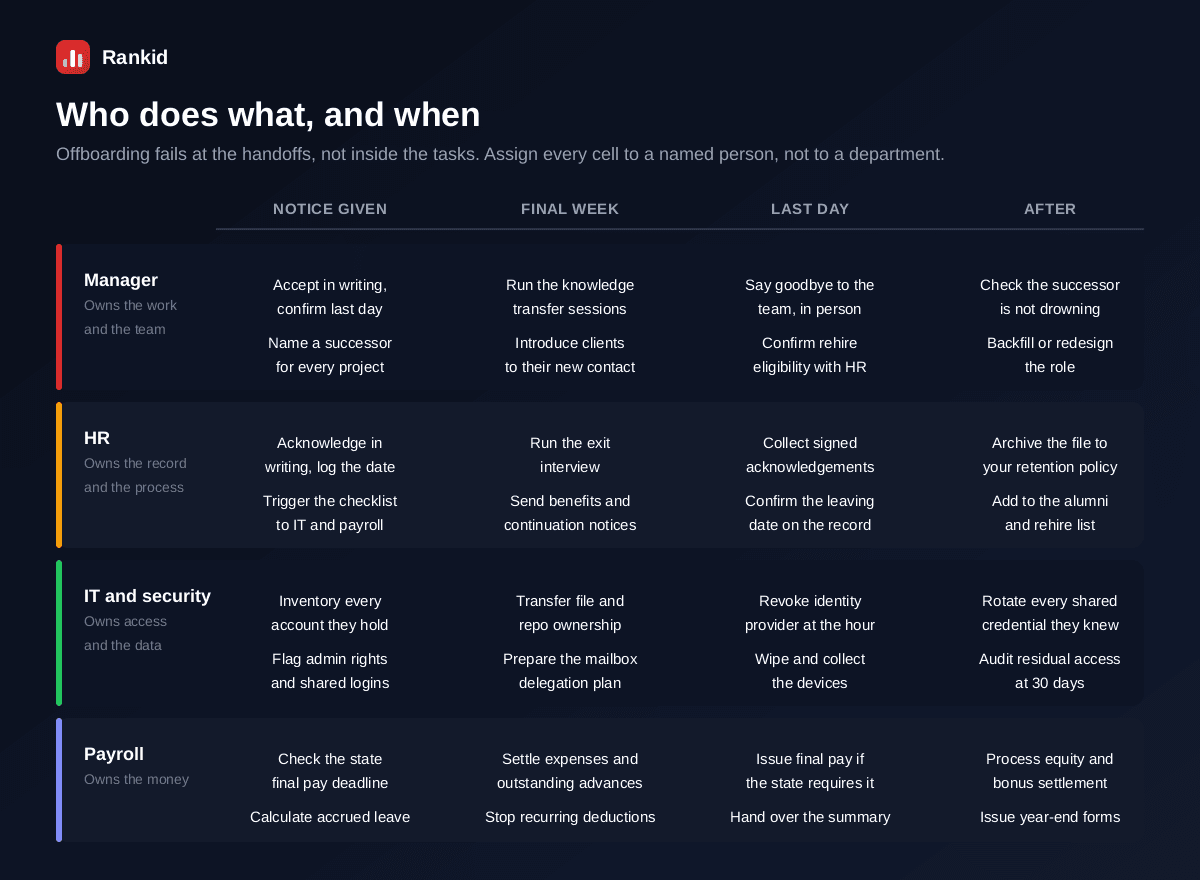
The rule that makes the grid work
Revoke access in this order, not all at once
There is a strong instinct to kill everything the moment someone leaves. Resist it, because the order genuinely matters and doing it in the wrong sequence destroys information you cannot recover.
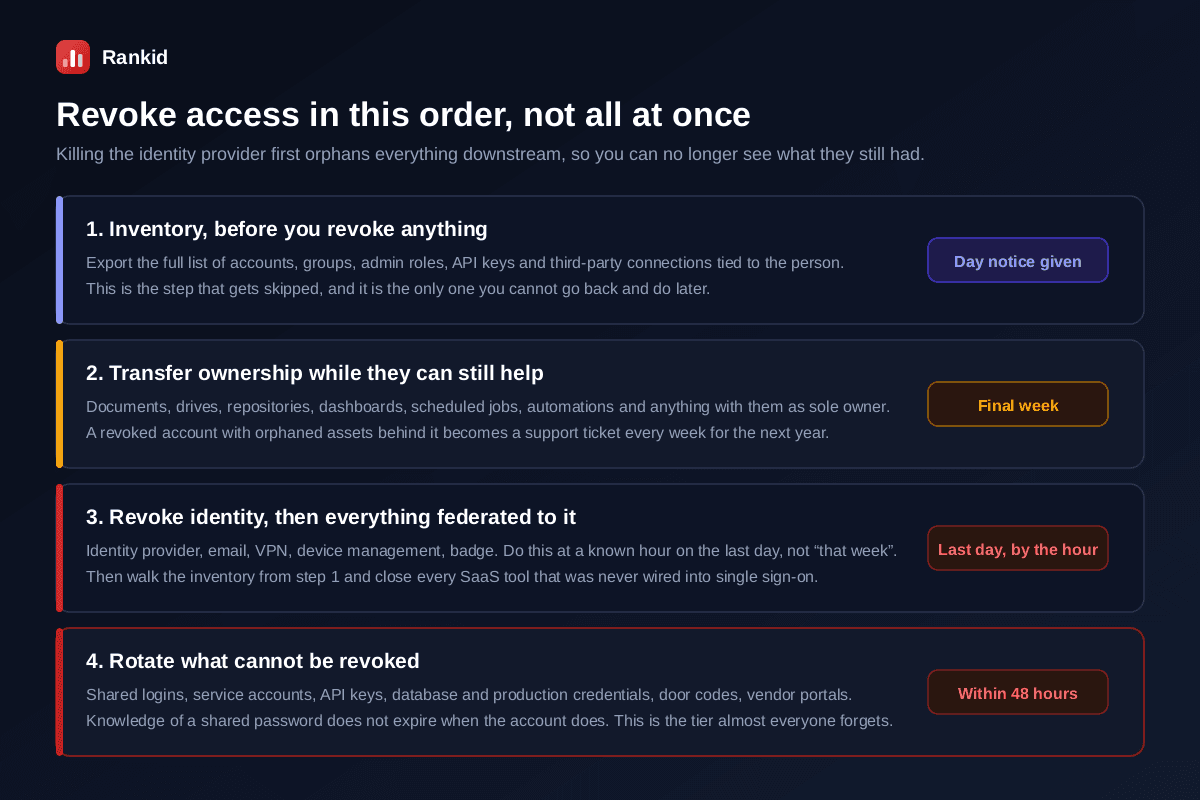
Inventory, before you revoke anything
Transfer ownership while they can still help
Revoke identity, then everything federated to it
Rotate what cannot be revoked
A dormant account with live credentials is one of the cleanest ways into a company, because it generates no alerts and belongs to nobody who would notice it being used. That is why the audit matters: schedule a residual access review at 30 days for every leaver. It always finds something, and the something it finds is almost always in tier four.
The knowledge transfer that actually produces something
"Please document your role before you go" produces one of two outcomes: nothing at all, or forty pages that nobody opens. Both are the same result. Five specific questions work far better, because they ask for judgement rather than for description.
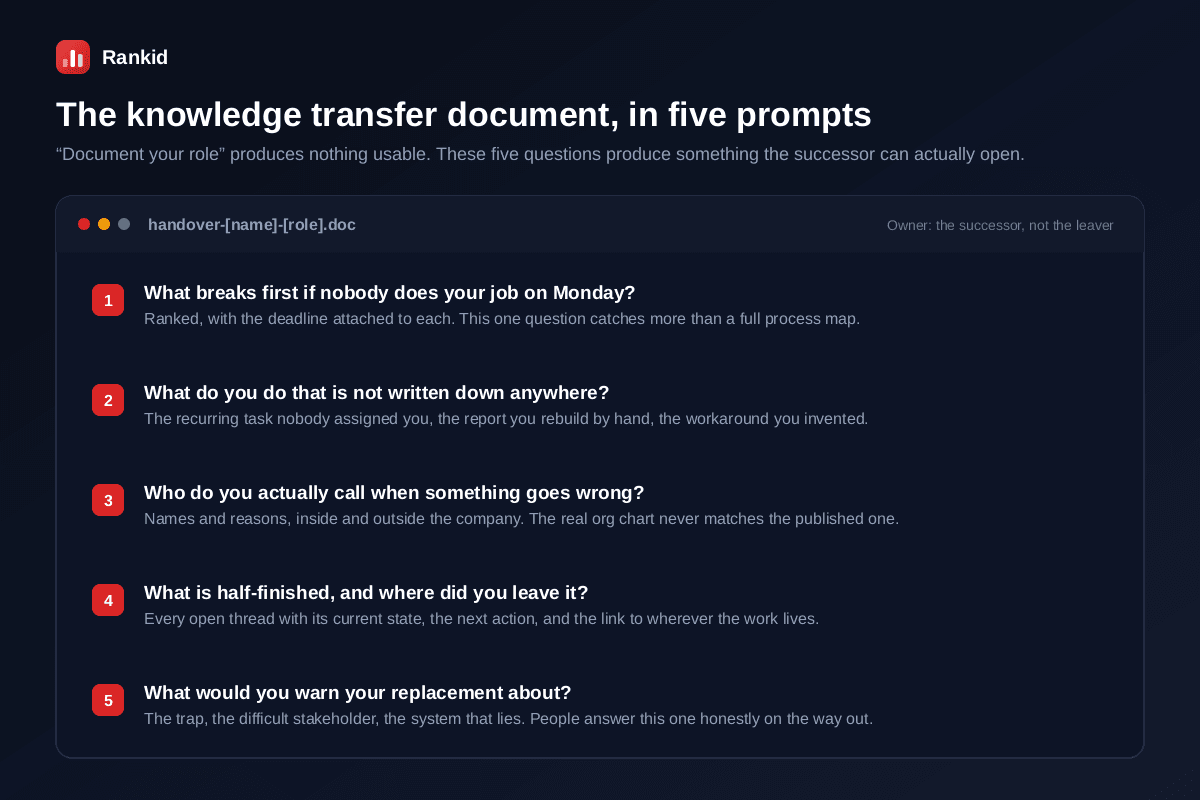
One structural rule does more work than the questions themselves: the successor writes the document, not the leaver. Someone writing alone documents what they think matters, which is usually the interesting parts of their job. A successor writing while asking questions documents what they cannot yet do, which is the part that actually breaks on Monday.
Schedule these sessions across the whole notice period rather than the final afternoon. Handovers booked for the last two days reliably produce something unusable, because the successor has not yet hit the questions worth asking. If the role is being backfilled rather than absorbed, this document is also the honest raw material for the job description, and it is usually far more accurate than the one written from memory two years ago.
Resignation and dismissal need the same list, run differently
The tasks are identical. The sequence, the timing and the tone are not, and running the resignation playbook for a dismissal is one of the fastest ways to make an exit go badly.
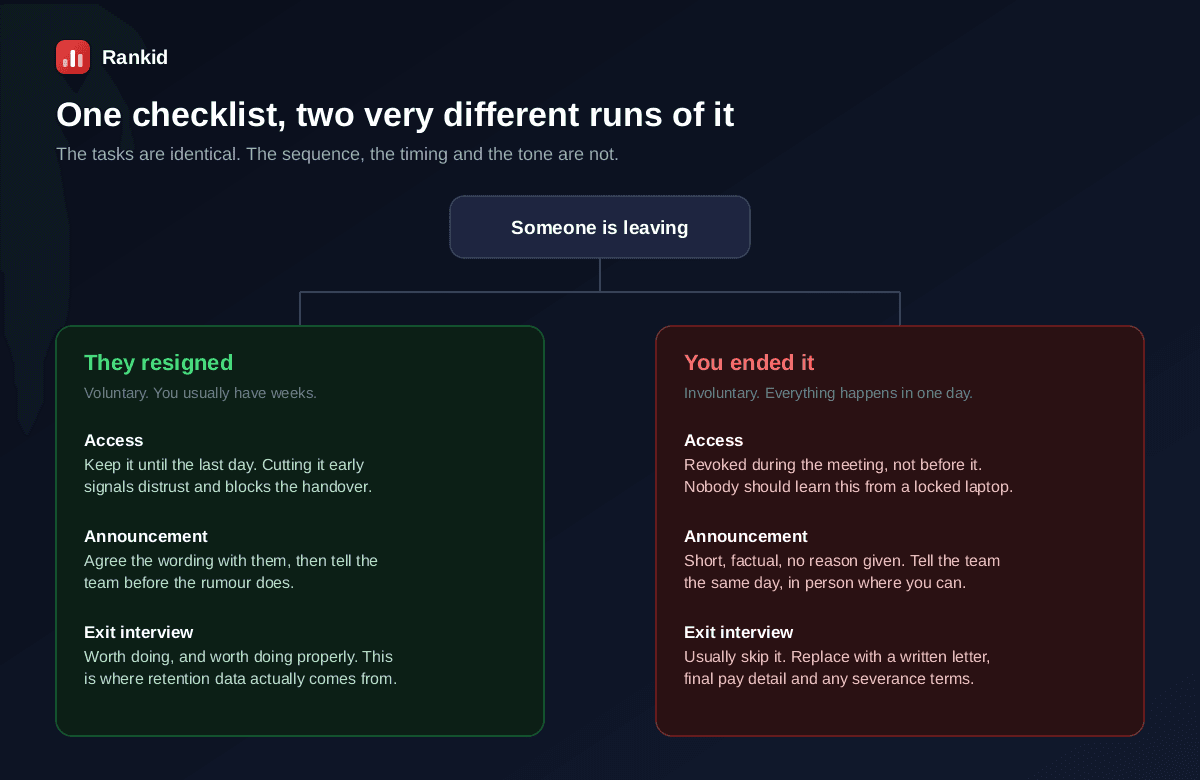
The access timing is the detail people get wrong most often in both directions. Cutting a resigning employee's access on the day they hand in notice is a common overreaction that signals distrust to everyone watching and blocks the handover you actually need. Cutting a dismissed employee's access before the meeting is the opposite mistake: nobody should learn they have been let go from a laptop that stopped working.
For the dismissal conversation itself, our termination letter guide covers what must and must never go into the written record, and severance pay covers what you may owe. If the exit is happening inside the first few months, the probation period guide covers how that conversation differs.
Final pay, benefits and the paperwork
This is the workstream with actual deadlines attached, and the deadlines are set by law rather than by you. In the United States final pay timing is state law, and it frequently differs depending on whether the person resigned or was dismissed. Check yours before you promise anyone a date.
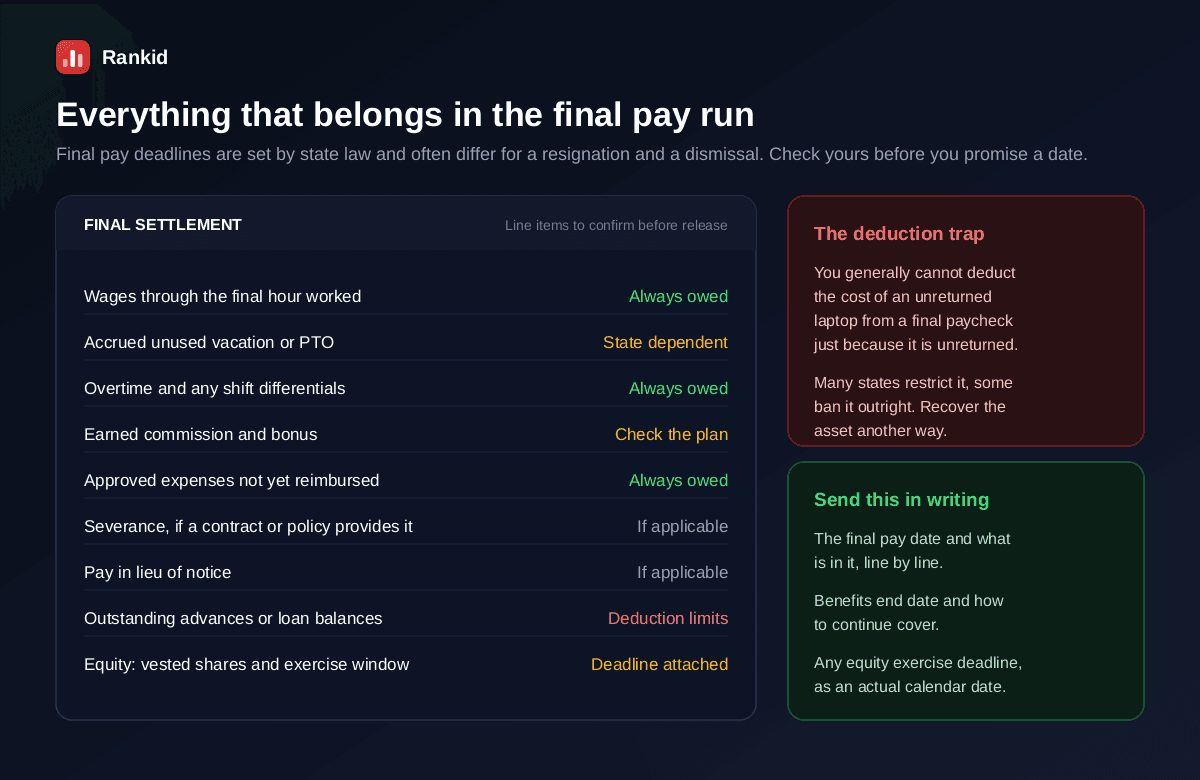
Two items catch employers out repeatedly. The first is the deduction trap: you generally cannot take the cost of an unreturned laptop out of a final paycheck just because it has not come back. Many states restrict this and some ban it outright. Recover the asset another way, which in practice means sending the prepaid return box before the last day rather than chasing afterwards.
The second is equity. The post-termination exercise window is commonly 90 days and it is a deadline, not a formality. Communicate it as an actual calendar date. "You have 90 days" is the version that gets missed; "your window closes on 4 December" is the version that does not.
What improper offboarding actually costs
Improper offboarding is an exit where the checklist was partly or wholly skipped, usually because the departure was rushed, the owner was unclear, or the process only ever existed in one person's head. The reason it persists is that the bill arrives on four different timescales, so nobody connects the cost back to the exit that caused it.
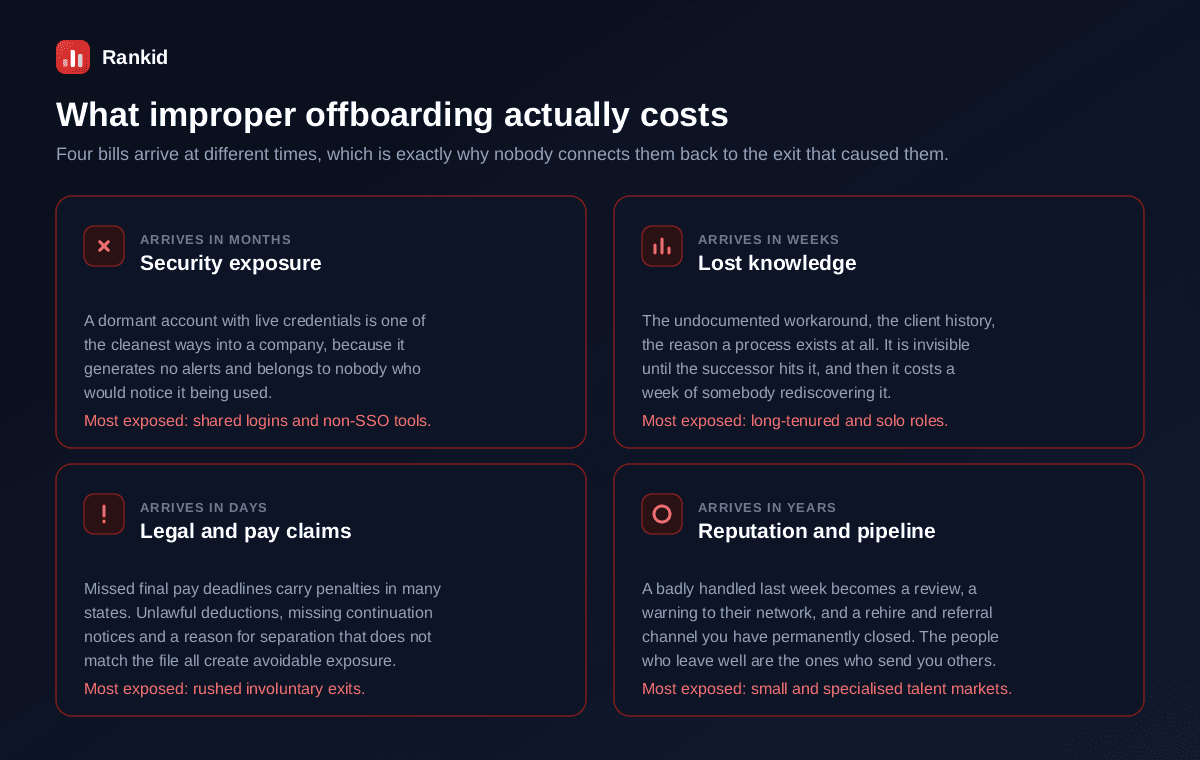
The knowledge column is the one that shows up in your numbers without ever being labelled. A successor spending a week rediscovering an undocumented process is real cost that lands in cost per hire and productivity, and it compounds when turnover is high. If your turnover rate is elevated, a weak offboarding process is not the cause but it is a multiplier on the cost.
Offboarding remote employees
The substance is identical. The logistics and the timing are what change, and three details cover most of it.
- Send the return box before the last day, not after. Recovery rates fall sharply once somebody is no longer being paid and no longer feels any obligation. Prepaid, tracked, and confirm the address while they are still responsive.
- Verify the device actually received the wipe command. Issuing the instruction in your device management console is not the same as the device checking in and executing it. Confirm, do not assume.
- Give the exit a real ending. A remote departure has no natural last day in the office, so without a deliberate goodbye it ends with someone quietly disappearing from a channel, which is corrosive for the team that stays. Watch time zones on the final day too: a 5pm access cut in one country is mid-morning in another.
If you hire across borders, the same discipline that makes remote hiring work makes remote offboarding work: write down who does what, and never rely on physical proximity to catch a missed step.
The last week decides whether they ever come back
Everything above is risk management. This section is the part with upside, and it is the reason offboarding deserves budget rather than just compliance. Offboarding is the last impression, and it is the one people describe to other people.
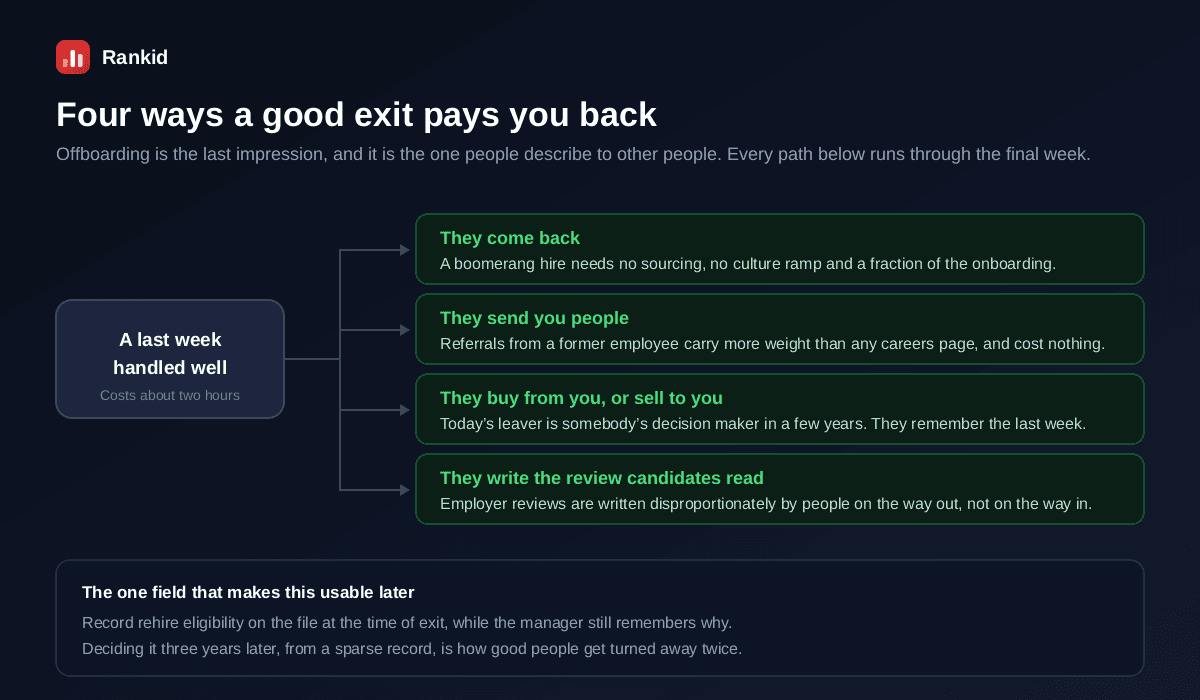
The operational version of this is a single field: rehire eligibility, recorded at the time of exit with a one-line reason, while the manager still remembers. Deciding it three years later from a sparse record is how good people get turned away twice. Make sure the reason is about performance or conduct rather than about the mere fact that somebody left, because plenty of companies quietly mark good leavers ineligible out of irritation and cannot explain the decision when the person applies again.
Former employees who return are among the cheapest and lowest-risk hires available, and they belong in your talent pipeline as a named source rather than as an accident. The exit interview is where a lot of this gets set, and it works best as a separate conversation from the checklist: see exit interview questions and structure for how to run one that produces something you can act on.
What to automate, and what never to
The triggers and the deprovisioning automate well. The judgement does not, and the line between them is clearer than in most HR processes.
- Automate the trigger. One event, usually the termination date entered in the HRIS, should fire tasks to IT, payroll, facilities and the manager. Manual kickoff is where offboarding silently fails, because it depends on someone remembering to start it.
- Automate the inventory. This is the highest-value automation and the least glamorous. Knowing what someone actually has access to is the genuinely hard part, and no manual checklist keeps pace with how fast teams adopt new tools.
- Automate the audit. A residual access review that runs at 30 days and reports anything still live costs nothing to schedule and catches the tier-four misses every time.
- Never automate the conversation. The handover, the announcement wording, the rehire judgement and anything involving a distressed person in a room. An automated goodbye is worse than no goodbye.
The same principle applies across the hiring cycle: automate the mechanical, keep the human where judgement is required. Our guide on what to automate and what never to automate covers the same line on the front end of the process.
The other half of an exit is the backfill
Every offboarding creates a requisition, and the handover document you just produced is the most accurate role description you will ever have. Use it: it describes what the job actually involved rather than what it was advertised as two years ago, including the parts nobody wrote down.
The failure mode here is speed. A backfill under time pressure is where screening standards slip, and a rushed replacement who does not work out means running this entire process again in six months. Raising a clean job requisition and screening against real requirements rather than against whoever writes the most confident summary is what stops the cycle repeating.
Backfilling the role? Screen the shortlist against what the job really needs
Upload the applicants and the job description. Rankid scores every candidate against the actual requirements and shows the evidence behind each score, so a rushed backfill does not become next quarter's offboarding. First 5 resumes free, no signup.
Try bulk screening freeFrequently asked questions
What is offboarding?
Offboarding is the structured process a company follows when someone leaves, covering everything from the moment notice is given to the point the person is fully separated from the organisation. It has four workstreams that run in parallel: recovering access and assets, transferring knowledge and ownership of work, settling pay, benefits and paperwork, and closing the relationship in a way that protects the employer's reputation. It applies to every kind of exit, whether the person resigned, was dismissed, was made redundant or retired, and it applies equally to contractors and to anyone else who held company access. The word is the mirror of onboarding and it is a genuine term of art in HR and IT, not jargon someone invented: if you already have an onboarding checklist, you are most of the way to an offboarding one, because nearly every onboarding step has an exact reverse. The reason it matters more than it looks is that offboarding failures are silent. Nobody notices a SaaS account that was never closed until it is used.
What should an employee offboarding checklist include?
Organise it by owner and by phase rather than as one long list, because offboarding fails at the handoffs rather than inside the tasks. Four owners: the manager owns the work and the team, HR owns the record and the process, IT and security own access and data, and payroll owns the money. Four phases: notice given, final week, last day, and after. The manager accepts the resignation in writing, names a successor for every project, runs the knowledge transfer, introduces clients to their new contact, and confirms rehire eligibility. HR acknowledges in writing, triggers the checklist to IT and payroll, runs the exit interview, sends benefits and continuation notices, collects signed acknowledgements, and archives the file. IT inventories every account the person holds, transfers file and repository ownership, revokes the identity provider at a known hour, wipes and collects devices, then rotates every shared credential the person knew. Payroll checks the state final pay deadline, calculates accrued leave, settles expenses, and processes equity and bonus. Assign every cell to a named person, never to a department, because a task owned by a department is a task owned by nobody.
What is the correct order to revoke access when an employee leaves?
Four tiers, in this order, and the order matters more than the speed. First, inventory before you revoke anything: export the full list of accounts, groups, admin roles, API keys and third-party connections tied to the person. This is the step that gets skipped, and it is the only one you cannot go back and do later, because killing the identity provider first orphans everything downstream and you lose visibility into what they still had. Second, transfer ownership while they can still help: documents, drives, repositories, dashboards, scheduled jobs, automations and anything where they are the sole owner. Third, revoke identity and everything federated to it, meaning identity provider, email, VPN, device management and badge, at a known hour on the last day rather than vaguely that week, then walk your inventory and close every SaaS tool that was never wired into single sign-on. Fourth, rotate what cannot be revoked: shared logins, service accounts, API keys, database and production credentials, door codes and vendor portals. Knowledge of a shared password does not expire when an account does, and this fourth tier is the one almost everyone forgets.
What is improper offboarding and why does it matter?
Improper offboarding is an exit where the checklist was partly or wholly skipped, most often because the departure was rushed, the owner was unclear, or the process only existed in one person's head. It matters because the costs arrive on four different timescales, which is exactly why nobody connects them back to the exit that caused them. Legal and pay exposure arrives within days: missed final pay deadlines carry penalties in many states, and unlawful deductions or missing continuation notices create claims. Lost knowledge arrives within weeks, when the successor hits an undocumented workaround and spends a week rediscovering it. Security exposure arrives within months, because a dormant account with live credentials generates no alerts and belongs to nobody who would notice it being used, which makes it one of the cleanest ways into a company. Reputation damage arrives over years, in the form of employer reviews, a warning to the person's network, and a rehire and referral channel that is now permanently closed.
How is offboarding different for a resignation and a dismissal?
The tasks are identical. The sequence, the timing and the tone are completely different, and using the resignation playbook for a dismissal is how exits go badly wrong. When someone resigns you usually have weeks, so keep their access until the last day, because cutting it early signals distrust and blocks the handover you need. Agree the announcement wording with them and tell the team before the rumour does. Run a proper exit interview, because voluntary exits are where genuine retention data comes from. When you end the employment, everything happens in one day. Access is revoked during the meeting rather than before it, since nobody should learn they have been dismissed from a laptop that stopped working. The announcement is short and factual with no reason given, delivered the same day and in person where you can. The exit interview is usually skipped and replaced with a written letter, the final pay detail and any severance terms. One rule spans both: the practical facts must be in writing, because almost nothing said in the meeting itself is retained.
What has to be included in an employee's final pay?
Wages through the final hour worked, overtime and shift differentials, and approved expenses not yet reimbursed are owed in essentially all cases. Accrued unused vacation or PTO is state dependent in the United States: some states treat it as earned wages that must be paid out, others let company policy govern. Earned commission and bonus depend on the plan document, which is where the definition of earned actually lives. Severance and pay in lieu of notice apply only if a contract or policy provides for them. Two items catch employers out. Deductions for unreturned equipment are restricted in many states and banned outright in some, so you generally cannot take the cost of a laptop out of a final paycheck simply because the laptop has not come back, and you should recover the asset another way. And equity has a deadline attached: the post-termination exercise window is often 90 days and needs to be communicated as an actual calendar date rather than a duration. Final pay deadlines themselves are set by state law and frequently differ for a resignation and a dismissal, so check yours before promising a date.
How do you run a knowledge transfer that actually produces something useful?
Ask five specific questions instead of saying "document your role", which reliably produces either nothing or forty pages nobody opens. What breaks first if nobody does your job on Monday, ranked, with the deadline attached to each. What do you do that is not written down anywhere, meaning the recurring task nobody assigned them, the report they rebuild by hand, the workaround they invented. Who do you actually call when something goes wrong, with names and reasons, inside and outside the company, because the real org chart never matches the published one. What is half-finished and where did you leave it, with the current state, the next action and a link to where the work lives. And what would you warn your replacement about, which is the question people answer honestly on the way out and almost never answer honestly while employed. One structural rule makes all of it work: the successor writes the document, not the leaver. A leaver writing alone documents what they think matters. A successor writing while asking questions documents what they cannot yet do.
How do you offboard a remote employee?
The difference is logistics and timing rather than substance. Send the return box with a prepaid, tracked label before the last day rather than after it, because the recovery rate falls sharply once someone is no longer being paid and no longer feels obliged to act. Confirm the address while they are still responsive. For devices, make sure your mobile device management can wipe and lock remotely, and verify that the device actually checked in and received the command rather than assuming the instruction landed. Handle the goodbye deliberately, because a remote exit has no natural last day in the office and can otherwise end with someone simply disappearing from a channel, which is corrosive for the team that remains. Set a specific hour for access revocation and tell the manager what it is, so nobody schedules a handover call for after the account is gone. And be careful with time zones on the final day, since an access cut at 5pm in one country can land mid-morning in another.
Should you do an exit interview as part of offboarding?
For voluntary exits, yes, and it should be a separate session from the administrative checklist. Nobody reflects usefully on culture and management while they are also sorting out their laptop, their final payslip and their benefits, so mixing the two produces shallow answers to both. Hold the feedback conversation two to five days before the last day, allow 30 to 45 minutes, and keep the practical checklist on a different day. For involuntary exits, an exit interview is usually inappropriate and is better replaced by a clear written letter covering final pay, benefits end date and any severance terms. The value of exit interviews comes entirely from aggregation: a single conversation tells you about one person, while twenty conversations tell you about your company. If nobody is reading them in batches and nothing ever changes as a result, you are extracting honesty from people on their way out and then wasting it, which is worse than not asking.
What is rehire eligibility and when should it be recorded?
Rehire eligibility is a field on the employment record stating whether the company would employ the person again, and it should be set at the time of exit while the manager still remembers why, not three years later from a sparse file. It matters because former employees are among the cheapest and lowest-risk hires available: a returning employee needs no sourcing, no culture ramp and a fraction of the onboarding, and they arrive already knowing how the place works. They are also a referral channel that costs nothing and carries more weight with candidates than any careers page, precisely because it is unpaid. Record the status, record a one-line reason, and make sure the reason is about performance or conduct rather than about the fact that someone left, because plenty of companies quietly mark good leavers ineligible out of nothing more than irritation and then cannot explain the decision when the person applies again. Set a policy for who can change the field and review it before any rejection is sent to a former employee.
Can offboarding be automated?
The triggers and the deprovisioning can be largely automated, and the judgement cannot. What automates well: a single event, usually the termination date entered in the HRIS, firing tasks to IT, payroll, facilities and the manager; identity provider deprovisioning that cascades to every federated application; automatic mailbox delegation and file ownership transfer; and a residual access audit that runs at 30 days and reports anything still live. Most modern HRIS and identity platforms do this natively, and the SaaS management category exists specifically to find the applications that were never wired into single sign-on. What does not automate: the handover conversation, the decision about announcement wording, the rehire eligibility judgement, and anything involving a distressed person in a room. The most valuable automation is not the deprovisioning at all, it is the inventory, because knowing what someone actually has access to is the hard part and no manual checklist keeps up with how quickly teams adopt new tools.
How long should the whole offboarding process take?
Access and asset recovery should be complete within 48 hours of the last day, and the shared credential rotation should be inside that window too. Final pay follows your state deadline, which for a dismissal can be as short as the same day. Knowledge transfer should take the whole notice period rather than the last afternoon, which is the single most common scheduling mistake: handovers booked for the final two days produce a document nobody can use, because the successor has not yet hit the questions that matter. The parts that should deliberately run longer are the two that get dropped. A residual access audit at 30 days catches what the last-day sweep missed, and it always catches something. And a check-in with the successor at 30 days catches the knowledge gaps that only surface once they are doing the job alone. Put both in the calendar at the time of exit, because neither will happen if they depend on someone remembering.
Key takeaways
- Offboarding covers four parallel workstreams: access and assets, knowledge transfer, pay and paperwork, and the relationship. Most companies do the first well and the other three badly.
- Write the checklist as a grid of four owners by four phases, and assign every cell to a named person. A task owned by a department is a task owned by nobody.
- Revoke access in order: inventory first, transfer ownership second, revoke identity third, rotate shared credentials fourth. Killing the identity provider first destroys the map.
- Tier four, the shared and service credentials, is the tier almost everyone forgets. Knowledge of a shared password does not expire when the account does.
- Run a residual access audit at 30 days for every leaver. It always finds something, and what it finds is almost always in tier four.
- Ask five specific handover questions instead of saying 'document your role', and have the successor write the document rather than the leaver.
- Final pay deadlines are state law and often differ for resignations and dismissals. Deducting unreturned equipment from a final paycheck is restricted in many states and banned in some.
- Record rehire eligibility at the time of exit with a one-line reason. Former employees are among the cheapest hires and the most credible referral source you have.
Frequently asked questions
What is offboarding?
Offboarding is the structured process a company follows when someone leaves, covering everything from the moment notice is given to the point the person is fully separated from the organisation. It has four workstreams that run in parallel: recovering access and assets, transferring knowledge and ownership of work, settling pay, benefits and paperwork, and closing the relationship in a way that protects the employer's reputation. It applies to every kind of exit, whether the person resigned, was dismissed, was made redundant or retired, and it applies equally to contractors and to anyone else who held company access. The word is the mirror of onboarding and it is a genuine term of art in HR and IT, not jargon someone invented: if you already have an onboarding checklist, you are most of the way to an offboarding one, because nearly every onboarding step has an exact reverse. The reason it matters more than it looks is that offboarding failures are silent. Nobody notices a SaaS account that was never closed until it is used.
What should an employee offboarding checklist include?
Organise it by owner and by phase rather than as one long list, because offboarding fails at the handoffs rather than inside the tasks. Four owners: the manager owns the work and the team, HR owns the record and the process, IT and security own access and data, and payroll owns the money. Four phases: notice given, final week, last day, and after. The manager accepts the resignation in writing, names a successor for every project, runs the knowledge transfer, introduces clients to their new contact, and confirms rehire eligibility. HR acknowledges in writing, triggers the checklist to IT and payroll, runs the exit interview, sends benefits and continuation notices, collects signed acknowledgements, and archives the file. IT inventories every account the person holds, transfers file and repository ownership, revokes the identity provider at a known hour, wipes and collects devices, then rotates every shared credential the person knew. Payroll checks the state final pay deadline, calculates accrued leave, settles expenses, and processes equity and bonus. Assign every cell to a named person, never to a department, because a task owned by a department is a task owned by nobody.
What is the correct order to revoke access when an employee leaves?
Four tiers, in this order, and the order matters more than the speed. First, inventory before you revoke anything: export the full list of accounts, groups, admin roles, API keys and third-party connections tied to the person. This is the step that gets skipped, and it is the only one you cannot go back and do later, because killing the identity provider first orphans everything downstream and you lose visibility into what they still had. Second, transfer ownership while they can still help: documents, drives, repositories, dashboards, scheduled jobs, automations and anything where they are the sole owner. Third, revoke identity and everything federated to it, meaning identity provider, email, VPN, device management and badge, at a known hour on the last day rather than vaguely that week, then walk your inventory and close every SaaS tool that was never wired into single sign-on. Fourth, rotate what cannot be revoked: shared logins, service accounts, API keys, database and production credentials, door codes and vendor portals. Knowledge of a shared password does not expire when an account does, and this fourth tier is the one almost everyone forgets.
What is improper offboarding and why does it matter?
Improper offboarding is an exit where the checklist was partly or wholly skipped, most often because the departure was rushed, the owner was unclear, or the process only existed in one person's head. It matters because the costs arrive on four different timescales, which is exactly why nobody connects them back to the exit that caused them. Legal and pay exposure arrives within days: missed final pay deadlines carry penalties in many states, and unlawful deductions or missing continuation notices create claims. Lost knowledge arrives within weeks, when the successor hits an undocumented workaround and spends a week rediscovering it. Security exposure arrives within months, because a dormant account with live credentials generates no alerts and belongs to nobody who would notice it being used, which makes it one of the cleanest ways into a company. Reputation damage arrives over years, in the form of employer reviews, a warning to the person's network, and a rehire and referral channel that is now permanently closed.
How is offboarding different for a resignation and a dismissal?
The tasks are identical. The sequence, the timing and the tone are completely different, and using the resignation playbook for a dismissal is how exits go badly wrong. When someone resigns you usually have weeks, so keep their access until the last day, because cutting it early signals distrust and blocks the handover you need. Agree the announcement wording with them and tell the team before the rumour does. Run a proper exit interview, because voluntary exits are where genuine retention data comes from. When you end the employment, everything happens in one day. Access is revoked during the meeting rather than before it, since nobody should learn they have been dismissed from a laptop that stopped working. The announcement is short and factual with no reason given, delivered the same day and in person where you can. The exit interview is usually skipped and replaced with a written letter, the final pay detail and any severance terms. One rule spans both: the practical facts must be in writing, because almost nothing said in the meeting itself is retained.
What has to be included in an employee's final pay?
Wages through the final hour worked, overtime and shift differentials, and approved expenses not yet reimbursed are owed in essentially all cases. Accrued unused vacation or PTO is state dependent in the United States: some states treat it as earned wages that must be paid out, others let company policy govern. Earned commission and bonus depend on the plan document, which is where the definition of earned actually lives. Severance and pay in lieu of notice apply only if a contract or policy provides for them. Two items catch employers out. Deductions for unreturned equipment are restricted in many states and banned outright in some, so you generally cannot take the cost of a laptop out of a final paycheck simply because the laptop has not come back, and you should recover the asset another way. And equity has a deadline attached: the post-termination exercise window is often 90 days and needs to be communicated as an actual calendar date rather than a duration. Final pay deadlines themselves are set by state law and frequently differ for a resignation and a dismissal, so check yours before promising a date.
How do you run a knowledge transfer that actually produces something useful?
Ask five specific questions instead of saying "document your role", which reliably produces either nothing or forty pages nobody opens. What breaks first if nobody does your job on Monday, ranked, with the deadline attached to each. What do you do that is not written down anywhere, meaning the recurring task nobody assigned them, the report they rebuild by hand, the workaround they invented. Who do you actually call when something goes wrong, with names and reasons, inside and outside the company, because the real org chart never matches the published one. What is half-finished and where did you leave it, with the current state, the next action and a link to where the work lives. And what would you warn your replacement about, which is the question people answer honestly on the way out and almost never answer honestly while employed. One structural rule makes all of it work: the successor writes the document, not the leaver. A leaver writing alone documents what they think matters. A successor writing while asking questions documents what they cannot yet do.
How do you offboard a remote employee?
The difference is logistics and timing rather than substance. Send the return box with a prepaid, tracked label before the last day rather than after it, because the recovery rate falls sharply once someone is no longer being paid and no longer feels obliged to act. Confirm the address while they are still responsive. For devices, make sure your mobile device management can wipe and lock remotely, and verify that the device actually checked in and received the command rather than assuming the instruction landed. Handle the goodbye deliberately, because a remote exit has no natural last day in the office and can otherwise end with someone simply disappearing from a channel, which is corrosive for the team that remains. Set a specific hour for access revocation and tell the manager what it is, so nobody schedules a handover call for after the account is gone. And be careful with time zones on the final day, since an access cut at 5pm in one country can land mid-morning in another.
Should you do an exit interview as part of offboarding?
For voluntary exits, yes, and it should be a separate session from the administrative checklist. Nobody reflects usefully on culture and management while they are also sorting out their laptop, their final payslip and their benefits, so mixing the two produces shallow answers to both. Hold the feedback conversation two to five days before the last day, allow 30 to 45 minutes, and keep the practical checklist on a different day. For involuntary exits, an exit interview is usually inappropriate and is better replaced by a clear written letter covering final pay, benefits end date and any severance terms. The value of exit interviews comes entirely from aggregation: a single conversation tells you about one person, while twenty conversations tell you about your company. If nobody is reading them in batches and nothing ever changes as a result, you are extracting honesty from people on their way out and then wasting it, which is worse than not asking.
What is rehire eligibility and when should it be recorded?
Rehire eligibility is a field on the employment record stating whether the company would employ the person again, and it should be set at the time of exit while the manager still remembers why, not three years later from a sparse file. It matters because former employees are among the cheapest and lowest-risk hires available: a returning employee needs no sourcing, no culture ramp and a fraction of the onboarding, and they arrive already knowing how the place works. They are also a referral channel that costs nothing and carries more weight with candidates than any careers page, precisely because it is unpaid. Record the status, record a one-line reason, and make sure the reason is about performance or conduct rather than about the fact that someone left, because plenty of companies quietly mark good leavers ineligible out of nothing more than irritation and then cannot explain the decision when the person applies again. Set a policy for who can change the field and review it before any rejection is sent to a former employee.
Can offboarding be automated?
The triggers and the deprovisioning can be largely automated, and the judgement cannot. What automates well: a single event, usually the termination date entered in the HRIS, firing tasks to IT, payroll, facilities and the manager; identity provider deprovisioning that cascades to every federated application; automatic mailbox delegation and file ownership transfer; and a residual access audit that runs at 30 days and reports anything still live. Most modern HRIS and identity platforms do this natively, and the SaaS management category exists specifically to find the applications that were never wired into single sign-on. What does not automate: the handover conversation, the decision about announcement wording, the rehire eligibility judgement, and anything involving a distressed person in a room. The most valuable automation is not the deprovisioning at all, it is the inventory, because knowing what someone actually has access to is the hard part and no manual checklist keeps up with how quickly teams adopt new tools.
How long should the whole offboarding process take?
Access and asset recovery should be complete within 48 hours of the last day, and the shared credential rotation should be inside that window too. Final pay follows your state deadline, which for a dismissal can be as short as the same day. Knowledge transfer should take the whole notice period rather than the last afternoon, which is the single most common scheduling mistake: handovers booked for the final two days produce a document nobody can use, because the successor has not yet hit the questions that matter. The parts that should deliberately run longer are the two that get dropped. A residual access audit at 30 days catches what the last-day sweep missed, and it always catches something. And a check-in with the successor at 30 days catches the knowledge gaps that only surface once they are doing the job alone. Put both in the calendar at the time of exit, because neither will happen if they depend on someone remembering.