Right to Disconnect: Do You Have to Answer Work Messages After Hours? (Laws, Your Pay Rights and Scripts)
It's 9:47 p.m. Your phone buzzes: "Quick one, can you take a look at this before tomorrow?" You could ignore it. But what if it's urgent? What if your boss notices? Ten minutes later you're back in your inbox, and your evening is gone. The "infinite workday" is now so normal that whole countries have passed laws against it. In the US, nobody has, but you have more protection than you think, and better options than either answering everything or going dark.
Quick answer
Quick answer: in the US there's no federal or state right to disconnect, so your employer can usually expect some after-hours availability. But if you're non-exempt, after-hours emails, texts and calls are generally paid work time. Countries including France, Spain, Portugal, Belgium and Australia do give a right to disconnect, and Australia's first rulings in 2026 show it isn't a blanket ban on contact. Wherever you are, the fix is the same: agree response-time tiers, define "urgent," and be visibly reliable inside your hours.
The infinite workday, in numbers
In June 2025, Microsoft analyzed trillions of anonymized signals from Microsoft 365 users and described the rise of the infinite workday:
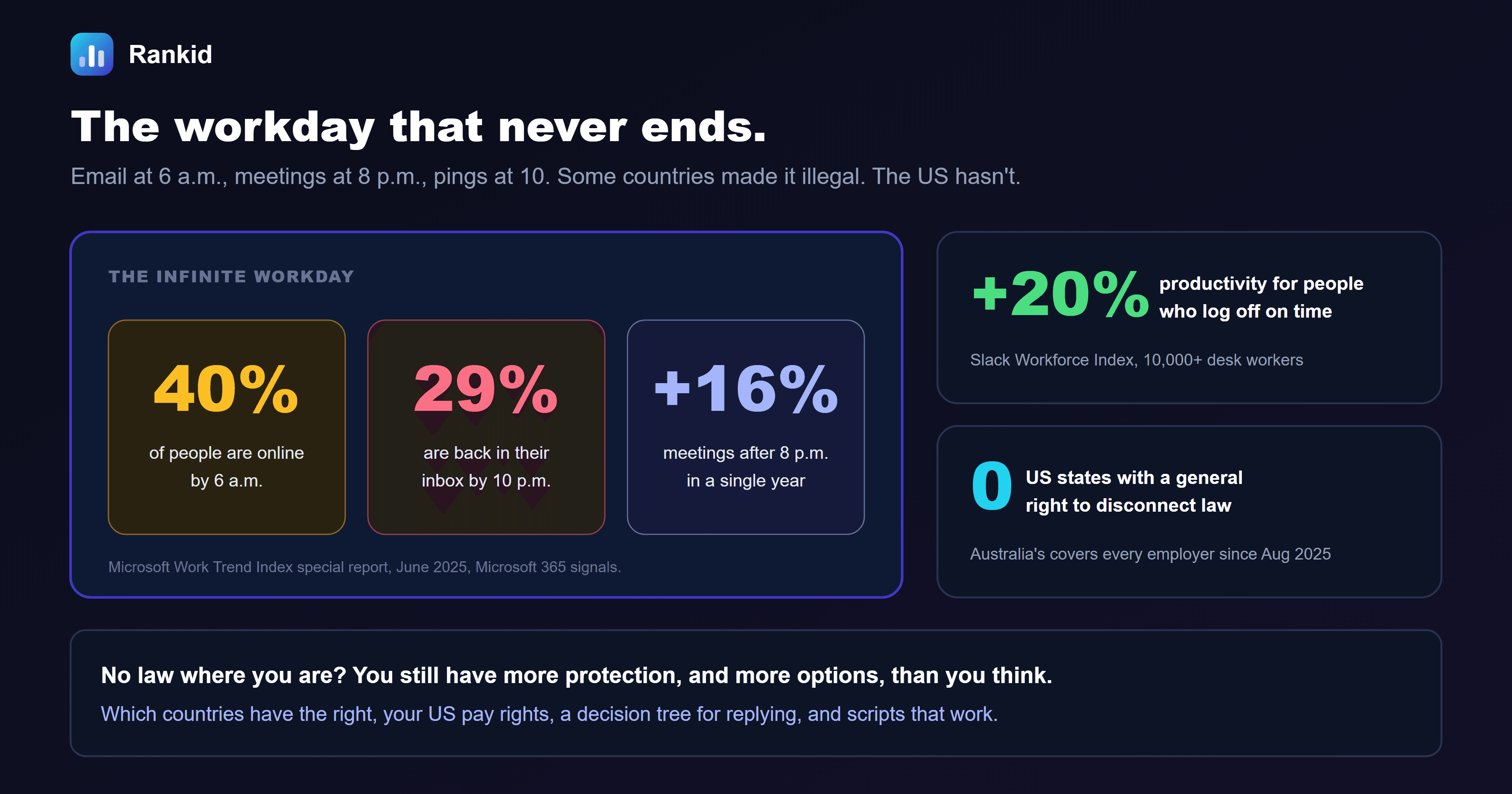
- 40% of people are online by 6 a.m., reviewing email to plan their day.
- 29% are back in their inbox by 10 p.m., and meetings after 8 p.m. rose 16% in a year.
- During the core workday, the average worker is interrupted roughly every two minutes, about 275 times a day, by meetings, email or chat, and receives about 117 emails and 153 Teams messages daily.
That last point explains the first two. When the day is shredded by pings, real work leaks into mornings and evenings. And it doesn't pay off: Slack's Workforce Index found desk workers who log off at the end of the day score 20% higher on productivity than those who feel obligated to keep working, and more than half of after-hours workers said they did it because they felt pressured, not because they chose to. Always-on work is a fast road to burnout, or to the slow disengagement we call quiet cracking.
Where the right to disconnect is law
A right to disconnect means you can ignore, or can't be penalized for ignoring, work contact outside your hours. The details vary a lot.
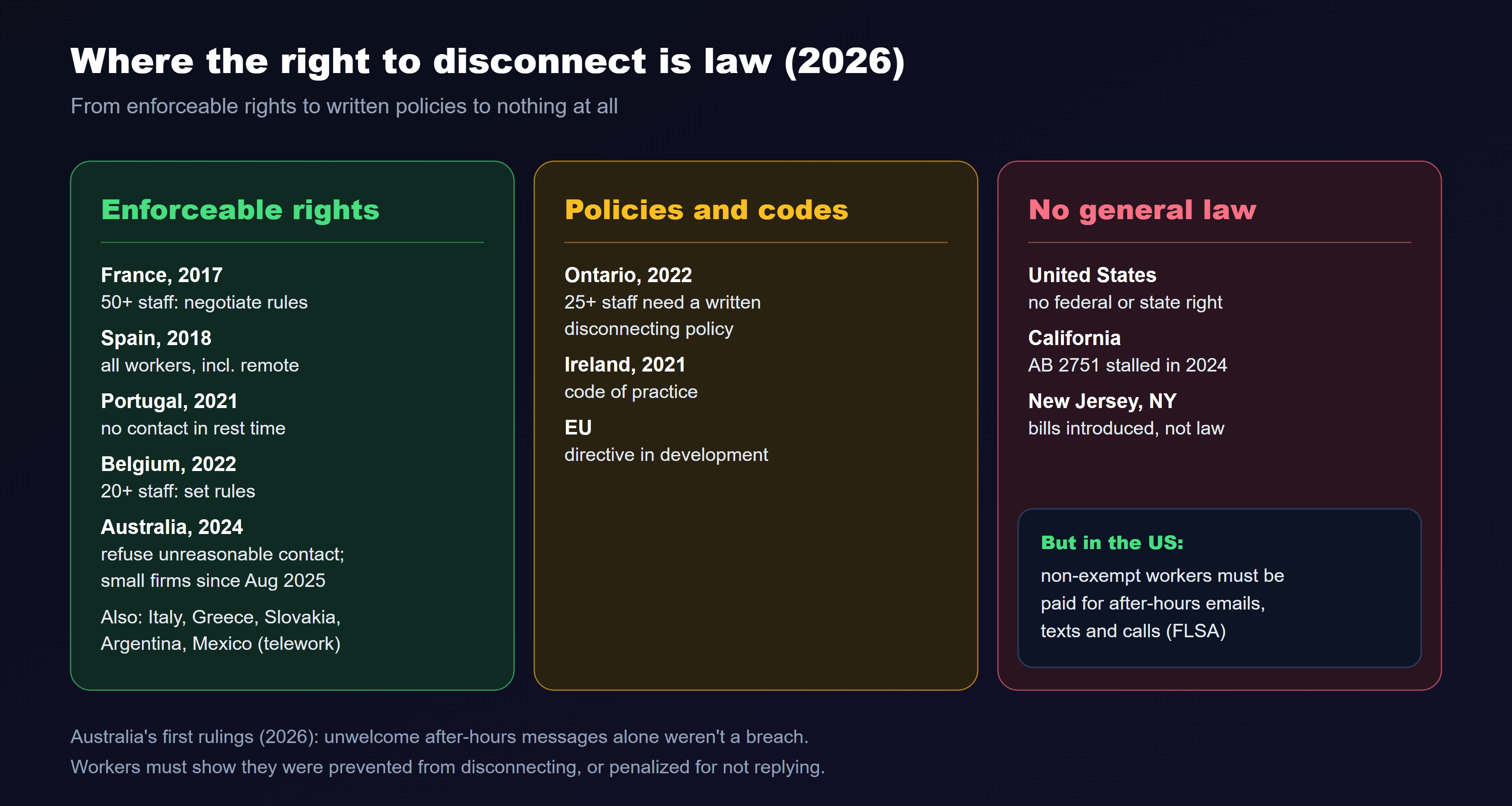
- France was first, in 2017: employers with 50 or more staff must negotiate rules on disconnecting.
- Spain (2018), Portugal (2021), Belgium (2022, for employers with 20 or more), Italy, Greece and Slovakiahave their own versions. Portugal's is among the strictest: employers must generally refrain from contacting employees in their rest time, except in force majeure.
- Argentina and Mexicoprotect teleworkers' right to disconnect.
- Ontario, Canada has required employers with 25 or more employees to have a written disconnecting-from-work policy since 2022. Ireland has a code of practice, and the EU is working toward a directive.
- Australia has the most talked-about version, covered next.
Australia's law, and what its first rulings revealed
Since August 26, 2024, and for small businesses since August 26, 2025, Australian employees can refuse to monitor, read or respond to contact from their employer, or from a third party such as a client, outside working hours, unless the refusal is unreasonable. Whether it's unreasonable depends on the reason for the contact, how it's made and how disruptive it is, whether you're paid to be available, your role and seniority, and your personal circumstances, such as caring responsibilities.
The first substantive rulings came in 2026, from the South Australian Employment Tribunal, and they surprised people. Two apprentice hairdressers said their salon owner sent them TikTok and Snapchat videos and out-of-hours messages, including on days off, and was in a bad mood if they didn't reply. The tribunal called some of the contact unpleasant and intrusive, but found no breach: the question wasn't whether the employer contacted them, but whether they were actually prevented from disconnecting or penalized for ignoring it.
The lesson, wherever you work
In the US: what actually protects you
There's no US right to disconnect. California's AB 2751 stalled in 2024, and bills have been introduced in New Jersey and New York without becoming law. Most employment is at-will, so in most states an employer can set availability expectations and discipline people who don't meet them. But three things work in your favor. (This is general information, not legal advice.)
- Non-exempt? After-hours work is paid work.Under the Fair Labor Standards Act, time your employer "suffers or permits" you to work counts as hours worked, including reading and answering emails, Slack messages, texts and calls, if your employer knows or should know about it. If it pushes you over 40 hours, it's overtime. The "de minimis" exception for trivial moments is narrow, and California's Supreme Court has largely rejected it for state claims. Our guide to exempt vs non-exemptexplains which category you're in.
- On-call rules.If after-hours restrictions are so tight you can't use the time for yourself, for example you must stay nearby and respond within minutes, that time may be paid work. If you can live your life and just answer the occasional call, usually only the calls count.
- Your own written agreement.Expectations you've agreed with your manager, in writing, are the most practical protection most US workers have. They're also exactly what a new manager inherits.
Non-exempt and answering at night? Track it
Should you reply? A 30-second decision tree
Not every after-hours message deserves the same response. Run this check before you open the thread.
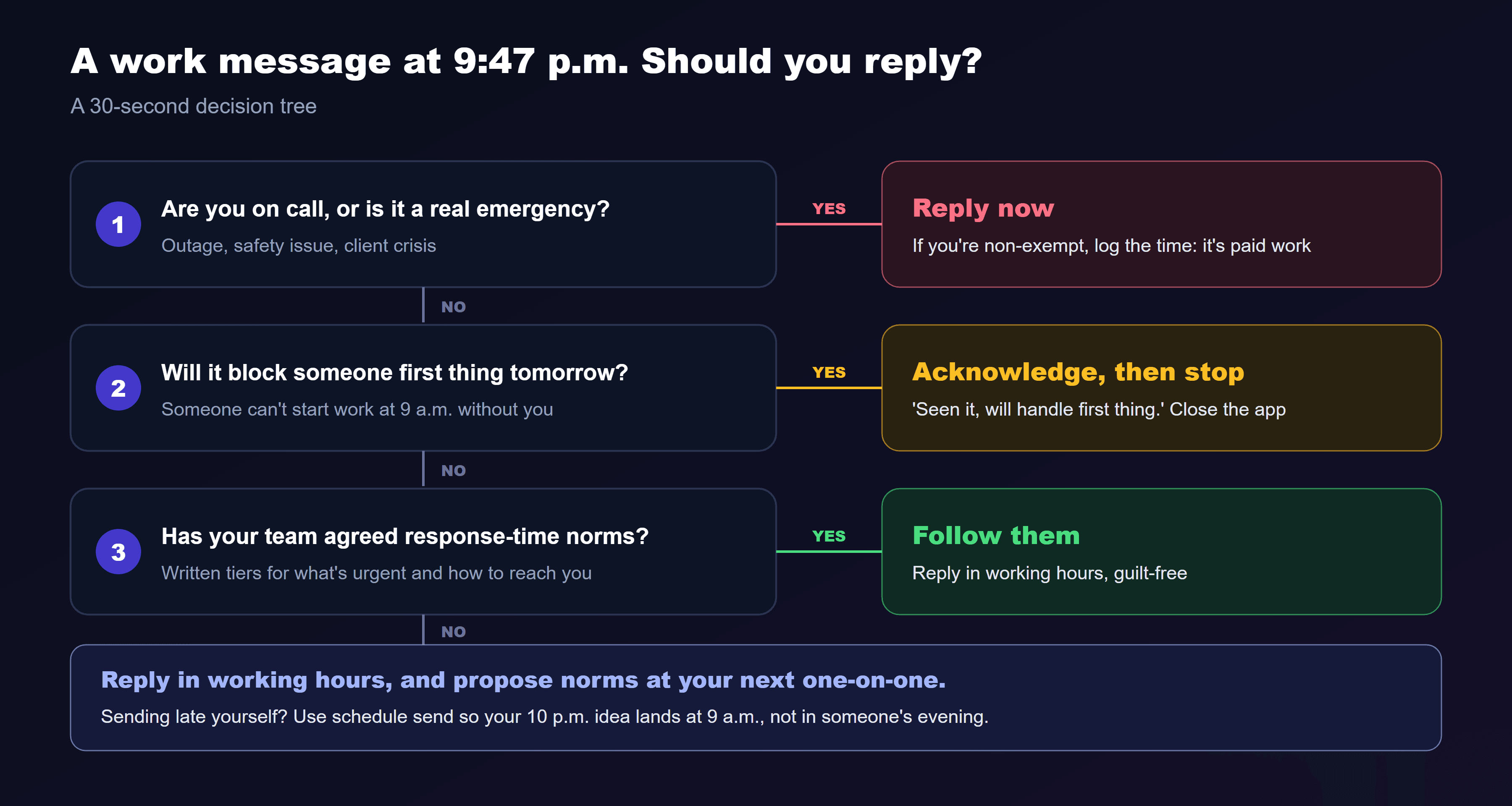
Is it a real emergency, or are you on call?
Will it block someone first thing tomorrow?
Everything else waits
Don't be part of the problem
How to set after-hours boundaries: scripts that work
Boundaries land best as a plan for being reliable, not a refusal to be available. A few scripts:
- Setting expectations with your manager:"To do my best work, I'm going to check messages until about 6 and first thing in the morning. If something is truly urgent after hours, please call me and I'll pick up. Does that work for you?"
- Defining urgent:"Can we agree what counts as urgent after hours? I'm thinking outages, client escalations and anything blocking a launch. Everything else I'll pick up in the morning."
- Across time zones:"We overlap from 8 to 11 my time. I'll keep that window free for live work and answer async messages within one working day."
- When it keeps happening:"I've noticed I'm regularly getting requests after 9 p.m. Can we look at what's driving that? If evening work is part of the role, I'd like to talk about how it's planned and recognized."
- Before you accept a job:"What are the expectations for availability outside core hours, and how is on-call handled?" More in our list of questions to ask in an interview.
Then back it up. Be fast and dependable inside your hours, turn on notification schedules in Teams or Slack, and keep work apps off your lock screen. The best way to make a boundary stick is to make it obvious that it isn't costing anyone anything. If you're negotiating more structural flexibility, our guides to the four-day work week and return-to-office mandates cover how to make the case.
Ready for a job that respects your evenings?
Paste your resume and a job description into Rankid for a free 0-100 match score and the exact requirements you meet and miss, so every application counts and your job search doesn't eat your nights too. No signup required.
Check your match score freeFor employers: an after-hours policy that works
You don't need a law to benefit from a right-to-disconnect policy. If you employ people in Australia, Europe or Ontario, you may need one anyway. A good policy fits on one page:
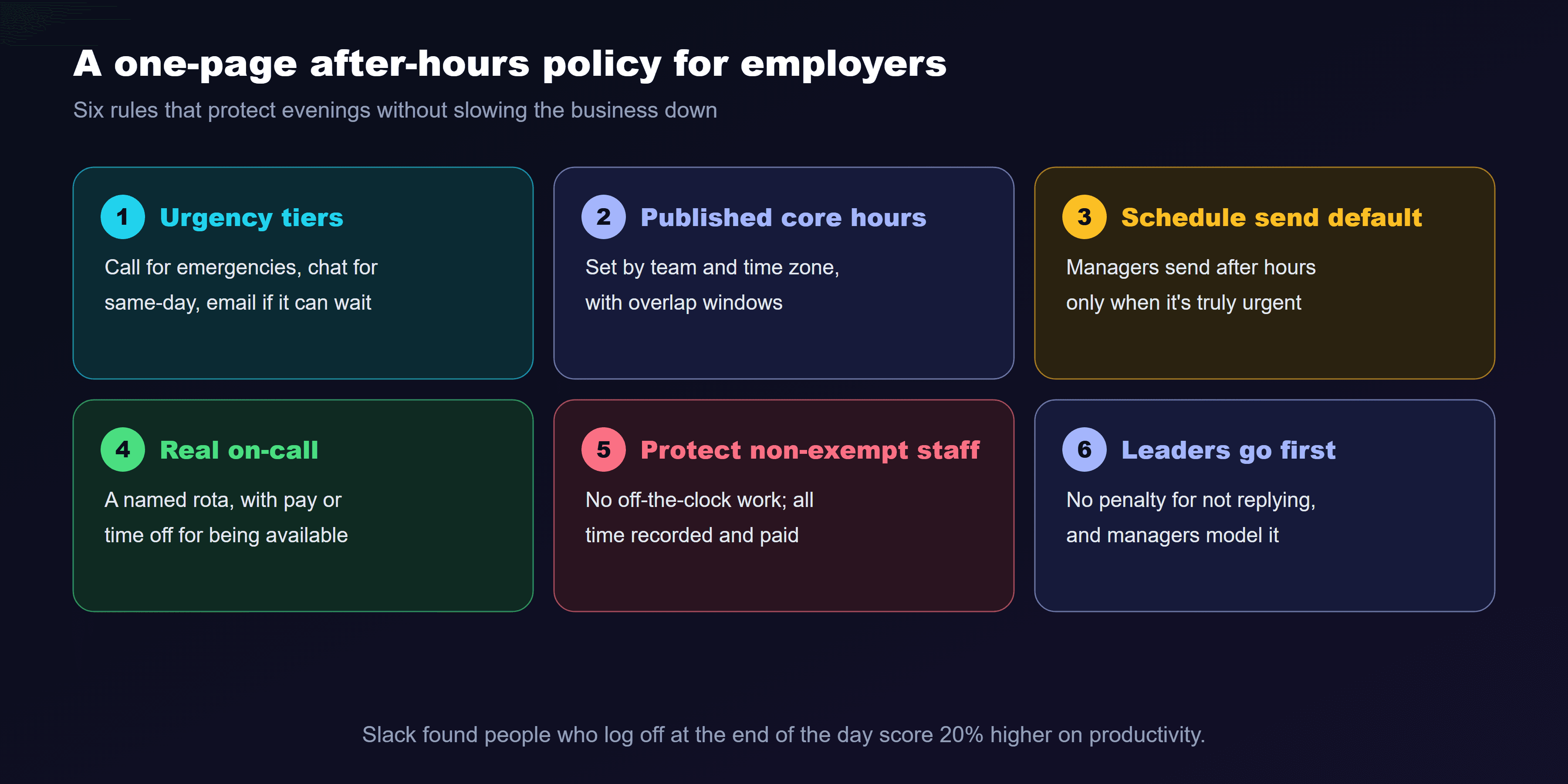
- Urgency tiers. Phone for emergencies, chat for same-day, email for anything that can wait. When everything arrives the same way, everything feels urgent.
- Core hours by team and time zone. Publish them. Our guide to hiring remote employees covers setting overlap windows across time zones.
- Schedule send by default for managers.A leader's late-night message sets the norm faster than any policy.
- Make on-call real. A named rota with pay or time off, instead of everyone being vaguely available all the time.
- Protect non-exempt staff.Ban off-the-clock work, require all time to be recorded, and don't give hourly employees work devices with notifications on unless that time is paid.
- No penalty for not replying. Put it in writing, and mean it. Burnout and turnover cost far more, as our guide to employee turnover shows.
Spend less of your evening on hiring
Rankid scores every resume against your job description on a consistent 0-100 scale and shows the exact requirements each candidate matched and missed, so screening takes minutes during the workday, not hours after it. First 5 resumes free, no signup.
Try bulk screening freeFrequently asked questions
What is the right to disconnect?
The right to disconnect is a legal right for employees to ignore, or not be penalized for ignoring, work emails, calls and messages outside their working hours. France introduced one of the first in 2017, and versions now exist in countries including Spain, Italy, Portugal, Belgium, Greece and Australia, while Ontario requires larger employers to have a written disconnecting-from-work policy.
Is there a right to disconnect in the US?
Not as of October 2026. There's no federal right to disconnect, and no state has passed a general one. California's AB 2751 stalled in 2024, and bills have been introduced in New Jersey and New York. In most of the US, after-hours expectations are set by your employer's policy, your contract and your manager, though wage-and-hour law still applies.
Do I get paid for answering work emails after hours?
If you're non-exempt (eligible for overtime), generally yes. Under the Fair Labor Standards Act, work your employer 'suffers or permits' counts as hours worked, and that includes reading and replying to emails, texts and calls off the clock if your employer knows or should know you're doing it. Truly trivial moments may be ignored under the narrow 'de minimis' rule, but regular after-hours messaging adds up, and California generally doesn't apply that rule. Exempt employees don't get extra pay for extra hours.
Can I get fired for not answering my phone after work?
In most US states, possibly. Most employment is at-will, so unless a contract, union agreement or specific law protects you, an employer can generally discipline you for not meeting its availability expectations. That's why it's worth clarifying expectations in writing, and why on-call duties should be explicit and, for non-exempt staff, paid. In Australia, by contrast, employees can refuse unreasonable after-hours contact.
Which countries have a right to disconnect?
Countries with right-to-disconnect laws or obligations include France (2017, for employers with 50 or more staff), Italy (for agile workers), Spain (2018), Belgium (2022, for employers with 20 or more), Portugal (2021), Greece, Slovakia, Argentina and Mexico (for teleworkers), and Australia (2024, extended to small businesses in August 2025). Ontario requires employers with 25 or more employees to have a written policy. Ireland has a code of practice, and the EU is working on a directive.
How does Australia's right to disconnect work?
Since August 26, 2024 for most employers, and August 26, 2025 for small businesses, Australian employees can refuse to monitor, read or respond to contact outside working hours unless the refusal is unreasonable. Reasonableness depends on factors such as why the contact was made, how disruptive it is, whether the employee is paid to be available, the role and level of responsibility, and personal circumstances such as caring duties. The first substantive rulings in 2026 found that frequent, unwelcome messages alone weren't a breach; the employee has to show they were actually prevented from disconnecting or penalized for not responding.
How do I tell my boss I won't answer messages after hours?
Frame it as a plan, not a refusal. For example: 'To do my best work, I'm going to check messages until about 6 p.m. and first thing in the morning. If something is truly urgent after hours, please call me and I'll pick up.' Agree what counts as urgent, then be reliable inside your hours so the boundary builds trust rather than worry.
Does working after hours make you more productive?
Usually not. Slack's Workforce Index found that desk workers who log off at the end of the workday scored 20% higher on productivity than those who felt obligated to work after hours, and more than half of people working outside standard hours said they felt pressured to rather than choosing to. Microsoft's 2025 data found the average worker is interrupted about every two minutes during the core workday, which pushes focus work into evenings.
Key takeaways
- The infinite workday is real: 40% of people are online by 6 a.m., 29% check email again by 10 p.m., and meetings after 8 p.m. rose 16% in a year (Microsoft).
- Logging off pays: Slack found workers who log off at the end of the day score 20% higher on productivity.
- The US has no federal or state right to disconnect as of October 2026, and most employment is at-will.
- If you're non-exempt, after-hours emails, texts and calls are generally paid work time, and California largely rejects the de minimis exception.
- France, Spain, Portugal, Belgium, Italy, Greece, Australia and others have right-to-disconnect laws, and Ontario requires a written policy.
- Australia's first rulings in 2026 show the law protects your right not to respond, not a ban on contact. You must show you were prevented or penalized.
- Use a 30-second decision tree: emergencies now, a one-line acknowledgment for tomorrow's blockers, everything else in working hours.
- Set boundaries as a reliability plan, define urgent together, use schedule send, and ask about after-hours expectations before you accept a job.
Frequently asked questions
What is the right to disconnect?
The right to disconnect is a legal right for employees to ignore, or not be penalized for ignoring, work emails, calls and messages outside their working hours. France introduced one of the first in 2017, and versions now exist in countries including Spain, Italy, Portugal, Belgium, Greece and Australia, while Ontario requires larger employers to have a written disconnecting-from-work policy.
Is there a right to disconnect in the US?
Not as of October 2026. There's no federal right to disconnect, and no state has passed a general one. California's AB 2751 stalled in 2024, and bills have been introduced in New Jersey and New York. In most of the US, after-hours expectations are set by your employer's policy, your contract and your manager, though wage-and-hour law still applies.
Do I get paid for answering work emails after hours?
If you're non-exempt (eligible for overtime), generally yes. Under the Fair Labor Standards Act, work your employer 'suffers or permits' counts as hours worked, and that includes reading and replying to emails, texts and calls off the clock if your employer knows or should know you're doing it. Truly trivial moments may be ignored under the narrow 'de minimis' rule, but regular after-hours messaging adds up, and California generally doesn't apply that rule. Exempt employees don't get extra pay for extra hours.
Can I get fired for not answering my phone after work?
In most US states, possibly. Most employment is at-will, so unless a contract, union agreement or specific law protects you, an employer can generally discipline you for not meeting its availability expectations. That's why it's worth clarifying expectations in writing, and why on-call duties should be explicit and, for non-exempt staff, paid. In Australia, by contrast, employees can refuse unreasonable after-hours contact.
Which countries have a right to disconnect?
Countries with right-to-disconnect laws or obligations include France (2017, for employers with 50 or more staff), Italy (for agile workers), Spain (2018), Belgium (2022, for employers with 20 or more), Portugal (2021), Greece, Slovakia, Argentina and Mexico (for teleworkers), and Australia (2024, extended to small businesses in August 2025). Ontario requires employers with 25 or more employees to have a written policy. Ireland has a code of practice, and the EU is working on a directive.
How does Australia's right to disconnect work?
Since August 26, 2024 for most employers, and August 26, 2025 for small businesses, Australian employees can refuse to monitor, read or respond to contact outside working hours unless the refusal is unreasonable. Reasonableness depends on factors such as why the contact was made, how disruptive it is, whether the employee is paid to be available, the role and level of responsibility, and personal circumstances such as caring duties. The first substantive rulings in 2026 found that frequent, unwelcome messages alone weren't a breach; the employee has to show they were actually prevented from disconnecting or penalized for not responding.
How do I tell my boss I won't answer messages after hours?
Frame it as a plan, not a refusal. For example: 'To do my best work, I'm going to check messages until about 6 p.m. and first thing in the morning. If something is truly urgent after hours, please call me and I'll pick up.' Agree what counts as urgent, then be reliable inside your hours so the boundary builds trust rather than worry.
Does working after hours make you more productive?
Usually not. Slack's Workforce Index found that desk workers who log off at the end of the workday scored 20% higher on productivity than those who felt obligated to work after hours, and more than half of people working outside standard hours said they felt pressured to rather than choosing to. Microsoft's 2025 data found the average worker is interrupted about every two minutes during the core workday, which pushes focus work into evenings.