Quiet Cracking: The Workplace Trend You Can't See Until It's Too Late (Signs, Self-Check and a 30-Day Fix)
You still show up. You still hit most of your deadlines. Nobody would call you a quiet quitter, and you wouldn't call yourself burned out. But something has been slowly going wrong for months: the Sunday dread arrives earlier, the ideas stopped coming, and you can't remember the last time work felt good. There's now a name for that, and it turns out more than half of workers have it. It's called quiet cracking, and its danger is that, by the time anyone notices, it's usually well advanced.
Quick answer
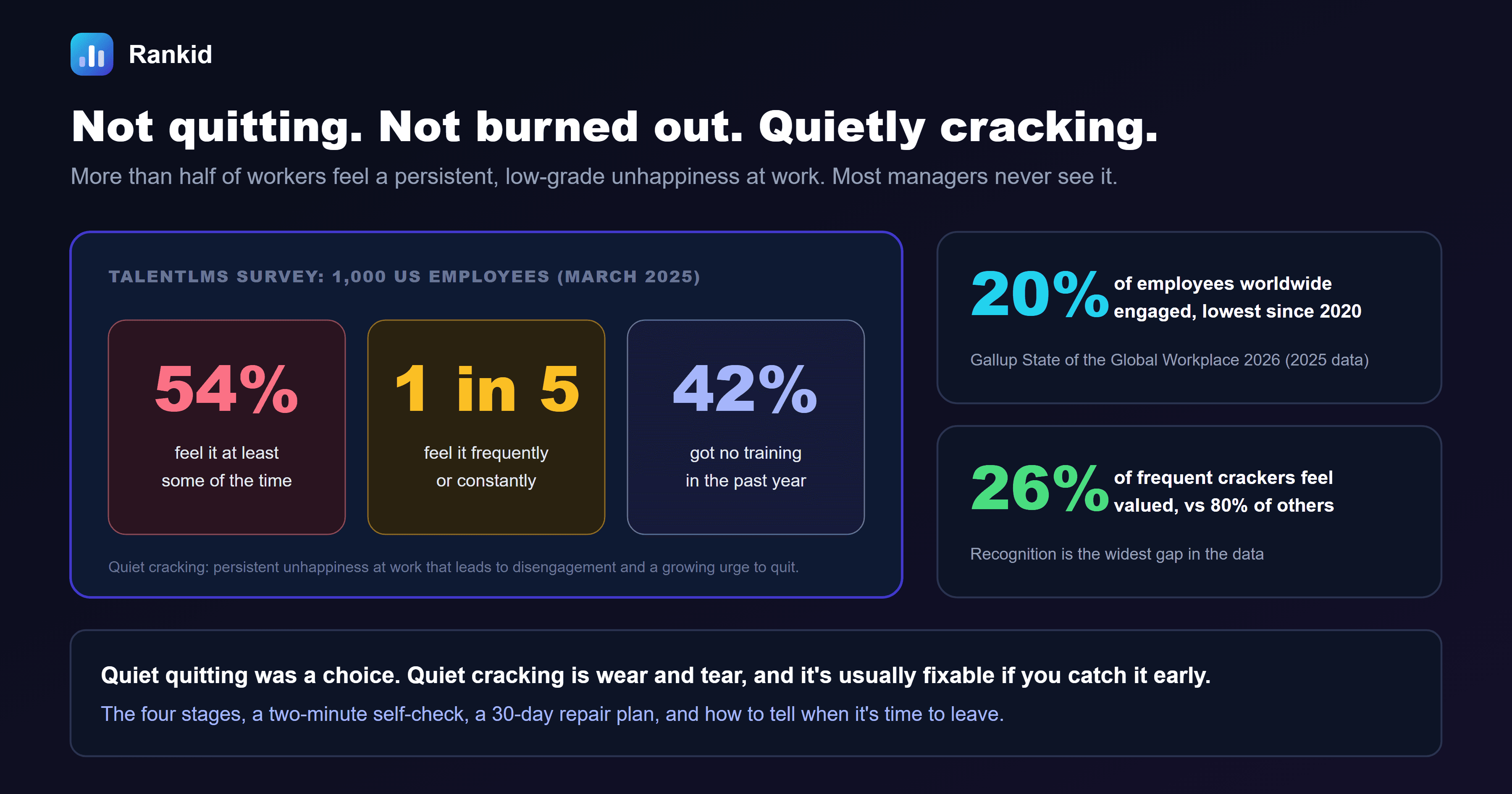
Quick answer: quiet cracking is persistent, low-grade unhappiness at work that slowly erodes engagement and performance. In a TalentLMS survey of 1,000 US employees, 54% experience it and 1 in 5 feel it frequently or constantly. Unlike quiet quitting, nobody chooses it. The biggest drivers in the data are not feeling valued, no training and a manager who doesn't listen. It moves through four stages, and the early ones are easy to reverse: name the cause, ask for one specific change, rebuild one visible win, and reassess after 30 days.
What is quiet cracking?
The term comes from a 2025 survey by the workplace learning platform TalentLMS, which defined quiet cracking as "a persistent feeling of workplace unhappiness that leads to disengagement, poor performance, and an increased desire to quit."The word "cracking" is deliberate. It describes something that happens to you gradually under steady pressure, like a hairline crack in a windscreen that spreads a little every time the temperature changes.
The numbers are striking. In the survey of 1,000 US employees, conducted in March 2025:
- 54% experience quiet cracking at some level: 34% occasionally, 14% frequently and 6% constantly.
- 82% feel secure in their job today, but only 62% feel secure about their future with the company.
- 42% received no employer-provided training in the previous 12 months, and people without training were 140% more likely to feel insecure about their jobs.
- Among people who experience it frequently, only 26% feel valued at work, compared with 80%of those who don't experience it.
- 47%of quiet crackers say their manager doesn't listen to their concerns.
It isn't a US-only story. Gallup's State of the Global Workplace 2026 report found that just 20% of employees worldwide were engaged in 2025, the second annual decline and the lowest level since 2020, with falling engagement among managers driving most of the drop. Gallup estimates low engagement costs the global economy around $10 trillion in lost productivity. Quiet cracking is what that statistic feels like from the inside.
Quiet cracking vs quiet quitting, burnout and job hugging
Workplace trends with "quiet" in the name now arrive every year, and they get used interchangeably. They aren't the same, and the difference matters because each one has a different fix.
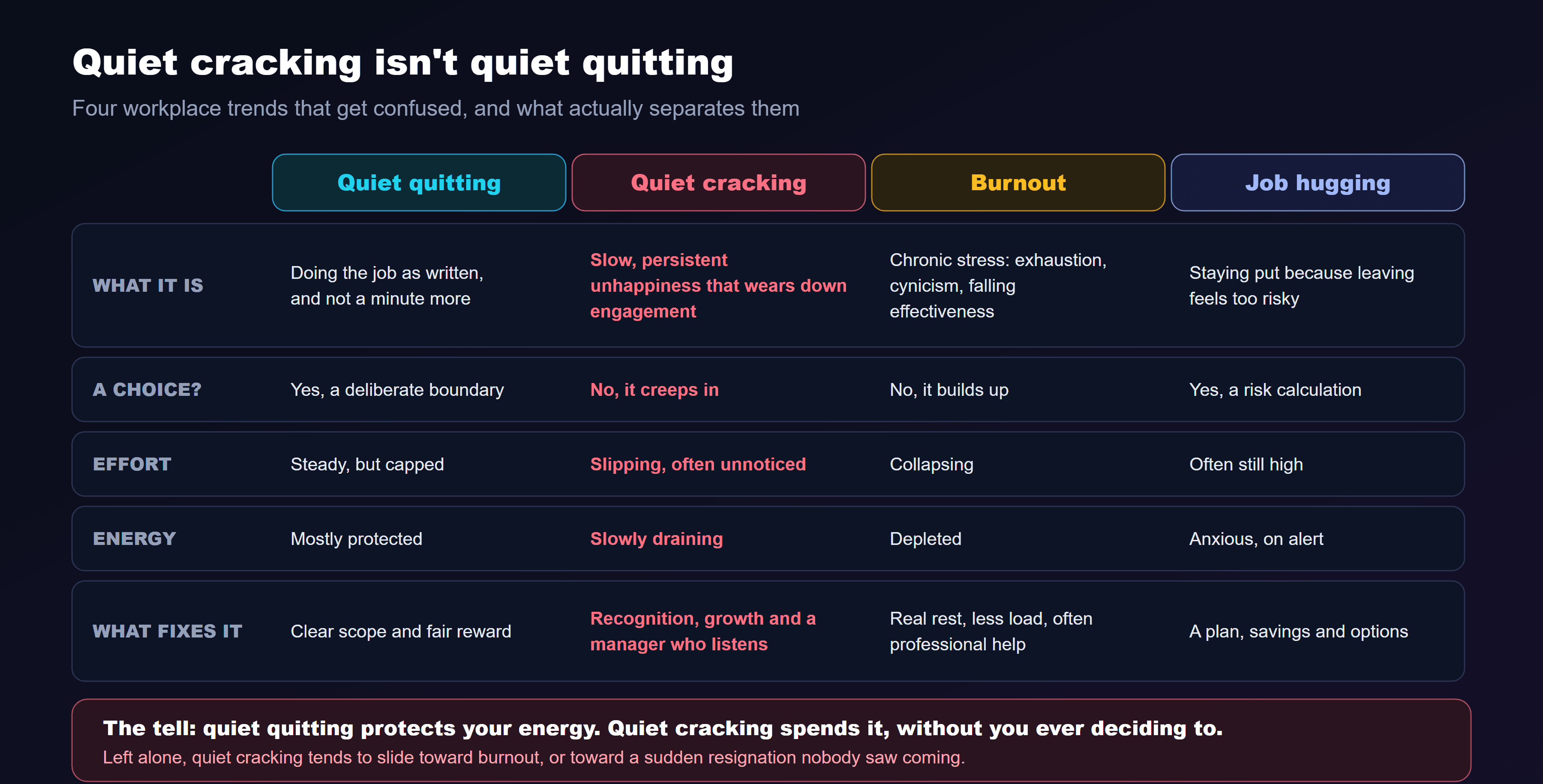
- Quiet quitting is a boundary. You decide to do the job as written and stop volunteering for more. Many quiet quitters feel perfectly fine. (The employer-side mirror image is quiet firing.)
- Quiet cracking is erosion. Nobody decides to do it. Motivation and wellbeing wear down until effort slips on its own.
- Burnout is the end state of unmanaged chronic stress. The World Health Organization describes it through three dimensions: exhaustion, mental distance or cynicism about the job, and reduced professional effectiveness.
- Job hugging is about tenure, not effort: clinging to a job because the market feels too risky to leave. Our guide to job hugging covers it in detail. It often overlaps with quiet cracking, which is what makes the combination so draining: you're unhappy and you feel you can't leave.
Why it's spreading now
The four stages of quiet cracking
Quiet cracking doesn't appear overnight. It tends to move through recognisable stages, and each one is easier to reverse than the next.
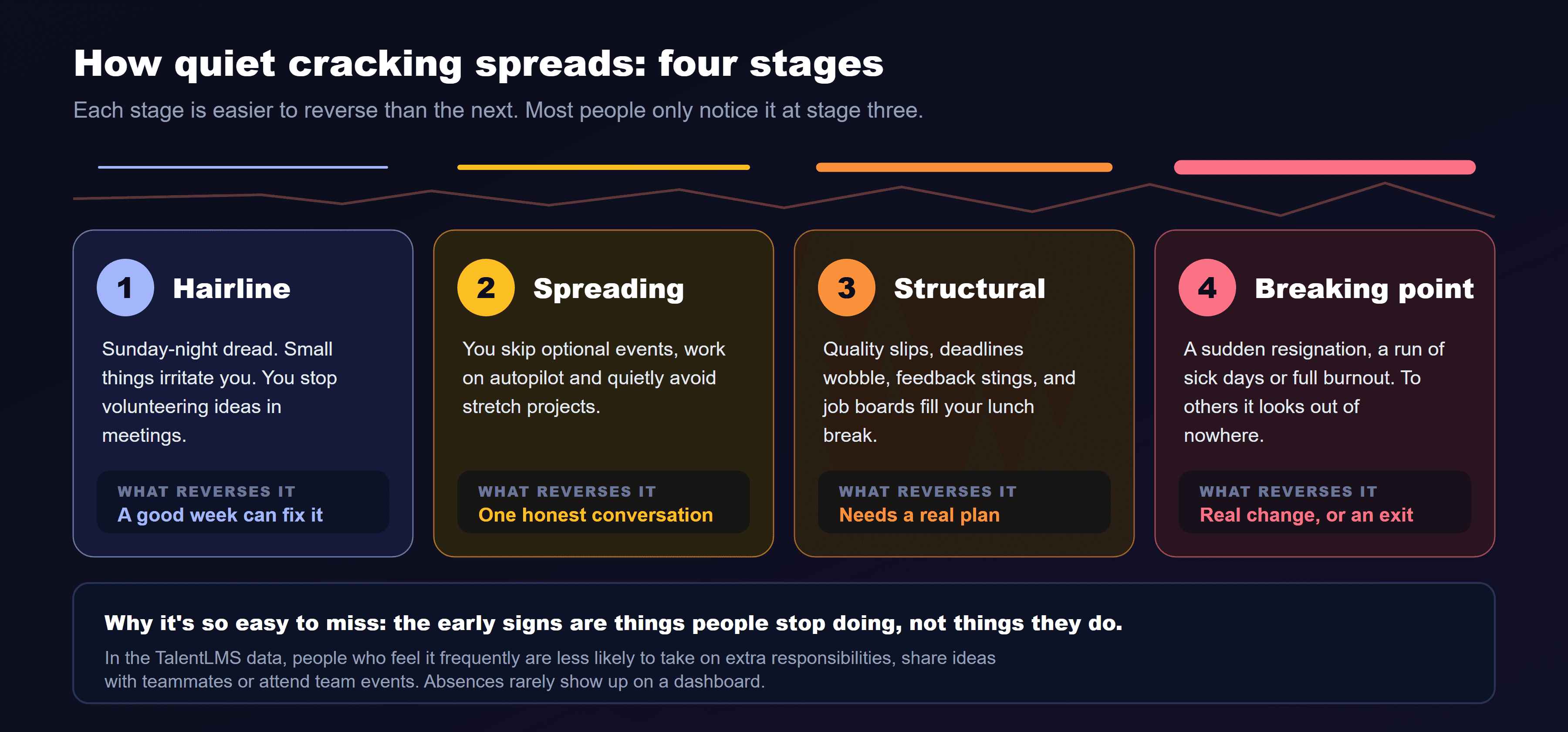
Hairline: the mood shifts
Spreading: you start withdrawing
Structural: performance starts to show it
Breaking point
The two-minute quiet cracking self-check
This isn't a clinical test, just a structured way to be honest with yourself. Answer each question for the past month, scoring 0 for rarely, 1 for sometimes and 2 for often.
- I feel a sense of dread before the work week starts.
- I've stopped sharing ideas or suggestions I would once have raised.
- I skip optional meetings, socials or team events when I can.
- I avoid new or stretch work, even when it would be good for my career.
- I can't remember the last time someone recognised my work specifically.
- I haven't learned anything new at work in months.
- When I raise a concern, I don't believe anything will change.
- Small problems irritate me more than they used to.
- The quality of my work has slipped, and I've noticed but not addressed it.
- I browse job listings out of escape, not as part of a plan.
0 to 5: probably a rough patch rather than a crack. 6 to 12:early quiet cracking (stages one and two). Act now, while it's cheap to fix. 13 to 20: advanced (stages three and four). Make a plan this week, and look at your health as well as your job.
Look at which questions scored highest
What causes quiet cracking
The data points to a short list of causes, and most of them have little to do with pay.
- Not feeling valued. The biggest gap in the data: 26% of frequent quiet crackers feel valued, against 80% of unaffected employees. Recognition that is specific and timely costs almost nothing, which is why its absence is so corrosive.
- No growth.42% of employees had no employer training in a year. Learning is how people feel they're moving forward, and how they feel secure. Without it, the job starts to feel like a dead end.
- A manager who doesn't listen.47% of quiet crackers say their manager doesn't listen to their concerns. Gallup has long found that managers account for most of the variation in team engagement, and manager engagement itself is falling.
- Workload and unclear expectations.29% of employees describe their workload as unmanageable and 15% don't understand what's expected of them.
- Uncertainty.Economic uncertainty topped the list of concerns behind job insecurity. Watching colleagues get laid off and wondering if you're next is a slow, steady pressure. Our guide to signs of layoffs helps separate real warning signs from noise.
A 30-day plan to repair it
The worst response to quiet cracking is a vague resolution to "feel better about work." The best is a short sequence of small, specific moves, with an honest check at the end.
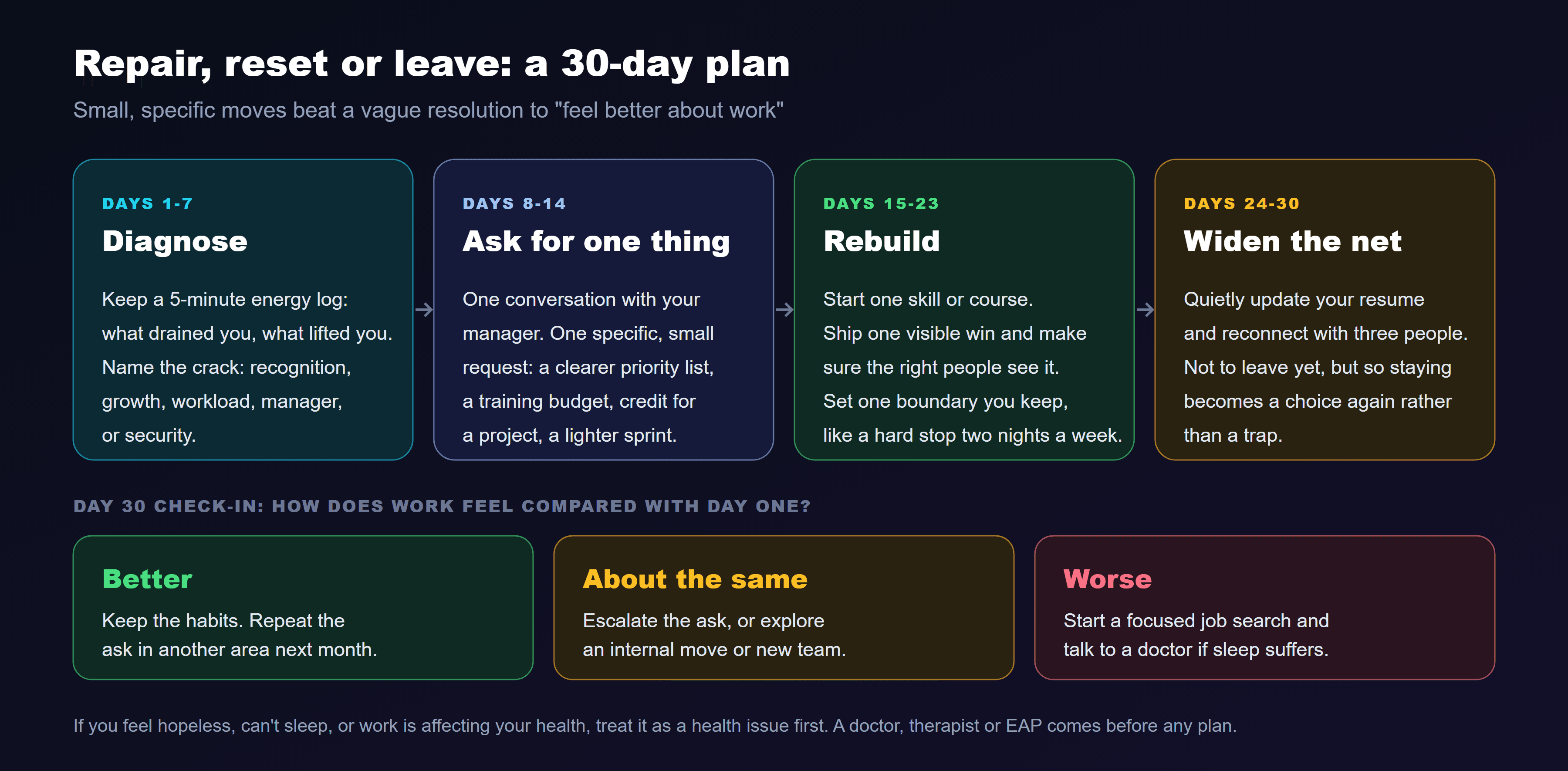
Days 1 to 7: diagnose
Days 8 to 14: ask for one thing
Days 15 to 23: rebuild
Days 24 to 30: widen the net
Health comes first
What to say to your manager
Most people avoid this conversation because they fear sounding negative or disloyal. Keep it short, specific and forward-looking, and make one request. A few scripts to adapt:
- Recognition:"I'd find it really useful to know which parts of my work are landing well. Could we spend five minutes on that in our one-on-ones?"
- Growth:"I want to keep developing here. Is there budget or time for me to build [skill] this quarter? I think it would help with [team goal]." An individual development plan makes this concrete.
- Workload:"I can do A, B and C well, or A through E badly. Which two should I deprioritise?"
- Clarity:"I want to make sure I'm focused on what matters most to you. Can we agree the three outcomes you'll judge me on this quarter?"
If you've made a clear, reasonable request and nothing changes, that's information too. It tells you whether the crack can be repaired where you are.
If the answer is to leave: job hunting while cracking
Quiet cracking makes job searching harder: low energy produces generic applications, and generic applications produce rejections, which deepen the crack. Break the loop by applying to fewer roles, more precisely.
- Search while employed.It's easier to negotiate from a job than from a gap, and quitting on a bad day rarely leads to a better one. When you do resign, our guide to explaining your reason for leaving keeps it positive.
- Aim at the crack. If the problem was recognition or growth, ask interviewers how feedback works and what the last person in the role went on to do. Our list of questions to ask in an interview helps you spot the same problems before you join.
- Tailor, don't spray. Five well-matched applications beat fifty generic ones, especially when your energy is limited. Our guide to tailoring your resume shows how.
Low on energy? Make every application count
Paste your resume and a job description into Rankid for a free 0-100 match score and the exact requirements you meet and miss, so a handful of targeted applications does the work of fifty. No signup required.
Check your match score freeFor managers and HR: spotting quiet cracking early
Quiet cracking is hard to see because it shows up as absence: the idea that wasn't shared, the event that was skipped, the stretch project nobody volunteered for. By the time it appears in performance data, you're at stage three.
- Watch for withdrawal, not misbehaviour. Shorter updates, fewer questions, declined optional work and slower replies from previously engaged people are the early signals.
- Ask about energy, not just status."What's draining you right now?" and "What would you like to learn next?" surface more in a one-on-one than any project update.
- Make recognition specific and frequent. It was the widest gap in the data, and the cheapest to close. Say what the person did and why it mattered.
- Invest in training. Employees with training were far more likely to feel secure. Even small, regular learning time signals a future at the company.
- Close the loop on feedback. Nothing deepens the crack faster than asking for input and doing nothing visible with it. Your exit interviewswill tell you what you missed, but by then it's too late.
Quiet cracking is expensive. Disengaged people produce less, and when the crack finally breaks, you pay for the resignation too. Our guide to employee turnover rate shows how quickly those costs add up.
When a role does open up, refill it fast
Rankid scores every resume against your job description on a consistent 0-100 scale and shows the exact requirements each candidate matched and missed, so backfilling a role doesn't leave the rest of your team stretched for months. First 5 resumes free, no signup.
Try bulk screening freeFrequently asked questions
What is quiet cracking?
Quiet cracking is a persistent feeling of unhappiness at work that slowly leads to disengagement, weaker performance and a growing desire to quit. The term was coined by the learning platform TalentLMS in 2025. Unlike quiet quitting, it isn't a deliberate decision to do less. It creeps in, often unnoticed by the person and their manager, until it shows up as a performance dip, burnout or a sudden resignation.
How common is quiet cracking?
In TalentLMS's March 2025 survey of 1,000 US employees, 54% said they experience some level of quiet cracking: 34% occasionally, 14% frequently and 6% constantly. That makes it a majority experience rather than a fringe one. It sits against a wider backdrop of low engagement: Gallup's State of the Global Workplace 2026 report found only 20% of employees worldwide were engaged in 2025, the lowest level since 2020.
What is the difference between quiet cracking and quiet quitting?
Quiet quitting is a choice: you deliberately do the job as written and stop going above and beyond, usually to protect your energy. Quiet cracking isn't chosen: it's a slow erosion of motivation and wellbeing caused by things like feeling unvalued, untrained or unheard. Quiet quitters often feel fine. Quiet crackers usually don't, and their effort slips without them deciding it should.
Is quiet cracking the same as burnout?
Not quite. Burnout, as described by the World Health Organization, is the result of chronic workplace stress that hasn't been managed, marked by exhaustion, mental distance or cynicism about the job, and reduced effectiveness. Quiet cracking is quieter and earlier: persistent unhappiness and disengagement that may not yet involve exhaustion. Left unaddressed, it can slide into burnout.
What are the signs of quiet cracking?
Common signs include Sunday-night dread, irritation over small things, no longer volunteering ideas, skipping optional meetings and team events, avoiding stretch projects, working on autopilot, slipping quality or deadlines, feeling stung by feedback, and browsing job listings without a real plan. Many early signs are things you stop doing, which is why they're easy to miss.
What causes quiet cracking?
The TalentLMS data points to a few drivers: lack of recognition (only 26% of people who feel it frequently say they feel valued, compared with 80% of those who don't), lack of training (42% of employees received none from their employer in the previous year), managers who don't listen (47% of quiet crackers say their manager doesn't listen to their concerns), unmanageable workloads, unclear expectations and economic uncertainty.
How do I fix quiet cracking?
Treat it like a slow leak rather than a crisis. Spend a week logging what drains and energizes you and name the main cause. Then ask your manager for one specific change, start one skill or course, ship and share a visible win, and set one boundary you actually keep. After 30 days, decide: keep going if it's better, escalate or move internally if it's the same, or start a focused job search if it's worse.
Should I quit my job if I'm quietly cracking?
Not necessarily, and not straight away. Quiet cracking is often fixable, especially at early stages, if the cause is something your manager can influence like recognition, training or workload. If you've asked for specific changes and nothing moves, or the cause is structural, like a manager who won't listen or a company in decline, a planned job search is reasonable. Search while employed if you can, and avoid quitting on a bad day.
How do I talk to my manager about feeling unhappy at work?
Keep it specific and forward-looking. Name the pattern without drama, connect it to work outcomes, and make one concrete request. For example: 'I've noticed my energy for the job has dropped over the last few months, and I think it's because I'm not getting much feedback on whether my work is landing. Could we add a monthly check-in on priorities and progress?' A small, clear ask is much easier to say yes to than a general complaint.
How can managers spot quiet cracking on their team?
Look for withdrawal rather than misbehavior: fewer ideas in meetings, skipped optional events, shorter updates, declining stretch work, and slower responses from previously engaged people. Regular one-on-ones that ask about energy and growth, not just status, are the best early-warning system. Recognition, training and visibly acting on feedback are the most effective fixes in the data.
Key takeaways
- Quiet cracking is persistent, low-grade unhappiness at work that slowly erodes engagement and performance. Nobody chooses it, which is what separates it from quiet quitting.
- In TalentLMS's survey of 1,000 US employees, 54% experience it and 1 in 5 feel it frequently or constantly. Globally, Gallup puts engagement at 20%, the lowest since 2020.
- Quiet quitting protects your energy, quiet cracking spends it, burnout is exhaustion, and job hugging is staying out of fear. Each needs a different fix.
- It moves through four stages: hairline, spreading, structural and breaking point. The early stages are the easiest to reverse and the hardest to see.
- The biggest drivers are not feeling valued (26% vs 80%), no training (42% had none in a year) and a manager who doesn't listen (47% of quiet crackers).
- Fix it with a 30-day plan: diagnose the crack, ask for one specific change, rebuild with a skill and a visible win, widen your options, then reassess honestly.
- If you leave, search while employed and apply to fewer roles, more precisely.
- Managers should watch for withdrawal, ask about energy and growth in one-on-ones, and make recognition specific and frequent.
Frequently asked questions
What is quiet cracking?
Quiet cracking is a persistent feeling of unhappiness at work that slowly leads to disengagement, weaker performance and a growing desire to quit. The term was coined by the learning platform TalentLMS in 2025. Unlike quiet quitting, it isn't a deliberate decision to do less. It creeps in, often unnoticed by the person and their manager, until it shows up as a performance dip, burnout or a sudden resignation.
How common is quiet cracking?
In TalentLMS's March 2025 survey of 1,000 US employees, 54% said they experience some level of quiet cracking: 34% occasionally, 14% frequently and 6% constantly. That makes it a majority experience rather than a fringe one. It sits against a wider backdrop of low engagement: Gallup's State of the Global Workplace 2026 report found only 20% of employees worldwide were engaged in 2025, the lowest level since 2020.
What is the difference between quiet cracking and quiet quitting?
Quiet quitting is a choice: you deliberately do the job as written and stop going above and beyond, usually to protect your energy. Quiet cracking isn't chosen: it's a slow erosion of motivation and wellbeing caused by things like feeling unvalued, untrained or unheard. Quiet quitters often feel fine. Quiet crackers usually don't, and their effort slips without them deciding it should.
Is quiet cracking the same as burnout?
Not quite. Burnout, as described by the World Health Organization, is the result of chronic workplace stress that hasn't been managed, marked by exhaustion, mental distance or cynicism about the job, and reduced effectiveness. Quiet cracking is quieter and earlier: persistent unhappiness and disengagement that may not yet involve exhaustion. Left unaddressed, it can slide into burnout.
What are the signs of quiet cracking?
Common signs include Sunday-night dread, irritation over small things, no longer volunteering ideas, skipping optional meetings and team events, avoiding stretch projects, working on autopilot, slipping quality or deadlines, feeling stung by feedback, and browsing job listings without a real plan. Many early signs are things you stop doing, which is why they're easy to miss.
What causes quiet cracking?
The TalentLMS data points to a few drivers: lack of recognition (only 26% of people who feel it frequently say they feel valued, compared with 80% of those who don't), lack of training (42% of employees received none from their employer in the previous year), managers who don't listen (47% of quiet crackers say their manager doesn't listen to their concerns), unmanageable workloads, unclear expectations and economic uncertainty.
How do I fix quiet cracking?
Treat it like a slow leak rather than a crisis. Spend a week logging what drains and energizes you and name the main cause. Then ask your manager for one specific change, start one skill or course, ship and share a visible win, and set one boundary you actually keep. After 30 days, decide: keep going if it's better, escalate or move internally if it's the same, or start a focused job search if it's worse.
Should I quit my job if I'm quietly cracking?
Not necessarily, and not straight away. Quiet cracking is often fixable, especially at early stages, if the cause is something your manager can influence like recognition, training or workload. If you've asked for specific changes and nothing moves, or the cause is structural, like a manager who won't listen or a company in decline, a planned job search is reasonable. Search while employed if you can, and avoid quitting on a bad day.
How do I talk to my manager about feeling unhappy at work?
Keep it specific and forward-looking. Name the pattern without drama, connect it to work outcomes, and make one concrete request. For example: 'I've noticed my energy for the job has dropped over the last few months, and I think it's because I'm not getting much feedback on whether my work is landing. Could we add a monthly check-in on priorities and progress?' A small, clear ask is much easier to say yes to than a general complaint.
How can managers spot quiet cracking on their team?
Look for withdrawal rather than misbehavior: fewer ideas in meetings, skipped optional events, shorter updates, declining stretch work, and slower responses from previously engaged people. Regular one-on-ones that ask about energy and growth, not just status, are the best early-warning system. Recognition, training and visibly acting on feedback are the most effective fixes in the data.