Return-to-Office Mandates in 2026: Coffee Badging, Hushed Hybrid, and What the Data Really Shows
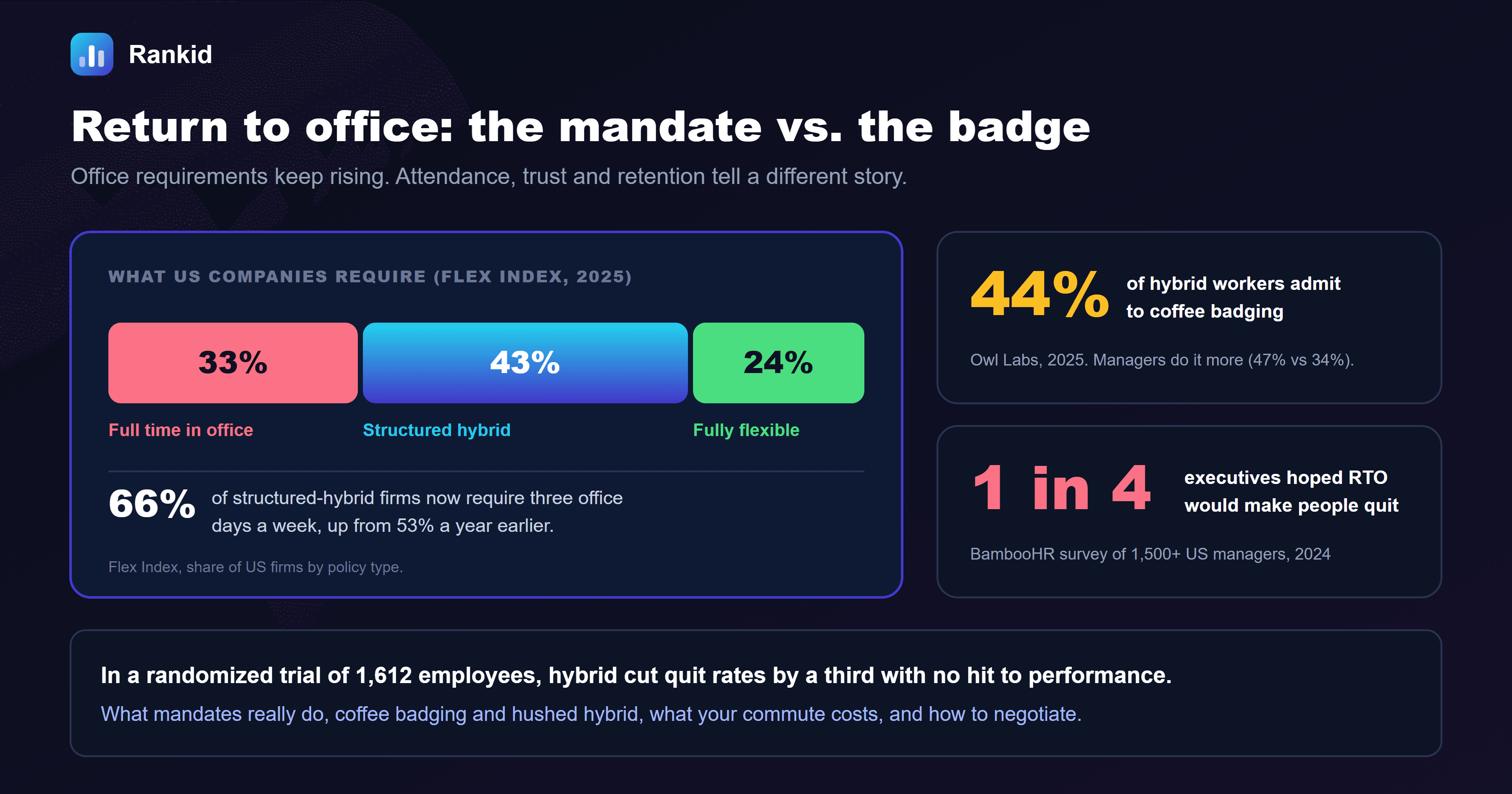
The email arrives on a Monday: starting next quarter, everyone is back in the office four days a week. The announcement talks about culture, collaboration and energy. It doesn't mention that office buildings are still half-empty on Fridays, that almost half of hybrid workers admit to badging in just long enough to be seen, or that a randomized trial found hybrid work cut quitting by a third without hurting performance. Return-to-office mandates are tightening in 2026. Here's what the data says they actually do, how people are quietly responding, and how to protect your own flexibility.
Quick answer
Quick answer: about a third of US firms require full-time office work and 66% of structured-hybrid firms now require three days a week (Flex Index), but real attendance lags: occupancy peaks around 66% on Tuesdays (Kastle) and 44% of hybrid workers coffee badge (Owl Labs). Evidence that mandates raise productivity is weak, while hybrid work cut quits by a third in a randomized trial and mandates were followed by higher turnover among senior and skilled staff. If you face a mandate, calculate what it costs you, negotiate with evidence, and get any agreement in writing.
Where return to office stands in 2026
Headlines make it sound as if everyone is heading back five days a week. The reality is more layered. The Flex Index, which tracks work policies at thousands of US companies, found that about 33% required full-time office attendance in 2025, about 43% ran structured hybrid schedules, and roughly a quarter were fully flexible.
The real shift is inside hybrid. Among companies with a set schedule, 66% now require three days a week, up from 53% a year earlier, and a cluster of large employers in banking, tech and manufacturing moved from two or three days to four or five. Several now enforce attendance with badge data that tracks hours, not just swipes.
Mandates and attendance are not the same thing
What the research says about RTO mandates
The justification for mandates is usually collaboration, culture and mentoring, and those matter. But the best available evidence doesn't show that forcing more office days reliably raises performance, and it does show a cost in talent.
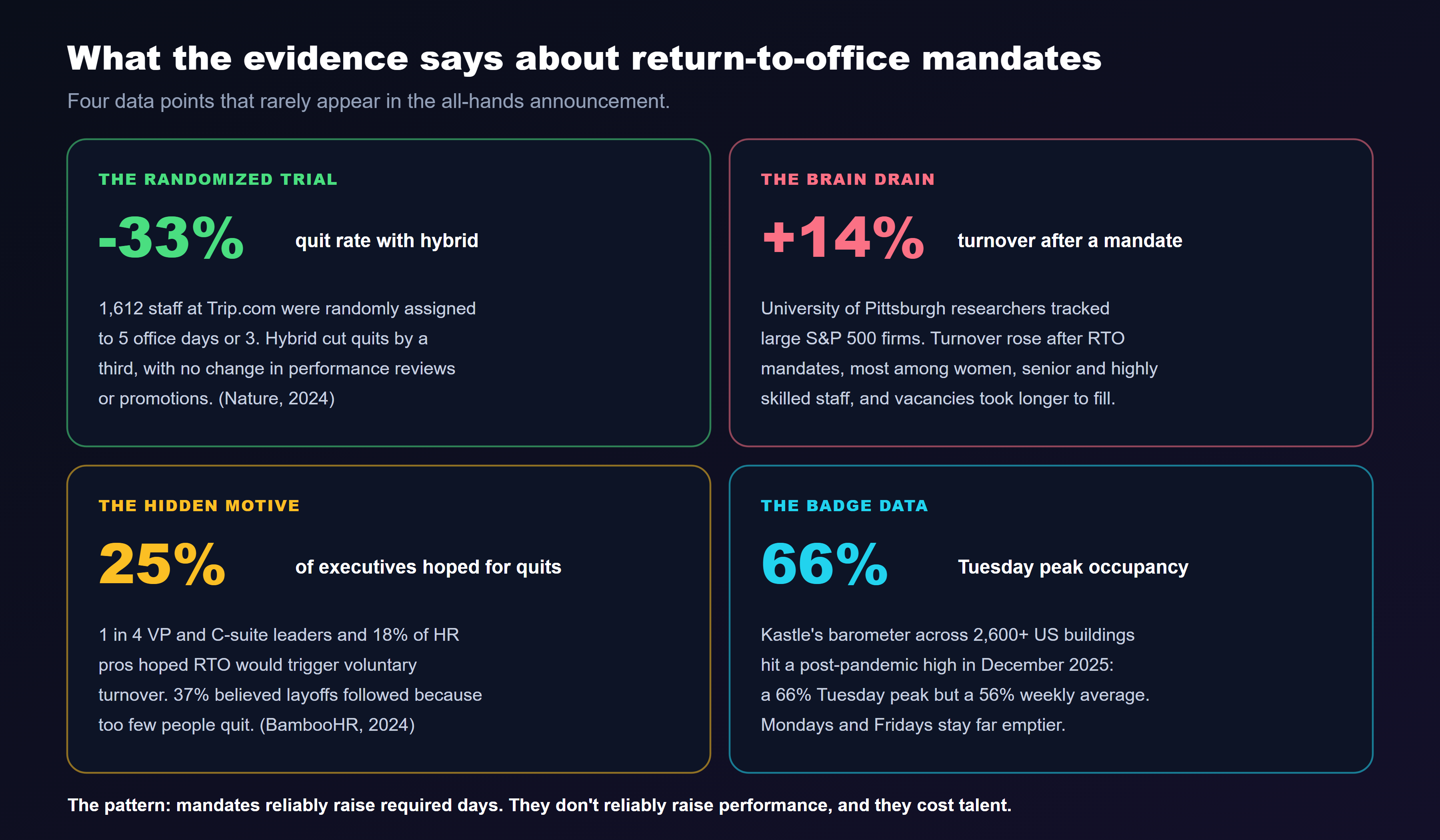
- The randomized trial. Stanford economist Nick Bloom and colleagues randomly assigned 1,612 employees at Trip.com to either five office days or three. Published in Nature in 2024, the study found hybrid workers quit a third less often, with no difference in performance reviews or promotions over two years.
- The brain drain.Researchers at the University of Pittsburgh studying large S&P 500 firms found turnover rose about 14% after RTO mandates, with bigger effects among women and senior, highly skilled employees, and vacancies took longer to fill.
- The hidden motive. In a 2024 BambooHR survey of more than 1,500 US managers, 1 in 4 executivesadmitted they hoped RTO would lead some employees to quit. It's why some people call mandates soft layoffs: people who resign don't get severance.
- The trust gap. Owl Labs found managers were more likely than individual contributors to coffee badge themselves (47% vs 34%), which says a lot about how strongly mandates are believed in by the people enforcing them.
None of this means offices are pointless. In-person time can help new starters learn faster and builds relationships remote work struggles to replace. The evidence points to a narrower conclusion: well-designed hybrid schedules capture most of the benefit, and blanket mandates bring real costs.
Coffee badging, hushed hybrid and other quiet responses
Few people respond to a mandate by simply complying or quitting. Most land somewhere in between.
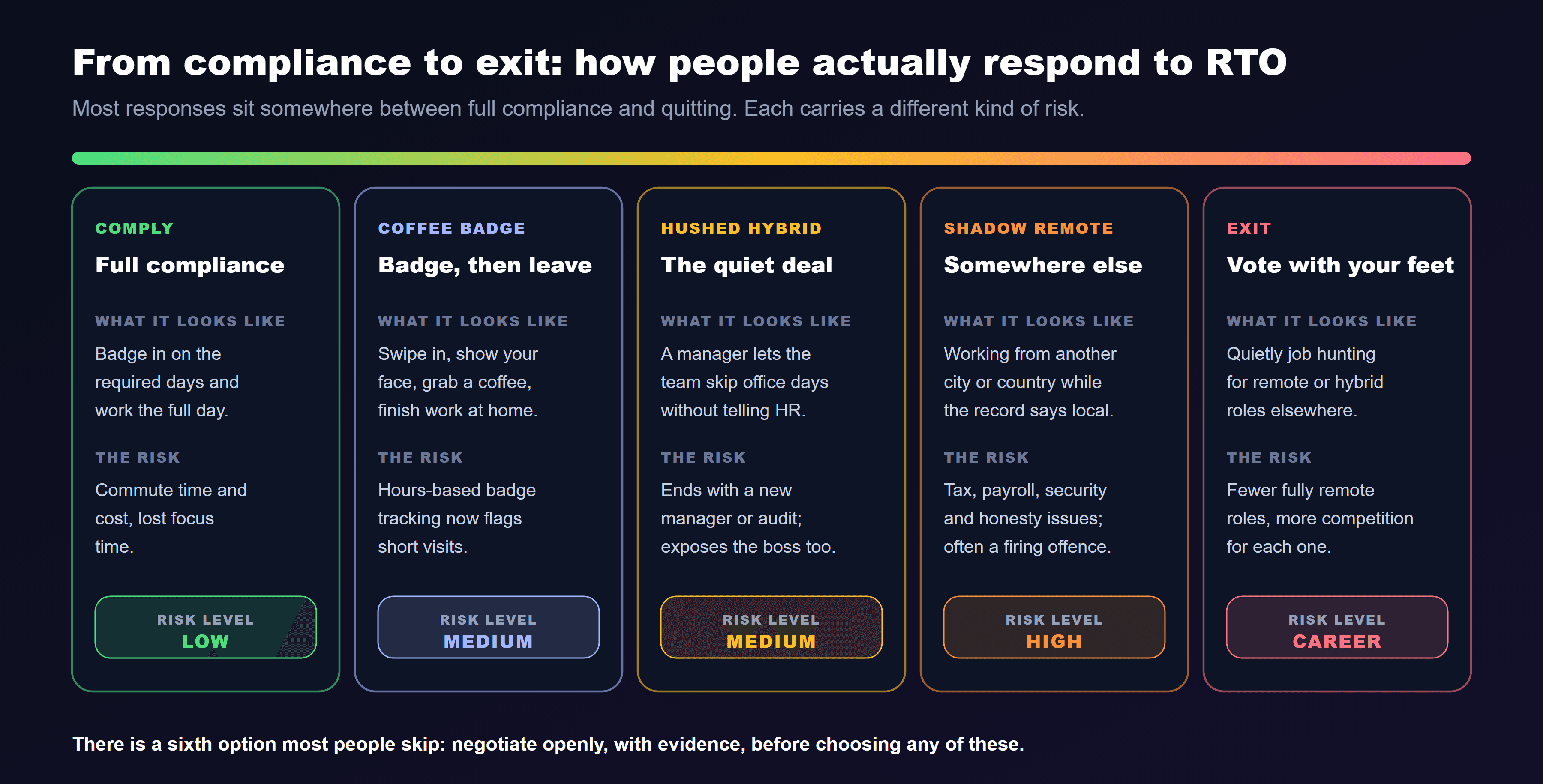
- Coffee badging. Swipe in, show your face, grab a coffee, go home. It satisfies a swipe-count policy but increasingly fails hours-based tracking, and it can look worse than an honest conversation if a manager notices.
- Hushed hybrid.A manager quietly lets the team skip office days. It depends entirely on one person and one policy staying the same, and it can put that manager's own job at risk.
- Shadow remote.Working from another city, state or country while your employer believes you're local. This is the risky one: it can create tax and payroll problems, break security rules, and it is a misrepresentation many employers treat as grounds for dismissal.
- Exit.Looking for a more flexible employer. It's a legitimate choice, but fully remote roles are now scarcer and far more competitive than in 2021.
There's a sixth response that gets skipped surprisingly often: an open negotiation backed by evidence. It's covered below. And if a mandate is part of a broader pattern of being pushed out, our guide to quiet firing explains the signs.
What an RTO mandate actually costs you
Most people feel the cost of a mandate without ever calculating it. Doing the maths turns a vague frustration into a concrete number you can weigh, or bring into a negotiation.
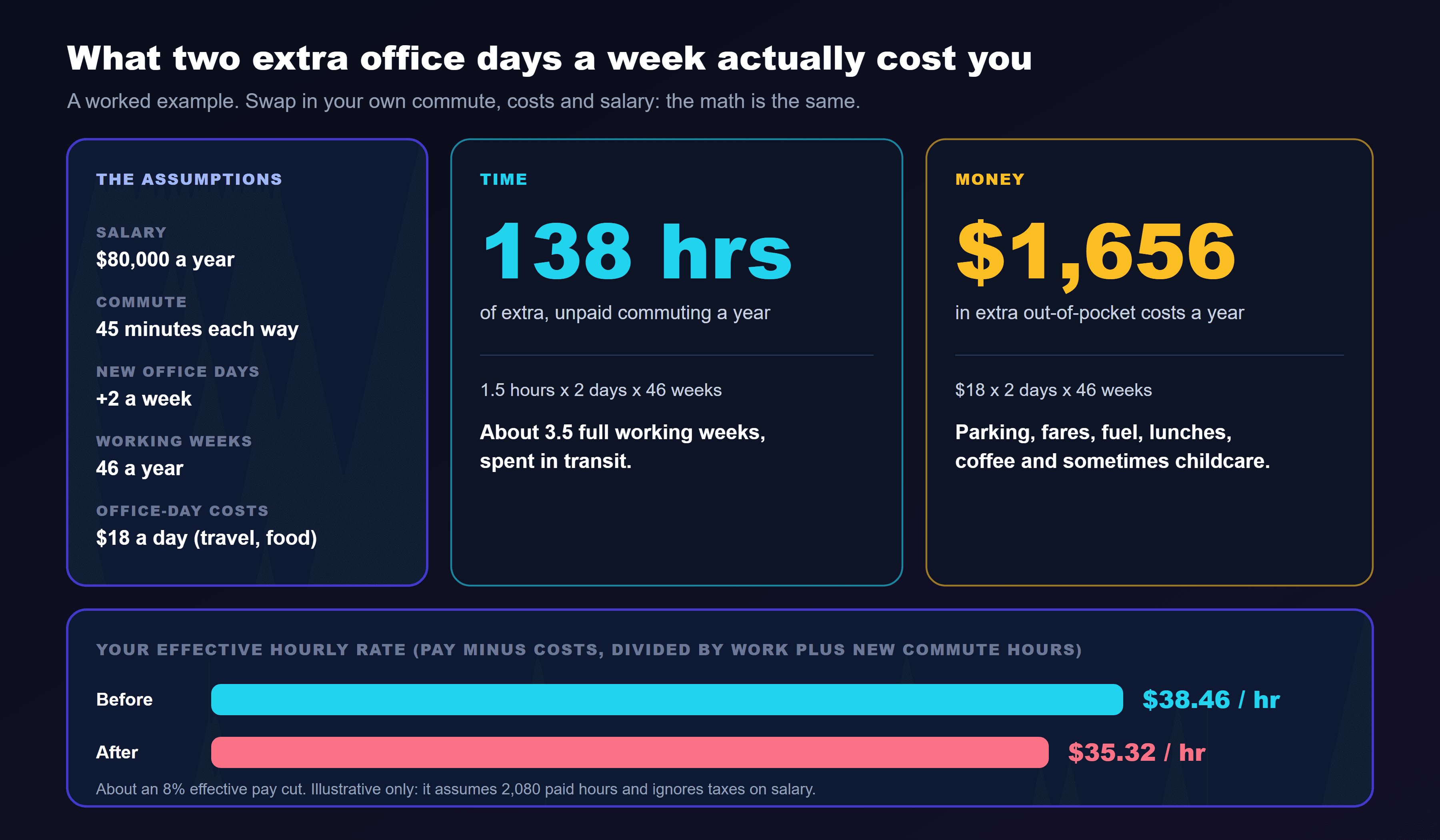
In this example, two extra office days add 138 hours of commuting a year, about three and a half working weeks, and $1,656 in costs. Spread across the year, that's roughly an 8% cut in effective hourly pay. Your own numbers could be smaller or much larger, especially if you pay for parking or extra childcare. Either way, it's the figure to keep in mind when you compare staying with a move elsewhere or ask for a raise.
How to negotiate your own arrangement
Mandates are often less rigid in practice than in the announcement, especially for strong performers. The key is to solve your manager's problem rather than argue about the policy.
Read what you actually agreed to
Build your evidence
Find the real concern
Propose something specific
Use the right channel for special circumstances
Get it in writing
If the answer is no
Looking for a more flexible role? Target the right ones
Remote and hybrid roles attract far more applicants than office jobs. Paste your resume and the posting into Rankid for a free 0-100 match score and the exact requirements you meet and miss, so you apply where you're strongest. No signup required.
Check your match score freeFor employers: an RTO policy that doesn't cost you your best people
If you're setting or enforcing an office policy, the research suggests a few principles that capture the benefits of in-person work without an avoidable talent drain.
- Start with the purpose.Decide what office time is for, whether onboarding, collaboration, client work or mentoring, and design days around it. "Because we said so" breeds coffee badging.
- Coordinate, don't just count. Team anchor days where the right people are actually in together deliver more than a headcount target.
- Watch who leaves. Track regretted attrition by level, gender and team after any policy change, using your turnover rate and exit interviews. Research suggests senior and skilled staff leave first.
- Be honest about the goal. If you need to reduce headcount, a layoff with severance is more honest, and more predictable, than a mandate designed to make people quit.
- Build a real exception process. Handle accommodation requests promptly and consistently, and document decisions.
- Hire for the policy you have. State the in-office expectation clearly in job descriptions and offers. Our guide on hiring remote employees covers what to put in writing.
Backfill faster when policy changes cost you people
Rankid scores every resume against your job description on a consistent 0-100 scale and shows the exact requirements each candidate matched and missed, so you can refill critical roles quickly and fairly. First 5 resumes free, no signup.
Try bulk screening freeFrequently asked questions
What is a return-to-office mandate?
A return-to-office (RTO) mandate is an employer policy requiring staff to work from the office a set number of days, from a fixed hybrid schedule such as three days a week up to five days a week. Many are now enforced with badge data that records when, and increasingly for how long, employees are in the building.
How many companies require full-time office work?
About a third of US companies required full-time office attendance in 2025, according to the Flex Index, which tracks thousands of US firms. About 43% run structured hybrid schedules and the rest are fully flexible. Among structured-hybrid firms, 66% now require three days a week, up from 53% a year earlier, so requirements are tightening even where flexibility remains.
What is coffee badging?
Coffee badging means badging into the office, staying long enough to be seen and perhaps have a coffee, then leaving to work from home. Owl Labs found 44% of hybrid workers admitted doing it in 2025, with managers more likely to do so than individual contributors. Some employers now track time in the building, not just badge swipes, to discourage it.
What is hushed hybrid?
Hushed hybrid is an informal arrangement where a manager quietly lets their team work remotely on days the official policy requires office attendance, without telling senior leadership or HR. It keeps teams happy but is fragile: it can end abruptly with a new manager or an attendance audit, and it can put the manager at risk too.
Do return-to-office mandates increase productivity?
The best evidence says not reliably. A randomized trial of 1,612 employees at Trip.com, published in Nature in 2024, found that working from home two days a week cut quit rates by a third with no effect on performance reviews or promotions. Some managers value in-person collaboration and mentoring, and those benefits are real for some roles, but broad mandates have not been shown to raise productivity across the board.
Do RTO mandates cause people to quit?
Research suggests they can. University of Pittsburgh researchers studying large S&P 500 firms found employee turnover rose about 14% after RTO mandates, with larger effects among women and senior, highly skilled employees, and companies took longer to fill vacancies. A 2024 BambooHR survey found 1 in 4 executives admitted they hoped RTO would lead some staff to quit.
Is a return-to-office mandate a soft layoff?
Sometimes it functions like one. When people quit rather than comply, the company reduces headcount without paying severance or unemployment-related costs. In BambooHR's survey, 25% of VP and C-suite executives and 18% of HR professionals said they hoped for some voluntary turnover, and 37% of managers believed their company made layoffs because fewer people quit than expected.
Can my employer force me to return to the office?
In most US jobs, yes. Most employment is at-will, so an employer can change where you work unless your contract, a union agreement or a written remote-work agreement says otherwise. Exceptions include reasonable accommodations for disabilities under the Americans with Disabilities Act and some state-level protections. If you were hired as fully remote, check your offer letter and any written agreement.
Can I ask for remote work as a disability accommodation?
Yes. Under the ADA, employees with a qualifying disability can request a reasonable accommodation, and remote or hybrid work can be one, depending on the job's essential functions. Make the request in writing, provide medical documentation if asked, and take part in the interactive process with your employer. The employer can offer an alternative accommodation if it's effective.
How do I negotiate to keep working from home?
Make it a business case, not a preference. Show your results since working hybrid or remote, propose a specific arrangement such as fixed anchor days for collaboration, offer a trial period with clear measures, and address the manager's real concern, whether that's mentoring, availability or visibility. Put any agreement in writing.
How much does commuting really cost?
More than most people calculate. In a worked example, a 45-minute commute each way for two extra office days a week adds about 138 hours a year, roughly three and a half working weeks. At $18 a day in travel and food costs, it also adds about $1,656 a year. For someone earning $80,000, that works out to roughly an 8% cut in effective hourly pay.
Key takeaways
- About a third of US firms require full-time office work, but the bigger shift is inside hybrid: 66% of structured-hybrid firms now require three days a week (Flex Index).
- Attendance lags mandates: Kastle's occupancy peaked at 66% on Tuesdays in December 2025, with a 56% weekly average.
- A randomized trial of 1,612 employees found hybrid work cut quits by a third with no effect on performance or promotions (Nature, 2024).
- Research on large US firms found turnover rose about 14% after RTO mandates, especially among women and senior, skilled staff.
- 1 in 4 executives admitted hoping RTO would make people quit, which is why mandates are sometimes called soft layoffs.
- 44% of hybrid workers admit to coffee badging, and managers do it more than individual contributors. Hushed hybrid and shadow remote work carry real risks.
- Calculate your own cost: two extra office days can add more than 130 hours of commuting a year and cut effective hourly pay by several percent.
- Negotiate with evidence, address your manager's real concern, use the ADA accommodation process where relevant, and get any agreement in writing.
Frequently asked questions
What is a return-to-office mandate?
A return-to-office (RTO) mandate is an employer policy requiring staff to work from the office a set number of days, from a fixed hybrid schedule such as three days a week up to five days a week. Many are now enforced with badge data that records when, and increasingly for how long, employees are in the building.
How many companies require full-time office work?
About a third of US companies required full-time office attendance in 2025, according to the Flex Index, which tracks thousands of US firms. About 43% run structured hybrid schedules and the rest are fully flexible. Among structured-hybrid firms, 66% now require three days a week, up from 53% a year earlier, so requirements are tightening even where flexibility remains.
What is coffee badging?
Coffee badging means badging into the office, staying long enough to be seen and perhaps have a coffee, then leaving to work from home. Owl Labs found 44% of hybrid workers admitted doing it in 2025, with managers more likely to do so than individual contributors. Some employers now track time in the building, not just badge swipes, to discourage it.
What is hushed hybrid?
Hushed hybrid is an informal arrangement where a manager quietly lets their team work remotely on days the official policy requires office attendance, without telling senior leadership or HR. It keeps teams happy but is fragile: it can end abruptly with a new manager or an attendance audit, and it can put the manager at risk too.
Do return-to-office mandates increase productivity?
The best evidence says not reliably. A randomized trial of 1,612 employees at Trip.com, published in Nature in 2024, found that working from home two days a week cut quit rates by a third with no effect on performance reviews or promotions. Some managers value in-person collaboration and mentoring, and those benefits are real for some roles, but broad mandates have not been shown to raise productivity across the board.
Do RTO mandates cause people to quit?
Research suggests they can. University of Pittsburgh researchers studying large S&P 500 firms found employee turnover rose about 14% after RTO mandates, with larger effects among women and senior, highly skilled employees, and companies took longer to fill vacancies. A 2024 BambooHR survey found 1 in 4 executives admitted they hoped RTO would lead some staff to quit.
Is a return-to-office mandate a soft layoff?
Sometimes it functions like one. When people quit rather than comply, the company reduces headcount without paying severance or unemployment-related costs. In BambooHR's survey, 25% of VP and C-suite executives and 18% of HR professionals said they hoped for some voluntary turnover, and 37% of managers believed their company made layoffs because fewer people quit than expected.
Can my employer force me to return to the office?
In most US jobs, yes. Most employment is at-will, so an employer can change where you work unless your contract, a union agreement or a written remote-work agreement says otherwise. Exceptions include reasonable accommodations for disabilities under the Americans with Disabilities Act and some state-level protections. If you were hired as fully remote, check your offer letter and any written agreement.
Can I ask for remote work as a disability accommodation?
Yes. Under the ADA, employees with a qualifying disability can request a reasonable accommodation, and remote or hybrid work can be one, depending on the job's essential functions. Make the request in writing, provide medical documentation if asked, and take part in the interactive process with your employer. The employer can offer an alternative accommodation if it's effective.
How do I negotiate to keep working from home?
Make it a business case, not a preference. Show your results since working hybrid or remote, propose a specific arrangement such as fixed anchor days for collaboration, offer a trial period with clear measures, and address the manager's real concern, whether that's mentoring, availability or visibility. Put any agreement in writing.
How much does commuting really cost?
More than most people calculate. In a worked example, a 45-minute commute each way for two extra office days a week adds about 138 hours a year, roughly three and a half working weeks. At $18 a day in travel and food costs, it also adds about $1,656 a year. For someone earning $80,000, that works out to roughly an 8% cut in effective hourly pay.