Furlough vs Layoff vs Fired: What Each One Means and What You Are Owed (2026)
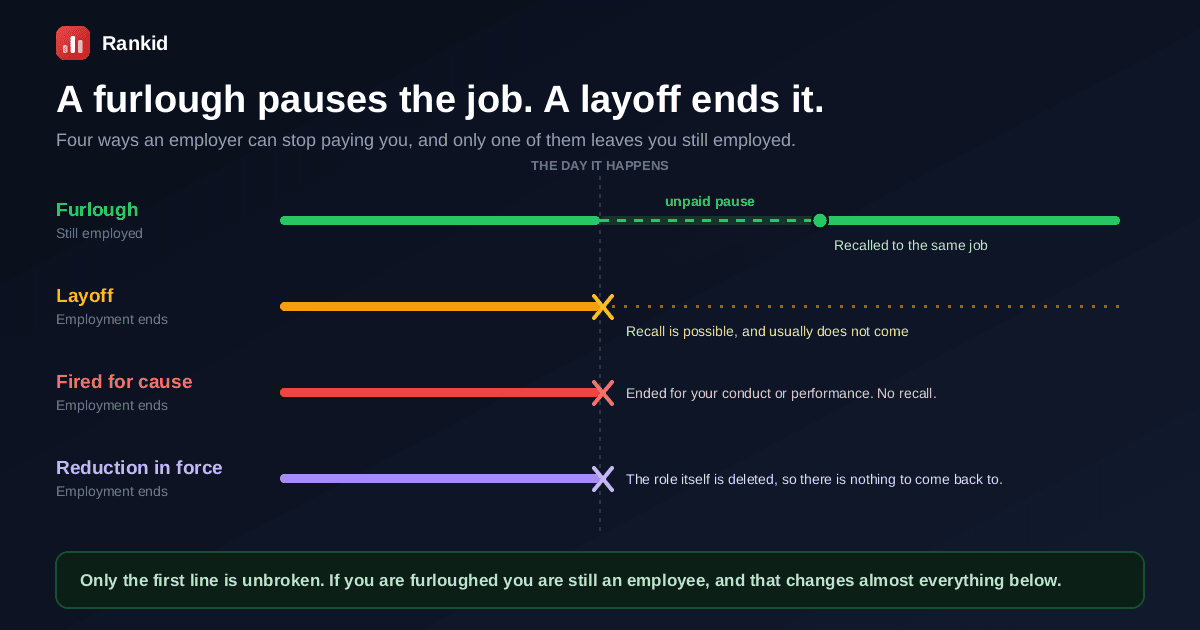
The calendar invite says "quick chat" and gives no agenda. Twenty minutes later you have been told something, and on the walk back to your desk you realise you are not entirely sure what. Are you still employed? Is your health cover still running? Can you claim anything? Should you start applying, or wait? The four words people use for this, furlough, layoff, fired and reduction, sound like different intensities of the same event. They are not. They are four different legal situations with four different sets of entitlements.
Quick answer
Quick answer: a furlough pauses your job and you stay employed, so health cover usually continues and your service date keeps running. A layoff ends employment for business reasons. Fired ends it for conduct or performance. A reduction in force deletes the role itself. The furlough-versus-layoff line decides your benefits; the laid-off-versus-fired line decides your unemployment claim and your rehire eligibility, and matters far less than people think on your resume.
What is a furlough?
A furlough is a temporary, usually unpaid pause in your work during which you remain employed. That last clause is the entire concept. You are still on the books, your job formally still exists, and the expectation is that you come back.
Employers reach for it when they believe the work is returning and they want these specific people when it does. It avoids severance now and avoids the cost of rehiring and retraining later. The trade you are being asked to accept is income you are not receiving for a period nobody will commit to.
It goes by other names: temporary layoff, shutdown, standby, mandatory time off. The label matters far less than the answer to one question, which is worth asking directly and in writing: am I still employed?
One disclaimer, stated plainly
Furlough vs layoff: what is still switched on
Both stop your pay, which is why they feel identical in the moment. Only one leaves the employment relationship running, and six things hang off that single fact.
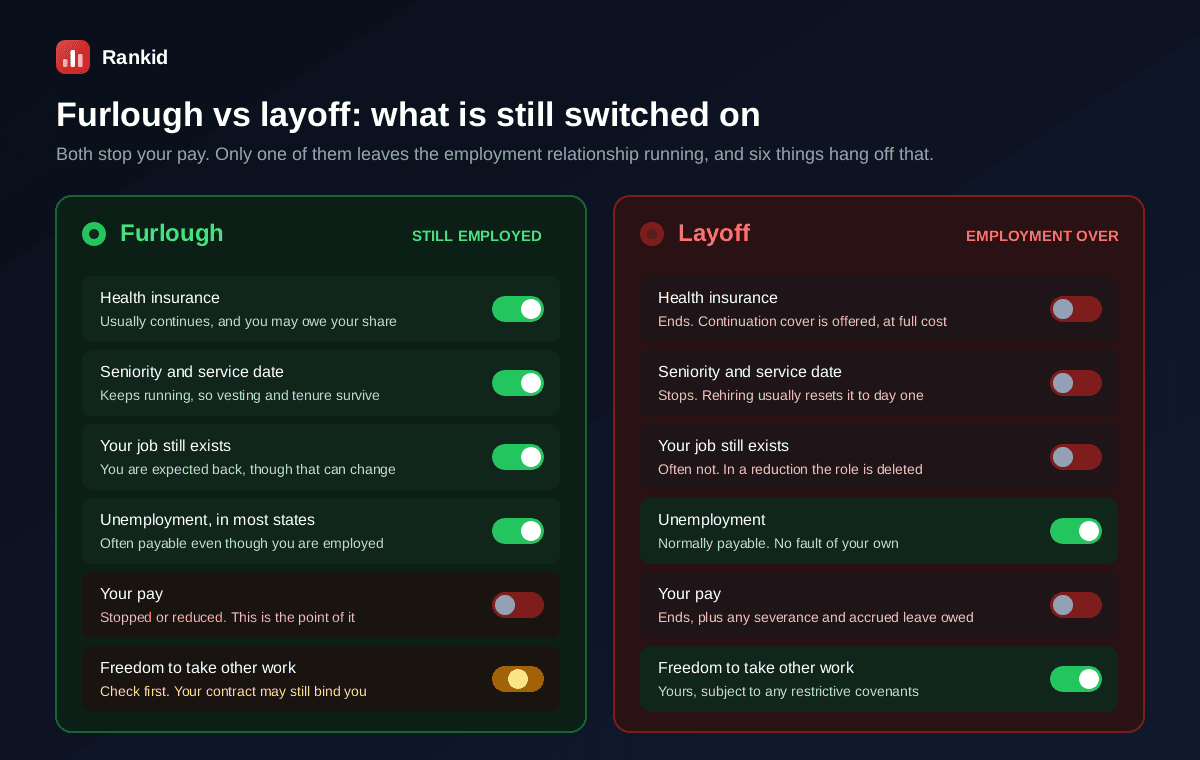
Two rows on that chart catch people out. Unemployment is often payable during a furlough, even though you technically remain employed, because most states pay when hours drop to zero or near it. People routinely fail to claim because they assume being employed disqualifies them. It usually does not.
And your freedom to take other work is not automatic on furlough. You are still an employee, so exclusivity clauses, conflicts provisions and duties of loyalty may still bind you. Ask in writing. Most employers say yes readily, because a furlough they cannot pay for is one where they know people need income.
Laid off vs fired: where it actually matters
This is the distinction people worry about most, and the worry is aimed at the wrong targets. It is enormously consequential in two places and close to irrelevant in two others.
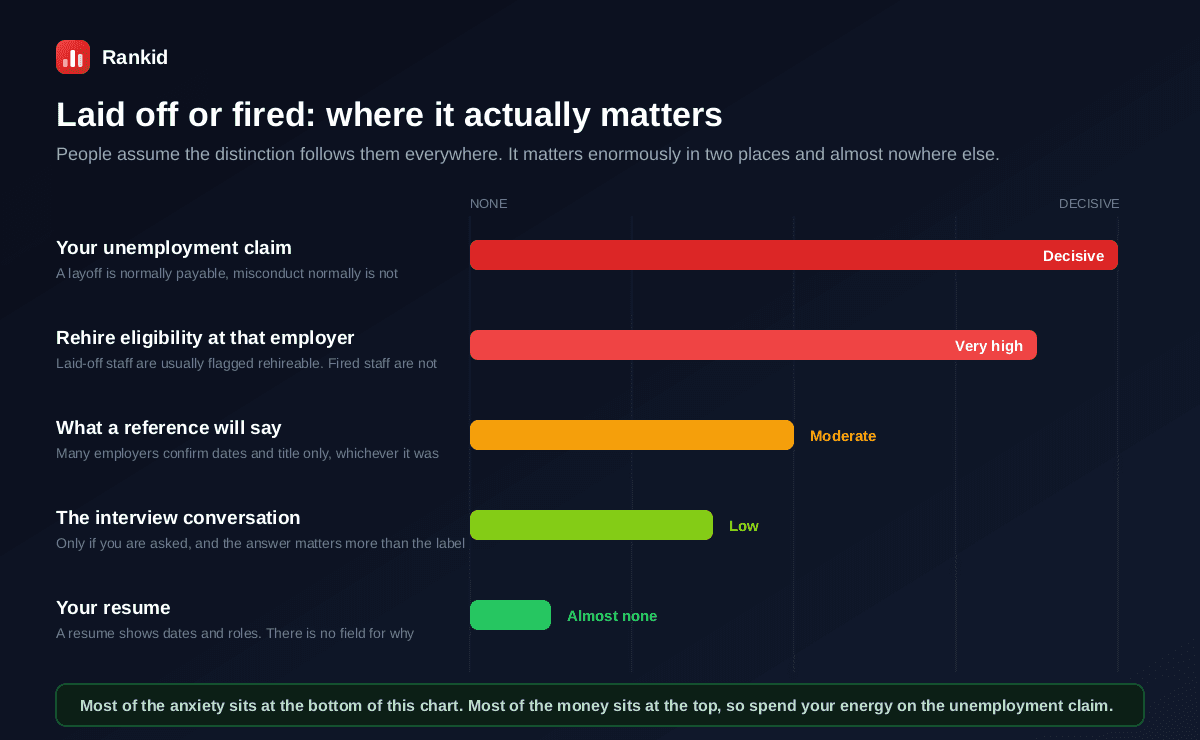
Read that chart as an instruction about where to spend your effort. Most of the anxiety sits at the bottom. Most of the money sits at the top. An hour spent getting your unemployment claim right is worth more than a week spent worrying about how a resume line reads.
What you are owed under each of the four
Here is the whole picture in one place. These are general US patterns, and your state, your contract and your employer's own policy can all improve on any of them.
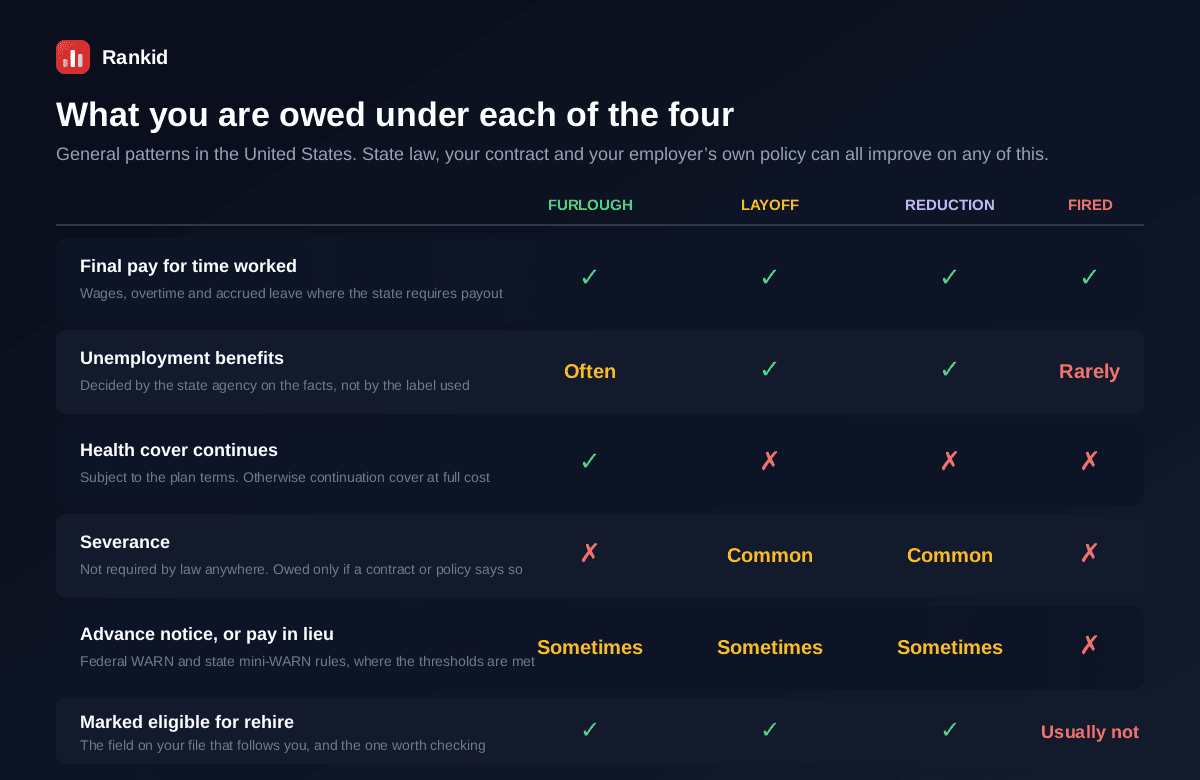
The severance row deserves a note, because it is the most misunderstood entitlement in employment. No US federal or state law requires severance pay in ordinary circumstances. It is common in layoffs because employers use it to buy a release of claims, not because they owe it. That is also why you should read the agreement rather than signing to get the money moving: our guide to severance pay and what you sign away covers the review periods, the revocation window and the restrictive covenants that sometimes arrive attached.
The 60 days of notice most people never claim
The federal WARN Act gives some workers a right to 60 calendar days of written notice before a large layoff. Most people who were entitled to it never find out, because nobody tells you about a right your employer just failed to honour.
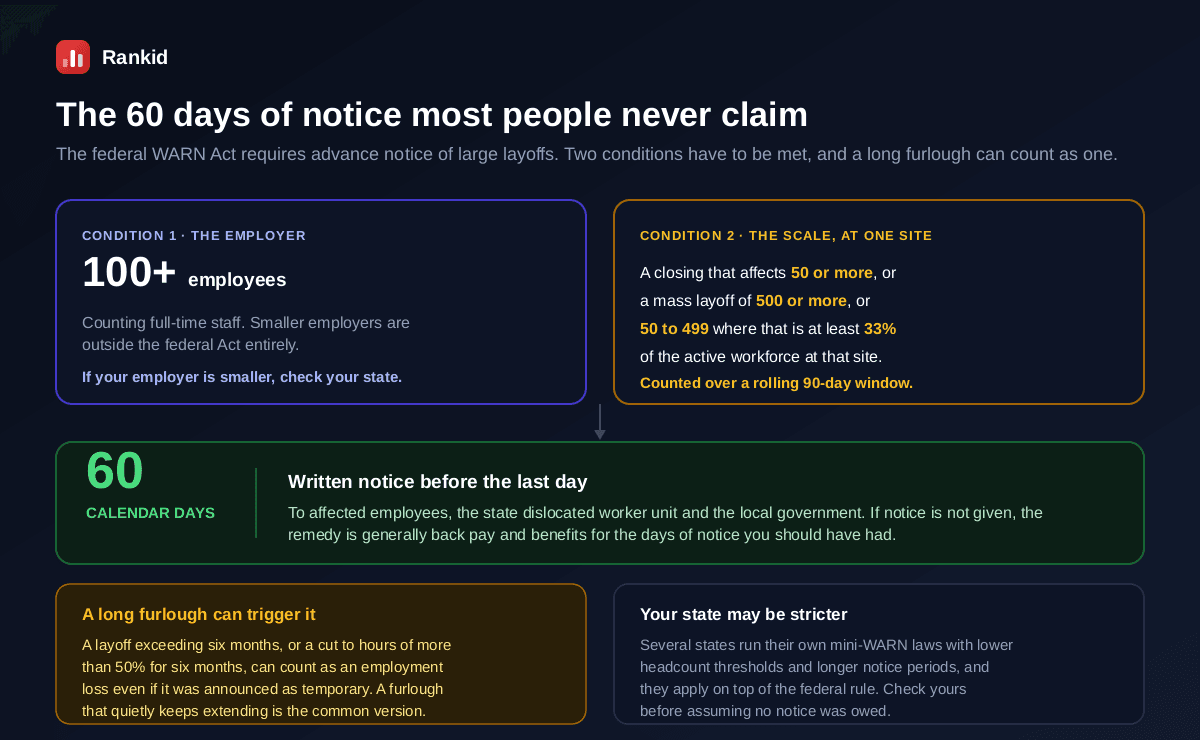
Two things are easy to miss. A furlough that quietly keeps extending past six months can retroactively count as an employment loss and trigger the obligation, which is the most common real-world version of a WARN claim. And several states run mini-WARN laws with lower headcount thresholds and longer notice periods that sit on top of the federal rule, so a small employer is not automatically outside the requirement.
For employers: the salaried furlough trap
This one costs real money and almost nobody sees it coming. Under the federal salary basis rules, an exempt salaried employee must receive their full weekly salary for any week in which they perform any work at all. Which means furloughs of exempt staff have to be taken in whole workweeks.
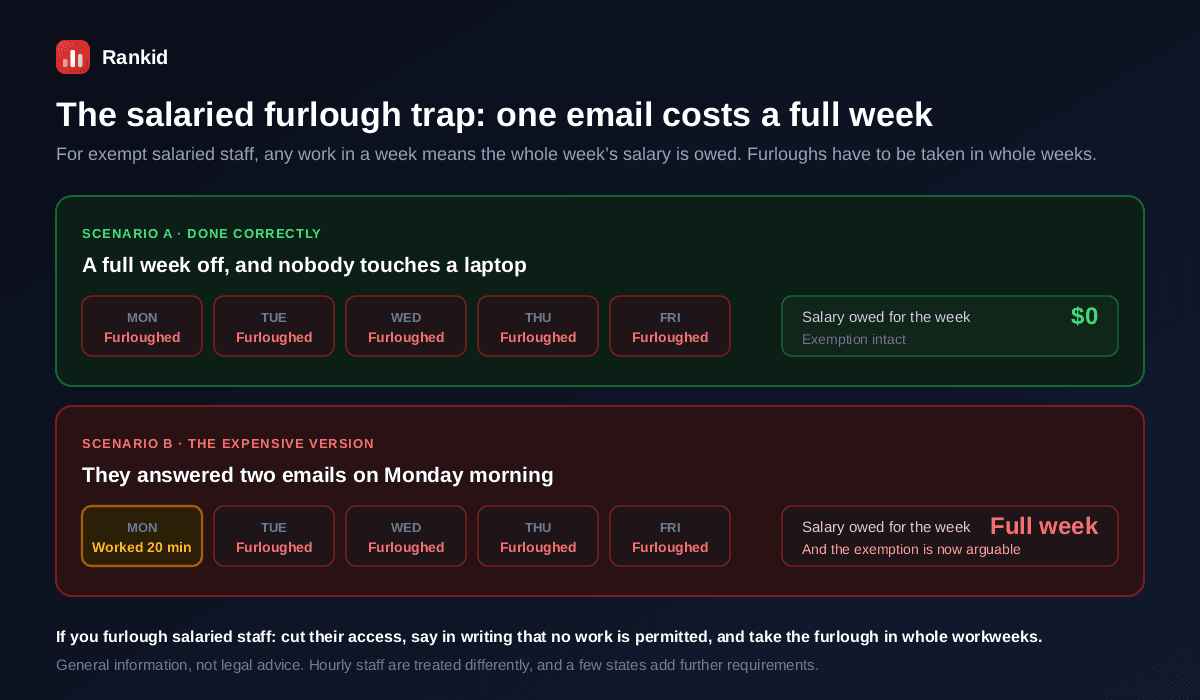
Twenty minutes of email on the Monday costs you the whole week. Worse, repeated partial-week deductions can call the exemption itself into question, which opens a much larger conversation about overtime going backwards.
- Cut system access for the furlough period. This is the only control that actually works, because conscientious people check their inbox.
- Say in writing that no work of any kind is permitted, and that replying to messages counts as work. Managers cause most of these breaches by asking "one quick question".
- Schedule on whole-week boundaries. Hourly staff are different, since they are paid for hours actually worked, and a few states add further requirements on top.
The classification underneath all of this is worth getting right first: see exempt vs non-exempt employees for the tests that decide which rules apply to whom.
If it just happened to you
Get the four facts in writing, today
File for unemployment immediately, even on furlough
Read the severance agreement before you sign anything
Check whether notice was owed
Start applying now, not after the furlough resolves
What to say in the interview
Same shape every time: one plain sentence about what happened, no blame, then forward. The single most useful rule is that the length of your answer signals how big a problem you think it is. Two sentences, then stop.
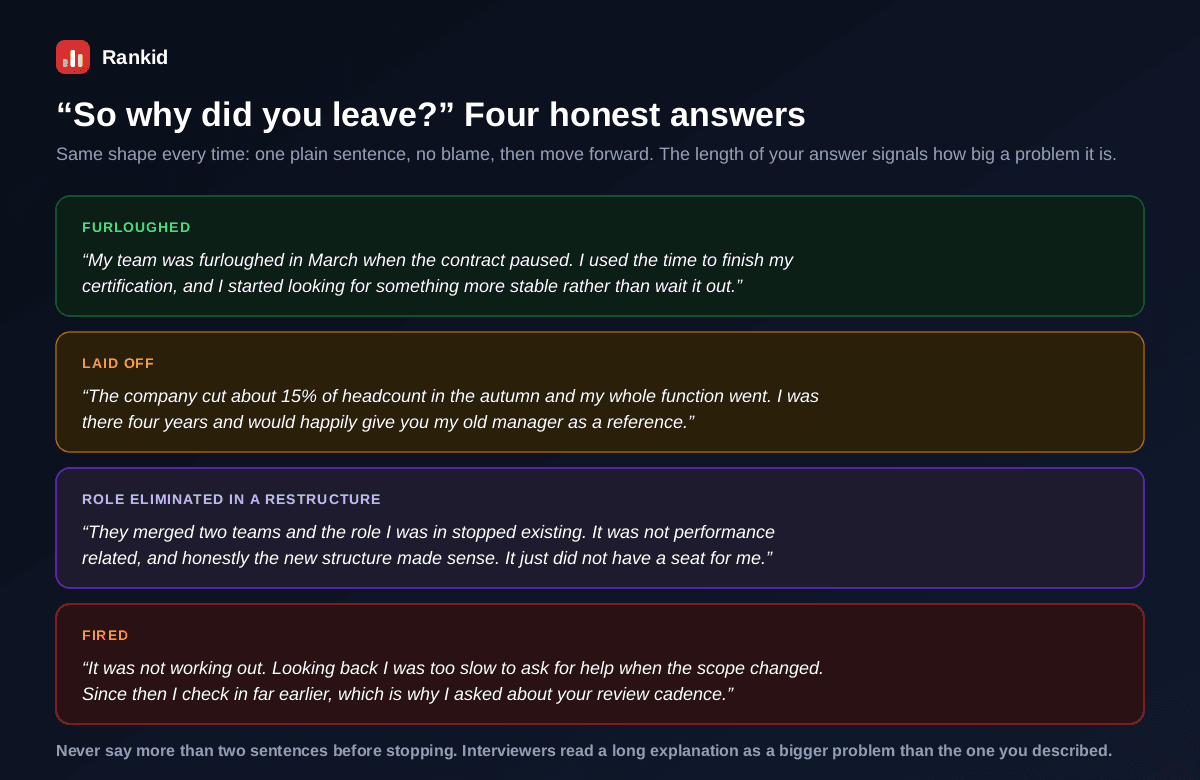
Notice what none of them do: criticise the former employer, over-explain, or volunteer detail nobody asked for. For the wider set of wordings, including the version that goes on an application form, see how to answer "reason for leaving" and explaining employment gaps.
And do not annotate the resume itself. Writing "role eliminated" next to a job draws attention to something no reader had questioned. The thing that genuinely costs you interviews is not the separation, it is a resume that does not match the job you are applying to, which is entirely fixable.
Back on the market? Check your resume against the job first
Paste your resume and the job description into Rankid. You'll get a 0-100 match score, the skills you've matched, and the exact keywords you're missing, free. Nobody is screening you out for being laid off. They are screening you out for a weak match.
Check your match score freeFor employers: which tool fits which problem
Choose on how long you expect the problem to last, not on how bad it feels this quarter. Getting this wrong is more expensive than the saving that motivated it.
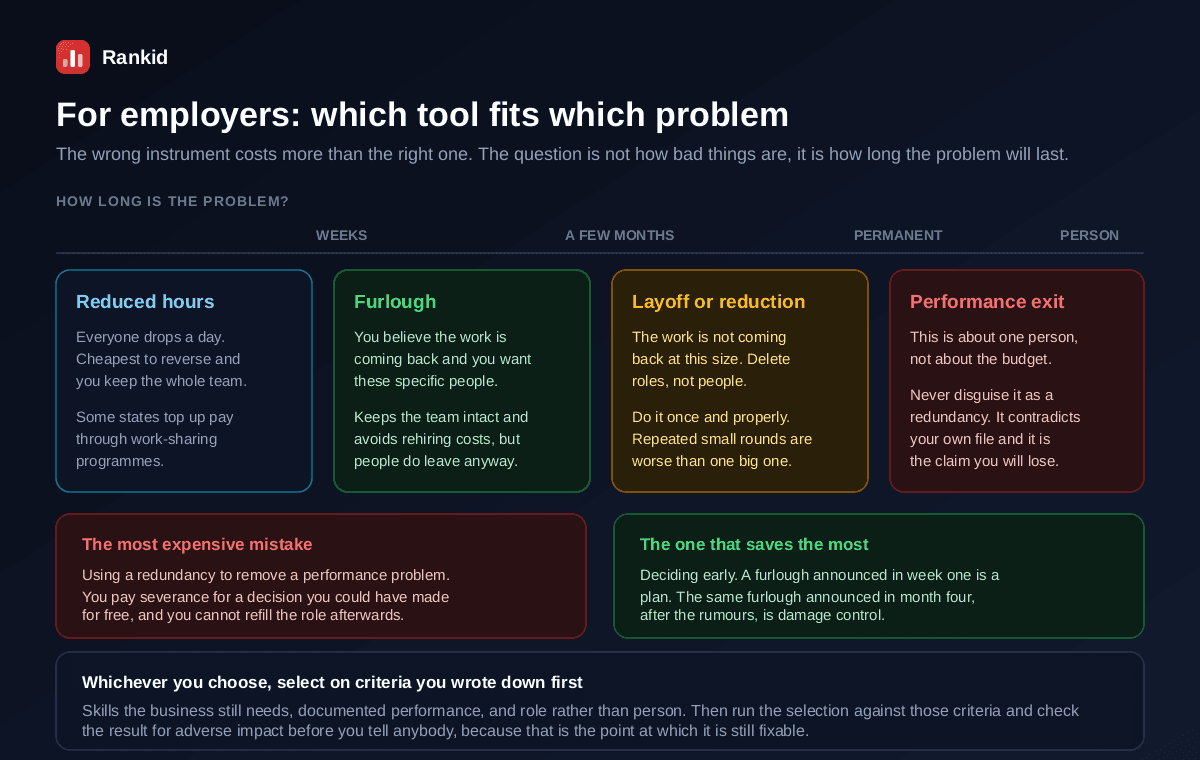
The most expensive mistake in this whole area is disguising a performance exit as a redundancy. You pay severance for a decision you could have made for free, you contradict your own documentation, and you cannot refill the role afterwards without undermining the reason you gave. If the problem is one person, handle it as one: the performance improvement plan guide covers the honest version, and termination letters covers what belongs in the record.
Whichever instrument you use, write the selection criteria down before you pick names, and check the result for adverse impact before you announce anything. That is the last point at which it is still fixable. And run the exit properly once it is decided: employee offboarding covers the access, final pay and knowledge steps that a rushed reduction reliably skips.
Rebuilding the team? Screen the shortlist against the roles you actually kept
Upload the applicants and the job description. Rankid scores every candidate against the real requirements and shows the evidence behind each score, so the rebuild does not repeat the mistakes the cuts were meant to fix. First 5 resumes free, no signup.
Try bulk screening freeFrequently asked questions
What is a furlough?
A furlough is a temporary, usually unpaid, pause in your work where you remain employed. That last part is the whole point and it is what separates a furlough from everything else on this list. You are still on the books, your service date usually keeps running, your health cover normally continues under the plan terms, and your job is in principle still there waiting for you. Employers use furloughs when they believe the work is coming back and they want these particular people to be there when it does, because a furlough avoids the cost of severance now and the cost of rehiring and retraining later. The trade is that you are not being paid, or are being paid much less, for a period nobody can promise the length of. Furloughs appear under various names, including temporary layoff, shutdown, standby and mandatory time off, and the label matters less than the answer to one question: am I still employed?
What is the difference between a furlough and a layoff?
A furlough pauses the employment relationship. A layoff ends it. Six practical things follow from that. Health insurance usually continues on furlough under the plan terms, whereas a layoff ends active cover and you are offered continuation cover at full cost instead. Your seniority and service date keep running on furlough, while a layoff stops them and a later rehire usually resets you to day one. Your job still formally exists on furlough, whereas in a reduction the role is often deleted entirely. Unemployment is normally payable after a layoff and is also often payable during a furlough in most states, even though you technically remain employed. Your pay stops or reduces in both. And your freedom to take other work is unrestricted after a layoff, subject to any restrictive covenants, whereas on furlough you should check your contract first, because you are still an employee and duties of loyalty or exclusivity terms may still apply.
What is the difference between being laid off and being fired?
Being laid off means the job ended for business reasons that were not about you: the budget, the contract, the restructure. Being fired means employment ended because of your conduct or performance. The distinction matters enormously in two places and much less than people fear everywhere else. It is decisive for your unemployment claim, because a layoff is normally payable while dismissal for misconduct normally is not. It is close to decisive for rehire eligibility at that employer, since laid-off staff are usually flagged as rehireable and dismissed staff usually are not. It matters moderately for what a reference will say, though many employers confirm only dates and job title either way. It matters surprisingly little in an interview, where the quality of your answer counts for far more than the label. And it matters almost not at all on your resume, which shows dates and roles and has no field for why you left. Most of the anxiety sits at the bottom of that list and most of the money sits at the top.
Can you collect unemployment while on furlough?
Often yes, and this surprises people because they assume being employed disqualifies them. In most US states, unemployment insurance is available to workers whose hours have been reduced to zero or substantially reduced, and a furlough is exactly that. The determination is made by your state agency on the facts rather than on the word your employer used, so file rather than assuming. Several practical points make a real difference to the outcome. Apply promptly, because benefits generally are not backdated to before you filed. Report any partial earnings honestly, since many states run partial benefit formulas that reduce rather than eliminate payment. Check whether your state requires active work search while furloughed, because some waive it where you have a definite return date and others do not. And note that if your employer continues to pay you anything during the furlough, that may reduce or delay benefits. Rules and amounts vary widely by state, so use your own state agency as the source rather than a general article.
How long can a furlough last?
There is no legal maximum for private employers in most places, which is precisely the problem with them. Furloughs are typically announced in weeks and are frequently extended, and the honest position is that a furlough with no stated end date is a layoff that has not been decided yet. Two thresholds are worth knowing. First, under the federal WARN Act a layoff exceeding six months, or a reduction in hours of more than 50 percent for six months, can count as an employment loss even where it was originally announced as temporary, which can trigger notice obligations retroactively. Second, your health plan will have its own rules about how long coverage can continue for a non-active employee, and hitting that limit converts your situation without anybody announcing it. If you are furloughed, ask three questions in writing: what is the expected return date, at what point does this convert to a layoff, and when does my health cover end. A company that cannot answer the third question has not planned this properly.
Can you work another job while furloughed?
Usually yes in practice, but check before you do, because you are still an employee and that is not true of someone who has been laid off. Three things to look at. Your contract may contain an exclusivity clause, a duty of loyalty or a conflicts provision that still binds you while employed, and taking work with a competitor is the version most likely to cause a genuine problem. Your employer may have set conditions in the furlough notice itself, and some ask to be told about outside work rather than prohibiting it. And your unemployment claim is affected by earnings from other work, which you must report, though many states reduce rather than remove benefits. The safest route is a short written request confirming that outside work is permitted, which most employers grant readily because a furlough they cannot pay for is a furlough where they know people need income. Get the answer in writing rather than relying on a verbal assurance from a manager who may not be there when you return.
What is the WARN Act and am I owed 60 days notice?
The federal Worker Adjustment and Retraining Notification Act requires certain employers to give 60 calendar days of written notice before a large layoff or plant closing. Two conditions must be met. The employer must have 100 or more employees, so smaller employers are outside the federal Act entirely. And the action must reach a scale threshold at a single site of employment: a closing affecting 50 or more, a mass layoff of 500 or more, or a layoff of 50 to 499 where that represents at least 33 percent of the active workforce at that site, counted over a rolling 90-day window. Where it applies, notice goes to affected employees, the state dislocated worker unit and the local government, and the usual remedy for failure is back pay and benefits for the days of notice you should have received. Two things people miss. A furlough that keeps extending past six months can retroactively count as an employment loss and trigger it. And a number of states run their own mini-WARN laws with lower thresholds and longer notice periods that apply on top of the federal rule, so check your state before concluding no notice was owed.
Do you get severance if you are laid off?
Only if a contract, a policy or a collective agreement provides for it. No US federal law and no state law requires severance pay in ordinary circumstances, which surprises most people. In practice it is common in layoffs and reductions in force and rare in furloughs and dismissals for cause, because employers use it to buy a release of claims rather than out of obligation. That last point is the one to understand before you sign anything: a severance agreement almost always asks you to waive your right to bring claims, and sometimes to accept new restrictive covenants you were not previously subject to. You generally get review time to consider it, and workers aged 40 and over are entitled to a longer statutory review period and a revocation window under federal age discrimination law. Read it rather than signing quickly to get the payment moving, and check specifically what you are giving up and whether anything in it restricts where you can work next.
Does being furloughed or laid off look bad on your resume?
Much less than people expect, and far less than the anxiety around it suggests. A resume shows organisations, roles and dates. There is no field for why you left, and no reader assumes a departure was your fault. Layoffs and furloughs in particular are widely understood as business events rather than personal ones, and interviewers have seen a great many of them. Three practical points. Do not annotate your resume with the reason: writing 'role eliminated' next to a job draws attention to something nobody had questioned. Do keep your dates accurate, since date gaps are routine and inconsistencies are not. And if the gap since is long, address it in the cover letter or the interview in a sentence rather than leaving it unexplained. The thing that genuinely harms an application is not the separation, it is a resume that does not match the job being applied for, which is a completely fixable problem and a much better use of your energy.
What should I say in an interview about being laid off or fired?
Use the same shape every time: one plain sentence about what happened, no blame, then move forward. The length of your answer signals how big a problem you think it is, so keep it to two sentences and stop talking. For a furlough: 'My team was furloughed in March when the contract paused. I used the time to finish my certification and started looking for something more stable rather than wait it out.' For a layoff: 'The company cut about 15 percent of headcount and my whole function went. I was there four years and would happily give you my old manager as a reference.' For a restructure: 'They merged two teams and the role stopped existing. It was not performance related and the new structure made sense, it just did not have a seat for me.' For being fired, own it briefly and show what changed: 'It was not working out. Looking back I was too slow to ask for help when the scope changed, so now I check in far earlier.' Never criticise the former employer, and never volunteer more detail than the question asked for.
What is the salaried furlough trap employers fall into?
Under the federal salary basis rules, an exempt salaried employee must receive their full weekly salary for any week in which they perform any work at all, with only limited permitted deductions. That means a furlough of exempt staff has to be taken in whole workweeks. If somebody answers two emails on the Monday of a furloughed week, the employer owes the full week's salary, and repeated or systematic partial-week deductions can call the exemption itself into question, which raises the possibility of overtime liability going backwards. Employers fall into this constantly because they furlough a salaried team, then a manager asks somebody a quick question, or the person checks their inbox out of conscientiousness. Three steps prevent it: cut system access for the furlough period, state in writing that no work of any kind is permitted and that responding to messages counts as work, and schedule furloughs on whole-week boundaries. Hourly employees are treated differently, since they are simply paid for hours actually worked, and a few states add further requirements.
As an employer, how do I choose between reduced hours, furlough and layoff?
Choose on how long you expect the problem to last rather than on how bad it feels right now. If it is a matter of weeks, reduced hours across the team is cheapest to reverse and keeps everybody, and several states run work-sharing programmes that top up pay for reduced schedules. If it is a few months and you genuinely believe the work is returning and you want these specific people back, a furlough keeps the team intact and avoids rehiring costs, accepting that some people will leave anyway. If the work is not coming back at this size, a layoff or reduction in force is the honest instrument: delete roles rather than people, do it once and properly, because repeated small rounds damage morale far more than one larger action. And if the issue is one individual rather than the budget, handle it as a performance matter. The most expensive mistake in this whole area is disguising a performance exit as a redundancy: you pay severance for a decision you could have made for free, you contradict your own documentation, and you cannot refill the role afterwards without undermining the stated reason.
Key takeaways
- A furlough pauses the job and you stay employed. A layoff ends employment. That single difference drives health cover, seniority and whether your job still exists.
- You can often claim unemployment while furloughed, even though you are still employed. Most states pay when hours drop to zero, and people routinely fail to file because they assume otherwise.
- On furlough, check your contract before taking other work. You are still an employee, so exclusivity and loyalty terms may still bind you.
- Laid off vs fired is decisive for your unemployment claim and your rehire eligibility, and almost irrelevant on your resume. Spend your energy accordingly.
- No US law requires severance. It is common in layoffs because employers use it to buy a release of claims, which is why you should read it before signing.
- The WARN Act can entitle you to 60 days of written notice, and a furlough that extends past six months can trigger it retroactively. Several states are stricter than the federal rule.
- Employers: furlough exempt salaried staff in whole workweeks only. Twenty minutes of email on the Monday means the full week's salary is owed.
- A furlough with no stated end date is a layoff that has not been decided yet. Start applying now rather than waiting for it to resolve.
- In interviews, use two sentences and stop. The length of your answer signals how big a problem you think it is.
- Employers: choose the tool by how long the problem will last, and never disguise a performance exit as a redundancy.
Frequently asked questions
What is a furlough?
A furlough is a temporary, usually unpaid, pause in your work where you remain employed. That last part is the whole point and it is what separates a furlough from everything else on this list. You are still on the books, your service date usually keeps running, your health cover normally continues under the plan terms, and your job is in principle still there waiting for you. Employers use furloughs when they believe the work is coming back and they want these particular people to be there when it does, because a furlough avoids the cost of severance now and the cost of rehiring and retraining later. The trade is that you are not being paid, or are being paid much less, for a period nobody can promise the length of. Furloughs appear under various names, including temporary layoff, shutdown, standby and mandatory time off, and the label matters less than the answer to one question: am I still employed?
What is the difference between a furlough and a layoff?
A furlough pauses the employment relationship. A layoff ends it. Six practical things follow from that. Health insurance usually continues on furlough under the plan terms, whereas a layoff ends active cover and you are offered continuation cover at full cost instead. Your seniority and service date keep running on furlough, while a layoff stops them and a later rehire usually resets you to day one. Your job still formally exists on furlough, whereas in a reduction the role is often deleted entirely. Unemployment is normally payable after a layoff and is also often payable during a furlough in most states, even though you technically remain employed. Your pay stops or reduces in both. And your freedom to take other work is unrestricted after a layoff, subject to any restrictive covenants, whereas on furlough you should check your contract first, because you are still an employee and duties of loyalty or exclusivity terms may still apply.
What is the difference between being laid off and being fired?
Being laid off means the job ended for business reasons that were not about you: the budget, the contract, the restructure. Being fired means employment ended because of your conduct or performance. The distinction matters enormously in two places and much less than people fear everywhere else. It is decisive for your unemployment claim, because a layoff is normally payable while dismissal for misconduct normally is not. It is close to decisive for rehire eligibility at that employer, since laid-off staff are usually flagged as rehireable and dismissed staff usually are not. It matters moderately for what a reference will say, though many employers confirm only dates and job title either way. It matters surprisingly little in an interview, where the quality of your answer counts for far more than the label. And it matters almost not at all on your resume, which shows dates and roles and has no field for why you left. Most of the anxiety sits at the bottom of that list and most of the money sits at the top.
Can you collect unemployment while on furlough?
Often yes, and this surprises people because they assume being employed disqualifies them. In most US states, unemployment insurance is available to workers whose hours have been reduced to zero or substantially reduced, and a furlough is exactly that. The determination is made by your state agency on the facts rather than on the word your employer used, so file rather than assuming. Several practical points make a real difference to the outcome. Apply promptly, because benefits generally are not backdated to before you filed. Report any partial earnings honestly, since many states run partial benefit formulas that reduce rather than eliminate payment. Check whether your state requires active work search while furloughed, because some waive it where you have a definite return date and others do not. And note that if your employer continues to pay you anything during the furlough, that may reduce or delay benefits. Rules and amounts vary widely by state, so use your own state agency as the source rather than a general article.
How long can a furlough last?
There is no legal maximum for private employers in most places, which is precisely the problem with them. Furloughs are typically announced in weeks and are frequently extended, and the honest position is that a furlough with no stated end date is a layoff that has not been decided yet. Two thresholds are worth knowing. First, under the federal WARN Act a layoff exceeding six months, or a reduction in hours of more than 50 percent for six months, can count as an employment loss even where it was originally announced as temporary, which can trigger notice obligations retroactively. Second, your health plan will have its own rules about how long coverage can continue for a non-active employee, and hitting that limit converts your situation without anybody announcing it. If you are furloughed, ask three questions in writing: what is the expected return date, at what point does this convert to a layoff, and when does my health cover end. A company that cannot answer the third question has not planned this properly.
Can you work another job while furloughed?
Usually yes in practice, but check before you do, because you are still an employee and that is not true of someone who has been laid off. Three things to look at. Your contract may contain an exclusivity clause, a duty of loyalty or a conflicts provision that still binds you while employed, and taking work with a competitor is the version most likely to cause a genuine problem. Your employer may have set conditions in the furlough notice itself, and some ask to be told about outside work rather than prohibiting it. And your unemployment claim is affected by earnings from other work, which you must report, though many states reduce rather than remove benefits. The safest route is a short written request confirming that outside work is permitted, which most employers grant readily because a furlough they cannot pay for is a furlough where they know people need income. Get the answer in writing rather than relying on a verbal assurance from a manager who may not be there when you return.
What is the WARN Act and am I owed 60 days notice?
The federal Worker Adjustment and Retraining Notification Act requires certain employers to give 60 calendar days of written notice before a large layoff or plant closing. Two conditions must be met. The employer must have 100 or more employees, so smaller employers are outside the federal Act entirely. And the action must reach a scale threshold at a single site of employment: a closing affecting 50 or more, a mass layoff of 500 or more, or a layoff of 50 to 499 where that represents at least 33 percent of the active workforce at that site, counted over a rolling 90-day window. Where it applies, notice goes to affected employees, the state dislocated worker unit and the local government, and the usual remedy for failure is back pay and benefits for the days of notice you should have received. Two things people miss. A furlough that keeps extending past six months can retroactively count as an employment loss and trigger it. And a number of states run their own mini-WARN laws with lower thresholds and longer notice periods that apply on top of the federal rule, so check your state before concluding no notice was owed.
Do you get severance if you are laid off?
Only if a contract, a policy or a collective agreement provides for it. No US federal law and no state law requires severance pay in ordinary circumstances, which surprises most people. In practice it is common in layoffs and reductions in force and rare in furloughs and dismissals for cause, because employers use it to buy a release of claims rather than out of obligation. That last point is the one to understand before you sign anything: a severance agreement almost always asks you to waive your right to bring claims, and sometimes to accept new restrictive covenants you were not previously subject to. You generally get review time to consider it, and workers aged 40 and over are entitled to a longer statutory review period and a revocation window under federal age discrimination law. Read it rather than signing quickly to get the payment moving, and check specifically what you are giving up and whether anything in it restricts where you can work next.
Does being furloughed or laid off look bad on your resume?
Much less than people expect, and far less than the anxiety around it suggests. A resume shows organisations, roles and dates. There is no field for why you left, and no reader assumes a departure was your fault. Layoffs and furloughs in particular are widely understood as business events rather than personal ones, and interviewers have seen a great many of them. Three practical points. Do not annotate your resume with the reason: writing 'role eliminated' next to a job draws attention to something nobody had questioned. Do keep your dates accurate, since date gaps are routine and inconsistencies are not. And if the gap since is long, address it in the cover letter or the interview in a sentence rather than leaving it unexplained. The thing that genuinely harms an application is not the separation, it is a resume that does not match the job being applied for, which is a completely fixable problem and a much better use of your energy.
What should I say in an interview about being laid off or fired?
Use the same shape every time: one plain sentence about what happened, no blame, then move forward. The length of your answer signals how big a problem you think it is, so keep it to two sentences and stop talking. For a furlough: 'My team was furloughed in March when the contract paused. I used the time to finish my certification and started looking for something more stable rather than wait it out.' For a layoff: 'The company cut about 15 percent of headcount and my whole function went. I was there four years and would happily give you my old manager as a reference.' For a restructure: 'They merged two teams and the role stopped existing. It was not performance related and the new structure made sense, it just did not have a seat for me.' For being fired, own it briefly and show what changed: 'It was not working out. Looking back I was too slow to ask for help when the scope changed, so now I check in far earlier.' Never criticise the former employer, and never volunteer more detail than the question asked for.
What is the salaried furlough trap employers fall into?
Under the federal salary basis rules, an exempt salaried employee must receive their full weekly salary for any week in which they perform any work at all, with only limited permitted deductions. That means a furlough of exempt staff has to be taken in whole workweeks. If somebody answers two emails on the Monday of a furloughed week, the employer owes the full week's salary, and repeated or systematic partial-week deductions can call the exemption itself into question, which raises the possibility of overtime liability going backwards. Employers fall into this constantly because they furlough a salaried team, then a manager asks somebody a quick question, or the person checks their inbox out of conscientiousness. Three steps prevent it: cut system access for the furlough period, state in writing that no work of any kind is permitted and that responding to messages counts as work, and schedule furloughs on whole-week boundaries. Hourly employees are treated differently, since they are simply paid for hours actually worked, and a few states add further requirements.
As an employer, how do I choose between reduced hours, furlough and layoff?
Choose on how long you expect the problem to last rather than on how bad it feels right now. If it is a matter of weeks, reduced hours across the team is cheapest to reverse and keeps everybody, and several states run work-sharing programmes that top up pay for reduced schedules. If it is a few months and you genuinely believe the work is returning and you want these specific people back, a furlough keeps the team intact and avoids rehiring costs, accepting that some people will leave anyway. If the work is not coming back at this size, a layoff or reduction in force is the honest instrument: delete roles rather than people, do it once and properly, because repeated small rounds damage morale far more than one larger action. And if the issue is one individual rather than the budget, handle it as a performance matter. The most expensive mistake in this whole area is disguising a performance exit as a redundancy: you pay severance for a decision you could have made for free, you contradict your own documentation, and you cannot refill the role afterwards without undermining the stated reason.