Non-Compete Agreements: Are They Actually Enforceable, and How to Get Out of One (2026)
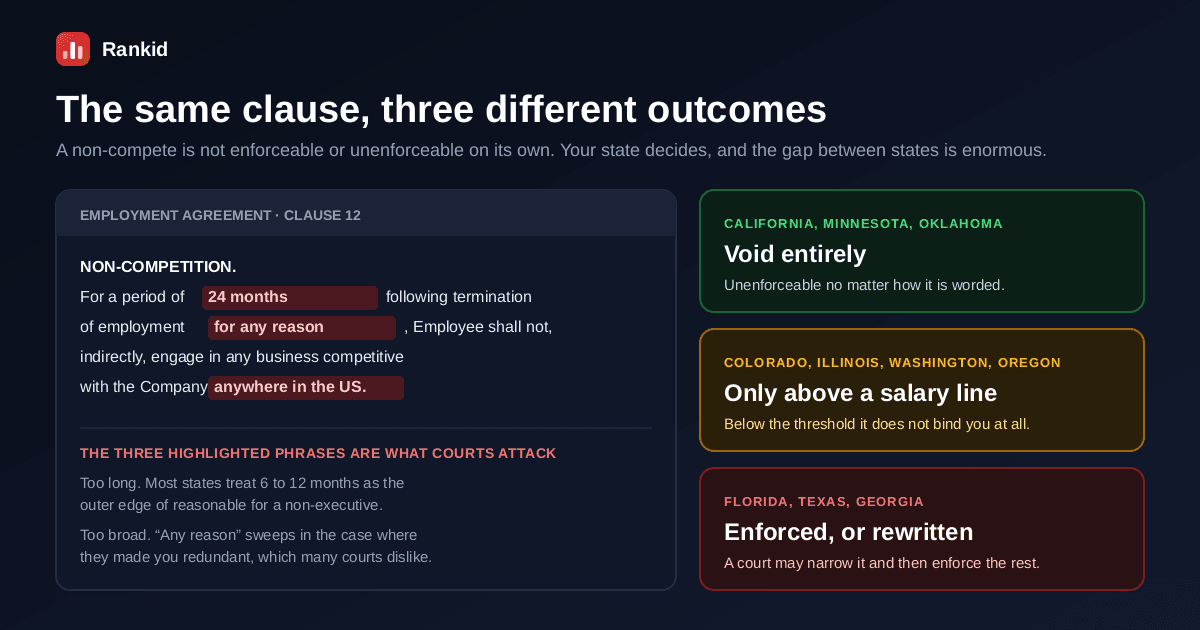
Two people sign the identical non-compete on the same day, at the same company, for the same role. One works in San Francisco and one works in Miami. Eighteen months later both accept offers from a competitor. For the first, the clause is worth precisely nothing and was unlawful to include. For the second, it is enforceable, and if a judge thinks it is too broad they may simply rewrite it into something narrower and enforce that instead. Nothing about the document produced that difference.
Quick answer
Quick answer: whether a non-compete binds you is decided by your state, not by the wording. It is void for most employees in California, Minnesota, Oklahoma and North Dakota; void below an income threshold in several more; and generally enforceable if reasonable elsewhere. The FTC ban never took effect, so ignore anything that says non-competes are banned nationwide. And check what you actually signed: many people who think they have a non-compete have only an NDA and a non-solicit.
What is a non-compete agreement?
A non-compete agreement, also called a non-compete clause or a covenant not to compete, is a contract term restricting where you can work after you leave. A typical one bars you from working for a competing business, in a defined activity, within a defined area, for a defined period after employment ends.
Those are the three dials: time, geography and activity. They are what courts examine, and a clause set generously on all three is the kind that gets struck down. The banner above shows a real-shaped example with the three phrases a court would go after highlighted.
One disclaimer, stated plainly
First, check what you actually signed
Before anything else: a large share of people who believe they are under a non-compete are not. Four different restrictions get called "my non-compete" in conversation, and only the widest one can stop you taking the job.
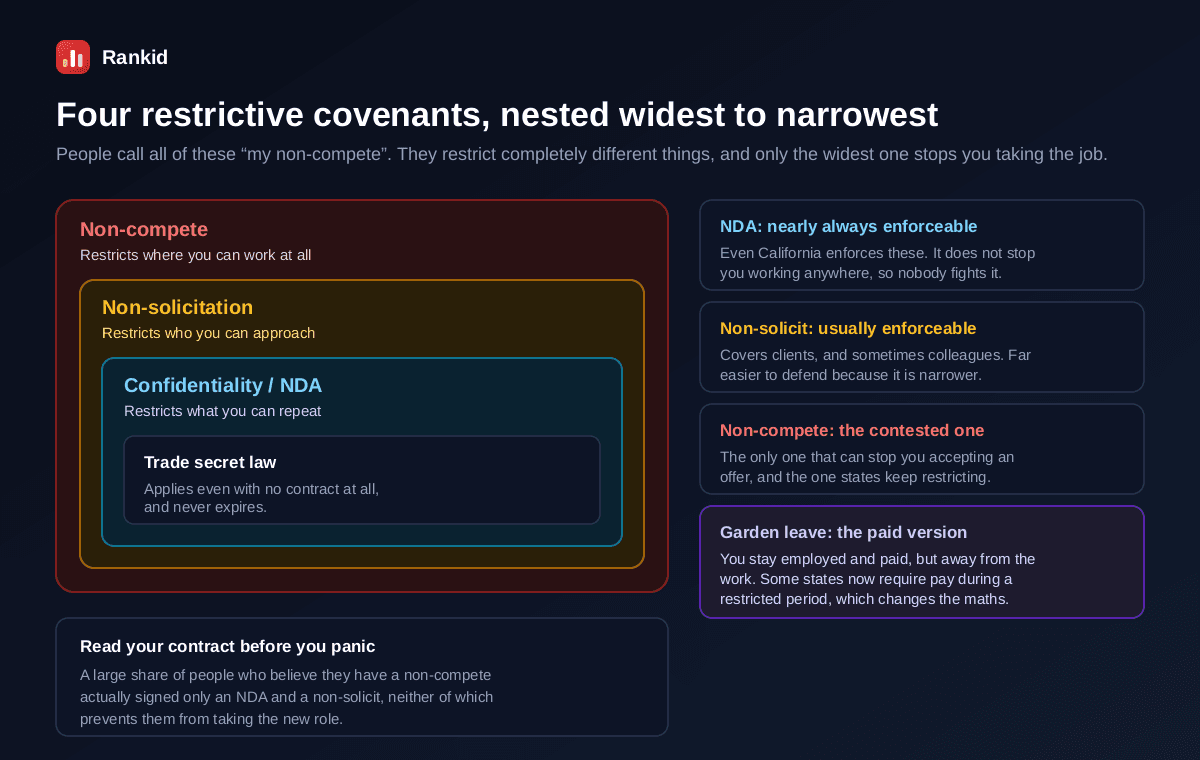
The distinction that matters most in practice is non-compete versus non-solicit. A non-solicit lets you take the new job and simply requires that you not chase your old clients or recruit your former colleagues. A non-compete can stop you accepting the offer at all. If your contract contains only the former, much of the anxiety people bring to this topic does not apply to you.
Note also that trade secret law sits underneath all of it, applies with no contract at all, and never expires. That is why "I never signed anything" is not a complete answer: taking source code, pricing models or customer data with you is a separate problem from any clause.
Are non-competes enforceable? It depends on your state
This is the single most important fact in the article, and most content buries it: enforceability is decided by state law, not by the document. The gap between the strictest and most permissive states is so wide that the same clause is a nullity in one and a genuine obstacle in another.
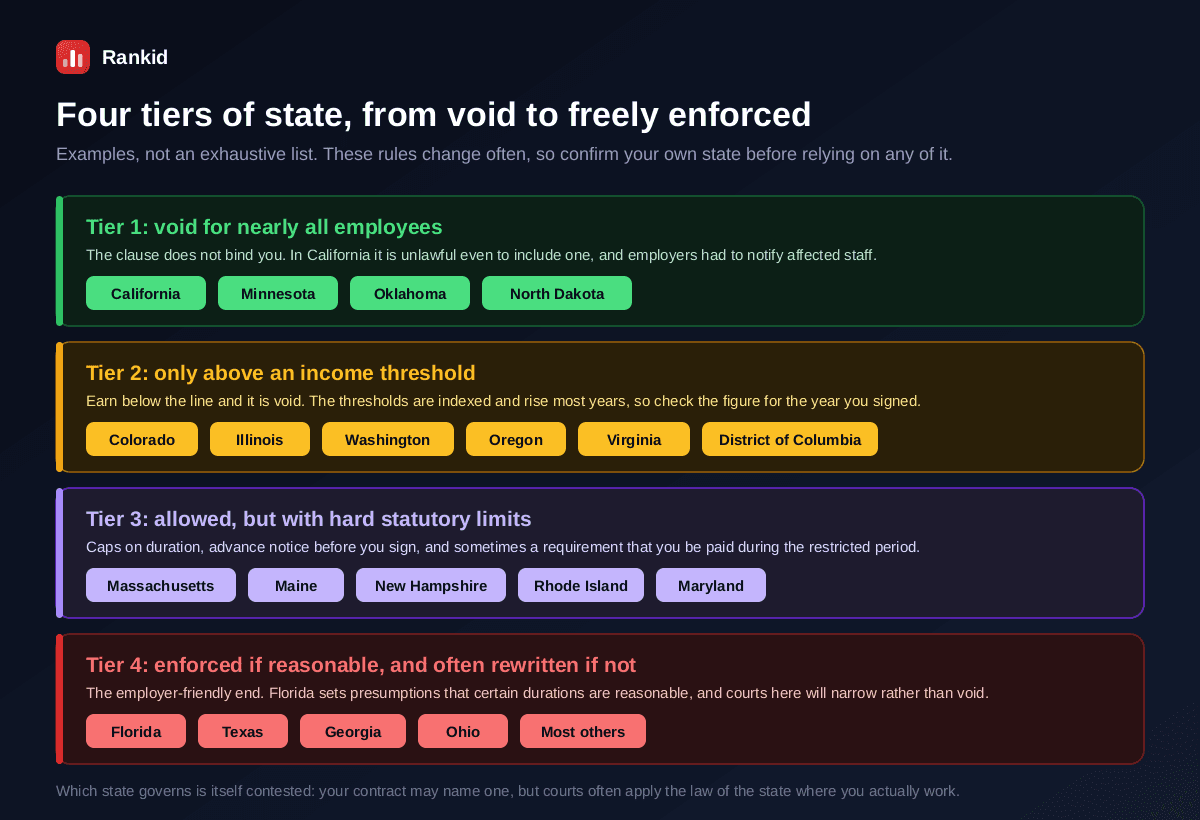
Two practical warnings about that chart. First, these rules change often, and several states have moved tiers in the last few years, so treat it as a map of the terrain rather than as current law for your situation. Second, which state's law applies is itself contested. Your contract may name a state, often a favourable one for the employer, but courts frequently apply the law of the state where you actually work, and some states have statutes specifically voiding choice-of-law clauses that try to route around their protections.
What the FTC non-compete ban actually did
This gets asked constantly and the answer is short: it never took effect. If you have read that non-competes are banned in the United States, that is wrong, and it is wrong in a way that could cost you if you act on it.
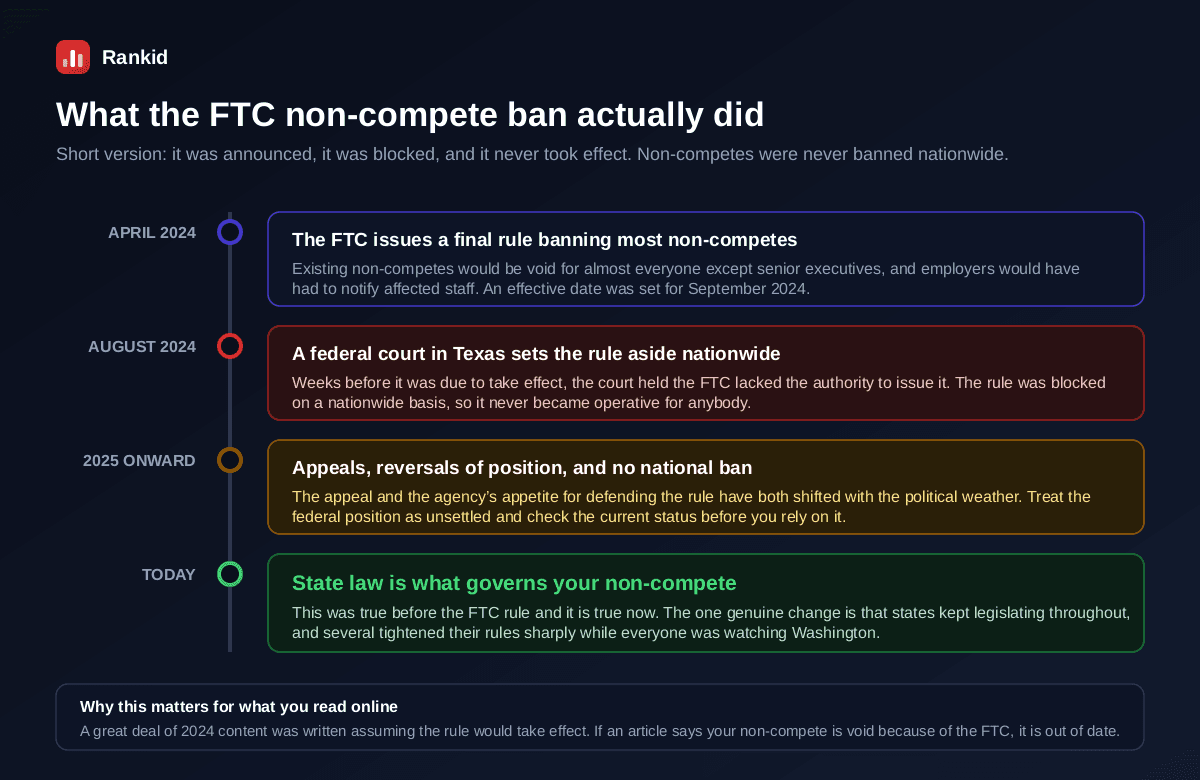
The federal picture has continued to move, so treat it as unsettled rather than resolved in either direction and check the current status before relying on it. What has not changed, and did not change at any point during the saga, is that state law governs. The one genuinely important development is easy to miss: several states tightened their own rules substantially while everyone was watching Washington.
The four gates a non-compete has to pass
In a state that permits non-competes at all, the clause still has to clear four separate tests. Failing any one of them is enough. This is the framework a lawyer will run your clause through, and you can run it yourself first.
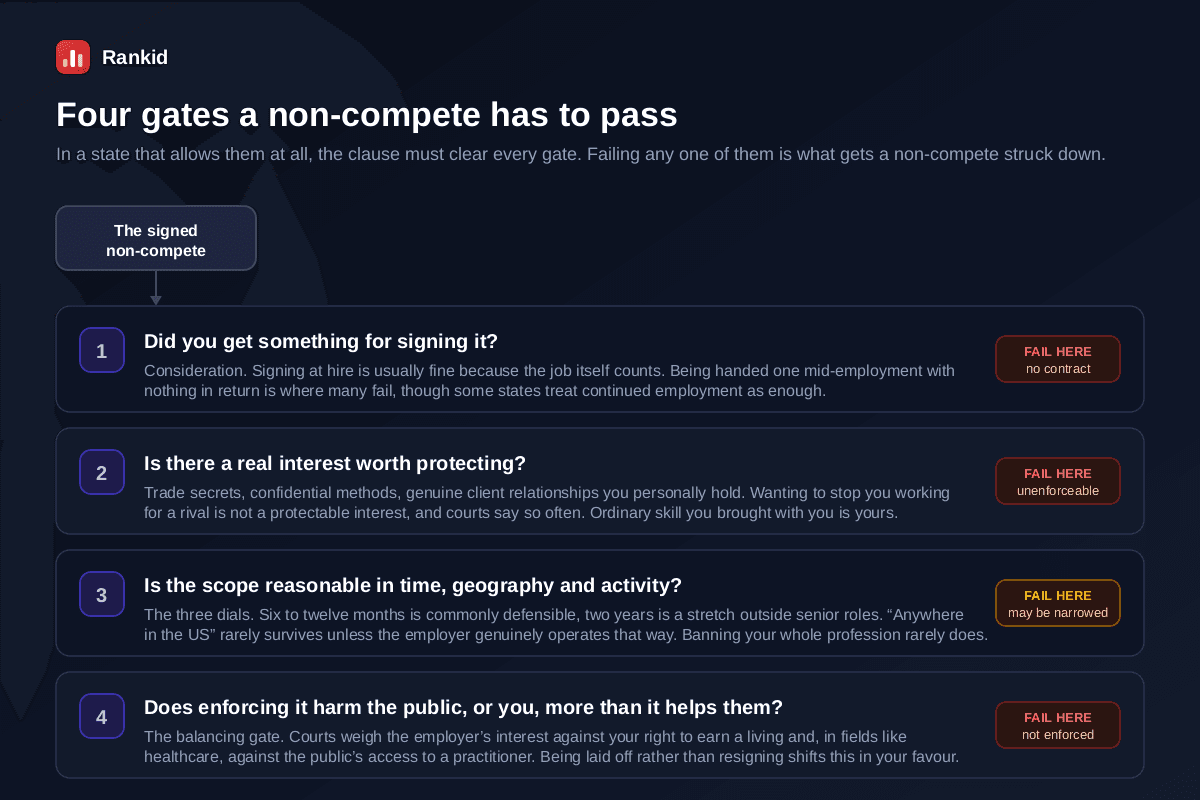
Gate two is the one people underestimate. Wanting to stop you working for a competitor is not, by itself, a protectable interest, and courts say so regularly. The employer has to point at something real: a trade secret, a confidential method, a client relationship you personally hold. The general skill and industry knowledge you developed on the job is yours to take with you, and a clause that is really aimed at stopping ordinary competition tends to fail here.
Gate four quietly matters if you were let go. Being made redundant rather than resigning shifts the balancing test noticeably in your favour, for the obvious reason that a court is unsympathetic to an employer that removed your job and then wants to block the replacement.
What happens when a non-compete is too broad
Here is the part almost nobody knows, and it changes everything about how you should read an overbroad clause. When a court decides a non-compete goes too far, three different doctrines produce three completely different outcomes, and which one applies depends on your state.
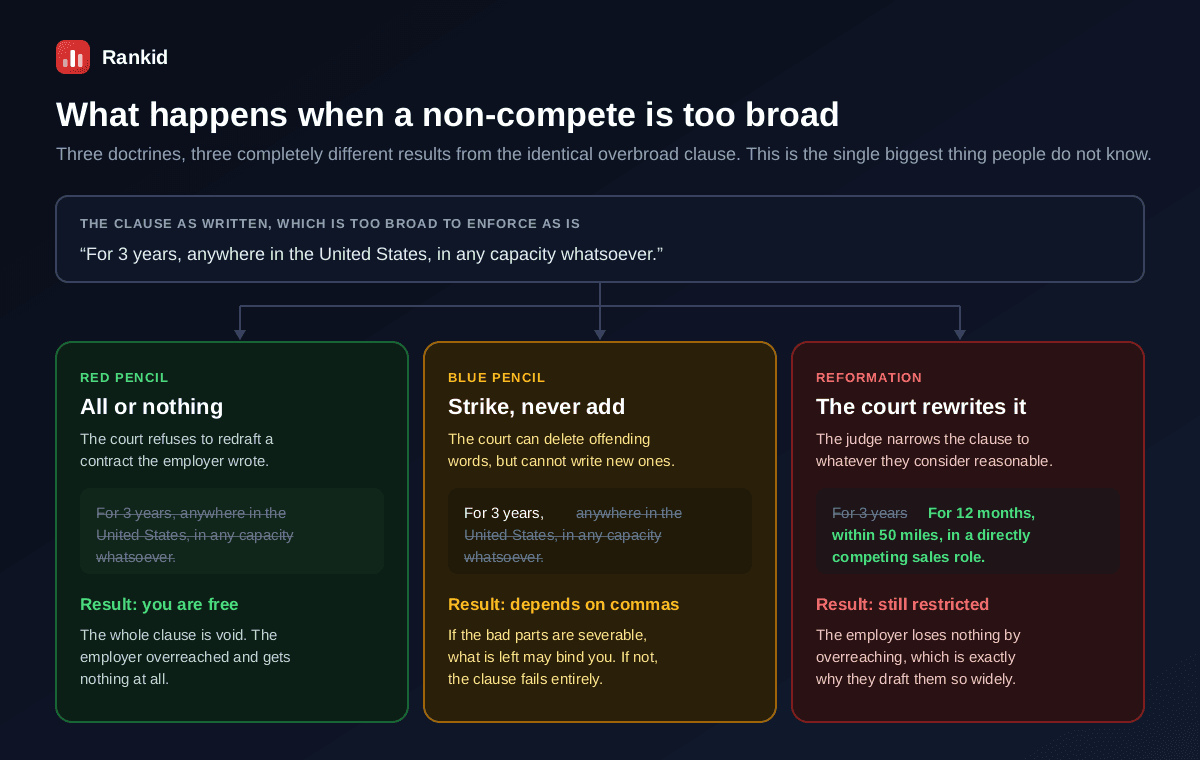
Follow the consequence through. In a reformationstate, an employer that drafts a wildly overbroad clause loses essentially nothing: the worst outcome is that a judge narrows it to something they would have been granted anyway. That asymmetry is exactly why so many templates are drafted far more aggressively than any court would enforce, and it is why "this looks unreasonable, so it must be void" is a dangerous assumption in most of the country.
In a red pencil state the incentive runs the opposite way, because overreaching costs the employer the entire clause. Knowing which regime you are in tells you whether an obviously excessive clause is good news or irrelevant.
How to get out of a non-compete
Work down this list. Almost nobody needs the bottom of it, because enforcement is expensive and employers know it. Most non-competes end quietly near the top.
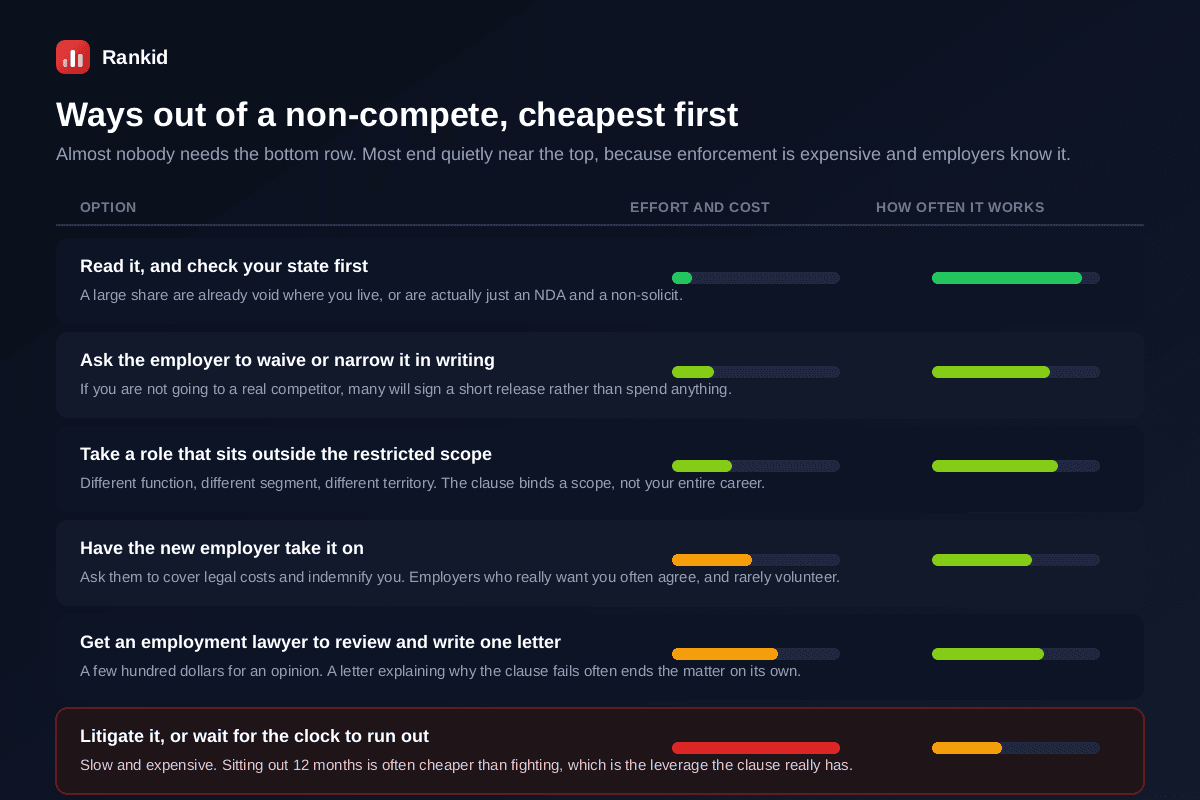
Read the actual document, then check your state
Ask for a written waiver or a narrowing
Consider a role outside the restricted scope
Push the risk onto the new employer
Pay a lawyer for a review and, if warranted, one letter
Litigation and simply waiting out the clock are the last resorts, and it is worth being clear-eyed about why: sitting out twelve months is often cheaper than fighting. That asymmetry, rather than the legal merits, is the real leverage a non-compete carries.
Before you sign: what is actually negotiable
Your leverage sits entirely in the gap between an offer and a signature, and it drops to close to zero afterwards. Read the restrictive covenants before you accept, not after you resign. Five asks are common enough that making them is unremarkable:
- Shorten the duration. Twelve months instead of twenty-four is the concession most often granted.
- Narrow the definition of a competitor to named companies or a specific segment, rather than any business that competes in any way.
- Narrow the geography to where you actually worked, rather than everywhere the company has a customer.
- Add a termination carve-out so the restriction does not apply if you are let go without cause or made redundant. This is the single most valuable ask on the list and many employers accept it without argument.
- Ask to be paid during the restricted period.Some states already require this, and framing it as "if you need me out of the market, that is worth something" is a reasonable position.
Two things to check in the clause itself
If the offer is still in play, this is one of several terms worth handling together rather than one at a time. See how to respond to a job offer and what belongs in an offer letter for the wider set.
Does it still apply if you were laid off?
It becomes considerably harder to enforce, and in some states an employer who terminates someone without cause cannot then block them from earning a living in their field. But do not assume it evaporates. Most clauses are drafted to apply on termination "for any reason" precisely to cover this, and whether a court honours that varies.
One thing to watch closely: severance is frequently the consideration used to make a restrictive covenant stick, or to impose a new one at exit that you were never subject to before. Read the separation agreement carefully rather than signing to get the payment moving. Our guide to severance pay and what you sign away covers the review periods and the release language, and employee offboarding covers what else should be happening at the same time.
Cleared to apply? Check your resume against the job first
Paste your resume and the job description into Rankid. You'll get a 0-100 match score, the skills you've matched, and the exact keywords you're missing, free. If a non-compete narrowed your options, the applications you do send need to land.
Check your match score freeFor employers: who actually needs one
The most common mistake is applying the same clause to everybody, and it is self-defeating. A court that sees the identical non-compete on a receptionist reads your template as overreach rather than as genuine protection, which weakens it exactly where you needed it to hold.
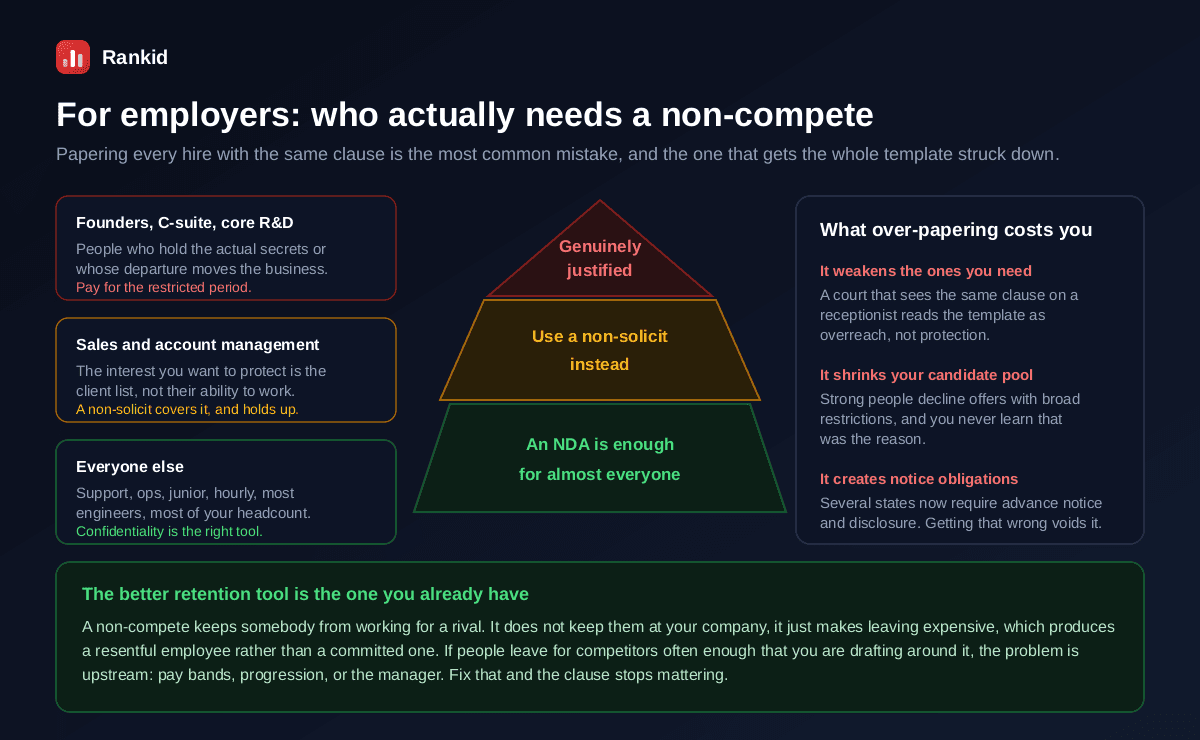
The middle tier is where most of the value is. For sales and account management, the interest you actually care about is the client relationship, and a non-solicitation clause protects it while being far more likely to survive a challenge. Reaching for a non-compete there trades a clause that works for one that might not.
The recruiting cost is the one that never shows up in a report, because candidates who decline over broad restrictions rarely tell you that was the reason. It shows up instead as a slower pipeline and a weaker shortlist, which lands in cost per hire and your funnel metrics with no obvious cause attached.
And it is worth saying plainly: a non-compete does not keep anyone at your company. It makes leaving expensive, which produces a resentful employee rather than a committed one. If people leave for competitors often enough that you are drafting around it, the problem is upstream in pay, progression or management, and the honest version of that conversation belongs in your one-on-ones and your exit interviews rather than in your contract template.
Frequently asked questions
What is a non-compete agreement?
A non-compete agreement, also called a non-compete clause or a covenant not to compete, is a contract term that restricts where you can work after leaving an employer. A typical clause bars you from working for a competing business, in a defined activity, within a defined geographic area, for a defined period after your employment ends. Those three dials, time, geography and activity, are what courts examine, and a clause that is generous on all three is the kind that gets struck down. It is worth being precise about what a non-compete is not. It is not a confidentiality agreement, which restricts what information you can repeat and is enforceable almost everywhere. It is not a non-solicitation clause, which restricts who you may approach, meaning clients and sometimes colleagues. And it is not garden leave, where you remain employed and paid but away from the work. A great many people who believe they have a non-compete have actually signed only an NDA and a non-solicit, neither of which prevents them from accepting a new job.
Are non-compete agreements enforceable?
It depends almost entirely on the state you work in, not on how the clause is written. States fall into roughly four tiers. In the first, non-competes are void for nearly all employees: California, Minnesota, Oklahoma and North Dakota. California goes furthest, making it unlawful even to include one and requiring employers to notify affected staff. In the second tier they are enforceable only above an income threshold, so a worker earning under the line is simply not bound: Colorado, Illinois, Washington, Oregon, Virginia and the District of Columbia work this way, and the thresholds are indexed and rise most years. In the third tier they are allowed but with hard statutory limits on duration, advance notice before signing, and sometimes a requirement that you be paid during the restricted period, as in Massachusetts, Maine, New Hampshire, Rhode Island and Maryland. In the fourth tier, which is most remaining states including Florida, Texas, Georgia and Ohio, they are enforced if reasonable and frequently rewritten by the court if not. One complication worth knowing: which state's law applies is itself contested, because your contract may name one state while courts often apply the law of the state where you actually work.
Did the FTC ban non-competes?
No. The FTC issued a final rule in April 2024 that would have banned most non-competes nationwide, voiding existing ones for almost everyone except senior executives and requiring employers to notify affected staff. It was scheduled to take effect in September 2024. In August 2024, weeks before that date, a federal court in Texas set the rule aside on a nationwide basis, holding that the FTC lacked the authority to issue it. The rule therefore never became operative for anybody. Appeals followed, and both the litigation and the agency's appetite for defending the rule have shifted with the political weather since, so the federal position should be treated as unsettled rather than settled in either direction. The practical takeaway has not changed: state law governs your non-compete, exactly as it did before the rule was announced. This matters for what you read online, because a great deal of content published in 2024 was written on the assumption that the rule would take effect. If an article tells you your non-compete is void because of the FTC, it is out of date.
What makes a non-compete unenforceable?
In a state that permits them at all, the clause has to clear four gates, and failing any one is enough to defeat it. First, consideration: did you get something in exchange for signing? Signing at hire is usually fine because the job itself counts, but being handed one mid-employment with nothing in return is where many fail, though some states treat continued employment as sufficient. Second, a legitimate protectable interest: trade secrets, confidential methods, or genuine client relationships you personally hold. Simply wanting to stop you working for a rival is not a protectable interest, and courts say so frequently. Ordinary skill and general industry knowledge you brought with you or developed is yours. Third, reasonable scope in time, geography and activity. Six to twelve months is commonly defensible, two years is a stretch outside senior roles, nationwide restrictions rarely survive unless the employer genuinely operates nationwide, and barring you from your entire profession rarely survives at all. Fourth, the balancing test: courts weigh the employer's interest against your right to earn a living and, in fields such as healthcare, against public access to a practitioner.
What happens if a non-compete is too broad?
Three doctrines produce three completely different results from the identical overbroad clause, and this is the single most consequential thing most people do not know. Under the red pencil approach, the court refuses to redraft a contract the employer wrote, so an overbroad clause is void in its entirety and you are free. Under the blue pencil approach, the court may delete offending words but cannot add new ones, so the outcome depends on whether the bad parts happen to be grammatically severable: sometimes what remains still binds you, and sometimes the clause collapses. Under reformation, also called equitable modification, the judge rewrites the clause to whatever they consider reasonable and then enforces the rewritten version, so a three-year nationwide ban might become twelve months within fifty miles. The consequence is worth stating plainly: in a reformation state the employer loses essentially nothing by overreaching, which is precisely why so many templates are drafted far more broadly than any court would enforce. Which doctrine applies is a matter of state law, and some states have shifted their approach over time.
Does a non-compete hold up if you are fired or laid off?
It often becomes considerably harder to enforce, but do not assume it evaporates. Several states have held that an employer who terminates someone without cause, and particularly one that makes a role redundant, cannot then prevent that person from earning a living in their field, and some have said so by statute. Even where no rule addresses it directly, this fact weighs heavily in the fourth gate, the balancing test, because a court is far less sympathetic to an employer who removed the job and then wants to block the replacement one. There are two practical points. Read the trigger language in your own clause: many say the restriction applies on termination "for any reason", and that phrase is drafted specifically to cover this situation, though it does not guarantee a court will honour it. And check any severance agreement carefully, because severance is frequently the consideration used to make a restrictive covenant stick, or to impose a new one at exit that you were not previously subject to.
How do I get out of a non-compete?
Work down the list from cheapest to most expensive, because almost nobody needs the bottom of it. Start by reading the actual document and checking your state, since a large share of non-competes are already void where the person lives, or turn out to be only an NDA and a non-solicit. Next, ask the employer to waive or narrow it in writing: if you are not going to a genuine competitor, many will sign a short release rather than spend anything at all. Third, consider taking a role that sits outside the restricted scope, meaning a different function, segment or territory, because the clause binds a defined scope rather than your entire career. Fourth, ask the new employer to take it on by covering legal costs and indemnifying you, which employers who really want you often agree to and almost never volunteer. Fifth, pay an employment lawyer a few hundred dollars to review it and, if warranted, send one letter explaining why the clause fails, which frequently ends the matter. Litigation and simply waiting out the clock are last resorts, and the fact that waiting is often cheaper than fighting is the real leverage these clauses have.
What is the difference between a non-compete and a non-solicitation agreement?
A non-compete restricts where you can work. A non-solicitation clause restricts who you can approach, which usually means the employer's clients and sometimes its employees. The practical difference is enormous: a non-solicit lets you take the new job and simply requires that you not go after your old customers or recruit your former colleagues, whereas a non-compete can stop you accepting the offer at all. Non-solicits are also much easier to enforce, precisely because they are narrower and map more directly onto a legitimate protectable interest. Even California, which voids non-competes, treats customer non-solicitation differently in some circumstances, though its courts have been sceptical of broad employee non-solicits. From the employer's side this is the most useful practical insight in the whole topic: for the majority of roles where a company instinctively reaches for a non-compete, particularly in sales, a non-solicit protects the thing they actually care about and will survive challenge, while the non-compete may not.
How long can a non-compete last?
There is no universal limit, and the answer depends on your state and your seniority. As a general pattern, six to twelve months is commonly considered defensible for a non-executive role, twelve to twenty-four months starts to attract scrutiny, and anything beyond two years is difficult to defend outside genuinely senior positions or a sale-of-business context, where much longer terms are routinely upheld because the seller was paid for the goodwill. Several states impose hard statutory caps rather than leaving it to a reasonableness test: Massachusetts limits most non-competes to twelve months, for example. Two details are easy to miss. Some clauses contain a tolling provision stating that the restricted period pauses while you are in breach, which can extend the real duration well past the stated one. And the clock usually starts on your last day of employment rather than on the date you resign, which matters when you have a long notice period, since serving notice may already be consuming part of the restricted window.
Should I sign a non-compete, and what can I negotiate?
Read it before you accept the offer, because your leverage is at its maximum in the gap between an offer and a signature and it drops to almost nothing afterwards. Five things are genuinely negotiable and are asked for often enough that requesting them is not unusual. Shorten the duration, since twelve months instead of twenty-four is the most commonly granted concession. Narrow the definition of a competitor to named companies or a specific market segment rather than any business that competes in any way. Narrow the geography to where you actually worked. Add a carve-out so the restriction does not apply if you are terminated without cause or made redundant, which is the single most valuable clause to ask for and one many employers accept without argument. And ask for pay during the restricted period, which some states now require anyway. If the employer refuses everything, that itself is information about how they treat people. Never rely on a verbal assurance that they would not enforce it; if it is not in the document, it does not exist.
Can my employer stop me from working for a competitor if I never signed anything?
Generally no, at least not on non-compete grounds, because a non-compete is a contract term and without a contract there is nothing to enforce. Two important qualifications. Trade secret law applies whether or not you ever signed anything, it has no expiry date, and it protects genuinely confidential information such as source code, formulations, pricing models and customer data, so taking or using that material can expose you regardless. And some employers include restrictive covenants inside documents people do not think of as contracts, including equity award agreements, bonus plans, commission schemes and employee handbooks you acknowledged electronically, so "I never signed a non-compete" is worth verifying rather than assuming. Ask HR for a copy of everything in your file with your signature on it, which you are entitled to in many states. Also note the duty of loyalty that exists in many jurisdictions while you are still employed, which is a separate matter from post-employment restrictions and is why competing while on the payroll is a different and riskier proposition.
Should employers use non-competes at all?
Sparingly, and for far fewer people than most companies use them for. Papering every hire with the same clause is the most common mistake and it actively undermines the cases where the protection matters, because a court that sees the identical clause on a receptionist reads the template as overreach rather than as genuine protection. A reasonable structure has three levels. For founders, C-suite and core R&D, meaning people who hold the actual secrets or whose departure moves the business, a non-compete may be justified, and paying for the restricted period both strengthens enforceability and is required in some states. For sales and account management, the interest you want to protect is the client relationship, so a non-solicitation clause covers it and is far more likely to survive. For everyone else, which is most of your headcount, a confidentiality agreement is the right tool. It is also worth being honest about what these clauses do not do. A non-compete does not keep anyone at your company, it only makes leaving expensive, which produces a resentful employee rather than a committed one. If people leave for competitors often enough that you are drafting around it, the problem is upstream in pay, progression or management.
Key takeaways
- Your state decides whether a non-compete is enforceable, not the wording. It is void for most employees in California, Minnesota, Oklahoma and North Dakota, and void below an income threshold in several more.
- The FTC ban never took effect. A federal court set it aside nationwide weeks before its 2024 effective date, so anything claiming non-competes are banned nationwide is out of date.
- Check what you actually signed. Many people who think they have a non-compete hold only an NDA and a non-solicit, neither of which stops them taking a new job.
- Four gates: consideration, a real protectable interest, reasonable scope in time, geography and activity, and a balancing test. Failing any one defeats the clause.
- Wanting to stop you working for a rival is not a protectable interest. General skill and industry knowledge you developed is yours.
- When a clause is too broad, some states void it entirely, some strike words, and some rewrite it and enforce the new version. In that last group, overreaching costs the employer nothing.
- Work down the exit options cheapest first. Reading it, checking your state, and asking for a written waiver resolve most cases long before a lawyer is needed.
- Negotiate before you sign, and the most valuable single ask is a carve-out so the restriction does not apply if you are let go without cause.
- For employers: use non-competes for the few, non-solicits for sales, and NDAs for everyone else. Papering every hire weakens the clauses you actually need.
Frequently asked questions
What is a non-compete agreement?
A non-compete agreement, also called a non-compete clause or a covenant not to compete, is a contract term that restricts where you can work after leaving an employer. A typical clause bars you from working for a competing business, in a defined activity, within a defined geographic area, for a defined period after your employment ends. Those three dials, time, geography and activity, are what courts examine, and a clause that is generous on all three is the kind that gets struck down. It is worth being precise about what a non-compete is not. It is not a confidentiality agreement, which restricts what information you can repeat and is enforceable almost everywhere. It is not a non-solicitation clause, which restricts who you may approach, meaning clients and sometimes colleagues. And it is not garden leave, where you remain employed and paid but away from the work. A great many people who believe they have a non-compete have actually signed only an NDA and a non-solicit, neither of which prevents them from accepting a new job.
Are non-compete agreements enforceable?
It depends almost entirely on the state you work in, not on how the clause is written. States fall into roughly four tiers. In the first, non-competes are void for nearly all employees: California, Minnesota, Oklahoma and North Dakota. California goes furthest, making it unlawful even to include one and requiring employers to notify affected staff. In the second tier they are enforceable only above an income threshold, so a worker earning under the line is simply not bound: Colorado, Illinois, Washington, Oregon, Virginia and the District of Columbia work this way, and the thresholds are indexed and rise most years. In the third tier they are allowed but with hard statutory limits on duration, advance notice before signing, and sometimes a requirement that you be paid during the restricted period, as in Massachusetts, Maine, New Hampshire, Rhode Island and Maryland. In the fourth tier, which is most remaining states including Florida, Texas, Georgia and Ohio, they are enforced if reasonable and frequently rewritten by the court if not. One complication worth knowing: which state's law applies is itself contested, because your contract may name one state while courts often apply the law of the state where you actually work.
Did the FTC ban non-competes?
No. The FTC issued a final rule in April 2024 that would have banned most non-competes nationwide, voiding existing ones for almost everyone except senior executives and requiring employers to notify affected staff. It was scheduled to take effect in September 2024. In August 2024, weeks before that date, a federal court in Texas set the rule aside on a nationwide basis, holding that the FTC lacked the authority to issue it. The rule therefore never became operative for anybody. Appeals followed, and both the litigation and the agency's appetite for defending the rule have shifted with the political weather since, so the federal position should be treated as unsettled rather than settled in either direction. The practical takeaway has not changed: state law governs your non-compete, exactly as it did before the rule was announced. This matters for what you read online, because a great deal of content published in 2024 was written on the assumption that the rule would take effect. If an article tells you your non-compete is void because of the FTC, it is out of date.
What makes a non-compete unenforceable?
In a state that permits them at all, the clause has to clear four gates, and failing any one is enough to defeat it. First, consideration: did you get something in exchange for signing? Signing at hire is usually fine because the job itself counts, but being handed one mid-employment with nothing in return is where many fail, though some states treat continued employment as sufficient. Second, a legitimate protectable interest: trade secrets, confidential methods, or genuine client relationships you personally hold. Simply wanting to stop you working for a rival is not a protectable interest, and courts say so frequently. Ordinary skill and general industry knowledge you brought with you or developed is yours. Third, reasonable scope in time, geography and activity. Six to twelve months is commonly defensible, two years is a stretch outside senior roles, nationwide restrictions rarely survive unless the employer genuinely operates nationwide, and barring you from your entire profession rarely survives at all. Fourth, the balancing test: courts weigh the employer's interest against your right to earn a living and, in fields such as healthcare, against public access to a practitioner.
What happens if a non-compete is too broad?
Three doctrines produce three completely different results from the identical overbroad clause, and this is the single most consequential thing most people do not know. Under the red pencil approach, the court refuses to redraft a contract the employer wrote, so an overbroad clause is void in its entirety and you are free. Under the blue pencil approach, the court may delete offending words but cannot add new ones, so the outcome depends on whether the bad parts happen to be grammatically severable: sometimes what remains still binds you, and sometimes the clause collapses. Under reformation, also called equitable modification, the judge rewrites the clause to whatever they consider reasonable and then enforces the rewritten version, so a three-year nationwide ban might become twelve months within fifty miles. The consequence is worth stating plainly: in a reformation state the employer loses essentially nothing by overreaching, which is precisely why so many templates are drafted far more broadly than any court would enforce. Which doctrine applies is a matter of state law, and some states have shifted their approach over time.
Does a non-compete hold up if you are fired or laid off?
It often becomes considerably harder to enforce, but do not assume it evaporates. Several states have held that an employer who terminates someone without cause, and particularly one that makes a role redundant, cannot then prevent that person from earning a living in their field, and some have said so by statute. Even where no rule addresses it directly, this fact weighs heavily in the fourth gate, the balancing test, because a court is far less sympathetic to an employer who removed the job and then wants to block the replacement one. There are two practical points. Read the trigger language in your own clause: many say the restriction applies on termination "for any reason", and that phrase is drafted specifically to cover this situation, though it does not guarantee a court will honour it. And check any severance agreement carefully, because severance is frequently the consideration used to make a restrictive covenant stick, or to impose a new one at exit that you were not previously subject to.
How do I get out of a non-compete?
Work down the list from cheapest to most expensive, because almost nobody needs the bottom of it. Start by reading the actual document and checking your state, since a large share of non-competes are already void where the person lives, or turn out to be only an NDA and a non-solicit. Next, ask the employer to waive or narrow it in writing: if you are not going to a genuine competitor, many will sign a short release rather than spend anything at all. Third, consider taking a role that sits outside the restricted scope, meaning a different function, segment or territory, because the clause binds a defined scope rather than your entire career. Fourth, ask the new employer to take it on by covering legal costs and indemnifying you, which employers who really want you often agree to and almost never volunteer. Fifth, pay an employment lawyer a few hundred dollars to review it and, if warranted, send one letter explaining why the clause fails, which frequently ends the matter. Litigation and simply waiting out the clock are last resorts, and the fact that waiting is often cheaper than fighting is the real leverage these clauses have.
What is the difference between a non-compete and a non-solicitation agreement?
A non-compete restricts where you can work. A non-solicitation clause restricts who you can approach, which usually means the employer's clients and sometimes its employees. The practical difference is enormous: a non-solicit lets you take the new job and simply requires that you not go after your old customers or recruit your former colleagues, whereas a non-compete can stop you accepting the offer at all. Non-solicits are also much easier to enforce, precisely because they are narrower and map more directly onto a legitimate protectable interest. Even California, which voids non-competes, treats customer non-solicitation differently in some circumstances, though its courts have been sceptical of broad employee non-solicits. From the employer's side this is the most useful practical insight in the whole topic: for the majority of roles where a company instinctively reaches for a non-compete, particularly in sales, a non-solicit protects the thing they actually care about and will survive challenge, while the non-compete may not.
How long can a non-compete last?
There is no universal limit, and the answer depends on your state and your seniority. As a general pattern, six to twelve months is commonly considered defensible for a non-executive role, twelve to twenty-four months starts to attract scrutiny, and anything beyond two years is difficult to defend outside genuinely senior positions or a sale-of-business context, where much longer terms are routinely upheld because the seller was paid for the goodwill. Several states impose hard statutory caps rather than leaving it to a reasonableness test: Massachusetts limits most non-competes to twelve months, for example. Two details are easy to miss. Some clauses contain a tolling provision stating that the restricted period pauses while you are in breach, which can extend the real duration well past the stated one. And the clock usually starts on your last day of employment rather than on the date you resign, which matters when you have a long notice period, since serving notice may already be consuming part of the restricted window.
Should I sign a non-compete, and what can I negotiate?
Read it before you accept the offer, because your leverage is at its maximum in the gap between an offer and a signature and it drops to almost nothing afterwards. Five things are genuinely negotiable and are asked for often enough that requesting them is not unusual. Shorten the duration, since twelve months instead of twenty-four is the most commonly granted concession. Narrow the definition of a competitor to named companies or a specific market segment rather than any business that competes in any way. Narrow the geography to where you actually worked. Add a carve-out so the restriction does not apply if you are terminated without cause or made redundant, which is the single most valuable clause to ask for and one many employers accept without argument. And ask for pay during the restricted period, which some states now require anyway. If the employer refuses everything, that itself is information about how they treat people. Never rely on a verbal assurance that they would not enforce it; if it is not in the document, it does not exist.
Can my employer stop me from working for a competitor if I never signed anything?
Generally no, at least not on non-compete grounds, because a non-compete is a contract term and without a contract there is nothing to enforce. Two important qualifications. Trade secret law applies whether or not you ever signed anything, it has no expiry date, and it protects genuinely confidential information such as source code, formulations, pricing models and customer data, so taking or using that material can expose you regardless. And some employers include restrictive covenants inside documents people do not think of as contracts, including equity award agreements, bonus plans, commission schemes and employee handbooks you acknowledged electronically, so "I never signed a non-compete" is worth verifying rather than assuming. Ask HR for a copy of everything in your file with your signature on it, which you are entitled to in many states. Also note the duty of loyalty that exists in many jurisdictions while you are still employed, which is a separate matter from post-employment restrictions and is why competing while on the payroll is a different and riskier proposition.
Should employers use non-competes at all?
Sparingly, and for far fewer people than most companies use them for. Papering every hire with the same clause is the most common mistake and it actively undermines the cases where the protection matters, because a court that sees the identical clause on a receptionist reads the template as overreach rather than as genuine protection. A reasonable structure has three levels. For founders, C-suite and core R&D, meaning people who hold the actual secrets or whose departure moves the business, a non-compete may be justified, and paying for the restricted period both strengthens enforceability and is required in some states. For sales and account management, the interest you want to protect is the client relationship, so a non-solicitation clause covers it and is far more likely to survive. For everyone else, which is most of your headcount, a confidentiality agreement is the right tool. It is also worth being honest about what these clauses do not do. A non-compete does not keep anyone at your company, it only makes leaving expensive, which produces a resentful employee rather than a committed one. If people leave for competitors often enough that you are drafting around it, the problem is upstream in pay, progression or management.