How to Write a Cover Letter for a Job Application (Format, Length, Examples, 2026)
Almost every cover letter opens with the same wasted sentence: "I am writing to apply for the position I saw advertised on your website." The reader already knows that. They know it because your application is sitting in a folder named after the job. Meanwhile the one thing they actually want, a reason to believe you can do this specific work, is buried in paragraph three, if it is there at all. Learning how to write a cover letter for a job application is mostly about spending your limited words on proof instead of ceremony. This guide gives you the five-part format that works, the right length, how to open and close, how to handle no name and no experience, and short examples you can adapt today.
Quick answer
Do you still need a cover letter in 2026?
Yes, whenever you are given the option. The honest version of this answer has two halves, though, and both matter. A cover letter is rarely the reason someone gets hired, and plenty of recruiters at high-volume companies genuinely do not read them. But it is very often the tiebreaker between two similar candidates, and it is the only part of the application where you get to make an argument rather than present a list. Skipping it in a competitive field means giving away free ground to someone who did not.
Send one when the posting asks for it, obviously, but also in the situations where the resume alone will under-represent you:
- You are changing careers or industries. Your resume shows the wrong job titles. The letter is where you connect the dots, which is the whole job of a career change application.
- You have an employment gap or a nonlinear path. A resume can only show the dates. A letter can explain them in one calm sentence, which is far better than leaving the reader to guess. See how to explain employment gaps.
- You are slightly under the stated requirements. If the posting wants five years and you have three strong ones, the letter is where you argue that the work is equivalent.
- You are applying to a small company or startup. At small headcount a human reads every single application, often the person you would report to. This is where letters have the highest return.
- You have a referral or a real connection to the work. A named referral in the first line of a letter is the most persuasive sentence in the entire application.
Optional means yes
Cover letter vs resume: what each document is actually for
Most weak cover letters fail for one structural reason: they are the resume again, in paragraph form. If a hiring manager can read your letter and learn nothing they did not already have, the letter had no purpose. The two documents do genuinely different jobs.
Your resume is a scannable evidence document. It is structured, dense, mostly the same from application to application with targeted tailoring, and it is built to survive being parsed by software and skimmed by a human in seconds. Its job is to prove what you have done. Your cover letter is a short argument in your own voice, written for exactly one job. Its job is to explain what that means for this employer: why this role, why this company, how a strange-looking path connects, why a gap exists, why experience from another field transfers.
A simple test before you send: cover the resume and read the letter alone. Does it tell the reader something new and specific? If it just restates your job history in prose, rewrite the middle. The place to fix keyword coverage and quantified results is the resume itself, not the letter, which is why it pays to check how well your resume matches the job description before you spend time on prose.
How long should a cover letter be?
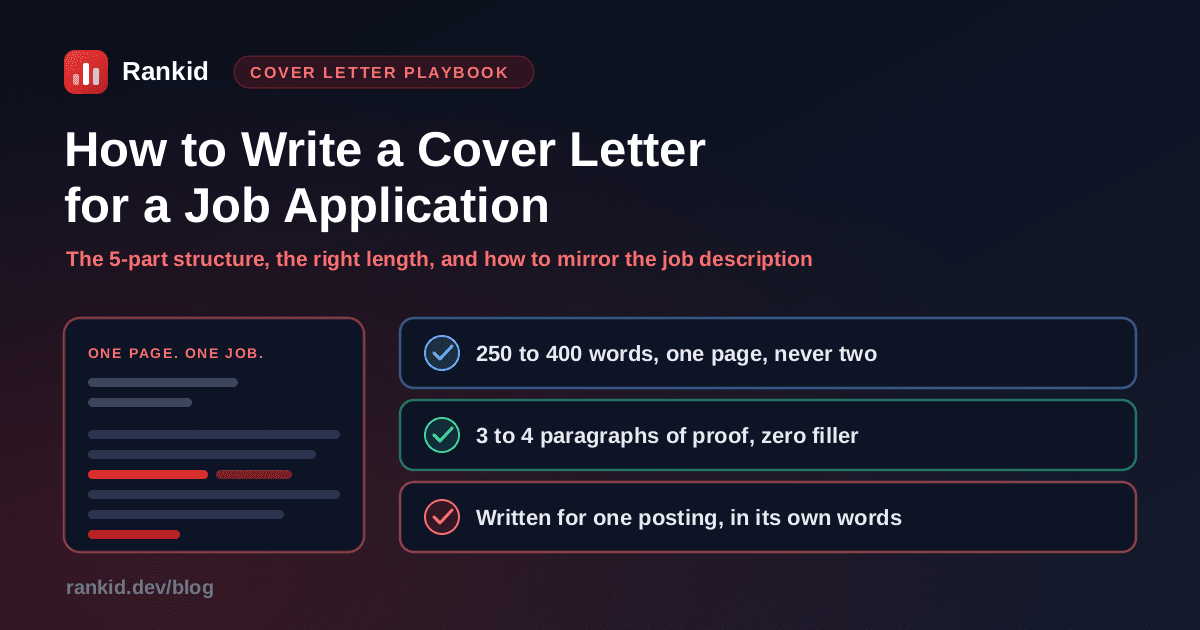
250 to 400 words, on one page, in three to four short paragraphs. That is the whole rule. Under roughly 150 words and it reads as though you could not be bothered. Over about 450 and it does not get finished, because your reader is working through a stack, not studying your application. Half a page of specific proof outperforms a full page padded with restated history.
If you are over the limit, the cuts are almost always in the same three places. Delete any sentence that would still be true if you sent it to a different company. Delete any sentence that repeats a resume bullet without adding context. And delete the personality claims: "hard-working team player with excellent communication skills" occupies a line and persuades no one, because everybody writes it and nobody proves it. The same discipline that governs how long a resume should be applies here, just tighter, because a letter has no structure to help the reader skim.
Cover letter format and structure: the 5 parts
Use the same five-part skeleton every time, and change only the evidence inside it. That is what makes writing a tailored letter a fifteen-minute job instead of an afternoon, and it is also what keeps you from freezing on the blank page. Formatting details: your name and contact line at the top, no postal addresses (nobody mails these), a plain professional font matching your resume, single spacing with a blank line between paragraphs, and a PDF file named something like firstname-lastname-cover-letter.pdf.
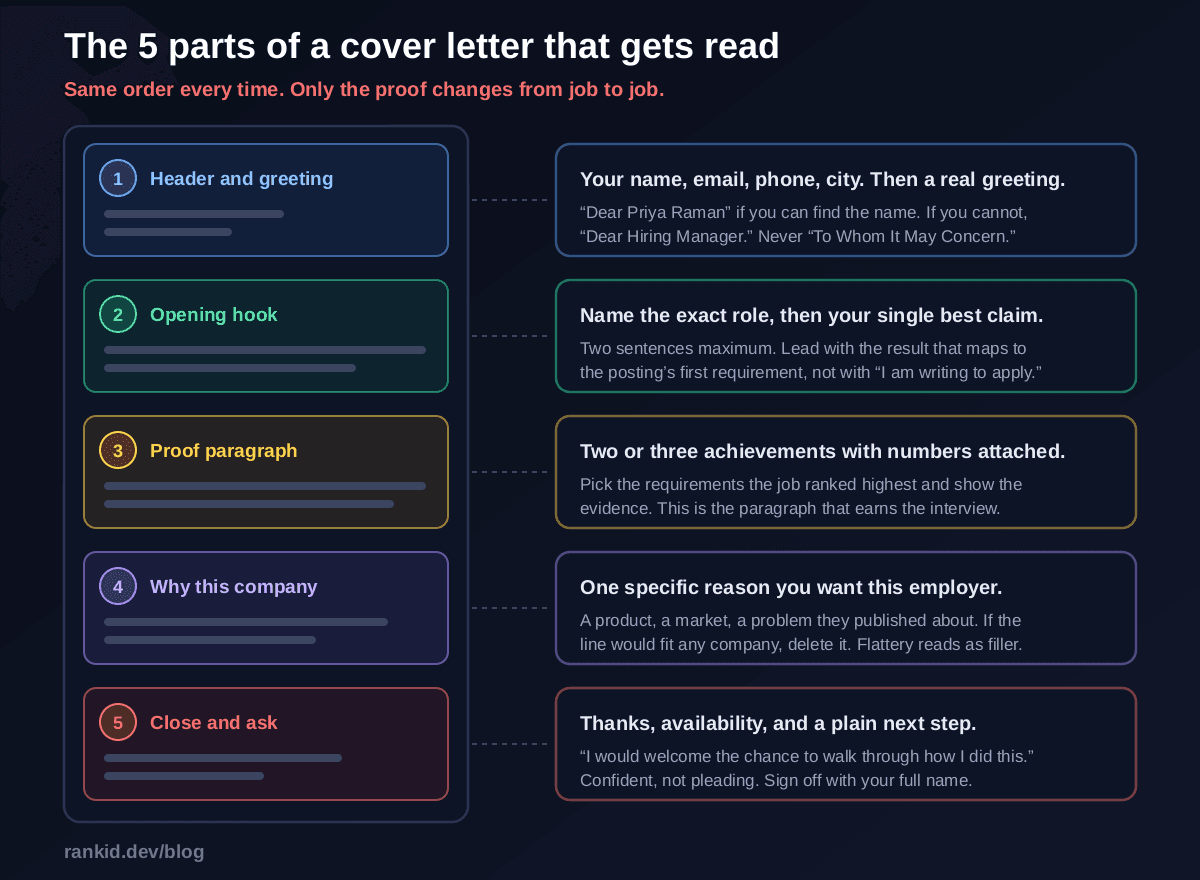
The proportions matter as much as the order. The proof paragraph should be the longest section by a clear margin, because it is the only part doing persuasive work. The header, the "why this company" line, and the close should each be one or two sentences. If your letter is currently a long introduction, a long conclusion, and a thin middle, you have the shape exactly backwards.
How to write a cover letter step by step
Work in this order. Writing the opening first is the classic trap, because you cannot write a good hook until you know what your strongest piece of evidence is.
Pull the top three requirements out of the job description
Read the posting and write down, in its own words, the three things it clearly cares about most. They are usually in the first few bullets, and they are usually repeated in the responsibilities section. These three become the spine of your letter. Ignore the boilerplate about being a self-starter and focus on the concrete, checkable requirements: a tool, a scale, a type of work, a specific outcome.
Match each requirement to one real piece of evidence
For each requirement, find one thing you have actually done that proves it, and attach a number. Not "managed budgets," but "owned a 70,000 dollar monthly ad budget." If you find yourself with no evidence at all for the top requirement, that is worth knowing before you write: either find the closest transferable equivalent, or reconsider the application. Our guide to quantifying achievements covers how to recover numbers when nothing was formally tracked.
Write the proof paragraph first
Turn those matched pairs into two or three tight sentences. One requirement per sentence, evidence attached, no adjectives doing the work. This is the paragraph that earns the interview, so write it while your attention is fresh, not at the end when you are tired and reaching for filler.
Now write the opening hook, using your best line
Look at the proof paragraph and take the single most impressive, most relevant result. Lead with it, and name the exact job title. Two sentences, maximum. If your best result is now doing double duty in the opening and the middle, rephrase the middle rather than downgrading the hook.
Add one specific reason you want this employer
One sentence, and it must be something that could not be said about a competitor: a product decision, a market they operate in, a problem they have written publicly about, a change in their industry you care about. "I have long admired your commitment to innovation" is worse than nothing, because it signals that you did not look.
Close with thanks and a plain next step, then cut 20 percent
Thank them, say you would welcome the chance to walk through the work, sign off with your full name. Then read the whole thing once and delete a fifth of it. There is always a fifth to delete, and the letter is stronger every time.
How to tailor a cover letter to the job description
Tailoring is the difference between a letter that gets read and a letter that gets skipped, and it is much less work than people assume. You are not rewriting from scratch for every application. You keep the skeleton, keep the "who I am" framing, and swap the proof paragraph so that it answers the requirements this particular posting put first. The mechanism is mirroring: take the language the job description uses and answer it directly with evidence.
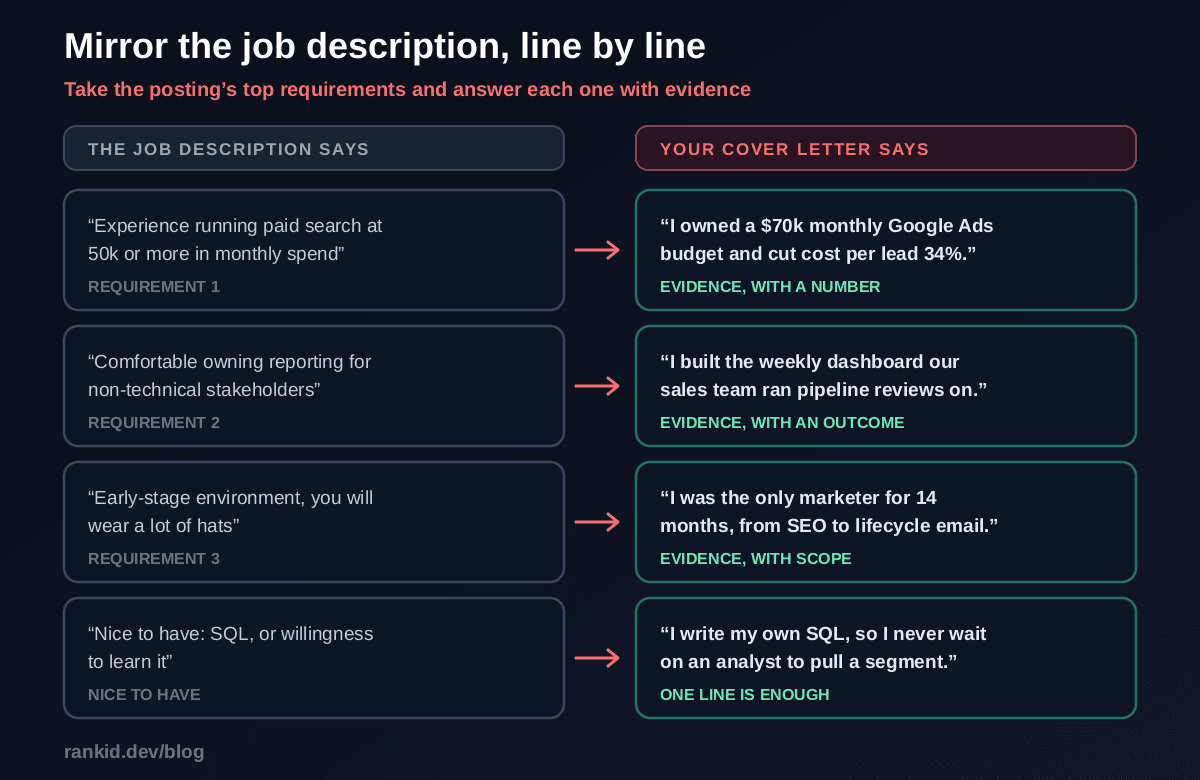
Notice what mirroring is not. It is not copying the posting's phrases back verbatim in a list, which reads as hollow and slightly desperate. It is answering the requirement in the same vocabulary with a fact attached. When the posting says "paid search at 50k or more in monthly spend," you say what you actually ran and what it produced. The shared vocabulary does the matching work; the number does the persuading.
Do the same pass on the resume you attach, because that is the document being scored. The approach is the same one we describe in how to tailor your resume to a job description, and it depends on getting the exact terms right rather than approximate synonyms, which is covered in resume keywords to get past the ATS. A tailored letter attached to an untailored resume is a wasted evening.
Check the application behind your letter
A cover letter cannot rescue a resume that misses the role's core skills, because the resume is what gets parsed and ranked first. Paste your resume and the job description into Rankid to get a 0 to 100 match score, the skills you already match, and the exact requirements you are missing, so you know what your letter still needs to argue. First check is free, no signup.
Check your match freeHow to start a cover letter: openings that actually work
The first sentence decides whether the rest gets read, and it is the sentence most people waste. Here are four openings that earn attention, roughly in order of strength.
- The referral."Amara Osei on your data team suggested I apply for the Analytics Engineer role." If you have this, it goes first. Nothing else in the letter will do as much work.
- The result that matches requirement one."I grew organic traffic from 12,000 to 48,000 monthly visits at a company your size, and I would like to do that for your Marketing Manager role."
- The specific connection."I have been running your API in production for two years, which is why the Developer Advocate opening caught my attention." Concrete, checkable, and impossible to fake.
- The direct claim, when you have no metric yet."I can write SQL, build the dashboard, and explain it to a room of non-analysts, which is what your Business Analyst posting asks for in its first three bullets."
And the openings to retire: "I am writing to express my interest in," "My name is X and I am a recent graduate of Y," "I believe I would be a great fit for your company," and any sentence beginning with "As a highly motivated professional." They are not offensive, they are just empty, and empty is expensive when you have 350 words.
How to address a cover letter when you cannot find a name
Try to find the name first, because a real name lifts the whole letter. Two minutes usually settles it: check the posting itself for a recruiter or hiring contact, look at the company's LinkedIn page for the person who leads the team you would join, check the careers page, or look at who posted the job on LinkedIn.
If it is genuinely not findable, use "Dear Hiring Manager,"which is neutral, professional, and completely acceptable in 2026. Reasonable alternatives are "Dear Engineering Hiring Team," or "Dear [Company] Recruiting Team." Avoid "To Whom It May Concern" (dated and cold), "Dear Sir/Madam" (dated and presumes gender), and "Hey there" (too casual for a document that goes in a file). If you find a name but not a title or pronouns, use the full name: "Dear Priya Raman," sidesteps the guess entirely and never lands wrong.
How to end a cover letter
The close should be three short moves and then stop: thank them, point to a next step, sign off. "Thank you for reading. I would welcome the chance to walk through how I built that reporting process, and I am available for a call any afternoon this week. Best regards, Sam Ortiz." That is enough.
Two failure modes to avoid. The first is pleading: "I really hope you will consider giving me a chance" transfers all the power to the reader and reads as anxious. The second is over-claiming: "I will follow up on Tuesday to schedule our interview" is presumptuous, and at most companies the hiring process cannot accommodate it anyway. Confident and unbothered is the target: you would like to talk, you are easy to reach, you are not waiting by the phone. It also helps to have realistic expectations about the wait, which we cover in how long it takes to hear back after applying.
Short cover letter examples you can adapt
These are deliberately short, because real ones should be. Read them for the shape and the ratio of proof to packaging, not to copy the wording.
1. Experienced candidate, direct match.
"Dear Priya Raman, I grew organic traffic from 12,000 to 48,000 monthly visits in nine months at a 40-person B2B company, and I would like to do the same for your Marketing Manager role. In my last two years at Harlow Data I owned a 70,000 dollar monthly paid budget and cut cost per lead 34 percent, built the weekly dashboard our sales team ran pipeline reviews on, and wrote the content programme that now drives 60 percent of inbound demos. I write my own SQL, so reporting never waits on an analyst. I am applying specifically because you sell to RevOps teams, which is the audience I have spent three years learning to write for, and it is a much harder audience than most marketers admit. Thank you for reading. I would welcome the chance to walk through the paid restructure in detail. Best regards, Sam Ortiz."
2. No experience yet, entry level.
"Dear Hiring Manager, I can build a dashboard, clean a messy dataset, and explain the result to people who do not work with data, which is what your Junior Analyst posting asks for in its first three bullets. During my final year I ran the analytics for a 400-member student society, cutting the time to produce our monthly membership report from six hours to under one by rebuilding it in SQL and Looker Studio. In a summer internship at Bell Logistics I audited 4,000 delivery records and found a duplication error worth roughly 12,000 dollars a year. I am early in my career and I know it, but I have already done the core work in your first bullet, and I learn fastest with real data in front of me. I would be glad to walk through either project. Thank you for your time. Best regards, Nadia Farrell."
3. Career changer.
"Dear Hiring Manager, For six years I taught high-school chemistry, which meant explaining complicated systems to skeptical audiences thirty times a week, and for the last eighteen months I have been doing the same thing as a technical writer. I documented a 200-endpoint API from scratch, cut support tickets about our authentication flow 41 percent by rewriting one guide, and built the style guide four other writers now use. Your posting asks for someone who can turn engineer explanations into something a customer can follow without help, and that is precisely the transfer I have already made. I am applying to you rather than a larger docs team because your product is developer-first, where documentation is the product experience rather than an afterthought. Thank you for reading. Best regards, Tomas Reyes."
What all three have in common
How to write a cover letter with no experience
The structure does not change when you have no work history. Only the source of the proof changes. Pull evidence from coursework and capstone projects, internships, freelance or volunteer work, societies and clubs you helped run, part-time jobs in unrelated fields, and self-directed projects you can link to. All of it counts, provided you describe it as work with an outcome rather than as an activity you participated in.
Two rules make the difference. First, quantify anyway: "grew a student society's engagement 3x in one semester" is real evidence, and small numbers are fine. Second, do not lead with enthusiasm. "I am passionate about marketing and eager to learn" is what every entry-level letter says, so it carries no information; a single specific thing you built carries more weight than a paragraph of eagerness. One honest sentence acknowledging you are early in your career is fine, as long as it is immediately followed by the requirement you already meet. The same evidence-first logic drives writing a resume with no experience, and the two documents should draw on the same set of projects without repeating each other word for word.
Do applicant tracking systems read cover letters?
Mostly they store them. Nearly every applicant tracking system keeps your cover letter attached to your application and makes the text searchable, and some include it in keyword matching or scoring. But the resume is what gets parsed into structured fields, scored, and ranked, which means the cover letter is a supporting document in the eyes of the software, not the main event.
Three practical consequences. First, never use the letter to smuggle in keywords you left off the resume, because the ranking that decides whether a human sees you happens on the resume. Second, keep the file machine-readable anyway: real text in a PDF, no text inside images, no tables or columns, which is the same standard described in our guide to an ATS-friendly resume and in PDF vs Word. Third, understand the order of operations: software or a screener ranks the application, and only then does anyone read your prose. That is why fixing resume match comes first. If you want the detail on how that ranking actually works, see how AI resume screening works and what a good resume match score looks like.
Cover letter mistakes that get you screened out
- Sending one generic letter to everything. The tell is a letter that never names anything only this company has. Readers spot it instantly, and it is worse than no letter, because it proves you did not look.
- Restating the resume in prose. If the letter adds no new information, it has no reason to exist. Add context, motivation, and explanation instead.
- Leading with yourself instead of the reader."I am seeking an opportunity where I can grow" describes what you want. The letter's job is to describe what they get.
- Unsupported personality claims. Hard-working, detail-oriented, excellent communicator, team player. Every candidate writes them, none of them prove anything. Replace each with a fact.
- The wrong company name. The classic copy-paste failure, and an instant rejection. If you reuse a base letter, check every proper noun before sending, every time.
- Apologising for gaps in your fit."Although I do not have direct experience in" hands the reader a reason to stop. State the transferable equivalent as a positive instead.
- Running long. Past a page, the close is never read, which means your next step and your best closing line are wasted.
- Obvious AI boilerplate. Fluent, structurally perfect, and completely interchangeable. Use AI to tighten your own sentences, not to invent your evidence. Our guide to using ChatGPT to tailor a resume applies the same way here.
Key takeaways
- Send a cover letter whenever the option exists, and always when changing careers, explaining a gap, or applying somewhere small.
- Keep it to 250 to 400 words on one page, three to four paragraphs, with the proof paragraph as the longest section.
- Use the same five parts every time: header and greeting, opening hook, proof paragraph, why this company, close and ask.
- Write the proof paragraph first, then build the hook from your strongest line in it.
- Tailor by mirroring: take the posting's top requirements and answer each one with a number, an outcome, or scope.
- Never restate your resume in prose. The letter exists to explain what the resume cannot.
- Use "Dear Hiring Manager" when there is no name, and the full name when there is one. Retire "To Whom It May Concern."
- The resume is what gets parsed and ranked, so check its match against the job description before you polish the letter.
A good cover letter is not a writing exercise, it is a short argument built from things you have actually done. Pull the three requirements that matter out of the posting, answer each one with real evidence and a number, add the single honest reason you want this employer, and stop. That takes fifteen minutes once you have a skeleton, and it produces something no other applicant can send. Then make sure the document doing the heavy lifting is ready too: paste your resume and the job description into Rankid's free resume checker to see your match score and the exact requirements you are still missing, so the letter you just wrote is attached to an application strong enough to reach the person you wrote it for.
Frequently asked questions
How do you write a cover letter for a job application?
Write it in five parts, in this order. First, a header with your name, email, phone, and city, followed by a real greeting ("Dear Priya Raman," or "Dear Hiring Manager," if you cannot find the name). Second, an opening hook of one or two sentences that names the exact role and leads with your single strongest, most relevant result. Third, a proof paragraph with two or three achievements that carry real numbers and answer the requirements the posting listed first. Fourth, one specific sentence on why this employer, referencing a product, market, or problem only they have. Fifth, a short close that thanks them and states a plain next step. Keep the whole thing to 250 to 400 words on one page, and rewrite the proof paragraph for every job rather than sending one generic letter to everyone.
How long should a cover letter be?
A cover letter should be 250 to 400 words and must fit on one page, which is roughly three to four short paragraphs. Anything under about 150 words tends to read as though you did not bother, and anything over 450 words rarely gets finished, because the reader is skimming a stack of applications rather than reading yours closely. Half a page of dense, specific proof beats a full page padded with restated resume history and phrases like "I am a hard-working team player with excellent communication skills." If you are struggling to cut, delete every sentence that would still be true if you sent it to a different company, and every sentence that repeats a resume bullet without adding context.
Do you still need a cover letter in 2026?
Yes, whenever the application gives you the option, and always when it is required. A cover letter is rarely the reason you get hired, but it is often the tiebreaker between similar candidates, and skipping it when the field is competitive gives away free ground. Include one if the posting asks for it, if you are changing careers or industries, if you have an employment gap or a nonlinear path to explain, if you are applying to a small company or startup where a human reads every application, or if you are slightly under the stated requirements and need to argue your case. You can reasonably skip it only when the application has no field for it, or when a recruiter has explicitly told you not to send one. When a form marks the upload optional, treat optional as yes.
How do you start a cover letter?
Start with the role and your strongest relevant result, not with an announcement that you are applying. "I am writing to apply for the Marketing Manager position I saw on your website" spends the most valuable sentence in the letter telling the reader something they already know. Instead, open with proof: "I grew organic traffic from 12,000 to 48,000 monthly visits at a company the same size as yours, and I would like to do that for the Marketing Manager role on your team." Other strong openings include a specific result tied to the posting's first requirement, a genuine and concrete connection to the company's work, or a referral name if you have one, since an internal referral is the single most persuasive first line available to you.
How do you write a cover letter with no experience?
Replace work history with evidence from anywhere else you have done comparable work: coursework and capstone projects, internships, freelance or volunteer work, university societies, part-time jobs, and self-directed projects you can link to. The structure does not change, only the source of the proof. Name the role, state what you can already do, then give two or three concrete examples with numbers attached, for example "I ran the social accounts for a 400-member student society and grew engagement 3x in one semester," rather than claiming you are passionate and eager to learn. Add one honest sentence acknowledging you are early in your career and explaining why you will get up to speed quickly, then point to the specific requirement in the posting you already meet. Enthusiasm without evidence is the most common mistake in an entry-level cover letter.
Do applicant tracking systems read cover letters?
Most applicant tracking systems store your cover letter and make it searchable, and some include its text when they score or keyword-match your application, but the cover letter is almost never the main input. Your resume is what gets parsed, scored, and ranked, so a great cover letter cannot rescue a resume that misses the role's core skills. The practical takeaway is to treat the two as one submission: make sure your resume carries the exact skills and keywords the posting uses, then use the cover letter to add the context, motivation, and explanation the resume format cannot hold. Never rely on the cover letter to smuggle in keywords you failed to put on the resume, and never assume a human will read the letter before the software has already ranked you.
What is the difference between a cover letter and a resume?
A resume is a scannable evidence document: a structured list of roles, dates, skills, and quantified results, written to be parsed by software and skimmed by a recruiter in seconds, and it stays broadly the same across applications with light tailoring. A cover letter is a short piece of argument written in your own voice for one specific job, and its purpose is to explain the things a resume cannot: why this role, why this company, how a nonlinear path connects, why a gap exists, or how your experience transfers into a new field. The resume proves what you have done; the cover letter explains what it means for this employer. They should never repeat each other, and if your letter is just your resume in paragraph form, it is doing nothing.
Should you use AI to write your cover letter?
Use it as a drafting and editing aid, not as a ghostwriter. AI is genuinely useful for extracting the top requirements from a job description, tightening a paragraph you have already written, and catching hedging or filler phrases. What it cannot supply are the specifics that make a letter persuasive: your real numbers, the actual project you shipped, the honest reason you want this employer. A fully AI-written letter is easy to spot because it is fluent and completely interchangeable, which is exactly what a hiring manager reading forty applications is filtering out. Write your own proof paragraph, then use AI to sharpen the language, and always read the result aloud to confirm it still sounds like you.