Job Abandonment: How Many Days It Takes, and Whether It Counts as Quitting or Being Fired (2026)
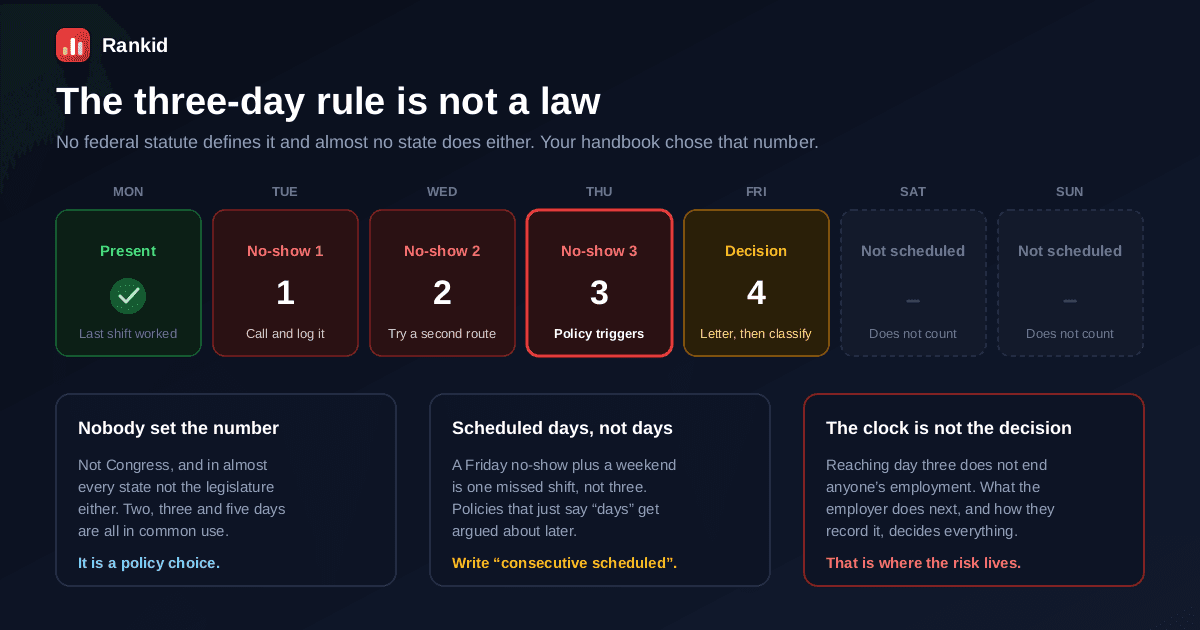
Somebody does not turn up on Tuesday. They do not turn up on Wednesday either, and the phone goes to voicemail. By Thursday the team is covering their work and somebody says the phrase that shows up in every handbook: after three days it counts as job abandonment. It sounds like a rule. It is not one. No statute anywhere sets that number, nothing ends automatically when it is reached, and the decision somebody is about to make in the next five minutes will determine whether this is a clean separation or an expensive one.
Quick answer
Quick answer: job abandonment is when an employee stops attending and does not make contact, and the employer concludes they are not coming back. It is a policy construct, not a legal one. Three consecutive scheduled days is the most common threshold and none is required by law. Nothing happens automatically: the employer must still decide whether to record it as a voluntary quit or an involuntary discharge, and that choice changes unemployment, the final pay deadline and how contestable it is. Make genuine contact attempts first, because some reasons for not showing up are legally protected.
What is job abandonment?
Job abandonment is when an employee stops coming to work, makes no contact, and the employer concludes from that conduct that they do not intend to return. It is normally written into a handbook as a set number of consecutive missed shifts without notice.
The sentence worth memorising is this one: job abandonment is a policy construct, not a legal category. No federal statute defines it, and almost no state defines it for private employers. The number in your handbook was chosen by whoever wrote your handbook.
Which leads to the second thing people get wrong. Nothing happens automatically. Employment does not end by itself on day three. A person is not fired by the calendar. Someone still has to decide, and how they decide, record and communicate it is where all of the consequences live.
One disclaimer, stated plainly
How many days counts as job abandonment?
Three consecutive scheduled work days is the most common answer and the most defensible one. It is not the only one in use, and none of them is required.
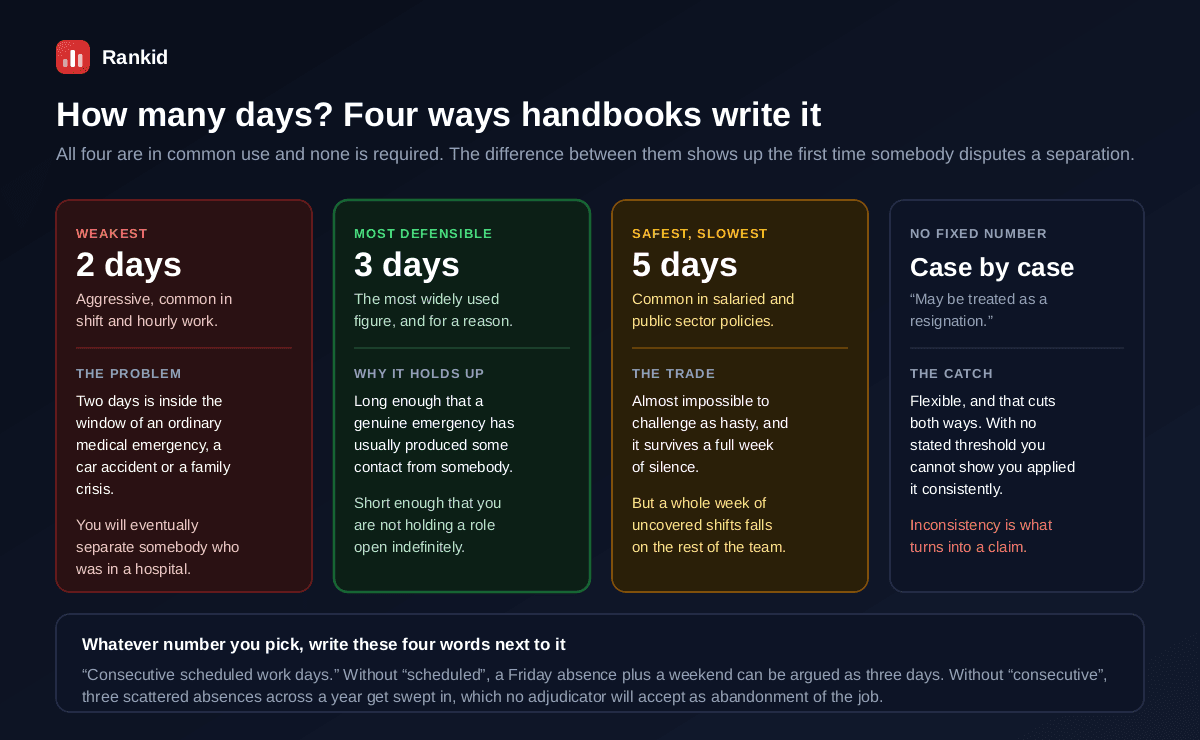
The genuinely important detail is not the number, it is the four words next to it: consecutive scheduled work days. Without scheduled, a Friday absence plus a weekend can be argued as three days, which no adjudicator will accept. Without consecutive, three scattered absences across a year get swept in, which is an attendance problem rather than an abandoned job.
Is it quitting, or being fired?
This is the part almost nobody thinks about, and it is the most consequential decision in the process. The same facts support either label, and the employer picks one. Most pick reflexively.
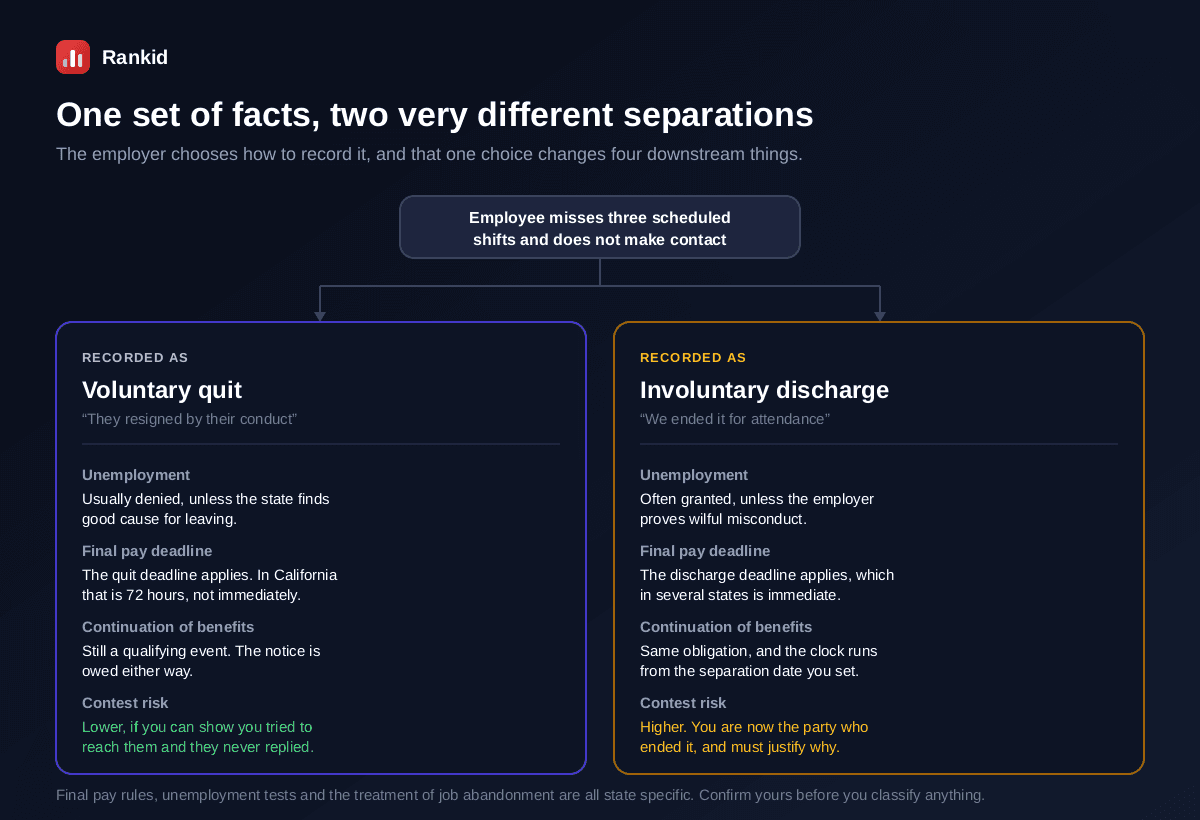
The final pay deadline is where employers most often injure themselves. Having decided this is a voluntary quit, they apply the quit timeline, when the facts might well be characterised as a discharge with a much shorter deadline. In several states, penalties for late final pay are real money, and nobody notices the clock started until it has already run out.
The other trap runs the opposite way. Recording it as a discharge feels honest, and it makes you the party who ended the employment, which means you are the party who has to justify it. Neither label is automatically correct: the point is that it is a decision with consequences, and it should be made deliberately by a named person rather than by whoever is filling in the form.
Is job abandonment illegal?
Separating someone who has genuinely stopped coming to work is not illegal. Separating someone whose absence was legally protected is, and that distinction is the entire answer.
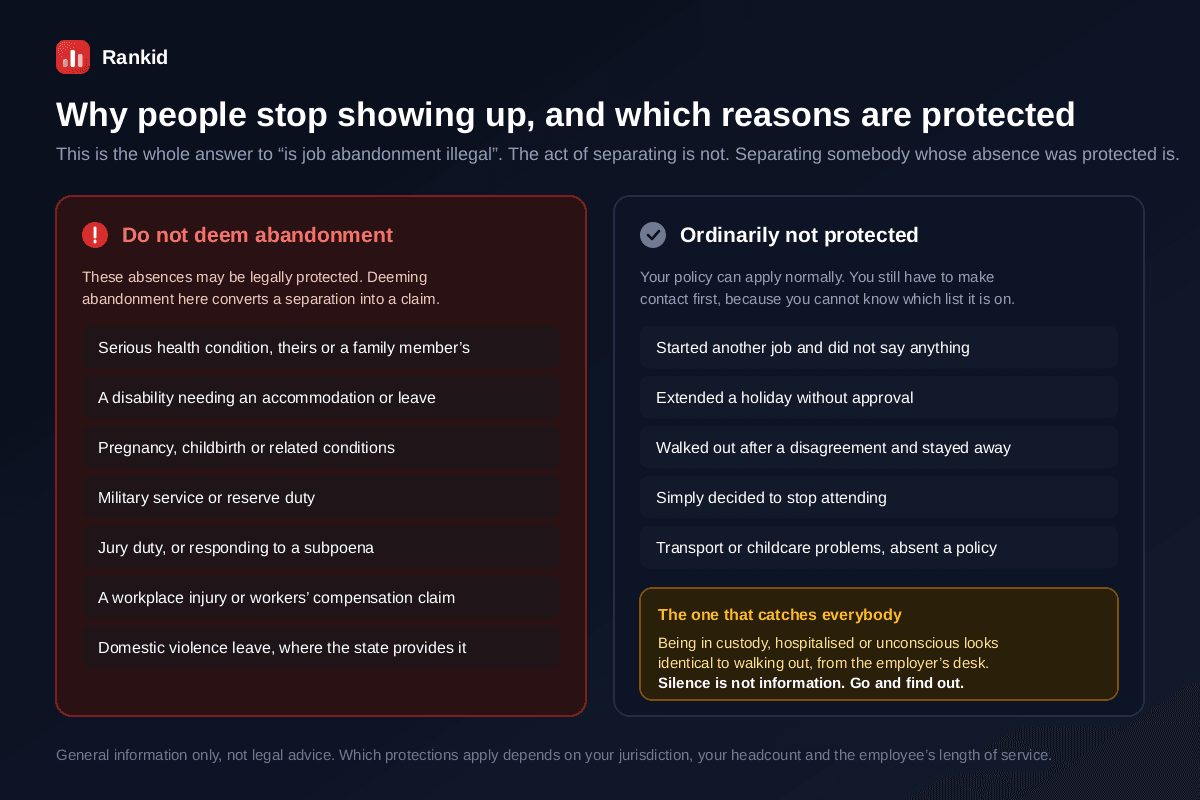
Here is the difficulty, stated honestly: the employer usually cannot tell which column an absence belongs in. Being hospitalised, detained or unconscious looks exactly like walking out when viewed from a desk. Silence contains no information at all.
Which is why the contact protocol is not a courtesy, it is the defence. An employer who made no genuine attempt to find out has no answer to the argument that they should have known. This is the same failure mode as ending someone's employment during a probation period without checking why performance changed: the decision may be defensible, and the process is what makes it so.
What to do before deeming abandonment
Every adjudicator, in every forum, asks the same question afterwards: what did you do to reach them? The right-hand column below is the answer you will need to produce, so create it as you go rather than reconstructing it later.
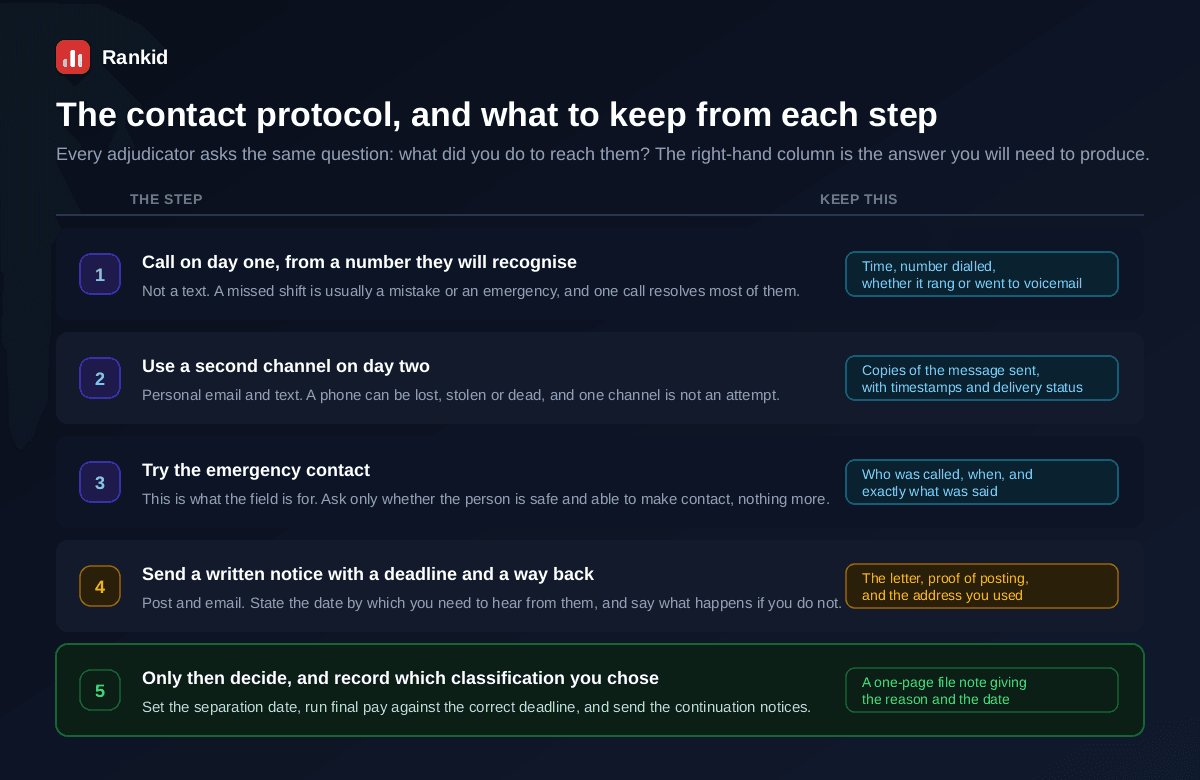
Call on day one, and actually call
Use a second channel on day two
Try the emergency contact
Send a written notice with a deadline and a way back
Only then decide, and write down which decision you made
The job abandonment letter
Five elements. The third is the one most letters leave out, and it is the one that converts a risky separation into a defensible one.
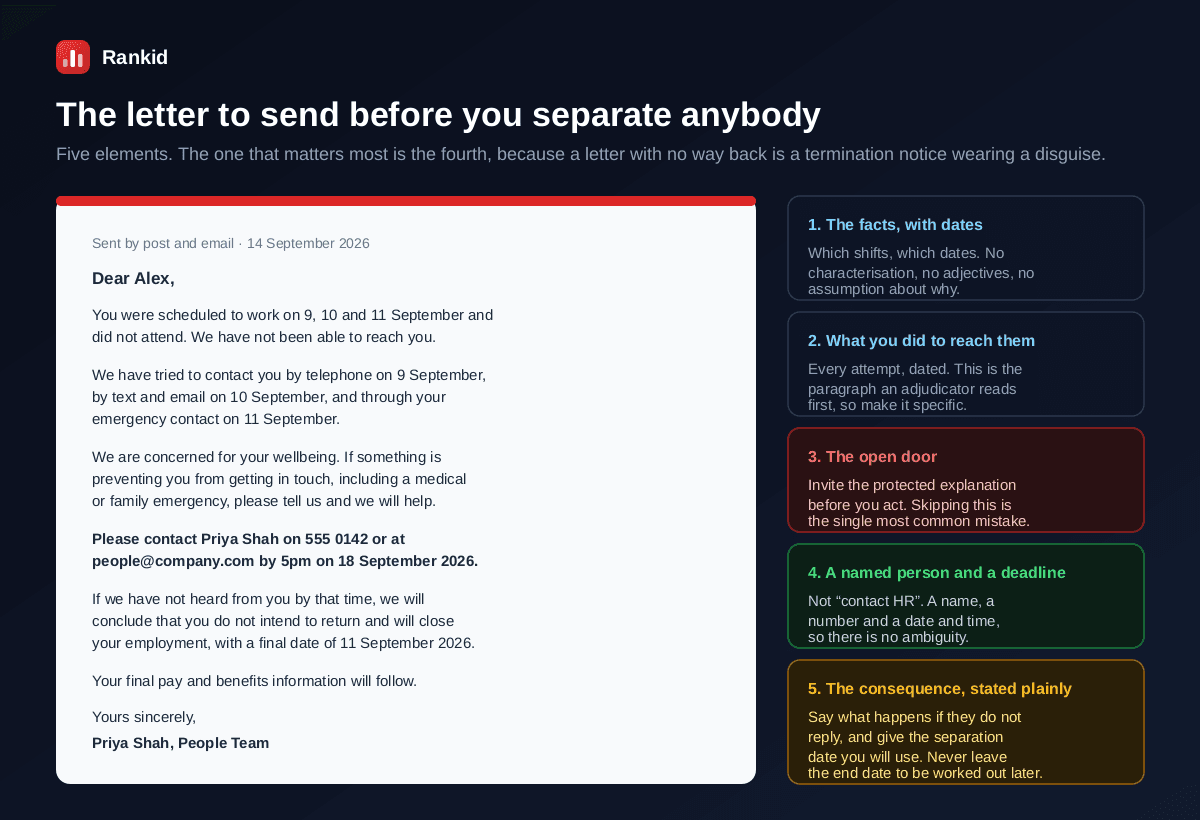
The open door is doing the heavy lifting. By explicitly inviting a medical or family explanation beforeyou act, you convert "the employer should have known" into "the employer asked and got no reply". It costs you two sentences and it is the difference between the two outcomes.
Note also that the letter names the separation date. Never leave that to be worked out later, because it drives the final pay deadline. If this does become a formal termination, our termination letter guide covers what must and must never appear in the written record, and employee offboarding covers the access, asset and final pay steps that follow.
If it happened to you: does it go on your record?
There is no single "record". There are four separate places, they hold different things, and only two can be reached by a future employer. Knowing which is which tells you where to spend your effort.
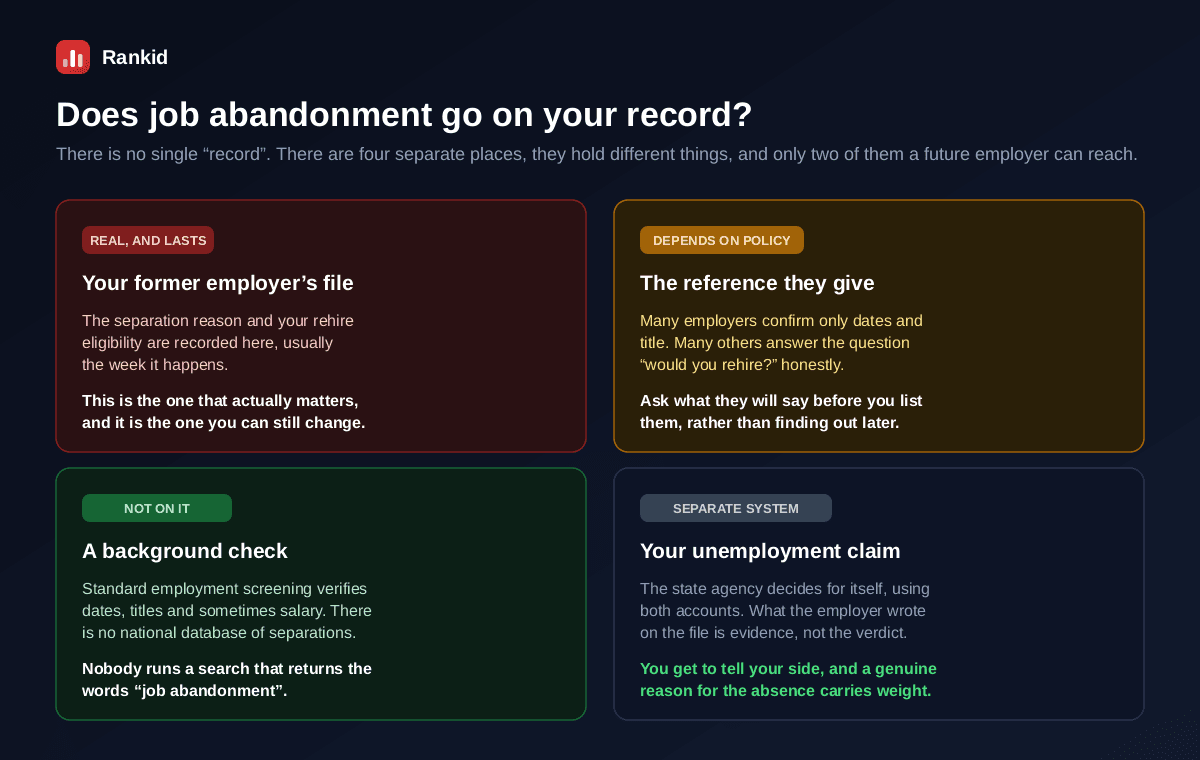
The practical takeaway is that the background check worry is misplaced and the reference and rehire-eligibility flag are the real exposure. Those live in one employer's system, they were set by a person, and a person can change them. That is worth a polite written request now rather than a discovery in two years.
Three things to do, in this order, if you believe the separation was unfair. Write to the employer immediately explaining what prevented you from attending and from making contact, and ask them to reconsider both the separation and its classification. File for unemployment without waiting for their answer, because the label on their form does not decide your claim and the filing deadlines are short. And if the absence was for a protected reason, or the timing followed a complaint you had made, get advice quickly, since those deadlines are measured in months.
When you do apply elsewhere, you will be asked about it. Keep the answer short, factual and forward-looking: our guide to answering "reason for leaving" covers the wording, and explaining employment gaps covers the version that goes on the resume.
Applying again? Check your resume against the job first
Paste your resume and the job description into Rankid. You'll get a 0-100 match score, the skills you've matched, and the exact keywords you're missing, free. A short or messy stint matters less when the match is obvious.
Check your match score freeA no call no show is not the same thing
These get written into the same handbook paragraph and they are different things. A no call no show is a single event: one shift missed without notice. Job abandonment is a conclusion drawn from a run of them, that the person is not coming back.
A single no call no show is an attendance matter that goes down the ordinary route. Treating one absence as a resignation is very difficult to defend, and it is the fact pattern most often reversed. Fix it by stating explicitly in the policy how many consecutive no call no shows trigger the abandonment process, and keeping the two sets of consequences separate. It takes two extra sentences.
Writing a policy that holds up
Most job abandonment policies contain exactly one of the seven things below, which is why they get argued with. The other six cost nothing to add.
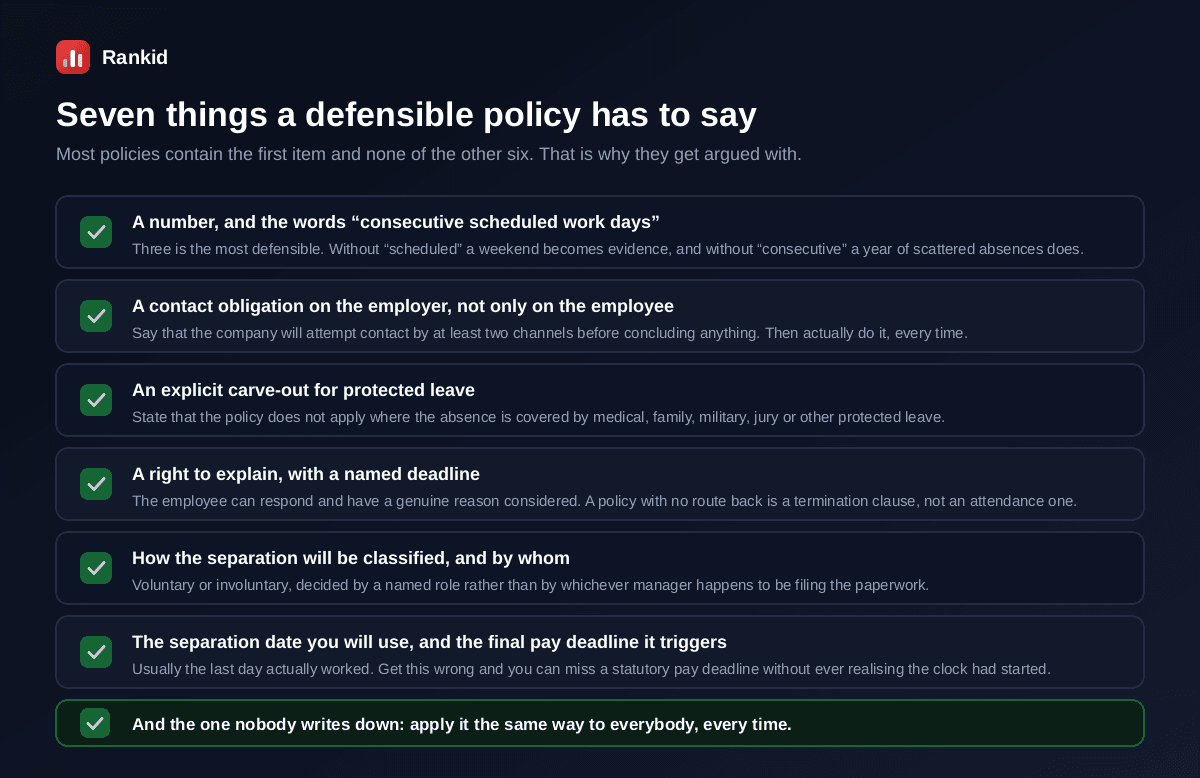
The last one is the one nobody writes down and the one that decides most cases. Inconsistency is what turns a defensible policy into a losing one. If you ran the full protocol for one person and skipped it for another, the difference between them is the only fact anybody will be interested in, and it will not be the policy on trial.
Worth noticing too: a rising number of abandonments is usually a symptom rather than a cause. It clusters in roles with unpredictable scheduling, weak onboarding and managers people do not feel able to call. If it is happening repeatedly in one team, the fix is upstream in onboarding and whether anyone is talking to them, and the cost shows up in first-year turnover and cost per hire long before anyone connects it back.
Backfilling the shift? Screen the shortlist against what the role really needs
Upload the applicants and the job description. Rankid scores every candidate against the actual requirements and shows the evidence behind each score, so an urgent backfill does not become next quarter's no-show. First 5 resumes free, no signup.
Try bulk screening freeFrequently asked questions
What is job abandonment?
Job abandonment is when an employee stops coming to work, does not make contact, and the employer concludes from that conduct that they do not intend to return. It is usually written into a handbook as a set number of consecutive missed shifts without notice, most commonly three. The critical thing to understand is that job abandonment is a policy construct, not a legal category. There is no federal statute defining it and almost no state defines it for private employers either, which means the number in your handbook was chosen by whoever wrote the handbook. Nothing automatic happens when that number is reached. Employment does not end by itself on day three. The employer still has to make a decision, and the decision they make, along with how they record it, determines everything that follows: whether unemployment is payable, which final pay deadline applies, and how easily the whole thing can be challenged later.
How many days is considered job abandonment?
Three consecutive scheduled work days is the most common threshold and the most defensible, but two, five and no fixed number at all are all in ordinary use. None is required by law. Two days is aggressive and sits inside the window of a normal medical emergency, a car accident or a family crisis, which means an employer using it will eventually separate somebody who was in a hospital. Three is long enough that a genuine emergency has usually produced contact from somebody, and short enough that a role is not held open indefinitely. Five is close to unchallengeable as hasty, but a full week of uncovered shifts falls on the rest of the team. A policy with no stated number is flexible in a way that cuts both ways, because without a threshold you cannot demonstrate that you applied it consistently, and inconsistency is what turns a separation into a claim. Whatever number you use, the wording that matters is consecutive scheduled work days. Without scheduled, a Friday absence plus a weekend can be argued as three days.
Is job abandonment voluntary or involuntary?
That is the employer's decision, and it is the single most consequential choice in the whole process. Recording it as a voluntary quit says the employee resigned through their conduct. Recording it as an involuntary discharge says the employer ended the employment for attendance. The same facts support either label, and four things change depending on which one is used. Unemployment: a voluntary quit is usually denied unless the state finds good cause, while a discharge is often granted unless the employer proves wilful misconduct. Final pay deadline: many states set different deadlines for quits and discharges, and in California a discharge is due immediately while a quit without notice is due within 72 hours, so classifying wrongly can cause a missed statutory deadline. Benefit continuation: the notice obligation applies either way, but the clock runs from the separation date chosen. Contest risk: a voluntary quit is easier to defend if you can show real contact attempts that went unanswered, while a discharge makes you the party who ended it and therefore the party who has to justify it.
Is job abandonment illegal?
Separating somebody who has genuinely stopped coming to work is not illegal in itself. Separating somebody whose absence was legally protected is, and that is the real answer to this question. A number of reasons for not showing up carry protection: a serious health condition affecting the employee or a family member, a disability requiring accommodation or leave, pregnancy and related conditions, military or reserve service, jury duty or a subpoena, a workplace injury or workers' compensation claim, and domestic violence leave where a state provides it. If any of those applies, deeming abandonment converts an ordinary separation into a discrimination, retaliation or interference claim. The difficulty is that the employer usually cannot tell which category an absence falls into, because being hospitalised, detained or unconscious looks identical to walking out when viewed from a desk. That is precisely why the contact protocol matters. Silence is not information, and an employer who has made no genuine attempt to find out has no defence to the argument that they should have known.
What should an employer do before deeming job abandonment?
Follow a documented contact protocol, because every adjudicator asks the same question afterwards: what did you do to reach them? Call on day one from a number they will recognise, not a text, since a missed shift is usually a mistake or an emergency and one call resolves most of them. Log the time, the number dialled and whether it rang or went to voicemail. Use a second channel on day two, meaning personal email and text, because a phone can be lost, stolen or dead and one channel is not a genuine attempt. Keep copies with timestamps. Try the emergency contact on day three, which is what that field exists for, and ask only whether the person is safe and able to make contact rather than anything about their circumstances. Then send a written notice by post and email that states the missed dates, lists the contact attempts, invites an explanation, gives a named person and a firm deadline, and says exactly what will happen if there is no reply. Only after that deadline passes should you decide, record which classification you chose, set the separation date and run final pay against the correct statutory deadline.
What should a job abandonment letter say?
Five elements, and the third is the one most letters omit. First, the facts with dates: which shifts were missed and when, stated plainly with no characterisation and no assumption about why. Second, what you did to reach them, listing every attempt with its date, because this is the paragraph an adjudicator reads first. Third, an open door: say you are concerned for their wellbeing and that if something is preventing them from getting in touch, including a medical or family emergency, they should tell you and you will discuss what support is available. This invites the protected explanation before you act, and skipping it is the most common and most expensive mistake in the whole process. Fourth, a named person with a phone number and email, and a specific deadline with a date and a time, rather than a vague instruction to contact HR. Fifth, the consequence stated plainly: what you will conclude if you do not hear from them, and the exact separation date you will use, which is usually the last day actually worked. Never leave the end date to be worked out later, because that date drives the final pay deadline.
Does job abandonment go on your record?
There is no single record, there are four separate places, and only two of them can be reached by a future employer. Your former employer's own file is real and lasting: the separation reason and your rehire eligibility get recorded there, usually within a week, and that is the one that genuinely matters. The reference they give depends entirely on their policy, since many employers confirm only dates and job title while many others will answer the question "would you rehire?" honestly, so it is worth asking what they will say before you list them. A standard background check does not show it: employment screening verifies dates, titles and sometimes salary, and there is no national database of separations that returns the words job abandonment. Your unemployment claim is a separate system entirely, where the state agency reaches its own conclusion using both accounts, so what the employer wrote is evidence rather than the verdict, and you get to give your side.
Can you get unemployment if you were separated for job abandonment?
Sometimes, and it depends on your state and on the facts rather than on the label the employer used. The agency makes its own determination. If the employer recorded it as a voluntary quit, the usual test is whether you had good cause for leaving, and a genuine emergency, a medical issue or unsafe conditions can meet it in many states. If the employer recorded it as a discharge, the usual test is whether your conduct amounted to wilful misconduct, and being unable to attend or unable to make contact for a real reason is generally not the same thing as deliberately disregarding your obligations. Two practical points make a real difference. File anyway rather than assuming you are disqualified, because the label an employer put on a form does not decide your claim. And explain what actually happened, with any documentation you have, since a hospital record, a police report or a phone showing failed calls carries more weight than an assertion. Deadlines for filing and appealing are short, so act quickly.
What should I do if I was separated for job abandonment unfairly?
Move quickly on three fronts. First, contact the employer in writing immediately, explain what prevented you from attending and from getting in touch, and ask them to reconsider the separation and its classification. Many employers will correct a record when given a genuine explanation, particularly where the reason was medical, because the alternative is a claim they would rather not have. Second, file for unemployment without waiting for that answer, and give the agency your side with any documentation. Third, look at the reason itself: if the absence was for a protected reason such as a serious health condition, a disability, pregnancy, military service or jury duty, or if the timing followed a complaint you had made, get advice from an employment lawyer promptly, because filing deadlines for those claims are measured in months rather than years. Separately, ask what the employer will say to future reference requests and what your rehire eligibility was recorded as, since that is the part which follows you and it is far easier to correct now than in two years.
Is a no call no show the same as job abandonment?
No, and conflating them is where a lot of policies go wrong. A no call no show is a single event: one scheduled shift missed with no notice. Job abandonment is a conclusion drawn from a pattern of them, that the person does not intend to return at all. A single no call no show is an attendance matter that normally goes down the ordinary disciplinary route, and treating one absence as abandonment is very difficult to defend. The relationship between them should be written into the policy explicitly: state how many consecutive no call no shows trigger the abandonment process, and keep the two sets of consequences separate. Most handbooks describe them in the same paragraph without distinguishing them, which produces the situation where a manager treats a single missed shift as a resignation. That is the fact pattern that most often ends up being reversed, and it is entirely avoidable with two extra sentences.
Does job abandonment affect your final paycheck?
It affects the deadline rather than the amount. You are owed all wages for time actually worked regardless of how you left, plus overtime, and plus accrued unused vacation in states that treat it as earned wages. What changes is when it must be paid, because many states set different deadlines for employees who quit and employees who are discharged, and the classification the employer chose determines which one applies. This is where employers most often trip themselves up: having recorded the separation as a voluntary quit, they apply the quit timeline, when the facts might well be characterised as a discharge with a much shorter deadline, and penalties for late final pay are meaningful in several states. Two further points. Deductions for unreturned equipment are restricted or prohibited in many states, so an employer generally cannot withhold a final paycheck because a uniform or a laptop has not come back. And the separation date drives everything, so it should be recorded deliberately rather than assumed.
How do you write a job abandonment policy that holds up?
Seven elements. A number with the words consecutive scheduled work days attached, because without scheduled a weekend becomes evidence and without consecutive a year of scattered absences does. A contact obligation on the employer, not only on the employee, committing the company to attempt contact through at least two channels before concluding anything. An explicit carve-out stating the policy does not apply where the absence is covered by medical, family, military, jury or other protected leave. A right to explain, with a named deadline, so the employee can respond and have a genuine reason considered, since a policy with no route back is a termination clause rather than an attendance one. A statement of how the separation will be classified and by whom, decided by a named role rather than by whichever manager is filing the paperwork. The separation date you will use and the final pay deadline it triggers. And the one nobody writes down: apply it the same way to everybody, every time, because inconsistency is what turns a defensible policy into a losing case.
Key takeaways
- Job abandonment is a policy construct, not a legal category. No federal statute defines it and almost no state does either, so the number in your handbook was a choice.
- Nothing happens automatically at day three. Employment does not end by itself, and somebody still has to decide.
- Three consecutive scheduled work days is the most defensible threshold. The four words that matter more than the number are 'consecutive scheduled work days'.
- Voluntary quit or involuntary discharge is the employer's call, and it changes unemployment eligibility, the final pay deadline, and how contestable the separation is.
- Separating somebody is not illegal. Separating somebody whose absence was protected by medical, family, military, jury or injury leave is.
- The employer cannot tell which reason applies from silence. That is why the contact protocol is the defence, not a courtesy.
- The letter needs an open door: invite a medical or family explanation before you act. It costs two sentences and it decides most disputes.
- It does not appear on a standard background check. The real exposure is the former employer's file and the rehire eligibility flag, both of which a person can change.
- A single no call no show is not abandonment. Write the relationship between the two into the policy explicitly.
- Apply the policy the same way every time. Inconsistency, not the policy, is what loses these cases.
Frequently asked questions
What is job abandonment?
Job abandonment is when an employee stops coming to work, does not make contact, and the employer concludes from that conduct that they do not intend to return. It is usually written into a handbook as a set number of consecutive missed shifts without notice, most commonly three. The critical thing to understand is that job abandonment is a policy construct, not a legal category. There is no federal statute defining it and almost no state defines it for private employers either, which means the number in your handbook was chosen by whoever wrote the handbook. Nothing automatic happens when that number is reached. Employment does not end by itself on day three. The employer still has to make a decision, and the decision they make, along with how they record it, determines everything that follows: whether unemployment is payable, which final pay deadline applies, and how easily the whole thing can be challenged later.
How many days is considered job abandonment?
Three consecutive scheduled work days is the most common threshold and the most defensible, but two, five and no fixed number at all are all in ordinary use. None is required by law. Two days is aggressive and sits inside the window of a normal medical emergency, a car accident or a family crisis, which means an employer using it will eventually separate somebody who was in a hospital. Three is long enough that a genuine emergency has usually produced contact from somebody, and short enough that a role is not held open indefinitely. Five is close to unchallengeable as hasty, but a full week of uncovered shifts falls on the rest of the team. A policy with no stated number is flexible in a way that cuts both ways, because without a threshold you cannot demonstrate that you applied it consistently, and inconsistency is what turns a separation into a claim. Whatever number you use, the wording that matters is consecutive scheduled work days. Without scheduled, a Friday absence plus a weekend can be argued as three days.
Is job abandonment voluntary or involuntary?
That is the employer's decision, and it is the single most consequential choice in the whole process. Recording it as a voluntary quit says the employee resigned through their conduct. Recording it as an involuntary discharge says the employer ended the employment for attendance. The same facts support either label, and four things change depending on which one is used. Unemployment: a voluntary quit is usually denied unless the state finds good cause, while a discharge is often granted unless the employer proves wilful misconduct. Final pay deadline: many states set different deadlines for quits and discharges, and in California a discharge is due immediately while a quit without notice is due within 72 hours, so classifying wrongly can cause a missed statutory deadline. Benefit continuation: the notice obligation applies either way, but the clock runs from the separation date chosen. Contest risk: a voluntary quit is easier to defend if you can show real contact attempts that went unanswered, while a discharge makes you the party who ended it and therefore the party who has to justify it.
Is job abandonment illegal?
Separating somebody who has genuinely stopped coming to work is not illegal in itself. Separating somebody whose absence was legally protected is, and that is the real answer to this question. A number of reasons for not showing up carry protection: a serious health condition affecting the employee or a family member, a disability requiring accommodation or leave, pregnancy and related conditions, military or reserve service, jury duty or a subpoena, a workplace injury or workers' compensation claim, and domestic violence leave where a state provides it. If any of those applies, deeming abandonment converts an ordinary separation into a discrimination, retaliation or interference claim. The difficulty is that the employer usually cannot tell which category an absence falls into, because being hospitalised, detained or unconscious looks identical to walking out when viewed from a desk. That is precisely why the contact protocol matters. Silence is not information, and an employer who has made no genuine attempt to find out has no defence to the argument that they should have known.
What should an employer do before deeming job abandonment?
Follow a documented contact protocol, because every adjudicator asks the same question afterwards: what did you do to reach them? Call on day one from a number they will recognise, not a text, since a missed shift is usually a mistake or an emergency and one call resolves most of them. Log the time, the number dialled and whether it rang or went to voicemail. Use a second channel on day two, meaning personal email and text, because a phone can be lost, stolen or dead and one channel is not a genuine attempt. Keep copies with timestamps. Try the emergency contact on day three, which is what that field exists for, and ask only whether the person is safe and able to make contact rather than anything about their circumstances. Then send a written notice by post and email that states the missed dates, lists the contact attempts, invites an explanation, gives a named person and a firm deadline, and says exactly what will happen if there is no reply. Only after that deadline passes should you decide, record which classification you chose, set the separation date and run final pay against the correct statutory deadline.
What should a job abandonment letter say?
Five elements, and the third is the one most letters omit. First, the facts with dates: which shifts were missed and when, stated plainly with no characterisation and no assumption about why. Second, what you did to reach them, listing every attempt with its date, because this is the paragraph an adjudicator reads first. Third, an open door: say you are concerned for their wellbeing and that if something is preventing them from getting in touch, including a medical or family emergency, they should tell you and you will discuss what support is available. This invites the protected explanation before you act, and skipping it is the most common and most expensive mistake in the whole process. Fourth, a named person with a phone number and email, and a specific deadline with a date and a time, rather than a vague instruction to contact HR. Fifth, the consequence stated plainly: what you will conclude if you do not hear from them, and the exact separation date you will use, which is usually the last day actually worked. Never leave the end date to be worked out later, because that date drives the final pay deadline.
Does job abandonment go on your record?
There is no single record, there are four separate places, and only two of them can be reached by a future employer. Your former employer's own file is real and lasting: the separation reason and your rehire eligibility get recorded there, usually within a week, and that is the one that genuinely matters. The reference they give depends entirely on their policy, since many employers confirm only dates and job title while many others will answer the question "would you rehire?" honestly, so it is worth asking what they will say before you list them. A standard background check does not show it: employment screening verifies dates, titles and sometimes salary, and there is no national database of separations that returns the words job abandonment. Your unemployment claim is a separate system entirely, where the state agency reaches its own conclusion using both accounts, so what the employer wrote is evidence rather than the verdict, and you get to give your side.
Can you get unemployment if you were separated for job abandonment?
Sometimes, and it depends on your state and on the facts rather than on the label the employer used. The agency makes its own determination. If the employer recorded it as a voluntary quit, the usual test is whether you had good cause for leaving, and a genuine emergency, a medical issue or unsafe conditions can meet it in many states. If the employer recorded it as a discharge, the usual test is whether your conduct amounted to wilful misconduct, and being unable to attend or unable to make contact for a real reason is generally not the same thing as deliberately disregarding your obligations. Two practical points make a real difference. File anyway rather than assuming you are disqualified, because the label an employer put on a form does not decide your claim. And explain what actually happened, with any documentation you have, since a hospital record, a police report or a phone showing failed calls carries more weight than an assertion. Deadlines for filing and appealing are short, so act quickly.
What should I do if I was separated for job abandonment unfairly?
Move quickly on three fronts. First, contact the employer in writing immediately, explain what prevented you from attending and from getting in touch, and ask them to reconsider the separation and its classification. Many employers will correct a record when given a genuine explanation, particularly where the reason was medical, because the alternative is a claim they would rather not have. Second, file for unemployment without waiting for that answer, and give the agency your side with any documentation. Third, look at the reason itself: if the absence was for a protected reason such as a serious health condition, a disability, pregnancy, military service or jury duty, or if the timing followed a complaint you had made, get advice from an employment lawyer promptly, because filing deadlines for those claims are measured in months rather than years. Separately, ask what the employer will say to future reference requests and what your rehire eligibility was recorded as, since that is the part which follows you and it is far easier to correct now than in two years.
Is a no call no show the same as job abandonment?
No, and conflating them is where a lot of policies go wrong. A no call no show is a single event: one scheduled shift missed with no notice. Job abandonment is a conclusion drawn from a pattern of them, that the person does not intend to return at all. A single no call no show is an attendance matter that normally goes down the ordinary disciplinary route, and treating one absence as abandonment is very difficult to defend. The relationship between them should be written into the policy explicitly: state how many consecutive no call no shows trigger the abandonment process, and keep the two sets of consequences separate. Most handbooks describe them in the same paragraph without distinguishing them, which produces the situation where a manager treats a single missed shift as a resignation. That is the fact pattern that most often ends up being reversed, and it is entirely avoidable with two extra sentences.
Does job abandonment affect your final paycheck?
It affects the deadline rather than the amount. You are owed all wages for time actually worked regardless of how you left, plus overtime, and plus accrued unused vacation in states that treat it as earned wages. What changes is when it must be paid, because many states set different deadlines for employees who quit and employees who are discharged, and the classification the employer chose determines which one applies. This is where employers most often trip themselves up: having recorded the separation as a voluntary quit, they apply the quit timeline, when the facts might well be characterised as a discharge with a much shorter deadline, and penalties for late final pay are meaningful in several states. Two further points. Deductions for unreturned equipment are restricted or prohibited in many states, so an employer generally cannot withhold a final paycheck because a uniform or a laptop has not come back. And the separation date drives everything, so it should be recorded deliberately rather than assumed.
How do you write a job abandonment policy that holds up?
Seven elements. A number with the words consecutive scheduled work days attached, because without scheduled a weekend becomes evidence and without consecutive a year of scattered absences does. A contact obligation on the employer, not only on the employee, committing the company to attempt contact through at least two channels before concluding anything. An explicit carve-out stating the policy does not apply where the absence is covered by medical, family, military, jury or other protected leave. A right to explain, with a named deadline, so the employee can respond and have a genuine reason considered, since a policy with no route back is a termination clause rather than an attendance one. A statement of how the separation will be classified and by whom, decided by a named role rather than by whichever manager is filing the paperwork. The separation date you will use and the final pay deadline it triggers. And the one nobody writes down: apply it the same way to everybody, every time, because inconsistency is what turns a defensible policy into a losing case.