Probation Period at Work: What It Means, the 90-Day Rule, and What Happens If You Fail (2026)
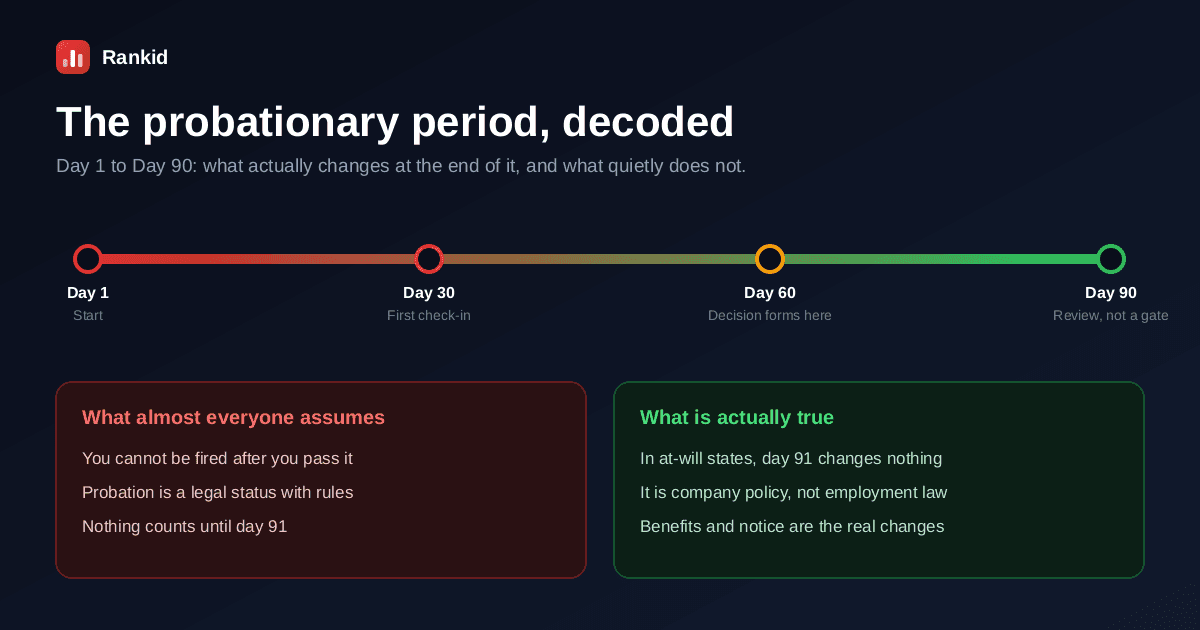
Ask ten people what happens when you pass your probation period and nine will tell you some version of the same thing: that you become permanent, that you are harder to fire, that you have finally landed. In most of the United States, none of that is true. Day 91 carries exactly the same job security as day 89. The probationary period is real, and it does change some genuinely important things, but almost nobody can name which ones.
Quick answer
Quick answer: a probation period is a defined assessment window at the start of a job, usually 90 days in the US and three to six months elsewhere. It is company policy, not employment law. Passing it does change your benefits eligibility, your notice period outside the US, your internal mobility, and the process an employer follows before an exit. It does not change your at-will status, your protection from discrimination, your right to be paid correctly, or your unemployment eligibility. All of those applied from hour one.
What is a probation period?
A probation period, also written as a probationary period and increasingly called an introductory period, is a defined stretch at the start of a job during which the employer formally assesses whether the hire was the right one. Ninety days is the most common length. The assessment runs in both directions, whether or not the employer says so: you are deciding about them at the same speed they are deciding about you.
The most useful sentence in this entire article is this one: probation is a company policy, not a legal status. It comes from your handbook or your contract, not from a statute. That is why two people doing identical jobs on the same street can have completely different probationary rules, and why almost every general claim about "what happens during probation" is wrong somewhere.
In the United States there is no statutory probation at all. The famous 90-day figure is not a legal threshold, it is borrowed from health plan waiting periods, and it stuck because it was already on the calendar. In the United Kingdom, Germany, India and much of Europe, probation is a genuine contractual term with real consequences attached, the biggest being a much shorter notice period on both sides.
One disclaimer, stated plainly
How long is a probation period?
There is no universal answer, and length tracks role complexity more closely than it tracks country. The logic is simple: probation should be long enough to see a full cycle of the actual work. A warehouse role shows itself in three weeks. A finance manager does not show themselves until a month end has closed badly.
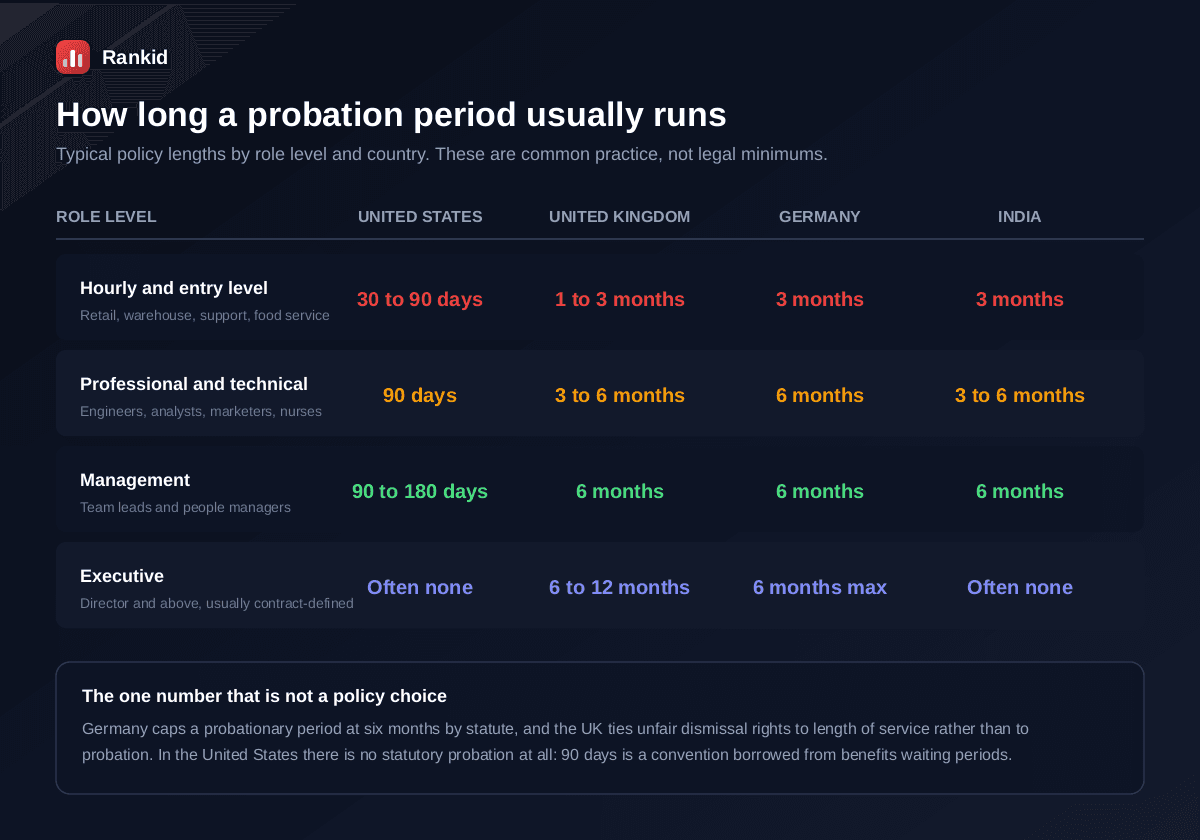
Two of those numbers are not policy choices. Germany caps a probationary period at six months by statute, so a twelve-month German probation is not a strict policy, it is an unenforceable one. And in the United Kingdom, unfair dismissal rights attach to length of service, not to probation status, which means extending someone's probation does not extend the employer's freedom to dismiss them. That surprises a lot of managers who assume the two clocks are the same clock.
A note for anyone reading this while job hunting: if a posting or an offer specifies an unusually long probation for the level, ask what happens at the end of it and what the review looks like. A vague answer is information. Companies that run probation well can describe it in thirty seconds.
What actually changes when probation ends?
This is the part nearly everyone gets backwards. Passing probation feels like crossing a line, and a specific, limited set of things really does change. The rest of what people believe changes was never true at any point.
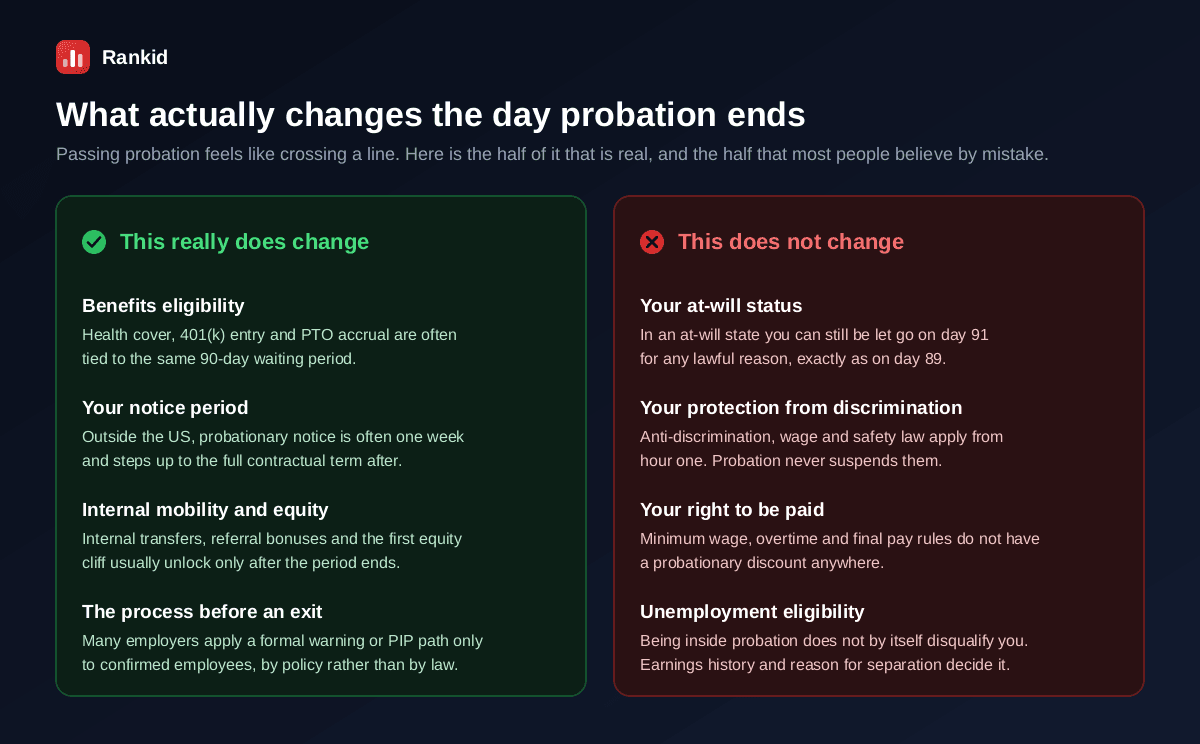
The left column is worth acting on. Benefits eligibility is the one with a real date attached: in the US, the Affordable Care Act limits a group health plan waiting period to 90 days, which is precisely why so many employers set probation and the waiting period to the same number. Retirement plan entry and leave accrual run on their own schedules, sometimes shorter and sometimes considerably longer, so read the benefits summary rather than the handbook chapter on probation. Where the two documents disagree, and they often do, the plan document usually governs.
The right column is worth internalising. Being inside a probationary period does not suspend a single employment protection. Anti-discrimination law, wage and hour law, workplace safety rules and protection from retaliation all apply from your first hour. If you are ever told otherwise during probation, that is not a rule, it is a mistake, and occasionally something worse.
Can you be fired during a probation period?
Yes. And in most of the United States, you can equally be fired the day after it ends, which is the sentence that does the real work here. Under at-will employment, either side can end the relationship at any time for any lawful reason, and a probationary period does not create a gate that closes behind you.
What often does change is process rather than rights. Many employers apply their formal warning or improvement plan path only to confirmed employees, so an exit during probation moves faster and carries lighter documentation. That is a policy choice, and the employer can vary it. It is not a protection that vests.
Outside the United States the difference is real rather than procedural. In the UK, Germany and India, dismissal during probation typically needs only the short probationary notice, while dismissal afterwards requires the full contractual notice and, past the relevant service threshold, engages stronger protections. That is why a probation end date genuinely matters in those markets and matters much less in the US.
The limits that apply everywhere, at every stage: you cannot lawfully be dismissed for a discriminatory reason, for raising a health and safety concern, for taking legally protected leave, or in retaliation for a protected complaint. Probation changes none of that. If a dismissal follows closely on the heels of one of those events, the timing is worth advice regardless of what week of the job you are in.
Can you quit during a probation period?
Yes, and it is usually the cheapest exit you will ever have, because the notice you owe is at its shortest. Outside the US, probationary notice is frequently one week where the full contractual term would be one to three months. Inside the US there is generally no legal notice obligation at all, and two weeks remains the professional custom regardless of how new you are.
If you are applying elsewhere while still inside probation, say so on the application form rather than hiding the short tenure. "1 week while in probation" makes you one of the fastest-available candidates in the pipeline, and recruiters treat availability as a real differentiator. The full set of wordings for that field is in our guide to the notice period and what to write on a job application.
Whether the job goes on your resume is a separate question. A stint under three months can usually be omitted or handled with a dated line, while anything longer is better explained than hidden, and there is a right way to do that: see how to explain employment gaps on your resume and how to answer "reason for leaving". When you do leave, keep the letter short and neutral; our resignation letter templates include a probation version.
The four checkpoints that decide the outcome
This section is written for managers, and it is the part that determines whether a probation period is a genuine assessment or ninety days of hoping. A probation period without written checkpoints does not measure anything. It just runs out.
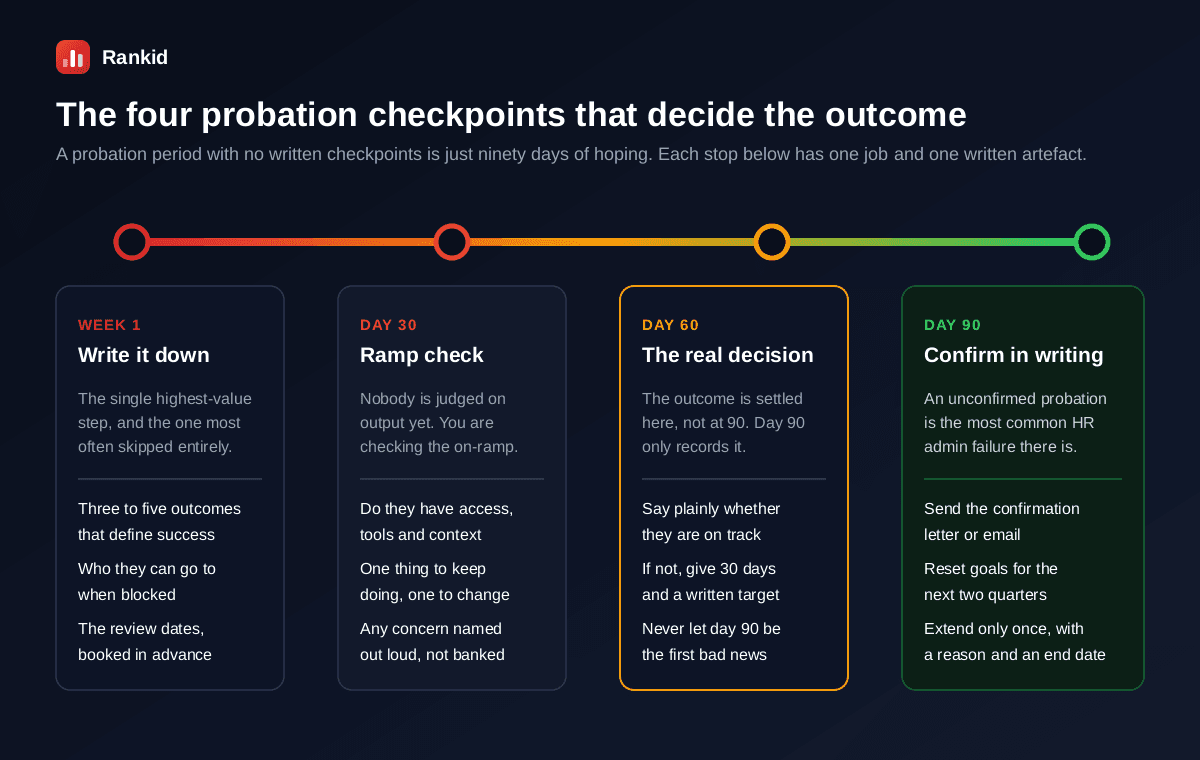
Week one: write the target down
Day 30: check the on-ramp, not the output
Day 60: make the real decision
Day 90: confirm it in writing
If that structure feels familiar, it is the same shape as a 30-60-90 day plan, run from the manager's side of the desk instead of the new hire's. The two documents should agree with each other, and it is worth checking that they do. The review conversations themselves work best inside an existing rhythm of one-on-one meetings rather than as standalone events, and the assessment is far easier when onboarding actually gave the person a fair run at the job.
The handbook wording that quietly undoes at-will employment
Here is the irony at the centre of US probation policy: a badly written probationary clause makes it harderto end someone's employment, not easier. If your handbook promises that employment becomes permanent after 90 days, you have handed a departing employee the argument that something changed on day 91. That is the opposite of what the policy was for.
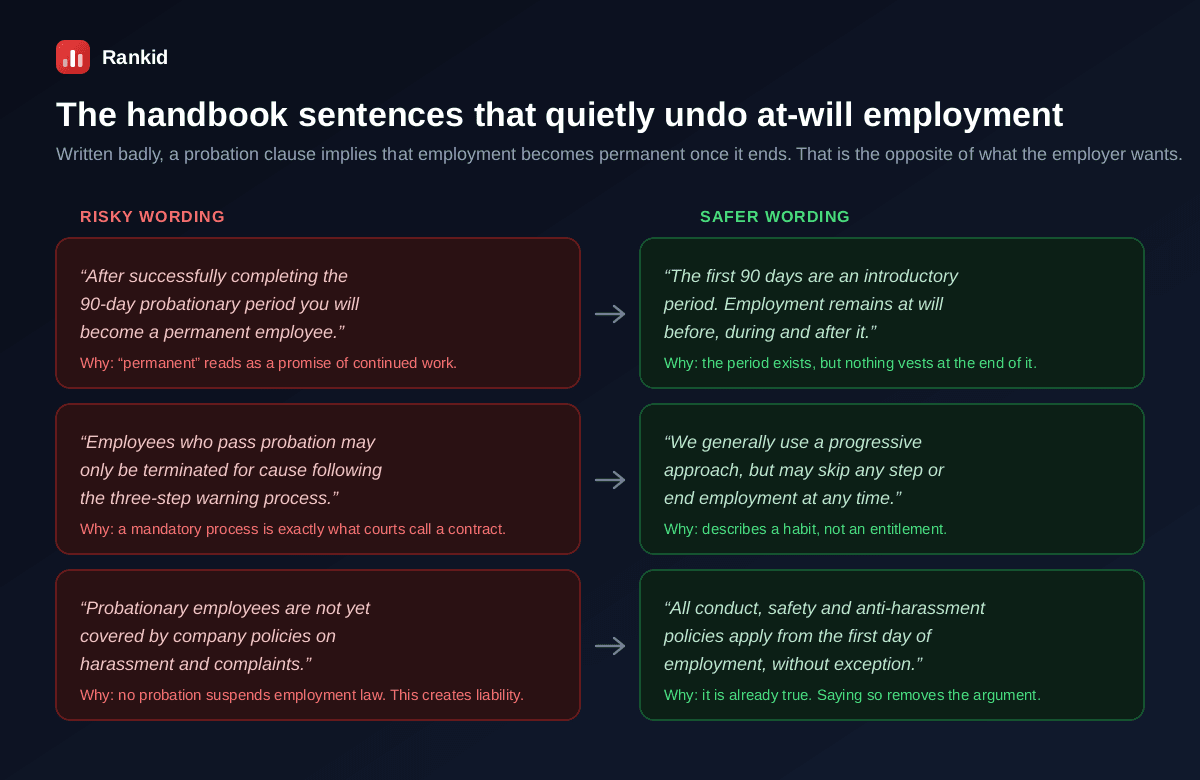
Three rules fix most policies:
- Drop the word "permanent". It reads as a promise of continued employment. Say instead that the employment relationship remains at will before, during and after the introductory period. This is why many employers renamed the whole thing to introductory period in the first place.
- Never make discipline steps mandatory."May only be terminated for cause following the three-step process" describes an entitlement, and an entitlement is what a court calls a contract. Say the company generally uses a progressive approach but may skip any step or end employment at any time.
- Never gate a protection behind probation. Harassment, safety and complaint policies apply from day one whatever your handbook says. Writing that they do not apply yet creates liability and buys you nothing at all.
For the employee reading this section
What to say when ending employment during probation
If day 60 was handled properly this conversation is not a surprise to anyone, which is what makes it survivable. It should take about four minutes. Longer conversations feel kinder while you are planning them and are consistently worse in the room.
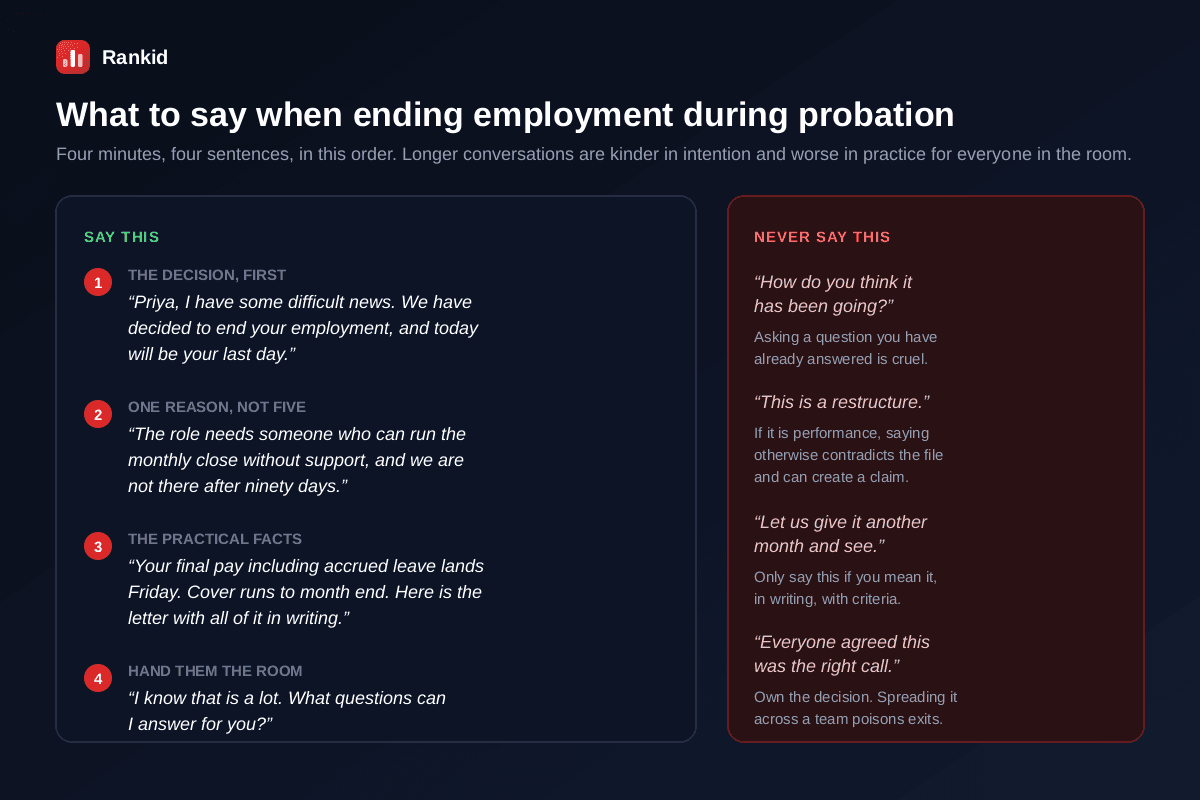
The order matters more than the words. People stop absorbing information seconds after they hear the decision, so anything you say before it is wasted and anything important after it needs to be in the letter as well. Give the letter in the meeting. Our termination letter templates include what must and must never go into one, and severance pay covers what you may owe if the contract or policy provides for it.
One decision to make before you book the meeting: whether to offer resignation instead. It is a real kindness in some cases and a mess in others, since it changes the reason for separation and can affect unemployment claims. Decide with HR beforehand rather than improvising it when the person asks, because you will be asked.
Signs your probation is going wrong, and what to do
Back to the employee's side. Probation rarely fails suddenly. It degrades in a recognisable order, and the earlier you spot the sequence, the cheaper it is to reverse. The most expensive mistake is waiting for someone to tell you formally, because by the time it is formal the decision is largely made.
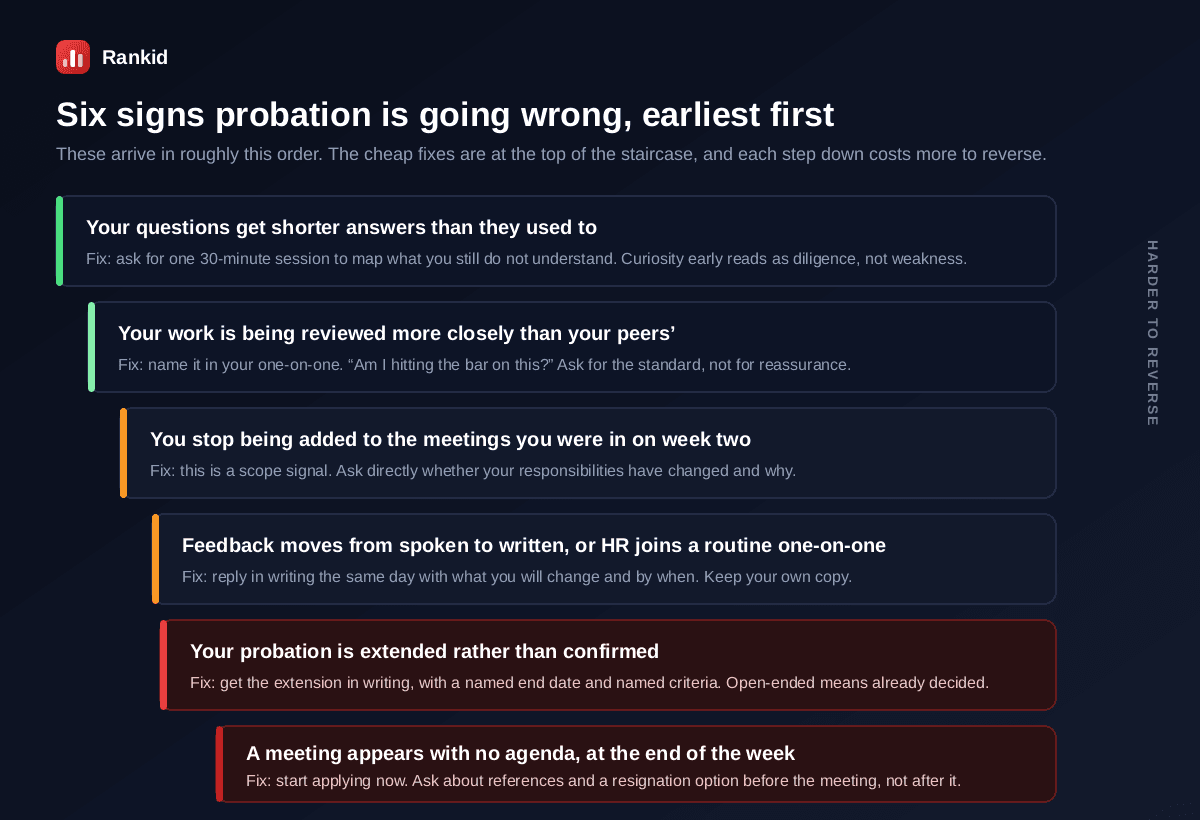
The single highest-value move at any point on that staircase is to ask for the standard rather than for reassurance. "How am I doing?" invites a polite answer that tells you nothing. "What does hitting the bar on this look like by day 90?" produces something you can act on, and it makes you look like the kind of person who wants to be measured. Ask it in a one-on-one, not in front of the team.
If you reach the last two steps, start applying while you still have a job, because the search is materially easier from inside one. Your notice period is short, which is an advantage worth putting in writing on applications, and a resume that is genuinely matched to each posting is the fastest lever you have. If it is being filtered before a human sees it, our guide on why you are not getting interviews covers the usual causes.
Applying again? Check your resume against the job first
Paste your resume and the job description into Rankid. You'll get a 0-100 match score, the skills you've matched, and the exact keywords you're missing, free. Short tenure hurts less when the match is obvious.
Check your match score freeProbation period vs PIP vs onboarding
These three run at the same time, get used interchangeably, and mean entirely different things. That confusion is how a routine check-in gets heard as a warning, and how a genuine warning gets heard as a check-in. Both errors are expensive.
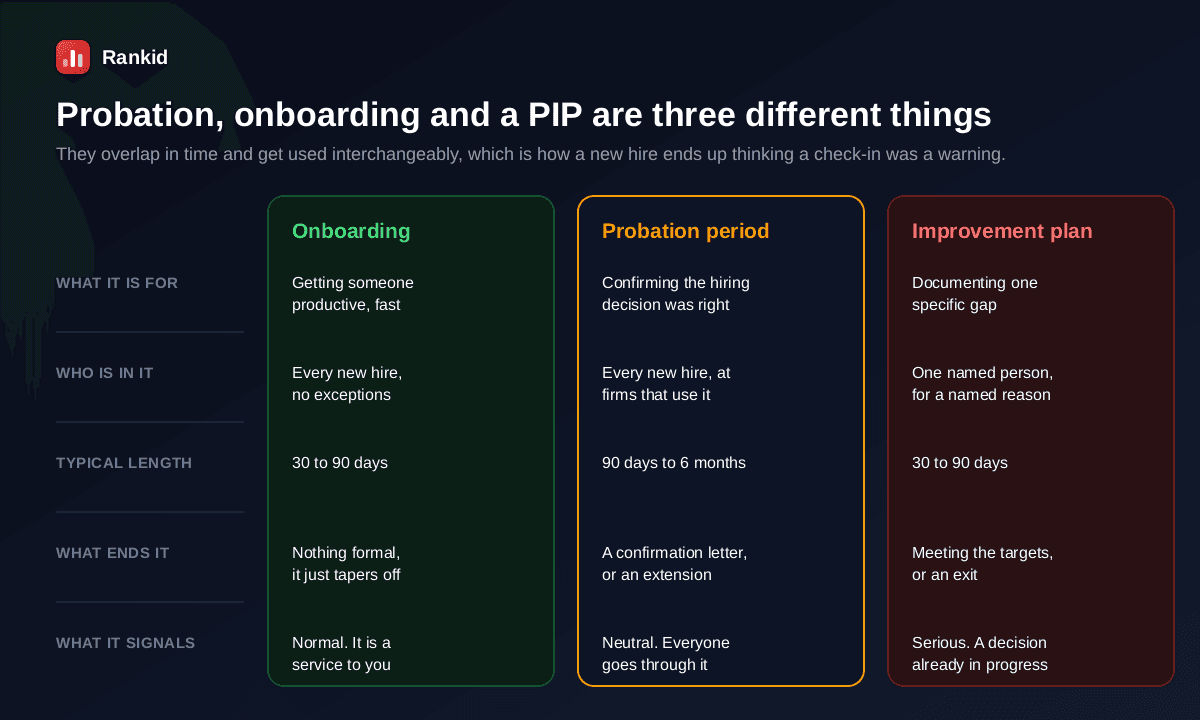
The practical rule for managers: name which one a meeting belongs to before the meeting starts. "This is your day 60 probation review" and "this is a formal conversation about performance" set completely different expectations, and the cost of letting someone guess is that they either panic over nothing or miss a real warning. For the mechanics of the third column, see our guide to the performance improvement plan.
And for the employee: if you are in a probation review, the questions being asked apply to everyone hired that quarter. If you are in a PIP, they apply to you. That is the whole difference, and it is worth asking directly which one you are in if nobody has told you.
The best way to shorten a probation period is to hire better
A probation period is a correction mechanism, and correction mechanisms are expensive. A failed 90-day hire costs the recruiting spend, three months of salary, the manager time, the team disruption and then the whole cycle again. It shows up in cost per hire and in first-year turnover, and if your probation failure rate is climbing, the problem is almost never the probation policy.
The two places it usually is: the screen and the scorecard. If resumes are being read for keywords rather than for evidence, you are optimising for people who write well about the job rather than people who can do it, which is exactly the failure mode that surfaces at day 60. Tightening resume screening criteria and running a consistent interview scorecard catches far more of this than any probationary review can, because it catches it before the person has left their last job.
This is the part Rankid exists for. Scoring every applicant against the actual requirements of the role, rather than against whoever wrote the most confident summary, gives you a shortlist built on evidence. Probation should be confirming a decision you already have good reason to believe in, not conducting the assessment you skipped.
Screen your next shortlist against the real requirements
Upload a batch of resumes and a job description. Rankid scores every candidate against what the role actually needs and shows you the evidence behind each score. First 5 resumes free, no signup.
Try bulk screening freeFrequently asked questions
What is a probation period at work?
A probation period, also called a probationary period or an introductory period, is a defined stretch at the start of a job, most commonly 90 days, during which the employer formally assesses whether the hire was the right one. It is a company policy rather than a legal status. That distinction matters more than anything else in this topic, because it means the rules come from your handbook or your contract, not from a statute, and they vary from employer to employer even within the same city. In the United States there is no statutory probation at all: the familiar 90-day figure is borrowed from benefits waiting periods rather than from employment law. In the United Kingdom, Germany, India and much of Europe, probation is a real contractual term with real consequences attached, most notably a shorter notice period on both sides. What a probation period is not, anywhere, is a suspension of employment law. Anti-discrimination protection, minimum wage, overtime and workplace safety rules apply from your first hour of work.
How long is a probation period?
Ninety days is the most common length in the United States, and three to six months is the norm in the United Kingdom, Germany and India. Length tracks role complexity more than anything else. Hourly and entry-level roles usually run 30 to 90 days because the job can be observed quickly. Professional and technical roles usually run 90 days in the US and three to six months elsewhere, because a full work cycle takes longer to see. Management roles frequently run six months, since you cannot judge a manager until you have seen them handle a real problem with a real person. Executive roles often have no probation at all, replaced by a negotiated contract with its own notice and severance terms. Two hard constraints are worth knowing. Germany caps a probationary period at six months by statute. And in the UK, unfair dismissal rights attach to length of service rather than to probation status, so extending someone's probation does not extend the employer's freedom to dismiss them.
Can you be fired during a probation period?
Yes, and in most of the United States you can equally be fired the day after it ends. This is the single biggest misconception about probation. Under at-will employment, which covers the vast majority of US private-sector jobs, either party can end the relationship at any time for any lawful reason, and passing a probationary period does not change that. What probation genuinely changes at many employers is process rather than rights: a company may apply its formal warning or performance improvement plan path only to confirmed employees, so an exit during probation tends to be faster and lighter on documentation. That is policy, not law. Outside the United States the picture is different and probation carries real weight: in the UK, Germany and India, dismissal during probation typically requires only the short probationary notice, while dismissal afterwards involves longer notice and, past the relevant service threshold, stronger protection. The limits that always apply, everywhere: you cannot be dismissed during probation for a discriminatory reason, for raising a safety concern, for taking legally protected leave or in retaliation for a protected complaint.
What actually changes when you pass your probation period?
Less than most people think, and the parts that do change are worth knowing precisely. Four things genuinely change at many employers. Benefits eligibility, because health cover, retirement plan entry and paid leave accrual are frequently tied to the same 90-day waiting period. Your notice period, which outside the United States is often one week during probation and steps up to the full contractual term after it. Internal mobility and equity, since internal transfers, referral bonuses and a first vesting cliff usually unlock only once you are confirmed. And the process before an exit, where a formal warning or improvement plan path may now apply to you by policy. Four things do not change. Your at-will status in an at-will state. Your protection from discrimination, harassment and retaliation, which applied from hour one. Your right to be paid minimum wage, overtime and correct final pay, none of which has a probationary discount. And your unemployment eligibility, which turns on earnings history and the reason for separation rather than on whether you were inside a probationary window.
Can I quit during my probation period?
Yes, and it is usually the easiest resignation you will ever hand in, because the notice you owe is at its shortest. Outside the United States, probationary notice is frequently one week or even a few days where the full contractual term would be one to three months, so leaving during probation is dramatically cheaper in time than leaving six months later. In the United States there is generally no legal notice obligation at all, and two weeks remains the professional custom regardless of tenure. Two practical points. If you are job hunting while still inside a probationary period, say so plainly on application forms, because a one-week notice period makes you one of the fastest-available candidates in the pipeline and that is a genuine advantage rather than something to hide. And think carefully about whether the role goes on your resume: a stint under three months can usually be omitted or handled with a dated line, while anything longer is better explained than hidden.
What does it mean if my probation period is extended?
It means the employer is not ready to confirm you and is not ready to let you go, and it should always come with two things in writing: a specific end date and specific criteria. An extension with neither is not really an extension, it is a decision that has already been made and has not yet been communicated. Extensions are legitimate when something outside your control interrupted the assessment, such as long-term sickness, a reorganisation, a manager change, or a project that simply had not started when the original window closed. They are a warning sign when the stated reason is vague, when the criteria are qualitative rather than observable, or when nobody had raised a concern with you before the extension appeared. If yours is extended, reply in writing the same week: confirm the new end date, restate the criteria in your own words, and ask for a mid-point check so you find out where you stand before the new deadline rather than on it.
How do you write a probationary period policy without destroying at-will employment?
By describing a period of assessment without promising anything at the end of it. The classic mistake is a sentence like "after successfully completing the 90-day probationary period you will become a permanent employee". In an at-will jurisdiction that wording invites the argument that employment became something other than at-will on day 91, which is the exact opposite of what the employer wanted. Three rules fix most policies. First, avoid "permanent" entirely and say the employment relationship remains at will before, during and after the introductory period. Second, never make your progressive discipline steps mandatory: say the company generally uses them but may skip any step or end employment at any time. Third, never suggest that any policy, particularly harassment, safety or complaint policies, applies only after probation, because they all apply from day one anyway and saying otherwise creates liability for no benefit. Many employers have moved to calling it an introductory period for exactly this reason. Have counsel review the final wording for your jurisdiction.
What should you say when terminating an employee during probation?
Four sentences, in this order, in a meeting that lasts about four minutes. Lead with the decision, not the preamble: "I have some difficult news. We have decided to end your employment, and today will be your last day." Then give one reason, not five, tied to the role rather than to the person: "The role needs someone who can run the monthly close without support, and we are not there after ninety days." Then the practical facts, which are what they will actually remember: final pay date, accrued leave, benefits end date, equipment return, and a letter that repeats all of it in writing. Then hand them the room: "I know that is a lot. What questions can I answer?" Four things to never say. Do not open with "how do you think it has been going", because asking a question you have already answered is cruel. Do not relabel a performance exit as a restructure, because it contradicts your own file and can create a claim. Do not float another month unless you genuinely mean it in writing with criteria. And do not spread the decision across a committee, because owning it is the only version that leaves the person's dignity intact.
Is a probation period the same as a performance improvement plan?
No, and confusing the two is how a routine check-in gets read as a warning. A probation period applies to every new hire at a company that uses them, runs 90 days to six months, exists to confirm that the hiring decision was right, and ends with a confirmation letter or an extension. It is neutral: everyone goes through it. A performance improvement plan applies to one named person for one named reason, runs 30 to 90 days, exists to document a specific gap, and ends either in the targets being met or in an exit. It is not neutral, and it should be read as a decision already in progress. Onboarding is a third thing again: it applies to every new hire without exception, it is a service delivered to you rather than an assessment of you, and it simply tapers off rather than ending formally. The three overlap in time, which is why employers should name which one a meeting belongs to before the meeting starts.
Do you get benefits during a probation period?
Usually some, and often not all, and the overlap between probation and benefits waiting periods is where the 90-day convention comes from in the first place. In the United States, the Affordable Care Act limits a group health plan waiting period to 90 days, which is why so many employers set both the waiting period and the probationary period at exactly that length. Retirement plan entry, paid time off accrual and employer matching frequently follow their own schedules, which may be shorter or considerably longer. What does not wait is pay itself: minimum wage, overtime, and any state-mandated sick leave apply from your first day worked, and a lower "training rate" during probation is lawful only in narrow, specifically defined circumstances. Read the benefits summary rather than the handbook chapter on probation, because the two documents are frequently written by different people and do not always agree. Where they conflict, the plan document usually governs.
Does a probation period affect unemployment benefits?
Not directly. Unemployment eligibility in the United States turns on your earnings during a base period and on the reason for the separation, not on whether you happened to be inside a probationary window. That said, two things about a short tenure matter in practice. You may not have earned enough in the relevant base period to qualify on that job alone, though earnings from previous employers in the same base period usually count toward it. And the stated reason for separation matters: a separation described as not meeting the requirements of a new role is typically treated differently from one described as misconduct. This is state-specific and worth checking with your state agency rather than assuming. If you are let go during probation, ask for the reason for separation in writing before you leave, because that document is the one most likely to matter later.
How should employers run a probation period so it actually works?
Put four checkpoints in the calendar on day one and never let the last one be the first time anyone hears bad news. In week one, write down three to five outcomes that define success, name who the person goes to when blocked, and book the review dates in advance. At day 30, check the on-ramp rather than the output: do they have access, tools and context, one thing to keep doing, one thing to change, and any concern said out loud rather than banked. At day 60, make the real decision, because by then you know, and say plainly whether the person is on track. If they are not, give a written target and 30 days to hit it. At day 90, record the decision you already made: send a confirmation letter, reset goals for the next two quarters, and extend only once, with a reason and an end date. The most common failure in the whole process is administrative rather than managerial: probation periods that quietly lapse because nobody sent the confirmation, leaving the employee's status ambiguous and the employer's position weaker than if they had never had a policy at all.
Key takeaways
- A probation period is company policy, not a legal status. The rules come from your handbook or contract, not from a statute, which is why they differ so widely between employers.
- Ninety days is the US convention, borrowed from health plan waiting periods. Three to six months is normal in the UK, Germany and India, and Germany caps it at six months by statute.
- Passing probation genuinely changes four things: benefits eligibility, your notice period outside the US, internal mobility and equity, and the process before an exit.
- It changes nothing about your at-will status, your protection from discrimination and retaliation, your right to be paid correctly, or your unemployment eligibility. All of those applied from hour one.
- For managers: book week one, day 30, day 60 and day 90 on the calendar upfront. The decision genuinely forms at day 60, and day 90 must never be the first time someone hears bad news.
- Write the policy so nothing vests at the end. Promising that employment becomes permanent after 90 days is the fastest way to weaken the at-will position you were trying to protect.
- Ending employment during probation takes four sentences: the decision, one reason, the practical facts, then the room. Give the letter in the meeting.
- If probation is going wrong, ask for the standard rather than for reassurance, and get any extension in writing with a named end date and named criteria.
Frequently asked questions
What is a probation period at work?
A probation period, also called a probationary period or an introductory period, is a defined stretch at the start of a job, most commonly 90 days, during which the employer formally assesses whether the hire was the right one. It is a company policy rather than a legal status. That distinction matters more than anything else in this topic, because it means the rules come from your handbook or your contract, not from a statute, and they vary from employer to employer even within the same city. In the United States there is no statutory probation at all: the familiar 90-day figure is borrowed from benefits waiting periods rather than from employment law. In the United Kingdom, Germany, India and much of Europe, probation is a real contractual term with real consequences attached, most notably a shorter notice period on both sides. What a probation period is not, anywhere, is a suspension of employment law. Anti-discrimination protection, minimum wage, overtime and workplace safety rules apply from your first hour of work.
How long is a probation period?
Ninety days is the most common length in the United States, and three to six months is the norm in the United Kingdom, Germany and India. Length tracks role complexity more than anything else. Hourly and entry-level roles usually run 30 to 90 days because the job can be observed quickly. Professional and technical roles usually run 90 days in the US and three to six months elsewhere, because a full work cycle takes longer to see. Management roles frequently run six months, since you cannot judge a manager until you have seen them handle a real problem with a real person. Executive roles often have no probation at all, replaced by a negotiated contract with its own notice and severance terms. Two hard constraints are worth knowing. Germany caps a probationary period at six months by statute. And in the UK, unfair dismissal rights attach to length of service rather than to probation status, so extending someone's probation does not extend the employer's freedom to dismiss them.
Can you be fired during a probation period?
Yes, and in most of the United States you can equally be fired the day after it ends. This is the single biggest misconception about probation. Under at-will employment, which covers the vast majority of US private-sector jobs, either party can end the relationship at any time for any lawful reason, and passing a probationary period does not change that. What probation genuinely changes at many employers is process rather than rights: a company may apply its formal warning or performance improvement plan path only to confirmed employees, so an exit during probation tends to be faster and lighter on documentation. That is policy, not law. Outside the United States the picture is different and probation carries real weight: in the UK, Germany and India, dismissal during probation typically requires only the short probationary notice, while dismissal afterwards involves longer notice and, past the relevant service threshold, stronger protection. The limits that always apply, everywhere: you cannot be dismissed during probation for a discriminatory reason, for raising a safety concern, for taking legally protected leave or in retaliation for a protected complaint.
What actually changes when you pass your probation period?
Less than most people think, and the parts that do change are worth knowing precisely. Four things genuinely change at many employers. Benefits eligibility, because health cover, retirement plan entry and paid leave accrual are frequently tied to the same 90-day waiting period. Your notice period, which outside the United States is often one week during probation and steps up to the full contractual term after it. Internal mobility and equity, since internal transfers, referral bonuses and a first vesting cliff usually unlock only once you are confirmed. And the process before an exit, where a formal warning or improvement plan path may now apply to you by policy. Four things do not change. Your at-will status in an at-will state. Your protection from discrimination, harassment and retaliation, which applied from hour one. Your right to be paid minimum wage, overtime and correct final pay, none of which has a probationary discount. And your unemployment eligibility, which turns on earnings history and the reason for separation rather than on whether you were inside a probationary window.
Can I quit during my probation period?
Yes, and it is usually the easiest resignation you will ever hand in, because the notice you owe is at its shortest. Outside the United States, probationary notice is frequently one week or even a few days where the full contractual term would be one to three months, so leaving during probation is dramatically cheaper in time than leaving six months later. In the United States there is generally no legal notice obligation at all, and two weeks remains the professional custom regardless of tenure. Two practical points. If you are job hunting while still inside a probationary period, say so plainly on application forms, because a one-week notice period makes you one of the fastest-available candidates in the pipeline and that is a genuine advantage rather than something to hide. And think carefully about whether the role goes on your resume: a stint under three months can usually be omitted or handled with a dated line, while anything longer is better explained than hidden.
What does it mean if my probation period is extended?
It means the employer is not ready to confirm you and is not ready to let you go, and it should always come with two things in writing: a specific end date and specific criteria. An extension with neither is not really an extension, it is a decision that has already been made and has not yet been communicated. Extensions are legitimate when something outside your control interrupted the assessment, such as long-term sickness, a reorganisation, a manager change, or a project that simply had not started when the original window closed. They are a warning sign when the stated reason is vague, when the criteria are qualitative rather than observable, or when nobody had raised a concern with you before the extension appeared. If yours is extended, reply in writing the same week: confirm the new end date, restate the criteria in your own words, and ask for a mid-point check so you find out where you stand before the new deadline rather than on it.
How do you write a probationary period policy without destroying at-will employment?
By describing a period of assessment without promising anything at the end of it. The classic mistake is a sentence like "after successfully completing the 90-day probationary period you will become a permanent employee". In an at-will jurisdiction that wording invites the argument that employment became something other than at-will on day 91, which is the exact opposite of what the employer wanted. Three rules fix most policies. First, avoid "permanent" entirely and say the employment relationship remains at will before, during and after the introductory period. Second, never make your progressive discipline steps mandatory: say the company generally uses them but may skip any step or end employment at any time. Third, never suggest that any policy, particularly harassment, safety or complaint policies, applies only after probation, because they all apply from day one anyway and saying otherwise creates liability for no benefit. Many employers have moved to calling it an introductory period for exactly this reason. Have counsel review the final wording for your jurisdiction.
What should you say when terminating an employee during probation?
Four sentences, in this order, in a meeting that lasts about four minutes. Lead with the decision, not the preamble: "I have some difficult news. We have decided to end your employment, and today will be your last day." Then give one reason, not five, tied to the role rather than to the person: "The role needs someone who can run the monthly close without support, and we are not there after ninety days." Then the practical facts, which are what they will actually remember: final pay date, accrued leave, benefits end date, equipment return, and a letter that repeats all of it in writing. Then hand them the room: "I know that is a lot. What questions can I answer?" Four things to never say. Do not open with "how do you think it has been going", because asking a question you have already answered is cruel. Do not relabel a performance exit as a restructure, because it contradicts your own file and can create a claim. Do not float another month unless you genuinely mean it in writing with criteria. And do not spread the decision across a committee, because owning it is the only version that leaves the person's dignity intact.
Is a probation period the same as a performance improvement plan?
No, and confusing the two is how a routine check-in gets read as a warning. A probation period applies to every new hire at a company that uses them, runs 90 days to six months, exists to confirm that the hiring decision was right, and ends with a confirmation letter or an extension. It is neutral: everyone goes through it. A performance improvement plan applies to one named person for one named reason, runs 30 to 90 days, exists to document a specific gap, and ends either in the targets being met or in an exit. It is not neutral, and it should be read as a decision already in progress. Onboarding is a third thing again: it applies to every new hire without exception, it is a service delivered to you rather than an assessment of you, and it simply tapers off rather than ending formally. The three overlap in time, which is why employers should name which one a meeting belongs to before the meeting starts.
Do you get benefits during a probation period?
Usually some, and often not all, and the overlap between probation and benefits waiting periods is where the 90-day convention comes from in the first place. In the United States, the Affordable Care Act limits a group health plan waiting period to 90 days, which is why so many employers set both the waiting period and the probationary period at exactly that length. Retirement plan entry, paid time off accrual and employer matching frequently follow their own schedules, which may be shorter or considerably longer. What does not wait is pay itself: minimum wage, overtime, and any state-mandated sick leave apply from your first day worked, and a lower "training rate" during probation is lawful only in narrow, specifically defined circumstances. Read the benefits summary rather than the handbook chapter on probation, because the two documents are frequently written by different people and do not always agree. Where they conflict, the plan document usually governs.
Does a probation period affect unemployment benefits?
Not directly. Unemployment eligibility in the United States turns on your earnings during a base period and on the reason for the separation, not on whether you happened to be inside a probationary window. That said, two things about a short tenure matter in practice. You may not have earned enough in the relevant base period to qualify on that job alone, though earnings from previous employers in the same base period usually count toward it. And the stated reason for separation matters: a separation described as not meeting the requirements of a new role is typically treated differently from one described as misconduct. This is state-specific and worth checking with your state agency rather than assuming. If you are let go during probation, ask for the reason for separation in writing before you leave, because that document is the one most likely to matter later.
How should employers run a probation period so it actually works?
Put four checkpoints in the calendar on day one and never let the last one be the first time anyone hears bad news. In week one, write down three to five outcomes that define success, name who the person goes to when blocked, and book the review dates in advance. At day 30, check the on-ramp rather than the output: do they have access, tools and context, one thing to keep doing, one thing to change, and any concern said out loud rather than banked. At day 60, make the real decision, because by then you know, and say plainly whether the person is on track. If they are not, give a written target and 30 days to hit it. At day 90, record the decision you already made: send a confirmation letter, reset goals for the next two quarters, and extend only once, with a reason and an end date. The most common failure in the whole process is administrative rather than managerial: probation periods that quietly lapse because nobody sent the confirmation, leaving the employee's status ambiguous and the employer's position weaker than if they had never had a policy at all.