Microshifting: What It Is, How It Works, and How to Ask Your Boss for It
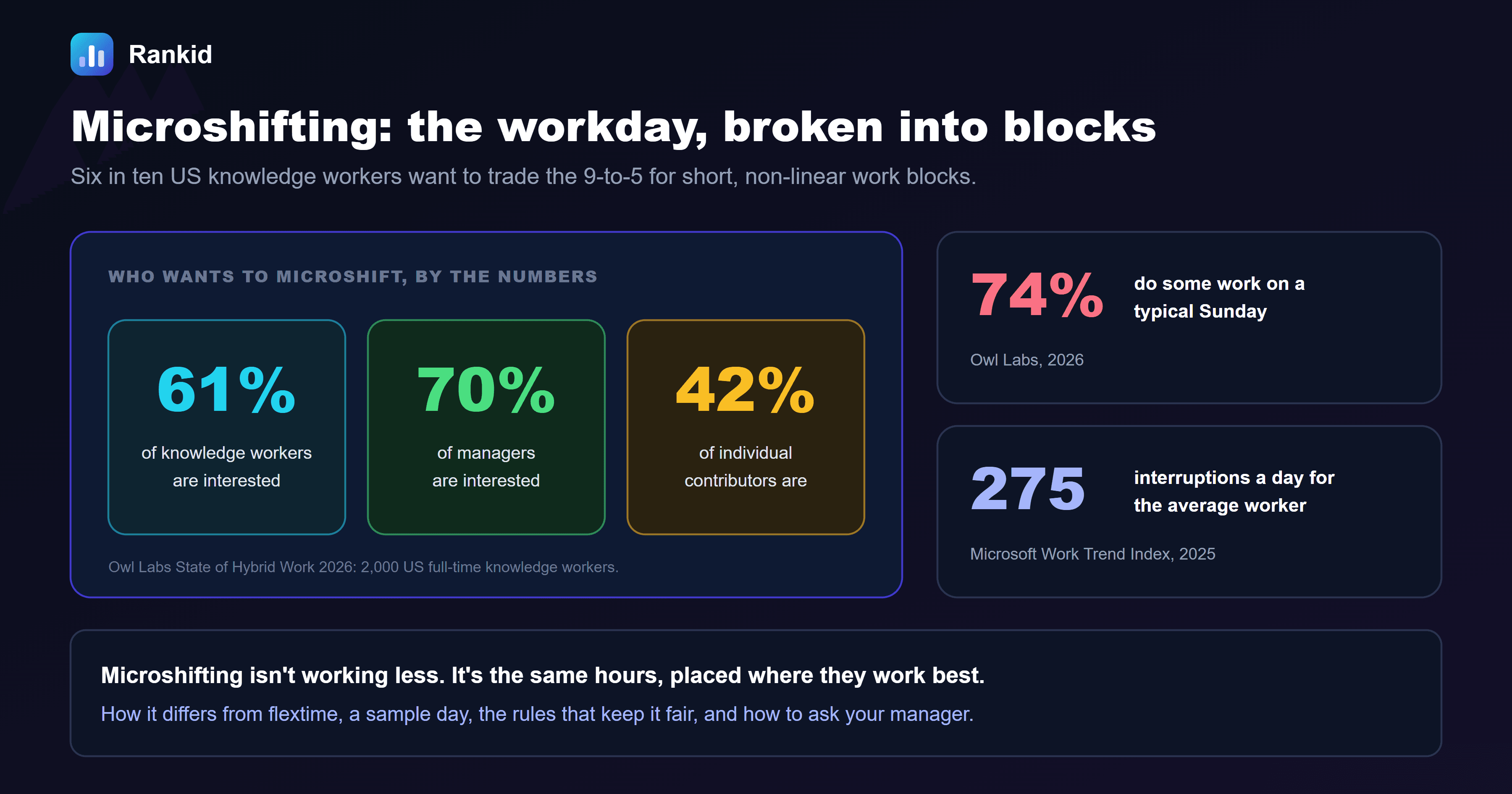
Ask US knowledge workers whether they'd like to break their day into short, flexible blocks, and 61% say yes. The surprise is who says it loudest. Among managers it's 70%. Among the people they manage, 42%. Microshifting is usually described as something employees want and bosses resist. The data says the opposite, and that changes how you should ask for it.
Quick answer
Quick answer: microshifting is working your normal hours in several short blocks spread across the day, with personal time in between, instead of one 9-to-5 stretch. 61% of US knowledge workers are interested (Owl Labs, 2026). It works when you agree core hours, response times and a clear end to the day. It fails when the day simply gets longer. For hourly roles, overtime and split-shift rules still apply.
What is microshifting?
Microshifting means dividing the workday into short, non-linear blocks and fitting them around the rest of your life. Owl Labs, which introduced the term in its 2025 State of Hybrid Work report, defines it as working in short blocks to manage your day around parenting, health, energy levels or your personal productivity.
Three things define it:
- The hours stay the same.It's a full-time job done in pieces, not a reduced schedule.
- The blocks are yours to place. You decide where they go, within limits agreed with your team.
- The gaps are real. Time between blocks is personal time, not time spent half-watching a chat window.
Hybrid work settled the question of where people work. Microshifting is about when. That's why it has grown alongside return-to-office mandates: when location is fixed again, time is the flexibility people have left to ask for.
Microshifting statistics for 2026
The most current figures come from Owl Labs' 2026 State of Hybrid Work report, its tenth annual survey, covering 2,000 full-time knowledge workers in the United States.
- 61% are interested in microshifting. In the 2025 report the figure was 65%, and 72% among caregivers.
- 70% of managers are interested, against 42% of individual contributors.
- Of those interested, 61% are millennials, 22% Gen X, 14% Gen Z and 3% baby boomers.
- 55% of those interested are menand 45% are women, so it isn't only a working-mothers issue.
- 74% do some work on a typical Sunday, and 21% put in a full or nearly full day.
- More than half schedule personal appointments during traditional working hours.
- Nearly half would give up 10% or more of their salary for flexible working hours.
Why managers want it more
What a microshifted day looks like
Here's the same eight hours arranged two ways. The first is the standard day. The second belongs to a parent who does their best thinking early.
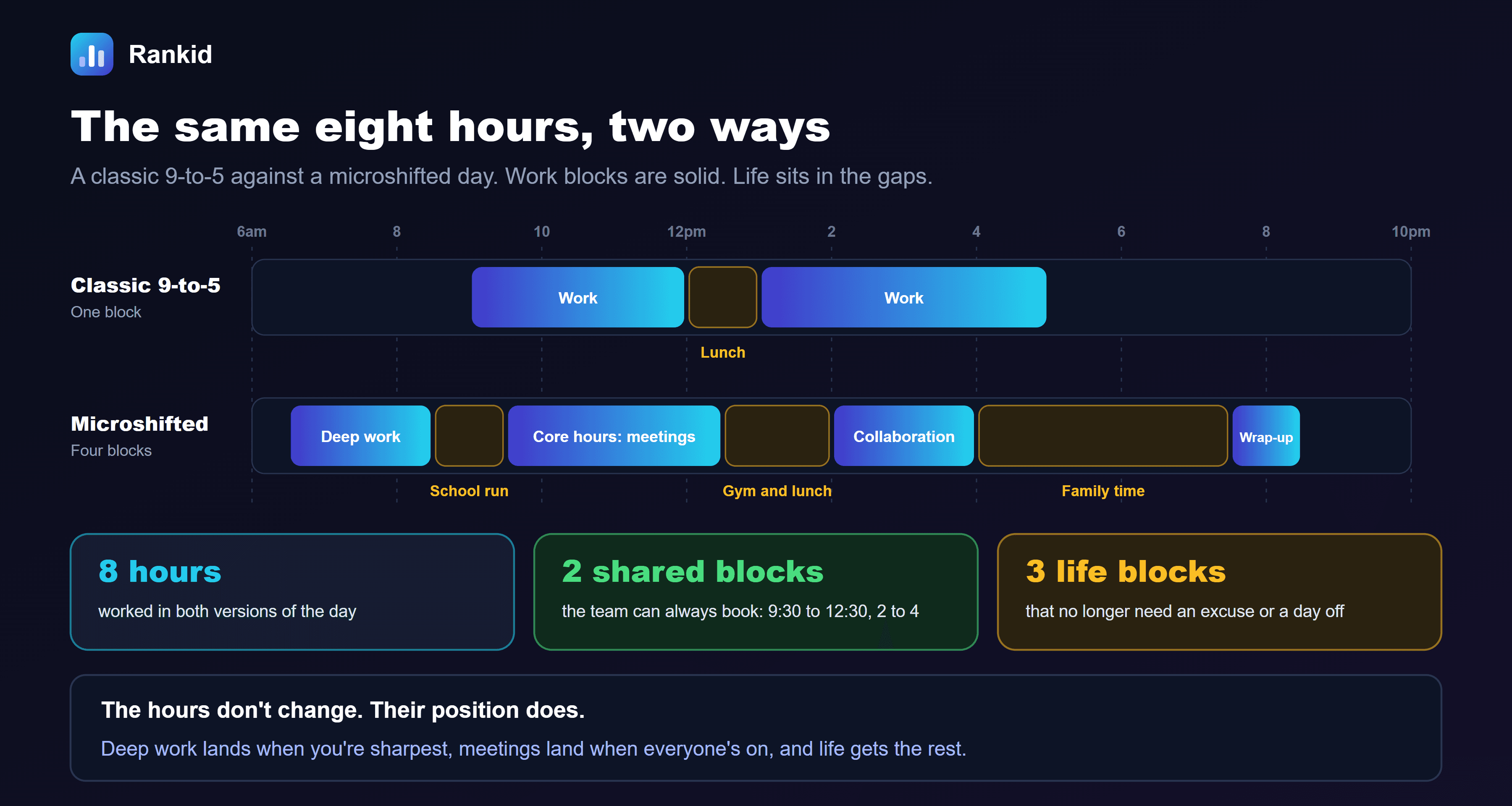
- 6:30 to 8:30am, deep work. Two quiet hours before anyone else is online.
- 8:30 to 9:30am, school run.
- 9:30am to 12:30pm, core hours. Meetings and anything that needs other people.
- 12:30 to 2pm, gym and lunch.
- 2 to 4pm, collaboration. A second block the team can book.
- 4 to 7:30pm, family.
- 7:30 to 8:30pm, wrap-up.Replies, admin, tomorrow's plan. Then the laptop closes.
The two shared blocks are what make this work for everyone else. Colleagues don't need to know your whole day. They need to know when they can reach you.
Microshifting vs flextime, split shifts and a compressed week
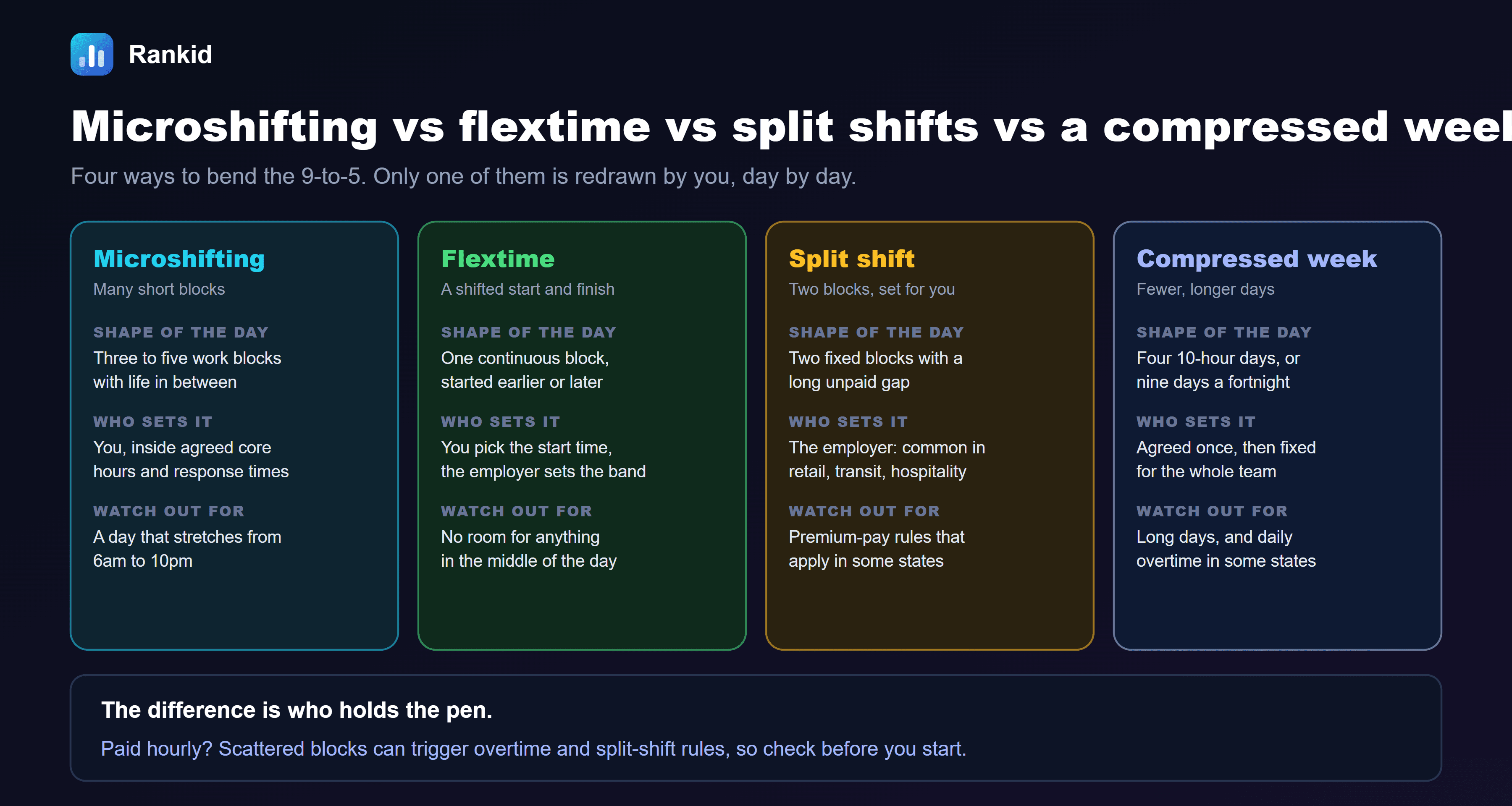
- Flextime shifts one continuous block earlier or later. It helps with a commute or a school drop-off, and does nothing for a 1pm appointment.
- A split shiftis two fixed blocks with a long gap, set by the employer. It serves the business's busy periods, not the worker's life.
- A compressed week packs full-time hours into fewer days. See the four-day work week for how that compares.
- Microshifting is the only one where the employee decides the shape of each day.
The pros and cons of microshifting
What it gets right:
- Work lands when you're sharpest. Hard tasks go in your best hours, not whichever hours are left after meetings.
- Life stops needing excuses. A school play or a physio appointment is a gap in the day, not half a day of leave.
- It costs the employer nothing. No salary, no office space, no new software. And nearly half of workers value flexible hours at 10% of pay or more.
- It protects focus.Microsoft's 2025 Work Trend Index found the average worker is interrupted every two minutes during core hours, about 275 times a day. A block outside those hours is often the only uninterrupted time available.
Where it goes wrong:
- The day stretches instead of splitting.This is the big one. The same Microsoft data shows about 40% of people checking email by 6am, meetings after 8pm up 16% in a year, and roughly a third back in their inbox by 10pm. If you add early and late blocks and keep the middle, you haven't microshifted. You've extended.
- Teams lose overlap. Five people on five patterns can struggle to find one shared hour.
- Visibility drops. In companies that reward presence, being offline at 3pm can be read as absence, whatever you shipped at 7am.
- Too many switches. Six 45-minute blocks are worse than one long one. Most people need at least 90 minutes to get anything substantial done.
The test for a real microshift
Is microshifting legal? What hourly workers should check
For salaried, overtime-exempt employees in the US, there's nothing to check. The law doesn't say when exempt staff must work their hours. For hourly, non-exempt employees, three rules still apply however the day is cut up:
- All time worked must be recorded and paid. A ten-minute reply at 9pm counts.
- Overtime. Federal law requires 1.5 times pay past 40 hours a week. Some states, including California, also count daily hours.
- Split-shift rules. A few states require extra pay when an employer schedules a split shift. A schedule the employee chooses is usually treated differently, but employers tend to want that choice in writing.
Not sure which group you're in? See exempt vs non-exempt. This is general information, not legal advice.
How to ask your manager for a microshifting schedule
Most requests fail because they sound like "can I work whenever I like?" The ones that succeed answer the manager's worries before they're spoken. Put four commitments on one page.
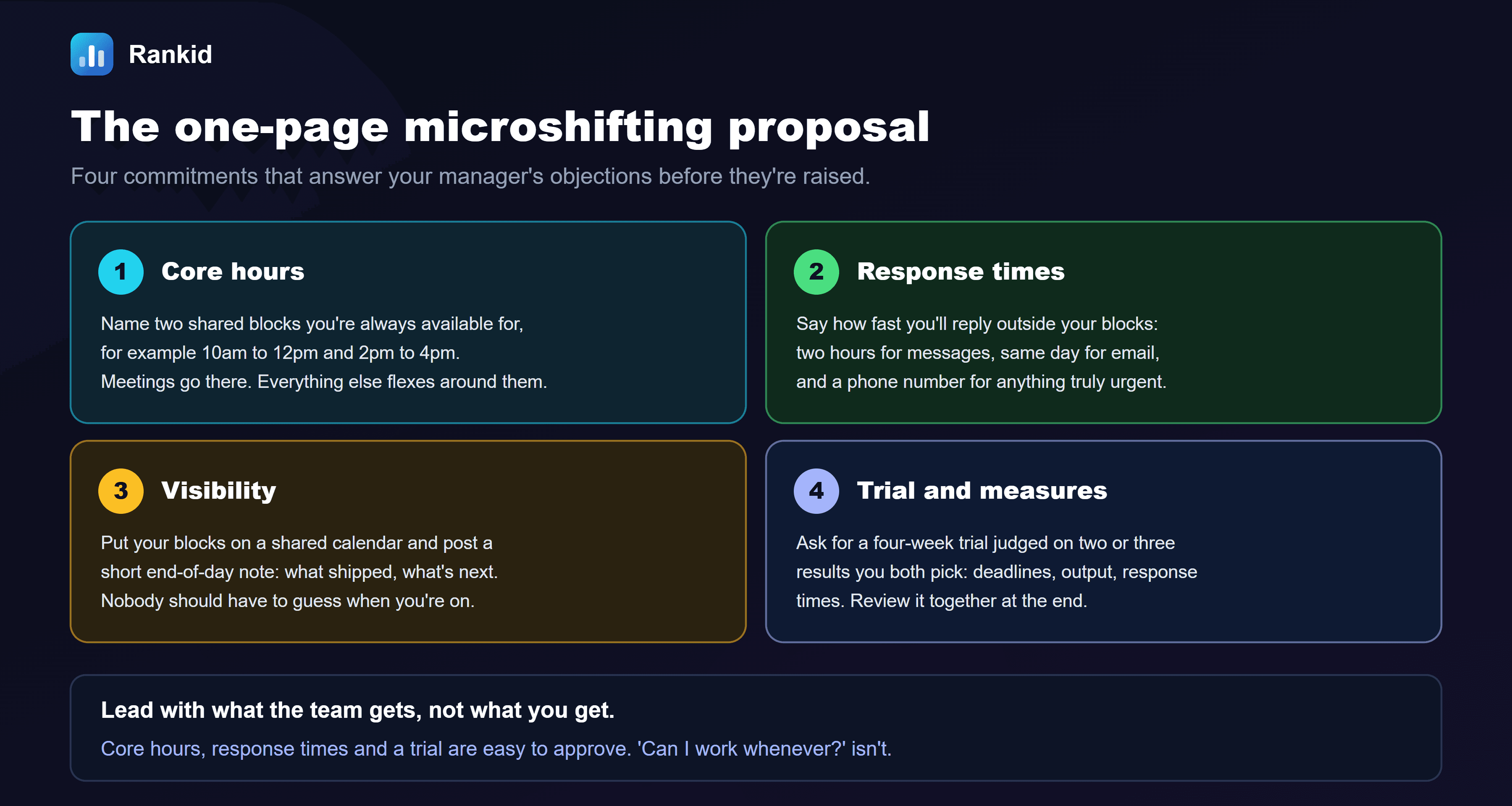
Core hours
Response times
Visibility
A trial with measures
If you're job hunting and schedule control matters to you, ask about it before you accept: what the core hours are, how the team handles meetings across different schedules, and whether anyone on the team already works this way. Add those to your questions to ask in an interview.
Looking for a role with real schedule flexibility?
Paste your resume and the job description. Rankid gives you a free 0-100 match score and shows the exact requirements you meet and miss, so you can focus on the flexible roles you're most likely to land. No signup required.
Check your match score freeFor employers: how to offer microshifting without chaos
Your people are already doing a version of this. More than half book personal appointments in work hours, and three quarters work on Sundays. A policy makes visible what is currently hidden, and it costs nothing.
- Set team core hours. Three or four hours a day when everyone is reachable. Protect them from being nibbled away.
- Measure output, not online status.Agree what done looks like for each role. Green dots aren't results.
- Publish response-time norms. Without them, people stay half-available all day, which defeats the point.
- Cap the day.Say plainly that blocks replace hours and don't add to them. Watch for people whose first and last messages keep drifting apart.
- Offer it evenly.If only managers get to do it, you've created a perk of rank. The 70% to 42% interest gap suggests many individual contributors already assume it isn't for them.
- Handle hourly roles deliberately.Record time accurately, check overtime and split-shift rules, and get the employee's choice of schedule in writing.
- Put it in the job ad. Stated core hours and schedule flexibility are a hiring advantage that most postings leave out. See how to write a job description.
Flexible roles attract a lot of applicants
Rankid scores every applicant against your job description on a consistent 0-100 scale and shows the exact requirements each matched and missed, so a large response doesn't slow you down. First 5 resumes free, no signup.
Try bulk screening freeFrequently asked questions
What is microshifting?
Microshifting is splitting your workday into several short, non-linear blocks instead of one continuous 9-to-5 stretch. You arrange the blocks around your energy, caregiving, health and other commitments, and you still work the same total hours. A typical microshifted day might be two hours of focused work early in the morning, a block of meetings mid-morning, a collaboration block in the afternoon and a short wrap-up in the evening. Owl Labs introduced the term in its 2025 State of Hybrid Work report.
How popular is microshifting?
In Owl Labs' 2026 State of Hybrid Work report, a survey of 2,000 US full-time knowledge workers, 61% said they are interested in microshifting. Interest is much higher among managers (70%) than individual contributors (42%). In the 2025 edition, 65% were interested, rising to 72% among caregivers.
What is the difference between microshifting and flextime?
Flextime moves one continuous block of work earlier or later, for example 7am to 3pm instead of 9am to 5pm. Microshifting breaks the day into several separate blocks with personal time in between. Flextime changes when your day starts and ends. Microshifting changes its shape.
Is microshifting the same as a split shift?
No. A split shift is two fixed blocks of work with a long unpaid gap, set by the employer, and it is common in hospitality, transit and retail. Microshifting is chosen by the employee and can change from day to day. The distinction matters for hourly workers, because some states, including California, require extra pay for employer-imposed split shifts.
Is microshifting legal?
Yes. For salaried, overtime-exempt employees in the US there is no legal obstacle, since the law does not dictate when their hours are worked. For hourly, non-exempt employees, the employer must still record all time worked and pay overtime past 40 hours a week, and in some states past a daily limit. That is why employers are often more cautious about microshifting for hourly roles.
What are the disadvantages of microshifting?
The main risk is that the workday stretches instead of splitting, so you end up available from early morning to late evening. Other downsides are harder scheduling for teams, slower replies, less visibility with managers who equate presence with performance, and frequent context switching if the blocks are too short. Clear core hours and a firm end time prevent most of these.
How do I ask my manager for a microshifting schedule?
Make a short written proposal with four commitments: the core hours you will always be available, how quickly you will reply outside your blocks, how colleagues will see your schedule, and a four-week trial judged on agreed results. Lead with what the team keeps, such as meeting coverage and response times, before you explain what you gain.
Does microshifting work for in-office or hourly jobs?
It works best for remote and hybrid knowledge work where output is measurable and tasks do not depend on a fixed place or shift. It is hard to apply to customer-facing, shift-based or safety-critical roles that need continuous coverage. Some in-office teams use a lighter version: shared core hours on site, with early or late blocks worked from home.
Key takeaways
- Microshifting is working your normal hours in several short, non-linear blocks, with personal time in between.
- 61% of US knowledge workers are interested, including 70% of managers and 42% of individual contributors (Owl Labs, 2026).
- It differs from flextime (one shifted block), split shifts (set by the employer) and a compressed week (fewer, longer days).
- The main risk is a day that stretches from early morning to late evening. Add up your blocks and set a firm end time.
- Salaried exempt workers face no legal obstacle. Hourly workers must still be paid for all time, with overtime and split-shift rules applying.
- Ask with a one-page proposal: core hours, response times, a visible calendar and a four-week trial with agreed measures.
- Employers should set core hours, measure output, publish response norms and offer it to all levels, not only managers.
Frequently asked questions
What is microshifting?
Microshifting is splitting your workday into several short, non-linear blocks instead of one continuous 9-to-5 stretch. You arrange the blocks around your energy, caregiving, health and other commitments, and you still work the same total hours. A typical microshifted day might be two hours of focused work early in the morning, a block of meetings mid-morning, a collaboration block in the afternoon and a short wrap-up in the evening. Owl Labs introduced the term in its 2025 State of Hybrid Work report.
How popular is microshifting?
In Owl Labs' 2026 State of Hybrid Work report, a survey of 2,000 US full-time knowledge workers, 61% said they are interested in microshifting. Interest is much higher among managers (70%) than individual contributors (42%). In the 2025 edition, 65% were interested, rising to 72% among caregivers.
What is the difference between microshifting and flextime?
Flextime moves one continuous block of work earlier or later, for example 7am to 3pm instead of 9am to 5pm. Microshifting breaks the day into several separate blocks with personal time in between. Flextime changes when your day starts and ends. Microshifting changes its shape.
Is microshifting the same as a split shift?
No. A split shift is two fixed blocks of work with a long unpaid gap, set by the employer, and it is common in hospitality, transit and retail. Microshifting is chosen by the employee and can change from day to day. The distinction matters for hourly workers, because some states, including California, require extra pay for employer-imposed split shifts.
Is microshifting legal?
Yes. For salaried, overtime-exempt employees in the US there is no legal obstacle, since the law does not dictate when their hours are worked. For hourly, non-exempt employees, the employer must still record all time worked and pay overtime past 40 hours a week, and in some states past a daily limit. That is why employers are often more cautious about microshifting for hourly roles.
What are the disadvantages of microshifting?
The main risk is that the workday stretches instead of splitting, so you end up available from early morning to late evening. Other downsides are harder scheduling for teams, slower replies, less visibility with managers who equate presence with performance, and frequent context switching if the blocks are too short. Clear core hours and a firm end time prevent most of these.
How do I ask my manager for a microshifting schedule?
Make a short written proposal with four commitments: the core hours you will always be available, how quickly you will reply outside your blocks, how colleagues will see your schedule, and a four-week trial judged on agreed results. Lead with what the team keeps, such as meeting coverage and response times, before you explain what you gain.
Does microshifting work for in-office or hourly jobs?
It works best for remote and hybrid knowledge work where output is measurable and tasks do not depend on a fixed place or shift. It is hard to apply to customer-facing, shift-based or safety-critical roles that need continuous coverage. Some in-office teams use a lighter version: shared core hours on site, with early or late blocks worked from home.