Job Hugging: Why Nobody Is Quitting in 2026 (and the Hidden Cost of Staying Put)
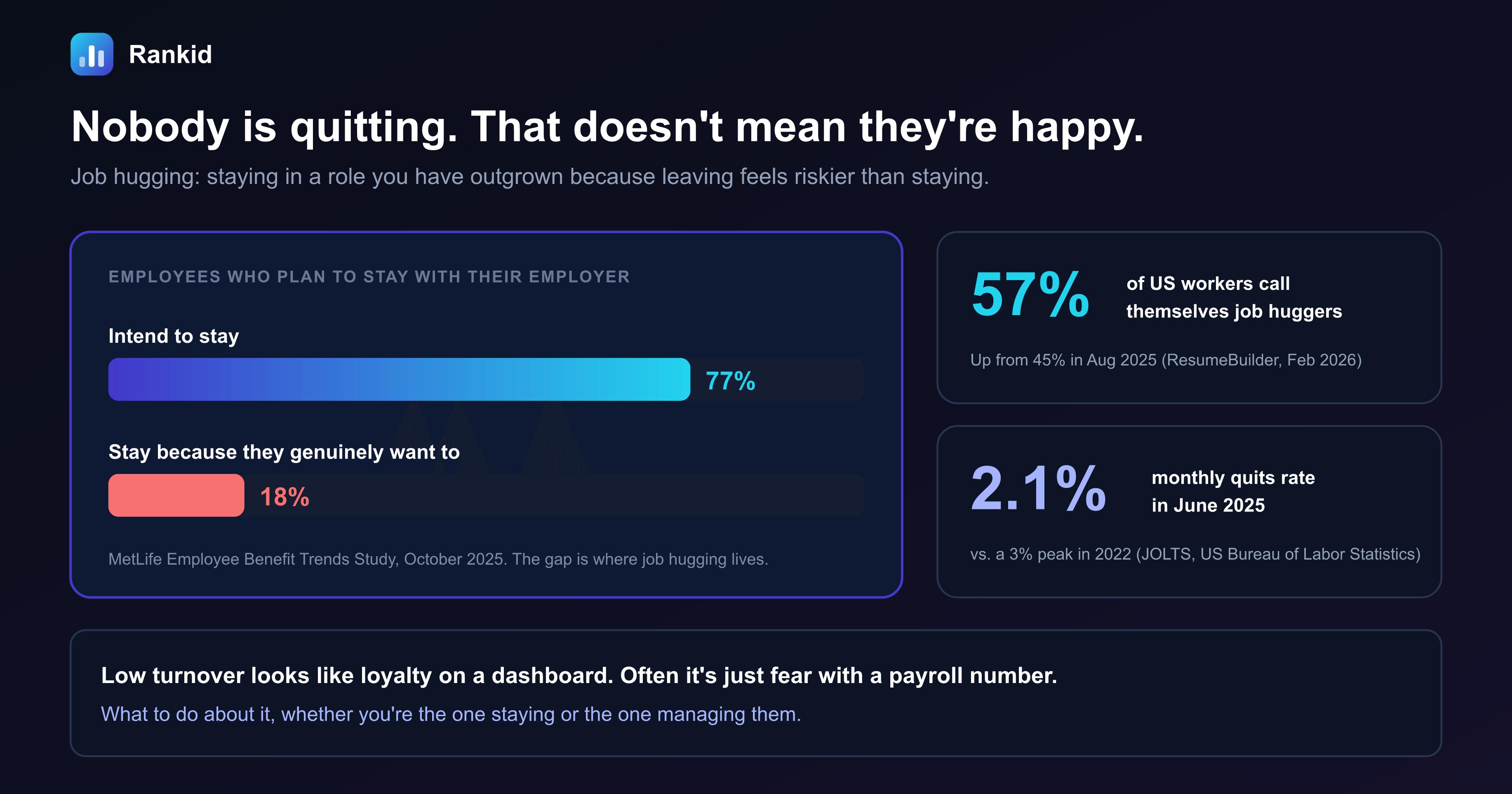
Look at your company's turnover dashboard. Resignations are down, average tenure is up, and the retention line finally points the way you always wanted. Then look at the people. The engineer who used to pitch ideas now waits to be assigned tasks. The manager who was ready for a promotion two years ago is still in the same seat, polishing a resume they never send. Neither has left. Neither is thriving. They are job hugging: holding tight to a role because the alternative feels riskier. It is the defining career behavior of 2026, and it carries a quiet cost for the people doing it and for the companies that mistake it for loyalty.
Quick answer
Quick answer: job hugging means staying in a job you have outgrown because leaving feels riskier than staying. In February 2026, 57% of US workers called themselves job huggers (up from 45% five months earlier), and while 77% of employees intend to stay, only 18% of those planning to stay say it is because they truly want to. Staying can be smart, but not on autopilot. Decide with two questions: is the role still teaching you, and how secure does it feel? Employers should treat low turnover as a warning sign and run stay interviews, fix pay drift, and create growth paths.
What job hugging is (and isn't)
Job hugging is the choice to hold on to your current job, often tightly and out of caution, even when you feel disengaged or see limited room to advance. The phrase took off in August 2025, widely credited to the consultancy Korn Ferry, as the mirror image of the Great Resignation. Where 2021 and 2022 were about people quitting in record numbers, 2025 and 2026 became about people not quitting, even when they wanted to.
It is easy to confuse with neighbors. It is not job hopping, which is the opposite behavior of moving frequently. It is not quiet quitting either, which is about doing the minimum, not about staying or leaving. And it is not the same as quiet firing, where an employer pushes someone out without formally dismissing them. Job hugging is about tenure and risk: the person may still work hard, but they are staying mostly because of what leaving might cost.
The numbers behind the trend
Several surveys point in the same direction, even though they ask different questions. Treat each on its own and look at the pattern.
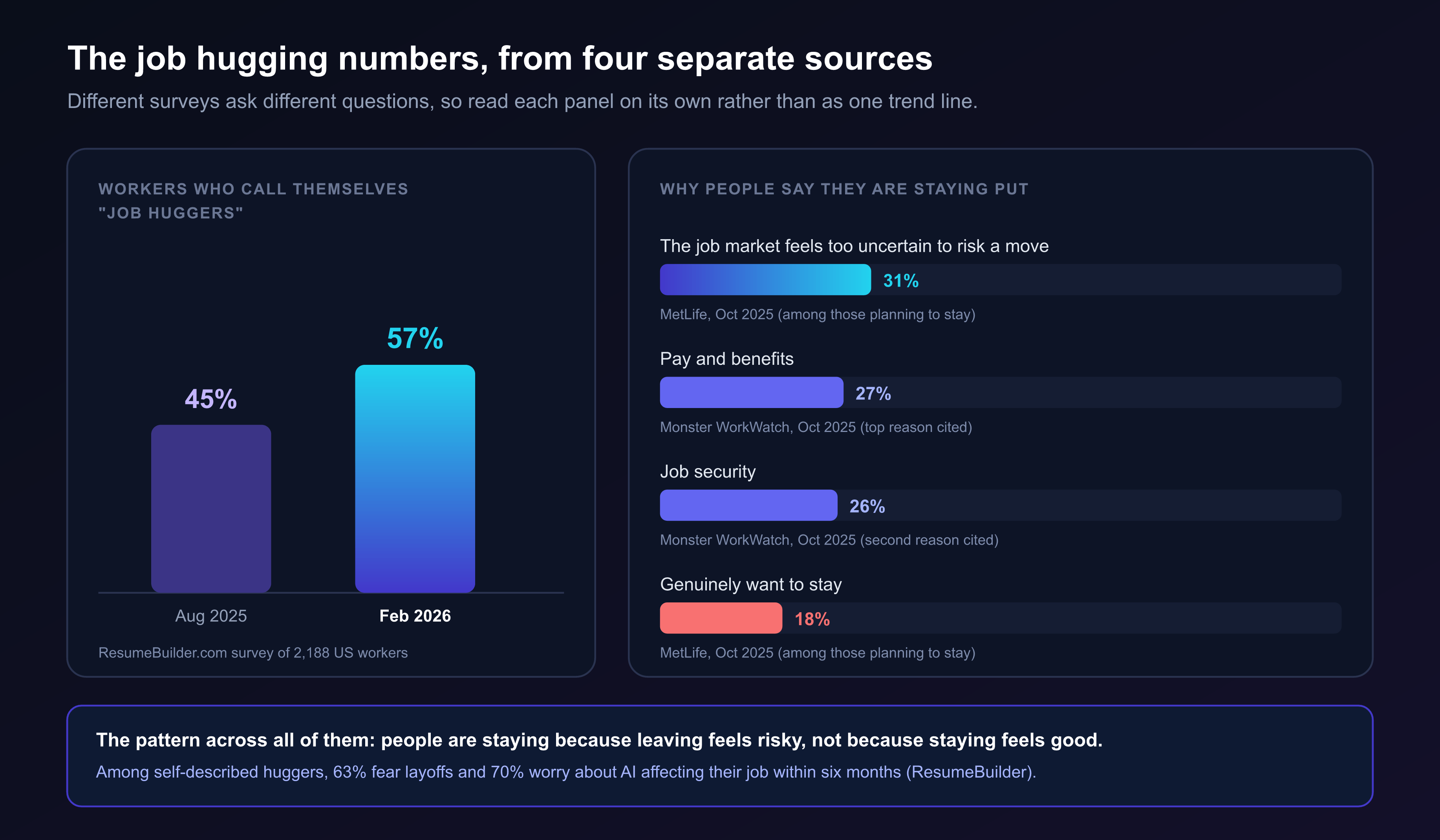
- Prevalence.A ResumeBuilder.com survey of 2,188 US workers found 57% identified as job huggers in February 2026, up from 45% in August 2025. Monster's WorkWatch report in October 2025 put the share actively engaged in job hugging at 48%.
- Intent to stay.MetLife's 2025 Employee Benefit Trends Study found 77% of employees intend to stay with their employer, up from 73% a year earlier. But only 18% said they were staying because they genuinely wanted to, and 31% of those planning to stay said the job market was too uncertain to risk leaving.
- Motivation.In Monster's report, the top reasons were pay and benefits (27%) and job security (26%).
- Fear. Among self-identified huggers, ResumeBuilder found 63% fear layoffs and 70% worry AI will affect their job within six months.
- The labor market. The US monthly quits rate, which peaked near 3% in 2022, was about 2.1% in mid-2025 and has stayed low since, with hiring near its slowest pace in years. When few employers are hiring, few employees leave.
Engagement data tells the other half of the story. Gallup's global workplace research has reported engagement falling to around 20% in 2026, among the lowest levels since 2020. Low quits alongside low engagement is the signature of job hugging: people are present, but not fully invested.
Why job hugging is happening now
- Fewer places to go. Slower hiring means fewer attractive openings, and some advertised roles never get filled at all. Our guide to ghost jobs explains why the market can look more open than it is.
- "Last in, first out." Newer employees tend to be the first cut in a downturn, so giving up seniority for a new job feels dangerous.
- Layoff and AI anxiety. Announced job cuts rose sharply in 2025, and workers are unsure how automation will reshape their role, so the devil they know feels safer.
- Pay and benefits are sticky. Health coverage, equity that is still vesting, and a reasonable salary are real reasons to stay put when the outside offer might not beat them.
- A harder search. Applications take longer and produce fewer replies. If you have found yourself wondering why you're not getting interviews, the friction alone can make staying feel rational.
Is job hugging actually bad?
Honestly, it depends, and some critics argue the term is just a new label for old behavior. Overall unemployment stayed relatively low through 2025, and staying in a stable job during a slow market is a defensible, even smart, decision. The problem is not staying. It is staying passively.
The costs of passive staying are real: skills that stop growing, promotions that never come, pay that drifts below the market, and a professional network that cools because you stopped needing it. Wharton professor Peter Cappelli has noted that people who feel stuck may miss out on the growth and raises that often come with changing jobs. The pay premium for switching has narrowed recently according to the Atlanta Fed's wage growth tracker, which reduces the price of staying, but the gap moves month to month, so check the latest data before assuming it holds.
The question that matters more than 'hug or hop'
Hug or hop? Place yourself on the grid
Two questions capture most of the decision: is the role still teaching you things, and how secure does your position feel? Your answers put you in one of four situations, and each has a different best move.
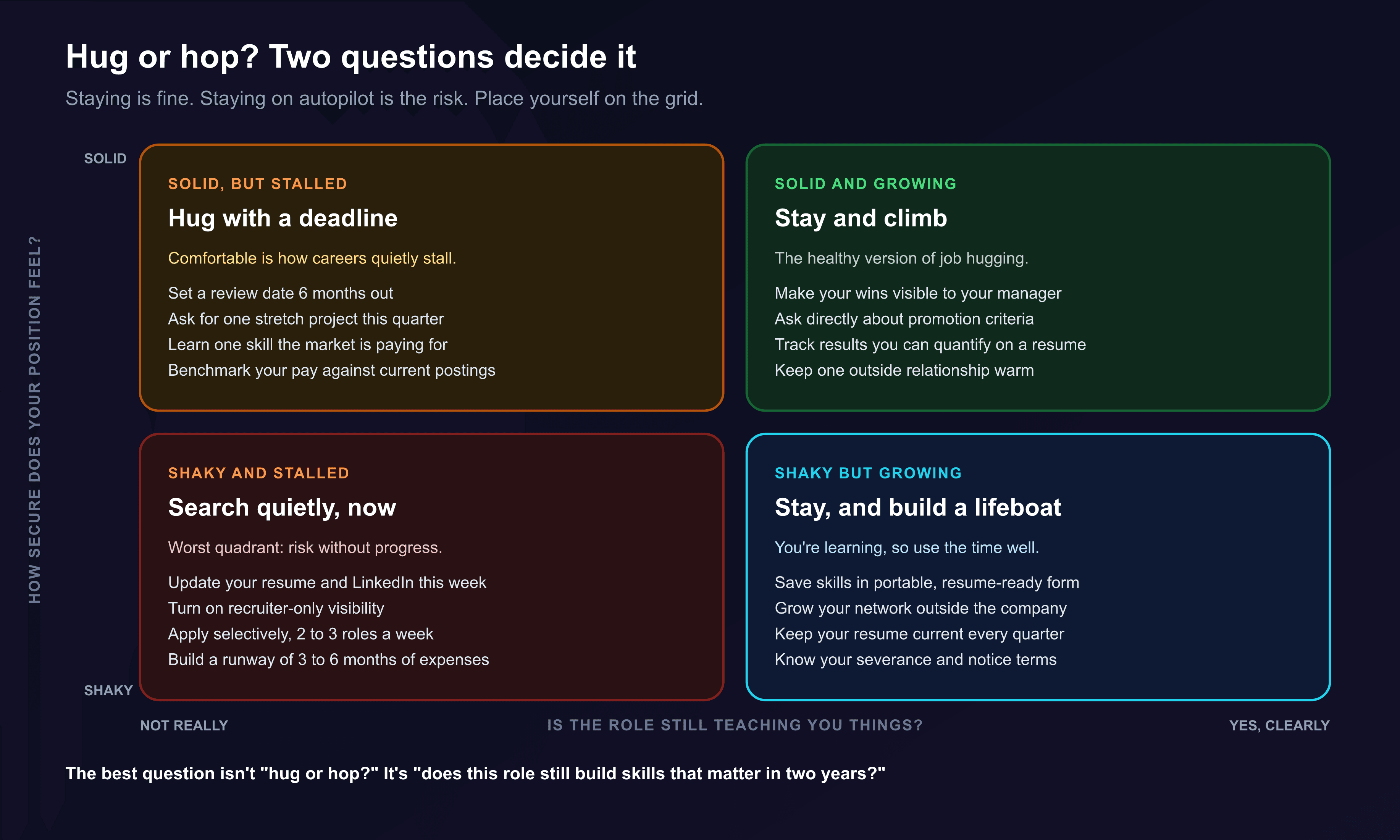
- Solid and growing: stay and climb. This is job hugging at its healthiest. Make your results visible, ask directly about promotion criteria, and keep one outside relationship warm.
- Solid but stalled: hug with a deadline. Comfort is how careers quietly stall. Set a review date six months out, ask for a stretch project, learn one skill the market pays for, and benchmark your pay against current postings.
- Shaky but growing: stay, and build a lifeboat. You are learning, so use the time. Keep your resume current every quarter, grow a network outside the company, and know your severance and notice terms.
- Shaky and stalled: search quietly, now. This is the worst quadrant, risk without progress. Update your materials this week, turn on recruiter-only visibility, apply selectively, and build a cash runway.
The quiet job search kit: seven things you can do without interviewing
You don't have to choose between hugging and a full-blown search. A quiet search keeps your options open at almost no risk, and it pays off whether a great opportunity or an unpleasant surprise arrives first.
Refresh your resume around results, not duties
Make yourself findable, privately
Learn your market value
Have low-stakes conversations outside your company
Build one skill on purpose
Check your resume against a real posting
Set a decision date
See how your resume stacks up against a job you'd actually want
Paste your resume and one real job posting into Rankid for a free 0-100 match score and the exact skills you have and the ones you're missing. It's the fastest way to learn whether the grass really is greener, before you decide to hug or hop. No signup required.
Check your match score freeFor employers: low turnover is not the same as engagement
If you manage people, job hugging can look like a win. Retention is up, recruiting costs are down, and nobody is handing in notice. But when MetLife found that only 18% of employees planning to stay say they genuinely want to, it was describing a reservoir of disengagement that a turnover metric cannot see. Our guide to the employee turnover rateexplains what that number does and doesn't capture.
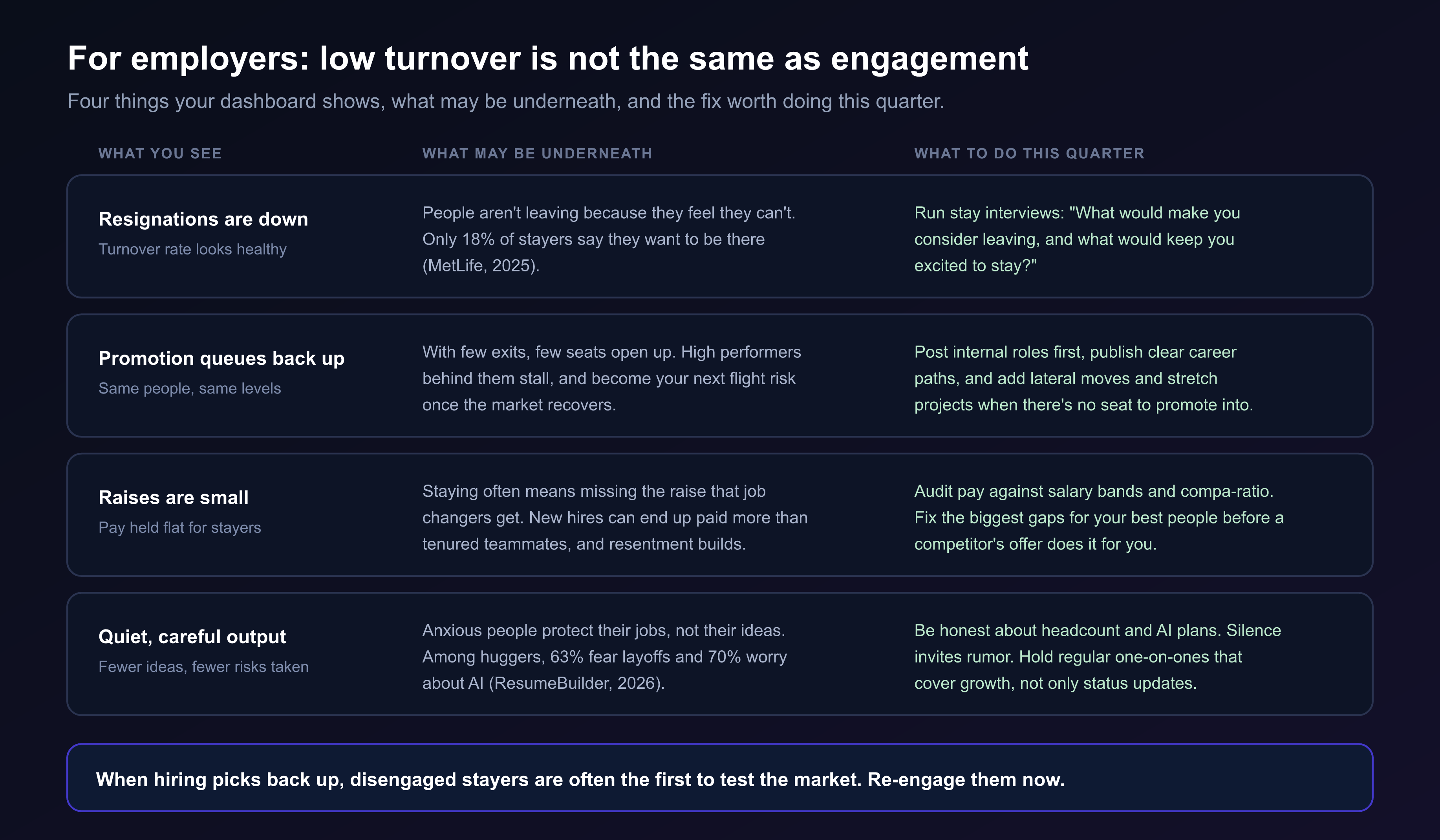
Four patterns are worth checking for. When resignations are down, ask why people are staying. When promotion queues back up, high performers behind the queue stall and become tomorrow's flight risk, so post roles internally first (see internal recruitment) and plan for succession. When raises are small and new hires are paid more than tenured teammates, resentment builds, so audit against your bands using compa-ratio. And when output turns quiet and careful, fear is often the reason, so be honest about headcount and AI plans, and use one-on-ones to talk about growth, not just status.
Stay interviews: the fastest way to find the hugger
An exit interview tells you why someone left, when it is too late to matter. A stay interview asks the people still here what would make them leave, and it is the cheapest retention tool you have. Hold them privately, one-on-one, and ask a small set of open questions:
- What do you look forward to when you come to work?
- What would make you consider leaving?
- What skills do you want to build in the next year?
- Is there anything about your role you would change tomorrow?
- What would make you excited to stay for the next two years?
The rule is to act visibly on at least one thing you hear. Turn insights into a real plan with an individual development plan. Ask, listen, and do something, or don't ask.
What happens when the market loosens
Job hugging is a response to conditions, not a permanent change in human nature. As hiring recovers, people who stayed out of caution instead of commitment are the most likely to start looking, often all at once. Companies that spend this window fixing growth paths, pay drift, and communication will hold on to their best people. Those that simply enjoy the quiet may face a wave of exits at the worst moment. Some will return later, which is why it pays to understand boomerang employees, and why it pays to learn what a counteroffer really means if someone does resign.
Hiring internally or externally? Compare candidates on the same scale
Whether you're filling a role from your own team or from outside, Rankid scores each resume against the job description on a consistent 0-100 scale and lists the matched and missing requirements, so promotion and hiring decisions rest on evidence. First 5 resumes free, no signup.
Try bulk screening freeFrequently asked questions
What is job hugging?
Job hugging is the tendency to hold on to your current job, often tightly and out of caution, even when you feel disengaged or see limited chances to advance, because leaving feels riskier than staying. The term emerged in mid-2025 as a counterpart to job hopping and the Great Resignation, and it is usually tied to economic uncertainty, slower hiring, and fears about layoffs and AI.
Where did the term job hugging come from?
The workforce consultancy Korn Ferry is generally credited with popularizing the phrase in August 2025, describing workers holding on to their jobs for dear life, although the company itself has said it is not certain it coined it. Business media picked it up within weeks, and by 2026 it had become shorthand for a labor market with very few quits and very few hires.
How many people are job hugging?
It depends on the survey and the wording. A ResumeBuilder.com survey of 2,188 US workers found that 57 percent identified as job huggers in February 2026, up from 45 percent five months earlier. Monster's WorkWatch report in late 2025 put the share actively engaged in job hugging at 48 percent. MetLife's 2025 benefit trends study found that 77 percent of employees intend to stay with their employer, up from 73 percent the year before. These are different questions, so compare the direction rather than the exact numbers.
Is job hugging the same as quiet quitting?
No. Quiet quitting describes doing the minimum required in a job, and it can happen whether or not the person plans to leave. Job hugging describes the decision to stay put despite dissatisfaction, and the person may still be working hard. The two can overlap, but job hugging is about tenure and risk, while quiet quitting is about effort.
Is job hugging actually bad for your career?
Not automatically. Staying can be a sound choice when hiring is slow, layoffs are a real worry, and your current role is stable. The risk appears when staying becomes autopilot: skills stop growing, promotions stall, pay drifts below the market, and your professional network cools. Career commentators, including Wharton's Peter Cappelli, have noted that people who feel stuck can miss the raises and growth that often come with a move. The better question isn't whether to hug, but whether your role still builds skills that will matter in two years.
Why is job hugging happening now?
Several forces overlap. Hiring has slowed and the monthly quits rate has fallen to around 2 percent from a peak near 3 percent in 2022, so there are simply fewer openings to jump to. Layoffs, including those tied to automation, make people cautious about giving up seniority. Many workers also fear that a new job would be the first cut in a downturn. Survey respondents most often cite pay and benefits and job security as their reasons for staying.
How can I tell whether I should stay or start looking?
Ask two questions: is the role still teaching me things that matter, and how secure does my position feel? If you are growing and secure, stay and make your wins visible. If you are secure but stalled, give yourself a deadline and a plan. If you are growing but the ground feels shaky, stay and build a safety net. If you are stalled and unsure, begin a quiet search now. The grid in this guide walks through each case.
What is a quiet job search?
It is preparing to leave without telling anyone you are looking: updating your resume and professional profile, turning on recruiter-only visibility, having low-key conversations with people outside your company, learning what your skills are worth, and applying selectively. It keeps your options open without the risk of your employer finding out prematurely, and it helps most when a good opportunity or a bad surprise arrives.
What should employers do about job huggers?
Stop treating low turnover as proof of engagement. Run stay interviews that ask what would make someone consider leaving, publish clear career paths, post internal roles first, add lateral moves and stretch projects when there are no promotion seats, and audit pay against your salary bands so that long-tenured people are not quietly underpaid. Be honest about headcount and AI plans, because silence fuels the fear that drives hugging. When hiring picks up, disengaged stayers are often the first to test the market.
Can job hugging hurt my pay?
It can, because the biggest raises have historically gone to people who change jobs. That gap has narrowed during the slow-hiring period, and the Atlanta Fed's wage growth tracker showed the switching premium shrinking in 2025, so staying costs less than the old advice to always hop suggested. It still varies month to month, so check the latest release, and benchmark your pay against current postings for your role at least once a year.
What are good stay interview questions?
Useful ones include: What do you look forward to when you come to work? What would make you consider leaving? What skills do you want to build in the next year? Is there anything about your role you would change tomorrow? What would make you excited to stay for the next two years? Ask them in a private one-on-one, listen without defending, and act visibly on at least one thing you hear.
Will job hugging last?
Probably not indefinitely. It is a response to specific conditions: slow hiring, layoff anxiety, and uncertainty about AI. When hiring picks up, people who stayed out of caution rather than commitment are likely to start looking, which is why employers who use this window to fix growth, pay, and communication are better positioned than those who simply enjoy the low turnover.
Key takeaways
- Job hugging means staying in a job you have outgrown because leaving feels riskier than staying. It is the opposite of job hopping and different from quiet quitting.
- 57% of US workers called themselves job huggers in February 2026, up from 45% in August 2025, per a ResumeBuilder survey of 2,188 workers.
- 77% of employees intend to stay with their employer, but only 18% of those planning to stay say they truly want to (MetLife, 2025).
- Top reasons for staying are pay and benefits (27%) and job security (26%), plus fear of layoffs and AI among self-identified huggers.
- Staying isn't automatically bad. The risk is passive staying: stalled skills, missed promotions, pay drift, and a cooling network.
- Decide with two questions: is the role still teaching you, and how secure does it feel? Then stay and climb, hug with a deadline, build a lifeboat, or search quietly now.
- A quiet job search keeps options open without interviewing: refresh your resume, get findable privately, learn your market value, build one skill, and set a decision date.
- Employers should treat low turnover as a warning sign: run stay interviews, publish career paths, post internal roles first, and audit pay against bands.
- Job hugging responds to conditions. When hiring picks up, disengaged stayers are often the first to look, so use this window to re-engage them.
Frequently asked questions
What is job hugging?
Job hugging is the tendency to hold on to your current job, often tightly and out of caution, even when you feel disengaged or see limited chances to advance, because leaving feels riskier than staying. The term emerged in mid-2025 as a counterpart to job hopping and the Great Resignation, and it is usually tied to economic uncertainty, slower hiring, and fears about layoffs and AI.
Where did the term job hugging come from?
The workforce consultancy Korn Ferry is generally credited with popularizing the phrase in August 2025, describing workers holding on to their jobs for dear life, although the company itself has said it is not certain it coined it. Business media picked it up within weeks, and by 2026 it had become shorthand for a labor market with very few quits and very few hires.
How many people are job hugging?
It depends on the survey and the wording. A ResumeBuilder.com survey of 2,188 US workers found that 57 percent identified as job huggers in February 2026, up from 45 percent five months earlier. Monster's WorkWatch report in late 2025 put the share actively engaged in job hugging at 48 percent. MetLife's 2025 benefit trends study found that 77 percent of employees intend to stay with their employer, up from 73 percent the year before. These are different questions, so compare the direction rather than the exact numbers.
Is job hugging the same as quiet quitting?
No. Quiet quitting describes doing the minimum required in a job, and it can happen whether or not the person plans to leave. Job hugging describes the decision to stay put despite dissatisfaction, and the person may still be working hard. The two can overlap, but job hugging is about tenure and risk, while quiet quitting is about effort.
Is job hugging actually bad for your career?
Not automatically. Staying can be a sound choice when hiring is slow, layoffs are a real worry, and your current role is stable. The risk appears when staying becomes autopilot: skills stop growing, promotions stall, pay drifts below the market, and your professional network cools. Career commentators, including Wharton's Peter Cappelli, have noted that people who feel stuck can miss the raises and growth that often come with a move. The better question isn't whether to hug, but whether your role still builds skills that will matter in two years.
Why is job hugging happening now?
Several forces overlap. Hiring has slowed and the monthly quits rate has fallen to around 2 percent from a peak near 3 percent in 2022, so there are simply fewer openings to jump to. Layoffs, including those tied to automation, make people cautious about giving up seniority. Many workers also fear that a new job would be the first cut in a downturn. Survey respondents most often cite pay and benefits and job security as their reasons for staying.
How can I tell whether I should stay or start looking?
Ask two questions: is the role still teaching me things that matter, and how secure does my position feel? If you are growing and secure, stay and make your wins visible. If you are secure but stalled, give yourself a deadline and a plan. If you are growing but the ground feels shaky, stay and build a safety net. If you are stalled and unsure, begin a quiet search now. The grid in this guide walks through each case.
What is a quiet job search?
It is preparing to leave without telling anyone you are looking: updating your resume and professional profile, turning on recruiter-only visibility, having low-key conversations with people outside your company, learning what your skills are worth, and applying selectively. It keeps your options open without the risk of your employer finding out prematurely, and it helps most when a good opportunity or a bad surprise arrives.
What should employers do about job huggers?
Stop treating low turnover as proof of engagement. Run stay interviews that ask what would make someone consider leaving, publish clear career paths, post internal roles first, add lateral moves and stretch projects when there are no promotion seats, and audit pay against your salary bands so that long-tenured people are not quietly underpaid. Be honest about headcount and AI plans, because silence fuels the fear that drives hugging. When hiring picks up, disengaged stayers are often the first to test the market.
Can job hugging hurt my pay?
It can, because the biggest raises have historically gone to people who change jobs. That gap has narrowed during the slow-hiring period, and the Atlanta Fed's wage growth tracker showed the switching premium shrinking in 2025, so staying costs less than the old advice to always hop suggested. It still varies month to month, so check the latest release, and benchmark your pay against current postings for your role at least once a year.
What are good stay interview questions?
Useful ones include: What do you look forward to when you come to work? What would make you consider leaving? What skills do you want to build in the next year? Is there anything about your role you would change tomorrow? What would make you excited to stay for the next two years? Ask them in a private one-on-one, listen without defending, and act visibly on at least one thing you hear.
Will job hugging last?
Probably not indefinitely. It is a response to specific conditions: slow hiring, layoff anxiety, and uncertainty about AI. When hiring picks up, people who stayed out of caution rather than commitment are likely to start looking, which is why employers who use this window to fix growth, pay, and communication are better positioned than those who simply enjoy the low turnover.