Signs Layoffs Are Coming: 21 Warning Signals by Lead Time, and What to Do First (2026)
Ask anyone who has been laid off whether they saw it coming, and most will say no. Ask them a week later, and many will list the signs: the hiring freeze in spring, the consultants in summer, the project that got "paused," the all-hands with no agenda. Layoffs rarely come out of nowhere. The signals tend to arrive in a predictable order, months, then weeks, then days ahead. With more than half a million US job cuts announced in 2026 so far, and AI now the most-cited reason, learning to read that forecast is one of the most useful career skills you can have.
Quick answer
Quick answer: the clearest signs of layoffs are a hiring freeze, missed targets, "efficiency" language, consultants reviewing the org, paused projects, a reorg with "details to follow," and, in the final days, meetings that suddenly include HR. One sign means little; a cluster arriving in order is a forecast. Mass layoffs usually require 60 to 90 days' WARN notice, which is public, so check your state's list. Don't quit pre-emptively. Start a quiet 90-day plan: cash, proof of your results, a warm network and an updated resume.
The 2026 layoff picture
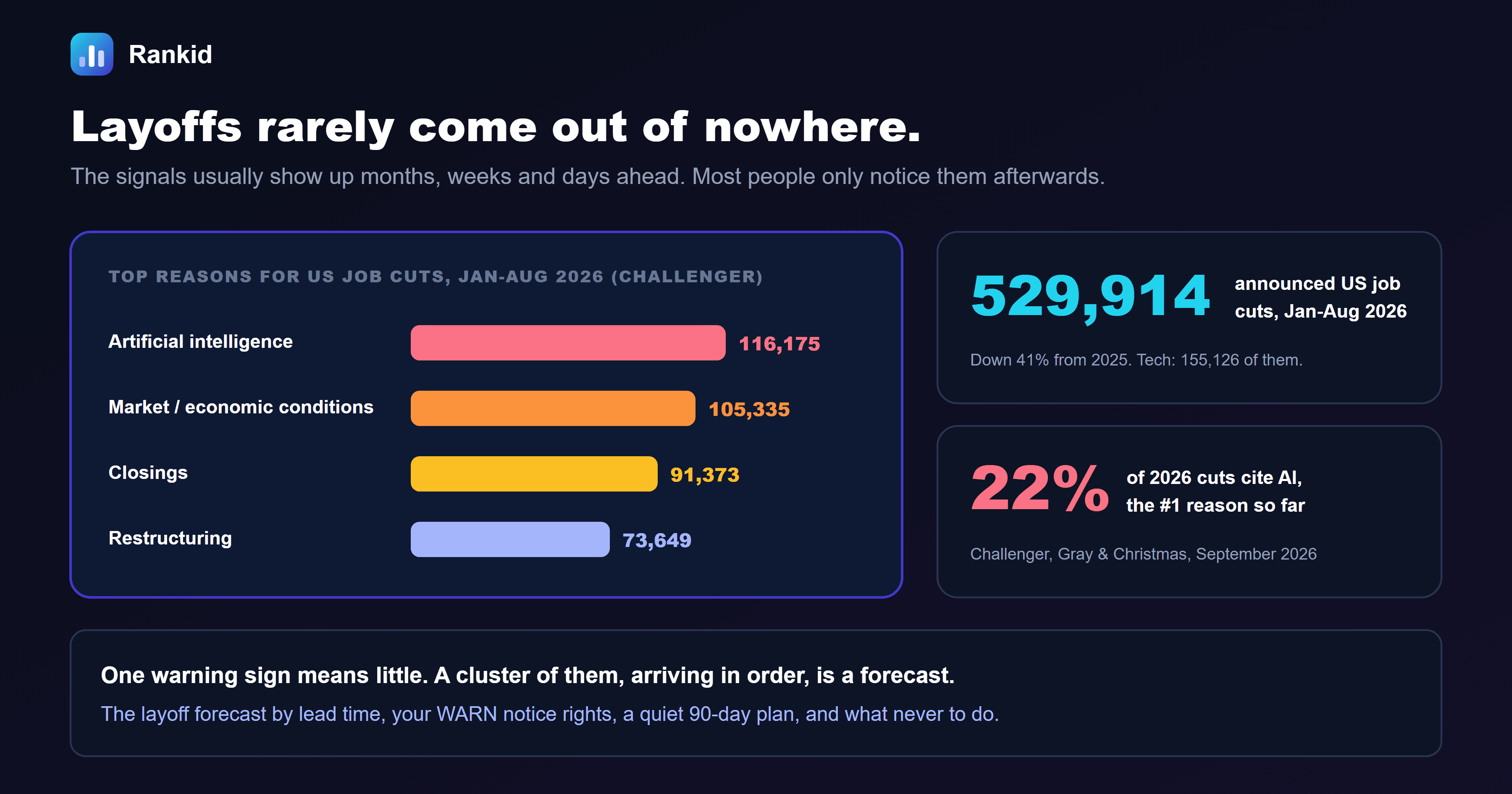
According to outplacement firm Challenger, Gray & Christmas, US employers announced 529,914 job cuts from January through August 2026. That's actually 41% fewer than in the same period of 2025, and hiring plans are up. But the reasons have shifted sharply:
- AI is the top reason. Artificial intelligence was cited in 116,175 announced cuts, about 22% of the total, making it the leading reason year to date, ahead of market and economic conditions (105,335), closings (91,373) and restructuring (73,649).
- Tech leads, but isn't alone. Technology companies announced 155,126 cuts, followed by transportation and health care. In August, consumer products led for the month.
- Fewer cuts doesn't mean safer.When layoffs are targeted rather than sweeping, they're harder to see coming from the headlines. That's why the signals inside your own company matter more than the national numbers.
The layoff forecast: 21 signals by lead time
Think of it like weather. One cloud tells you nothing. A pattern of pressure changes, arriving in sequence, is a forecast. Here are the signals most often reported before a layoff, grouped by how far ahead they typically appear.
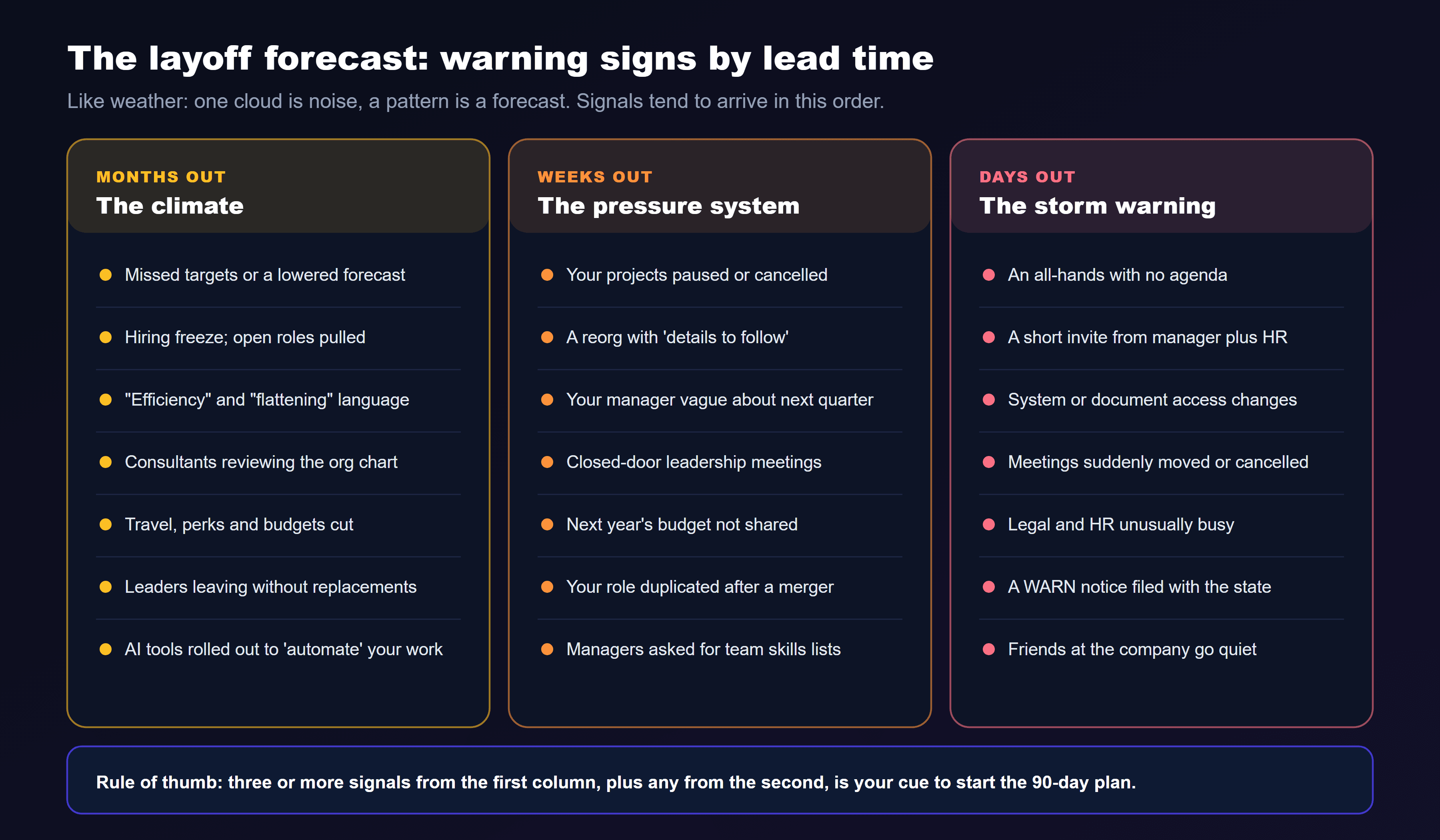
Months out: the climate. These are company-level signs that money is tight or the strategy is changing.
- Missed revenue targets, a lowered forecast, or a failed funding round.
- A hiring freeze, with open roles quietly pulled from the careers page. Our guide to ghost jobs explains why postings sometimes stay up anyway.
- Leaders talking about "efficiency," "flattening layers" or "doing more with less."
- Consultants interviewing teams or reviewing the org chart.
- Cuts to travel, events, perks and training budgets.
- Senior leaders leaving and not being replaced.
- New AI tools rolled out with an explicit goal of automating work your team does.
Weeks out: the pressure system. Signs that decisions are being made about teams and roles.
- Your projects are paused, deprioritised or cancelled, especially long-term ones.
- A reorg is announced with "more details to follow."
- Your manager becomes vague about next quarter or stops discussing your development.
- More closed-door leadership meetings and calendar holds without titles.
- Next year's budget or headcount plan isn't shared.
- After a merger, your role now exists twice.
- Managers are asked for skills inventories or lists of who does what.
Days out: the storm warning. Operational signs that a plan is being executed.
- An all-hands or team meeting appears with no agenda.
- A short invite from your manager, with HR attached.
- Changes to your access to systems, shared drives or customer accounts.
- Regular meetings suddenly moved or cancelled.
- HR and legal visibly stretched.
- A WARN notice filed with your state (more on this below).
- Colleagues who usually share information go quiet.
Signals that are often misread
WARN notices: the public early warning most people never check
For larger layoffs, US law requires advance written notice under the Worker Adjustment and Retraining Notification (WARN) Act, and several states add stronger rules of their own.
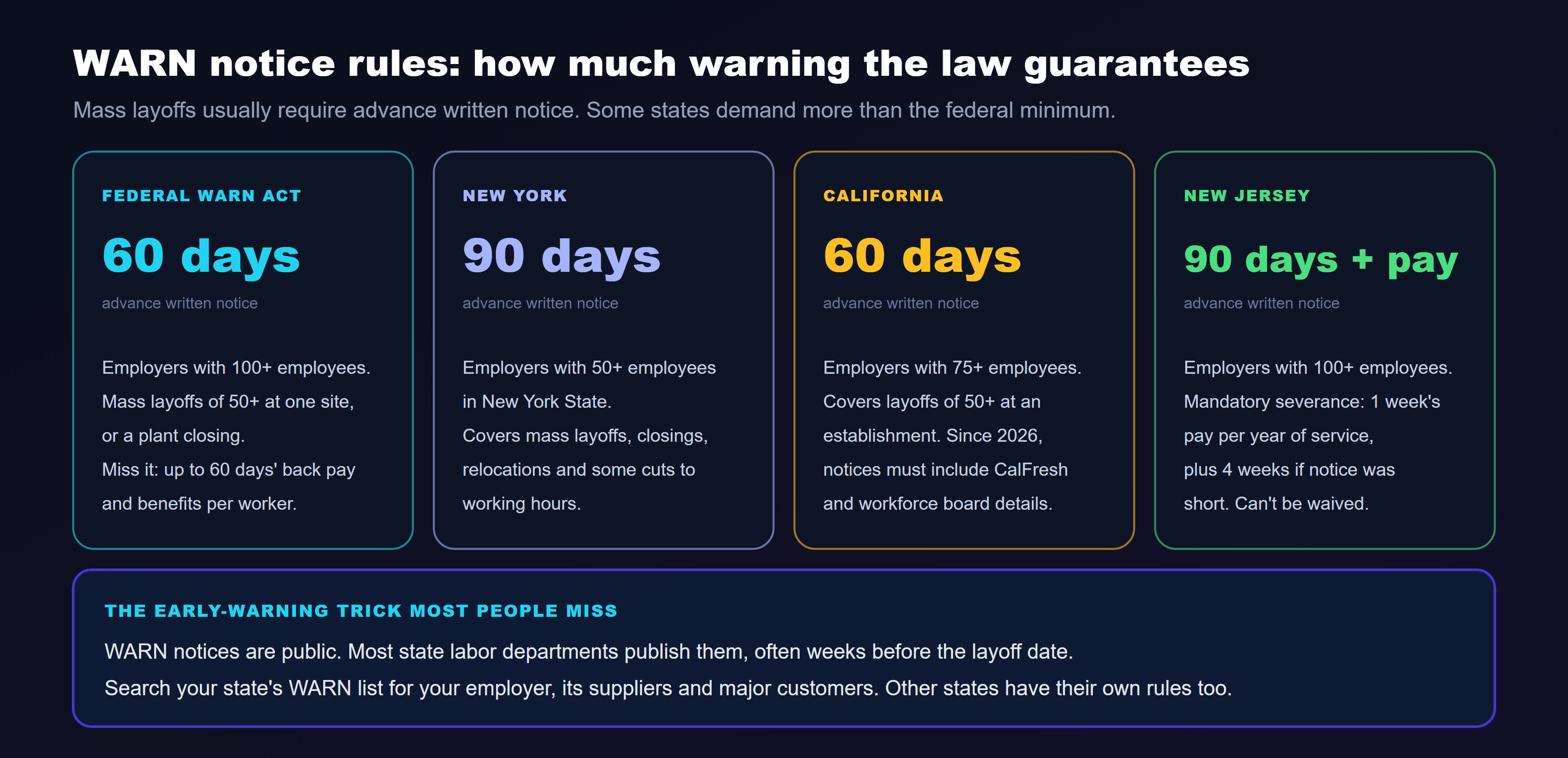
- Federal WARN. Employers with 100 or more employees generally must give 60 days' notice of a plant closing or a mass layoff of 50 or more people at one site. Failing to do so can mean up to 60 days of back pay and benefits per affected worker.
- New York. 90 days' notice, applying to employers with 50 or more employees in the state.
- California. Applies from 75 employees, and since January 2026, notices must include extra information, such as details of the CalFresh food assistance program.
- New Jersey. 90 days' notice plus mandatory severanceof one week's pay per year of service, and four more weeks if notice was short.
The detail most people miss: WARN notices are public. Most state labor departments publish them, often weeks before the layoff date. Searching your state's list for your employer, its key suppliers and its biggest customers can give you an early signal nobody at work will mention. Our guide to furloughs vs layoffs covers what each status means for your pay and benefits.
The quiet 90-day plan
If the forecast looks stormy, don't panic and don't announce anything. Just get ready, quietly. Everything below is useful even if the layoff never comes.
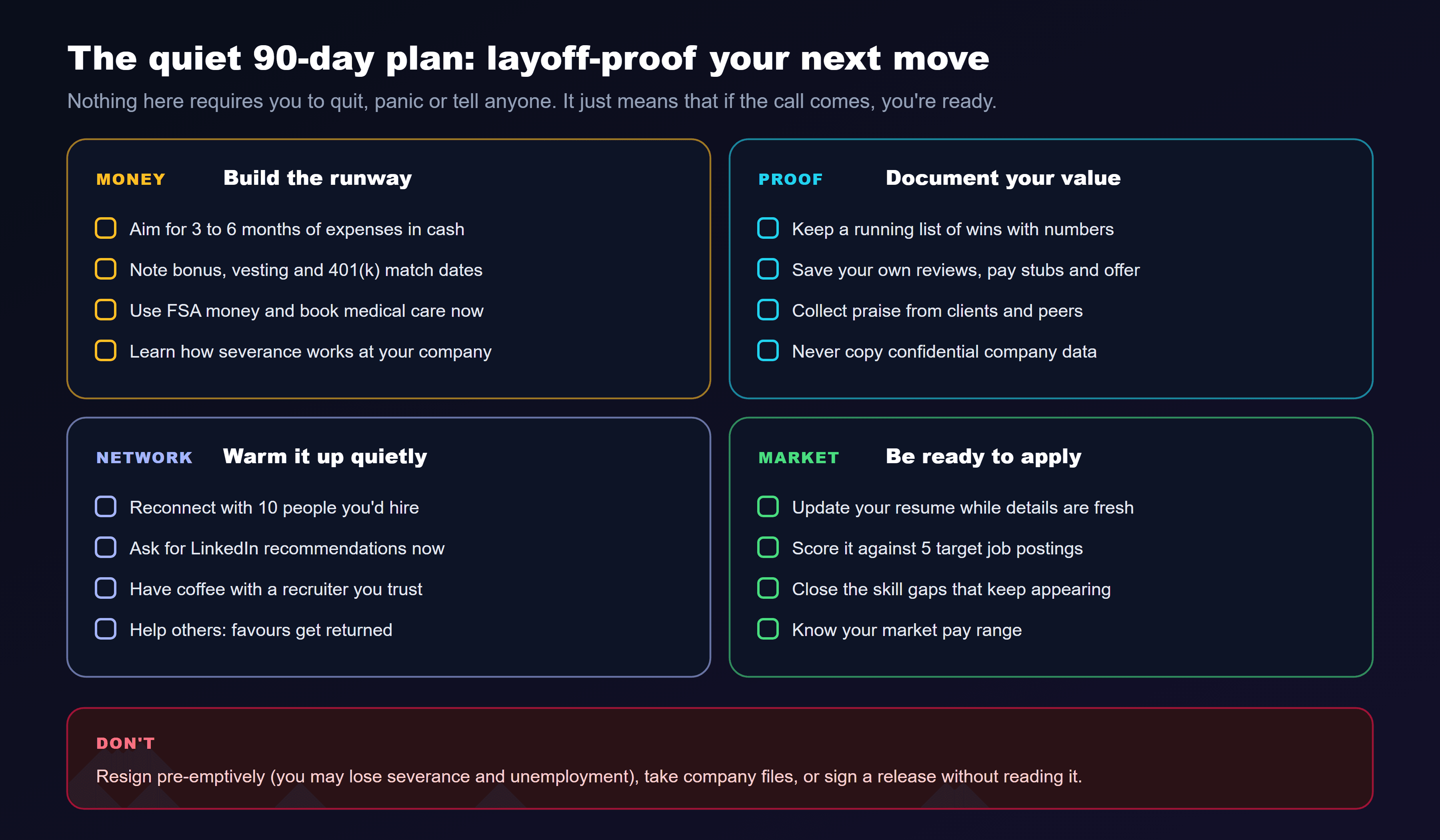
Build the runway
Document your value
Warm up your network
Get market-ready
Start applying selectively
Get your resume layoff-ready in minutes
Paste your resume and a job posting you'd want next into Rankid for a free 0-100 match score and the exact requirements you meet and miss. Fix the gaps now, while you still have time to do it calmly. No signup required.
Check your match score freeWhat never to do when layoffs are rumoured
- Don't resign pre-emptively.You'll usually give up severance and may lose eligibility for unemployment benefits.
- Don't take company files. Downloading client lists or confidential documents can breach your agreements and cost you severance or worse.
- Don't spread rumours. Speculation in team chats is visible and rarely helps you.
- Don't coast. In selective layoffs, visible impact still matters. Stay excellent on the work that counts.
- Don't sign on the spot. If the layoff comes, take the severance agreement away and read it.
If it happens: handling the day itself
Layoff meetings are usually short, often 10 to 15 minutes, with your manager and HR. You won't change the decision in that room, so focus on getting information.
- Ask for everything in writing. Last day, severance, benefits end date, COBRA, equity, final pay and unused vacation.
- Know your review period. Severance agreements that waive legal claims often come with a window to review before signing. Read our guide to severance pay before you do.
- Negotiate if it makes sense. More weeks of pay, extended health coverage, accelerated vesting, a neutral reference and outplacement support are all common asks.
- File for unemployment promptly. Rules vary by state, but delays can cost you weeks of benefits.
- Tell the story simply."My role was eliminated in a company-wide reduction" is all an interviewer needs, followed by your results. If the search takes a while, our guide to explaining employment gaps helps.
For employers: fewer surprises, better outcomes
Layoffs are sometimes unavoidable. How they're handled shapes whether the people who stay keep trusting you.
- Plan headcount before it's a crisis. Regular workforce planning reduces the chance of sudden, deep cuts.
- Meet notice obligations, and then some. Check federal and state WARN rules early. Earlier notice and fair severance cost less than the trust you lose without them.
- Tell people directly, in person or on video. Never by mass email or a disabled login.
- Run a clean offboarding. Our employee offboarding guide covers equipment, access, benefits and references.
- Look after the people who stay.Explain the reasons, the new plan and what's changed, or your best performers will start reading the forecast too.
Rebuilding a team after restructuring?
Rankid scores every resume against your job description on a consistent 0-100 scale and shows the exact requirements each candidate matched and missed, so you can hire for the roles that matter now, quickly and fairly. First 5 resumes free, no signup.
Try bulk screening freeFrequently asked questions
What are the signs that layoffs are coming?
Common early signs include missed targets or a lowered forecast, a hiring freeze with open roles pulled, 'efficiency' or 'flattening' language from leadership, consultants reviewing the organisation, cuts to travel and perks, and leaders leaving without replacements. Closer to the event, projects get paused, a reorg is announced with details to follow, managers become vague about next quarter, and closed-door meetings multiply. In the final days, look for all-hands meetings without agendas, short invites that include HR, and changes to system access.
How much notice do employers have to give before layoffs?
Under the federal WARN Act, employers with 100 or more employees generally must give 60 days' written notice before a plant closing or a mass layoff of 50 or more employees at one site. Some states go further: New York requires 90 days' notice for employers with 50 or more employees, New Jersey requires 90 days plus mandatory severance, and California's version covers employers with 75 or more employees. Employers that fail to give required notice can owe up to 60 days of back pay and benefits.
Where can I find WARN notices?
Most state labor or workforce departments publish WARN notices on their websites, usually as a searchable list or spreadsheet showing the employer, location, number of affected workers and effective date. Because notices are often filed weeks before the layoff date, checking your state's list for your employer, its key suppliers and major customers can give you early warning.
How many layoffs have there been in 2026?
US employers announced 529,914 job cuts from January through August 2026, down 41% from the same period of 2025, according to Challenger, Gray & Christmas. Artificial intelligence was the most cited reason year to date, linked to 116,175 cuts or about 22% of the total, and the technology sector led all industries with 155,126 announced cuts.
Should I quit before I get laid off?
Usually not. If you resign, you generally give up severance and may not qualify for unemployment benefits, and you lose the leverage of being part of a layoff. The better move is to prepare quietly: build savings, update your resume, warm up your network and start applying selectively, so you can leave on your own terms if a good offer comes, or take the package if the layoff arrives first.
What should I do if I think I'm about to be laid off?
Start a quiet 90-day plan. Build three to six months of cash if you can, note bonus, vesting and 401(k) match dates, use health benefits while covered, keep a list of your achievements with numbers, save your own performance reviews and pay stubs, reconnect with your network, update your resume and compare it against target job postings. Don't copy confidential company data and don't announce anything at work.
What happens in a layoff meeting?
Layoff meetings are usually short, often 10 to 15 minutes, with your manager and someone from HR. You'll typically be told your last day, your severance terms, what happens to your benefits and equity, and how to return equipment. You can ask questions and request everything in writing. You don't have to sign a severance agreement in the meeting, and you usually have days or weeks to review it.
Can I negotiate a severance package?
Often, yes, especially if you're senior, have long tenure, or have a claim the company would prefer to settle. Ask for the terms in writing, check the review period, compare against company norms, and consider asking for more weeks of pay, extended health coverage, accelerated vesting, a neutral reference or outplacement support. Employment lawyers can review agreements, particularly if you're asked to waive legal claims.
Is New Jersey severance mandatory?
For covered mass layoffs, yes. Since April 2023, New Jersey's WARN law requires employers with 100 or more employees to give 90 days' notice and pay mandatory severance of one week's pay per full year of service, plus an additional four weeks' pay if they fail to give full notice. Employees can't waive that severance without state or court approval.
How do I explain a layoff in a job interview?
Briefly and factually. Say the company eliminated your role or team as part of a broader reduction, mention the scale if it helps ('about 15% of the company'), then move quickly to what you achieved there and what you're looking for next. Layoffs are common and carry little stigma when explained calmly.
Key takeaways
- US employers announced 529,914 job cuts through August 2026, down 41% from 2025, but AI became the top cited reason at about 22% (Challenger, Gray & Christmas).
- Layoff signals tend to arrive in order: months out (missed targets, hiring freezes, efficiency language, consultants), weeks out (paused projects, vague reorgs), and days out (agenda-less all-hands, HR invites, access changes).
- One signal means little. A cluster arriving in sequence is a forecast.
- Federal WARN requires 60 days' notice for most mass layoffs at employers with 100+ staff. New York requires 90 days, and New Jersey requires 90 days plus mandatory severance.
- WARN notices are public. Checking your state's list for your employer, suppliers and customers can give early warning.
- Don't quit pre-emptively: you'll usually lose severance and possibly unemployment benefits.
- Start a quiet 90-day plan: build cash, document your wins, warm up your network, update your resume and apply selectively.
- On the day itself, ask for everything in writing, don't sign on the spot, negotiate where it makes sense and file for unemployment promptly.
Frequently asked questions
What are the signs that layoffs are coming?
Common early signs include missed targets or a lowered forecast, a hiring freeze with open roles pulled, 'efficiency' or 'flattening' language from leadership, consultants reviewing the organisation, cuts to travel and perks, and leaders leaving without replacements. Closer to the event, projects get paused, a reorg is announced with details to follow, managers become vague about next quarter, and closed-door meetings multiply. In the final days, look for all-hands meetings without agendas, short invites that include HR, and changes to system access.
How much notice do employers have to give before layoffs?
Under the federal WARN Act, employers with 100 or more employees generally must give 60 days' written notice before a plant closing or a mass layoff of 50 or more employees at one site. Some states go further: New York requires 90 days' notice for employers with 50 or more employees, New Jersey requires 90 days plus mandatory severance, and California's version covers employers with 75 or more employees. Employers that fail to give required notice can owe up to 60 days of back pay and benefits.
Where can I find WARN notices?
Most state labor or workforce departments publish WARN notices on their websites, usually as a searchable list or spreadsheet showing the employer, location, number of affected workers and effective date. Because notices are often filed weeks before the layoff date, checking your state's list for your employer, its key suppliers and major customers can give you early warning.
How many layoffs have there been in 2026?
US employers announced 529,914 job cuts from January through August 2026, down 41% from the same period of 2025, according to Challenger, Gray & Christmas. Artificial intelligence was the most cited reason year to date, linked to 116,175 cuts or about 22% of the total, and the technology sector led all industries with 155,126 announced cuts.
Should I quit before I get laid off?
Usually not. If you resign, you generally give up severance and may not qualify for unemployment benefits, and you lose the leverage of being part of a layoff. The better move is to prepare quietly: build savings, update your resume, warm up your network and start applying selectively, so you can leave on your own terms if a good offer comes, or take the package if the layoff arrives first.
What should I do if I think I'm about to be laid off?
Start a quiet 90-day plan. Build three to six months of cash if you can, note bonus, vesting and 401(k) match dates, use health benefits while covered, keep a list of your achievements with numbers, save your own performance reviews and pay stubs, reconnect with your network, update your resume and compare it against target job postings. Don't copy confidential company data and don't announce anything at work.
What happens in a layoff meeting?
Layoff meetings are usually short, often 10 to 15 minutes, with your manager and someone from HR. You'll typically be told your last day, your severance terms, what happens to your benefits and equity, and how to return equipment. You can ask questions and request everything in writing. You don't have to sign a severance agreement in the meeting, and you usually have days or weeks to review it.
Can I negotiate a severance package?
Often, yes, especially if you're senior, have long tenure, or have a claim the company would prefer to settle. Ask for the terms in writing, check the review period, compare against company norms, and consider asking for more weeks of pay, extended health coverage, accelerated vesting, a neutral reference or outplacement support. Employment lawyers can review agreements, particularly if you're asked to waive legal claims.
Is New Jersey severance mandatory?
For covered mass layoffs, yes. Since April 2023, New Jersey's WARN law requires employers with 100 or more employees to give 90 days' notice and pay mandatory severance of one week's pay per full year of service, plus an additional four weeks' pay if they fail to give full notice. Employees can't waive that severance without state or court approval.
How do I explain a layoff in a job interview?
Briefly and factually. Say the company eliminated your role or team as part of a broader reduction, mention the scale if it helps ('about 15% of the company'), then move quickly to what you achieved there and what you're looking for next. Layoffs are common and carry little stigma when explained calmly.