996 Work Schedule: What It Means, Whether It's Legal in the US, and How to Spot It
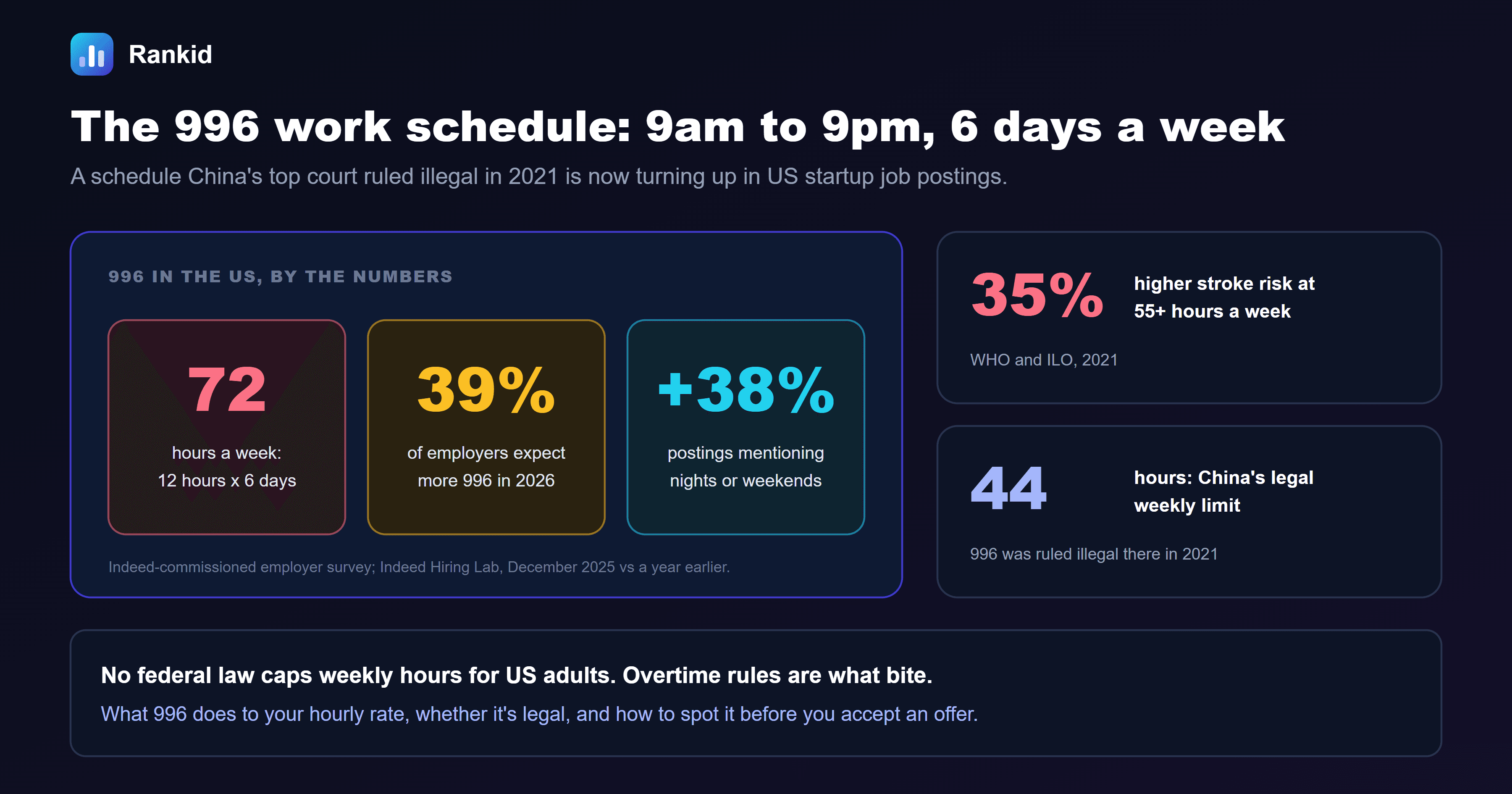
In August 2021, China's Supreme People's Court ruled that the 996 work schedule, 9am to 9pm, six days a week, broke the law. Four years later the same three digits began appearing in job postings in San Francisco and New York. A schedule one country banned after workers died is now pitched in another as a sign of ambition. If you're job hunting in tech, you need to know what it is, what it really pays, and how to recognize it when nobody uses the number.
Quick answer
Quick answer: 996 means 9am to 9pm, six days a week: 72 hours. It is generally legal in the US, because federal law doesn't cap adult working hours, though non-exempt staff must be paid overtime. 39% of employers expect it to increase in 2026 (Indeed). At 72 hours, a $150,000 salary works out to about $40 an hour, and research shows output barely rises past 55 hours while health risks do.
What is the 996 work schedule?
The name is the schedule: start at 9am, finish at 9pm, 6days a week. That's 12 hours a day and 72 hours a week, 32 more than a standard full-time job.
It took hold in Chinese technology companies in the 2010s. In 2019, engineers there launched a protest project on GitHub called 996.ICU, meaning "work 996, end up in intensive care." The same year, Alibaba founder Jack Ma called the schedule "a huge blessing." After a series of deaths linked to overwork, China's top court and labor ministry declared it illegal in August 2021.
Variants have their own shorthand. 007 means midnight to midnight, seven days a week: always on call. 955 is the ordinary 9-to-5, five days a week.
How 996 reached the US
The competition to build AI products is the cause. Founders argue that the window to win a market is short and that long hours are the price.
- AI sales startup Rilla posted an engineering job telling people not to apply unless they were excited to work about 70 hours a week in person.
- The CEO of AI coding company Cognition said publicly that the company expects 80-hour weeks, adding: "We don't believe in work-life balance."
- In a leaked memo in early 2025, Google co-founder Sergey Brin told AI staff that 60 hours a week was the "sweet spot" of productivity.
- A venture capital partner told Fortune in August 2025 that some AI companies were looking to write 996 clauses into executive hiring.
The numbers suggest the idea is spreading faster than the practice:
- 39% of employers in an Indeed-commissioned survey said they expect 996-style schedules to increase in 2026.
- Job postings mentioning weekend work, evening work and similar expectations were up 38% year over year in December 2025, according to Indeed Hiring Lab.
- Indeed also noted that verifiable cases of employees regularly working 9am to 9pm, six days a week, are limited.
Mostly a startup phenomenon
What 996 does to your hourly rate
A 996 offer often comes with a salary that looks generous. Divide it by the hours before you decide.
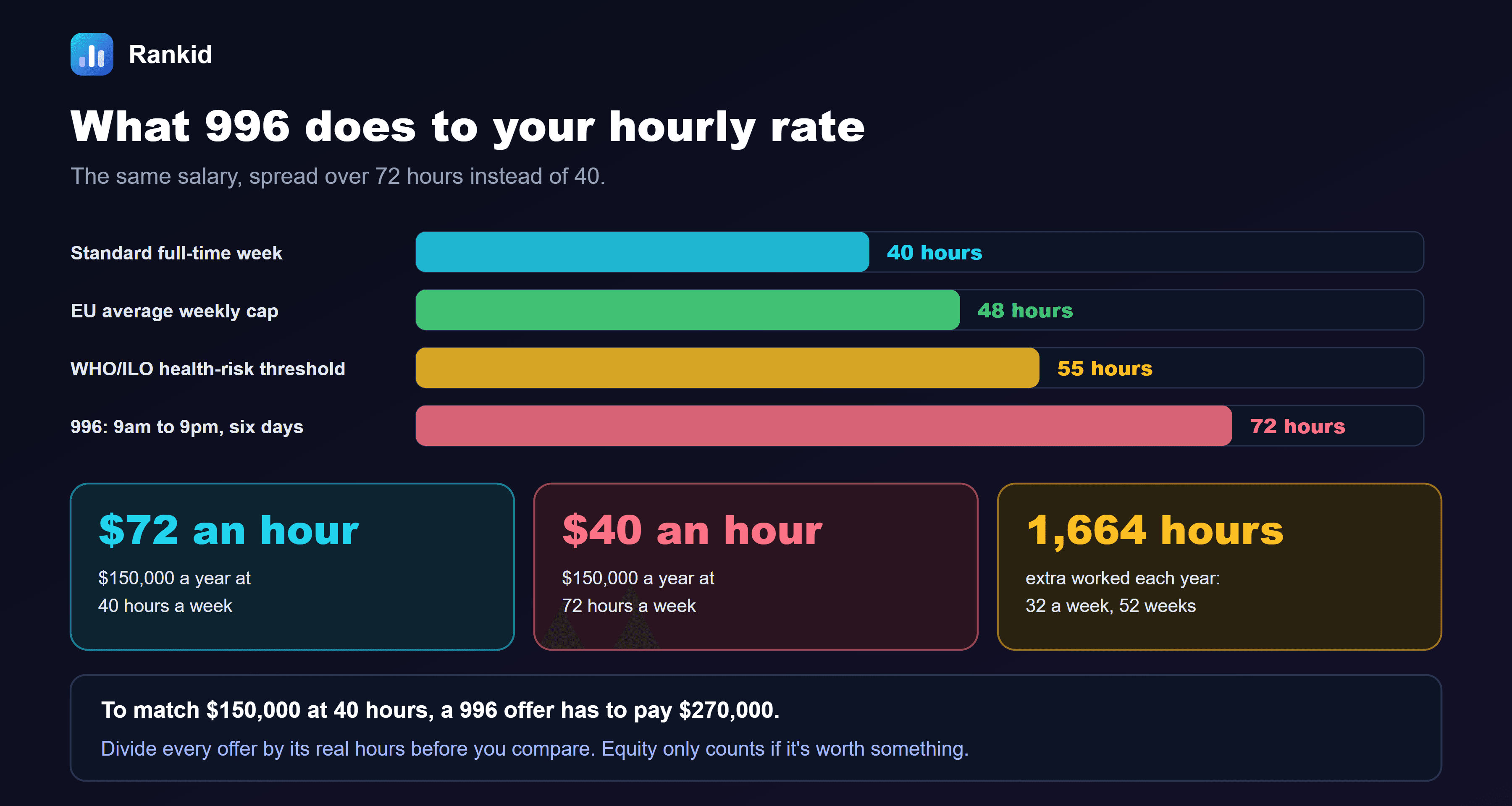
- $150,000 at 40 hours a week is about $72 an hour.
- $150,000 at 72 hours a week is about $40 an hour.
- To earn the same hourly rate at 72 hours, the salary would need to be $270,000.
- The extra 32 hours a week add up to 1,664 hours a year, which is most of a second full-time job.
Equity is the usual answer to this arithmetic. It can be a good one, but only if you know the numbers: how many shares, at what strike price, what the company was valued at in its last round, and how long you must stay to vest. Most startup equity ends up worth little. Treat it as a bonus you might get, and judge the offer on the cash. See how to respond to a job offer and how to negotiate salary.
Is 996 legal in the US?
In most cases, yes. That surprises people, so here is why.
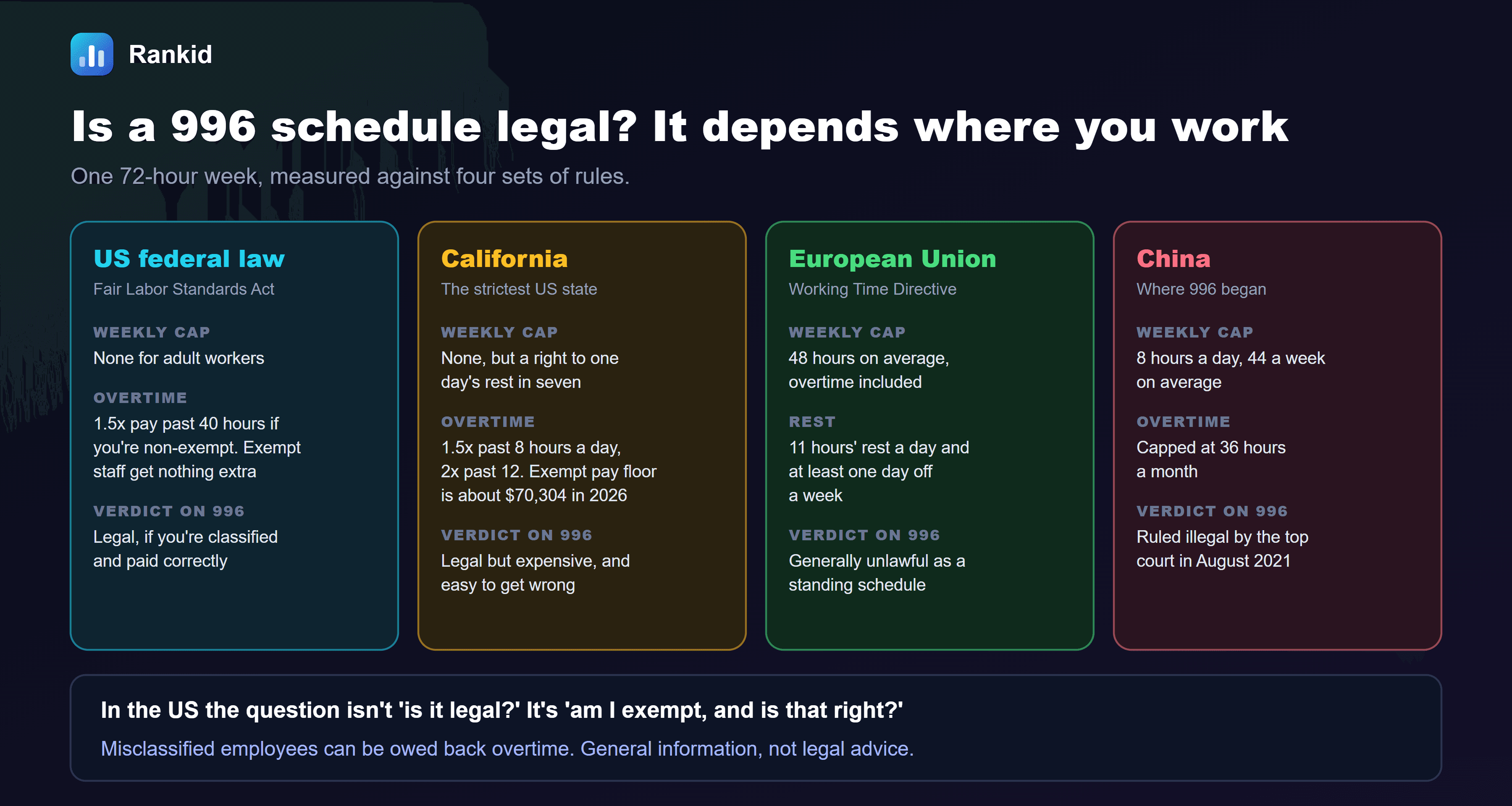
- No federal cap on hours.The Fair Labor Standards Act doesn't limit how many hours an adult can work in a week.
- Non-exempt employees must be paid overtime.That's 1.5 times the regular rate for every hour past 40. A 72-hour week means 32 overtime hours, which makes 996 costly for hourly staff.
- Exempt employees get nothing extra.If you're salaried, earn at least $684 a week ($35,568 a year) and your duties meet the test for an executive, administrative, professional or computer role, your employer can ask for 72 hours at the same pay. Most software engineers fall here.
- California is stricter.Non-exempt staff earn overtime after 8 hours in a day and double time after 12. Employees are generally entitled to one day's rest in seven. The exempt salary floor is about $70,304 in 2026, and the computer software exemption requires at least $122,573.13 a year.
- Employment is at-will. In most states you can be let go for refusing the hours, and you can leave whenever you choose.
The real legal exposure is misclassification. A junior employee labelled exempt whose pay or duties don't qualify is owed overtime, and at 32 extra hours a week that adds up quickly. If you're unsure of your status, see exempt vs non-exempt. This is general information, not legal advice.
Elsewhere the answer is different. The European Union limits the working week to 48 hours on average, including overtime, with 11 hours of rest a day. Several countries now have a right to disconnect.
Does working 72 hours a week work?
The case for 996 is that more hours mean more output. The research doesn't support it past a certain point.
- Output flattens. Stanford economist John Pencavel found that productivity per hour drops sharply after about 50 hours a week. People working 70 hours produced little more than those working 56. The last 14 hours bought almost nothing.
- Health risks rise. A 2021 analysis by the World Health Organization and the International Labour Organization linked working 55 or more hours a week to a 35% higher risk of stroke and a 17% higher risk of dying from heart disease, and attributed about 745,000 deaths in 2016 to long hours.
- Mistakes multiply. Tired people write worse code and make worse decisions, and someone has to fix both. Extra hours spent correcting errors made in earlier extra hours are a poor trade. See workslop for a related cost.
- People leave. Replacing an engineer costs months of salary and momentum. See employee turnover rate.
There is an honest counterpoint. A short, intense stretch before a launch can work, and some people choose demanding jobs early in their careers with their eyes open, for the learning and the equity. The problem is 996 as a permanent default, or as something you only discover after you've signed.
How to spot a 996 job before you accept
Few postings say "996." The signal is in the wording and in what you're told when you ask.
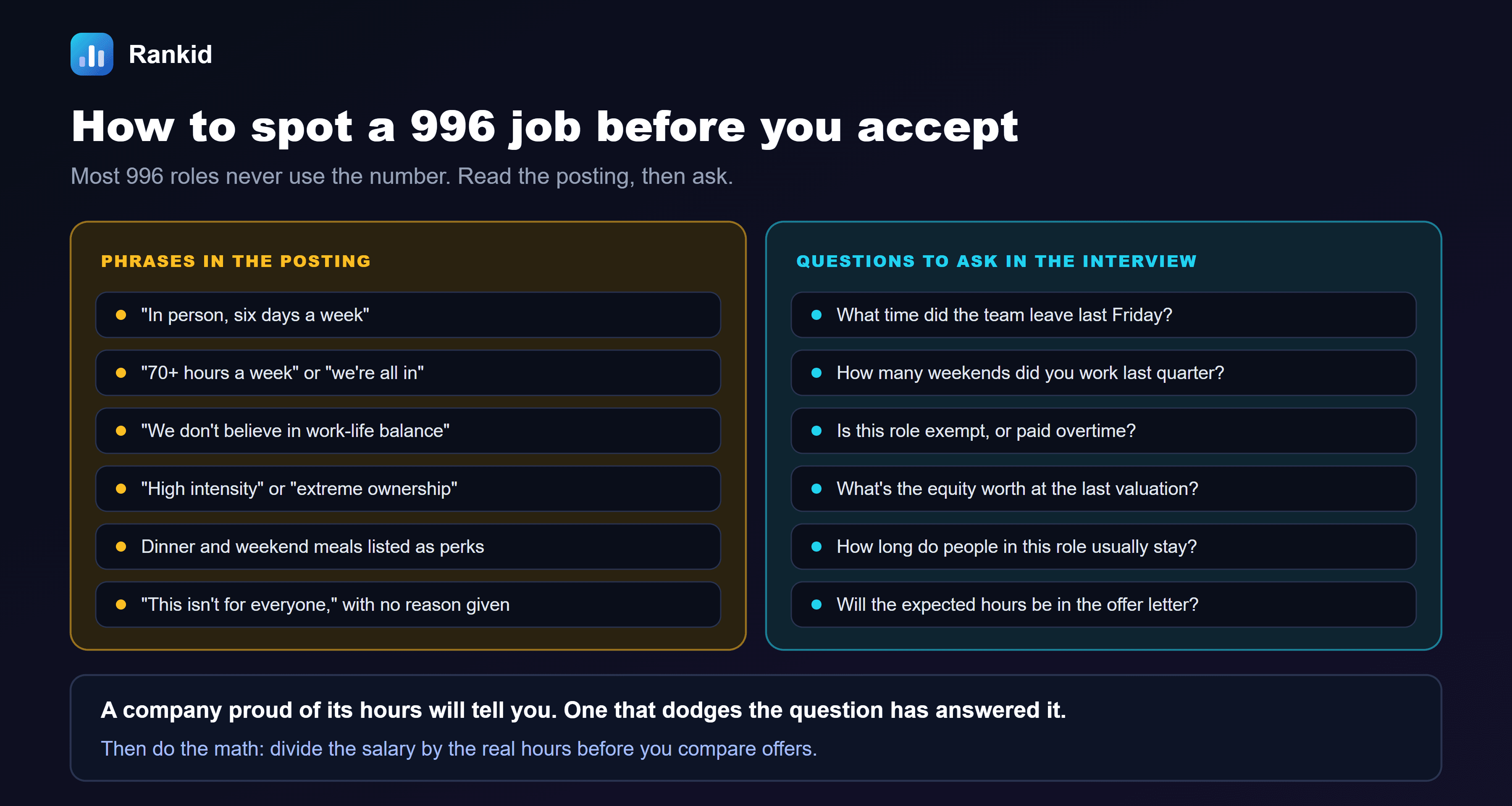
In the job posting:
- "In person, six days a week," or a Saturday mentioned anywhere.
- "70+ hours," "all in," "high intensity" or "extreme ownership."
- "We don't believe in work-life balance," or a founder who says so online.
- Dinner, late-night transport and weekend meals listed as benefits.
- "This isn't for everyone," with no explanation of why.
In the interview, ask about specifics, not culture:
What time did the team leave last Friday?
How many weekends did you work last quarter?
Is this role exempt, or paid overtime?
Will the expected hours be in the offer letter?
More ideas are in questions to ask in an interview. Check employee reviews and how long people stay, too: a team where most engineers leave within a year is answering your question for you.
Aim your applications at the roles you'd actually want
Paste your resume and a job description. Rankid gives you a free 0-100 match score and shows the exact requirements you meet and miss, so you can put your effort into the jobs worth having. No signup required.
Check your match score freeIf you're already working 996
- Check your classification.If your pay or duties don't meet the exempt test, you may be owed overtime.
- Keep your own record of hours. Dates, start and finish times, in a personal document.
- Get the equity in writing. Share count, strike price, vesting schedule and what happens if you leave.
- Set a review date. Decide now what would have to be true in six months for the trade to be worth it.
- Watch your health. Poor sleep, dread and constant exhaustion are early signs of quiet cracking.
- Build an exit route. A current resume and a few warm contacts cost little. See career cushioning.
For employers: what 996 costs you
- A smaller hiring pool.A six-day office week rules out most parents, carers and experienced people with options. You'll hire from whoever is left.
- Legal exposure. One misclassified employee working 72 hours creates a large back-pay claim. In California, add daily overtime, double time and rest-day rules.
- Less output than you think. If the research is right, hours 56 to 72 produce very little, and you pay for them in errors and departures.
- Say it plainly if you mean it. If long hours really are the job, put the expected hours in the posting and the offer. Candidates who accept knowingly stay longer than candidates who feel misled. See how to write a job description.
- Use intensity in bursts. A defined push before a launch, followed by real time off, gets most of the benefit without the attrition.
Hire faster without asking your team for more hours
Rankid scores every applicant against your job description on a consistent 0-100 scale and shows the exact requirements each matched and missed, so screening takes minutes, not evenings. First 5 resumes free, no signup.
Try bulk screening freeFrequently asked questions
What is the 996 work schedule?
996 means working from 9am to 9pm, six days a week. That is 12 hours a day and 72 hours a week, almost double a standard 40-hour week. The term comes from Chinese technology companies, where it became widespread in the 2010s. Since 2025 it has been used to describe US startups, mostly in artificial intelligence, that expect similar hours.
Is 996 legal in the United States?
Usually, yes. Federal law sets no limit on weekly hours for adults. The Fair Labor Standards Act requires employers to pay non-exempt employees 1.5 times their regular rate for hours past 40 in a week, so 996 is lawful for those workers if the 32 overtime hours are paid. Salaried employees who are properly classified as exempt can be asked to work 72 hours with no extra pay. The legal risk for employers is misclassification: treating someone as exempt when they are not.
Is 996 legal in California?
It can be, but California makes it harder and more expensive. Non-exempt employees are owed overtime after 8 hours in a day and double time after 12, employees are generally entitled to one day's rest in seven, and the minimum salary for most exempt roles is higher than the federal level, about $70,304 a year in 2026. Exempt computer software professionals must earn at least $122,573.13 a year in 2026 to qualify for that exemption.
Is 996 legal in China?
No. In August 2021, China's Supreme People's Court and the Ministry of Human Resources and Social Security jointly stated that 996 schedules violate labor law. Chinese law sets a standard of 8 hours a day and 44 hours a week on average, and caps overtime at 36 hours a month. Enforcement has been uneven.
How common is 996 in the US?
It is talked about more than it is practiced. In an Indeed-commissioned survey, 39% of employers said they expect 996-style schedules to increase in 2026, and Indeed Hiring Lab found postings mentioning weekend work, evening work and similar expectations were up 38% year over year in December 2025. Indeed also noted that verified cases of employees regularly working 9am to 9pm, six days a week, remain limited. It is concentrated in early-stage AI startups.
Does working 72 hours a week make you more productive?
Not in proportion to the hours. Research by Stanford economist John Pencavel found that output per hour falls sharply after about 50 hours a week, and that people working 70 hours produced little more than those working 56. Errors and rework rise with fatigue, which matters most in work that depends on judgment.
What are the health risks of a 996 schedule?
A 2021 analysis by the World Health Organization and the International Labour Organization found that working 55 or more hours a week is associated with a 35% higher risk of stroke and a 17% higher risk of dying from ischemic heart disease, compared with working 35 to 40 hours. It attributed about 745,000 deaths in 2016 to long working hours. A 72-hour week is well above that threshold.
How can I tell if a job is 996 before I accept?
Read the posting for phrases such as 'in person six days a week', '70+ hours', 'high intensity' or 'we don't believe in work-life balance', and for perks like dinner and weekend meals. Then ask directly in the interview: what time the team left last Friday, how many weekends they worked last quarter, and whether expected hours will be written into the offer letter.
Key takeaways
- 996 means working 9am to 9pm, six days a week: 72 hours.
- It began in Chinese tech, was ruled illegal there in August 2021, and is now used by some US AI startups.
- 39% of employers expect 996-style schedules to increase in 2026, and postings mentioning nights or weekends rose 38% in a year (Indeed), though verified cases remain limited.
- It's generally legal in the US: there's no federal cap on hours, non-exempt staff must be paid overtime, and exempt staff get nothing extra.
- At 72 hours a week, a $150,000 salary is about $40 an hour. Matching $150,000 at 40 hours would take $270,000.
- Output flattens past about 55 hours a week, while the risk of stroke and heart disease rises (Pencavel; WHO and ILO).
- Spot it through posting language and specific interview questions, and ask for expected hours in the offer letter.
Frequently asked questions
What is the 996 work schedule?
996 means working from 9am to 9pm, six days a week. That is 12 hours a day and 72 hours a week, almost double a standard 40-hour week. The term comes from Chinese technology companies, where it became widespread in the 2010s. Since 2025 it has been used to describe US startups, mostly in artificial intelligence, that expect similar hours.
Is 996 legal in the United States?
Usually, yes. Federal law sets no limit on weekly hours for adults. The Fair Labor Standards Act requires employers to pay non-exempt employees 1.5 times their regular rate for hours past 40 in a week, so 996 is lawful for those workers if the 32 overtime hours are paid. Salaried employees who are properly classified as exempt can be asked to work 72 hours with no extra pay. The legal risk for employers is misclassification: treating someone as exempt when they are not.
Is 996 legal in California?
It can be, but California makes it harder and more expensive. Non-exempt employees are owed overtime after 8 hours in a day and double time after 12, employees are generally entitled to one day's rest in seven, and the minimum salary for most exempt roles is higher than the federal level, about $70,304 a year in 2026. Exempt computer software professionals must earn at least $122,573.13 a year in 2026 to qualify for that exemption.
Is 996 legal in China?
No. In August 2021, China's Supreme People's Court and the Ministry of Human Resources and Social Security jointly stated that 996 schedules violate labor law. Chinese law sets a standard of 8 hours a day and 44 hours a week on average, and caps overtime at 36 hours a month. Enforcement has been uneven.
How common is 996 in the US?
It is talked about more than it is practiced. In an Indeed-commissioned survey, 39% of employers said they expect 996-style schedules to increase in 2026, and Indeed Hiring Lab found postings mentioning weekend work, evening work and similar expectations were up 38% year over year in December 2025. Indeed also noted that verified cases of employees regularly working 9am to 9pm, six days a week, remain limited. It is concentrated in early-stage AI startups.
Does working 72 hours a week make you more productive?
Not in proportion to the hours. Research by Stanford economist John Pencavel found that output per hour falls sharply after about 50 hours a week, and that people working 70 hours produced little more than those working 56. Errors and rework rise with fatigue, which matters most in work that depends on judgment.
What are the health risks of a 996 schedule?
A 2021 analysis by the World Health Organization and the International Labour Organization found that working 55 or more hours a week is associated with a 35% higher risk of stroke and a 17% higher risk of dying from ischemic heart disease, compared with working 35 to 40 hours. It attributed about 745,000 deaths in 2016 to long working hours. A 72-hour week is well above that threshold.
How can I tell if a job is 996 before I accept?
Read the posting for phrases such as 'in person six days a week', '70+ hours', 'high intensity' or 'we don't believe in work-life balance', and for perks like dinner and weekend meals. Then ask directly in the interview: what time the team left last Friday, how many weekends they worked last quarter, and whether expected hours will be written into the offer letter.