Career Cushioning: How to Build a Plan B Without Quitting (or Getting Caught)
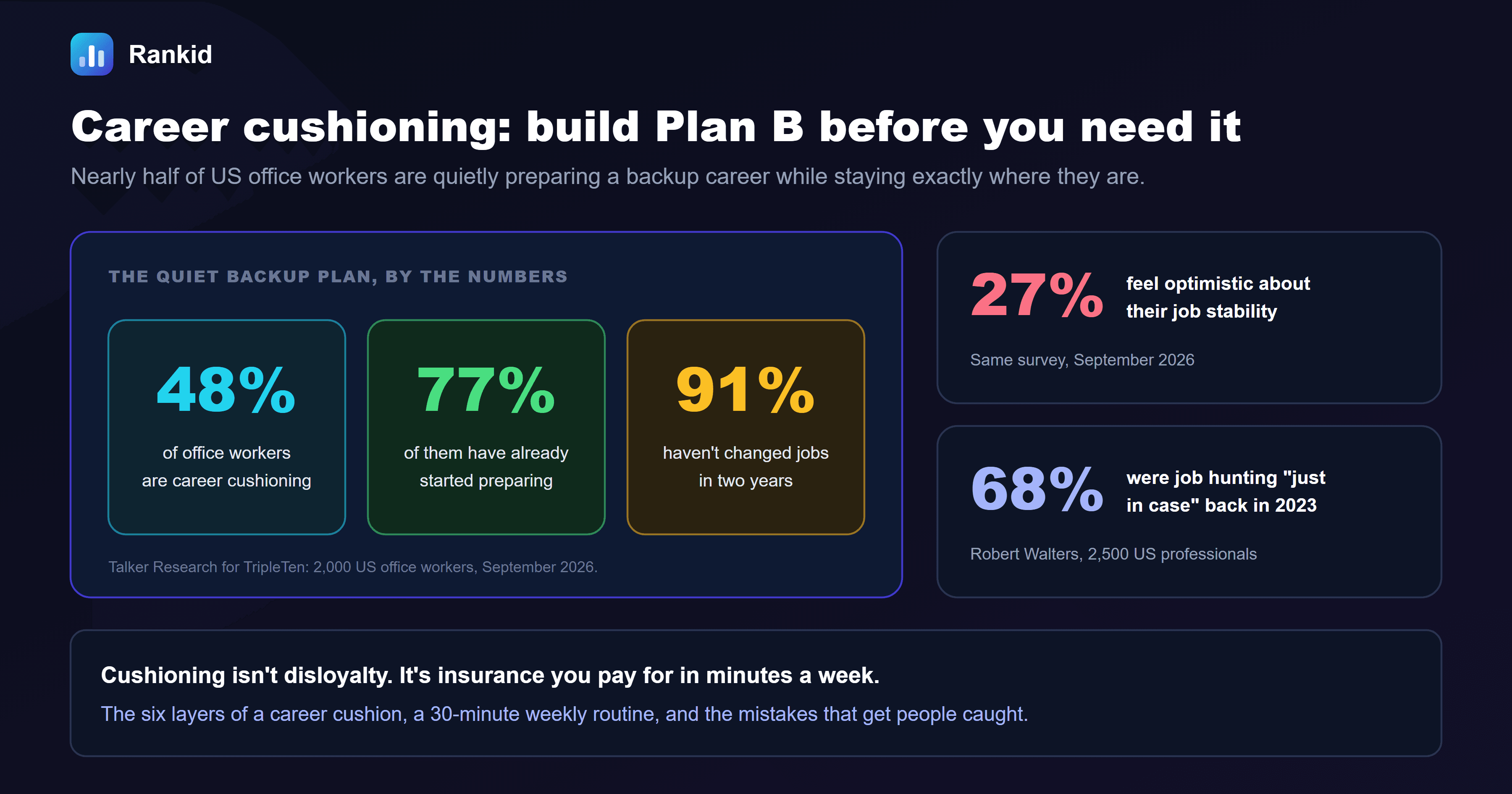
Here is a strange pair of numbers from the same survey. Ninety-one percent of US office workers have stayed in the same role for the past two years. Only 27% feel optimistic about their job stability. People aren't leaving, and they aren't relaxed either. What nearly half of them are doing instead has a name: career cushioning. It may be the most sensible workplace trend of 2026, provided you do it properly.
Quick answer
Quick answer: career cushioning is building a backup plan while you stay in your job: savings, a current resume, a warm network, new skills and some visibility to recruiters. 48%of US office workers say they're doing it (Talker Research for TripleTen, September 2026). It isn't disloyal and it isn't job hunting. It takes about 30 minutes a week. Keep it on your own time and your own devices, and keep doing your current job well.
What is career cushioning?
Career cushioning means preparing for a possible job loss or career change before it happens, without leaving your current role. The word comes from dating, where "cushioning" means keeping other options warm in case a relationship ends. It crossed over to work during the tech layoffs of late 2022.
In practice it looks like this:
- Keeping your resume and LinkedIn profile current, even when you're not applying.
- Staying in touch with former colleagues and people in your field.
- Learning a skill that your next role, not just your current one, will need.
- Reading job postings to see what the market wants and pays.
- Taking the occasional call from a recruiter.
- Building savings to cover a gap between jobs.
- Testing a second income or a different career path on a small scale.
What it doesn't involve is doing less at work. That's the line between cushioning and the trends it gets confused with.
Career cushioning statistics for 2026
The freshest data comes from a Talker Research survey of 2,000 US full-time office workers, conducted for education company TripleTen from September 4 to 11, 2026.
- 48% said they are career cushioning, and 77% of that group have already started preparing for a backup career.
- 91% have stayed in their current role for the past two years.
- Only 27% feel optimistic about their job stability, although 54% think the risk of losing their job in the next two years is low.
- 46% say their duties have changed significantly in two years, and 79% have learned new skills for their current job.
- The top reasons to pursue a backup path were tied at 29% each: doing something they enjoy more, a better lifestyle for the same pay, and losing their current job.
- The biggest barriers were lack of time (27%), concerns about age (26%) and fear of starting again at entry level (20%).
It isn't a new instinct. In 2023, recruiter Robert Walters polled 2,500 US white-collar professionals and found 68%were already looking at other jobs "just in case," driven by low job satisfaction (48%), lack of job security (28%) and internal changes at their company (16%).
Why now
Career cushioning vs job hugging vs quiet quitting
All three describe people who stay in a job they have doubts about. They lead to very different places.
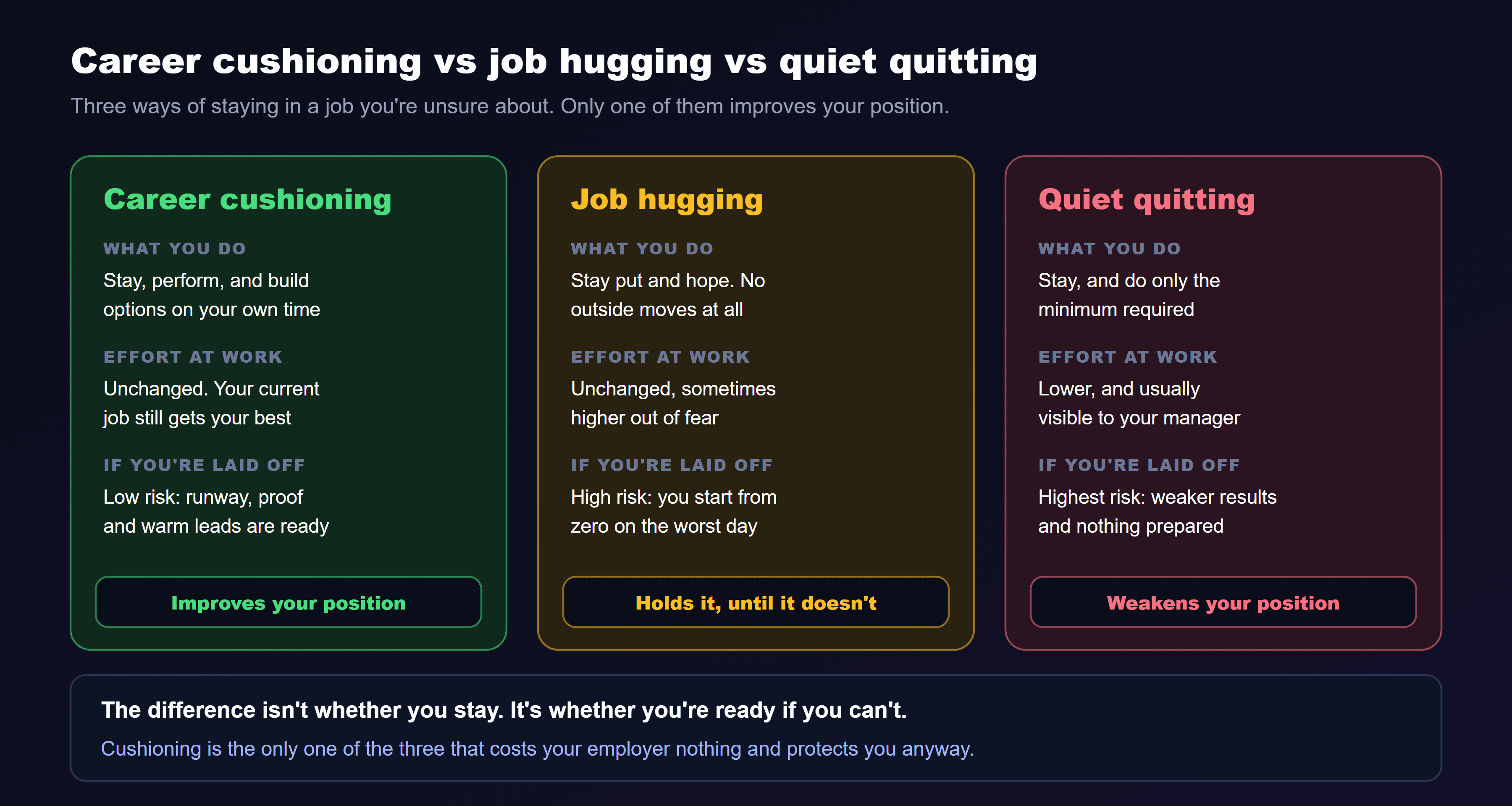
- Career cushioning: full effort at work, plus preparation outside it. If the job ends, you have savings, a resume and people to call.
- Job hugging: full effort at work, and nothing outside it. It feels safe, and it leaves you starting from zero on the worst possible day.
- Quiet quitting: reduced effort and no preparation. Results weaken, references weaken, and your name moves up the list when cuts come.
It also differs from overemployment, which means secretly holding two full-time jobs at once. Cushioning is preparation, not a second employer.
The six layers of a career cushion
Think of it as layers, built from the bottom. The lower ones buy you time. The upper ones give you options.
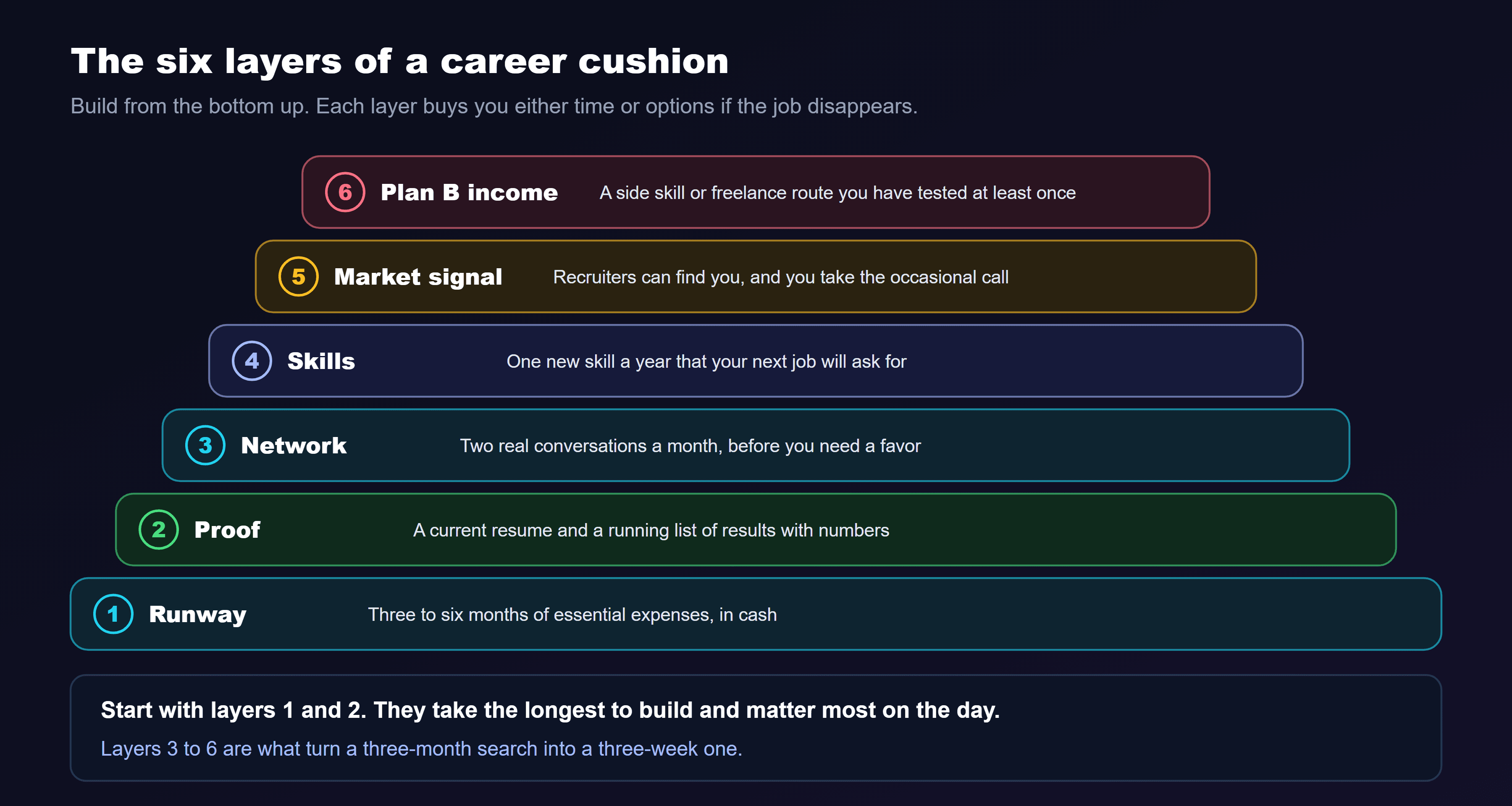
Runway: three to six months of essential expenses
Proof: a current resume and a list of results
Network: two real conversations a month
Skills: one new skill a year
Market signal: let recruiters find you
Plan B income: something you've tested once
The 30-minute weekly cushion
Lack of time is the number one barrier people report. So keep it small: one task a week, rotating through four themes.
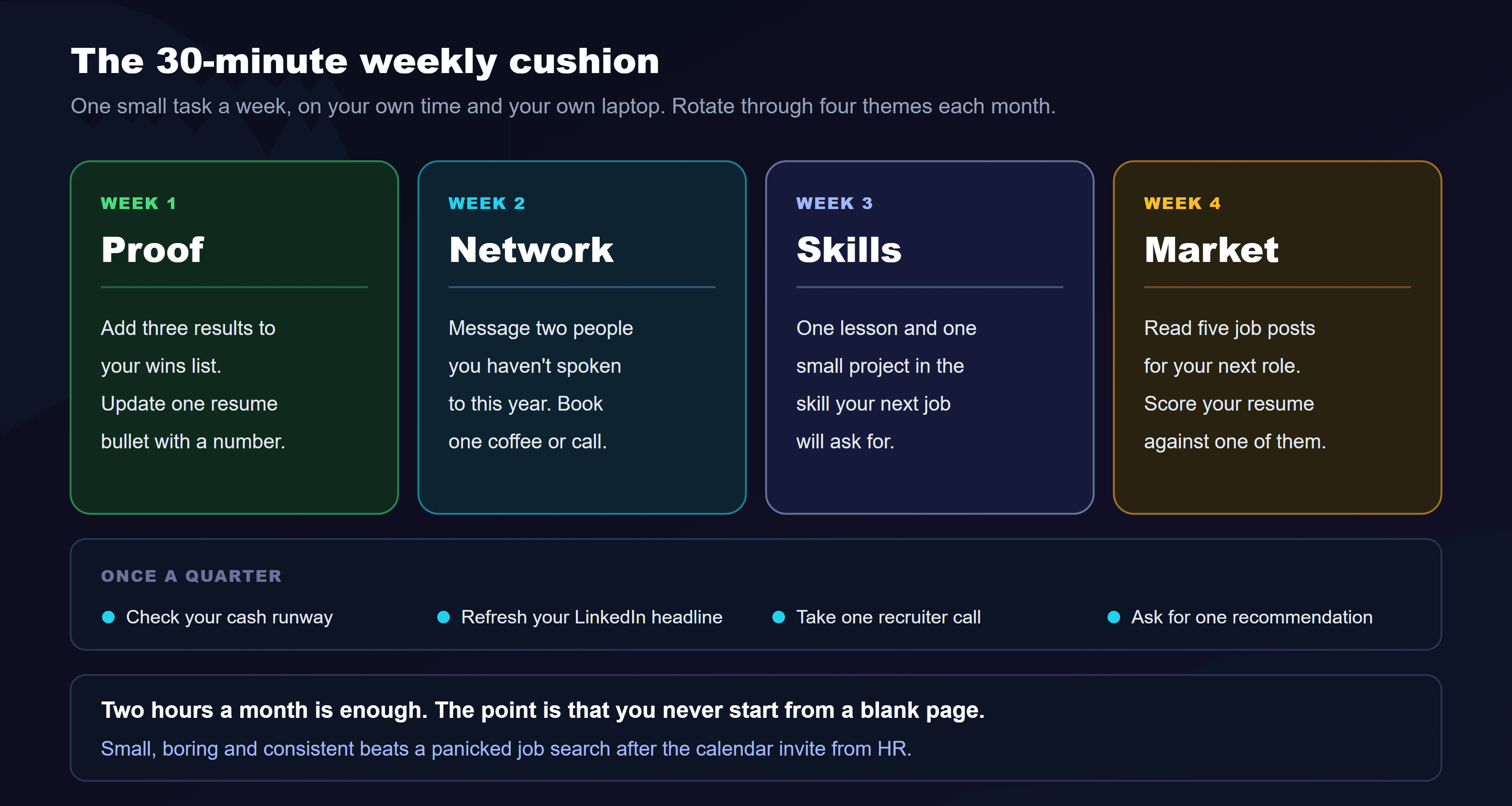
- Week 1, proof: add three results to your list and rewrite one resume bullet with a number in it.
- Week 2, network:message two people you haven't spoken to this year. Book one call.
- Week 3, skills: one lesson and one small project.
- Week 4, market: read five job postings for your next role and check your resume against one of them. The gaps tell you what to work on in week 3.
Do your week 4 check in two minutes
Paste your resume and a job description for the role you'd want next. Rankid gives you a free 0-100 match score and the exact requirements you meet and miss, so you know which skill to build before you need the job. No signup required.
Check your match score freeCan you be fired for career cushioning?
In the US, most employment is at-will, so yes, an employer can generally let you go for looking elsewhere, and no law protects job searching in itself. In reality, people are rarely fired for having a resume. They're fired, or quietly sidelined, for how they went about it.
Seven mistakes that get people caught:
- Using a work laptop or work email. Assume both are logged. See what employee monitoring can see.
- Doing it during work hours.Recruiter calls at your desk and interviews labelled "dentist" three times in a month get noticed.
- Switching on the public "Open to Work" banner.LinkedIn has a recruiters-only setting. It hides the signal from recruiters at your own company, though LinkedIn says it can't guarantee complete privacy.
- A sudden burst of LinkedIn activity. Ten new connections at a competitor and a rewritten profile in one evening is a message. Make changes gradually.
- Telling a colleague. It travels. Tell nobody at work.
- Ignoring your contract. Moonlighting, conflict-of-interest, confidentiality and non-compete clauses can all limit side work. Read them before you take on a freelance client.
- Letting your performance slip.The best cover for cushioning is being good at your job. It's also the best cushion.
Don't take company material
Is career cushioning disloyal?
No. Your employer has a plan for what happens if you leave, and a plan for what happens if it needs to cut your role. That isn't a sign of bad faith. It's ordinary risk management, and the same applies to you.
There's a practical argument too. The skills, contacts and market knowledge you build for a possible future make you more useful in your present job. And people with options tend to negotiate from a calmer position, whether that's asking for a raise or pushing back on an unreasonable request.
When to stop cushioning and start searching
Cushioning is the default. Switch to an active search if:
- You see several signs that layoffs are coming.
- You're being quietly managed out or placed on a performance improvement plan.
- Your week 4 check keeps showing roles you'd clearly prefer and already qualify for.
- The job is affecting your health. See quiet cracking.
With a cushion in place, an active search starts from a finished resume and a list of people to call. If an offer arrives, don't accept one you might walk away from; that road leads to career catfishing.
For employers: what to do when your team is cushioning
If half of office workers are cushioning, some of your best people are. You can't stop it, and trying to tends to speed up the outcome you're afraid of.
- Don't punish it. Penalizing someone for an updated LinkedIn profile tells the whole team that leaving is the only safe way to look around.
- Be honest about the business.People cushion hardest when they don't know what's happening. Regular, plain updates reduce the anxiety that drives it.
- Ask what would make them stay. Use one-on-ones for stay conversations, not only status updates.
- Offer the growth they're seeking elsewhere. Nearly half of workers already learn through employer training. An individual development plan and real internal moves give people a Plan B inside your company.
- Check pay against the market.If a recruiter call tells your employee they're underpaid, you'd rather have found out first. See salary bands and compa-ratio.
- Plan for the departures you can't prevent. Succession planningis the employer's own career cushion.
Hiring from a market full of careful movers?
Rankid scores every applicant against your job description on a consistent 0-100 scale and shows the exact requirements each matched and missed, so you can respond to strong candidates quickly. First 5 resumes free, no signup.
Try bulk screening freeFrequently asked questions
What is career cushioning?
Career cushioning is quietly preparing a backup plan while you stay in your current job. It includes keeping your resume current, building new skills, staying in touch with your network, taking the occasional recruiter call and exploring other career paths. The goal is to soften the landing if you're laid off or the job stops working for you. The term comes from dating, where 'cushioning' means keeping other options warm, and it became popular during the tech layoffs of late 2022.
How common is career cushioning?
Very. In a Talker Research survey of 2,000 US full-time office workers conducted for TripleTen in September 2026, 48% said they are career cushioning, and 77% of those said they have already begun preparing for a backup career. An earlier Robert Walters poll of 2,500 US white-collar professionals in 2023 found 68% were already looking at other jobs as a 'just in case' measure.
Is career cushioning the same as job hunting?
No. Job hunting has a deadline and an intention to leave. Career cushioning is ongoing preparation with no fixed plan to go. In the TripleTen survey, 91% of respondents had stayed in the same role for the past two years, so most people who cushion are not leaving. They are making sure they could.
What is the difference between career cushioning and job hugging?
Both involve staying put. Job hugging is holding on to your current job out of fear and making no outside moves at all, which leaves you unprepared if the job ends. Career cushioning is staying while actively building options on your own time. Quiet quitting is different again: staying while doing only the minimum, which weakens your results and your references.
Can you be fired for career cushioning?
In the US, most employment is at-will, so an employer can generally dismiss you for looking at other jobs, and nothing protects job searching as such. In practice, people get into trouble for how they do it: using a work laptop, searching during work hours, taking recruiter calls at their desk, or breaching a moonlighting or confidentiality clause. Done on your own time and your own devices, cushioning is low-risk.
Is career cushioning disloyal?
No, as long as your current job still gets your full effort. Employers keep contingency plans for every role, including succession plans and layoff scenarios. Keeping your own is the equivalent. It can even make you better at your job, because skills and contacts you build for a possible future are useful now.
How much time does career cushioning take?
About 30 minutes a week is enough once it's a habit. Rotate through four themes each month: record your results and update your resume, contact two people in your network, spend one session on a new skill, and read current job postings for your next role. Once a quarter, check your savings runway and refresh your LinkedIn profile.
What should I do first if I want to start career cushioning?
Start with the two things that take longest to build and matter most on the day you need them: money and proof. Work toward three to six months of essential expenses in savings, and start a running list of your results with numbers. Then update your resume from that list. Networking, skills and recruiter visibility come next.
Key takeaways
- Career cushioning is building a backup plan (savings, resume, network, skills, recruiter visibility) while staying in your current job.
- 48% of US office workers say they're doing it, and 77% of those have already started preparing (Talker Research for TripleTen, September 2026).
- 91% haven't changed roles in two years, yet only 27% feel optimistic about their job stability.
- It differs from job hugging (staying with no preparation) and quiet quitting (staying with less effort). Only cushioning improves your position.
- Build six layers from the bottom: runway, proof, network, skills, market signal and a tested Plan B income.
- Thirty minutes a week is enough: rotate through proof, network, skills and market checks each month.
- Keep it on your own time and devices, tell no one at work, check your contract, and keep performing.
- Employers can't stop cushioning. Honest communication, development plans, internal moves and fair pay give people a Plan B inside the company.
Frequently asked questions
What is career cushioning?
Career cushioning is quietly preparing a backup plan while you stay in your current job. It includes keeping your resume current, building new skills, staying in touch with your network, taking the occasional recruiter call and exploring other career paths. The goal is to soften the landing if you're laid off or the job stops working for you. The term comes from dating, where 'cushioning' means keeping other options warm, and it became popular during the tech layoffs of late 2022.
How common is career cushioning?
Very. In a Talker Research survey of 2,000 US full-time office workers conducted for TripleTen in September 2026, 48% said they are career cushioning, and 77% of those said they have already begun preparing for a backup career. An earlier Robert Walters poll of 2,500 US white-collar professionals in 2023 found 68% were already looking at other jobs as a 'just in case' measure.
Is career cushioning the same as job hunting?
No. Job hunting has a deadline and an intention to leave. Career cushioning is ongoing preparation with no fixed plan to go. In the TripleTen survey, 91% of respondents had stayed in the same role for the past two years, so most people who cushion are not leaving. They are making sure they could.
What is the difference between career cushioning and job hugging?
Both involve staying put. Job hugging is holding on to your current job out of fear and making no outside moves at all, which leaves you unprepared if the job ends. Career cushioning is staying while actively building options on your own time. Quiet quitting is different again: staying while doing only the minimum, which weakens your results and your references.
Can you be fired for career cushioning?
In the US, most employment is at-will, so an employer can generally dismiss you for looking at other jobs, and nothing protects job searching as such. In practice, people get into trouble for how they do it: using a work laptop, searching during work hours, taking recruiter calls at their desk, or breaching a moonlighting or confidentiality clause. Done on your own time and your own devices, cushioning is low-risk.
Is career cushioning disloyal?
No, as long as your current job still gets your full effort. Employers keep contingency plans for every role, including succession plans and layoff scenarios. Keeping your own is the equivalent. It can even make you better at your job, because skills and contacts you build for a possible future are useful now.
How much time does career cushioning take?
About 30 minutes a week is enough once it's a habit. Rotate through four themes each month: record your results and update your resume, contact two people in your network, spend one session on a new skill, and read current job postings for your next role. Once a quarter, check your savings runway and refresh your LinkedIn profile.
What should I do first if I want to start career cushioning?
Start with the two things that take longest to build and matter most on the day you need them: money and proof. Work toward three to six months of essential expenses in savings, and start a running list of your results with numbers. Then update your resume from that list. Networking, skills and recruiter visibility come next.