Diversity Hiring: Inclusive Practices That Change Who Gets Interviewed (2026)
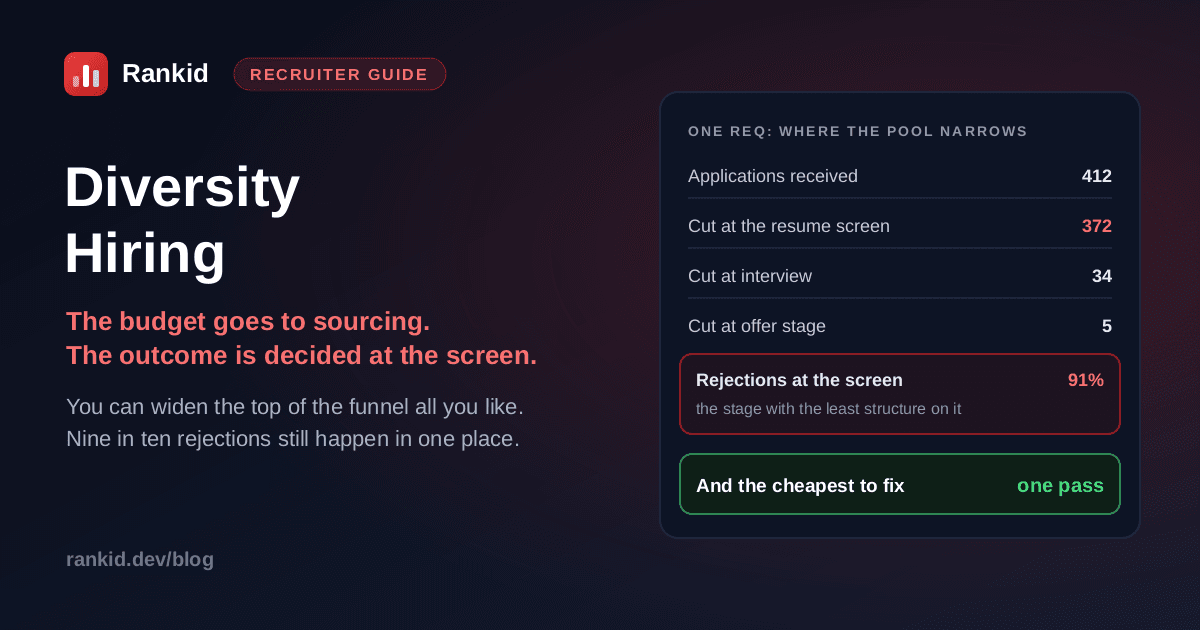
Almost every diversity hiring budget is spent at the top of the funnel: job board partnerships, event sponsorships, employer branding, careers-page photography. Then a requisition opens, 412 people apply, a recruiter reads about 40 of them before the week runs out, and a shortlist gets drawn. Whatever happened upstream, that last step just decided the outcome. This guide is about that step, because it is where nine in ten rejections happen and where the least structure usually sits.
Quick answer
What diversity hiring is, and what it is not
Diversity hiring is the practice of building a process in which qualified people from a wide range of backgrounds can realistically reach and pass each stage. The useful framing is subtractive rather than additive: you are not adding a thumb to the scale, you are removing the things already on it that have nothing to do with whether someone can do the work.
Those things are usually mundane. A degree requirement nobody can justify. A posting that lists fifteen requirements when five are real, which measurably deters candidates who read the list as a checklist rather than a wish list. A pay band kept secret, so the offer ends up anchored to whoever negotiated hardest. A screen that ran out of time at resume 40. None of that is anyone's intention, and all of it shapes who gets hired.
It is also worth being precise about the terms, because they are used interchangeably and mean different things. Diversity describes the composition of a group. Inclusion describes whether the process and the workplace actually work for the people in it. Diversity recruiting tends to mean widening the pool through sourcing; inclusive hiring means making each stage fair and navigable once people are in it. Widening the pool without fixing the process just routes more people through the same filter.
On quotas, plainly
The uncomfortable arithmetic: arrival order picks most shortlists
Here is the part that rarely appears in diversity hiring guides, probably because it is unglamorous. On a typical advertised role, applications substantially outnumber the hours available to read them. At roughly 90 seconds per resume for a real evaluation, 412 applicants is over ten hours of reading for a recruiter who is also carrying five other requisitions. That reading does not finish. It stops.
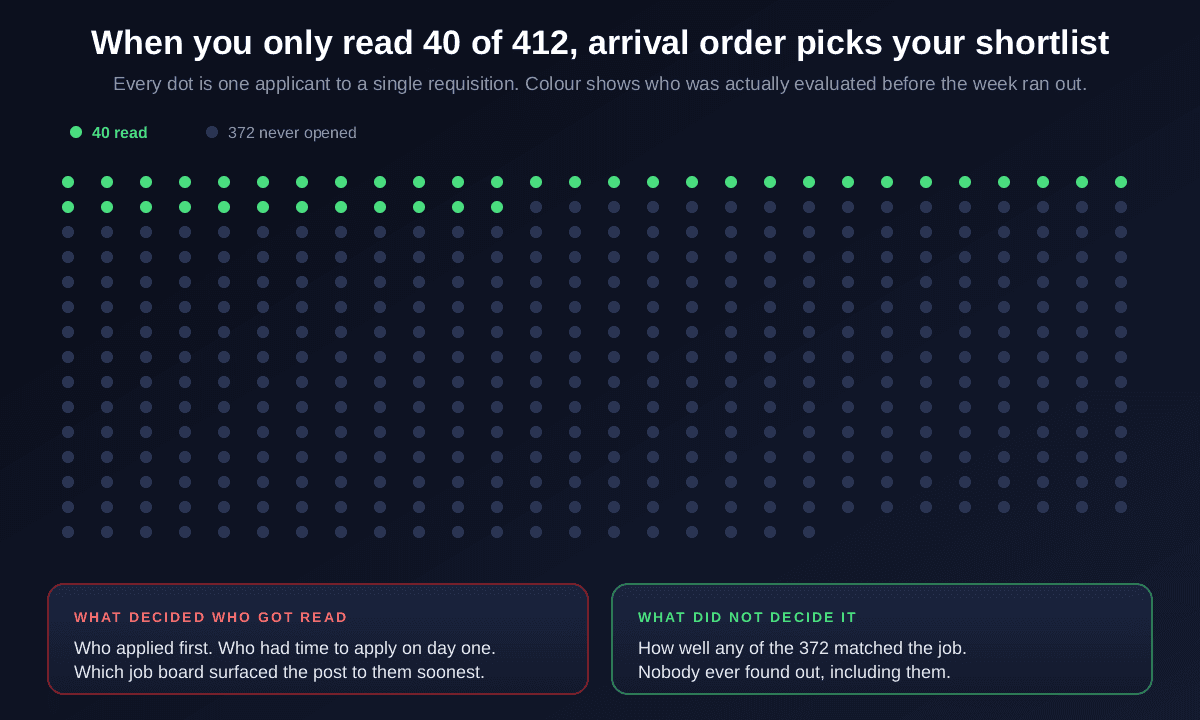
When it stops, the people who were evaluated are not the strongest 40. They are the earliest 40. And applying early is not randomly distributed: it correlates with being between jobs rather than working full time, with having the flexibility to apply during the workday, with which job board surfaced the post first, and with having a resume already tailored and ready to send. None of those things predicts job performance.
This matters more than most interview-stage interventions, and it is worth sitting with why. A structured interview process is genuinely valuable, but it operates on the six people who reached the interview. The decision about which six is made earlier, on incomplete information, by whoever had time. If you fix only the interview, you have made the last two percent of the process fair.
Inclusive hiring practices, ranked by how many people they reach
The most useful way to prioritise diversity and inclusion hiring practices is not by how much they are discussed, but by the number of candidates they act on. Same list, sorted by leverage:
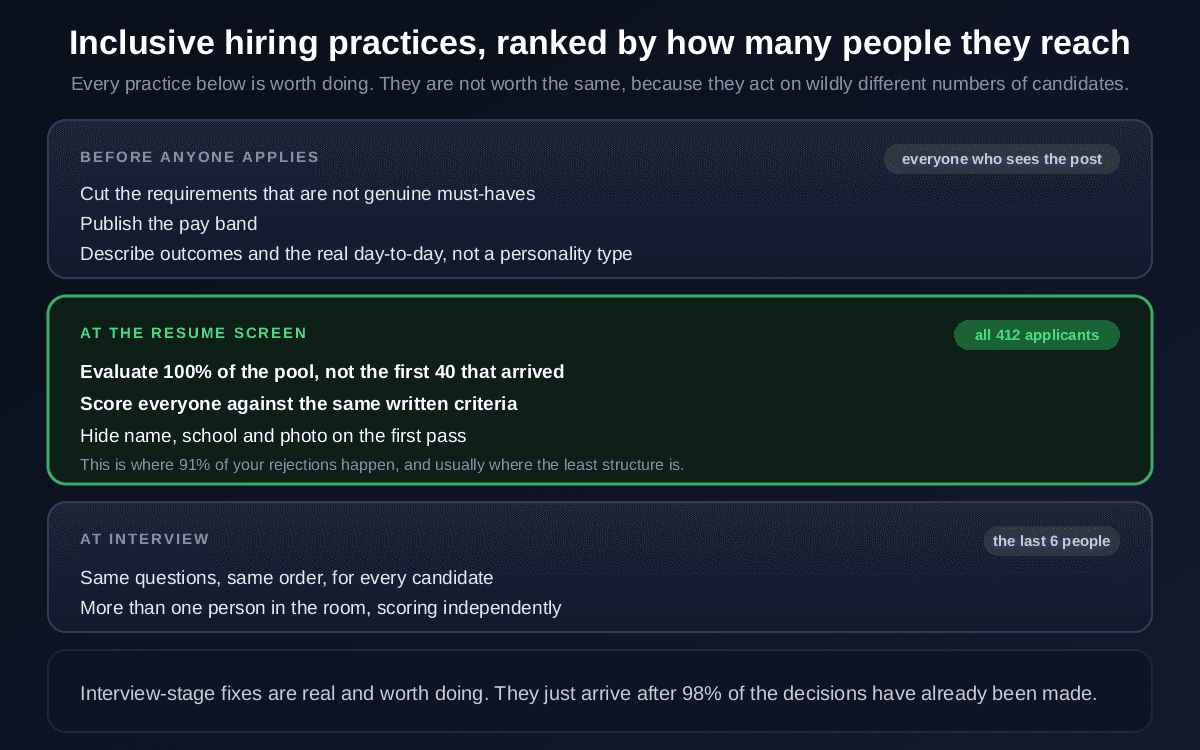
Cut the requirements that are not genuine must-haves
Go through the posting and force every requirement to justify itself: would you actually reject an otherwise excellent candidate for missing this? Most postings cannot defend half their list. Degree requirements deserve particular scrutiny, since for many roles they are a proxy for skills you could assess directly, which is the entire argument behind skills-based hiring. This is the single highest-reach edit available, because it changes who applies at all. The structure for it is in how to write a job description.
Publish the pay band
Increasingly required by law in US states including Colorado, California, New York and Washington, and worth doing everywhere else. A published band means the offer is anchored to the role rather than to who negotiated hardest, which is one of the more reliably documented sources of pay disparity. It also saves you the mismatched screening calls, as covered in the screening interview guide.
Evaluate the whole pool, not the first forty
The highest-leverage operational change in this entire guide. If every applicant is scored against the same written criteria, arrival order stops mattering and the person at position 340 gets the same consideration as the person at position 3. This is not primarily a fairness argument, it is a coverage argument: you cannot select well from a pool you never looked at. The mechanics are in how to screen resumes in bulk.
Write the criteria down before you start reading
Decide what a strong candidate looks like, in writing, before the first resume. Criteria invented while reading tend to drift toward whoever you have already seen, and they are impossible to audit afterwards. Separate must-haves from nice-to-haves explicitly. Our resume screening criteria guide covers how to write ones that actually discriminate between candidates on the work.
Structure the interview, and use more than one scorer
Same questions in the same order for every candidate, scored independently before anyone discusses them, so the first opinion voiced does not become the group's opinion. Worth doing, and reaching only the last handful of people, which is exactly the point of ordering this list. The question design is in interview questions to ask candidates.
Evaluate all 412, not the first 40
Upload your full applicant batch and paste the job description. Rankid scores every candidate 0 to 100 against the same criteria, with the skills and keywords each one matches and misses, so nobody gets skipped because the week ran out. Up to 200 resumes per batch, and your first 5 are free with no signup.
Score your whole applicant pool freeWhat is blind hiring, and does it actually work?
Blind hiring, sometimes called blind recruiting, means stripping identifying details from an application before it is evaluated: name, photo, address, school, graduation year, and sometimes employer names. The reasoning is straightforward, since those fields carry signals about ethnicity, gender, age and class that have nothing to do with the work.
The honest assessment is that it helps in a specific place and is oversold everywhere else. It works best exactly where humans are skim-reading and pattern-matching at speed, which is the resume screen. Its effect does not survive into the interview, where the person is visibly present. And it cannot rescue a flawed set of criteria: anonymising a resume that is being judged against an unnecessary degree requirement or a decade of continuous employment changes nothing about who passes.
Two practical cautions. First, blinding can make parse quality matter more, not less, because you have removed the contextual cues a human uses to fill gaps, and parse errors are not randomly distributed. Second, if you blind the screen but leave the criteria unexamined, you have built a fairer procedure on top of an unfair standard. Do the criteria first, then blind.
Diversity recruiting metrics that tell you something
Headline representation is the number everyone reports and the least useful one operationally, because it tells you that something is wrong without ever telling you where. Measure by stage instead:
- Selection rate at each stage.The share of each group that passes each step. Compare using the four-fifths rule: a group passing at under 80 percent of the highest group's rate flags that stage for examination. The full calculation is in adverse impact.
- Share of applicants actually evaluated. Almost nobody tracks this and it may be the most revealing number in your funnel. If it is 10 percent, most of your process is theoretical.
- Requirement count versus genuine must-haves. A posting with fifteen listed requirements and five real ones is filtering on the other ten whether you intended it or not.
- Source composition versus hire composition. If the pool you attract looks different from the people you hire, the loss is happening inside your process, not in your sourcing. That is a useful thing to know before spending more on sourcing.
- Drop-off and withdrawal by stage. Candidates leaving your process is a signal too, and it clusters around long silences and unclear next steps.
Measure the stage, not just the outcome
What to avoid
- Fixing the interview and calling it done. The most common pattern. It is real work applied to two percent of the decisions.
- Widening sourcing into an unchanged screen. Spending more to attract a broader pool that then meets the same first-forty filter converts budget into disappointment, and into a worse experience for the people you invited.
- Automating rejection. Automated ranking applied to the whole pool is a genuine improvement in consistency. Automated rejection scales whatever is wrong with your criteria across everyone at once, invisibly. Rank with software, decide with a person, as argued in recruitment automation.
- Deploying a screening tool without auditing it.Automated employment decision tools are specifically regulated in a growing number of places, including New York City's Local Law 144 bias-audit and notice requirements and the EU AI Act's high-risk classification for recruitment systems. Audit pass rates by group regardless of what the vendor claims.
- Treating culture fit as a criterion. Undefined culture fit is where unexamined preference goes to hide. If a behaviour genuinely matters, name it, turn it into a question about past work, and ask everyone the same one.
An inclusive hiring checklist you can run this week
- Every requirement in the posting can be justified as a genuine must-have, or it is cut.
- The pay band is published in the post.
- Screening criteria are written down before the first resume is opened.
- Every applicant is evaluated against those criteria, not just the early arrivals.
- Name, school and photo are hidden on the first pass, once the criteria are sound.
- No candidate is rejected by software without a person reviewing the decision.
- Interview questions are fixed in advance and identical across candidates.
- At least two people score independently before discussing.
- Accommodations are offered by default in the invitation, not on request.
- Selection rates by stage are calculated at least once per requisition.
- Everyone who applied receives an answer, including the people you never read.
Key takeaways
- Diversity hiring is subtractive: remove what filters people out for reasons unrelated to the work.
- Rank every inclusive practice by how many candidates it reaches, not by how much it is discussed.
- When 412 apply and 40 get read, arrival order picks your shortlist, and arrival order predicts nothing.
- 91% of rejections happen at the resume screen, the stage with the least structure on it.
- Blind hiring helps at the screen and cannot rescue flawed criteria. Fix the criteria first.
- Track selection rates by stage and the share of applicants actually evaluated, not headline representation.
- Rank with software and decide with a person. Rankid scores up to 200 resumes per batch, first 5 free.
Bottom line: diversity hiring gets treated as a values conversation when most of it is a throughput problem wearing a values costume. The pool you attract is only as good as the share of it you actually look at, and the fairest set of interview questions in the world cannot reach someone whose resume was never opened. Fix the stage where the volume is, apply one written standard to everybody in it, and the rest of your effort finally lands on a pool worth having. Score every applicant on your next requisition and find out who was in the 372.
Frequently asked questions
What is diversity hiring?
Diversity hiring is the practice of designing a hiring process so that qualified people from a wide range of backgrounds can realistically reach and pass each stage. It is a process discipline, not a preference system: the goal is to remove the arbitrary things that filter people out for reasons unrelated to whether they can do the job, such as an unnecessary degree requirement, a job post written to appeal to one kind of person, or a screen that only reads the first forty resumes to arrive. Done properly it widens who is genuinely considered without lowering the standard anyone is measured against.
What is the difference between diversity hiring and inclusive hiring?
Diversity describes the composition of a group, and inclusion describes whether the process and the workplace actually work for the people in it. In recruiting terms, diversity recruiting usually refers to widening the pool through sourcing and job posting, while inclusive hiring refers to making each stage of the process fair and navigable: an accessible application, a clear pay band, consistent evaluation criteria, structured interviews and accommodations offered by default. Widening the pool without fixing the process just means more people experience the same filter, which is why the two have to be done together.
What are the best diversity and inclusion hiring practices?
Rank them by how many candidates they actually touch. Practices before anyone applies reach everyone who sees the post: cut requirements that are not genuine must-haves, publish the pay band, and describe real outcomes rather than a personality type. Practices at the resume screen reach every applicant, and this is where most rejections happen: evaluate the entire pool rather than the first batch to arrive, score everyone against the same written criteria, and consider hiding name, school and photo on the first pass. Practices at interview reach only the handful who got that far: same questions in the same order, and more than one interviewer scoring independently. All of these are worth doing, but they are not worth the same.
What is blind hiring and does it work?
Blind hiring, also called blind recruiting, means removing identifying details such as name, photo, school, graduation year and address before a resume is evaluated, so the first judgement is made on relevant content only. The evidence for it is real but narrower than it is often sold as: it mainly helps at the stage where humans are skim-reading and pattern-matching, and its effect disappears once interviews begin. It also cannot fix a biased set of criteria, because anonymising a resume that is being judged against an unnecessary degree requirement changes nothing. Treat it as one useful control at the screen rather than as a solution on its own.
Are diversity hiring quotas legal?
In the United States, hiring quotas or set-asides based on race, sex or other protected characteristics are unlawful under Title VII, and corporate diversity programmes have faced increased legal scrutiny in recent years. What is generally lawful is widening the pool and standardising evaluation: broader sourcing, removing unnecessary requirements, diverse slates as an input goal rather than an outcome guarantee, structured interviews, and auditing pass rates for adverse impact. Rules differ by jurisdiction, and positive action provisions in the UK and parts of the EU work differently from US law, so take advice from employment counsel before setting any formal target.
What diversity recruiting metrics should you track?
Track pass rates by stage rather than headline representation, because a single overall number tells you that something is wrong but never where. Calculate the selection rate at each stage and compare groups using the four-fifths rule: if one group passes a stage at less than 80 percent of the rate of the highest-passing group, that stage needs examining. Add two operational metrics that most teams miss: the share of applicants who were actually evaluated rather than left unread, and the share of your requirements that are genuine must-haves. Both quietly shape who reaches the next stage.
Does AI resume screening help or hurt diversity?
It depends entirely on whether it ranks or rejects. Used to rank, automated scoring is usually more consistent than a human reading four hundred resumes, because applicant 380 is measured against the same criteria as applicant 3, which stops being true for a tired person around hour six. It also makes it affordable to evaluate the whole pool instead of the first forty. Used to reject, it applies any flaw in your criteria to everyone at once and silently, which is the worst of both worlds. Keep a person deciding, retain the reasoning behind each score, and audit pass rates by group regularly.
How do you build a diverse candidate pipeline on a small team?
Do the two cheapest things first. Rewrite one job post to cut the requirements that are not genuine must-haves and publish the pay band, which changes who applies at no cost. Then commit to evaluating every applicant against the same criteria rather than reading until you run out of time, which is the single change that stops arrival order deciding your shortlist. Neither needs a programme, a budget line or a dedicated hire, and together they act on more candidates than any interview-stage intervention a large team could run.