Dry Promotion: Should You Accept a Promotion Without a Raise? (The Real Cost, Your Rights and a Script)
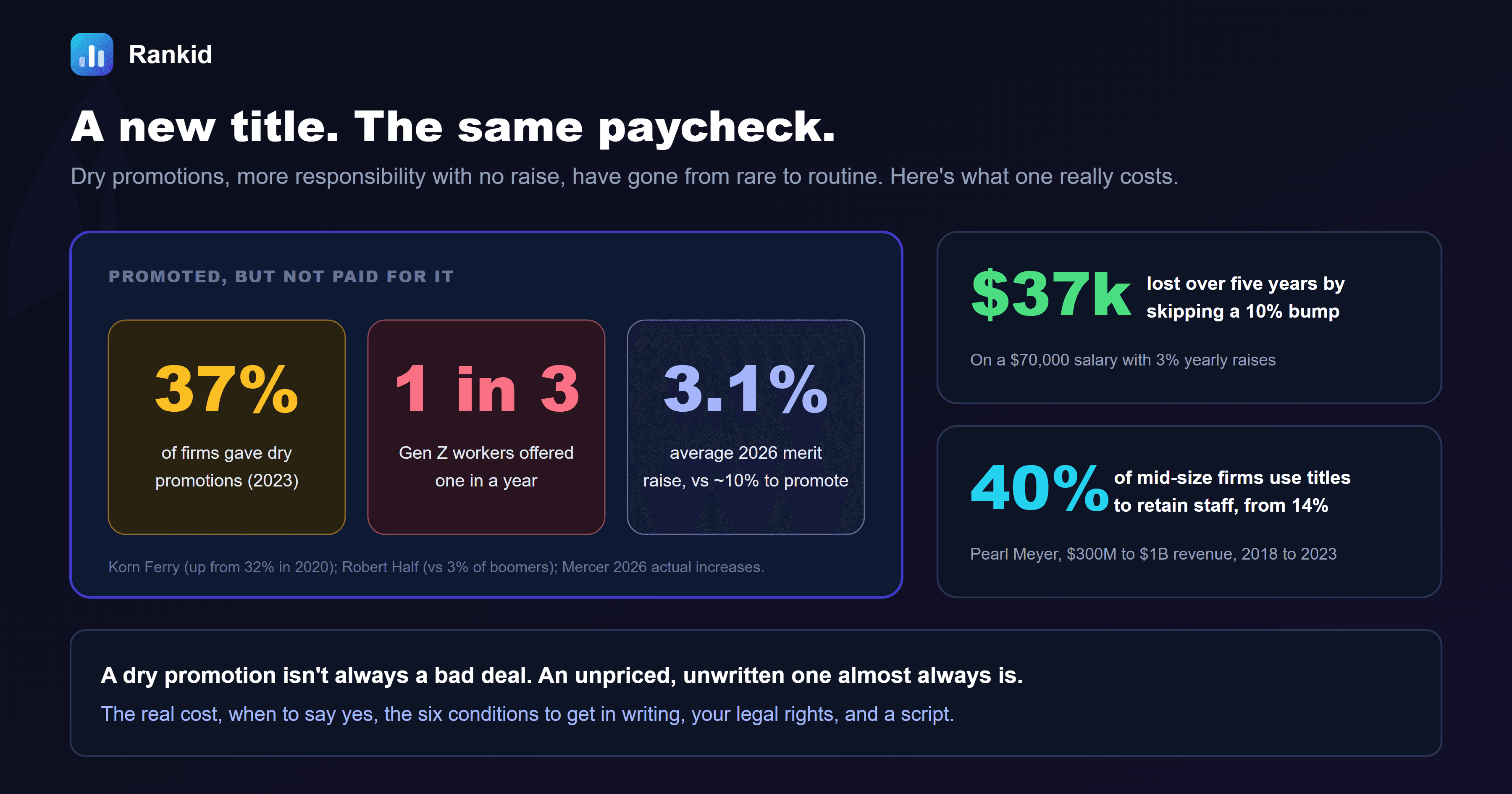
Your manager pulls you aside with good news: you're being promoted. New title, a team to lead, a seat in the bigger meetings. Then comes the part that's said a little faster: "We can't do anything on pay right now, but we'll revisit it." Congratulations, you've been offered a dry promotion. Once rare, they're now routine, especially for younger workers. And they're not automatically a bad deal. But most people accept them without pricing them, and that mistake can quietly cost tens of thousands of dollars.
Quick answer
Quick answer: a dry promotion is a bigger title and more responsibility with no raise. Korn Ferry found 37% of firms gave them in 2023. With average 2026 merit raises at 3.1% against a roughly 10% benchmark for a promotion, skipping the bump costs about $37,000 over five years on a $70,000 salary. Accept only if the title has real market value and there's a written path to pay, and get six conditions in writing: a review date, your new band, what comes off your plate, interim value, success criteria and your overtime status.
What is a dry promotion, and why are they everywhere?
A dry promotion, sometimes called a quiet promotion or a promotion in title only, moves you up in title and responsibility without moving your pay. The data shows how fast they've spread:
- 37% of firms gave dry promotions in 2023, up from 32% at the start of the decade, according to a survey cited by Korn Ferry.
- Among companies with $300 million to $1 billion in revenue, the share using job titles to retain staff jumped from 14% in 2018 to 40% in 2023, according to the pay consultancy Pearl Meyer. For companies under $300 million, it went from 10% to 35%. The very largest firms held steady at about 25%.
- A Robert Half survey found about a third of Gen Z workers were offered a dry promotion in the previous 12 months, compared with 18% of millennials, 7% of Gen X and just 3% of baby boomers.
Why now? Salary budgets are tight. Mercer found US employers actually paid average merit increases of 3.1%in 2026, slightly below what they'd planned, and total increases of 3.4%. Meanwhile, companies are flattening management layers and reorganizing around AI, which creates "new" roles nobody budgeted for. A title costs nothing to give. Pearl Meyer described the practice bluntly as a no-cost approach for smaller firms that can't compete on pay.
Why Gen Z gets the most dry promotions
What a dry promotion really costs
The cost of a missing raise isn't just this year's missing money. Every future raise is a percentage of your salary, so a lower base compounds. Here's a simple, illustrative example.
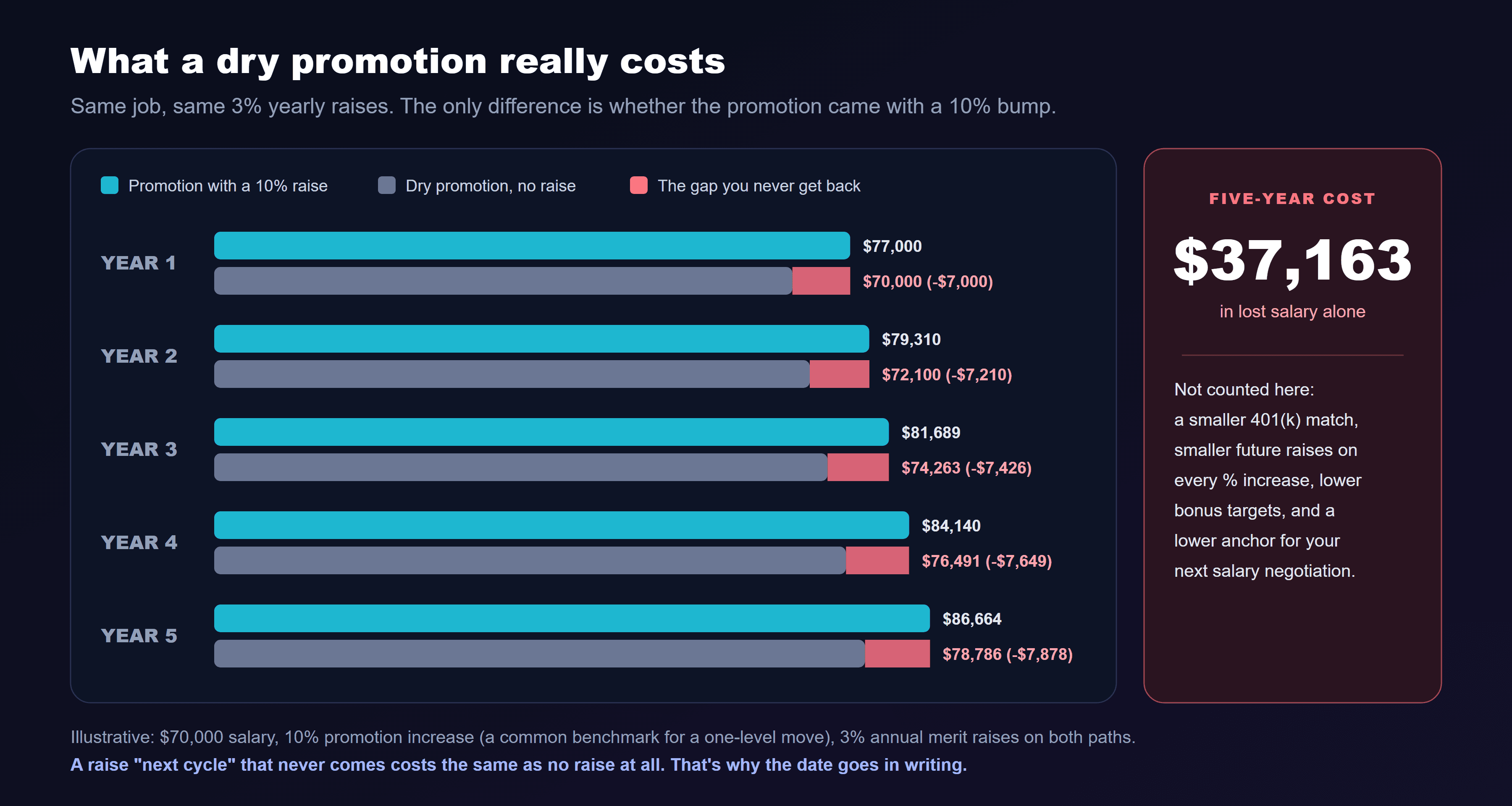
Take a $70,000 salary. With a 10% promotion raise and 3% annual raises after that, you'd earn $86,664 in year five. With a dry promotion and the same 3% raises, you'd earn $78,786. Over five years, the gap adds up to $37,163, before counting a smaller retirement match, smaller bonuses calculated as a percentage of salary, and a lower starting point for every future negotiation.
Now look at the other side of the ledger. If the new title means you can move to another company two years from now at a level, and a salary, you couldn't have reached otherwise, the dry promotion may pay for itself several times over. That's the real question: not "is this fair?" but "what is this title worth on the market, and what is it costing me?"
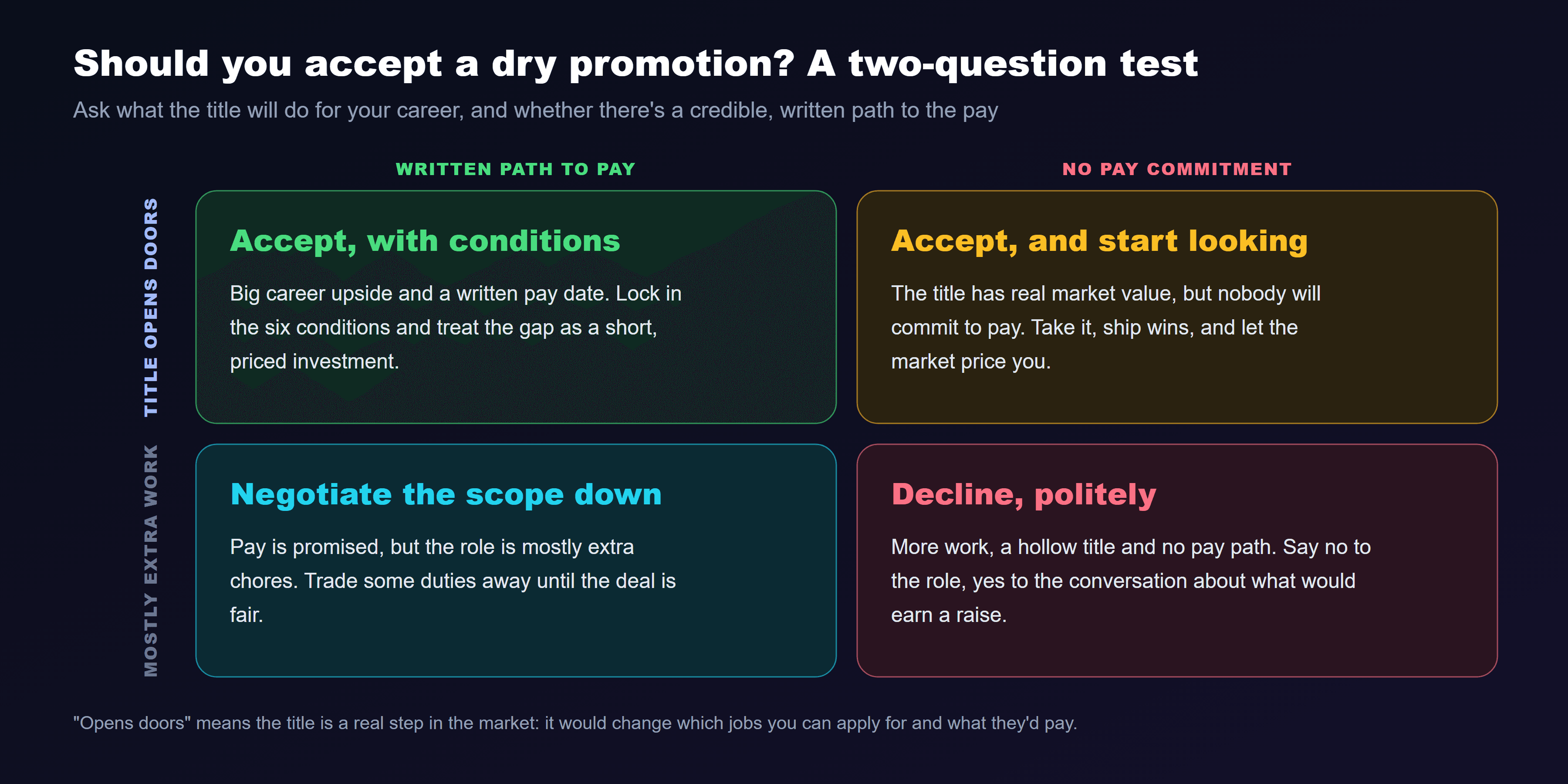
Should you accept? A two-question test
Does the title open doors?
Is there a written path to the pay?
- Doors and a written path: accept, with the conditions below. The gap is a short, priced investment.
- Doors, no pay commitment: accept if you want the experience, deliver visible wins, and quietly test the market in six to twelve months. A title is most valuable when someone else is willing to pay for it.
- Extra work, but pay is promised: negotiate the scope. Hand off some existing duties until the deal is fair in the meantime.
- Extra work, no pay path: decline politely, and use the moment to ask what it would take to earn a real promotion.
Before you say yes: six things to get in writing
The single biggest mistake with dry promotions is accepting on a verbal promise. Managers change, budgets change, and memories change faster than both. One short email fixes that.
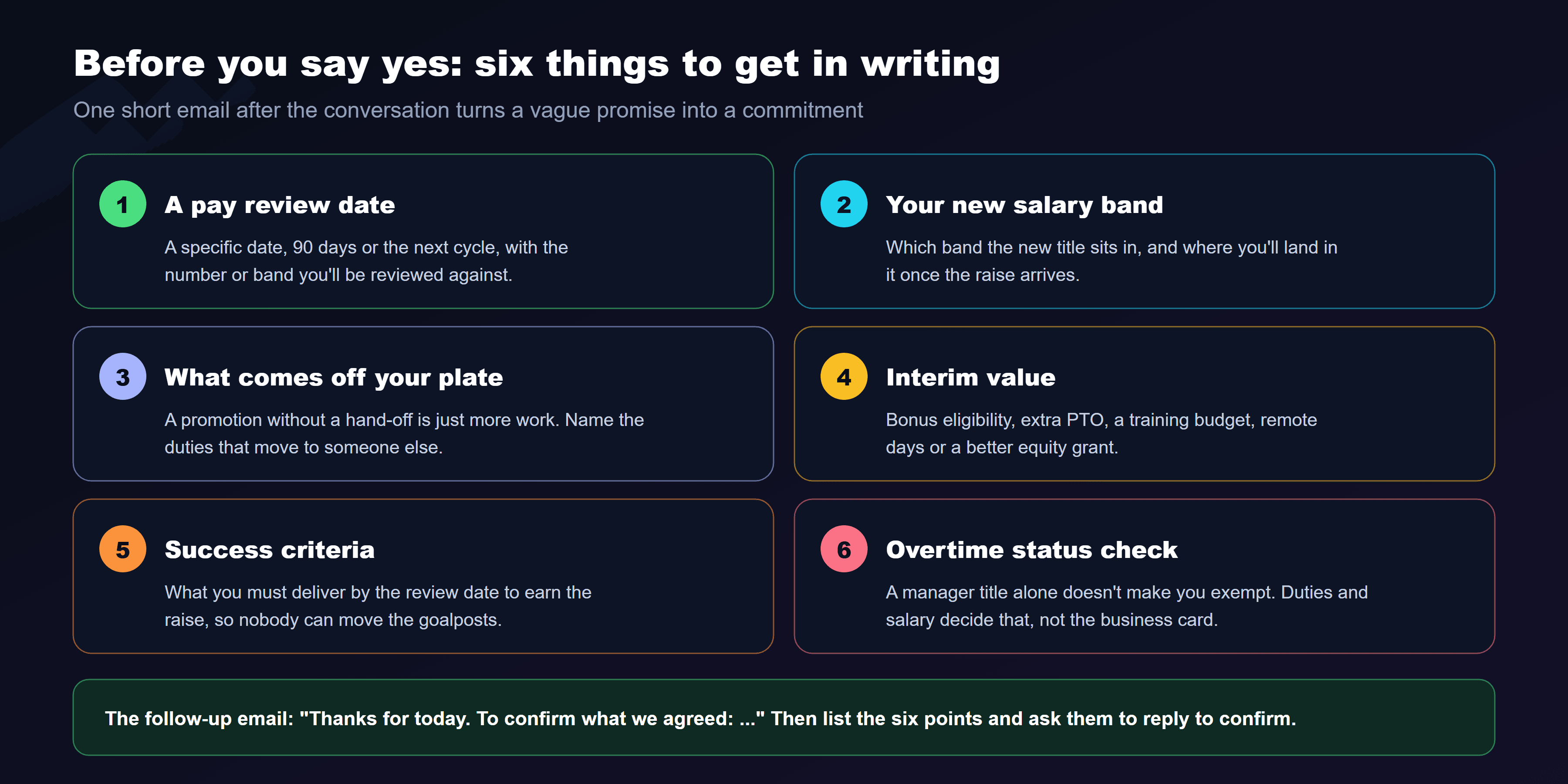
A pay review date
Your new salary band
What comes off your plate
Interim value
Success criteria
An overtime status check
The follow-up email
Is a dry promotion legal?
In most cases, yes. US employers can generally change your title and duties without changing your pay. But a few rules are worth knowing, because a dry promotion can bump into them. (This is general information, not legal advice.)
- Overtime. Under the federal Fair Labor Standards Act, being exempt from overtime depends on your salary and duties, not your title. The federal minimum salary for most exemptions is $684 a week ($35,568 a year), after a court struck down planned increases in 2024. Some states are higher: in California, exempt employees must earn at least $70,304in 2026. If you're "promoted" to manager but your pay is below the threshold, or you don't actually manage, you may still be owed overtime. Our guide to exempt vs non-exempt explains the tests.
- Equal pay.If you're doing substantially the same job as colleagues who are paid more, and the difference lines up with sex, race or another protected characteristic, that can raise equal pay concerns under federal and state law.
- Pay transparency. Some laws reach internal promotions. Colorado, for example, requires employers to make reasonable efforts to tell employees about promotion opportunities, including pay. In the EU, the Pay Transparency Directive, which member states were due to bring into national law by June 2026, gives workers the right to request information about pay levels for comparable work. Our guide to pay transparency lawscovers where these rules apply, and they're a great source of benchmark data for your negotiation.
How to negotiate, or decline, a dry promotion
You have more leverage than it feels like. The company has already decided you're the right person for a bigger job, and replacing you would cost far more than a raise. Use that, calmly.
- Open with yes to the role."Thank you, I really want this, and I'm confident I'll do it well." You're negotiating terms, not whether you're grateful.
- Ask about pay directly."What band does this role sit in, and how do we get me into it?" Use market data, not personal need. Our guides to salary negotiation and asking for a raise have scripts and benchmarks.
- If it's "not now," get the when."I understand the budget is fixed this cycle. Can we agree a review on [date], and what I'd need to deliver by then?"
- To decline:"I'm genuinely glad you see me in this role. I can't take on the extra scope without a change in pay, but I'd love to talk about what it would take to get there, and I'm happy to keep supporting the team." If you'd rather stay an individual contributor anyway, our guide to conscious unbossing covers turning down management without stalling your career.
Use the title: your resume and the market
Here's the angle most people miss. If you accept a dry promotion, the title is now yours, and the market prices titles. Update your resume and LinkedIn with your new title and the expanded scope, and quantify what you've delivered in it. Our guide to quantifying achievements shows how. Many US states and cities ban employers from asking about your salary history, so a new employer will often price you on the role you hold rather than the pay you're on. Our guide to the salary history questionexplains how to handle it where it's still asked.
That's also your best leverage at home. A competing offer at the level of your new title often produces the raise your manager "couldn't find" before. Just know how you'd respond; our guide to counteroffers covers the trade-offs.
New title? See which jobs it unlocks
Paste your updated resume and a job description at your new level into Rankid for a free 0-100 match score and the exact requirements you meet and miss, so you know what your title is worth on the market. No signup required.
Check your match score freeFor employers: when a dry promotion backfires
Dry promotions feel free. They aren't. Korn Ferry's global rewards leader called them "a slippery slope," and research suggests promotions without raises can make people more likely to leave, because they experience them as more work for the same pay.
- Be honest about why.Explain the budget situation and when pay will be reviewed. Silence reads as "never."
- Put the review date in writing. Then keep it. A broken promise costs more trust than no promise.
- Offer real interim value. Bonus eligibility, time off, training and flexibility all count, especially if you ask the person which matters most to them.
- Don't let titles drift from bands. Someone paid below the bottom of their band is a retention risk and, potentially, a pay equity problem. Check them in your regular compa-ratio reviews.
- Count the cost of losing them.If the person leaves, you'll likely pay market rate for a replacement anyway, plus the cost of hiring. Our guide to employee turnover shows how fast that adds up.
If a dry promotion costs you a star, replace them fast
Rankid scores every resume against your job description on a consistent 0-100 scale and shows the exact requirements each candidate matched and missed, so backfilling a key role takes days, not months. First 5 resumes free, no signup.
Try bulk screening freeFrequently asked questions
What is a dry promotion?
A dry promotion is when you're given a higher job title and more responsibility but no increase in pay. It's sometimes called a 'quiet promotion' or a 'promotion in title only.' Employers use dry promotions to recognize and retain people when salary budgets are tight, but employees often experience them as more work for the same money.
How common are dry promotions?
Increasingly common. A Korn Ferry survey found 37% of firms gave dry promotions in 2023, up from 32% at the start of the decade. Pearl Meyer found that the share of companies with $300 million to $1 billion in revenue using job titles to retain employees rose from 14% in 2018 to 40% in 2023. Younger workers see them most: a Robert Half survey found about a third of Gen Z workers had been offered a dry promotion in the previous 12 months, compared with 18% of millennials, 7% of Gen X and 3% of baby boomers.
How much of a raise should you get with a promotion?
A common benchmark for a one-level promotion is around 10%, with bigger jumps for moves into management or across levels, though promotion budgets have tightened in recent years. That's well above the typical annual merit raise: Mercer found US employers actually paid average merit increases of 3.1% in 2026. If a promotion comes with less than a normal merit raise, it's effectively a dry promotion.
Should I accept a promotion without a raise?
It depends on two things: whether the title has real market value that would change which jobs you can get, and whether there's a credible, written path to the pay. If both are true, accept with conditions in writing. If the title is valuable but nobody will commit to pay, consider accepting and starting a job search. If it's mostly extra work but pay is promised, negotiate the scope down. If it's extra work with no pay path, decline politely.
Is a dry promotion legal?
Generally yes. In the US, employers can usually change titles and duties without changing pay, as long as they still meet minimum wage, overtime and anti-discrimination laws. Watch for three issues: a 'manager' title doesn't make you exempt from overtime unless your duties and salary qualify, paying you less than colleagues of a different sex or race for substantially equal work can raise equal pay concerns, and some places, like Colorado, have rules about announcing promotion opportunities and pay. If you're unsure, talk to an employment lawyer or your state labor department.
Does a promotion change my overtime eligibility?
Not automatically. Under the federal Fair Labor Standards Act, being exempt from overtime depends on being paid a salary of at least $684 a week ($35,568 a year) and meeting a duties test, not on your title. Some states set higher thresholds; in California, exempt employees must earn at least $70,304 in 2026. If you get a manager title without a raise and your salary is below the threshold, or your duties don't qualify, you may still be entitled to overtime.
How do I negotiate a raise when offered a dry promotion?
Thank them, show you want the role, and then ask about pay directly: what band the new role sits in and when you'll move into it. If the answer is 'not now,' ask for a specific review date, the criteria you'll be judged on, and interim value such as bonus eligibility, extra time off or a training budget. Then confirm everything in a follow-up email. Benchmark the role with salary data so your ask is grounded in the market.
How do I decline a promotion without a raise?
Be appreciative and keep the door open. For example: 'Thank you, I'm genuinely glad you see me in this role. I'm not able to take on the extra scope without a change in pay, but I'd love to talk about what it would take to get there, and I'm happy to keep supporting the team in my current role.' Declining the role isn't declining your career; it's declining an unpriced deal.
Should I put a dry promotion on my resume?
Yes. Your resume should show your real title and the expanded responsibilities that came with it. A higher title can change which jobs you qualify for and what other employers will pay, which is one reason a dry promotion with real market value can still be worth accepting. Many US states and cities also bar employers from asking about your salary history, so your next offer can be based on the role rather than your current pay.
Key takeaways
- A dry promotion is a bigger title and more responsibility with no raise. Korn Ferry found 37% of firms gave them in 2023, up from 32% in 2020.
- They're spreading fastest at mid-size and smaller firms (Pearl Meyer: 14% to 40% for $300M-$1B companies) and among Gen Z (a third offered one in a year).
- With 2026 merit raises averaging 3.1% against a roughly 10% promotion benchmark, skipping the bump costs about $37,000 over five years on a $70,000 salary.
- Accept only if the title has real market value and there's a written path to pay. Otherwise negotiate the scope, start looking, or decline politely.
- Get six things in writing: a pay review date, your new band, what comes off your plate, interim value, success criteria and your overtime status.
- A manager title doesn't make you exempt from overtime. Salary thresholds ($35,568 federally, $70,304 in California in 2026) and duties tests decide that.
- If you accept, put the title on your resume. The market prices titles, and a competing offer is often what unlocks the raise.
- Employers should be honest about why, keep written review dates, offer interim value and watch for titles drifting below pay bands.
Frequently asked questions
What is a dry promotion?
A dry promotion is when you're given a higher job title and more responsibility but no increase in pay. It's sometimes called a 'quiet promotion' or a 'promotion in title only.' Employers use dry promotions to recognize and retain people when salary budgets are tight, but employees often experience them as more work for the same money.
How common are dry promotions?
Increasingly common. A Korn Ferry survey found 37% of firms gave dry promotions in 2023, up from 32% at the start of the decade. Pearl Meyer found that the share of companies with $300 million to $1 billion in revenue using job titles to retain employees rose from 14% in 2018 to 40% in 2023. Younger workers see them most: a Robert Half survey found about a third of Gen Z workers had been offered a dry promotion in the previous 12 months, compared with 18% of millennials, 7% of Gen X and 3% of baby boomers.
How much of a raise should you get with a promotion?
A common benchmark for a one-level promotion is around 10%, with bigger jumps for moves into management or across levels, though promotion budgets have tightened in recent years. That's well above the typical annual merit raise: Mercer found US employers actually paid average merit increases of 3.1% in 2026. If a promotion comes with less than a normal merit raise, it's effectively a dry promotion.
Should I accept a promotion without a raise?
It depends on two things: whether the title has real market value that would change which jobs you can get, and whether there's a credible, written path to the pay. If both are true, accept with conditions in writing. If the title is valuable but nobody will commit to pay, consider accepting and starting a job search. If it's mostly extra work but pay is promised, negotiate the scope down. If it's extra work with no pay path, decline politely.
Is a dry promotion legal?
Generally yes. In the US, employers can usually change titles and duties without changing pay, as long as they still meet minimum wage, overtime and anti-discrimination laws. Watch for three issues: a 'manager' title doesn't make you exempt from overtime unless your duties and salary qualify, paying you less than colleagues of a different sex or race for substantially equal work can raise equal pay concerns, and some places, like Colorado, have rules about announcing promotion opportunities and pay. If you're unsure, talk to an employment lawyer or your state labor department.
Does a promotion change my overtime eligibility?
Not automatically. Under the federal Fair Labor Standards Act, being exempt from overtime depends on being paid a salary of at least $684 a week ($35,568 a year) and meeting a duties test, not on your title. Some states set higher thresholds; in California, exempt employees must earn at least $70,304 in 2026. If you get a manager title without a raise and your salary is below the threshold, or your duties don't qualify, you may still be entitled to overtime.
How do I negotiate a raise when offered a dry promotion?
Thank them, show you want the role, and then ask about pay directly: what band the new role sits in and when you'll move into it. If the answer is 'not now,' ask for a specific review date, the criteria you'll be judged on, and interim value such as bonus eligibility, extra time off or a training budget. Then confirm everything in a follow-up email. Benchmark the role with salary data so your ask is grounded in the market.
How do I decline a promotion without a raise?
Be appreciative and keep the door open. For example: 'Thank you, I'm genuinely glad you see me in this role. I'm not able to take on the extra scope without a change in pay, but I'd love to talk about what it would take to get there, and I'm happy to keep supporting the team in my current role.' Declining the role isn't declining your career; it's declining an unpriced deal.
Should I put a dry promotion on my resume?
Yes. Your resume should show your real title and the expanded responsibilities that came with it. A higher title can change which jobs you qualify for and what other employers will pay, which is one reason a dry promotion with real market value can still be worth accepting. Many US states and cities also bar employers from asking about your salary history, so your next offer can be based on the role rather than your current pay.