Conscious Unbossing: Should You Become a Manager, or Is the IC Track the Smarter Bet? (2026)
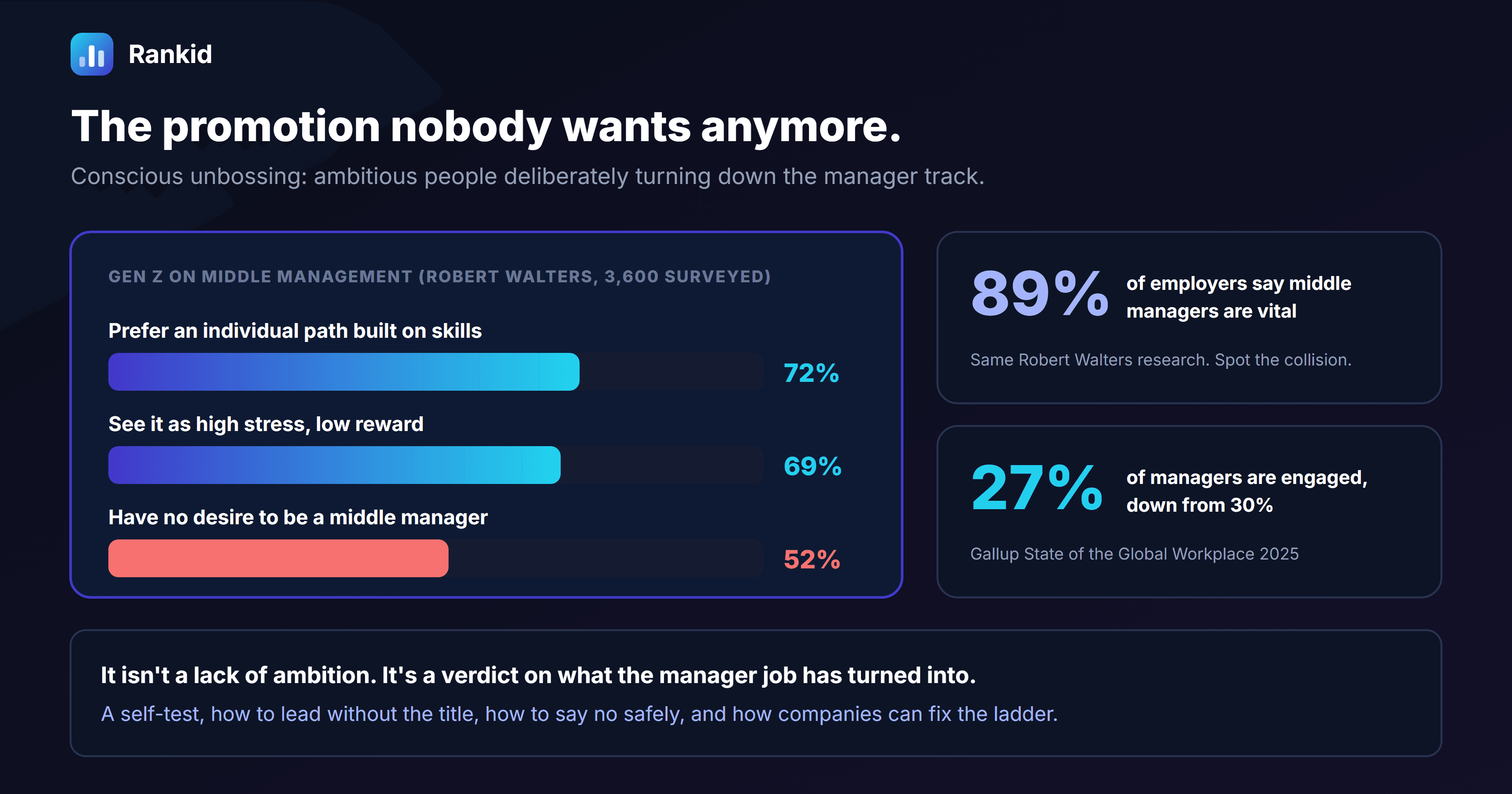
For decades the script was simple. You got good at your job, and your reward was a team to run. Then a generation looked at their managers, stuck between executive targets and burned-out teams, often still doing their old job on top of the new one, and politely said: no thanks. More than half of Gen Z professionals now say they don't want to be middle managers. At the same moment, some of the biggest companies in the world are quietly deleting those seats. It's called conscious unbossing, and whether you are deciding your next move or trying to fill a manager role nobody wants, it changes the math.
Quick answer
Quick answer: conscious unbossing is deliberately avoiding management roles to grow as an individual contributor (IC). 52% of Gen Z professionalsdon't want to be middle managers, and 69% see the role as high stress, low reward. The manager job has genuinely got harder: global manager engagement fell from 30% to 27%, and only 44% of managers have had formal training. Decide with the self-test below, and if you choose the IC path, make sure your company has a real ladder for it. You can decline a promotion safely by proposing a specific alternative. Employers should build dual career ladders so nobody has to manage to earn more.
What conscious unbossing is (and what it isn't)
Conscious unbossing is the deliberate choice to avoid or decline people-management roles, particularly middle management, and to grow as an individual contributor instead. The phrase spread in late 2024 after research by the recruitment firm Robert Walters, which described young professionals steering away from hierarchy not for lack of ambition but as a considered career decision.
It's easy to lump it in with other workplace buzzwords, but it's different. It isn't quiet quitting: unbossers often want more responsibility, just not direct reports. It isn't job hugging, which is about staying put out of caution. And it isn't anti-leadership. Most unbossers still want to lead ideas, projects and standards. They simply don't want to do it through performance reviews and headcount spreadsheets.
The numbers behind it
- 52%of Gen Z professionals have no desire to hold middle management roles, according to Robert Walters' survey of 3,600 of them.
- 69% see middle management as high stress and low reward, and 72% would rather advance through an individual path focused on skills and personal growth.
- 89%of employers in the same research say middle managers are vital to their organisation's success. That's the collision: the people companies need most in the role are the least interested in it.
Gen Z now makes up a growing share of the workforce, which is why this gap matters. Every retirement and every resignation among today's managers has to be filled by someone from a generation that, on the survey data, mostly doesn't want the job.
Why the manager job got worse
It would be easy to blame a generation. The data suggests the job itself changed.
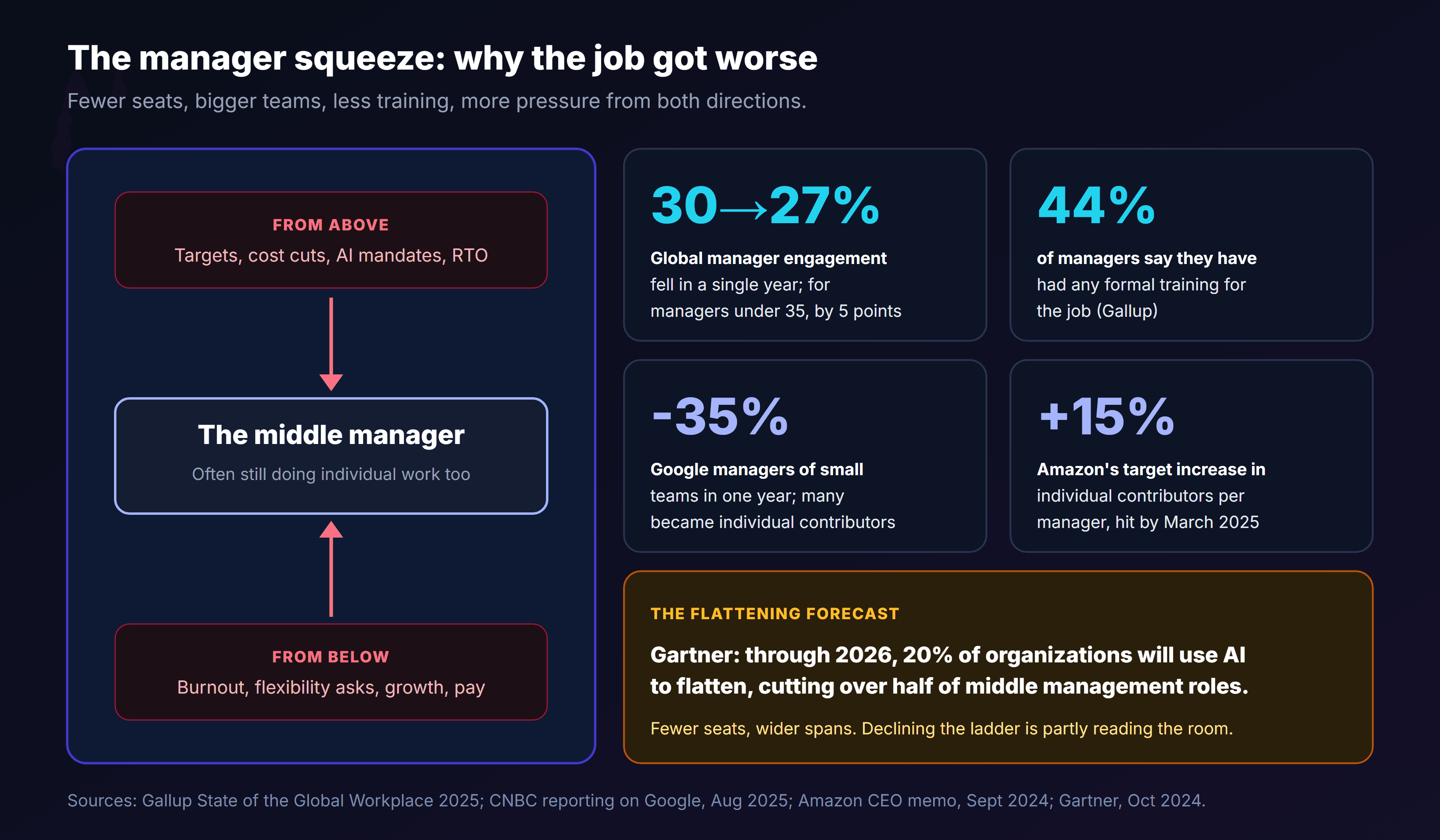
- Managers are the least happy they have been in years.Gallup's State of the Global Workplace 2025 found manager engagement fell from 30% to 27% in one year, while individual contributors stayed flat. Managers under 35 fell five points, and female managers seven.
- Most are learning on the job. Only 44% of managers told Gallup they have had any formal training, which is why so many people describe their first management role as being thrown in the deep end.
- The seats are disappearing. In August 2025, a Google executive said the company had 35% fewer managers of small teams than a year earlier, with many becoming individual contributors. Amazon set out to increase its ratio of individual contributors to managers by at least 15%, and hit the target by March 2025.
- More flattening is forecast. Gartner predicted that through 2026, 20% of organisations will use AI to flatten their structures, eliminating more than half of current middle management positions.
- The job keeps widening.Fewer managers means larger teams per manager, and many are "player-coaches" who still carry individual work on top of hiring, one-on-ones and difficult performance conversations.
The twist nobody mentions
Maker or manager? The eight-question self-test
Management isn't a reward for being good at your job. It's a different job. The questions below help you tell whether it's one you'd actually enjoy. Answer for an ordinary Tuesday, not your best day.
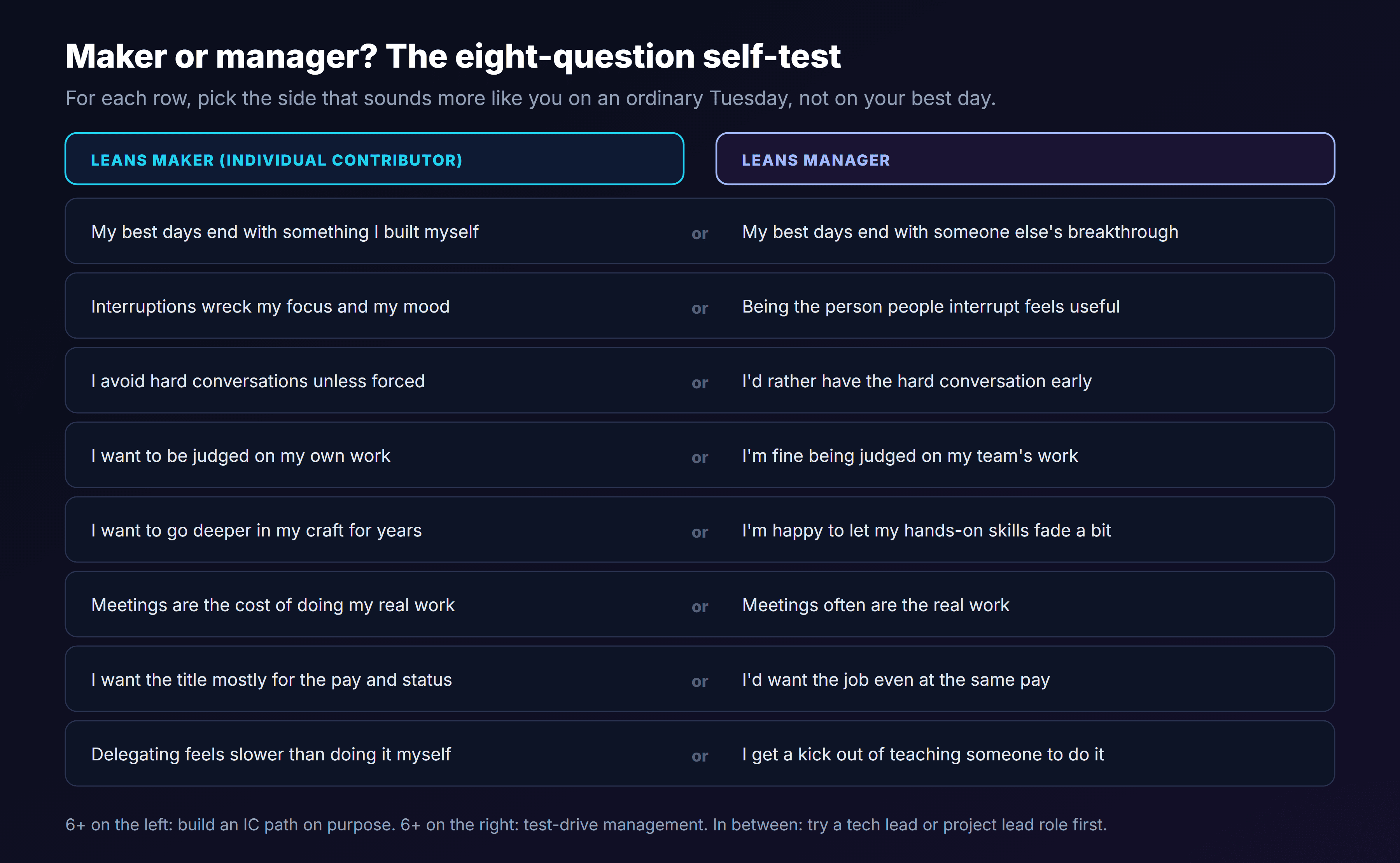
Two questions carry extra weight. If you would only want the job for the pay or status, that's a strong signal to find an IC path that pays instead. And if you avoid hard conversations, know that they are the core of the job, not an occasional part of it. If you land in the middle, don't decide in the abstract: try it.
Test-drive leadership before you commit
The best way to answer "should I become a manager?" is a low-risk experiment. Most of these can be arranged without a title change:
- Lead one project end to end, including kickoff, status updates and the retrospective.
- Mentor a new hire or an intern through their first three months.
- Act as tech lead or project lead for a quarter, owning decisions without owning performance reviews.
- Cover for your manager during their leave, with their blessing and a clear handover.
- Run hiring for one role: write the scorecard, interview, and debrief the panel.
Pay attention to how you feel at the end of each week, not only whether you did it well. People who become good managers usually find the people work energising rather than merely tolerable.
If you choose the IC path: how to lead without the title
Unbossing only works as a career strategy if you still grow. Senior individual contributors are promoted on scope and impact, so your job is to make both visible.
Find out how far the IC ladder goes
Take on bigger, messier problems
Multiply other people
Write things down
Put it on paper with numbers
Get a development plan in writing
How to turn down a management promotion (with a script)
Saying no to a promotion feels risky, because it can sound like saying no to growth. The fix is to decline the role while saying yes, loudly, to a different kind of growth.
Script: declining a manager role
- Decline in person or on a call first, then follow up in writing.
- Always propose a concrete alternative, so the conversation ends on your ambition rather than your refusal.
- Ask for the IC promotion criteria and a timeline, and write down what you agreed.
- If there's no IC path at all, that's a signal about your long-term ceiling at this company, not just this role.
"Where do you see yourself in five years?" without saying "manager"
Many people assume the expected answer is "leading a team." It isn't. Interviewers are checking ambition and fit, and scope is a stronger answer than a title:
Sample answer
The last sentence turns the question around, so you learn whether the company has a real IC ladder. For more ways to probe that, see our list of questions to ask in an interview, and for structuring answers in general, the common interview answers guide.
Does your resume read like a senior IC or like a task list?
Paste your resume and a senior individual contributor posting into Rankid for a free 0-100 match score and the exact requirements you meet and miss, including the leadership and scope signals senior roles screen for. No signup required.
Check your match score freeFor employers: fix the ladder, not the generation
If nobody wants your manager roles, the answer isn't a motivational speech about leadership. It's redesigning the job and the path around it.
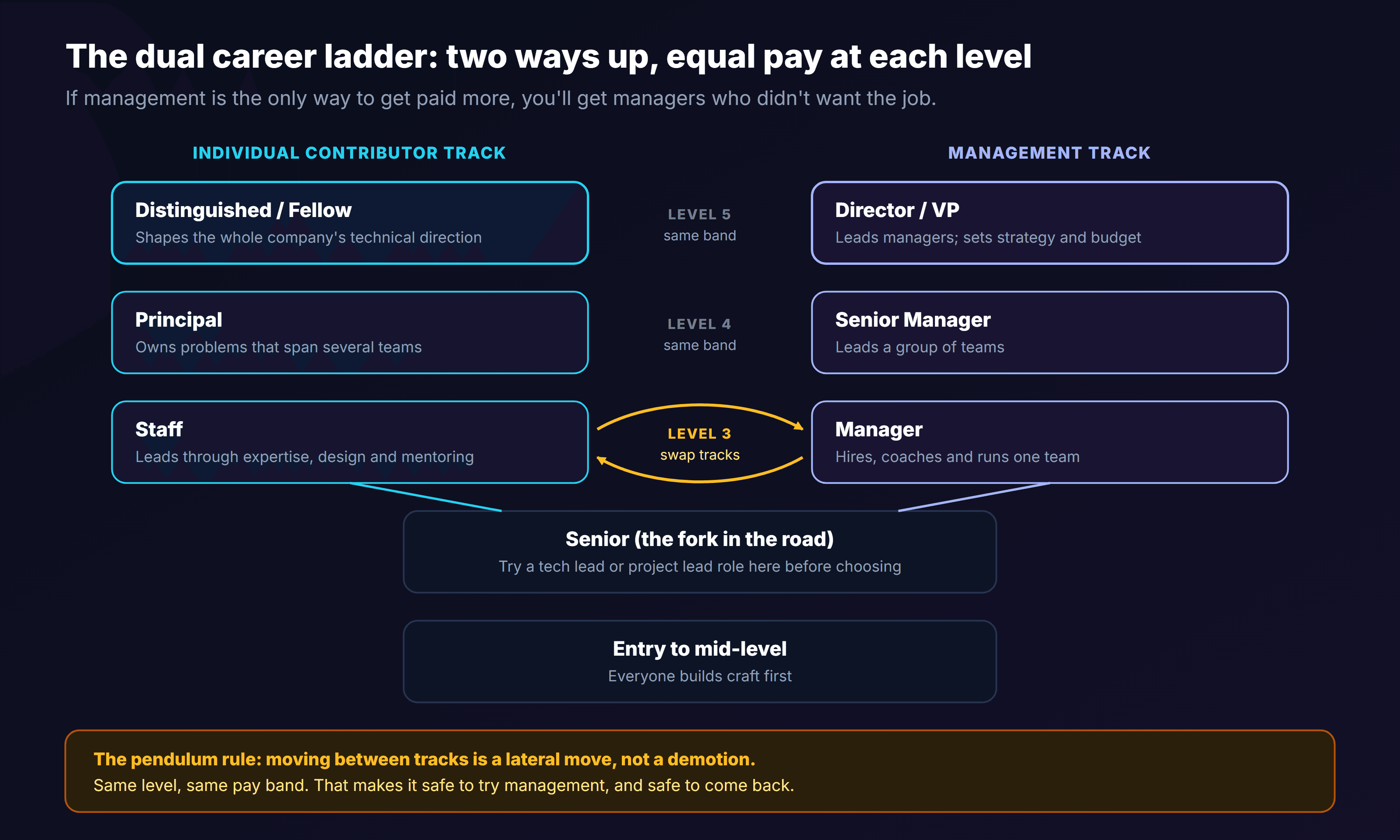
- Build a real dual career ladder. Parallel IC and management tracks with the same pay band at each level mean nobody has to manage to earn more, so the people who choose management actually want it.
- Make switching a lateral move. Let people try management and return to IC work without it being treated as a demotion. It lowers the stakes of saying yes.
- Train managers before, not after. With only 44% of managers reporting formal training, even a short program for first-time managers is a differentiator.
- Make the job doable.Keep spans of control reasonable, cut reporting and admin (this is where AI genuinely helps), and don't expect a full individual workload on top.
- Pay for it clearly. If people leadership is harder, its premium should be visible in your bands, not just a title.
- Protect your bench. Fewer willing managers is a succession planning risk. Identify people who enjoy leading early, give them test-drive roles, and fill leadership gaps through internal recruitment where you can.
Hiring for a senior IC or a manager? Screen for the right signals
Rankid scores every resume against your job description on a consistent 0-100 scale and lists the requirements each candidate matched and missed, so you can tell candidates with deep individual expertise from those with real people-leadership experience at a glance. First 5 resumes free, no signup.
Try bulk screening freeFrequently asked questions
What is conscious unbossing?
Conscious unbossing is the deliberate choice to avoid or decline management roles, especially middle management, in favour of growing as an individual contributor. The term took off in 2024 after research by the recruitment firm Robert Walters found that 52% of Gen Z professionals had no desire to be middle managers. It describes a considered career decision, not a lack of ambition: people still want growth, pay and influence, just not through managing others.
Why don't Gen Z workers want to be managers?
In the Robert Walters survey of 3,600 Gen Z professionals, 69% described middle management as high stress and low reward, and 72% said they would rather advance through an individual path focused on skills and personal growth. Broader data backs up the concern: Gallup found global manager engagement fell from 30% to 27% in a single year, managers under 35 saw a five-point drop, and only 44% of managers say they have had formal training for the role.
Is it only Gen Z who avoid management?
No. The term is usually applied to Gen Z because the headline research surveyed them, but experienced professionals also turn down management or step back from it. Many companies have also reduced management layers, so some people who might once have become managers now stay individual contributors by default rather than by choice.
Is turning down a management role bad for my career?
It depends on your company and field. Where there is a real individual contributor ladder, such as staff, principal and distinguished engineer or equivalent senior specialist roles, you can keep growing in pay and influence without managing anyone. Where management is the only route to higher pay bands, declining can cap your earnings. Before deciding, ask how far the IC track goes and how its pay compares at each level.
How do I know if I should become a manager?
Look at what energises you on an ordinary day. People who thrive in management usually get satisfaction from other people's progress, don't mind frequent interruptions, are willing to have difficult conversations early, and are comfortable being judged on the team's results rather than their own work. If you mostly want the title for the pay or status, or you want to go deeper in your craft for years, the individual contributor path is often a better fit. Trying a tech lead or project lead role first is the safest way to find out.
How do I turn down a promotion to manager without hurting my career?
Thank your manager and make clear you want to keep growing, then explain the kind of growth you are after and propose a concrete alternative, such as a senior individual contributor role, a tech lead position, ownership of a larger project, or mentoring responsibilities. Ask what the individual contributor path looks like at the next level and agree how progress will be measured. Declining the role while showing ambition in another direction protects your reputation.
Can you get promoted without managing people?
Yes, in organisations with a dual career ladder. Senior individual contributor roles are promoted on scope and impact: how large and ambiguous the problems you solve are, how many teams your work affects, and how much you raise others through mentoring, design and standards. Make that impact visible with concrete results and written documentation, and ask your manager for the promotion criteria in writing.
What is a dual career ladder?
A dual career ladder is a career framework with two parallel promotion paths, one for individual contributors and one for people managers, where equivalent levels share the same pay band. It lets strong specialists advance without being pushed into management and allows people to move between the tracks as a lateral move rather than a demotion.
Can I go back to being an individual contributor after managing?
Yes, and it is increasingly common. Many engineers and specialists move between management and individual work more than once over their careers, sometimes called the engineer-manager pendulum. It is easiest at companies where the two tracks share pay bands. Frame the move around where you add the most value, and use your management experience as a strength in senior individual contributor roles.
How should I answer 'Where do you see yourself in five years?' if I don't want to manage?
Focus on scope and impact rather than a title. For example: 'In five years I want to be the person this team relies on for our hardest technical problems, leading projects across teams and mentoring newer people. I'm more interested in growing my expertise and influence than in managing a team, and I'd like to understand what that path looks like here.' That shows ambition and lets you check whether the company supports an individual contributor track.
What can employers do if nobody wants to be a manager?
Make the job doable and the choice genuine. Train new managers before they start, keep spans of control reasonable, take administrative work off managers' plates, pay a clear premium for people leadership, and build a dual career ladder so that nobody has to manage to earn more. Let people try leadership through tech lead or interim roles, and make it safe to return to individual work. Those who choose management freely tend to be better at it.
Key takeaways
- Conscious unbossing is deliberately avoiding management to grow as an individual contributor. It's a career choice, not a lack of ambition.
- 52% of Gen Z professionals don't want to be middle managers, 69% see the role as high stress and low reward, and 72% prefer an individual, skills-based path (Robert Walters, 3,600 surveyed).
- 89% of employers say middle managers are vital, which is the collision driving the trend.
- The manager job got harder: engagement fell from 30% to 27% (Gallup), only 44% have formal training, and companies like Google and Amazon cut management layers.
- Use the eight-question self-test, and if you land in the middle, test-drive leadership through a project lead, mentoring or tech lead role.
- On the IC path, grow by taking on bigger problems, multiplying others, writing things down and quantifying impact, and confirm the IC ladder and pay bands exist.
- Decline a promotion by proposing a specific alternative and agreeing IC promotion criteria in writing.
- Answer 'where do you see yourself in five years' with scope and impact, not a title.
- Employers should build dual career ladders with equal pay bands, make switching tracks lateral, train managers first and keep the job doable.
Frequently asked questions
What is conscious unbossing?
Conscious unbossing is the deliberate choice to avoid or decline management roles, especially middle management, in favour of growing as an individual contributor. The term took off in 2024 after research by the recruitment firm Robert Walters found that 52% of Gen Z professionals had no desire to be middle managers. It describes a considered career decision, not a lack of ambition: people still want growth, pay and influence, just not through managing others.
Why don't Gen Z workers want to be managers?
In the Robert Walters survey of 3,600 Gen Z professionals, 69% described middle management as high stress and low reward, and 72% said they would rather advance through an individual path focused on skills and personal growth. Broader data backs up the concern: Gallup found global manager engagement fell from 30% to 27% in a single year, managers under 35 saw a five-point drop, and only 44% of managers say they have had formal training for the role.
Is it only Gen Z who avoid management?
No. The term is usually applied to Gen Z because the headline research surveyed them, but experienced professionals also turn down management or step back from it. Many companies have also reduced management layers, so some people who might once have become managers now stay individual contributors by default rather than by choice.
Is turning down a management role bad for my career?
It depends on your company and field. Where there is a real individual contributor ladder, such as staff, principal and distinguished engineer or equivalent senior specialist roles, you can keep growing in pay and influence without managing anyone. Where management is the only route to higher pay bands, declining can cap your earnings. Before deciding, ask how far the IC track goes and how its pay compares at each level.
How do I know if I should become a manager?
Look at what energises you on an ordinary day. People who thrive in management usually get satisfaction from other people's progress, don't mind frequent interruptions, are willing to have difficult conversations early, and are comfortable being judged on the team's results rather than their own work. If you mostly want the title for the pay or status, or you want to go deeper in your craft for years, the individual contributor path is often a better fit. Trying a tech lead or project lead role first is the safest way to find out.
How do I turn down a promotion to manager without hurting my career?
Thank your manager and make clear you want to keep growing, then explain the kind of growth you are after and propose a concrete alternative, such as a senior individual contributor role, a tech lead position, ownership of a larger project, or mentoring responsibilities. Ask what the individual contributor path looks like at the next level and agree how progress will be measured. Declining the role while showing ambition in another direction protects your reputation.
Can you get promoted without managing people?
Yes, in organisations with a dual career ladder. Senior individual contributor roles are promoted on scope and impact: how large and ambiguous the problems you solve are, how many teams your work affects, and how much you raise others through mentoring, design and standards. Make that impact visible with concrete results and written documentation, and ask your manager for the promotion criteria in writing.
What is a dual career ladder?
A dual career ladder is a career framework with two parallel promotion paths, one for individual contributors and one for people managers, where equivalent levels share the same pay band. It lets strong specialists advance without being pushed into management and allows people to move between the tracks as a lateral move rather than a demotion.
Can I go back to being an individual contributor after managing?
Yes, and it is increasingly common. Many engineers and specialists move between management and individual work more than once over their careers, sometimes called the engineer-manager pendulum. It is easiest at companies where the two tracks share pay bands. Frame the move around where you add the most value, and use your management experience as a strength in senior individual contributor roles.
How should I answer 'Where do you see yourself in five years?' if I don't want to manage?
Focus on scope and impact rather than a title. For example: 'In five years I want to be the person this team relies on for our hardest technical problems, leading projects across teams and mentoring newer people. I'm more interested in growing my expertise and influence than in managing a team, and I'd like to understand what that path looks like here.' That shows ambition and lets you check whether the company supports an individual contributor track.
What can employers do if nobody wants to be a manager?
Make the job doable and the choice genuine. Train new managers before they start, keep spans of control reasonable, take administrative work off managers' plates, pay a clear premium for people leadership, and build a dual career ladder so that nobody has to manage to earn more. Let people try leadership through tech lead or interim roles, and make it safe to return to individual work. Those who choose management freely tend to be better at it.