The Hidden Job Market: Is It True 80% of Jobs Are Never Posted? (And How to Get In Anyway)
You've heard it from a career coach, a LinkedIn post and probably a well-meaning uncle: "80% of jobs are never posted."It's repeated so often it feels like a law of nature. So we went looking for the study behind it. What we found is a number older than the internet, a 2016 poll, and underneath it all a real, measurable effect that matters more than the myth ever did.
Quick answer
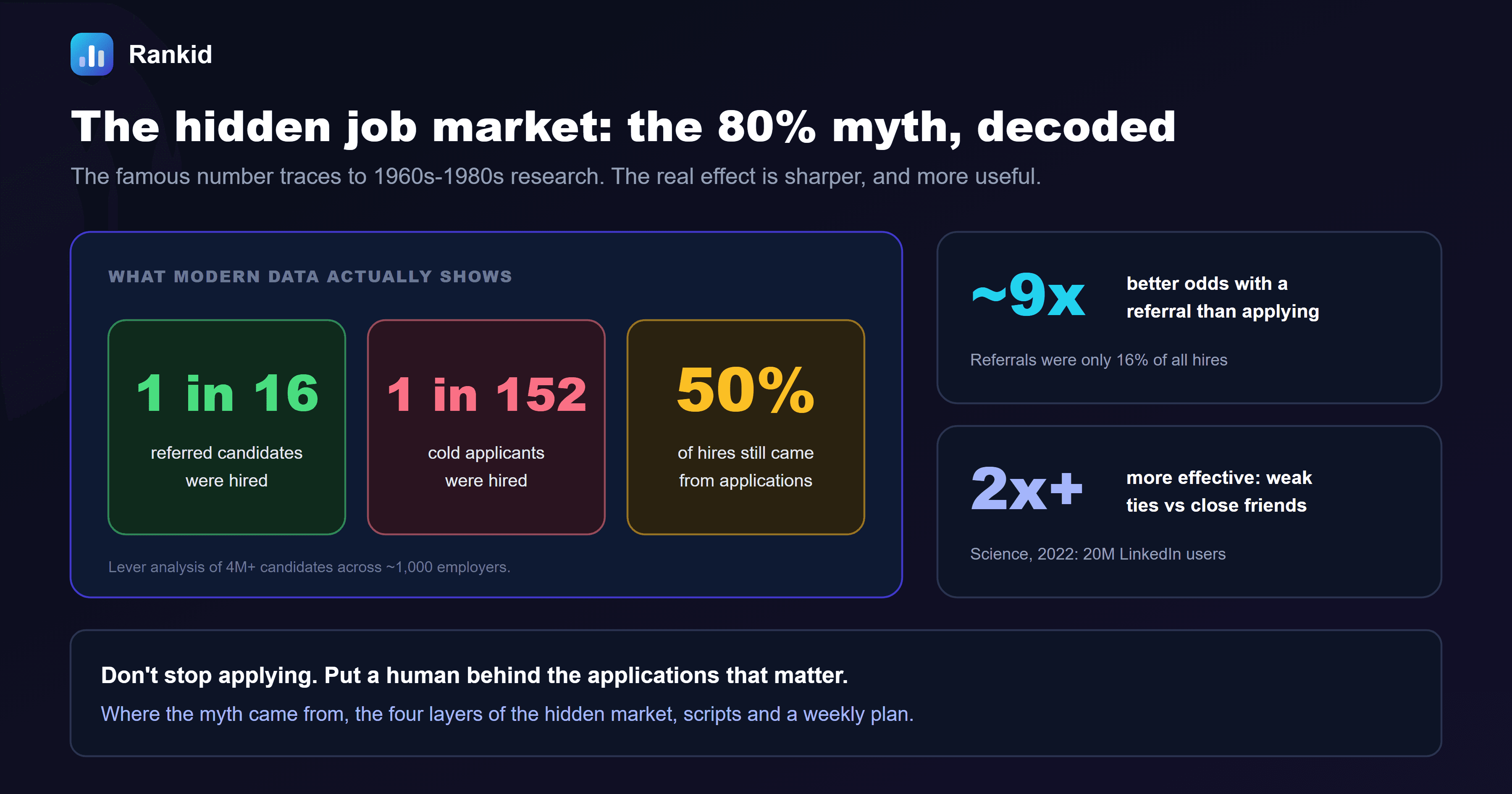
Quick answer: the hidden job marketis real, but the "80% of jobs are never posted" statistic is not modern data. It traces back to research from the 1960s to 1980s, when job ads were printed and expensive. What modern data shows is sharper: referred candidates were hired at 1 in 16 versus 1 in 152 for cold applicants (Lever, 4 million candidates), yet half of hires still came from applications. And your best door-openers are usually acquaintances, not close friends. Strategy: keep applying, but add a warm path to the jobs you want most.
What is the hidden job market?
The hidden job market is every job that gets filled without a normal, open application process deciding the outcome. That includes jobs that are never posted at all, but it also includes a much bigger group: jobs that are posted publicly while the real decision is shaped by a referral, an internal candidate or a recruiter's shortlist.
That second group is why the idea feels true even though most jobs are, technically, posted somewhere. You can see the listing. You just can't see the three people who were already in conversation with the hiring manager before it went live.
Where the "80% of jobs are never posted" statistic really comes from
Try to find a modern study showing that 70% or 80% of jobs are never advertised, and you'll come up empty. Writers and recruiters who have traced the claim, including in widely shared LinkedIn investigations, keep landing on the same chain of sources:
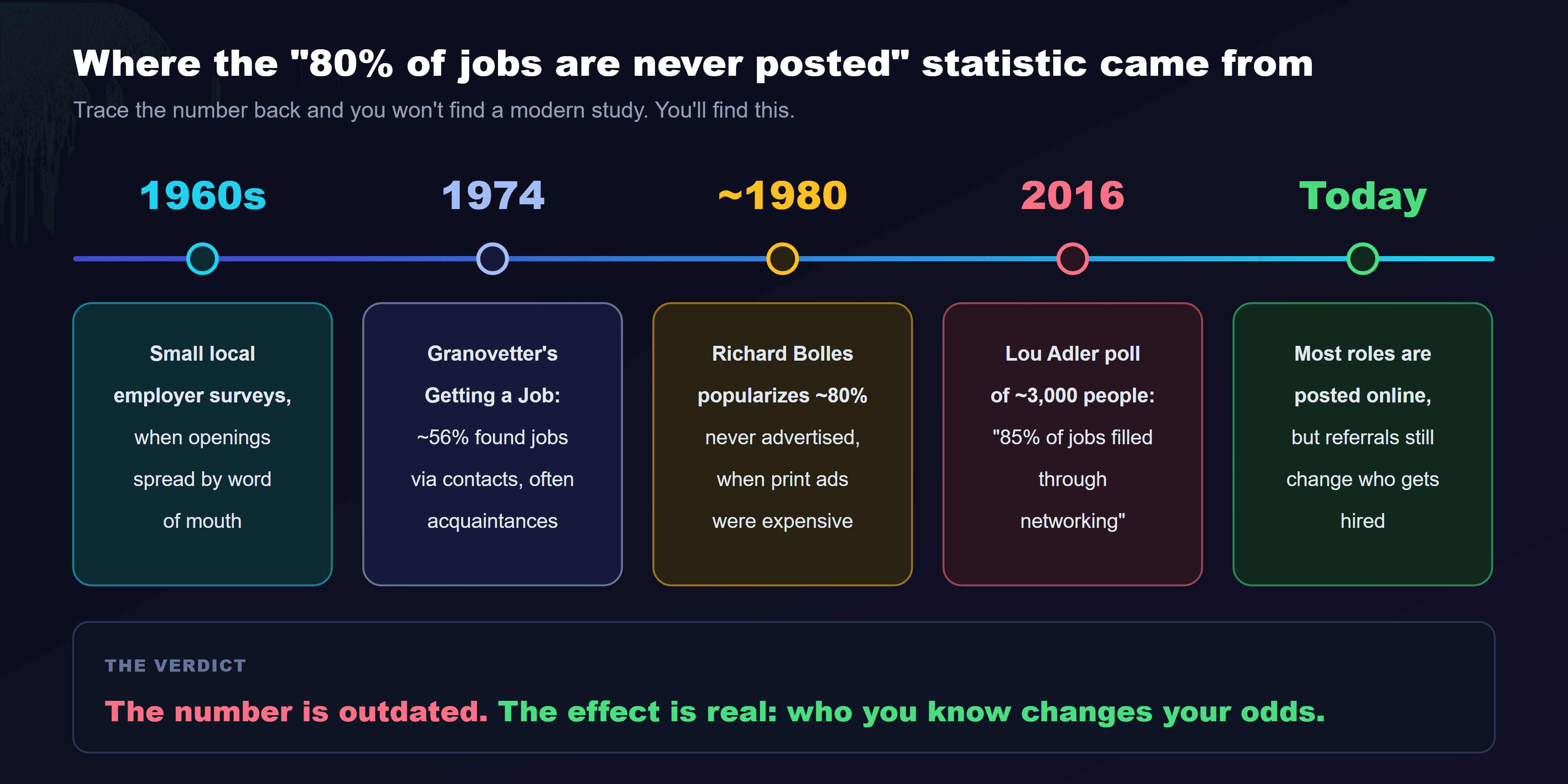
- The 1960s. Investigators have linked the figure to small surveys of local employers, from an era when openings were routinely filled by word of mouth and placement offices.
- 1974. Harvard sociologist Mark Granovetter published Getting a Job. Among the professional, technical and managerial workers he studied, about 56% found their jobs through personal contacts, and many of those leads came from acquaintances rather than close friends. That's the origin of the famous "strength of weak ties."
- Around 1980. Richard Bolles, author of What Color Is Your Parachute?, popularized the idea that most jobs (roughly 80%) are never advertised. At the time, printing job ads in newspapers was expensive, so many employers simply didn't.
- 2016.When the old number started to sound dated, a new one appeared: "85% of jobs are filled through networking." It traces to a LinkedIn write-up by recruiting consultant Lou Adler, based on a poll of about 3,000 people, not a representative study of hiring.
Why this matters to you
What the real data says about referrals
The best large dataset on this comes from Lever, which analyzed more than 4 million candidates and tens of thousands of hires across roughly 1,000 employers. The difference between sources is striking:
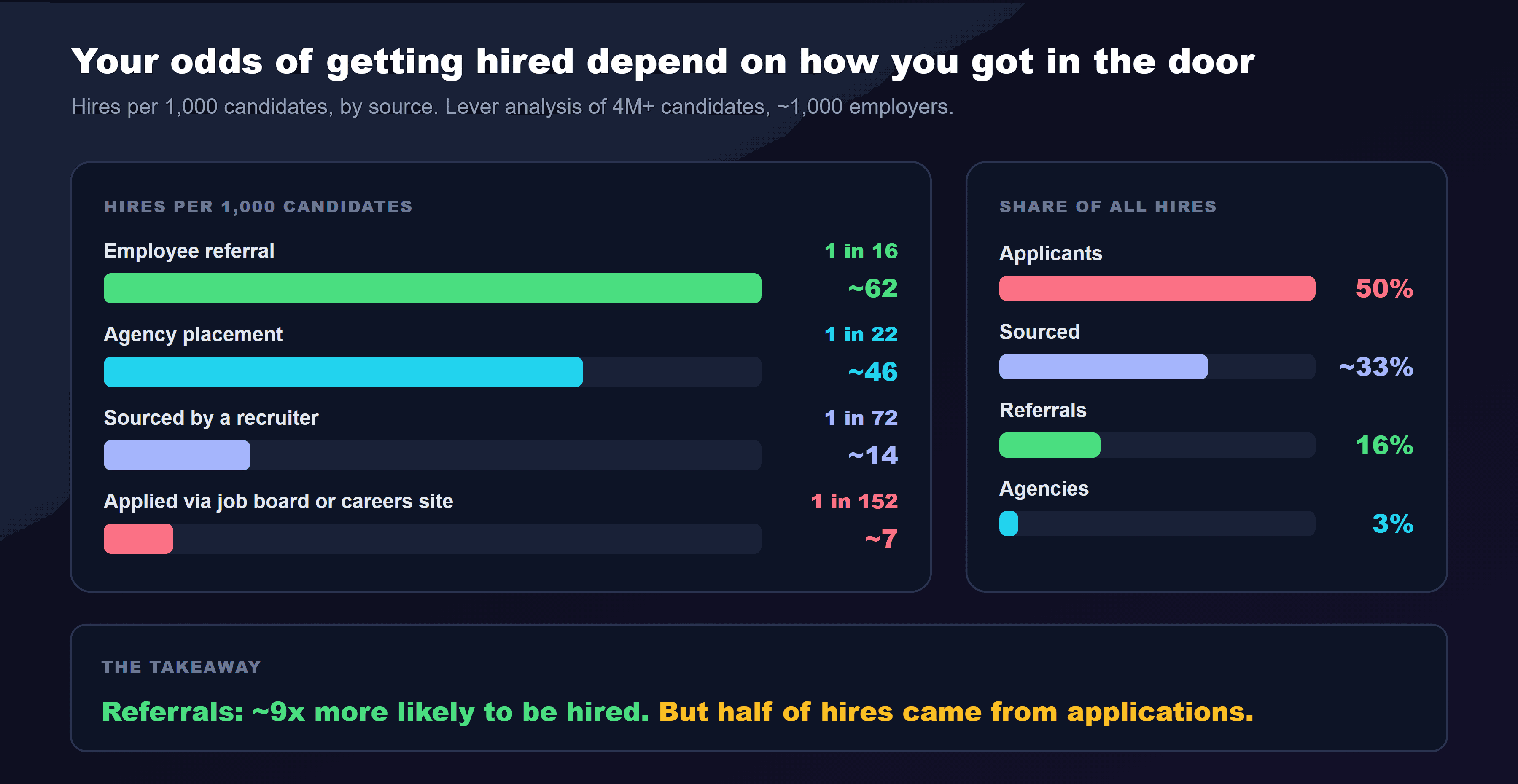
- Employee referrals: 1 in 16 candidates hired.
- Agency placements: 1 in 22.
- Sourced by a recruiter: 1 in 72.
- Applied through a job board or careers site: 1 in 152.
A referred candidate was about nine times more likelyto be hired than a cold applicant. But here's the part the "hidden job market" crowd leaves out: applicants still made up about half of all hires, simply because there are so many of them. Referrals were only 16%. Applying works. It's just a lower-odds channel, which is why it rewards being selective and well-matched rather than spraying applications everywhere.
The surprising part: your best door-openers aren't your friends
In 2022, researchers from MIT, Stanford, Harvard and LinkedIn published a study in Science built on randomized experiments with LinkedIn's "People You May Know" feature. It covered more than 20 million people over five years, 2 billion new connections and 600,000 job changes. The finding: moderately weak ties, people you know but rarely talk to, were more than twice as effective as strong ties at helping someone land at a new employer.
The logic is simple. Your close friends know the same people and hear about the same openings you do. A former coworker from two jobs ago, a classmate you haven't spoken to in a year, or someone you met at a conference sits in a different network, and that's where new information lives. The effect was strongest in more digital industries, like software, where weak ties increased mobility the most.
Translation
The four layers of the hidden job market
"Hidden" doesn't mean one thing. It helps to know which layer you're trying to reach, because each one opens differently.
- 1. Filled before posting. Internal moves, promotions and boomerang hires. The role may be posted only to satisfy policy. Your way in: be known by the team before the need appears.
- 2. Posted, but decided by referral. The listing is public, but referred candidates get reviewed first. Your way in: find a current employee who will flag your application.
- 3. Recruiter and agency pipelines. Specialist recruiters fill many roles from their own shortlists, especially senior and niche ones. Your way in: be findable and responsive. See how to get found by recruiters on LinkedIn.
- 4. Roles created for a person.A manager meets someone impressive and builds a job around them, or a startup hires before it writes a description. Your way in: conversations with decision-makers before there's an opening.
How to spot jobs before they're posted
The best time to reach out is before a job exists, when there's no pile of 500 applicants yet. Companies leave clues:
- New funding or strong earnings. Money usually turns into headcount within a few months.
- A new executive. New leaders tend to build their own teams, often within their first six months.
- Launches, expansions and new offices. Someone has to run them.
- People leaving.When someone on a team announces a move, there's about to be a backfill.
- Lots of similar postings. If a company posts three roles on a team, a fourth is often coming.
Be aware of the opposite signal too. Some public listings are ghost jobsthat aren't actively being filled, so a quick message to someone on the team can save you from applying into a void.
How to tap the hidden job market: a weekly warm-path plan
You don't need to become a networking person. You need a small, repeatable routine that adds a human to your job search. Here's one that takes about three hours a week.
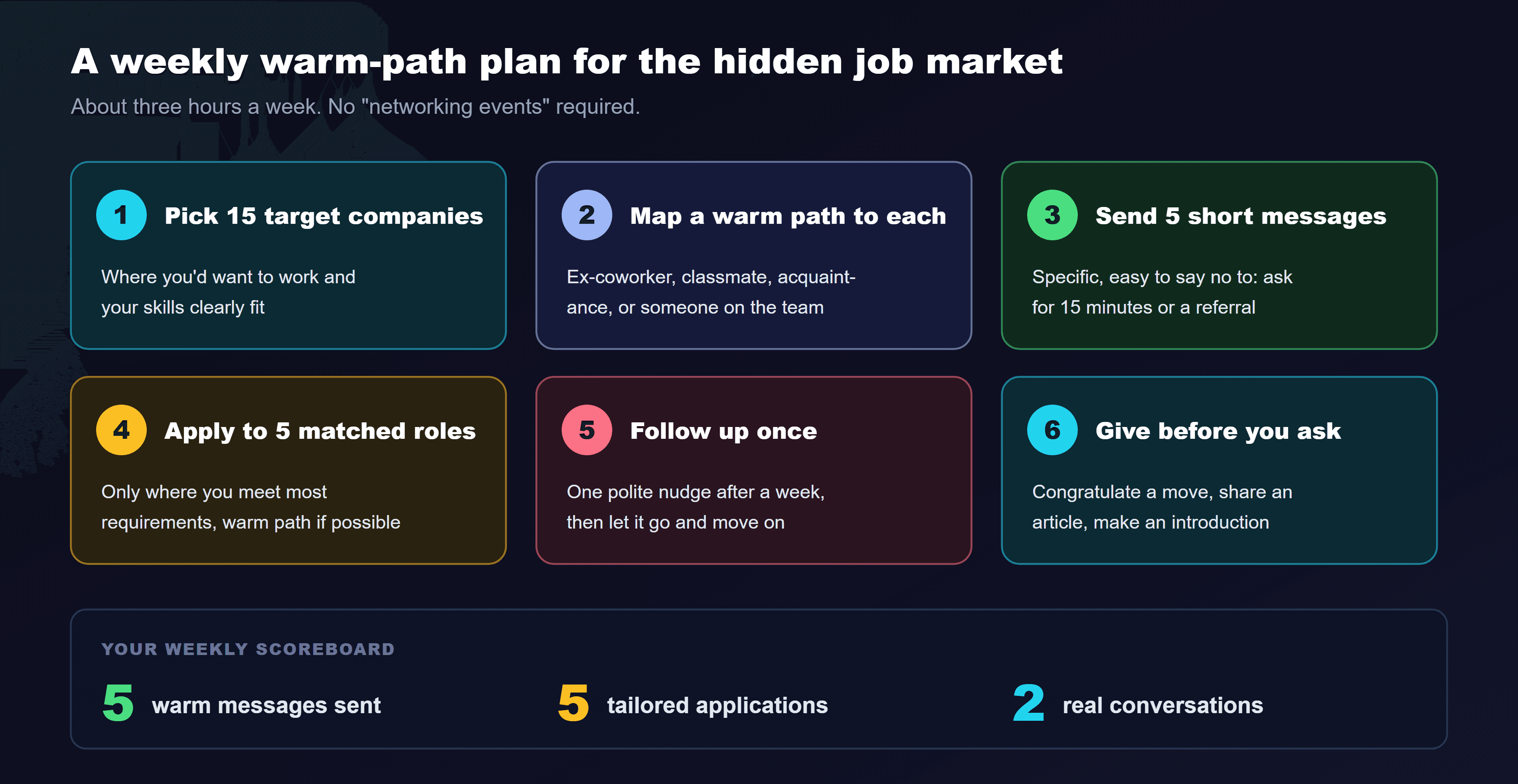
Pick 15 target companies
Map one warm path into each
Send five short messages a week
Apply to five well-matched roles
Follow up once
Give before you ask
Message scripts that actually get replies
- To an old coworker or acquaintance:"Hi Sam, saw you're at Northwind now, congrats. I'm exploring analytics roles and Northwind is high on my list. Would you be up for a 15-minute call about what the team's like? Totally fine if things are busy."
- Asking for a referral to a specific job:"I'm applying for the Senior Analyst role (link). I've spent three years building pricing models, which is most of the job description. Would you be comfortable referring me? I've pasted a two-line summary below you can forward."
- To a hiring manager, before or after applying:"Hi Priya, I just applied for the Product Designer role. I led the redesign of a checkout flow that lifted conversion 18%, which looks close to what your team is tackling. Happy to share the case study if useful."
- To a recruiter in your niche:"I'm a payroll systems specialist with Workday and ADP experience, open to roles in Chicago or remote. If you place people in this space, I'd love to be on your radar." More on this in how to respond to a recruiter.
Why your resume matters even more with a referral
A referral gets your resume read sooner and more carefully. It doesn't get it read more kindly. Many companies still run referred candidates through the same applicant tracking systemand the same screening criteria. And the person who referred you is putting their name on you, so they'll want to see a resume that clearly fits the role before they send it.
Before you ask for a referral, check that your resume speaks directly to the job description. If it doesn't, fix that first. Our guide to tailoring your resume to a job description walks through it step by step.
Make the referral worth it
Paste your resume and the job description into Rankid for a free 0-100 match score, plus the exact requirements you meet and miss. Fix the gaps before you ask someone to put their name on you. No signup required.
Check your match score freeFor employers: your referral program is your hidden job market
If referrals hire at nearly ten times the rate of cold applicants, the hidden job market isn't something that happens to you. It's something your team builds, for better or worse.
- Watch the diversity cost. Referrals tend to reproduce the networks your team already has. Balance them with structured sourcing, and read our guide to diversity hiring.
- Score everyone on the same criteria. A referral should earn a faster look, not a lower bar. Use consistent screening criteria for every source.
- Don't post roles you've already filled.If there's a committed internal candidate, say so. Fake-open postings damage your employer brand and candidate trust.
- Build a talent pipeline. Keep strong past applicants and silver medalists warm so your next hire comes from people who already know you. See how to build a talent pipeline.
Give every source the same fair look
Rankid scores referred, sourced and inbound resumes against the same job description on a consistent 0-100 scale, with the exact requirements each candidate matched and missed. Referrals get speed, not a free pass. First 5 resumes free, no signup.
Try bulk screening freeFrequently asked questions
What is the hidden job market?
The hidden job market is the set of jobs filled without a normal public application process: roles filled internally, through employee referrals, by recruiters and agencies working from their own networks, or created for a specific person before any posting exists. Some of these jobs are never posted; many are posted but effectively decided through a referral or a warm introduction.
Is it true that 80% of jobs are never advertised?
There is no modern evidence for it. Researchers tracing the claim link it to employer surveys from the 1960s, Mark Granovetter's 1974 study 'Getting a Job,' which found about 56% of the professionals he studied got their jobs through personal contacts, and career author Richard Bolles popularizing an 80% figure around 1980, when printed job ads were expensive. The newer '85% of jobs are filled through networking' line traces to a 2016 LinkedIn poll by recruiter Lou Adler. Today most jobs are posted somewhere, but referrals and connections strongly influence who gets them.
Do referrals really make a difference?
Yes. In Lever's analysis of more than 4 million candidates across about 1,000 employers, 1 in 16 referred candidates was hired, compared with 1 in 22 from agencies, 1 in 72 sourced by recruiters, and 1 in 152 who simply applied. That makes a referred candidate roughly nine times more likely to be hired than a cold applicant.
Is applying online a waste of time?
No. In the same Lever data, applicants made up about half of all hires, because so many more people apply. The smart move is not to stop applying, but to apply selectively to well-matched roles and try to add a warm path, such as a referral, a note to the hiring manager or a recruiter conversation, for the jobs you want most.
Who should I ask for a referral: close friends or acquaintances?
Often acquaintances. A 2022 study published in Science, based on experiments with more than 20 million LinkedIn users over five years, found that moderately weak ties, people you know but rarely interact with, were more than twice as effective as strong ties in helping someone move to a new employer. They connect you to information and openings your close circle already knows about.
How do I ask for a referral without being awkward?
Make it specific and easy to say no to. Name the exact role, link it, give two lines on why you fit, and offer a short blurb they can forward. For example: 'I'm applying for the Senior Analyst role on your team (link). I've spent three years building the same kind of pricing models. Would you be comfortable referring me, or pointing me to the right person? Totally fine if not.'
How do I find jobs that aren't posted?
Watch for signals that a company is about to hire: new funding, a new executive, office openings, product launches and team members leaving. Then reach out to people on that team before the role is posted. Follow target companies, stay in touch with former colleagues, talk to specialist recruiters in your field, and keep your LinkedIn profile searchable so recruiters can find you.
Why are jobs posted when there's already an internal candidate?
Many organizations, especially public-sector employers and large companies, require every role to be posted for fairness, compliance or pay transparency rules, even when a strong internal or referred candidate exists. That's one reason some postings feel like ghost jobs. It's also why a warm path matters: being known before the posting goes up puts you in the same position as the insider.
Key takeaways
- The hidden job market is real: jobs filled internally, by referral, through recruiters, or created for a specific person.
- The '80% of jobs are never posted' claim traces to 1960s-1980s research and a 2016 poll, not to modern hiring data.
- In Lever's data on 4 million candidates, referrals were hired at 1 in 16 versus 1 in 152 for cold applicants, about 9x better odds.
- But half of all hires still came from applications, so don't stop applying. Apply selectively and add a warm path where it counts.
- A Science study of 20 million LinkedIn users found moderately weak ties are more than twice as effective as close friends for job moves.
- Spot jobs early through funding, new executives, launches and departures, and reach out before the posting goes live.
- A simple weekly routine works: 15 target companies, 5 messages, 5 well-matched applications, one follow-up each.
- A referral gets your resume read sooner, not judged more kindly. Make sure it matches the job before you ask.
Frequently asked questions
What is the hidden job market?
The hidden job market is the set of jobs filled without a normal public application process: roles filled internally, through employee referrals, by recruiters and agencies working from their own networks, or created for a specific person before any posting exists. Some of these jobs are never posted; many are posted but effectively decided through a referral or a warm introduction.
Is it true that 80% of jobs are never advertised?
There is no modern evidence for it. Researchers tracing the claim link it to employer surveys from the 1960s, Mark Granovetter's 1974 study 'Getting a Job,' which found about 56% of the professionals he studied got their jobs through personal contacts, and career author Richard Bolles popularizing an 80% figure around 1980, when printed job ads were expensive. The newer '85% of jobs are filled through networking' line traces to a 2016 LinkedIn poll by recruiter Lou Adler. Today most jobs are posted somewhere, but referrals and connections strongly influence who gets them.
Do referrals really make a difference?
Yes. In Lever's analysis of more than 4 million candidates across about 1,000 employers, 1 in 16 referred candidates was hired, compared with 1 in 22 from agencies, 1 in 72 sourced by recruiters, and 1 in 152 who simply applied. That makes a referred candidate roughly nine times more likely to be hired than a cold applicant.
Is applying online a waste of time?
No. In the same Lever data, applicants made up about half of all hires, because so many more people apply. The smart move is not to stop applying, but to apply selectively to well-matched roles and try to add a warm path, such as a referral, a note to the hiring manager or a recruiter conversation, for the jobs you want most.
Who should I ask for a referral: close friends or acquaintances?
Often acquaintances. A 2022 study published in Science, based on experiments with more than 20 million LinkedIn users over five years, found that moderately weak ties, people you know but rarely interact with, were more than twice as effective as strong ties in helping someone move to a new employer. They connect you to information and openings your close circle already knows about.
How do I ask for a referral without being awkward?
Make it specific and easy to say no to. Name the exact role, link it, give two lines on why you fit, and offer a short blurb they can forward. For example: 'I'm applying for the Senior Analyst role on your team (link). I've spent three years building the same kind of pricing models. Would you be comfortable referring me, or pointing me to the right person? Totally fine if not.'
How do I find jobs that aren't posted?
Watch for signals that a company is about to hire: new funding, a new executive, office openings, product launches and team members leaving. Then reach out to people on that team before the role is posted. Follow target companies, stay in touch with former colleagues, talk to specialist recruiters in your field, and keep your LinkedIn profile searchable so recruiters can find you.
Why are jobs posted when there's already an internal candidate?
Many organizations, especially public-sector employers and large companies, require every role to be posted for fairness, compliance or pay transparency rules, even when a strong internal or referred candidate exists. That's one reason some postings feel like ghost jobs. It's also why a warm path matters: being known before the posting goes up puts you in the same position as the insider.