The Keeper Test: What It Is, Who Uses It, and How to Tell If You'd Pass
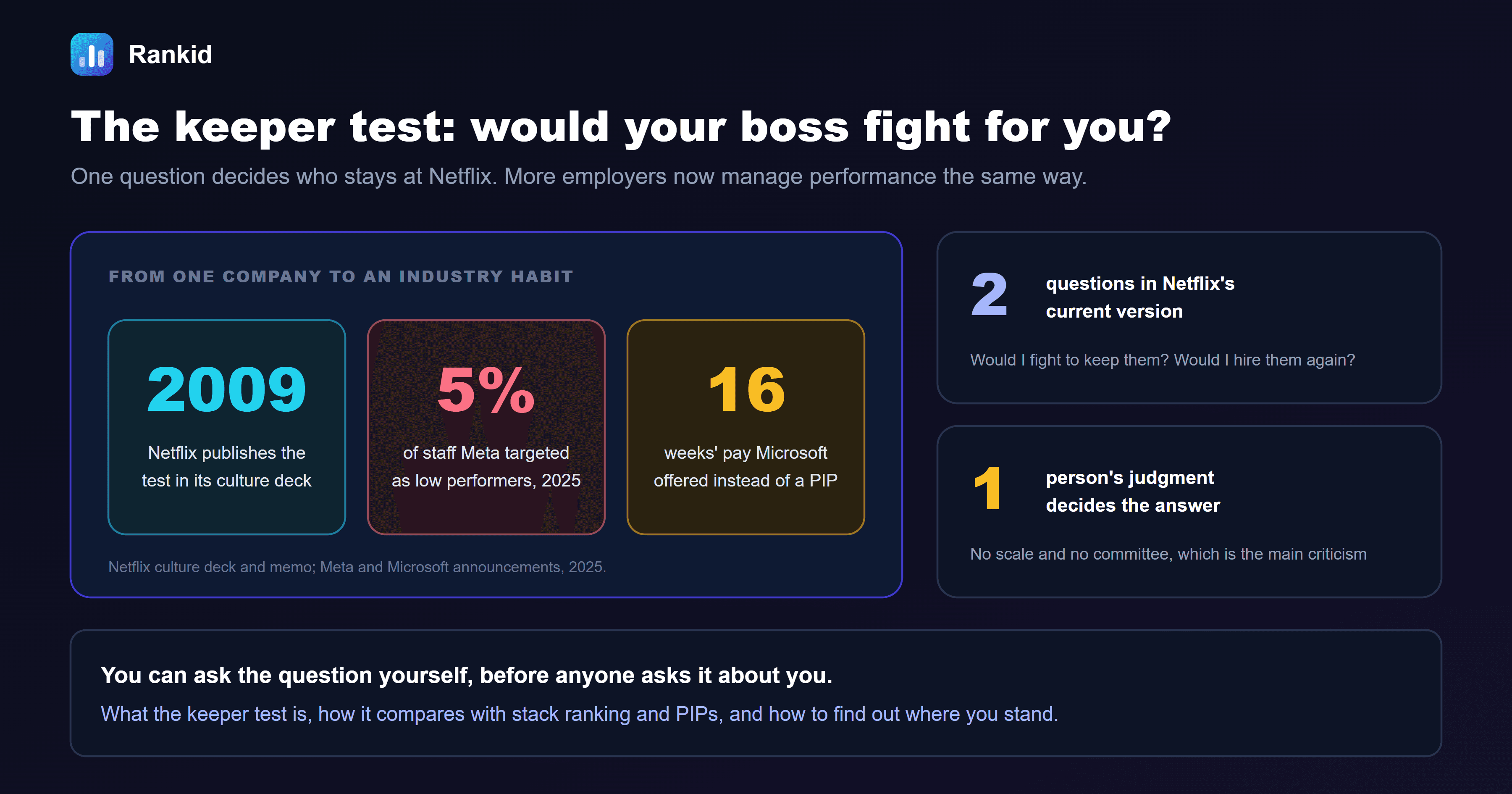
Imagine you told your manager tomorrow that you had another offer. Would they go to their boss, find budget, and try to change your mind? Or would they say they're sorry to hear it and ask about your last day? At Netflix, managers are expected to know the answer for every person on their team. The question is called the keeper test, and the thinking behind it has spread well beyond one company.
Quick answer
Quick answer: the keeper test is a question a manager asks about each employee: "if this person wanted to leave, would I fight to keep them?" If the answer is no, the person is let go, usually with severance. Netflix has used it since 2009. It has no rating scale and no quota, which makes it fast and also subjective. You don't have to wait to find out your result: you can ask your manager the same question.
What is the keeper test?
The keeper test is a performance standard expressed as one question. Instead of asking "is this person meeting expectations?", a manager asks "would I fight to keep this person?"
Netflix's current culture memo puts it in two forms:
- "If X wanted to leave, would I fight to keep them?"
- "Knowing everything I know today, would I hire X again?"
If the answer is no, the manager is expected to act on it. The reasoning is in the same memo: Netflix models itself "on a professional sports team, not a family," with the right player in every position.
The bar is the unusual part. Under most performance systems, doing the job competently keeps you employed. Under the keeper test, competent isn't the standard. Hard to replace is.
Where it came from, and how it has changed
- 2009.Netflix publishes its culture deck, written by co-founder Reed Hastings and chief talent officer Patty McCord. It includes the keeper test and the line that "adequate performance gets a generous severance package." The deck has since been viewed millions of times.
- 2024.Netflix rewrites its culture memo. The test stays, with softer framing: "In the abstract, the keeper test can sound scary. In reality, we encourage everyone to speak to their managers about what's going well and what's not on a regular basis." Managers are told to weigh a person's whole record, not a single incident.
Why you're hearing about it now
Few companies use the name. Many have moved toward the idea: that keeping your job requires more than adequate performance, and that managers should act quickly when it's missing.
- Meta.In January 2025, Mark Zuckerberg said he had decided to "raise the bar on performance management and move out low performers faster," targeting about 5% of staff.
- Microsoft.In 2025 it began offering some low-rated employees a choice: enter a performance improvement plan, or leave with 16 weeks' pay. Those who leave with low ratings aren't eligible for rehire for two years.
- Amazon. It has reportedly long set internal targets for what it calls unregretted attrition.
The job market makes the test harder to fail safely
Keeper test vs stack ranking vs PIP
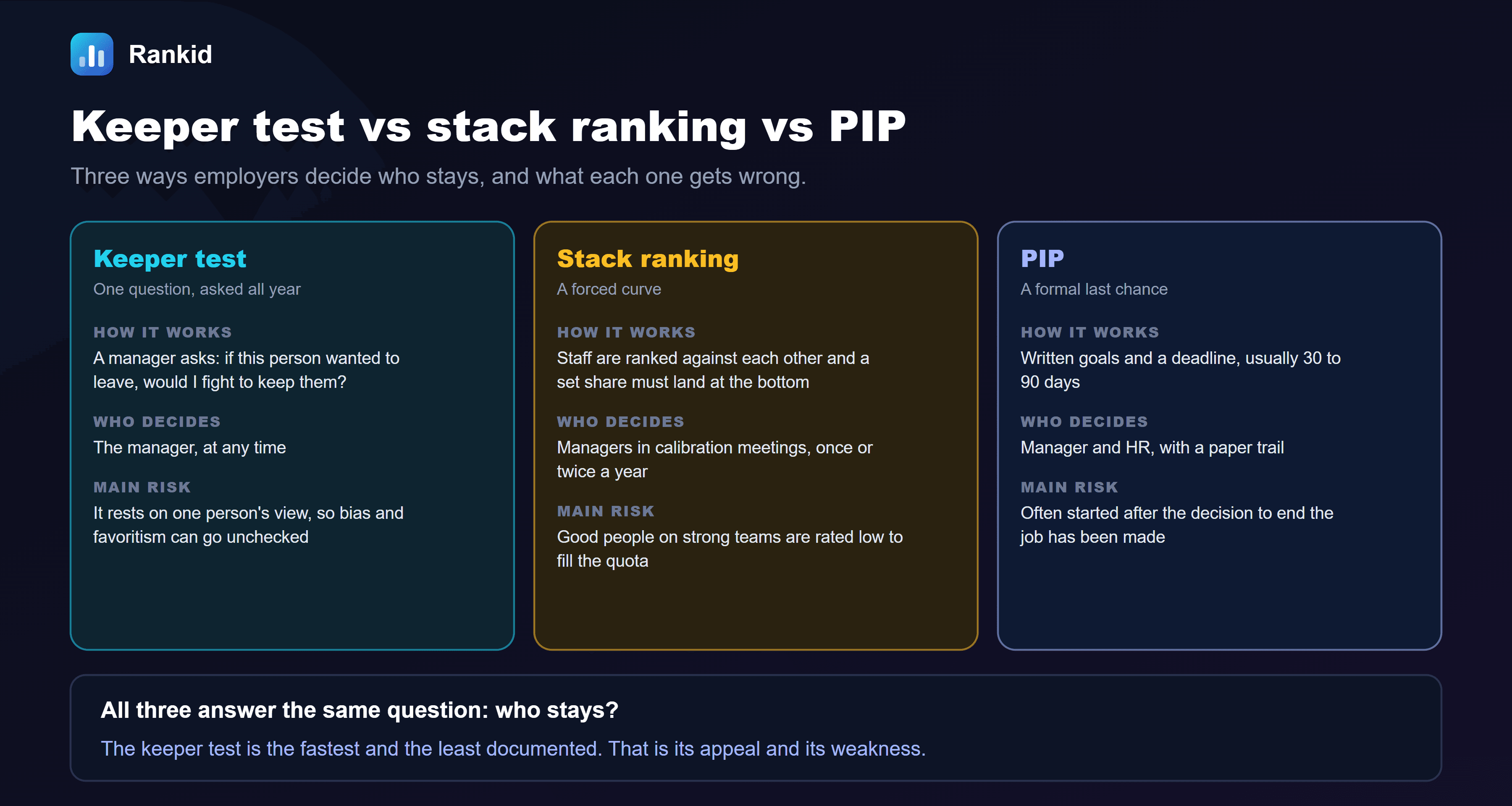
- Keeper test. One manager, one question, any time. No quota. Fast and lightly documented.
- Stack ranking.Employees are ranked against each other and a fixed share must be rated lowest. General Electric made it famous under Jack Welch, removing the bottom 10% each year. Microsoft dropped its version in 2013. Also called forced ranking or "rank and yank."
- Performance improvement plan. Written goals with a deadline, usually 30 to 90 days. Netflix has traditionally preferred severance to a PIP. See performance improvement plans.
What it gets right, and wrong
The case for it:
- It's honest. People aren't kept for years in roles their manager has given up on.
- There's no quota, so a strong team isn't forced to name a loser.
- It prompts managers to tell their best people they're valued before they resign.
- Severance in place of a drawn-out PIP can be kinder to the person leaving.
The case against it:
- It's one person's opinion."Would I hire them again?" favors people the manager finds familiar and easy to work with. That is how bias gets in.
- It ignores the manager's part. A no can reflect unclear goals or poor support as much as the employee.
- It can produce fear. People who feel permanently on trial take fewer risks and admit fewer mistakes.
- It penalizes rough patches. A new parent, an illness or a bad project can turn a yes into a no for a few months.
- It can become quiet neglect.Where a manager can't act on a no straight away, the employee is often sidelined instead. See quiet firing.
Would you pass? The signs to read
Most employers will never tell you they're asking this question. Your manager's behavior usually shows the answer.
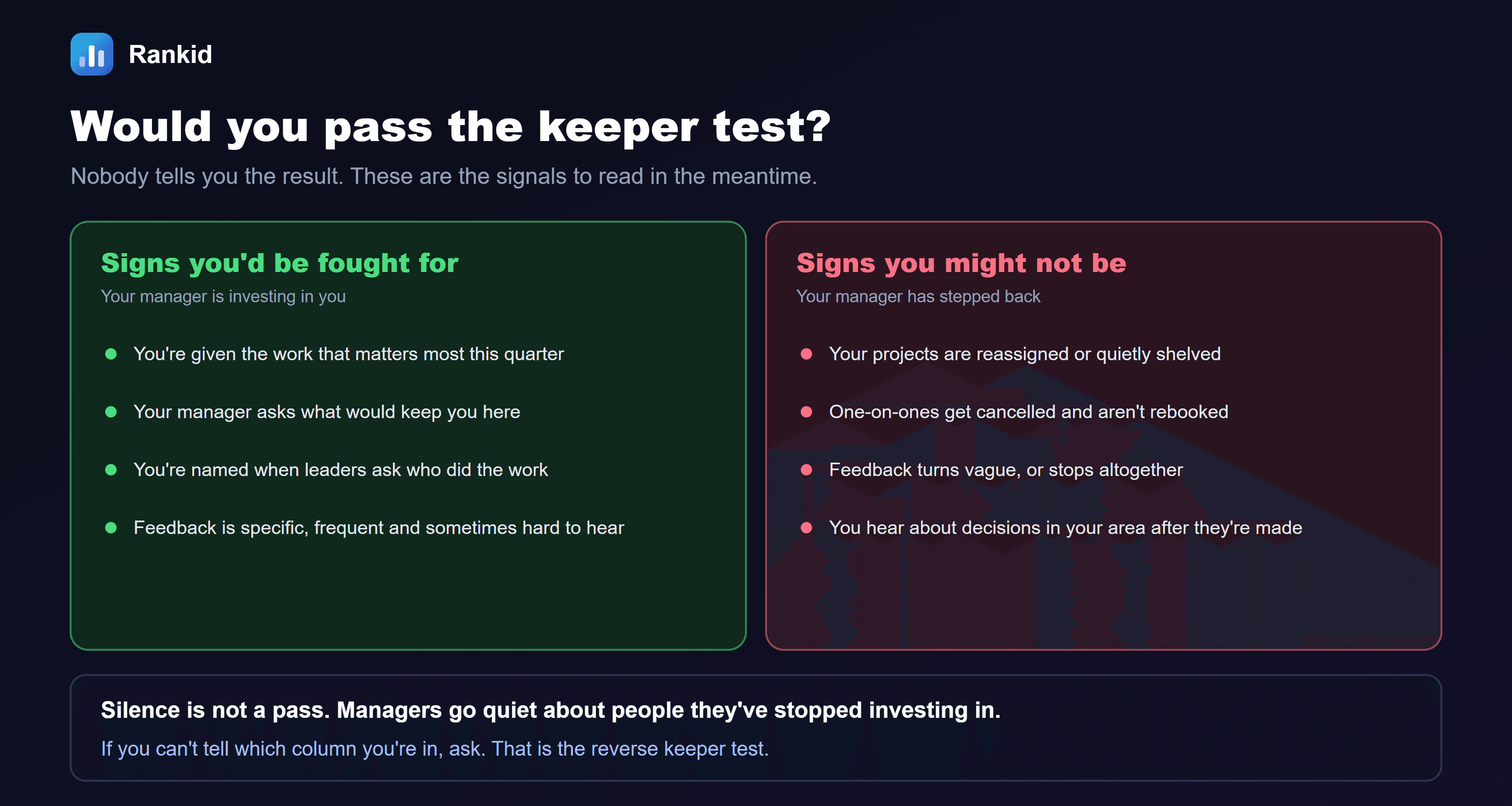
The counterintuitive one is feedback. Hard, specific feedback is a sign of investment. Managers rarely spend that effort on someone they expect to lose. Vague praise followed by silence is the more worrying pattern.
You can also run the test on yourself. Answer these honestly:
- If my job were posted today, would I be the strongest applicant?
- What do I do that would be hard to hand to someone else next month?
- Can I name three results from the last six months, with numbers?
- Does my manager's boss know what I work on?
- When did my manager last ask for my opinion on something that mattered?
Three or more uncomfortable answers doesn't mean you're about to be let go. It means the next section is worth doing this month.
The reverse keeper test: how to ask your manager
Netflix encourages employees to turn the question around. You can do the same anywhere. It feels risky, and it's usually less risky than not knowing.
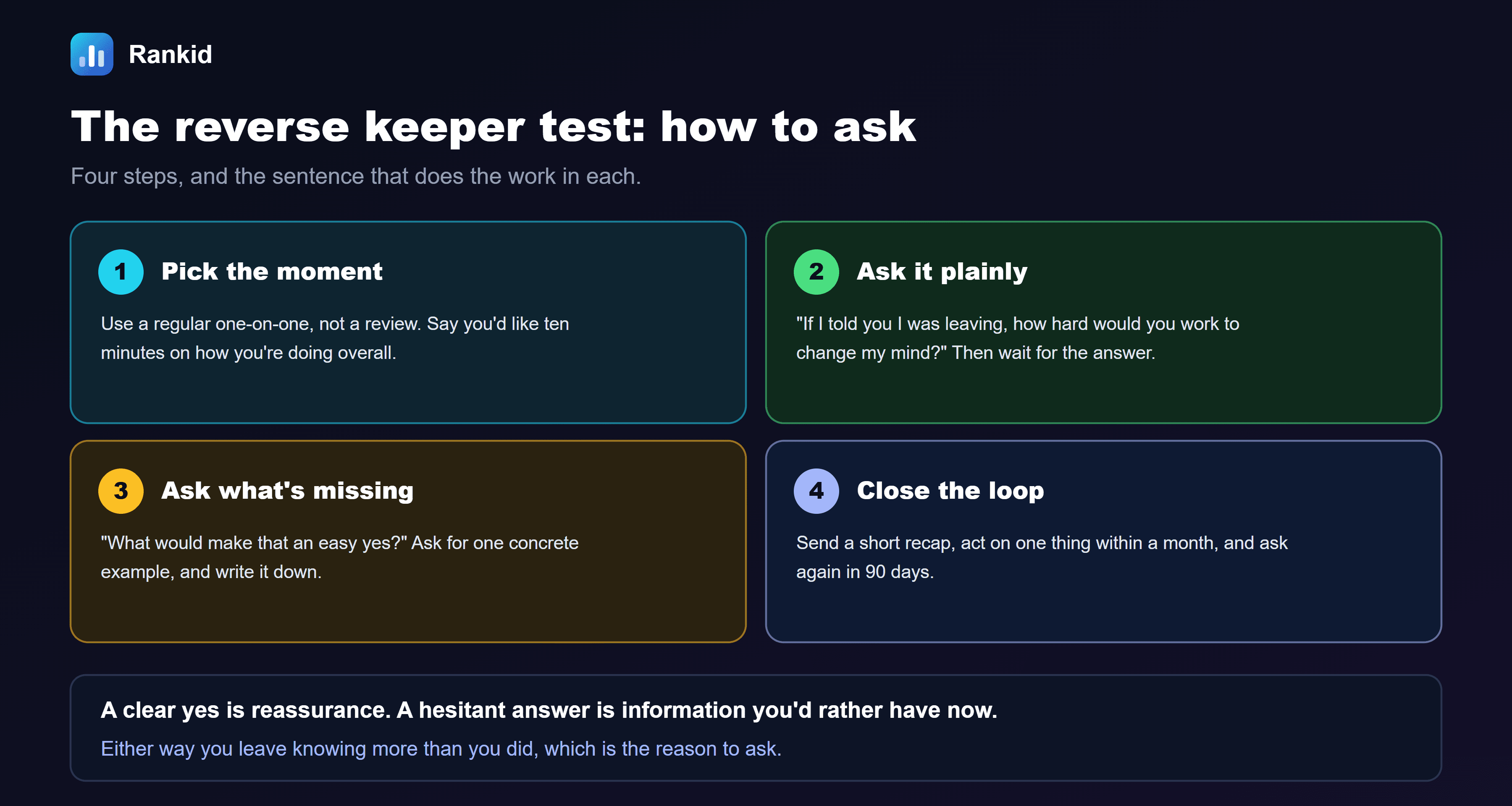
Pick the moment
Ask it plainly
Ask what's missing
Close the loop
If the answer is hesitant, you've learned it while you still have a salary and time. Work on the gap they named, and start preparing options in parallel. See career cushioning. If the answer is a clear yes, that's useful too, including the next time you ask for a raise.
Would you be hired for your own job today?
That's the second keeper test question. Find out: paste your resume and a current posting for your role. Rankid gives you a free 0-100 match score and shows the exact requirements you meet and miss. No signup required.
Check your match score freeIs the keeper test legal?
In the US, generally yes. Most employment is at will, so an employer doesn't need to prove misconduct to end a job. Three points matter:
- Discrimination law still applies. If the people who fail are disproportionately older, female, of one race, or recently back from protected leave, a subjective test is hard to defend. See adverse impact.
- Severance isn't guaranteed.It's a company practice, usually offered in exchange for a release of claims. See severance pay.
- Unemployment benefits are usually available. Being let go for performance is different from being fired for misconduct. Rules vary by state.
This is general information, not legal advice.
For managers: how to run it fairly
The question is useful. Acting on a gut answer isn't. If you're going to use it, build in the checks it lacks.
- Write down why.If you can't name the results or behaviors behind a no in two sentences, it's a feeling, not an assessment.
- Ask what you contributed. Were the goals clear? Did they get feedback? Is the role the wrong fit for a capable person?
- Tell them before you decide.A no should never be a surprise. Say what's missing and give real time to close it.
- Get a second view.Compare answers with a peer or your own manager. One person's judgment is where bias hides.
- Check the pattern. Look at who has failed across the organization by age, sex, race and leave status before anyone is let go.
- Use the yes, too.If you'd fight to keep someone, tell them now, and look at their pay. Most managers only do this after the resignation. See counteroffers when you resign.
- Apply the standard when hiring. A high bar for staying only works with a consistent bar for joining. See interview scorecards.
Hire people you'd fight to keep
A keeper test starts at the hiring stage. Rankid scores every applicant against your job description on a consistent 0-100 scale and shows the exact requirements each matched and missed, so the first decision is based on evidence. First 5 resumes free, no signup.
Try bulk screening freeFrequently asked questions
What is the keeper test?
The keeper test is a way of deciding who stays on a team. A manager asks of each person: if they told me they were leaving, would I fight to keep them? If the honest answer is no, the practice is to let that person go with severance and hire someone the manager would fight for. Netflix introduced it and still uses it.
What is the exact keeper test question?
Netflix's current culture memo asks managers two questions: 'if X wanted to leave, would I fight to keep them?' or 'knowing everything I know today, would I hire X again?' Earlier versions asked which people a manager would fight hard to keep if they were leaving for a similar job at another company.
Who created the keeper test?
It comes from Netflix, where co-founder Reed Hastings and former chief talent officer Patty McCord set it out in the company's 2009 culture deck. The deck said Netflix was a team, not a family, and that adequate performance would receive a generous severance package.
What is the reverse keeper test?
It is the same question asked by the employee. You ask your manager something like: 'If I told you I was leaving, how hard would you work to change my mind?' Netflix encourages employees to ask it so that nobody is surprised. It works at any company as a direct way to find out where you stand.
How is the keeper test different from stack ranking?
Stack ranking compares employees with each other and requires a fixed share to be rated at the bottom, typically once a year. The keeper test has no quota and no schedule: it is one manager's judgment about one person, at any time. Stack ranking can force out good people on strong teams. The keeper test depends heavily on the individual manager.
Is the keeper test legal?
In the US, generally yes. Most employment is at will, so an employer can end a job for performance or fit without proving misconduct. It becomes a legal risk if the people who fail are disproportionately of one sex, race, age group or other protected class, or if the decision is retaliation. Subjective tests make that harder for an employer to defend.
How do I know if I would pass the keeper test?
Look at how your manager invests in you. Good signs are being given the most important work, specific and regular feedback, and being asked what would keep you. Warning signs are reassigned projects, cancelled one-on-ones, vague or absent feedback, and being left out of decisions in your area. The most reliable method is to ask directly.
Do you get severance if you fail the keeper test?
At Netflix, people let go under the keeper test have traditionally received severance, which the company has described as generous. Elsewhere it depends on the employer, since US law does not generally require severance. If you are let go for performance and not misconduct, you can usually still claim unemployment benefits, though rules vary by state.
Key takeaways
- The keeper test is a question a manager asks about each employee: if this person wanted to leave, would I fight to keep them? If not, the person is let go, usually with severance.
- Netflix introduced it in its 2009 culture deck. Its current memo adds a second question: knowing everything I know today, would I hire this person again?
- The standard is higher than meeting expectations. Adequate performance is not enough to pass.
- Unlike stack ranking, it has no quota or schedule. Unlike a PIP, it involves little documentation. It depends on one manager's judgment, which is its main weakness.
- Signs you'd pass include important work, specific feedback and a manager who asks what would keep you. Signs you might not include reassigned projects, cancelled one-on-ones and silence.
- You can ask directly with the reverse keeper test: 'If I told you I was leaving, how hard would you work to change my mind?' Then ask what would make it an easy yes.
- Managers who use it should write down their reasons, give warning, get a second opinion and check outcomes for bias before acting.
Frequently asked questions
What is the keeper test?
The keeper test is a way of deciding who stays on a team. A manager asks of each person: if they told me they were leaving, would I fight to keep them? If the honest answer is no, the practice is to let that person go with severance and hire someone the manager would fight for. Netflix introduced it and still uses it.
What is the exact keeper test question?
Netflix's current culture memo asks managers two questions: 'if X wanted to leave, would I fight to keep them?' or 'knowing everything I know today, would I hire X again?' Earlier versions asked which people a manager would fight hard to keep if they were leaving for a similar job at another company.
Who created the keeper test?
It comes from Netflix, where co-founder Reed Hastings and former chief talent officer Patty McCord set it out in the company's 2009 culture deck. The deck said Netflix was a team, not a family, and that adequate performance would receive a generous severance package.
What is the reverse keeper test?
It is the same question asked by the employee. You ask your manager something like: 'If I told you I was leaving, how hard would you work to change my mind?' Netflix encourages employees to ask it so that nobody is surprised. It works at any company as a direct way to find out where you stand.
How is the keeper test different from stack ranking?
Stack ranking compares employees with each other and requires a fixed share to be rated at the bottom, typically once a year. The keeper test has no quota and no schedule: it is one manager's judgment about one person, at any time. Stack ranking can force out good people on strong teams. The keeper test depends heavily on the individual manager.
Is the keeper test legal?
In the US, generally yes. Most employment is at will, so an employer can end a job for performance or fit without proving misconduct. It becomes a legal risk if the people who fail are disproportionately of one sex, race, age group or other protected class, or if the decision is retaliation. Subjective tests make that harder for an employer to defend.
How do I know if I would pass the keeper test?
Look at how your manager invests in you. Good signs are being given the most important work, specific and regular feedback, and being asked what would keep you. Warning signs are reassigned projects, cancelled one-on-ones, vague or absent feedback, and being left out of decisions in your area. The most reliable method is to ask directly.
Do you get severance if you fail the keeper test?
At Netflix, people let go under the keeper test have traditionally received severance, which the company has described as generous. Elsewhere it depends on the employer, since US law does not generally require severance. If you are let go for performance and not misconduct, you can usually still claim unemployment benefits, though rules vary by state.