The Low-Hire, Low-Fire Job Market: Why It's So Hard to Get Hired When Layoffs Are Low
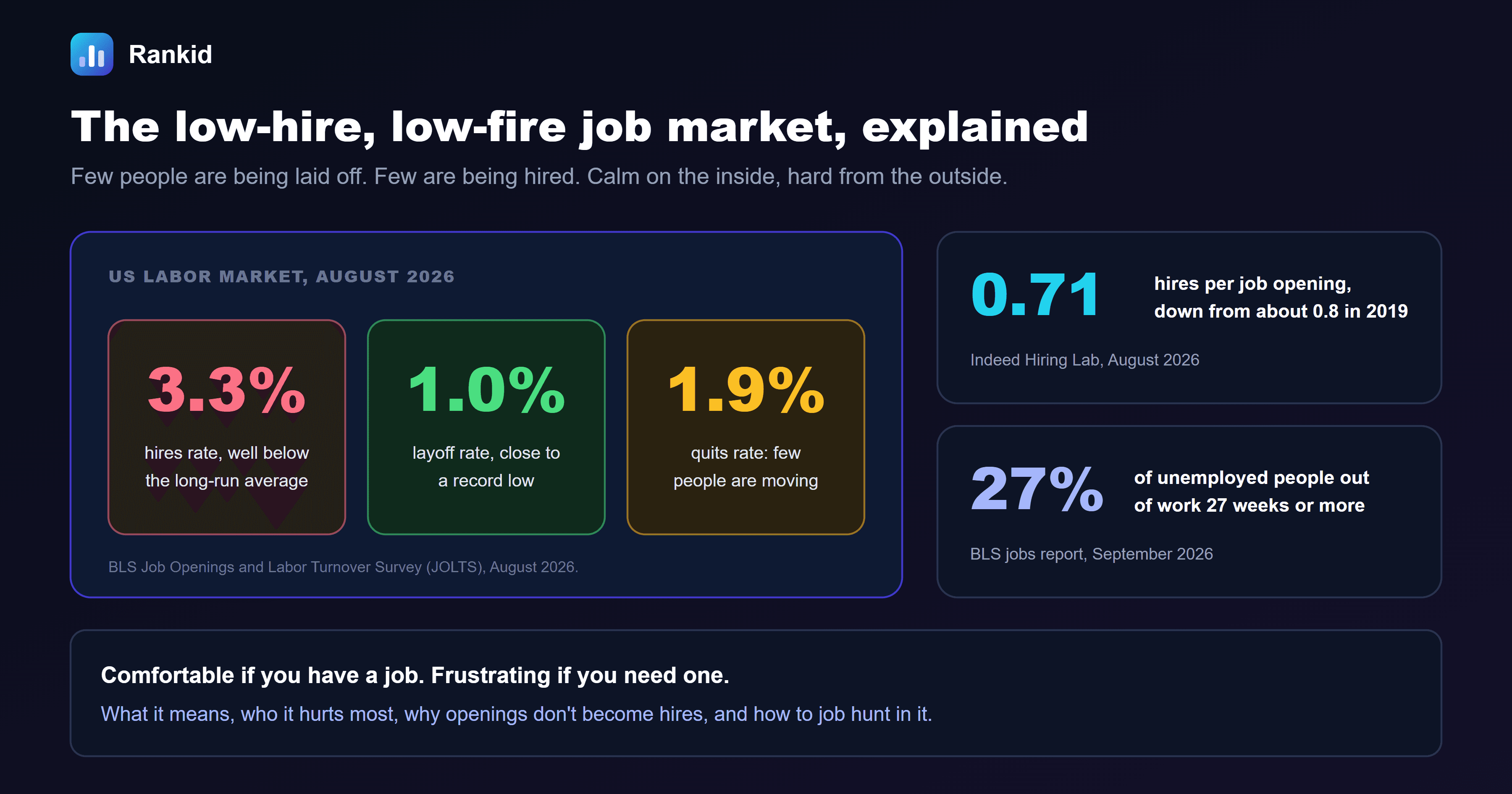
The headlines say unemployment is low and layoffs are near record lows. Your inbox says you've sent 140 applications and had three calls. Both are accurate. Economists have a name for a market that produces both at once: low-hire, low-fire.
Quick answer
Quick answer: a low-hire, low-fire job market is one where employers are laying off very few people and hiring very few. In August 2026 the US hires rate was 3.3%, the layoff rate 1.0% and the quits rate 1.9%(BLS). If you have a job, you're unusually safe. If you need one, there are fewer seats opening than at almost any time since 2000, so referrals, timing and a tailored resume matter more than volume.
What is a low-hire, low-fire job market?
It's a labor market with very little movement in either direction. Employers hold on to the staff they have and add few new ones. Workers stay where they are. The phrase is used by Federal Reserve officials and labor economists, and you'll also see "no-hire, no-fire" or "frozen job market."
A simple way to picture it is a company with 1,000 employees in a typical month of 2026:
- About 33 people are hired. The long-run average would be 37.
- About 19 quit.
- About 10 are laid off or let go. The long-run average would be 14.
Almost everyone who was there last month is still there this month. That's reassuring from the inside. From the outside, it means very few empty chairs.
The numbers behind it
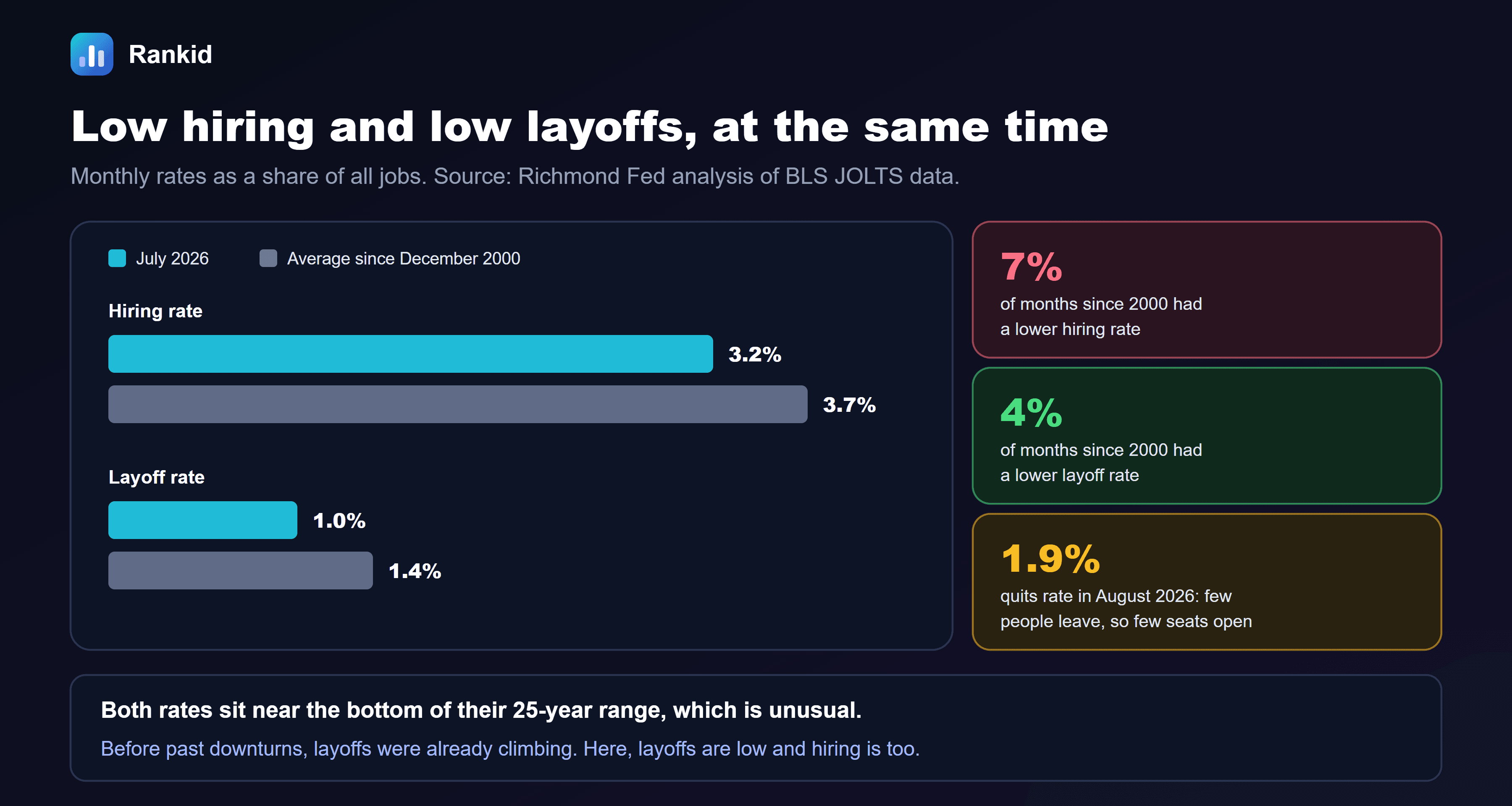
- Hires rate 3.3%, layoff rate 1.0%, quits rate 1.9%. BLS Job Openings and Labor Turnover Survey (JOLTS) for August 2026. Job openings stood at 7.1 million.
- Both rates are near 25-year lows. Using July 2026 data, the Richmond Fed found the hiring rate (3.2%) was lower in only 7% of months since December 2000, and the layoff rate (1.0%) was lower in only 4%.
- 0.71 hires per job opening.Indeed Hiring Lab's figure for August 2026, down from about 0.8 in August 2019.
- Long searches. In the September 2026 jobs report, unemployed people had been looking for an average of 24.8 weeks. About 1.9 million, or 27.1% of the unemployed, had been out of work 27 weeks or more. The unemployment rate was 4.2%.
- Few hiring announcements.Employers announced plans to hire 210,612 workers through September 2026, with seasonal hiring plans well below last year's (Challenger, Gray & Christmas).
One opening per unemployed person, and still no offer
Why openings aren't turning into hires
- Nobody is leaving.Most hiring replaces someone who quit. At a 1.9% quits rate, there's little to replace. See job hugging.
- Employers are waiting.Andy Challenger of Challenger, Gray & Christmas described companies as being in "a wait-and-see period," unsure about demand, costs and how much work AI will absorb.
- They're holding on to staff. After the hiring difficulties of 2021 and 2022, many employers would sooner keep people than risk having to rehire. Economists call it labor hoarding. It keeps layoffs low and adds no new seats.
- Cuts are small and quiet. Where jobs do go, it's often a few at a time. See forever layoffs.
- Every opening is flooded. Fewer postings and easy applications mean each one draws hundreds of candidates, which slows the decision. See AI auto-apply tools.
One market, two experiences
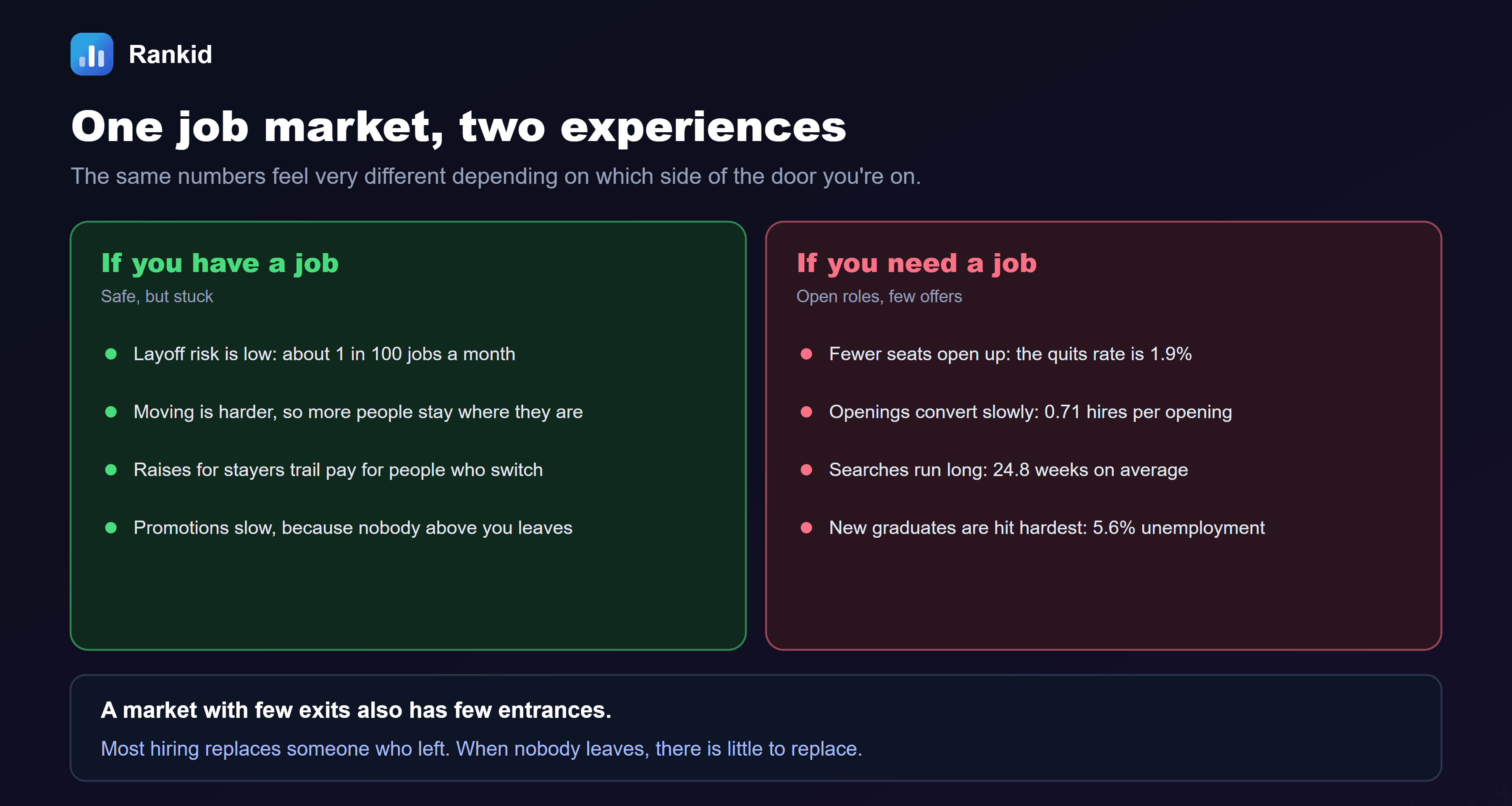
If you have a job,you're statistically secure. The cost is mobility: fewer outside offers, slower promotions because nobody above you leaves, and raises that trail what a new hire would get. See pay compression.
If you need a job,you're competing for a small number of real openings. The groups hit hardest are the ones trying to get in:
- New graduates.Unemployment for recent college graduates was about 5.6% in the second quarter of 2026, against 4.2% for all workers, and 42% were in jobs that don't usually need a degree (New York Fed). See AI and entry-level jobs.
- People who've been laid off. Losing a job is rare. Replacing one is slow.
- Career changers and returners.Cautious employers prefer candidates who've done the exact job before.
- Older job seekers. Long searches get longer. See job searching over 50.
Is this a recession signal?
Not on its own. Recessions show up as rising layoffs, and layoffs are near record lows. The Richmond Fed points out that in October 2007, just before the last deep recession, layoffs were already elevated. That isn't the picture now.
The concern is fragility. Indeed's Cory Stahle has called recent job gains "a fragile kind of growth," because they depend on people not leaving more than on employers recruiting. With hiring this slow, a modest rise in layoffs would lift unemployment quickly, since those workers would have few places to go.
There is one encouraging sign: Indeed reported that job postings turned positive year over year in mid-September 2026 for the first time in more than four years. The numbers to watch are the hires rate and the quits rate. When people start quitting again, seats open.
How to job hunt in a low-hire market
Sending more applications is the natural response, and it's the least effective one when few openings convert. Spend the same hours differently.
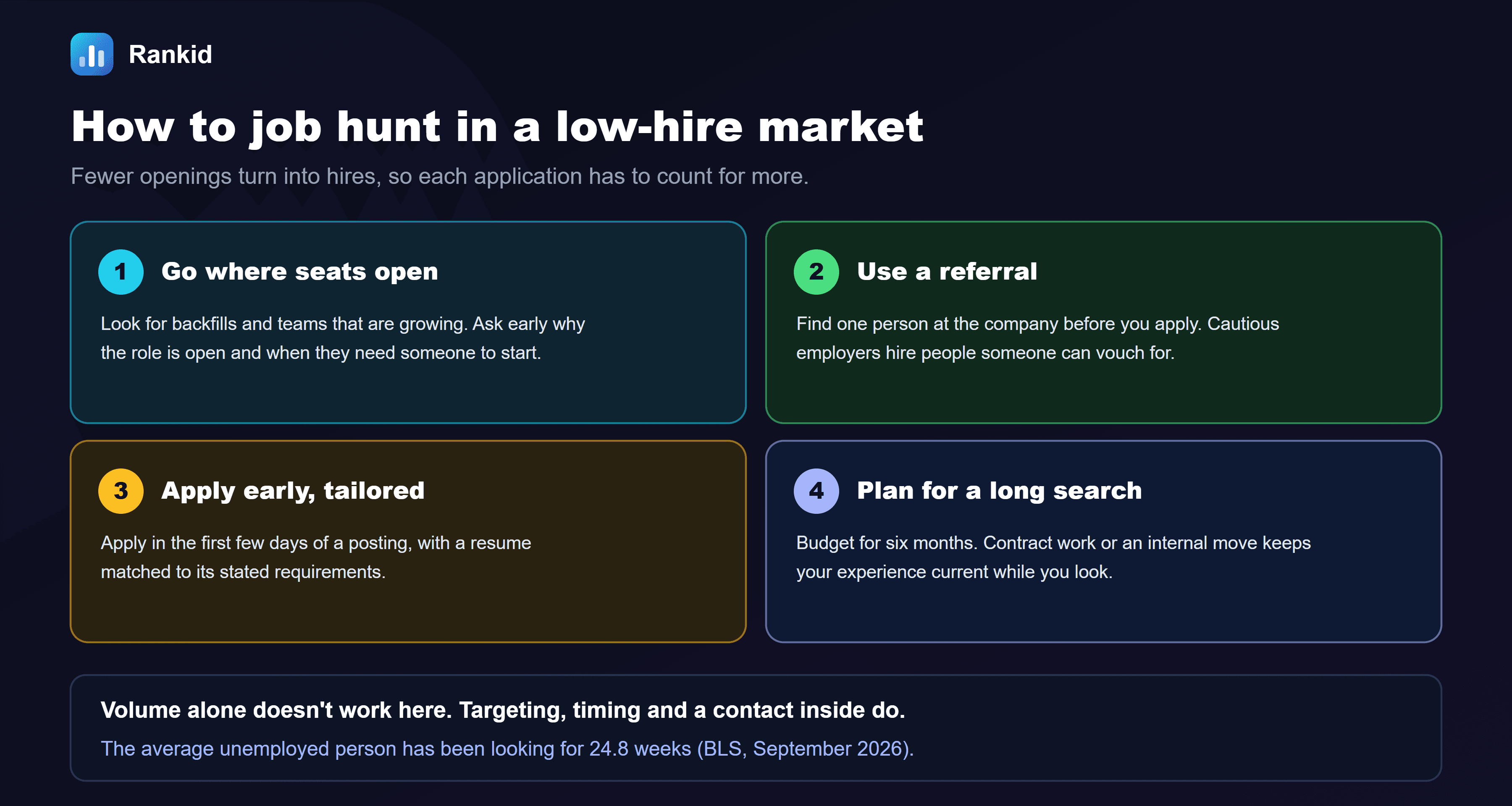
Go where seats open
Use a referral
Apply early, tailored
Plan for a long search
If you're applying and hearing nothing, check the basics before assuming it's the market. See why you're not getting interviews and how long it takes to hear back.
Make each application count
When few openings become hires, a generic resume costs you the ones that do. Paste your resume and the job description. Rankid gives you a free 0-100 match score and shows the exact requirements you meet and miss before you apply. No signup required.
Check your match score freeIf you already have a job
- Don't resign without an offer. The gap between jobs is longer than it used to be.
- Search while employed. It's slower, and your position is stronger. See career cushioning.
- Ask for the adjustment where you are. If your pay has slipped behind the market, a market adjustment is easier than a move right now. See how to ask for a raise.
- Keep building. A quiet market is a good time to add a skill or a result you can put a number on, ready for when hiring picks up.
For employers: what a frozen market hides
- Low turnover isn't the same as high engagement.Some people are staying because they can't move. When hiring recovers, they will. See employee turnover rate.
- Close or fill your open roles.Postings left up for months waste candidates' time and damage your reputation with the people you'll want later.
- Keep an entry-level intake.A few years of not hiring juniors leaves a gap in the middle of the organization that can't be bought back quickly. See talent pipeline.
- Screen consistently. Hundreds of applicants per opening means strong candidates are easy to miss. Use the same criteria for every resume. See resume screening criteria.
- Reply to everyone. In a market this slow, candidates remember who answered. See candidate experience.
Hundreds of applicants for one opening?
Rankid scores every resume against your job description on a consistent 0-100 scale and shows the exact requirements each candidate matched and missed, so the right person isn't buried on page six. First 5 resumes free, no signup.
Try bulk screening freeFrequently asked questions
What is a low-hire, low-fire job market?
It is a labor market where employers are neither laying off many people nor hiring many. Workers who have jobs are unlikely to lose them, and people looking for work find that few positions are actually being filled. In August 2026 the US hires rate was 3.3% and the layoff rate was 1.0%, both low by historical standards.
Why is it so hard to find a job when unemployment is low?
Because unemployment is low mainly due to few layoffs, not strong hiring. Most hiring replaces someone who left, and with a quits rate of 1.9% very few people are leaving. Employers are also filling fewer of the roles they advertise: Indeed measured 0.71 hires per job opening in August 2026, down from about 0.8 in 2019.
Who is hurt most by a low-hire, low-fire market?
People trying to get in: new graduates, people returning to work, career changers and anyone who has been laid off. The New York Fed put unemployment for recent college graduates at about 5.6% in the second quarter of 2026, above the 4.2% rate for all workers, with 42% of recent graduates working in jobs that don't usually require a degree.
How long does it take to find a job in 2026?
It varies widely, but searches are long. In the September 2026 jobs report, unemployed people had been looking for an average of 24.8 weeks, and 27.1% of them, about 1.9 million people, had been out of work for 27 weeks or more.
Is a low-hire, low-fire market a sign of a recession?
Not in itself. Recessions are marked by rising layoffs, and layoffs are near record lows. The Richmond Fed notes that before the 2008 recession layoffs were already climbing, which is not the case now. The risk is that the balance is fragile: with hiring this slow, even a modest rise in layoffs would push unemployment up quickly.
Why aren't companies hiring?
Several reasons are commonly given: uncertainty about the economy and costs, a wait-and-see approach to how AI will change staffing, and low turnover that leaves fewer vacancies to backfill. Many employers that struggled to hire in 2021 and 2022 are also reluctant to let people go, which keeps layoffs low without creating new openings.
How do I get hired in a low-hire market?
Focus on roles that are definitely being filled, such as backfills with a start date. Get a referral before you apply. Apply in the first few days of a posting with a resume matched to its requirements. Plan your finances for a search of around six months, and consider contract work or an internal move to keep your experience current.
Should I quit my job in a low-hire, low-fire market?
Line up the next job first. With hiring slow, leaving without an offer can mean a long gap. If you are unhappy, start a quiet search while employed, since employed candidates usually have more leverage, and look at internal moves, which face less competition than external postings.
Key takeaways
- A low-hire, low-fire job market is one where employers lay off very few people and hire very few, so there is little movement in either direction.
- In August 2026 the US hires rate was 3.3%, the layoff rate 1.0% and the quits rate 1.9% (BLS). The Richmond Fed found both hiring and layoffs near the bottom of their range since 2000.
- Most hiring replaces someone who left. With few people quitting, few seats open, and only 0.71 hires were made per job opening in August 2026 (Indeed).
- People with jobs are secure but less mobile. People looking for one face long searches: an average of 24.8 weeks, with 27.1% of the unemployed out of work 27 weeks or more.
- New graduates are hit hardest, with unemployment of about 5.6% and 42% underemployed in the second quarter of 2026 (New York Fed).
- It is not a recession signal by itself, because layoffs are low, but the balance is fragile if layoffs rise.
- To get hired, target roles that must be filled, get a referral, apply early with a tailored resume, and plan financially for a search of around six months.
Frequently asked questions
What is a low-hire, low-fire job market?
It is a labor market where employers are neither laying off many people nor hiring many. Workers who have jobs are unlikely to lose them, and people looking for work find that few positions are actually being filled. In August 2026 the US hires rate was 3.3% and the layoff rate was 1.0%, both low by historical standards.
Why is it so hard to find a job when unemployment is low?
Because unemployment is low mainly due to few layoffs, not strong hiring. Most hiring replaces someone who left, and with a quits rate of 1.9% very few people are leaving. Employers are also filling fewer of the roles they advertise: Indeed measured 0.71 hires per job opening in August 2026, down from about 0.8 in 2019.
Who is hurt most by a low-hire, low-fire market?
People trying to get in: new graduates, people returning to work, career changers and anyone who has been laid off. The New York Fed put unemployment for recent college graduates at about 5.6% in the second quarter of 2026, above the 4.2% rate for all workers, with 42% of recent graduates working in jobs that don't usually require a degree.
How long does it take to find a job in 2026?
It varies widely, but searches are long. In the September 2026 jobs report, unemployed people had been looking for an average of 24.8 weeks, and 27.1% of them, about 1.9 million people, had been out of work for 27 weeks or more.
Is a low-hire, low-fire market a sign of a recession?
Not in itself. Recessions are marked by rising layoffs, and layoffs are near record lows. The Richmond Fed notes that before the 2008 recession layoffs were already climbing, which is not the case now. The risk is that the balance is fragile: with hiring this slow, even a modest rise in layoffs would push unemployment up quickly.
Why aren't companies hiring?
Several reasons are commonly given: uncertainty about the economy and costs, a wait-and-see approach to how AI will change staffing, and low turnover that leaves fewer vacancies to backfill. Many employers that struggled to hire in 2021 and 2022 are also reluctant to let people go, which keeps layoffs low without creating new openings.
How do I get hired in a low-hire market?
Focus on roles that are definitely being filled, such as backfills with a start date. Get a referral before you apply. Apply in the first few days of a posting with a resume matched to its requirements. Plan your finances for a search of around six months, and consider contract work or an internal move to keep your experience current.
Should I quit my job in a low-hire, low-fire market?
Line up the next job first. With hiring slow, leaving without an offer can mean a long gap. If you are unhappy, start a quiet search while employed, since employed candidates usually have more leverage, and look at internal moves, which face less competition than external postings.